
GET SOBER 06: DOPAMINE VS DOPAMINE
Dopamine is two faced.
It has no allegiances other than to whatever it wants the most....
This is good news, because you can and do want different things. If you are reading this, then you clearly don’t want to be drinking. But also, you do want to drink because you do. So we have an interesting conflict arise where the dopamine circuits appear to be in direct competition with one another. Essentially, the winner is determined by whichever one is stronger, although what exactly defines strength in terms of dopaminergic desires is complex. Time, place, energy levels, environment, people… it’s difficult to know exhaustively the factors in play. Observation of yourself, your behaviour, and the machinations of these competing desires will help you to understand how they operate. Awareness is the first step toward change, and just like a muscle, you can exercise and strengthen the desires that are healthy, and leave the undesirable ones to atrophy.
The part of your “want” mode that wants to stop is already on the ascendancy. You really want to stop, and the dopamine is what’s compelling you to keep reading. And it will continue to propel you forward because you want it. From here, you just need to accumulate enough knowledge and experience to overcome the other desire.
-THE TWO CIRCUITS
Before we move on to look at the conscious and subconscious minds, it’s crucial to understand that the dopamine circuit comprises two sequential, but different circuits. Each of these circuits performs a different role in the act of getting something. Understanding this structure helps us to weaponise the dopamine system against itself and puts us in a position of strength moving forward.
The first of the two circuits is called the dopamine desire circuit. The desire circuit is the portion of the dopamine system that involuntarily fires in response to some kind of stimuli. (We will consider this circuit a subset of involuntary behaviour the subconscious mind.) When the desire circuit activates, the associated dopamine draws your attention, focuses the mind, and produces desire for a particular object or outcome. It has no plan about how to get whatever it has set its eyes on: it just stimulates pure desire for whatever it is.
In terms of competing desires, a weighing process takes place. The relative weight of conflicting desires at any one point depends on the wider context and a variety of factors as discussed previously.
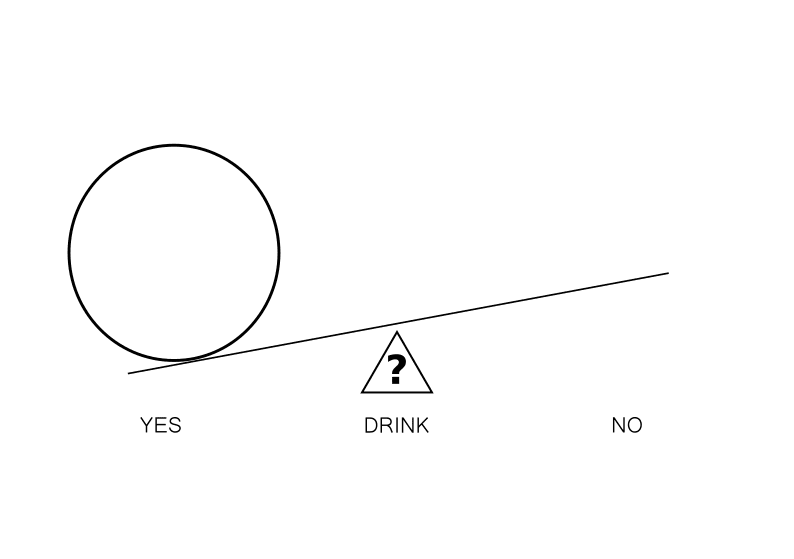
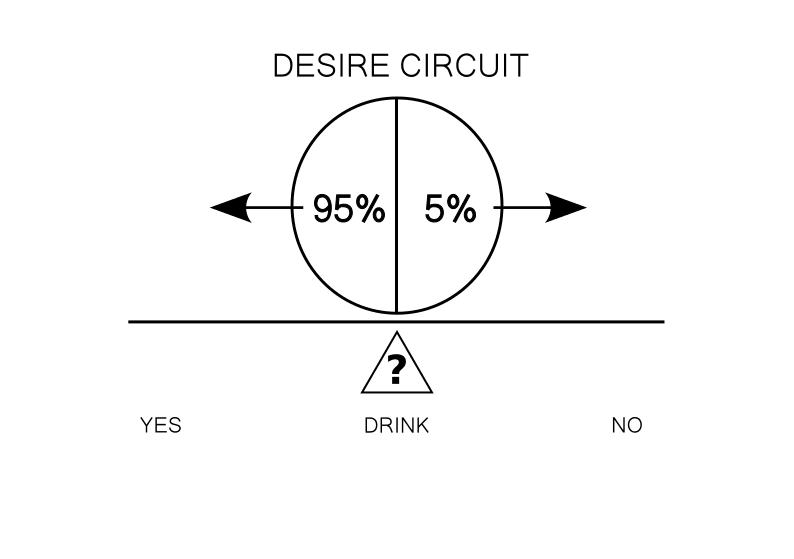 One of the two desires out competes the other, and the scales tip in favour of that particular desire. The winning desire is then fed to the second circuit.
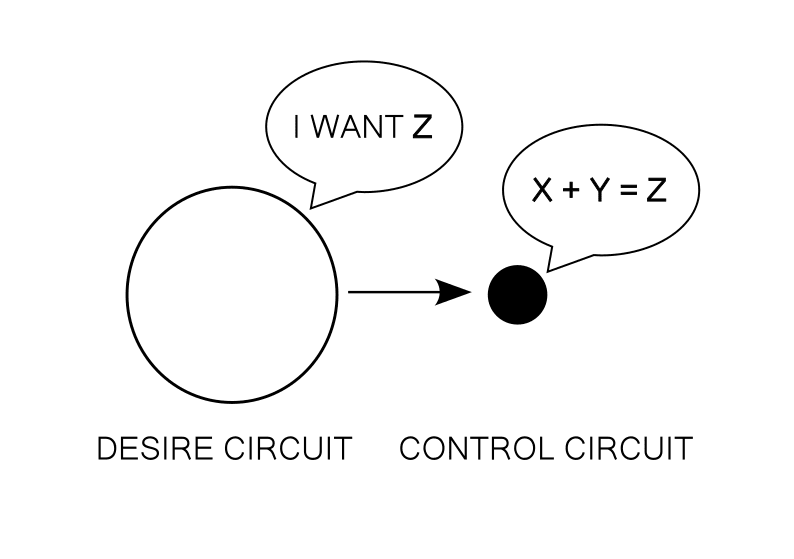
 The second circuit is known as the dopamine control circuit. Once the desire has been stimulated, the job of the control circuit—again powered by dopamine—is to work out how to get results, how to maximise those results, whether it’s worth it in the first place, and if so, what is it worth to get there. It thinks, identifies obstacles and accomplices, strategises, plans, and implements whatever it deems to be the best course of action. (We will consider this circuit a subset of voluntary behaviour or the conscious mind.)
The following image illustrates this process: the dominant desire circuit decides what it wants and instructs the subservient control circuit to go and do its bidding.
The second circuit is known as the dopamine control circuit. Once the desire has been stimulated, the job of the control circuit—again powered by dopamine—is to work out how to get results, how to maximise those results, whether it’s worth it in the first place, and if so, what is it worth to get there. It thinks, identifies obstacles and accomplices, strategises, plans, and implements whatever it deems to be the best course of action. (We will consider this circuit a subset of voluntary behaviour or the conscious mind.)
The following image illustrates this process: the dominant desire circuit decides what it wants and instructs the subservient control circuit to go and do its bidding.
 You can think of the desire circuit like a child who sees a new toy advertised on TV. They identify it as something they simply must have, even though it costs a fortune. They are going to keep pestering their parents relentlessly to try and get what they want. The parents (the control circuit) not wanting to upset the child because they have been well behaved recently, will look into whether they can afford it, where they can get it cheapest, whether there are any discount codes available, and so on. If they can make it happen then they’ll execute and get the toy. If the cost is too high, or the sacrifice elsewhere is too great, they’ll back out and deal with the child nagging. A nagging child is easier to deal with than Child Protection Services knocking at your door to find out why you are sending your child to school with no shoes.
If the desire circuit decides that it wants to drink more than not, the control circuit goes to work to make it happen: Where can I buy alcohol? Do I need money? How can I get there? And so on. If the desire circuit decides it doesn’t want to drink more than it does, it goes to work to make that happen instead: Where can I get help? What excuse can I give not to go to my best friend’s birthday party? How do I get to sleep without a drink? And so on.
So, that's basically what's happening. And for now that's all...
But before I go, remember: working on sobriety is an iterative process. We never fail, only learn. Be kind to yourself and never give up.
Marky
#sobriety #sober #getsober #sobercoach #sobercoaching #sobrietycoach #sobrietycoaching #quitbooze #quitdrinking #stopdrinking #alcohol #alcoholfree #getsober06 #dopamine
You can think of the desire circuit like a child who sees a new toy advertised on TV. They identify it as something they simply must have, even though it costs a fortune. They are going to keep pestering their parents relentlessly to try and get what they want. The parents (the control circuit) not wanting to upset the child because they have been well behaved recently, will look into whether they can afford it, where they can get it cheapest, whether there are any discount codes available, and so on. If they can make it happen then they’ll execute and get the toy. If the cost is too high, or the sacrifice elsewhere is too great, they’ll back out and deal with the child nagging. A nagging child is easier to deal with than Child Protection Services knocking at your door to find out why you are sending your child to school with no shoes.
If the desire circuit decides that it wants to drink more than not, the control circuit goes to work to make it happen: Where can I buy alcohol? Do I need money? How can I get there? And so on. If the desire circuit decides it doesn’t want to drink more than it does, it goes to work to make that happen instead: Where can I get help? What excuse can I give not to go to my best friend’s birthday party? How do I get to sleep without a drink? And so on.
So, that's basically what's happening. And for now that's all...
But before I go, remember: working on sobriety is an iterative process. We never fail, only learn. Be kind to yourself and never give up.
Marky
#sobriety #sober #getsober #sobercoach #sobercoaching #sobrietycoach #sobrietycoaching #quitbooze #quitdrinking #stopdrinking #alcohol #alcoholfree #getsober06 #dopamine
One of the two desires out competes the other, and the scales tip in favour of that particular desire. The winning desire is then fed to the second circuit.
The second circuit is known as the dopamine control circuit. Once the desire has been stimulated, the job of the control circuit—again powered by dopamine—is to work out how to get results, how to maximise those results, whether it’s worth it in the first place, and if so, what is it worth to get there. It thinks, identifies obstacles and accomplices, strategises, plans, and implements whatever it deems to be the best course of action. (We will consider this circuit a subset of voluntary behaviour or the conscious mind.)
The following image illustrates this process: the dominant desire circuit decides what it wants and instructs the subservient control circuit to go and do its bidding.
You can think of the desire circuit like a child who sees a new toy advertised on TV. They identify it as something they simply must have, even though it costs a fortune. They are going to keep pestering their parents relentlessly to try and get what they want. The parents (the control circuit) not wanting to upset the child because they have been well behaved recently, will look into whether they can afford it, where they can get it cheapest, whether there are any discount codes available, and so on. If they can make it happen then they’ll execute and get the toy. If the cost is too high, or the sacrifice elsewhere is too great, they’ll back out and deal with the child nagging. A nagging child is easier to deal with than Child Protection Services knocking at your door to find out why you are sending your child to school with no shoes.
If the desire circuit decides that it wants to drink more than not, the control circuit goes to work to make it happen: Where can I buy alcohol? Do I need money? How can I get there? And so on. If the desire circuit decides it doesn’t want to drink more than it does, it goes to work to make that happen instead: Where can I get help? What excuse can I give not to go to my best friend’s birthday party? How do I get to sleep without a drink? And so on.
So, that's basically what's happening. And for now that's all...
But before I go, remember: working on sobriety is an iterative process. We never fail, only learn. Be kind to yourself and never give up.
Marky
#sobriety #sober #getsober #sobercoach #sobercoaching #sobrietycoach #sobrietycoaching #quitbooze #quitdrinking #stopdrinking #alcohol #alcoholfree #getsober06 #dopamine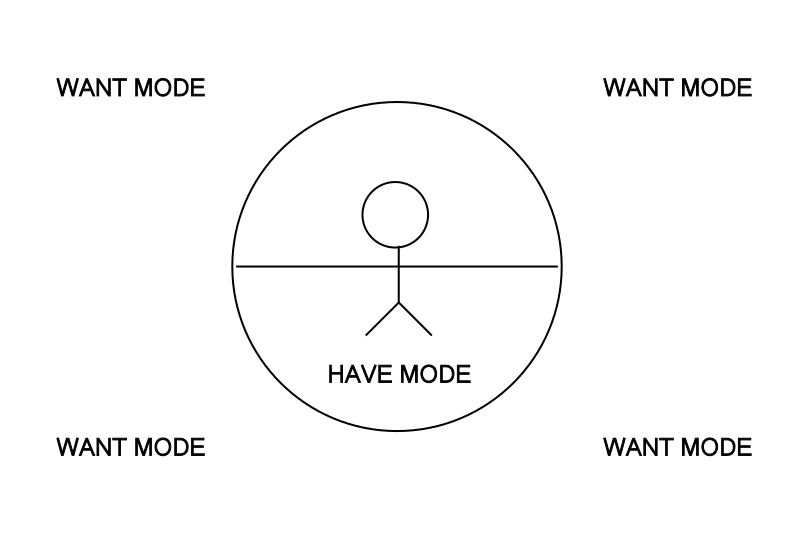 And so by definition, the things you have are in the “now,” here in the present, whereas the things you want can only ever exist in the future. Only when it is the present can you finally have what you want, which consequently extinguishes the original desire. (In the meantime, you have to get up and make things happen.) Your brain and behaviour are therefore constantly switching between these modes in a delicate balancing act. For the alcohol dependent, you’ve fallen off both ends. The see-saw may have been rigged from the start, or it’s been damaged by daily use, but either way, you’re going to have to supervise until you can restore some kind of balance.
-A NEVER ENDING CYCLE
As a mental model, it’s easier to understand the process as a never-ending cycle. That’s how it is supposed to function, anyway. Sometimes there’s a glitch in the cycle, which is actually the crux of our problem, But let’s understand it as a functioning system first.
And so by definition, the things you have are in the “now,” here in the present, whereas the things you want can only ever exist in the future. Only when it is the present can you finally have what you want, which consequently extinguishes the original desire. (In the meantime, you have to get up and make things happen.) Your brain and behaviour are therefore constantly switching between these modes in a delicate balancing act. For the alcohol dependent, you’ve fallen off both ends. The see-saw may have been rigged from the start, or it’s been damaged by daily use, but either way, you’re going to have to supervise until you can restore some kind of balance.
-A NEVER ENDING CYCLE
As a mental model, it’s easier to understand the process as a never-ending cycle. That’s how it is supposed to function, anyway. Sometimes there’s a glitch in the cycle, which is actually the crux of our problem, But let’s understand it as a functioning system first.
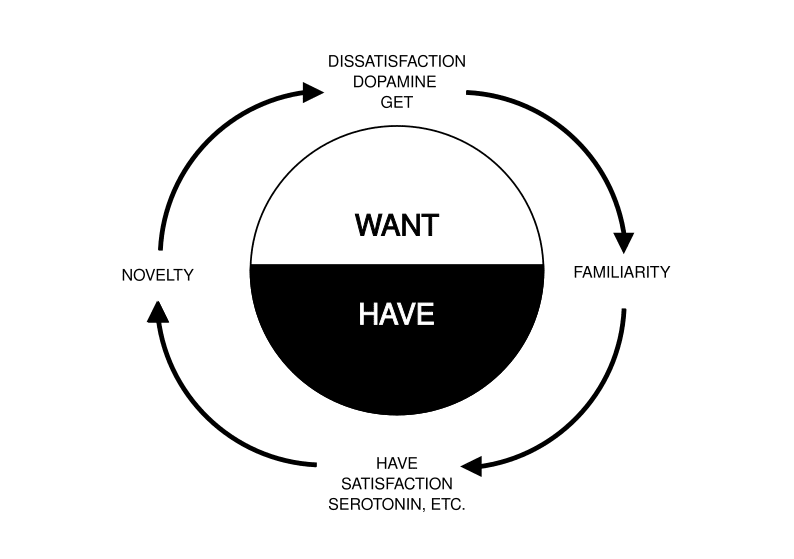 At any point in the cycle, we can only ever be operating in the “want” of “have” mode, and we continue to do so until the conditions arise to send us back into the other. And so we continue, going around in circles, flipping from one to the other.
-HAVE MODE
The “have” mode operates when we are engaged in the “here and now” with what we have. It is overseen by neurotransmitters, such as serotonin and endorphins, and what are known as endocannabinoids. (The details are not particularly important, rather the overall concept.) Because this mode of operation is configured for the present moment, the pathways and neurotransmitters facilitate a feeling of contentment and satisfaction, states which oppose mental projection into either the past of future. Examples of such might include being engaged in a good conversation or listening to a song that makes you forget yourself and time.
-WANT MODE
The “want” mode is very different and seemingly more complex. First and foremost, when this mode activates, it draws us out of the present and thrusts us mentally into a future projection of possibility. The “have” mode is stood down.
This mode is fuelled instead by the neurotransmitter dopamine. Dopamine has the exact opposite function to the apparatus of the “have” mode: it makes us dissatisfied with the “here and now,” and propels us toward a future outcome. For evolutionary purposes, this system gets us the resources we need for survival: food, reproduction, and so on. The resources we need, or perceive we need, in modern societies are, of course, much more complex.
Activation of this mode (release of dopamine) occurs when an element of novelty or deviation from the expected is identified in our physical or metal environment. Our subconscious continuously scans and maps our environment, and as soon as it identifies a contrast between the known and the unknown, a flag goes up. When we encounter something new or unexpected, it signifies possibility: the potential of resources directly, or the means to obtain or maximise resources indirectly. This is, of course, advantageous, and such circumstances set in motion the dopamine-driven functioning of the cycle. From here, alert and motivated, you investigate, strategise, and extract, where possible, what you can.
Once you have exhausted all possibility, and the new becomes the normal, the dopamine has done its job, the dopamine circuits shut down, and you’re returned to the “have” mode. Here you stay until you encounter the next deviation from the normal and are thrust into “want” mode again.
Imagine being lost in the desert, and you catch a glimmer of the sun’s reflection in what looks like water in the distance. Despite being tired and exhausted, you sprint as fast as you ever have and jump into crystal clear water when you arrive. You drink till your heart’s content and you can drink no more. The dopamine has done it’s job and you’ve secured a new resource. You know where it is now, and while you might need it gain, you’ll never sprint toward it like your life depends on it. That was the dopamine.
So how exactly is all this relevant to our situation? Well, as eluded to earlier, the system goes off the rails and we are the lucky ones who get stuck in "want" mode. A topic for next time...
But before I go, remember: working on sobriety is an iterative process. We never fail, only learn. Be kind to yourself and never give up.
Marky
#sobriety #sober #getsober #sobercoach #sobercoaching #sobrietycoach #sobrietycoaching #quitbooze #quitdrinking #stopdrinking #alcohol #alcoholfree #getsober04 #dopamine
At any point in the cycle, we can only ever be operating in the “want” of “have” mode, and we continue to do so until the conditions arise to send us back into the other. And so we continue, going around in circles, flipping from one to the other.
-HAVE MODE
The “have” mode operates when we are engaged in the “here and now” with what we have. It is overseen by neurotransmitters, such as serotonin and endorphins, and what are known as endocannabinoids. (The details are not particularly important, rather the overall concept.) Because this mode of operation is configured for the present moment, the pathways and neurotransmitters facilitate a feeling of contentment and satisfaction, states which oppose mental projection into either the past of future. Examples of such might include being engaged in a good conversation or listening to a song that makes you forget yourself and time.
-WANT MODE
The “want” mode is very different and seemingly more complex. First and foremost, when this mode activates, it draws us out of the present and thrusts us mentally into a future projection of possibility. The “have” mode is stood down.
This mode is fuelled instead by the neurotransmitter dopamine. Dopamine has the exact opposite function to the apparatus of the “have” mode: it makes us dissatisfied with the “here and now,” and propels us toward a future outcome. For evolutionary purposes, this system gets us the resources we need for survival: food, reproduction, and so on. The resources we need, or perceive we need, in modern societies are, of course, much more complex.
Activation of this mode (release of dopamine) occurs when an element of novelty or deviation from the expected is identified in our physical or metal environment. Our subconscious continuously scans and maps our environment, and as soon as it identifies a contrast between the known and the unknown, a flag goes up. When we encounter something new or unexpected, it signifies possibility: the potential of resources directly, or the means to obtain or maximise resources indirectly. This is, of course, advantageous, and such circumstances set in motion the dopamine-driven functioning of the cycle. From here, alert and motivated, you investigate, strategise, and extract, where possible, what you can.
Once you have exhausted all possibility, and the new becomes the normal, the dopamine has done its job, the dopamine circuits shut down, and you’re returned to the “have” mode. Here you stay until you encounter the next deviation from the normal and are thrust into “want” mode again.
Imagine being lost in the desert, and you catch a glimmer of the sun’s reflection in what looks like water in the distance. Despite being tired and exhausted, you sprint as fast as you ever have and jump into crystal clear water when you arrive. You drink till your heart’s content and you can drink no more. The dopamine has done it’s job and you’ve secured a new resource. You know where it is now, and while you might need it gain, you’ll never sprint toward it like your life depends on it. That was the dopamine.
So how exactly is all this relevant to our situation? Well, as eluded to earlier, the system goes off the rails and we are the lucky ones who get stuck in "want" mode. A topic for next time...
But before I go, remember: working on sobriety is an iterative process. We never fail, only learn. Be kind to yourself and never give up.
Marky
#sobriety #sober #getsober #sobercoach #sobercoaching #sobrietycoach #sobrietycoaching #quitbooze #quitdrinking #stopdrinking #alcohol #alcoholfree #getsober04 #dopamine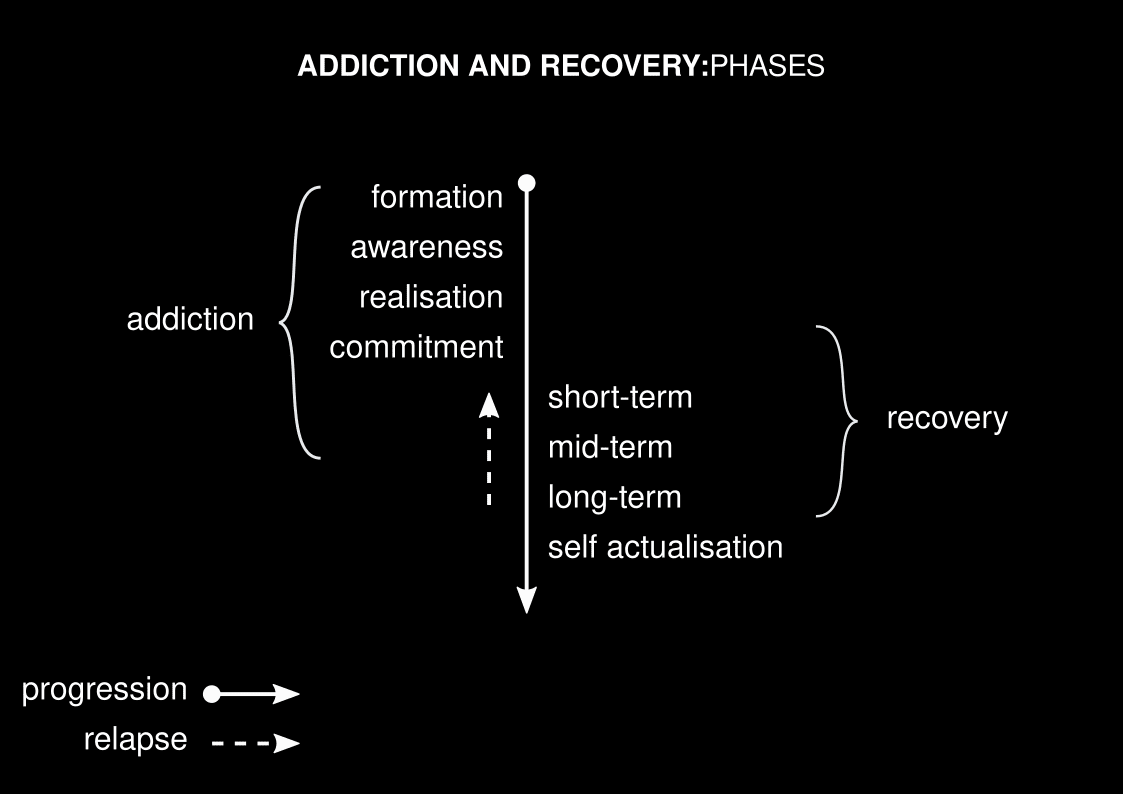 We can identify and characterise each of these stages to help you figure out exactly where you are and how you got there. This is important because what you might want to focus on—and what will be most beneficial—changes depending on how far along you are, how far along you have been, and where you're most likely to relapse.
-ADDICTION PHASE
The addiction phase consists of four main stages:
--FORMATION
Formation is the stage where you encounter alcohol, think "mmm, this is nice", and it becomes embedded in your habitual behaviour. Social licencing normalises this process. (I have mad beef with social normalisation of lots of things but I won't go there right now.)
--AWARENESS
Awareness is the stage where the negative consequences begin seep into your awareness. You may or may not associate these negative outcomes with drinking. For example, it becomes obvious that your life is a disorganised mess, you may be overly emotional in one way or another, etc.
--REALISATION
Realisation is the stage where negative effects are fully manifest and obviously linked to your drinking. You've reached a tipping point and you can't reasonably deny that you have a problem.
--COMMITMENT
Commitment is the stage where you have accepted the reality of your situation and orient yourself toward sorting it out. If you are reading this, then you've almost certainly reached this stage. (Well done by the way.)
-RECOVERY PHASE
The recovery phase, in brief, consists of the following stages:
--SHORT-TERM
Short-term recovery includes the first few days and weeks after you stop drinking. Relapse happens and isn't particularly unexpected. The focus here is just to stop consuming alcohol and make yourself as comfortable as possible.
--MID-TERM
With alcohol out of your system and no more consumed, mid-term recovery begins after a month or two. The focus here is to maintain sobriety and start to repair mainly the physical damage done by drinking. Relapse is less likely than in short-term recovery.
--LONG-TERM
After regaining physical health, your attention turns to working on emotional and psychological well-being. You are making real progress towards a better life, which at this point is self-evident. Relapse becomes less likely as you don't want to give up everything that you have achieved.
--SELF-ACTUALISATION
Self-actualisation is the stage where the person you were meant to be without this little detour is fully recovered. It is the highest level of psychological development, where personal potential is fully realised. And that's where we're going. Sounds nice...
So that's how it goes. And for now, that is all...
But before I go, remember: working on sobriety is an iterative process. We never fail, only learn. Be kind to yourself and never give up.
Marky
#sobriety #sober #getsober #sobercoach #sobercoaching #sobrietycoach #sobrietycoaching #quitbooze #quitdrinking #stopdrinking #alcohol #alcoholfree #getsober02
We can identify and characterise each of these stages to help you figure out exactly where you are and how you got there. This is important because what you might want to focus on—and what will be most beneficial—changes depending on how far along you are, how far along you have been, and where you're most likely to relapse.
-ADDICTION PHASE
The addiction phase consists of four main stages:
--FORMATION
Formation is the stage where you encounter alcohol, think "mmm, this is nice", and it becomes embedded in your habitual behaviour. Social licencing normalises this process. (I have mad beef with social normalisation of lots of things but I won't go there right now.)
--AWARENESS
Awareness is the stage where the negative consequences begin seep into your awareness. You may or may not associate these negative outcomes with drinking. For example, it becomes obvious that your life is a disorganised mess, you may be overly emotional in one way or another, etc.
--REALISATION
Realisation is the stage where negative effects are fully manifest and obviously linked to your drinking. You've reached a tipping point and you can't reasonably deny that you have a problem.
--COMMITMENT
Commitment is the stage where you have accepted the reality of your situation and orient yourself toward sorting it out. If you are reading this, then you've almost certainly reached this stage. (Well done by the way.)
-RECOVERY PHASE
The recovery phase, in brief, consists of the following stages:
--SHORT-TERM
Short-term recovery includes the first few days and weeks after you stop drinking. Relapse happens and isn't particularly unexpected. The focus here is just to stop consuming alcohol and make yourself as comfortable as possible.
--MID-TERM
With alcohol out of your system and no more consumed, mid-term recovery begins after a month or two. The focus here is to maintain sobriety and start to repair mainly the physical damage done by drinking. Relapse is less likely than in short-term recovery.
--LONG-TERM
After regaining physical health, your attention turns to working on emotional and psychological well-being. You are making real progress towards a better life, which at this point is self-evident. Relapse becomes less likely as you don't want to give up everything that you have achieved.
--SELF-ACTUALISATION
Self-actualisation is the stage where the person you were meant to be without this little detour is fully recovered. It is the highest level of psychological development, where personal potential is fully realised. And that's where we're going. Sounds nice...
So that's how it goes. And for now, that is all...
But before I go, remember: working on sobriety is an iterative process. We never fail, only learn. Be kind to yourself and never give up.
Marky
#sobriety #sober #getsober #sobercoach #sobercoaching #sobrietycoach #sobrietycoaching #quitbooze #quitdrinking #stopdrinking #alcohol #alcoholfree #getsober02