The latest release of the #AirGradient firmware removed the code that phones home to the company servers even when you check the to to explicitly tell it not to do so. This is a big win for #privacy and #SelfHosting!

GitHub
Release Release 3.2.0 · airgradienthq/arduino
What's Changed
Fix invalidate value check for getAverage function by @samuelbles07 in #275
Fix display 0 measurements value on boot by @samuelbles...
I plan on flashing this onto my device and testing it to verify nothing was missed. #tcpdump and #wireshark are my friends. 😄
#security #cybersecurity #infosec #OpenSource #OpenHardware #electronics
This doesn't have anything to do with the #HestiaPi (yet 😉), but AirGradient is one step closer to fixing their compilation instructions.
This is exciting news because once their code is modified to stop phoning home to the company's server, I plan on adding documentation to the HestiaPi project on how to configure the #AirGradient ONE to act as a remote temperature and humidity sensor.
If you've ever had a #thermostat mounted too close to the door, you understand why this is important.
Here are some lesser known differences between an open source #IoT project and a commercial IoT appliance:
1. Support - #OpenSource projects field questions. Actual humans, taking the time to understand your questions and answer them!
2. Repair - Again, people will help you fix things
3. Less #environmental impact - Fewer things ending up in the landfill on account of the repairability, often times they have more localized production, less shipping, etc.
4. Customizability - that's something rarely found in commercial offerings
I have one clicky edition #HestiaPi left and I'm having a blowout sale. If you were on the fence, now is a good opportunity to pull the trigger.
https://www.tindie.com/products/eternalsunshine/hestiapi-one-clicky/
#OpenSource #IoT #hardware #OpenHardware #electronics #diy #foss #floss #freedom #tech #FreedomTech
It requires hardware modifications to both the HestiaPi and the LCD, and a little Bash script, but it's possible to have the backlight turn completely off when not in use. Tapping the screen causes it to turn back on.
There's a writeup on the community forum which I will be including in the owner's manual.
#OpenHardware should be #hackable like this. I also plan on making this possible to do without hardware modification to the #HestiaPi on the next #hardware revision of the PCB. #OpenSource
hestiahacker - I've been trying to recreate another person's work with a more expensive LCD touchscreen that is able to turn off its backlight.
They are using different #hardware and #software, but have been very helpful in posting about their work and sharing scripts.
I think it will be possible to get it working with the #HestiaPi if I do one small hardware modification. Can't really be sure until it's tested, but I'm hopeful.
If I get it, instructions will be added to the owners manual. ❤️🙂 #FOSS #IoT #OpenSource #OpenHardware
I shipped out an order today and thought "Gee that street name looks really familiar...". Checked my order history and sure enough a repeat customer.
Anyone should be happy to have a repeat customer, but it REALLY says something that someone bought two thermostats. It's not like a thumb drive where you could always use one more.
Presumably it's a gift, because if it broke they probably wouldn't be buying another of the same make and model. Besides, I'm pretty sure everyone who has problems reached out to me.
So I'm pleased as punch today. Thank you, customer who shall not be named. You made my day.
If I were to take on another #OpenSource #smart #IoT device project to liberate people from their technical overlords, what should it be?
I'm looking for inspiration.
I'm not ready to take on another project right now, but I might be soon. The main catches are:
I. Existing project (I'll search for one, and I'm flexible on this point)
II. Not already available for purchase
III. Something I'd personally be willing to use

Sometimes when you take a chance, it works out. Other times, it doesn't.
I recently designed a temperature/humidity board, got PCBs made and tried to assemble them. None of them worked. Like, at all!
So I redesigned it, making it simpler and tried again. Another 100% fail.
I had someone review my design. He said it looked good. Maybe it was manufactueing errors? I'm pretty good at soldering, but yeah maybe...
So I took a big chance and dropped $250 on machine-assembled terperature sensors boards. Of my design really was good, they should work. Otherwise I just spend a bunch of money to ship e-waste half way around the world.
They arrived today and they work! Whew! I was really nervous about that one. This batch was about the same price as the cheapest pre-assembled board that I could find. If I can scale up from 50 boards to 250, I could have a very nice price. At least 10% cheaper than market prices. Of course I'd also have to pay $1200 up front and probably never sell them all to break even. So I'll probably stick to the "small" batches for now.
#electronics #manufacturing #learning by #failure
I'm just going to put this here
List of open-source hardware projects - Wikipedia
Do with it what you will
I hope I don't regret this, but I just put in an order for $250 worth of temperature sensors to be made with a custom designed board.
If successful, it'll lower the cost of all models of the #HestiaPi. At the same time, it will also help alleviate supply chain issues.
If unsuccessful, it's a lot of money down the drain. Go big or go home, right? #IoT #electronics #OpenHardware
I'm having a blowout #sale on the clicky version of the #HestiaPi #thermostats! I'm posting to #nostr first because I know how much you folks love #freedom
https://www.tindie.com/products/eternalsunshine/hestiapi-one-clicky/
No #cloud service here.
No data collection.
No company who is going to discontinue the model and leave you without #security updates.
No dystopian bullshit!
#IoT #privacy #FreedomTech #cybersecurity
I got an order for a #HestiaPi kit today. The payment processing fee was $4.07. According to bitcoinfees[.]net, the payment processing fee would have been somewhere between $0.27 and $0.91 if it was made on-chain.
Honestly, this doesn't seem like that big of a difference. Sure, it could have been $3 cheaper, but on a $120 thermostat, that's not a huge deal.
Adding in the fee to Tindie, we're now up to just over $10 for them to host the website, deal with the order tracking, email me when an order comes in, emailing the buying when it ships, and so on. Also, Tindie has way more people looking at it than any Bitcoin or Monero marketplace. Plus, people feel more comfortable if there's a company inbetween them and the buyer so they have someone to turn to if they get ripped off. Whether that's justified or not doesn't really matter.
Don't get me wrong, I'd prefer a p2p based system with a mediator that only steps in if there is a dispute. I'd also prefer to be paid in Bitcoin on Monero.
OpenBazaar had this (at least for Bitcoin, not sure about Monero), but it never caught on. Perhaps they were too early? Heck, it might still be too early now. I'd be happy to pay a fee to the platform to host all this, just like I do with Tindie. It'd be a valuable service and they deserve to get paid for providing it. **sigh** Maybe someday...
I designed my own #PCB for the #BME280 sensor (#temperature, #humidity, and barometric pressure), and the design is solid, but assembling it by hand is too difficult.
After 6 attempts and a bunch of rework, none of them were functional. Too much solder in one case, which shorted things out. Not enough in another case and the sensor came off. Some other error in another case were it read 32°F (incorrect) and no humidity reading.
So I'm giving up. A failed experiment. #electronics #hardware #GrowNostr
I'm working on a new #prototype for the #HestiaPi #PCB. All revisions up to now had some extra long headers (but not too long, or the case can't close!) which connected directly to the touchscreen. This meant you had to line up the pins perfectly while putting on the shell of the case. It it tedious the first few times.
This #experimental version uses a ribbon cable instead, so you attach the screen before attaching the cover.
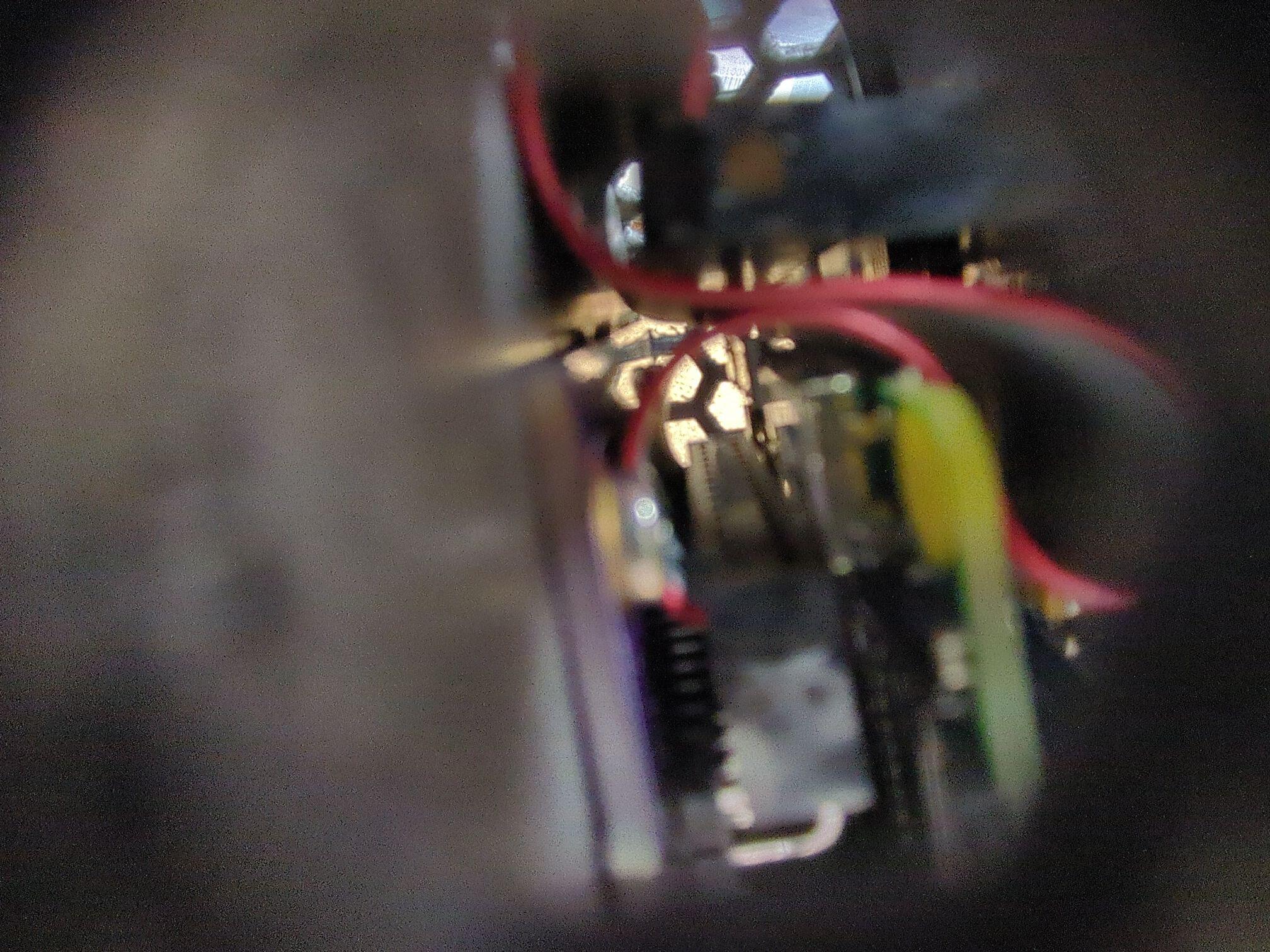
Pic is peeking in through the side of the case. #IoT #thermostat #OpenSource #hardware #OpenHardware
Call to #hackerspaces & #makerspaces around the world, lets join forces!
Hi. 👋 I make #OpenSource smart #thermostats that don't spy on you. I don't ship internationally for two reasons: financial cost and environmental cost. I'd like to join a network of Makerspaces to have them be produced regionally so people outside of America can get a pre-made unit.
Does this network already exist? If so, how do I join? If it doesn't exist, would you like to help build it?
#IoT #BoostsWelcome #GrowNostr
I'm working on a new #prototype #PCB which should:
1.) Replace the dreaded LCD pins with a ribbon cable
2.) Swap the reset switch out for one that is compatible with both the #RaspberryPi Zero W and the Zero 2 W, and
3.) Allow using pi boards with pre-soldered on headers
The first one is the cause of the the most complaints: the cover is hard to put on while aligning the LCD pins at the same time. The other two are about making it more accessible to #DIY & replace parts if needed.
I spent $50 on these prototype boards to learn that 8 holes are too small, 6 are in the wrong location, I don't have double stacked 90° headers that I thought I had, and I shouldn't have soldered that ribbon cable in place.🤦
If I order another ribbon cable ($20 after shipping), I should be able to hack something together with the current version to verify there aren't any other problems. Then another $50 for an updated board design and I will have a candidate for the new design. Hopefully all the changes I make will be perfect. 🤞
Best case scenario: $50 more on boards, and $50 on ribbon cables and headers before I have a functional unit. I already have all the other parts. So probably about $200 in total to make this new revision. #ROI will be about 20 units, which is about 2 years at my current rate. (I make $10 profit per thermostat, which typically gets eaten up by me having to re-ship screens, cases, etc. when things go wrong.)
#electronics #prototyping is expensive! 💸
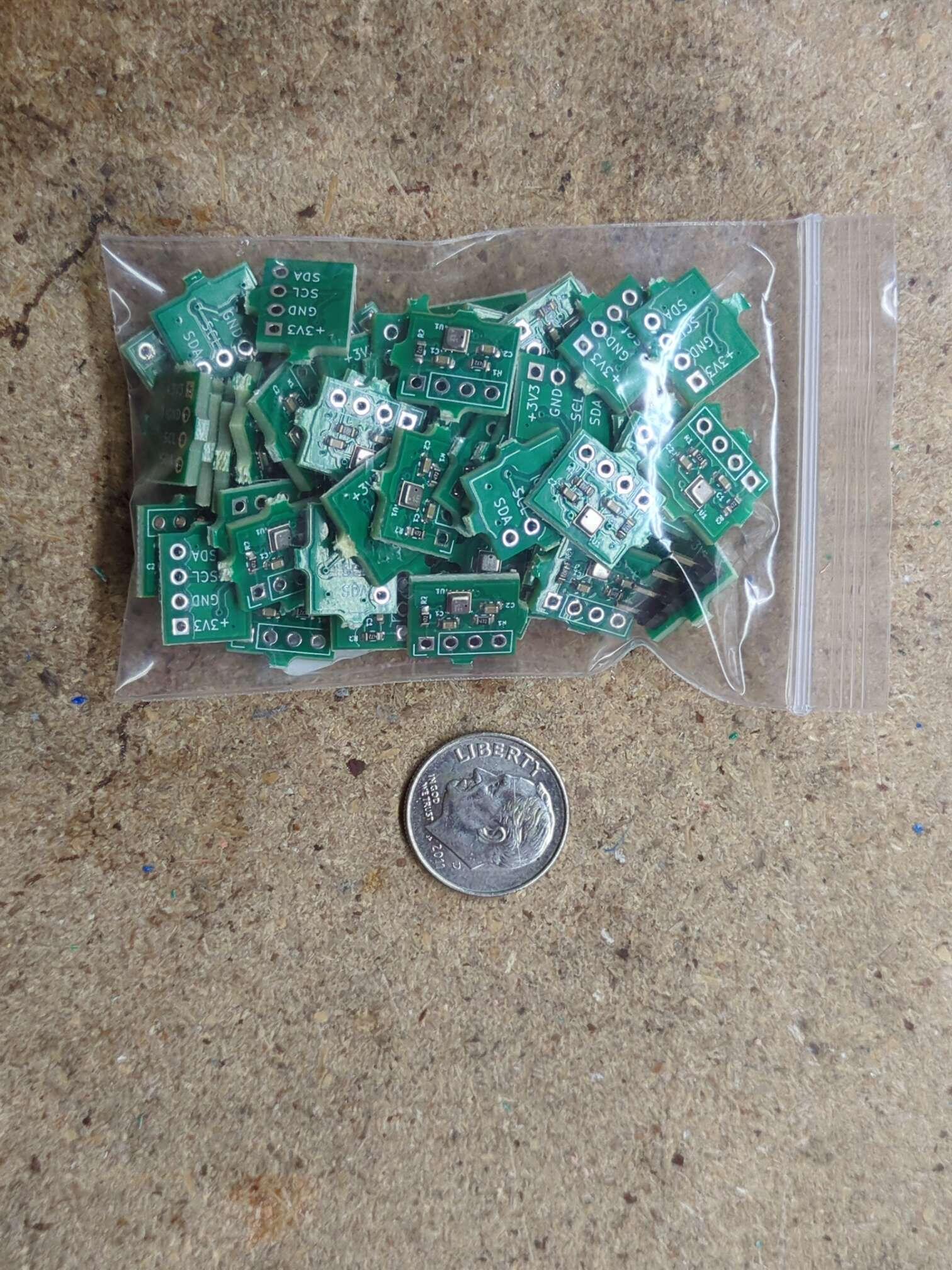 The comparable sensor from sparkfun is $21.50 (and they're sold out)!
