SatoπŸ‡¦πŸ‡·πŸ„βš½πŸ™πŸ‰'s avatar
SatoπŸ‡¦πŸ‡·πŸ„βš½πŸ™πŸ‰
npub1ywmv...mhsq
The Argentine Peso is where I come from. Football player and piano tuner. And Bitcoin lover resonant
Yesterday I closed the guitar was working on by glueing the back, back on its back side. I didn't take images of it because there are certain things I'm not so proud of, not so savvy, ugly looking or very clumsy at. So today I started painting a bit of the guitar body and I needed to make a new bridge. Because you know the old one was plastic and couldn't be really glued , at least not in the long term. So I found this block of wood... I'm not sure what it is. I've used similar in the past for bridges or fretboard. People name it GuayacΓ‘n, but I doubt those popular names here because we are thousands of kilometres away from the rainforest they come and those names tend to be generalisations of, let's say "dark wood". And whenever it's reddish in colour they tend to name it "quebracho" even though there are a few species, more or less hard woods that are red and come from the same area of the country. Anyway let's then say it's a piece of GuayacΓ‘n. Very hard wood and with time it turns black-ish. I read the fibers and splitted it with a hammer and the axe head. This way I worked it to obtain a quartersawn piece. And then layed the measurements of the former bridge to keep sawing and carvin. Entertaining tasks! There is a whole mess in the workshop now. Even there is a soup my little son prepared me with things he found. And Im glueing now a little splinter that shouldn't have been splitted from the bridge. I do make mistakes, a lot. I try to cover them up and fix them. And I also try to not post them on Nostr. Would you like to see more of them? More in general? #proofofwork #pow #woodworking #wood #lutherie #luthier #guitar #workshop #handtools
Well some more pictures about this project. The top was so deformed that I had to brace it entirely. Though I would have wanted to just glue the transversal bridge plate. It wasn't enough to really give the top a desired shape. So I brought it back to a functional form glueing the braces. I didn't wanted to for a couple of reasons. But anyway, I did it. One of the reasons is that the soundboard was 2,7 mm thick... And that is a lot for my taste, but it's more than the standard. Industry covers potential loses, I guess. Because tops this thick will fail less, endure more, yet they can sound no better. So, giving it braces implied even more rigidity and making it less responsive. I had to shave some wood with a violinmaker scraper to make it thinner and more sensitive since it felt massive and dead. The top should be a sensible and responsive membrane (but not as thin to fail or deform with time). That is also the reason why I didn't reinforced the soundhole. It showed no deformation in half a century or more and it's already thick. Another reason is, it implied more work. (Not that I don't want to work) More work means more expensive for me, since I don't want to charge the client for something I didn't expect. Anyway, my own neuroticism. Another reason is that I think the guitar will sound above it's former full potential. Will be something between an industrial guitar and an artisan guitar. And I cannot take credit. Not that I want the whole credit for it. It is just that I can feed the myth that those guitars are so good when they clearly aren't. One typical solution for it is to attach a little paper saying "repaired by" so and so and the date. Anyway. Thoughts. I did it anyway, and I would do it again and again because this crazy world deserves better sounding guitars always and in good hands. And it's my due service. Details: Hairdryer helps me warm the zones where I have to shape the wood again and gives me better timing with the hide glue. A little thin shellac on the inside is healthy. Since the instrument will "breathe" at a more synchronous pace between the inside and the outside. Thus, time shall tell, deform itself at a slower rate.
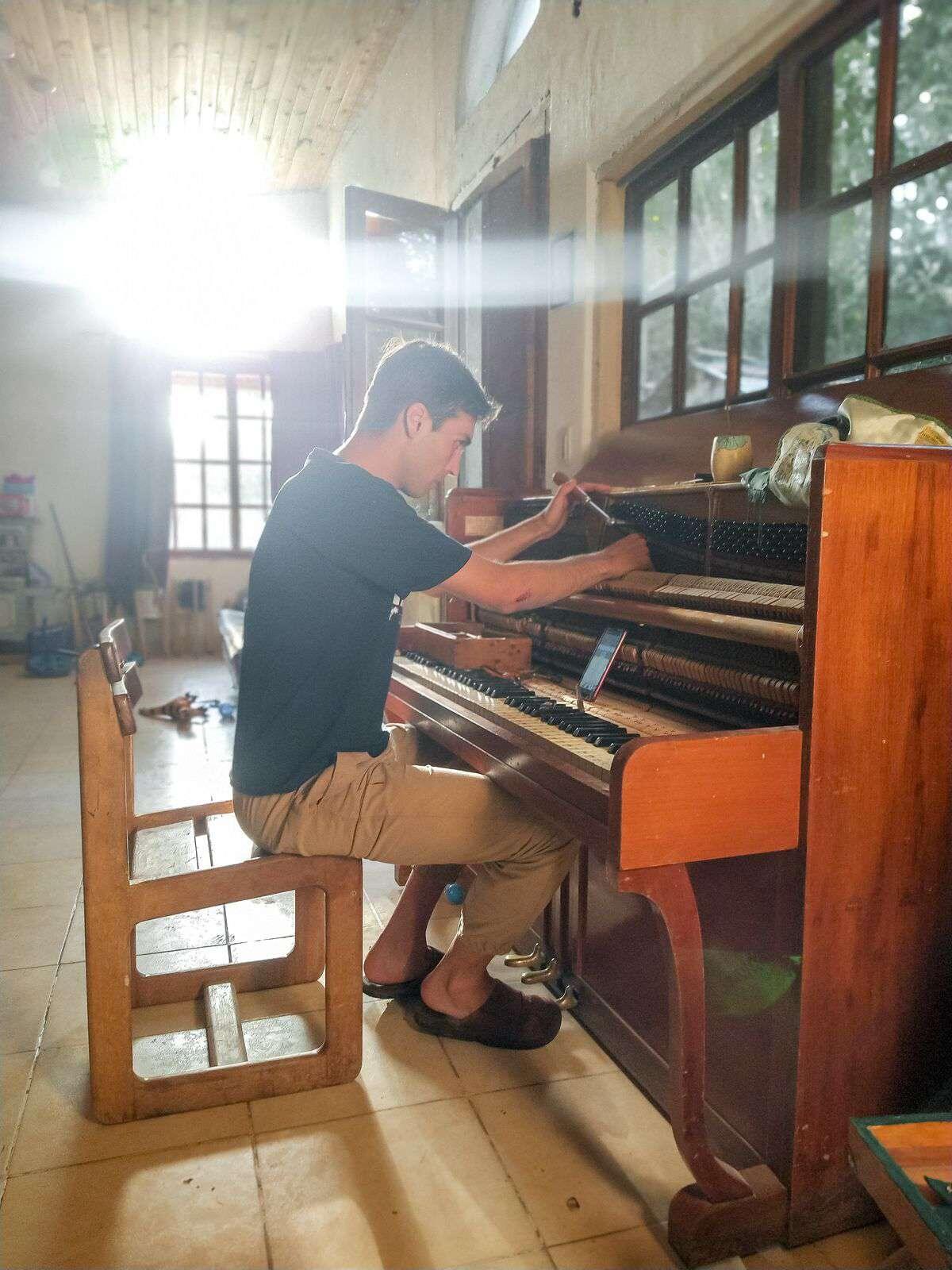
Today another guitar came to the workshop. In this occasion it's a "Antigua Casa NuΓ±ez" very traditional guitar builders from the late XXth century in Argentina. Though the first ones were well built with true craftsmanship, later ones were losing the art and craft and became cheaper and cheaper, until the owners sold the industry and was acquired by "Gracia" (very popular nowadays but not so good) This is the reason why most folk confuse the brand and think it is synonym of quality. I've seen good "Antigua Casa NuΓ±ez" and really bad ones that were just old. So this is the middle way. It's kind of well built in it's structural quality and wood-wise. But begining to sin in fiat debtism paradigm, I mean losing its gold standard, so you can see: 1- A fucking plastic bridge that will never glue to a top but it has two bolts and nuts. 2-plywood back and sides 3-no god-damned braces on the top 4-how on earth is the neck attached to the body, no one knows, but it is loose. (Will find out soon) On the bright side: 1- top is solid wood spruce (thank God) 2 - an ugly rosette but at least it is not a sticker. 3- at least, the few braces it has, are correct. 4- I've seen worse, much worse Zap for more
Some pictures of the bracing of the guitar. This method of clamping and glueing was abandoned by me long time ago. I don't have much space in the little workshop so the frame was thrown outside. After cleaning it I setted the solera, the guitar mold which has a little bit of a concave to form the top of the guitar. Selected the braces from good wood, canadian red cedar, and cutted them to length. Disposed them dry to see them and proceeded to look for little scraps of wood and some wild reeds in my backyard to make the camping posts that pressure the top. This will help the top to acquire the desired dome. Key elements here: Hide glue. Nothing like hide glue for sound in a guitar. Industry will try to sell you anything. Titebonds and alifatixs and you name it. All crap. Use traditional hide glue, it's vibrating and it's alive and it transmits sound like nothing, and you can unglue whenever you want with heat and water. Another key element here is the long plane, I don't remember the exact name in english... Anyway. That is to set the braces straight. You just use it upside down and drag the braces over the mouth to a thin shaving.
This was a blade of a little keyhole saw that was rolling around my workshop for a while now. It has some story: It was part of a backsaw that I bought on a flee market. Not a good one, it was damaged or something. I cutted it to make some card scrapers. Some parts of the teeth rolled here and there in the workshop and one day, I decided to make a little keyhole saw to gift to my father for father's day. It was part of a little box I prepared with a set of tiny esential carving tools. The keyhole saw, some tiny gouges, tiny chisel, whittling knife and so on. He used that little box and added his own tools too. When he died I took the box and made it mine. And misusing the keyhole saw I broke the blade again. So again it went rolling and stumbling around the many movings and transformations of my own workshop. But magically never lost, always at hand. So today I thought it would be nice to give it a new life by making it a new handle so I can use it properly to cut through the mouth of the guitar and the reinforcement I'm doing to the soundhole. Si here it is, I couldn't help to give it a little bit of zoomorphic character and add a bit of ornament on my own limitations. I always think, when doing handles and things interactive with hands: "Do it in a way it can be entangled with your skin, bones, muscle and tendons of your hands through eternity" Yes, I am a bit of a lunatic
I've been working on this guitar for a while now. Easy. No hurries. A lot going on in the workshop so I cannot go fast. But now I'm catching up. It's a nice wooden guitar. The building though, full of sins, as industrial guitars usually have. That bracing was hideous and useless. The gap below the transversal bar was a factory mistake in the glueing. And I am also repairing the back, full of cracks and shrinking gaps. I'm reinforcing the soundhole with thick quartersawn Alerce pieces. Soundholes should not vibrate, they should be rigid. Yet industry guitars take no time doing this reinforcing or they do it very lame and weak, resulting in soundhole vibrating thus deforming the whole top with time and losing sound potential.
Yesterday my beloved @Anto βš–οΈπŸ‡¦πŸ‡·πŸ“·πŸ’» won a prize in a photography contest. First prize was a full fletched Nikon camera (She had two of them in the past and they were both stolen, almost ten years ago) We never materially recovered from those loses. Unfortunately she didn't won first prize. It is her dream to be able to have a nice reflex camera to be able to work as a photographer again. Since her passion and mission is taking photographs. (The picture she is holding was captured with a phone) (Yes, it's me and our son) Just sayin'... image
Here, more orderly. I know you've been traumatised with rainbows, but the transcendental and spiritual meaning of it is really important to me. I've seen them in my journeys as a synesthetic representation of pure love and transparency. So I don't really care how gay it all looks. I will override your traumatised brain with my intent and meaning image
↑