Bitcoin News's avatar
Bitcoin News
BitcoinNewsCom@primal.net
npub1ya6d...ug3q
Daily News on Bitcoin and Lightning. #BitcoinNews
Bitcoin News's avatar
BitcoinNews 4 hours ago
🇯🇵 japan weighs a waiting period before new exchange users can move crypto to their own wallets In a Nov. 26 discussion paper, Japan's Financial Services Agency says exchanges will be required to stop crypto being used for investment fraud, including a delay before newly opened accounts can send coins to self-custody wallets. The paper does not say how long the wait would be. It also asks whether to deter access to DeFi services that lack anti-money-laundering controls, starting with regulated exchanges, stablecoin issuers and banks. If adopted, new users in Japan could no longer buy Bitcoin and move it straight to a wallet they control. image

Bitcoin News's avatar
BitcoinNews 4 hours ago
NEW: Coinkite admits at least 15 independent security reviews missed the Coldcard flaw that let hackers take at least 1,789 BTC. Its postmortem says audits confirmed the wallets had the right system for generating seed phrases, but nobody checked the devices actually used it. A software error made them use a weaker system instead, and the phrases still looked normal. Coinkite has about 300 loss tickets from 242 accounts, no compensation plan yet, and warns that updates cannot fix seeds already generated. Move those funds. image
Bitcoin News's avatar
BitcoinNews 8 hours ago
Researchers Claim New Breakthrough in Elliptic Curve Cryptography Researchers at Zhejiang University have proposed a deterministic, subexponential-time algorithm for solving the elliptic curve discrete logarithm problem, building on OpenAI’s October 2026 mathematical breakthrough. The algorithm requires neither quantum computing nor randomness. This is particularly relevant to Bitcoin, as both its ECDSA and Schnorr signatures rely on the difficulty of solving this mathematical problem to prevent private keys from being derived from public keys. However, Ledger CTO Charles Guillemet has downplayed the immediate threat, explaining that: - The algorithm only outperforms existing attacks at extraordinarily large key sizes. - Bitcoin’s 256-bit elliptic curve cryptography remains practically unaffected. - The underlying OpenAI research is still under review. - Pollard’s rho remains the most effective known general attack against Bitcoin’s elliptic curve. While Bitcoin’s cryptography remains secure against known practical attacks, the pace at which AI is accelerating mathematical and cryptographic research is increasingly noteworthy. “Years of research are made in weeks … there’s no reason to panic… yet,” Guillemet said. image
Bitcoin News's avatar
BitcoinNews 9 hours ago
🇦🇷 Argentina Bans Its Central Bank from Printing Money to Fund the Government Congress gave final approval Thursday to a new central bank charter. It bars the bank from lending to the Treasury, provinces or municipalities, and from buying government debt when it is issued. Its main mission is now protecting the value of the peso. "More than 90 years of fraud through money printing to finance the fiscal deficit is over," President Javier Milei wrote on X, in Spanish. The bank can still trade government bonds in the secondary market for monetary policy. A future government would need Congress to change the law to turn that financing back on. image
Bitcoin News's avatar
BitcoinNews 10 hours ago
NEW: How much Bitcoin belongs in a 60/40 portfolio? Charles Schwab's own math lands near 3%. Its April research caps Bitcoin at 10% of total portfolio volatility, which works out to about 2.8% for a moderate investor and 4% for an aggressive one. Size it by expected returns instead and the range runs from 1.5% at 10% a year to 6.6% at 15%. Schwab opened direct Bitcoin trading to retail clients in October and holds an estimated 20% of US spot crypto ETP assets. image
Bitcoin News's avatar
BitcoinNews 10 hours ago
$7 Billion in Bitcoin Options Expire Friday as Traders Pile into Downside Protection Approximately $7 billion in Bitcoin options are scheduled to expire Friday, with derivatives positioning having shifted significantly toward bearish bets since October. Demand for put options has increased, with downside protection concentrated at strike prices of $60,000 and below. Traders are also paying higher implied volatility premiums for near-term contracts than longer-dated options, reflecting heightened uncertainty. The positioning marks a sharp deterioration in market sentiment following Bitcoin's prolonged selloff.
Bitcoin News's avatar
BitcoinNews 12 hours ago
NEW: Switzerland gets its first spot Bitcoin ETF as BIT Asset Management's BBIT starts trading on the SIX Swiss Exchange. The structure matters. Most European Bitcoin products are debt notes carrying issuer credit risk, while BBIT is a FINMA-approved fund holding physical Bitcoin in cold storage at AMINA Bank, ring-fenced from the manager. It launches with 350 BTC, a 0.19% target fee and trading lines in USD and CHF. FINMA signed off on Oct. 20 after an 18-month review. image
Bitcoin News's avatar
BitcoinNews 14 hours ago
NEW: Bitcoin goes 98 minutes and 19 seconds without a block, the longest gap since July. The stall between blocks 977,697 and 977,698 on November 26 leaves payments and exchange deposits unconfirmed, with no block space to bid fees on. It's the 69th longest since 2011 and the third of its size this year. The record is 141 minutes, in October 2011. image
Bitcoin News's avatar
BitcoinNews 20 hours ago
NEW: A bill to write the Strategic Bitcoin Reserve into law now heads to the full House after the House Financial Services Committee formally reports it. It bars the government from selling, swapping, auctioning or encumbering its Bitcoin for at least 20 years and requires proof-of-reserve reports. Addresses linked to the U.S. government hold 306.8K BTC, worth over $18.7B, per Arkham. Time is short: this Congress ends January 3, and Polymarket gives a national reserve under 5% odds before 2027. Without the bill, a future president can undo Trump's executive order alone. image
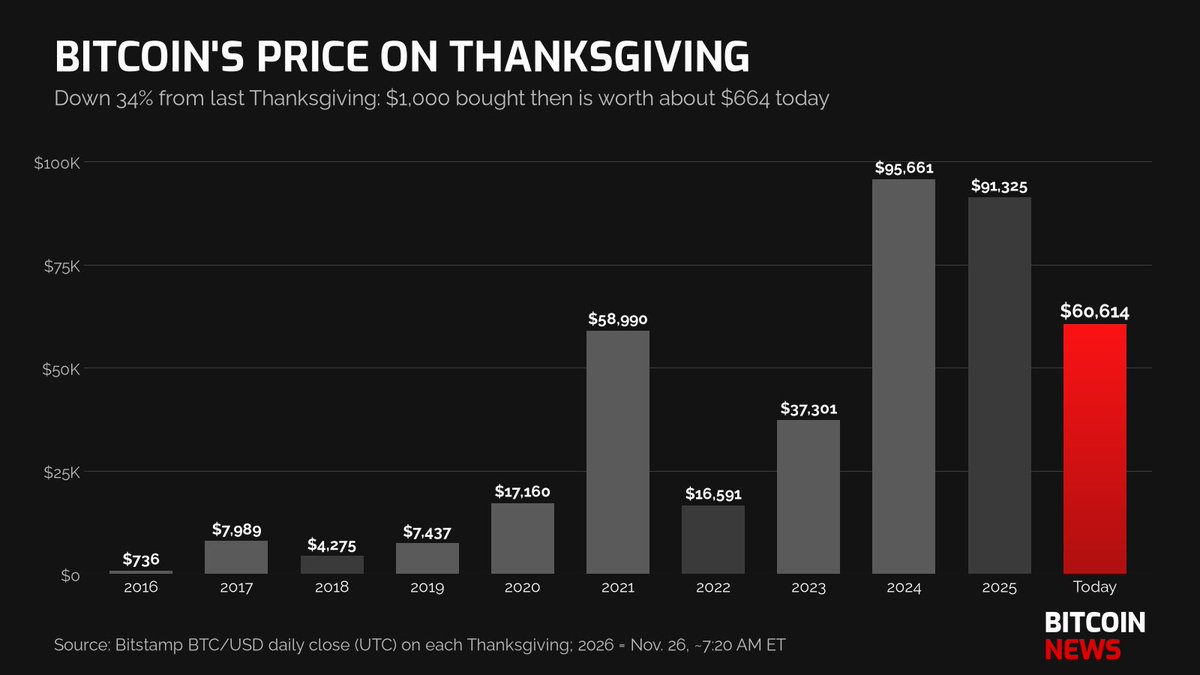
Bitcoin’s Price on Thanksgiving 🦃 2009: No established market price 2010: $0.28 2011: $2.44 2012: $12.29 2013: $1,007 2014: $370 2015: $356 2016: $736 2017: $7,989 2018: $4,275 2019: $7,437 2020: $17,160 2021: $58,990 2022: $16,591 2023: $37,301 2024: $95,661 2025: $91,325 2026: $60,614 Happy Thanksgiving! image
NEW: "NVIDIA should not be holding $29B in melting fiat currency. It's time to buy Bitcoin," says JAN3 CEO Samson Mow. image
NEW: Braiins warns attackers are hijacking Bitcoin miners' hashpower by impersonating mining pools. The pool operator logs 24 incidents between November 7 and 20, growing from under 175 PH/s to 1.9 EH/s in two weeks. Four attacks on November 20 each hit 1,050 to 1,600 mining sites, mostly in Europe. The weak point is unencrypted Stratum V1, a 2012 protocol that cannot confirm a miner is talking to the right pool, so the attacker collects credit for someone else's work. Braiins says most of Bitcoin's hashrate still runs on it. image
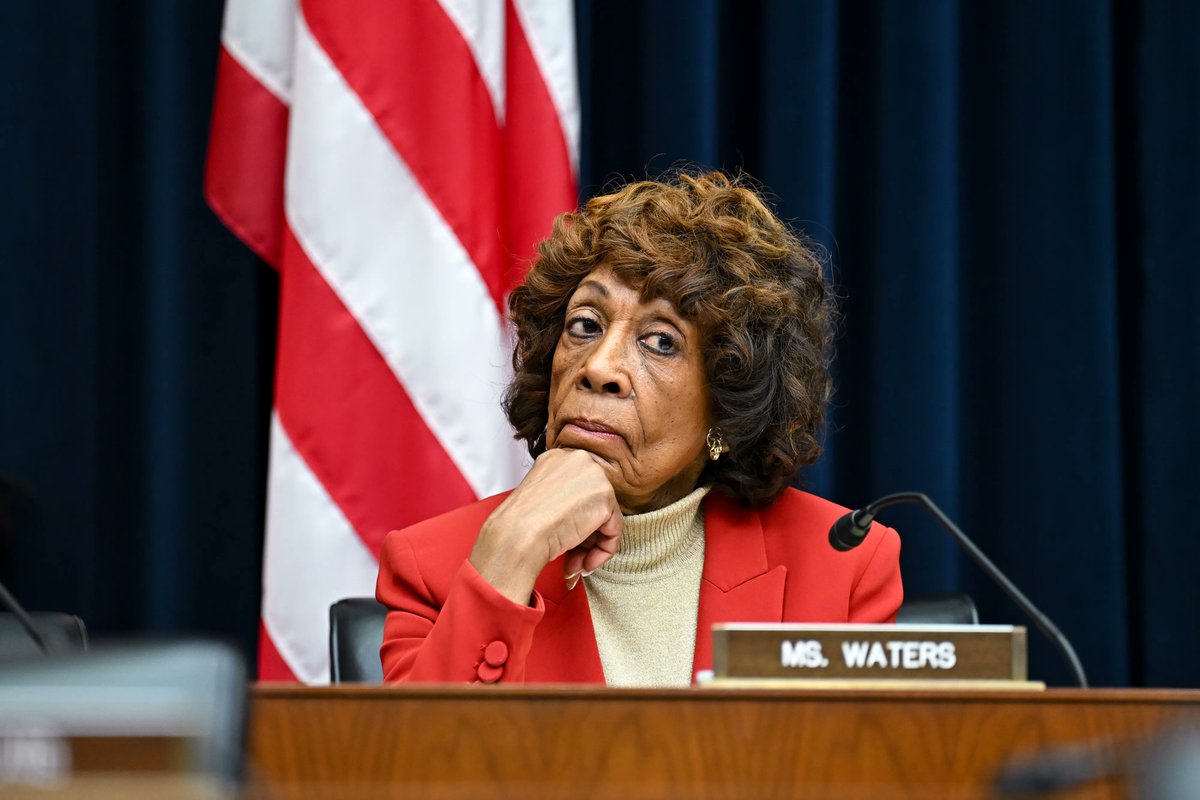
🇺🇸 maxine waters says the first crypto bill her committee must pass is one to "stop Trump's crypto corruption" The top Democrat on the House Financial Services Committee pointed to her Stop TRUMP in Crypto Act, which would bar the president, vice president, members of Congress and their immediate families from issuing, promoting or profiting from crypto. In a Nov. 25 statement after Trump's latest dinner for $TRUMP holders, Waters said the memecoin peaked at "around $74" and is now worth "less than $1," while Trump made "$635 million in royalties on his memecoin last year alone." She said Democrats will "investigate Trump's sham memecoin and other crypto ventures." Waters is in line to chair the committee when the new Congress is seated in January, after Democrats won the House in this month's midterms. The Strategic Bitcoin Reserve bill her committee reported out this week has to clear both chambers before then, or it starts over under her gavel. image
🇨🇭 Switzerland Launches Its First Spot Bitcoin ETF with 350 BTC in Assets BIT Asset Management's spot Bitcoin ETF ($BBIT) began trading today on SIX Swiss Exchange, becoming Switzerland's first and Europe's only currently active spot Bitcoin ETF, according to the asset manager. The fund launched with 350 BTC worth approximately $21 million and carries an annual expense ratio of 0.19%. Bitcoin is held in segregated cold storage at Swiss-regulated AMINA Bank. The ETF trades in both U.S. dollars and Swiss francs, with eligible investors also able to purchase fund shares using Bitcoin. The launch expands regulated Bitcoin investment access through Switzerland's traditional banking and brokerage infrastructure.
NEW: Canaan wins two more Nordic orders to heat homes with Bitcoin miners. The 430 Avalon A1566HA-500T units add 215 PH/s and produce water at about 80°C that feeds straight into district heating networks, replacing heat from burning fuel. Both buyers are repeat customers. The program now spans 1,350 machines, and Canaan estimates it can warm nearly 8,000 homes, up from about 2,800 when it launched in May. image
NEW: "If you believe there will be more inflation and printing of money in the future, Bitcoin is as important as it's ever been," says Coinbase CEO Brian Armstrong. image
U.S. Strategic Bitcoin Reserve Bill Moves One Step Closer to Becoming Law The American Reserve Modernization Act (H.R. 8957) has cleared the House Financial Services Committee and is now eligible for a full House vote. The legislation would codify President Trump’s Strategic Bitcoin Reserve into law, prohibiting the government from selling, swapping, auctioning or otherwise disposing of its reserve holdings for at least 20 years. The bill would also mandate proof-of-reserves reporting and require federal agencies to account for their digital asset holdings. The U.S. government currently holds an estimated 306,795 BTC worth $18.7 billion. The bill faces a tight deadline, with just over five weeks to secure House and Senate approval and presidential signature before the current Congress ends on January 3. If enacted, the legislation would make it significantly more difficult for future administrations to dismantle the Strategic Bitcoin Reserve. image
NEW: Eric Trump's American Bitcoin takes a $150M credit line from FalconX, secured by its own Bitcoin. The two-year revolving facility carries a 5.95% loan fee and a 143% initial collateral ratio, so every $1 drawn needs about $1.43 in pledged BTC. CEO Mike Ho calls it non-dilutive capital, letting the miner fund growth without selling from a reserve of more than 8.5K BTC. ABTC jumps 17% Monday to about $4.09, yet the stock is still down roughly 84% this year. image
Bitcoin News's avatar
BitcoinNews 2 days ago
Proving P = Np May Not Spell the End of Bitcoin’s Cryptography UCLA adjunct professor Arun Rao highlights why even proving P = NP might not spell the end of modern cryptography. A proof could be nonconstructive, establishing that efficient algorithms exist without revealing how to implement them. For Bitcoin, the real threat would be discovering a practical algorithm capable of deriving private keys from public keys or breaking its underlying hash functions. There is a fundamental difference between proving that a solution exists and knowing how to find it. sudoraohacker: Don Knuth on P=NP: “As you say, I've come to believe that P = N P, namely that there does exist an integer M and an algorithm  that will solve every n-bit problem belonging to the class N P in nM elementary steps. Some of my reasoning is admittedly naïve: It's hard to believe that P ≠ N P and that so many brilliant people have failed to discover why. On the other hand if you imagine a number M that's finite but incredibly large—like say the number 10  3 discussed in my paper on "coping with finiteness"—then there's a humongous number of possible algorithms that do nM bitwise or addition or shift operations on n given bits, and it's really hard to believe that all of those algorithms fail. My main point, however, is that I don't believe that the equality P = N P will turn out to be helpful even if it is proved, because such a proof will almost surely be nonconstructive. Although I think M probably exists, I also think human beings will never know such a value. I even suspect that nobody will even know an upper bound on M. Mathematics is full of examples where something is proved to exist, yet the proof tells us nothing about how to find it. Knowledge of the mere existence of an algorithm is completely different from the knowledge of an actual algorithm. For example, RSA cryptography relies on the fact that one party knows the factors of a number, but the other party knows only that factors exist. Another example is that the game of N × N Hex has a winning strategy for the first player, for all N. John Nash found a beautiful and extremely simple proof of this theorem in 1952. But Wikipedia tells me that such a strategy is still unknown when N = 9, despite many attempts. I can't believe anyone will ever know it when N is 100. More to the point, Robertson and Seymour have proved a famous theorem in graph theory: Any class  of graphs that is closed under taking minors has a finite number of minor-minimal graphs. (A minor of a graph is any graph obtainable by deleting vertices, deleting edges, or shrinking edges to a point. A minor-minimal graph H for  is a graph whose smaller minors all belong to  although H itself doesn't.) Therefore there exists a polynomial-time algorithm to decide whether or not a given graph belongs to : The algorithm checks that G doesn't contain any of  's minor-minimal graphs as a minor. But we don't know what that algorithm is, except for a few special classes , because the set of minor-minimal graphs is often unknown. The algorithm exists, but it's not known to be discoverable in finite time. This consequence of Robertson and Seymour's theorem definitely surprised me, when I learned about it while reading a paper by Lovász. And it tipped the balance, in my mind, toward the hypothesis that P = N P. The moral is that people should distinguish between known (or knowable) polynomial-time algorithms and arbitrary polynomial-time algorithms. People might never be able to implement a polynomial-time-worst-case algorithm for satisfiability, even though P happens to equal N P.”
Bitcoin News's avatar
BitcoinNews 2 days ago
This is an 80,000 BTU Bitcoin mining heater. Here's how it works: • The miners: up to 6 Antminer S19j Pros sit submerged in oil inside a Fog Hashing B6 immersion tank. The S19j Pros are older, but still earning. • The tank: the oil never leaves it. It absorbs the heat from the hashboards and passes it to a heat exchanger inside the tank. • The heating loop: glycol runs through that exchanger, out to a manifold, and through tubing in the concrete floor. The cooled glycol returns and the cycle repeats. • The power: all of it runs on a single 125 amp, single-phase breaker. • The math: 80,000 BTU an hour is about 23 kW of heat. Six S19j Pros at stock settings make about 18 kW, so they're likely tuned up. 23 kW is also close to the 24 kW a 125 amp, 240 V circuit can carry continuously. The heat would be made anyway. Here it warms the building, and the Bitcoin mined pays back part of the energy bill. 🎥 softwarmllc
↑