
Deleted Account
npub1x9qa...cj06
Deleted Account

Signal to noise ratio of Iran commentary.

A common claim in commentary about the U.S.–Israeli campaign against Iran is that the United States entered the conflict without a coherent strategy. Such claims are premature.
Strategic design is rarely visible to outside observers during the early phases of a conflict. The appropriate analytical starting point is therefore the opposite hypothesis: that U.S. leadership initiated the campaign with a coherent hierarchy of ends and an associated campaign plan, and that operations are unfolding broadly within the expected range of wartime uncertainty and enemy reaction.
The task of analysis is not to assume the absence of strategy, but to test whether the observable pattern of action can be explained by a plausible strategic design.
If you want to understand Bitcoin beyond price charts and hype, subscribe to Dollars2Bitcoin.
Clear analysis of how Bitcoin actually works, what it means for the global monetary system, and why it matters.

Dollars2Bitcoin | Richard Martin | Substack
Clear thinking about Bitcoin for leaders navigating money, finance, and sovereign power. Click to read Dollars2Bitcoin, by Richard Martin, a Substa...
Bitcoin is no longer just a technology experiment or a speculative asset. It now sits inside the global monetary system alongside states, banks, and financial markets.
Most commentary still focuses on price, protocol debates, or ideology. That misses the real question. Governments, financial institutions, corporations, and investors are now forced to respond to a monetary network they do not control.
This article explains why Bitcoin must be analysed structurally and strategically, not just technologically or financially, and why understanding institutional responses will matter far more than predicting the next price move.
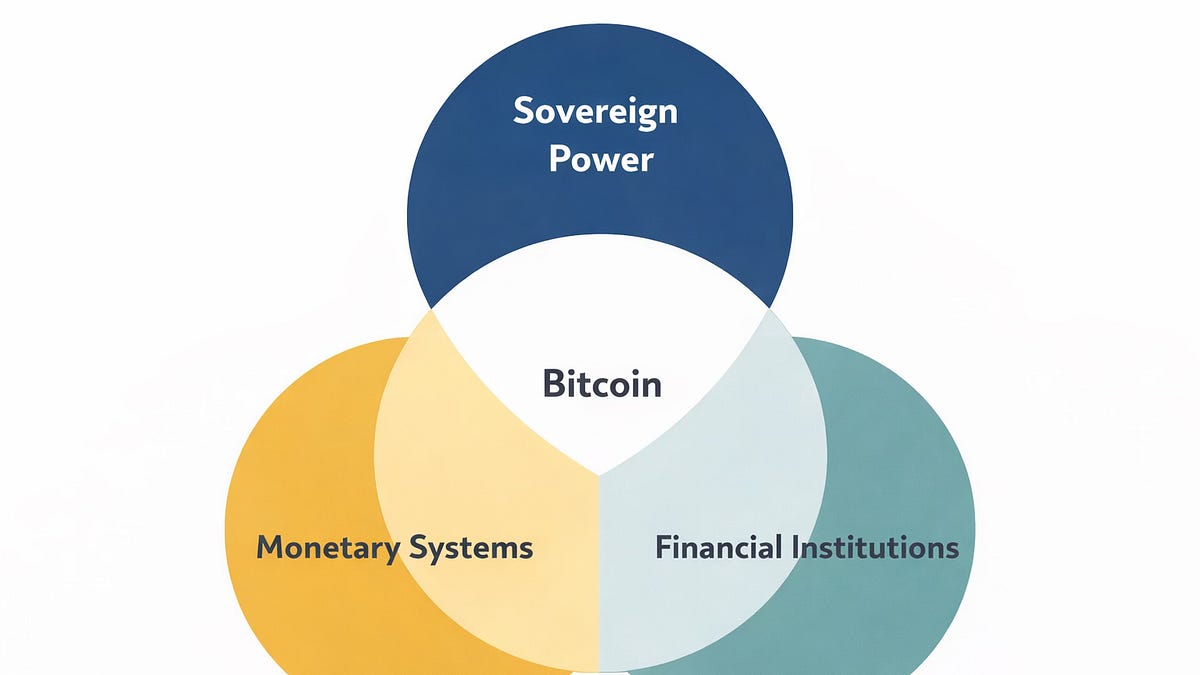
Bitcoin and the Structure of the Global Monetary System
Why Strategic Analysis Matters
I’ve read your Pegged white paper with genuine interest. It is both original and thought-provoking, an attempt to design a monetary protocol that redistributes value through provably fair lotteries, stripped of governance, narrative, or intervention. The elegance of its neutrality is clear, and it advances an important conversation about how money can be structured differently.
That said, I want to offer a critique that comes less from technical design and more from praxeology and anthropology, from the standpoint of how humans act, organize, and construct legitimacy.
From a praxeological perspective, money and capital are not ends in themselves; they are means to purposeful human action. Exclusion from finance is indeed a structural constraint, but it is not an empty space. Where formal banking and credit fail, people already build institutions to mitigate risk and create access: families and kin networks, savings circles, reciprocal lending, remittances, microfinance groups. These institutions exist because they counter randomness. They convert uncertainty into predictability through reciprocity, trust, and mutual obligation.
Pegged, by contrast, elevates randomness as its principle of fairness. This is technically ingenious, but anthropologically brittle. In real communities, repeated random outcomes are rarely interpreted as neutral. If the same individual wins twice, suspicion of foul play arises, no matter how strong the cryptographic proof. Without narrative legitimacy or embedded trust, structural neutrality risks being read as arbitrariness or collusion.
Moreover, excluded populations often place the highest value on reliability, continuity, and competence. A chance-based redistribution system may feel less like access and more like a casino. By design, Pegged refuses the social institutions that humans rely on to transform windfalls into sustained capital. The result is a profound cultural mismatch: what appears mathematically fair may be experienced socially as illegitimate.
My question, then, is whether randomness can ever serve as a sufficient foundation for money. Pegged is an experiment in radical neutrality, but fairness in human terms usually requires more than chance. It requires narrative, reciprocity, and competence. Without these, a protocol may function flawlessly in code yet fail as a human institution.
I offer this not as dismissal but as engagement. Pegged opens a fascinating design space. My critique is that it risks mistaking exclusion for emptiness, overlooking the dense institutional logics that already govern access to capital. I would be very interested to hear how you see Pegged addressing this cultural dimension.
With respect,
Richard Martin
I've created a Bitcoin Home Mining Calculator:  #bitcoin #mining #homemining #calculator
Google Docs
Bitcoin Home Mining Calculator.xlsx
Bitcoin Home Mining Calculator
Yours to use. Yellow cells for variables and green cells for estimates. Let me know what you think.
Rich
Google Docs
Bitcoin Home Mining Calculator.xlsx
No evidence yet that Charlie Kirk’s assassin was a “leftist.” Shooter remains unidentified; motive unknown. Claims about ideology are speculation. Important to separate facts from rhetoric. #Nostr #CharlieKirk
I once worked with a submariner who watched a Royal Navy sub limp back into port with bent diving planes and a dented conning tower after colliding with a Soviet sub it had been shadowing. Encounters like that were routine in the Cold War and far riskier than a handful of drones.
You also do not see Canada or the United States activating Article 4 every time Russia tests NORAD air defences in the north. What is happening in Poland is a different kind of provocation. It is political theatre designed to unsettle. The real threat is psychological, aimed at eroding NATO cohesion by frightening the population, with a view to buying time for Russia to hold on to its gains in Ukraine.
Bitcoin is the deterministic automation of money.
What drives me is the need to understand human action. All is action, always taken within constraint, never entirely free. Strategic action is that which carries disproportionate consequence, shaping the fate of orders and communities. My method is radical decentring: stepping into the actor’s frame to see what they saw, without imposing my moral judgment. I seek the underlying patterns — functional and symbolic — that persist across time, revealing how humans make meaning and navigate necessity.

Store of value and medium of exchange are two sides of the same coin.
History shouldn’t be judged by hindsight; strategy must be judged ex ante — see my new essay on Vietnam and U.S. grand strategy, 1955–65.
This essay grew out of a recent exchange about Vietnam, American grand strategy, and how we judge historical decisions. Too often debates about wars collapse into hindsight: “it was unnecessary” or “it worked” — both argued from the same outcomes.
My point is that serious study of strategy must judge decisions ex ante, by what leaders knew and feared at the time, not by what we know now. Vietnam (1955–1965) is a living example. Whatever we think of the outcome, U.S. political, military, and foreign policy leaders largely agreed on the ends. The debates were about ways and means under uncertainty, with lessons from Munich, World War II, and Korea in mind.
The result is this essay: “Judging Strategy Ex Ante: Vietnam, U.S. Grand Strategy, and the Lessons of Context (1955–1965).” It sets out eight principles for analyzing strategy that I think apply as much to today’s world as to the Cold War.
View article →
Strategy isn’t chemistry in a lab. Leaders make choices in real time, with prior beliefs, knowledge and background, fears, and messy constraints. Hindsight proves nothing.
Eight principles for thinking straight about strategy:
1. Ex ante, not hindsight.
2. Ends–Ways–Means under uncertainty.
3. Hierarchy of ends (local → global).
4. Priors matter.
5. All sides have agency.
6. Least-bad options.
7. Synchronic + diachronic context.
8. Reasonable under the circumstances.
Strategic history’s value is not in proving what should have happened, but in understanding how leaders thought and why they chose as they did.