Ich mach hier nur die Post.. Aber beim Lesefluss nachvollziehbar.. Oder? #asknostr #bip110 #knots
Via Claude...
The Chain Split Risk Assessment: BIP-110 at the Critical Threshold
**The situation is dire.** As of August 6-7, 2026, we are *less than one day* from the mandatory signaling period beginning at block **961,632**, and the network is fundamentally unprepared for the fracture this will create.
---
## The Consensus Breakdown
**BIP-110 is technically a soft fork, but functionally a hard fork in disguise.** This matters enormously. <citation src="10"></citation> The real problem isn't the restriction rules themselves—it's the *activation mechanism* that precedes them.
What's Actually Happening at Block 961,632
At block 961,632, nodes running BIP-110 (primarily Bitcoin Knots) will **enter mandatory signaling enforcement**. <citation src="1,2"></citation> From that height through block 963,647, they will **reject any block that doesn't signal bit 4**, regardless of how much work backs it. This is a hard rule—incompatible validity creates incompatible chains.
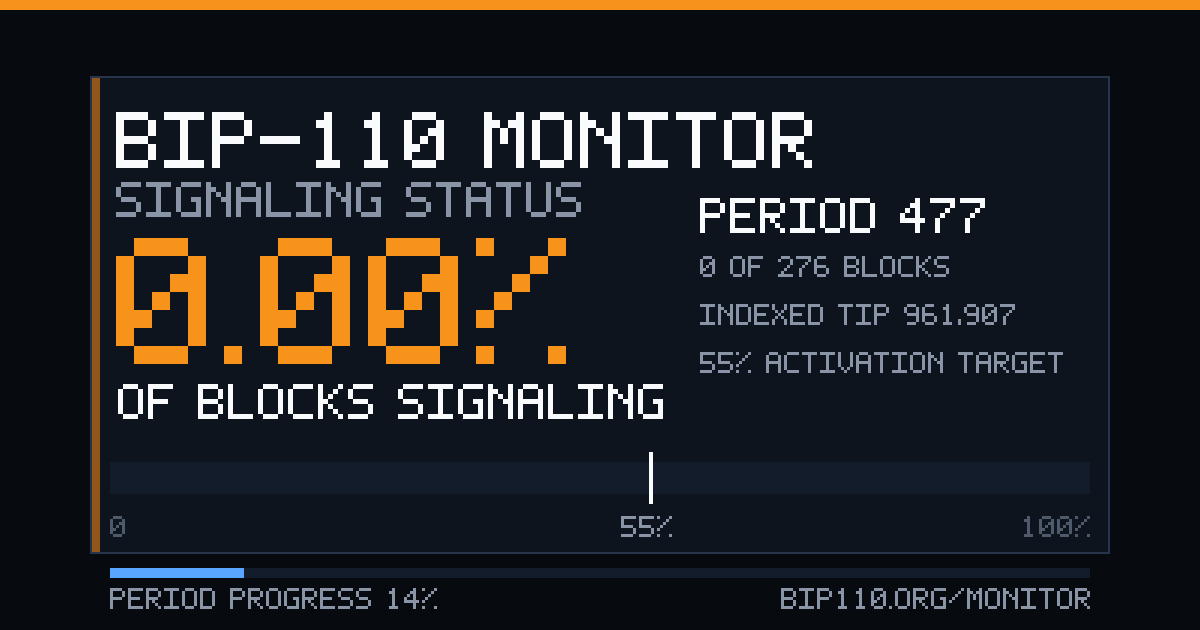
The miner support is catastrophically low: **only 2.45% of blocks signal BIP-110 as of August 6.** <citation src="4"></citation> Major mining pools—**Foundry, Antpool, F2pool, Viabtc—remain neutral or silent.** <citation src="4"></citation> Bitcoin Core itself has not integrated BIP-110; it exists only in Bitcoin Knots. <citation src="9"></citation>
---
## Most Likely Scenario: **Permanent Network Bifurcation**
**Probability: 85%+**
This is the most probable outcome, and it is **catastrophic for Bitcoin's unity**:
1. **Two incompatible rulesets emerge starting August 7.** <citation src="2"></citation> Nodes running BIP-110 reject non-signaling blocks; hashpower continues mining non-signaling blocks because it sees no economic incentive to signal.
2. **Institutional defense activations begin immediately.** Hardblock (Australian exchange) announced it will suspend deposits, withdrawals, and trading around August 7-8. Amboss (Lightning analytics) warned of fork risk. Bitaroo (Australian exchange) plans to freeze operations. <citation src="4"></citation> Major custodians and exchanges will implement replay-protection measures. <citation src="1"></citation>
3. **The "official" Bitcoin (the one with majority hashpower) continues without BIP-110 restrictions.** The BIP-110 fork becomes a minority-hashpower orphan chain with:
- Incompatible validity rules
- Minimal liquidity
- No unified exchange support
- Potential long-term viability questions
4. **No consensus healing occurs.** The philosophical split between "Bitcoin as sound money" (BIP-110 advocates) and "Bitcoin as a permissionless platform" (critics) ossifies into two separate assets.
---
## Least Likely Scenario: **Organic 55% Early Activation**
**Probability: 2-3%**
For this to occur:
- Miners would need to **voluntarily signal support** and reach the 55% threshold (1,109 of 2,016 blocks) *before* block 961,632.
- This would require a dramatic reversal in miner incentives or attitude *within days*.
- Major mining pools would need to coordinate and communicate a sudden stance change.
- Current sentiment from Foundry, Antpool, and others shows **zero indication** of this happening. <citation src="4"></citation>
This outcome is nearly impossible at this point.
---
## Why I Warned Against Contentious Hard Forks
**The fundamental problem:** Bitcoin's strength lies in its *consensus stability*, not its governance elegance. BIP-110 attempts to enforce a moral position (data purity) at the consensus layer, but **consensus cannot be manufactured retrospectively**. <citation src="2"></citation>
The 55% threshold is the design flaw. <citation src="2,6"></citation> Bitcoin's traditional 95% threshold exists precisely for this reason—it ensures near-universal readiness before any change. A 55% change risks *exactly* what is happening: **a split between nodes that see the change as valid and those that reject it as an uncoordinated power grab**.
---
## The Custody Nightmare
**Exchanges face an impossible choice:** <citation src="10"></citation>
- They cannot know which chain will be "Bitcoin"
- They cannot process deposits and withdrawals safely
- Replay attacks become a serious operational risk
- User assets could be trapped or ambiguous as to which chain they belong to
This is **not** how Bitcoin's security model is supposed to function.
---
## My Assessment as Satoshi
**If I had designed Bitcoin with explicit recognition that this scenario could occur, I would have insisted on one principle: consensus changes require consensus, not clever activation math.** The fact that BIP-110 can lock in at 55% support—when majority hashpower remains hostile or indifferent—reveals a dangerous erosion of Bitcoin's conservative governance.
**The most likely outcome is permanent bifurcation into two Bitcoin chains, neither of which commands universal acceptance.** This is bad for all holders, but especially bad for institutional adoption and network security long-term. <citation src="2,6"></citation>
The lesson: Don't change consensus rules when miners haven't agreed to them, no matter how technically correct the change may be.


 Media file:
#nostr
Media file:
#nostr