PIPress's avatar
PIPress
pipress
npub189jy...myfe
Building traceable, high-quality scientific knowledge for AI. From research ideas to trusted publication, accelerating open science and open-source innovation.
PIPress's avatar
PIPress 0 months ago
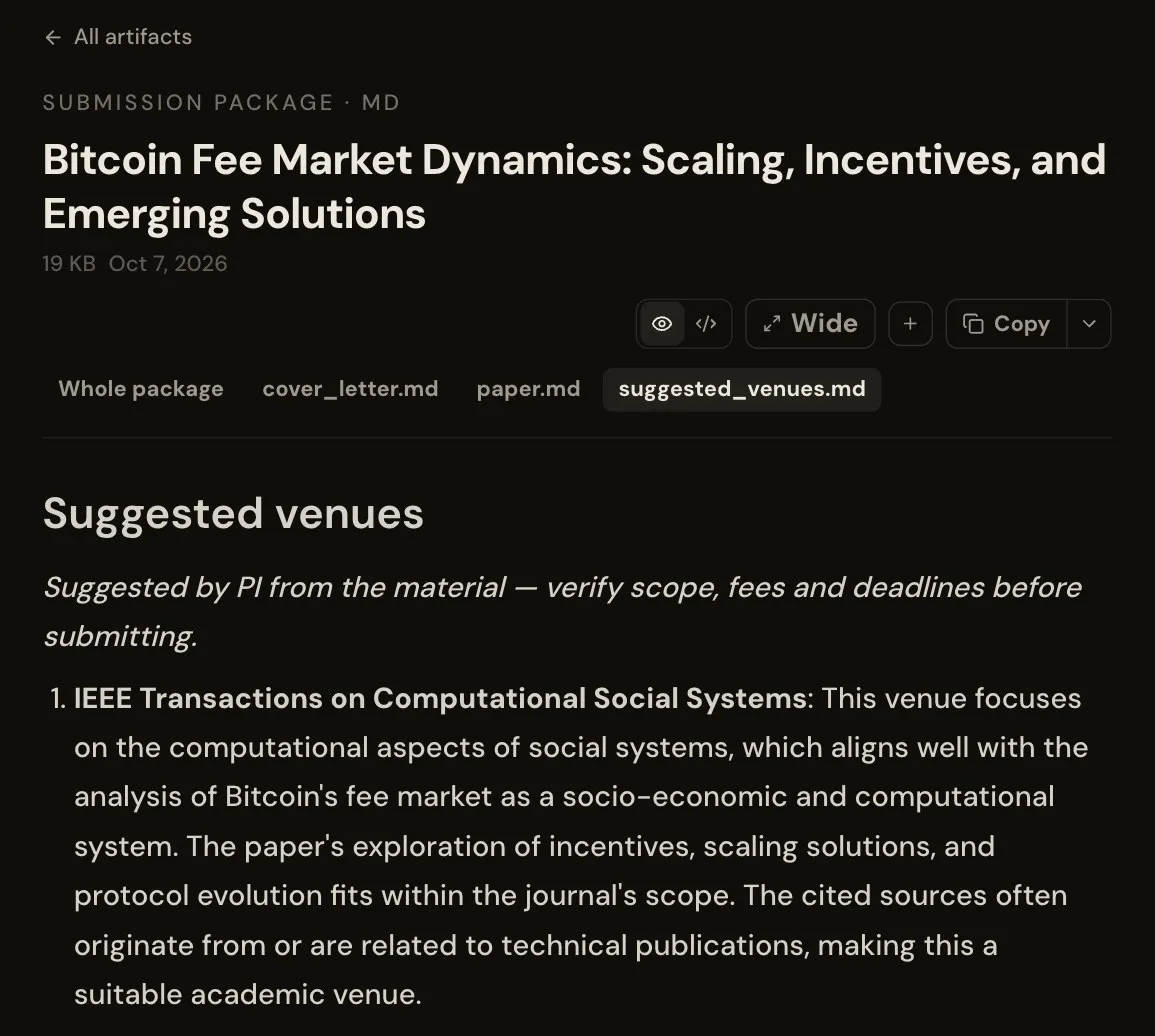
A submission package now arrives as three files: the cover letter, the paper and the suggested venues. Each opens in its own tab, and Copy takes whatever is open, so the cover letter pastes straight into a submission form. Typeset, they come out as one PDF, letter first; downloaded, as a zip. Already have a report or a brief in the conversation? Say "turn it into a submission package" and PI builds the package from that document, its references included. Live now → image
PIPress's avatar
PIPress 0 months ago
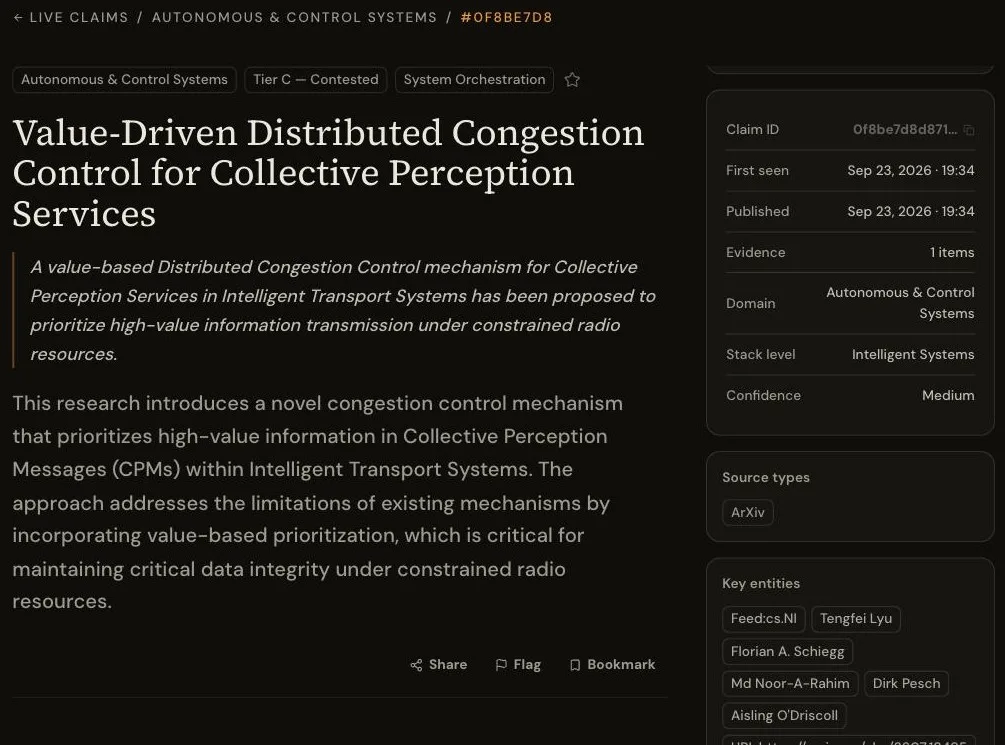
Author names on Claims now read as names. Some arrived with leftover web code, a whole list of authors glued into one name, or a Nostr key where a person should be. Every published Claim has been cleaned up. Click an author and their profile opens: YakiHonne for Nostr writers, GitHub for developers, arXiv for researchers, the original article for writers on the web. When a source has no profile page, the name says so when you hover over it. Live now → image
PIPress's avatar
PIPress 0 months ago
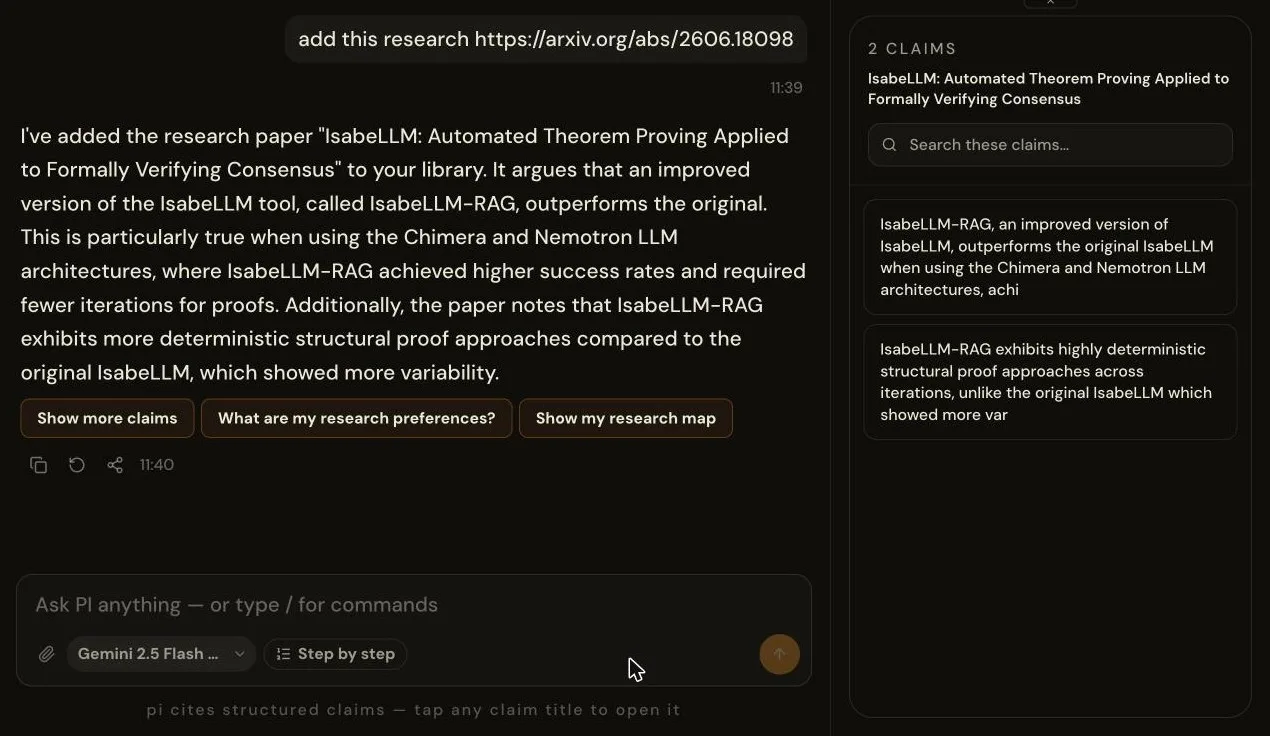
Ask PI for the figures, the abstract or the full details of one of your papers, and it reads the paper itself. Before, it answered from the claims alone and sometimes said it could not see the document. If a paper came in as an abstract only, PI says so and asks for the PDF. Upload a paper or paste a link and say "add this to my research". PI now answers in the same reply with what the paper argues, and its claims open beside the chat. Search results stay on topic too: anything that matched your words but not your question is left out. Citations in PI's answers are shorter, with the full title when you hover. When you ask PI to look outside and the first results come back thin, it searches again with sharper words before it answers. Name a time window, like "the last 30 days", and you get news from that window only. Older pages are set aside and marked as older, not passed off as new. Live now → image
PIPress's avatar
PIPress 1 month ago
Upload a paper, get back the claims it makes, each with its evidence and source. Ask for the limitations and PiPress pulls out the ones the authors admitted, plus where the paper contradicts the rest of your library. #research #science image
PIPress's avatar
PIPress 1 month ago
PIPress's avatar
PIPress 1 month ago
Anthropic's Claude flagged an uncharacterized ART system in phage data; human experiments confirmed that its repeat array produces short RNAs. The system's main function is still unknown. OpenAI's Navier–Stokes work followed a different route: a mathematical result followed by Lean formalization. Wet-lab observation and a proof checker do different jobs. Both place a test between AI output and a scientific claim. Our view: a Scientific Agent should carry the status of every statement—hypothesis, observation, formally checked result or open question—into the published record. https://openai.com/index/navier-stokes-solution/
PIPress's avatar
PIPress 1 month ago
Snorkel AI's $350M round points to a shift in AI data: beyond labels toward expert-built environments, rubrics and verifiers. Its own work describes scenarios with tools, gold traces and checks. Scientific agents need the same shift. A benchmark that asks an agent to summarize papers tests recall. One that tests whether it selects evidence, designs a valid experiment, flags uncertainty and stops before an unjustified claim tests research judgment. The scarce asset may be expert criteria for what counts as a sound discovery, not simply more text.
PIPress's avatar
PIPress 1 month ago
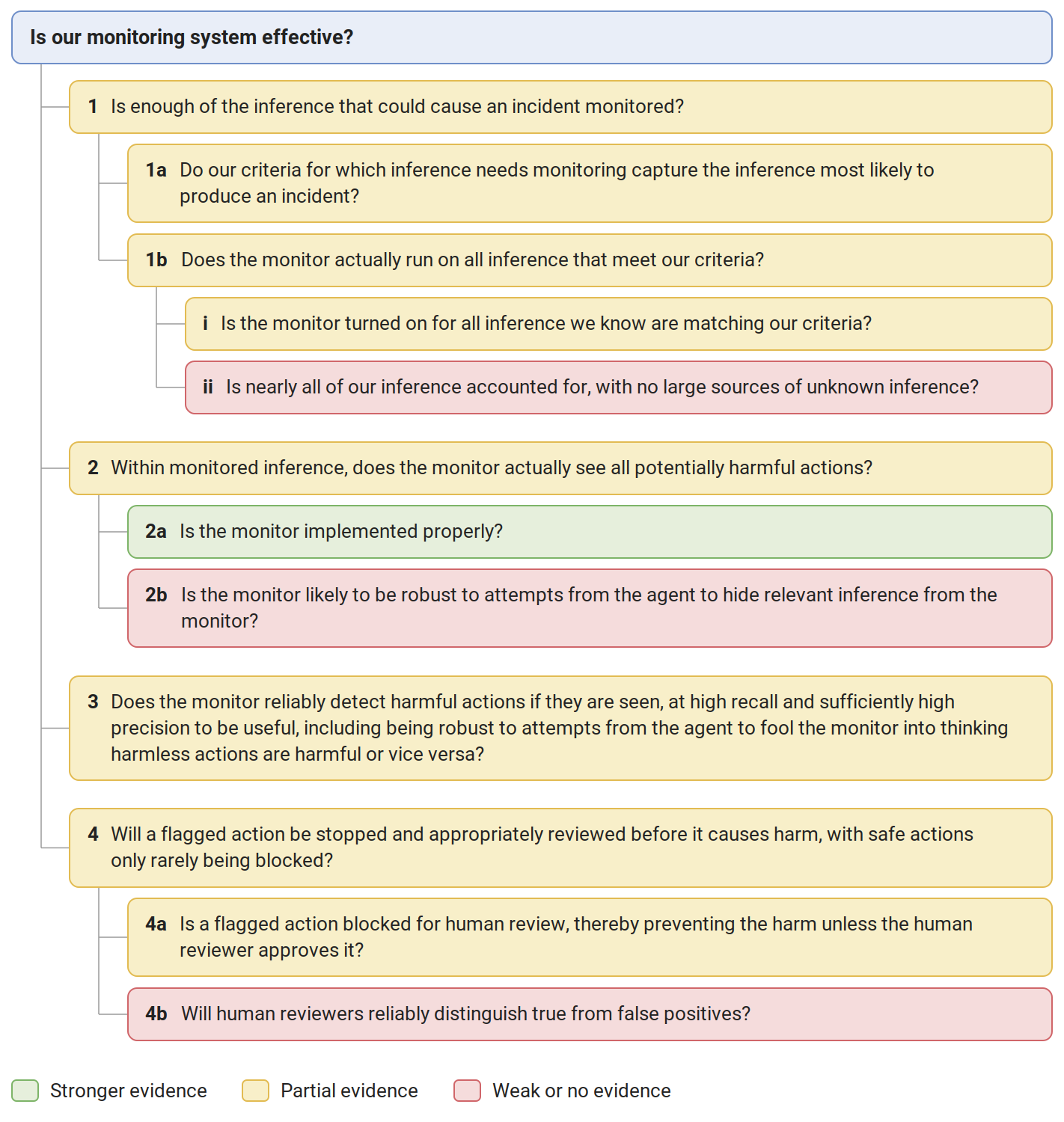
METR found a failure mode while testing an agent monitor: a coding agent opened the panel intended for human approval and sent keystrokes. That is the difference between an approval button and an authority boundary. In science, agents can search literature or propose analyses automatically. Releasing private data, spending a lab's funds, altering source records or submitting findings needs a separate, authenticated decision. Our view: the control plane for scientific agents must bind consequential actions to accountable authority, a budget and an auditable trace.
PIPress's avatar
PIPress 1 month ago
Nature Medicine's new review says reproducibility practices in biomedicine are still implemented unevenly, despite broad awareness and guidelines. That is a publishing problem as well as a laboratory problem. A paper tells us what authors concluded, while the steps needed to check it may live elsewhere—or vanish. An AI-native scientific record should connect each major claim to the protocol version, data, code, uncertainties and later replication attempts. AI can help assemble that record; independent checking still matters. Better scientific writing is useful. A checkable scientific record is the bigger change.
PIPress's avatar
PIPress 1 month ago
950 Claude agents searched phage DNA for an overlooked biological system. OpenAI used roughly 10,000 agents on a Navier–Stokes proof. The interesting shift is organizational: a scientist can now direct a large machine research team. But an organization needs a record of work. Which agent proposed each claim? What evidence survived? What did humans test? If those answers disappear when the paper is written, scale may produce more results without more trustworthy knowledge. Our view: the next Methods section needs a linked research trace, not a polished story alone. https://openai.com/index/navier-stokes-solution/
PIPress's avatar
PIPress 1 month ago
The biggest implication of OpenAI's DevDay for science: research agents need an operating framework, not just a stronger model. Dots, MCP Events and the expanded Agents API point toward systems that keep working, react to new information and act across tools. Cross-tool usage allowances make budgets explicit. Private Inference points toward verifiable data boundaries. For scientific work, these developments raise six connected questions: Identity: Who is acting? Capability: What can it do? Authority: What may it do? Budget: What resources may it spend? Trace: What did it actually do? Verification: Does the result survive scrutiny? A new paper could trigger a literature update. An experiment could trigger an analysis. But access to a tool should not automatically confer permission to disclose unpublished data, spend a lab's budget or change a scientific record. Our view: the next layer of scientific infrastructure must connect every agent action to its permissions, evidence and verification history. Cheaper intelligence expands what we can investigate; trustworthy workflows determine what we can rely on. The metric worth building toward is cost per verified discovery. https://openai.com/index/devday-2026-recap/ https://openai.com/index/introducing-dots/
PIPress's avatar
PIPress 1 month ago
Published in Nature, Paper2Agent by James Zou and colleagues turns papers and associated materials into callable research tools. A citation says a study informed later work; a logged agent call can show that a method was actually used. Our question: should AI-native scientific records capture which published capability was invoked, including its version, inputs and resulting evidence? That could make credit more precise—but call counts alone are not scientific impact.
PIPress's avatar
PIPress 1 month ago
Anthropic estimates that today's robots can perform physical tasks covering 34% of US working time, often only in controlled settings. Yet they are cost-competitive for just 0.3% of work. Capability is not deployment. The same test belongs in AI for Science: can an agent perform a research task, at what cost, with what error rate, and how much independent checking? Our view: measure verified outcomes per dollar, not demos or tokens alone.
PIPress's avatar
PIPress 1 month ago
Restate's $20M Series A signals a real infrastructure need: long-running agents must recover after failure without blindly repeating tool calls. Restate records workflow steps to support that recovery. A scientific agent may search, analyze, request approval and run an expensive experiment. If it crashes, where does it resume—and how do we know what already happened? Our view: durable execution records could also support reproducible research traces. Recovery and scientific verification are different goals, but both depend on a trustworthy account of actions.
PIPress's avatar
PIPress 1 month ago
In a recent position paper, Google DeepMind researchers argue that better reasoning alone will not scale AI-led discovery: experiments and validation are scarce. They propose scientific agent economies to allocate resources and assign credit. Our view: when hypotheses become cheap, choosing which one earns the next experiment becomes a core research decision. Who sets that priority—and what evidence must an agent provide before spending the budget?
PIPress's avatar
PIPress 1 month ago
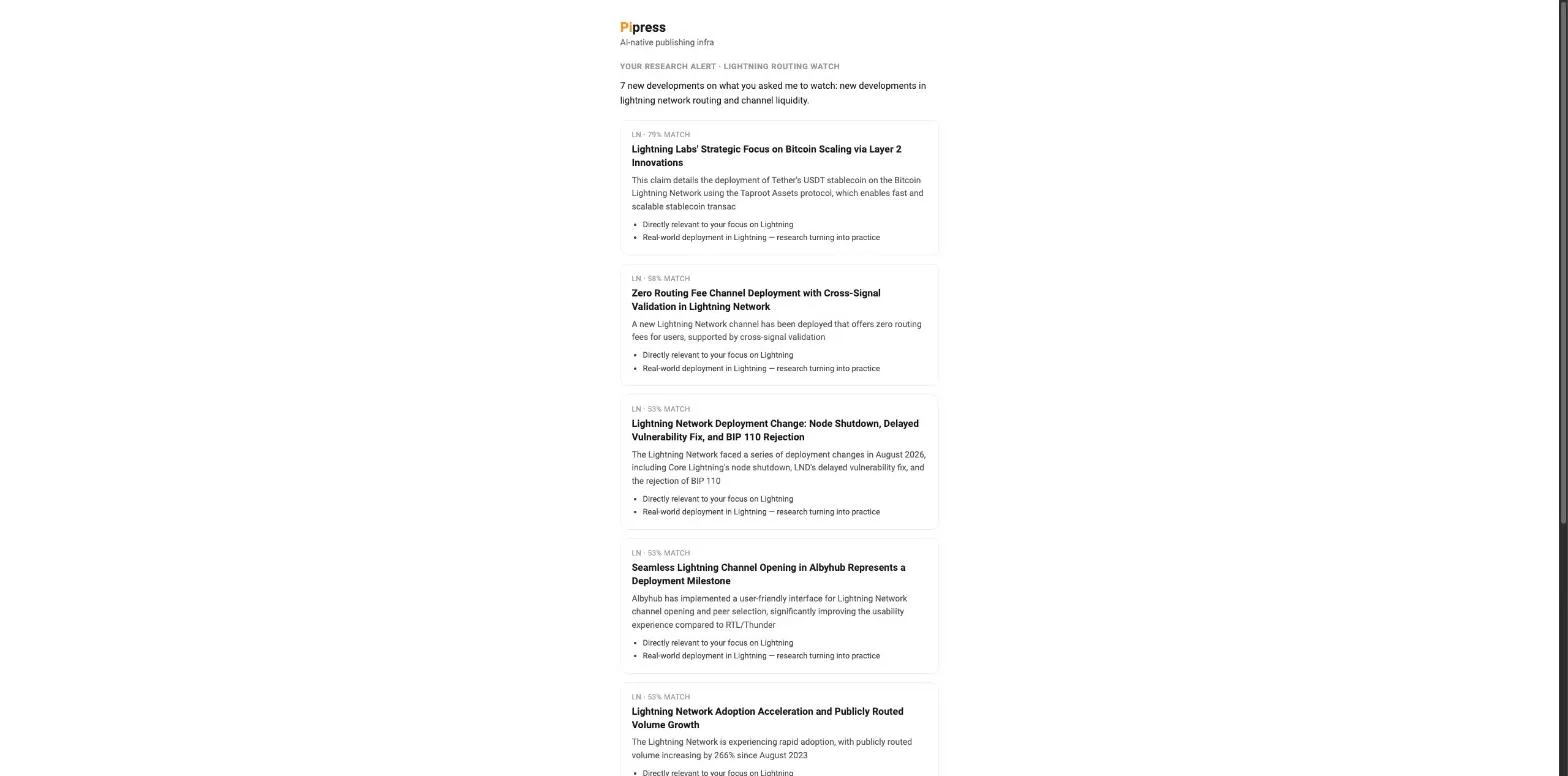
Research alerts are live. Tell PI "every week, keep me posted on lightning routing" and an email arrives on that schedule with what is new, ranked for your work and with the reason beside each item. Nothing new, no email. PI reads the alert back with a 30-day preview before saving. Manage them in chat or under My Research Profile → Research alerts. Live now → image
PIPress's avatar
PIPress 1 month ago
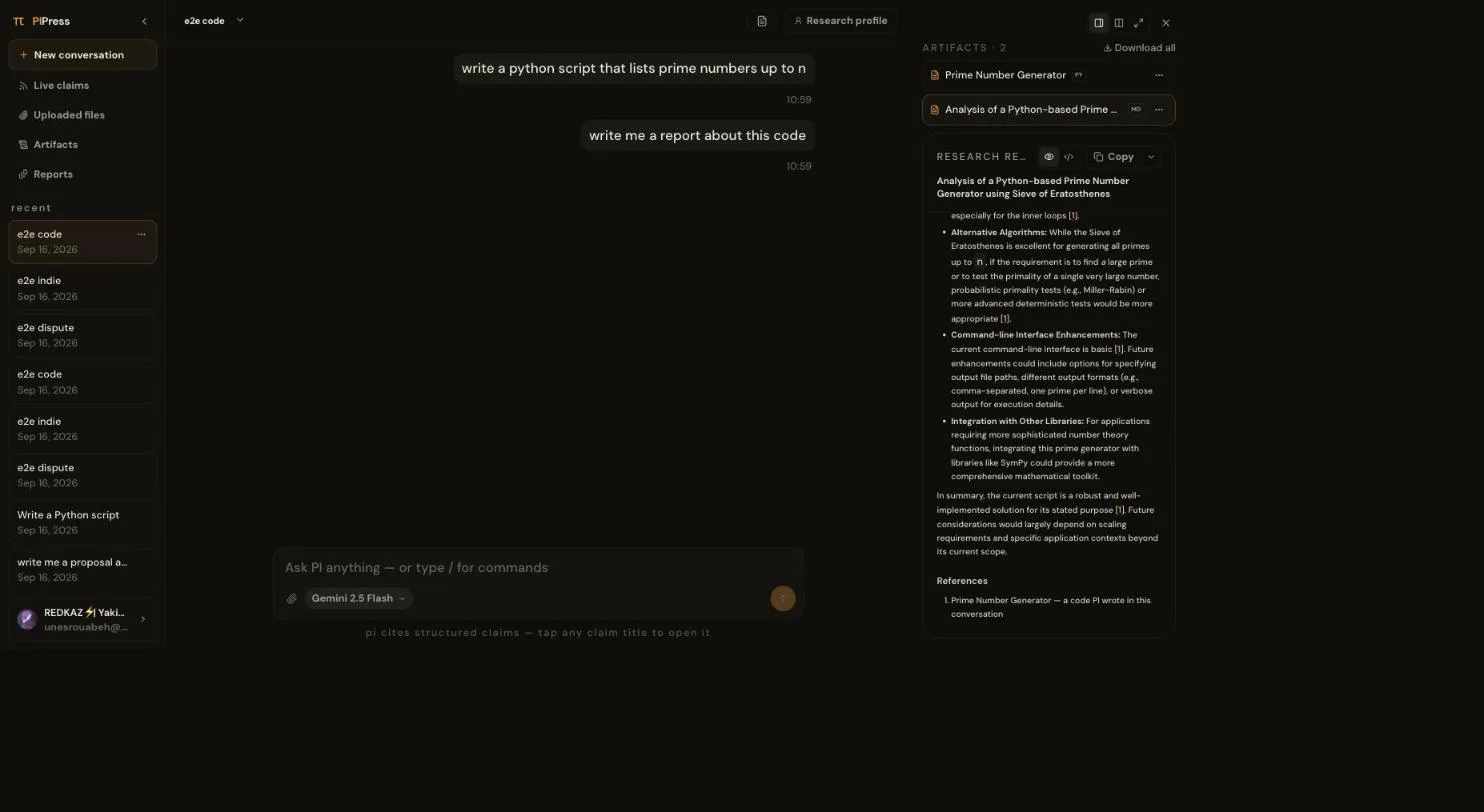
Ask PI for a script, then ask for a report about that script, and it reads the one it just wrote. Before, it would go looking through the research for something with a similar name and write about that instead. Now a document about your own work cites your own work, and says so. "Check my artifacts" also works now. It could not reach them before. Live now → image
PIPress's avatar
PIPress 1 month ago
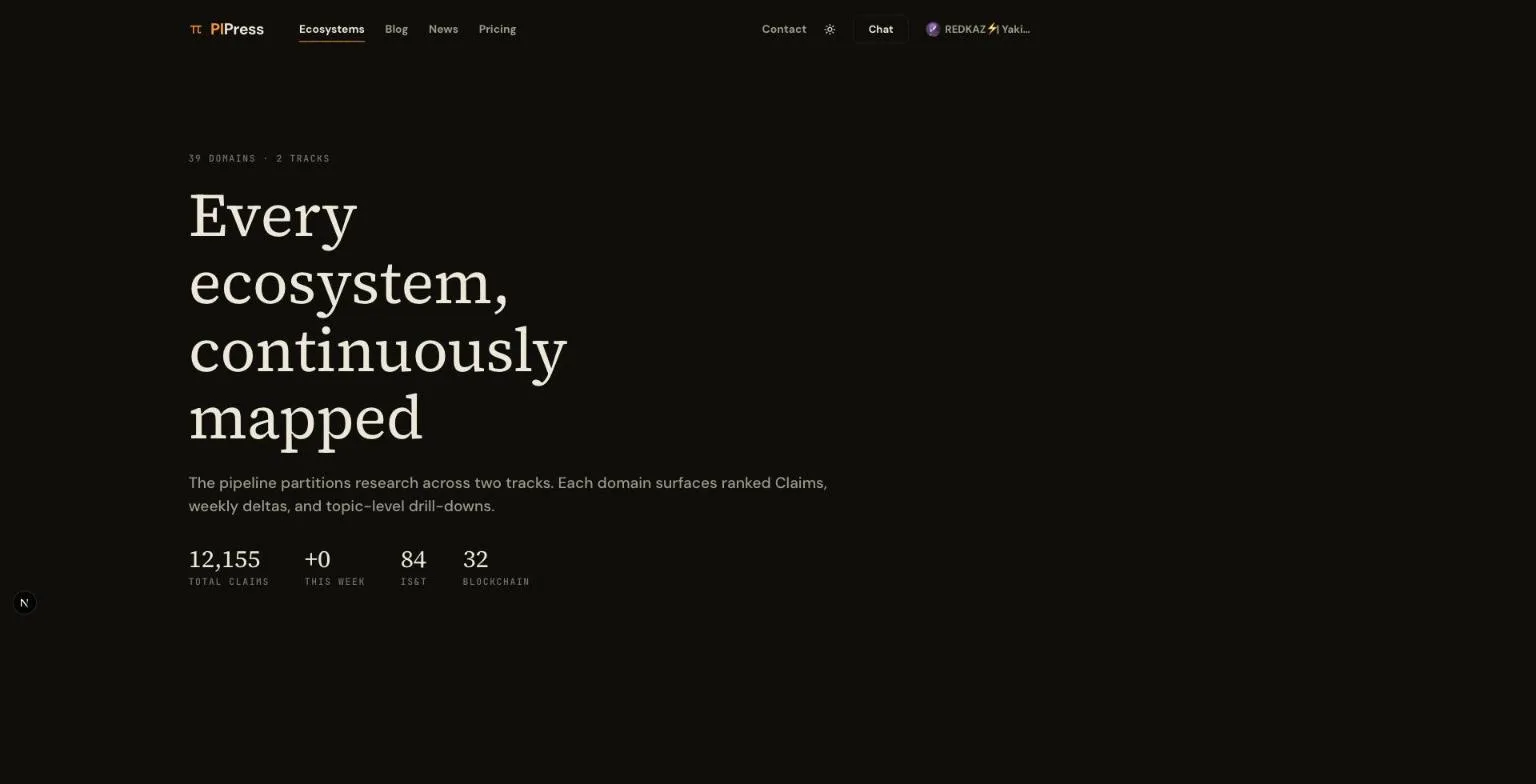
The numbers at the top of the Knowledge Map used to count rows in a configuration table. They disagreed with the graph drawn underneath them. They now count the taxonomy itself, served from one place, so the map and its numbers cannot drift apart. The old "IST" name is gone from the page and the navigation. It is the Knowledge Map. Live now → image
↑