bitcoms

Zero-JS Hypermedia Browser

avatar
bitcoms
bitcoms@nostrplebs.com
npub18s6a...eqxk
Writing and photographing Bitcoin

Notes (20)

BITCOIN IS NOT CRYPTO Bitcoin is the best digital monetary system due to its rock-solid core properties, its fairness to all participants and – crucially – because it eliminates trust. Despite publicly being declared dead hundreds of times every year since its birth, Bitcoin is now the world’s most secure large computer network with millions of users worldwide. Robust in design, it continues to grow, with the Lindy Effect already suggesting that it has a very long future indeed. Since Bitcoin’s inception in 2009, many thousands of imitators have been created – ‘crypto’ as distinct from Bitcoin. But because Bitcoin is the first successful digital money, any crypto trying to be money, irrespective of its characteristics, cannot compete with Bitcoin’s established network effects. Even near-identical copies ‘hard-forked’ from Bitcoin itself have all diminished in value, participation and security relative to Bitcoin over time. As time passes, this network effect is getting stronger. It is a key reason why no crypto network comes close to Bitcoin’s value, and – due to Metcalfe’s Law – is unlikely to do so in the future. Some cryptos are better than Bitcoin at various non-monetary things, e.g. using less power, being more private, and acting as a platform for other cryptos and so-called ‘smart contracts’. But all cryptos are inferior to Bitcoin at being money. This isn’t just due to Bitcoin’s network effect: it is also because almost all cryptos suffer from one or more of four critical shortcomings. First, most cryptos rely on trust because they eschew Bitcoin’s proof-of-work consensus mechanism for the misleadingly named ‘proof of stake’. In reality, this is proof of nothing because it trusts subjective abstract power (the opinion of the privileged), rather than verifying objective physical power (via computational work irrefutably done). By design, proof of stake also increases centralisation, ensuring the rich and powerful get richer and more powerful: in proof of work, work begets wealth, but in proof of stake, wealth begets wealth. Second, most cryptos are less censorship resistant than Bitcoin because, instead of being controlled by a large number of ordinary users, they are instead effectively controlled by a small number of privileged users. Even though they cloak themselves in the verbiage of decentralisation, they are in reality decentralised in name only. Third, far from being sound and fair monetary systems, many cryptos are scams with sizeable ‘pre-mines’, where before launch insiders take a large proportion (or even most of) the coins which will be created. This exacerbates the problems of proof of stake, with the insiders accruing even more profit and control at the expense of the outsiders. Fourth, many cryptos do not have a hard monetary limit, or that limit is not clearly defined. This makes them vulnerable to inflation, where the privileged participants can be enriched at the expense of the others. Some crypto creators have genuinely noble intentions, and are trying to improve on Bitcoin: it may be the most secure and decentralised computer network in history, but its limited transaction throughput means it is not particularly scalable. Unfortunately, these attempts all fail due to the so-called ‘blockchain trilemma’, which states that security, scalability and decentralisation cannot all be achieved together. Bitcoin wins by not trying to resolve this trilemma at all on the ledger itself, instead incentivising large-volume small-value transactions to move to second-layer networks with far higher capacity than any crypto's blockchain. Note that Bitcoin’s superiority as money isn’t only the opinion of individual Bitcoiners. It’s also the view of large financial institutions. “Bitcoin is fundamentally different from any other digital asset. No other digital asset is likely to improve upon bitcoin as a monetary good because bitcoin is the most (relative to other digital assets) secure, decentralized, sound digital money and any ‘improvement’ will necessarily face tradeoffs.” – Fidelity Research Study 'Bitcoin First: Why Investors Need to Consider Bitcoin Separately from Other Digital Assets, 2022 Bitcoin is not crypto. https://www.bitcoms.xyz/bitcoin-is/bitcoin-is-not-crypto
2024-09-26 15:45:58 from 1 relay(s) View Thread →
GM Keeping things rational. image
2024-09-24 08:48:22 from 1 relay(s) View Thread →
BITCOIN IS THE WORLD'S BEST PAYMENTS SYSTEM It takes minutes for the network to confirm payments on the Bitcoin ledger. Only a few transactions can be processed per second, and each one costs between a few pence and few pounds. Comparing this with the tens of thousands-of-transactions-per-second capacity of credit card networks, many dismiss Bitcoin out of hand as a potential large-scale payments network. But this is entirely wrong, because it compares apples with oranges. Most people don’t consider that the existing financial system works in layers. You may make dozens or even hundreds of credit card transactions per month, but you probably only pay your credit card bill once. Similarly, your bank records your bill payment together with thousands of others, but then settles them all at once with a single payment on the bank ledger money system. Bitcoin is also evolving layers, such as Lightning, a decentralized ‘layer-2’ network for instant Bitcoin payments. Lightning’s payments-per-second capacity is in the millions, with transaction speeds of up to a few milliseconds and near-zero fees. Lightning was first implemented in 2017, and has scaled quickly, with its bitcoin capacity growing fivefold in the two years to October 2022. This and other layer-2 systems (such as Liquid and Ark) could eventually keep most Bitcoin payments off the underlying base-layer ledger. While still small in global dollar terms, such layered systems could eliminate the traditional payments system’s huge costs and frictions which are currently borne by business, and largely passed on to an oblivious public in the form of higher prices. For example, credit card companies charge US businesses 1.3% - 3.5% of every transaction, whereas Lightning is practically free. Businesses must wait weeks to receive their money from card companies, but Lightning settles instantly, making the funds available straight away. And just like on the Bitcoin base layer, international payments need no foreign exchange fees or complicated and expensive cross-border bank transfers. And with innovative Bitcoin companies offering instant fiat currency conversion services at both ends of Lightning transactions, parties transacting in dollars and euros don’t even need to know that they are using Bitcoin payment rails. These are early days, but layer-2s such as Lightning are already functioning as a reliable instant payments solution, day in day out, all over the planet from El Salvador to the British Isles. Bitcoin is the world’s best payment system. https://www.bitcoms.xyz/bitcoin-is/bitcoin-is-the-worlds-best-payment-system
2024-09-19 20:44:51 from 1 relay(s) View Thread →
BITCOIN IS HUMAN RIGHTS In 2005, almost half of the world’s population lived in a free country. Today, only 1 in 5 people enjoy such privilege. Even if you live in a free country now, you may not for much longer: the wind of change is against you. Money is a big part of freedom: if your money is confiscated or restricted, then you’re not free at all. In some cultures, part of the population has long been overtly financially repressed. But Bitcoin is already starting to help. For example, by being paid in bitcoins, Afghan women prevented from having bank accounts have been able to keep their own earnings, rather than having to hand them over to men. Many regimes use the financial system overtly to repress their entire populations. Cubans have long turned to the US dollar to protect themselves from often-rampant local currency inflation, but in recent years both Cuban and US authorities have limited the ways of holding dollars in Cuba and closed down the channels to receive them from abroad. Some Cubans have been turned to Bitcoin to remit, transact and save. Autocratic regimes financially stifle their opponents. In Russia for example, the bank accounts of opposition groups are routinely shut down. But one group, the Anti-Corruption Foundation, circumvented this problem by receiving bitcoins directly from donors. Due to the intermediated nature of traditional payments systems, humanitarian aid is sometimes syphoned off by pilfering middlemen, corrupt local officials, thieving political elites, and corrupt aid workers. By using Bitcoin, aid donors can eliminate many of these issues by paying funds directly to the recipient, irrespective of where they are in the world. When a whole country comes under attack, the traditional financial system can cease to function. But when invaded by Russia in 2022, the government of Ukraine could immediately appeal to the international community for financial assistance in bitcoins. And when things get so bad that fleeing the country is the only option, Bitcoin can be a lifeline, as it was for some Ukrainians who managed to flee to neighbouring countries with their savings. Even soldiers can’t confiscate money if it’s nothing but a memorised seed phrase which can be later be used to recover bitcoins. Bitcoin is anti-repression, anti-tyranny, anti-corruption, anti-authoritarian, anti-warlord technology. Bitcoin is human rights. https://www.bitcoms.xyz/bitcoin-is/bitcoin-is-human-rights
2024-09-17 13:34:39 from 1 relay(s) View Thread →
I’ve never understood why Americans feel the need to seek permission from the state to so much as cross a road. The Land of the Free? nostr:note1dkrhh5h3a55ntzah2svylltvn366jdk40222k6up2a4ed2nr8kwsdguach
2024-09-17 09:56:22 from 1 relay(s) View Thread →
BITCOIN IS DANGEROUS Bitcoin isn’t controlled by any government, institution, corporation, or any other centralised authority. And its supply is strictly limited to 21 million bitcoins – no more can ever be created. This is completely different from fiat money, whose supply, price and distribution are constantly changed by government institutions (such as central banks) and government-regulated companies (such as retail banks). As a neutral, limited-supply money beyond anyone’s control, Bitcoin represents a grave threat to power. In a world dominated by Bitcoin, it would be much more difficult for governments to spend what they can’t afford, and then dodge the resulting debt using inflation. It would also choke off an ever-fiercer government money torrent which entire sectors of big business such as pharmaceuticals and defence have come to rely on. Bitcoin also directly threatens the banking industry by rendering many of its services – from current accounts to wire transfers – obsolete. And by reducing the need for gargantuan markets such as foreign exchange (trillions of dollars per day) and investments such as shares and bonds (which many only buy to try to protect themselves from inflation), Bitcoin also threatens the wider finance industry. Whether deliberate or through unconscious bias, attacks on Bitcoin are coloured by these threats to established power and vested interests. Bitcoin is dangerous. https://www.bitcoms.xyz/bitcoin-is/bitcoin-is-dangerous
2024-09-16 07:51:52 from 1 relay(s) View Thread →
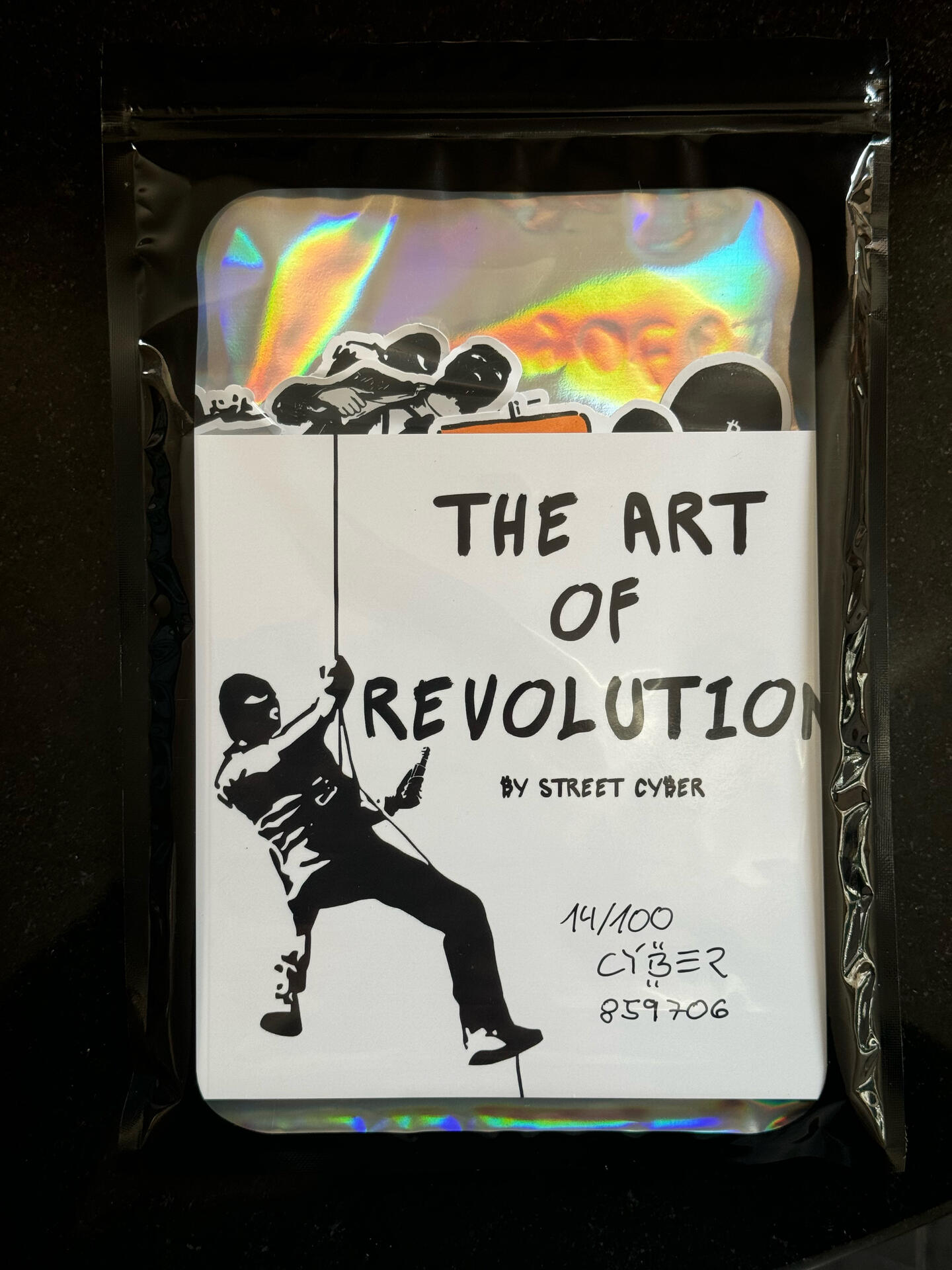
GM Great start to the week: the new Bitcoin art book from nostr:npub1h5cmp8kys9dkzysv4wha3wuzruadalhtj82zyznscsx6fkw2efysje0yp0 image
2024-09-16 07:40:26 from 1 relay(s) View Thread →
BITCOIN IS THEFT RESISTANT We have already seen that few assets (such as gold and cash) are free from counterparty risk. These are typically tangible, portable and fungible, and always in the owner’s possession. However, because of these qualities, the only barriers between would-be thieves and such assets are physical. If thieves overcome physical barriers (such as locked doors), they can steal and use the asset. Bitcoin taken into self-custody is also a fungible and portable asset without counterparty risk. But because it is not tangible, it can be much harder to steal than cash or gold. For example, if thieves make off with your pin-code protected hardware ‘wallet’, they still cannot take your Bitcoin. Even if they hold you at gunpoint, you cannot give them bitcoins stored in a geographically distributed ‘multi-sig wallet’ where you only have access to one of the signatures. Bitcoin is theft resistant. https://www.bitcoms.xyz/bitcoin-is/bitcoin-is-theft-resistant
2024-09-12 16:09:55 from 1 relay(s) View Thread →
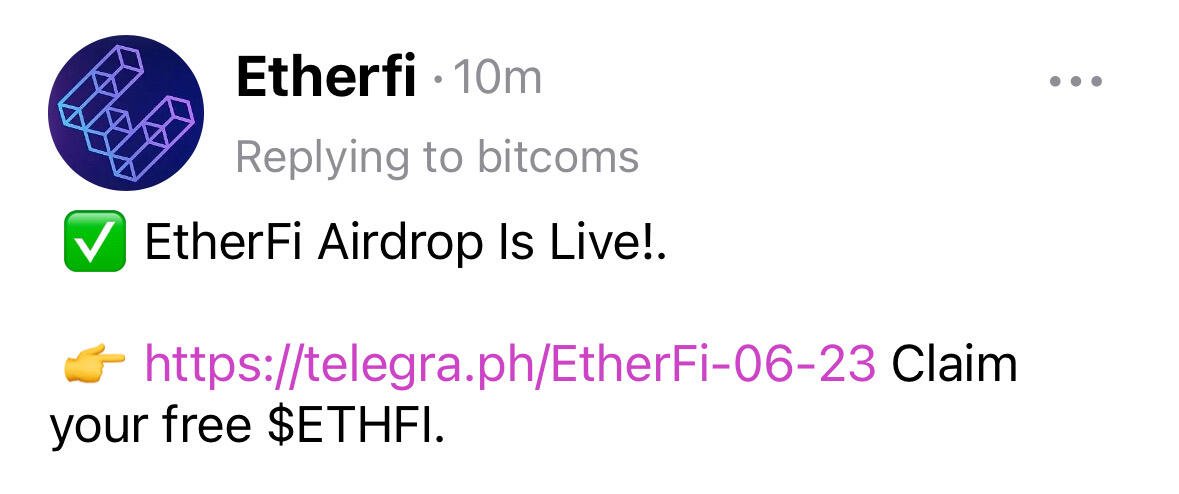
The shitcoin spammers have finally arrived. image
2024-09-11 09:55:51 from 1 relay(s) View Thread →
This is spot on. Even mainstream academics like Jonathan Haidt are now writing books on how harmful this is. nostr:note1f4hqsmgkt2xthkc4cvnex4rsvw5j9eqc8vmqqvg0j9nmdjuyawfq02nhx9
2024-09-11 09:43:05 from 1 relay(s) View Thread →
BITCOIN IS NOT TRULY YOURS UNTIL YOU MAKE IT YOURS Bitcoins only exist on the Bitcoin ledger. They never leave. All that changes is who has the cryptographic keys to control them. People typically acquire satoshis from third-party exchanges. However, this step alone does not eliminate counterparty risk, because any relevant Bitcoin keys are held by that third party – not you. A second step – you taking custody of your own satoshis using your own keys – is needed to make them truly yours. This may sound daunting, but is usually straightforward. To perform this second step, you need a ‘wallet’. ‘Wallet’ options include dedicated hardware (for offline ‘cold storage’), software (which sits on a mobile device or computer), ‘multi-sig’ (where more than one person/ device is needed to gain access to the bitcoins), and even hardware/ software combination solutions. None of these 'wallets' actually contain your bitcoins (remember they always stay on the Bitcoin ledger), but instead control the private keys which grant access to them. Which ‘wallet’ you choose will depend on your own circumstances, attitude, budget and knowledge level, as well as the value involved. But it should always be based on open-source software and have easy-to-implement and robust backup procedures, so you can still access your bitcoin(s) if your hardware/ software – or the company which made it – fails. Until you take this second step, ‘your’ bitcoin isn’t yours at all: it’s just a balance owed to you by your third-party provider, which you may well lose (if the provider becomes bankrupt, for example). Bitcoin is not truly yours until you make it yours. https://www.bitcoms.xyz/bitcoin-is/bitcoin-is-not-truly-yours-until-you-make-it-yours
2024-09-10 15:23:35 from 1 relay(s) View Thread →