A fennec fox is happy to see its owner.
Watch these big cats having a blast sliding down an icy slope! 🐯❄️🥹
A black heron using its wings like an umbrella, creating shade to attract fish, a behavior known as canopy feeding.
The incredible mimicry and concealed beauty of the Indian Leaf Butterfly (Kallima paralekta). With their wings closed, they perfectly resemble a dead leaf, providing effective camouflage from predators.
[📹 Melissa_yung]
Ruby and Bokasi, an okapi and a duiker, two animals with much different sizes who became friends and the San Diego Zoo.
[📹 sandiegozoo]
These two mating lions chose the wrong spot to start their family, and the local rhinos wasted no time in making their objections known.
Rhinoceroses—especially males—are fiercely territorial and not particularly fond of sharing their space with other animals. When those animals are lions, the tension escalates. While adult rhinos aren’t typically threatened by lions, their calves certainly are, making lions unwelcome neighbors.
Regardless of what the lions were up to—in this case, mating—the rhinos made it clear they’d prefer the big cats take their business elsewhere.
[📹 rashid\_billow]
Harambe died 9 years ago

Check out this beaver having the cutest morning bath! 🛁🥹
The peculiar feeding behavior of Sanderlings involves chasing waves to consume invertebrate prey, which are drawn to the upper layers of sand by the plankton and detritus carried in with each wave.
This is what an overweight Sphynx cat looks like
The Matsuba koi is admired for its distinctive scales that resemble pinecone patterns — fitting, as ‘Matsuba’ means ‘pine needle’ in Japanese.
Its unique eyelines can sometimes create the illusion of a human-like face when viewed from certain angles.
Sometimes, what starts as an innocent attempt to photograph some adorable wood ducklings can take a sudden, grim turn. These little ones, already vulnerable without their mother, stood little chance on their own.
From the perspective of the hawk—who will soon enter the frame—this is an opportunity too good to pass up. With no mother duck to defend them, the raptor is free to make her choice from the unguarded brood. As the slow-motion footage shows, she initially attempts to grab two at once, but ultimately settles for just one.
It’s important to remember: the hawk, too, has young to feed. As difficult as it may be to witness life end so abruptly, this is not a flaw in nature’s design, but an essential part of it. Nature runs on cycles of survival, predation, and loss—a reality that, while harsh, is fundamental to the ecosystem’s balance.
[📹 sean_isnt_rich]
Feeding baby penguins
[🎞️ AI]
Hurry up, dinner’s almost ready! 😋
The aerodynamics of a cow.
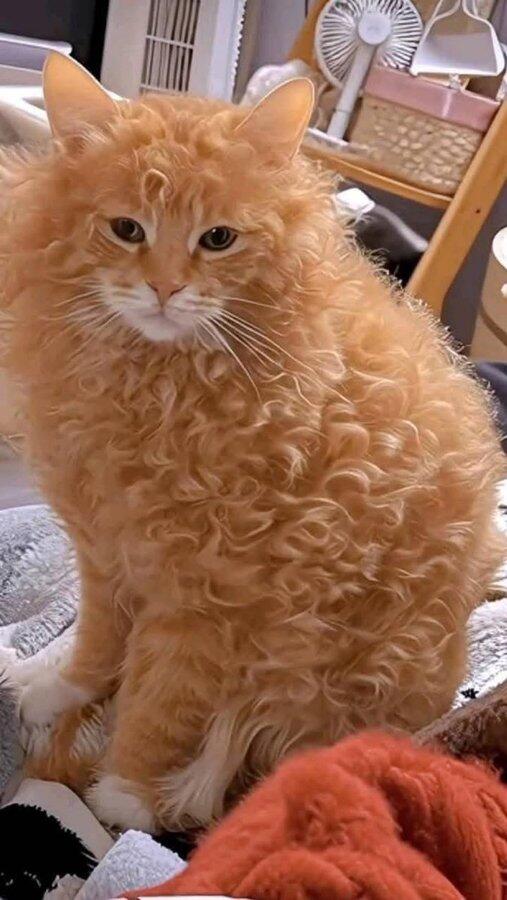
If you had him, what would you call him?
Male Sympetrum fonscolombii
[📹 malbafont_macrophotography]
A deceased whale—likely a humpback—releases gas for the final time, violently expelling its rotting internal organs into the sea.
These dramatic explosions are unique to whales, as most decomposing animals can't contain the buildup of internal gases after death. In whales, methane accumulates as their organs break down, trapped by thick muscle and layers of blubber.
The process is intensified because a whale’s exterior often decomposes more slowly than its interior, especially in cold ocean waters—creating the perfect conditions for an eventual rupture. Once the internal pressure reaches a critical point, the gas finds the weakest spot to escape, leading to a spectacular detonation.
The only way to prevent such an explosion is to perforate the whale’s thick skin in advance—no easy task in the open ocean.
[📹 ozzymansvideolicensing]
The incredible geometry of a pufferfish skeleton.
This unique structure enables them to rapidly fill with water when threatened, inflating their bodies while raising sharp spines to ward off predators.

Absolutely adorable! 🫏😍❤️
