Previous quote reminds me of this quote:

That’s a lot of signal…
This pope? And the men he chooses to run the church? It just gets crazier and crazier. Harder to defend the church in the worlds eyes. God have mercy. These are strange and hard times.
This is good priest with a good podcast. He’s not afraid to speak the truth.
https://pca.st/episode/938b2f9f-99ea-4d1f-af02-256b13234a7d

Monday 8 January 2024
The Baptism of the Lord - Feast
Spiritual Reading
Your Second Reading from the Office of Readings:
The Baptism of the Lord
The Baptism of Christ, by Piero della Francesca, c.1450-60.
From a sermon by Saint Gregory Nazianzen
The baptism of Christ
Christ is bathed in light; let us also be bathed in light. Christ is baptized; let us also go down with him, and rise with him.
John is baptizing when Jesus draws near. Perhaps he comes to sanctify his baptizer; certainly he comes to bury sinful humanity in the waters. He comes to sanctify the Jordan for our sake and in readiness for us; he who is spirit and flesh comes to begin a new creation through the Spirit and water.
The Baptist protests; Jesus insists. Then John says: I ought to be baptized by you. He is the lamp in the presence of the sun, the voice in the presence of the Word, the friend in the presence of the Bridegroom, the greatest of all born of woman in the presence of the firstborn of all creation, the one who leapt in his mother’s womb in the presence of him who was adored in the womb, the forerunner and future forerunner in the presence of him who has already come and is to come again. I ought to be baptized by you: we should also add, “and for you,” for John is to be baptized in blood, washed clean like Peter, not only by the washing of his feet.
Jesus rises from the waters; the world rises with him. The heavens, like Paradise with its flaming sword, closed by Adam for himself and his descendants, are rent open. The Spirit comes to him as to an equal, bearing witness to his Godhead. A voice bears witness to him from heaven, his place of origin. The Spirit descends in bodily form like the dove that so long ago announced the ending of the flood and so gives honour to the body that is one with God.
Today let us do honour to Christ’s baptism and celebrate this feast in holiness. Be cleansed entirely and continue to be cleansed. Nothing gives such pleasure to God as the conversion and salvation of men, for whom his every word and every revelation exist. He wants you to become a living force for all mankind, lights shining in the world. You are to be radiant lights as you stand beside Christ, the great light, bathed in the glory of him who is the light of heaven. You are to enjoy more and more the pure and dazzling light of the Trinity, as now you have received – though not in its fullness – a ray of its splendour, proceeding from the one God, in Christ Jesus our Lord, to whom be glory and power for ever and ever. Amen.
________
In other parts of the world and other calendars:
Saint Peter Thomas, Bishop
From 'The Life of St Peter Thomas' by his secretary Philip of Mézières
The patriarch's last days on earth
As the feast of Christmas drew near, my father presided in person at the divine services. In the middle of the night which ushered in the feast he made his way from the Carmelite monastery where he was staying to the cathedral of Famagosta for the solemn celebration of Matins. He celebrated with full solemnity the three Masses of Christmas, but was affected by the cold and caught an infection in the throat, for he was weakened by fasting and vigils and wore only light clothing, following the example of the holy fathers of the desert.
During the following days he offered Mass daily but was evidently trying to conceal his illness. On the Tuesday the fever became critical. He made a general and particular confession, and spoke affectionately with his household. Then turning to the cross he adored and kissed it, and with joined hands fervently asked forgiveness of all his confreres, a gesture which moved them to tears. “My brothers and friends,” he said, “what toils and dangers you have met with in my service – hunger and thirst, cold and unexpected trials. I have never given you the recognition or the recompense you deserve, and yet you were kind enough to bear with me and my shortcomings. How often for me you faced real risk of your lives! How can I repay you? Forgive me; I beg you to forgive me.”
Then he asked that the sacred Body of the Lord be brought to him, and he received communion with reverence and unfeigned faith. At the end of that day, at the sixth hour of the night, he asked that the bishop of Laodicea, who was vicar of the diocese of Famagosta, should come in his pontifical vestments accompanied by the clergy of the cathedral to anoint him with the oil of the sick. Meanwhile he summoned his own household and put on the symbols of his episcopal office. Despite his weakness he sought out the office of anointing with his own hand and, having found the right place, followed attentively the preliminary prayers. After this he lay down on some sackcloth spread on the ground and waited calmly for the arrival of the bishop.
When they heard the bishop coming with all his clergy he began to recite the penitential psalms in a loud clear voice suggestive of a man in full health: “Lord, rebuke me not in your anger.” With those around him making the responses he continued till about half way through the seven psalms. At last, however, his strength gave out, though his mind remained clear, and he signalled to his vicar-bishop to join in and support him, and thus the whole seven psalms were completed. As the vicar anointed him with the holy oil he managed to make all the responses of the ritual, striving to keep from the eyes of others the threadbare tunic and scapular he always wore.
When the anointing was finished, my father devoutly recited the Confiteor and received absolution from the bishop. He humbly asked forgiveness of him, his household and all the assisting clergy if he had in any way offended them in the exercise of his office; and at the same time he requested them to ask on his behalf the same pardon of all the inhabitants of Cyprus and elsewhere. Finally, he gave up his soul to the God who made him. It was the sixth day of January in the year of our salvation thirteen hundred and sixty-six.
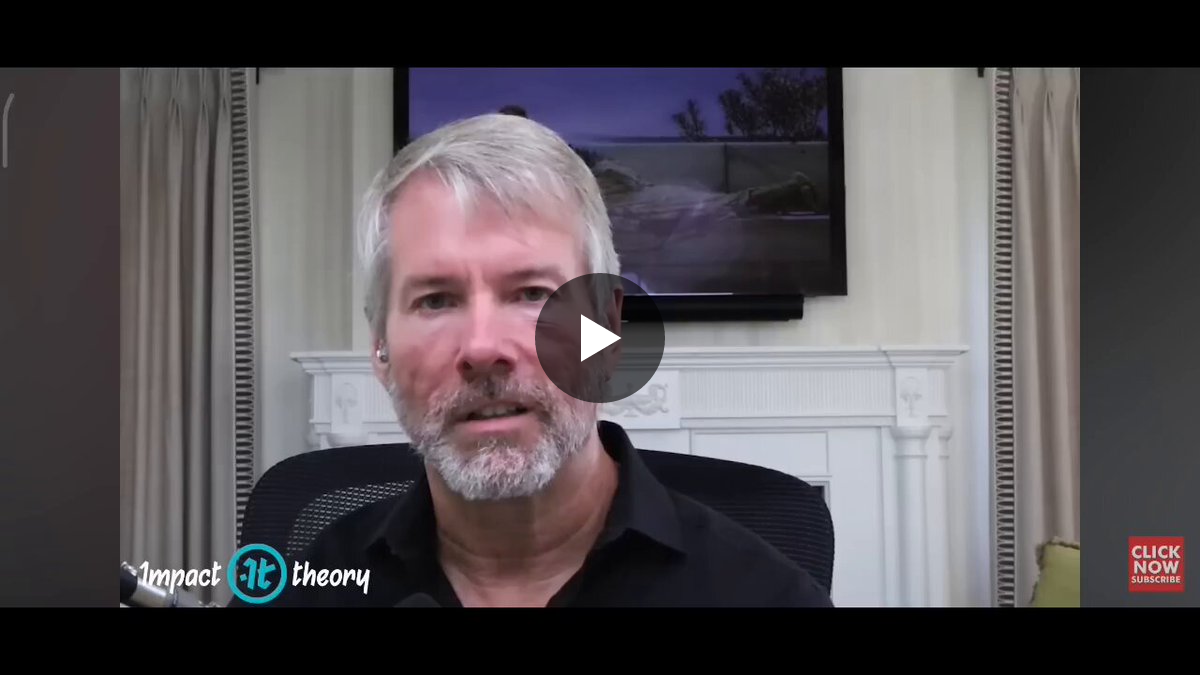
Saw this on Simply Bitcoin. Saylor Are we bullish enough?

Pocket Casts
BTC157: Personal AI Models and Bitcoin w/ Jeff Booth (Bitcoin Podcast)
IN THIS EPISODE, YOU’LL LEARN:Why is Jeff training an AI agent to personify himself?How could such an agent potentially be used in the future?Wha...
Fascinating.
I do see a disturbing trend though. I forget the time stamp, but Jeff (who is one of my favorite thinkers in this space, just brilliant) discusses the “Jeff AI bot” he is building to help make company decisions and same time. Like a “mini Jeff booth”. It attends meetings, takes notes, looks like Jeff.
Creepy enough. But probably common in near future.
Then they discuss how the models will make our mini me AIs more and more like us. After 20 years, they will almost be us. Then they discuss when we die, our families will have a “copy of us” to
ask questions to, talk with. Forever.
They discuss that, without mentioning that it is…crazy, creepy, unhumam, wrong?
Bizarre.
We are not our knowledge. We are not our ideas. We are not our image. We are body/souls (must have both to be human) made in the image of God. We are physical, corporeal. It’s why God took in a body to save us. We die, but we were not made to die. We will live forever with Him, and He has risen from the dead, and all will rise one day.
AI bots are NOT us. Not even close. Even if it looks, talks and thinks like you. Just 1s and 0s. That ain’t you. I fear the Christian truth of what it means to be human is getting lost in the conversations. And when Jeff mentions this I realized many people might be starting to get comfy with insane ideas.
We are going to be dealing with some crazy stuff very soon. Let’s not get lost in the false promises. Live forever on the chip? No, no, no.
Sunday 7 January 2024
The Epiphany of the Lord - Solemnity
About Today
Year: B(II). Liturgical Colour: White.
The Epiphany of the Lord
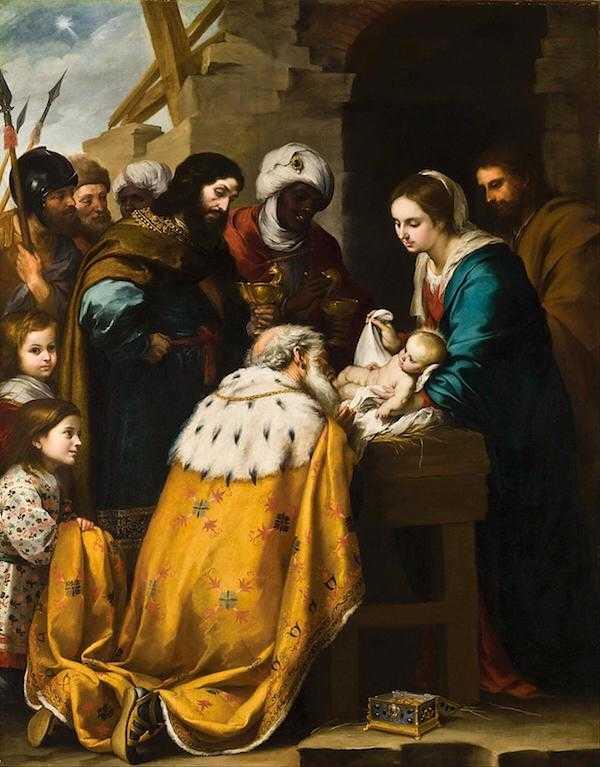
— The Adoration of the Magi, by Bartolomé Esteban Murillo, c.1657.
In other years: St Raymond of Peñafort (c.1175 - 1275)
— Fresco by Tommaso da Modena (1352) in the church of San Niccolò, Treviso.
He was born near Barcelona somewhere between 1175 and 1180. He was educated at the University of Barcelona, where he taught canon law for fifteen years. After a spell at the University of Bologna he returned to Barcelona in 1222 and became a Dominican. At the command of Pope Gregory IX he organised, codified and edited canon law, which, when he started, was nothing better than a chaotic accumulation of isolated decrees. He was elected to be General of the Dominicans and gave the order an excellent set of regulations for its better governance. He died in 1275. Among his works, the Summa casuum is noteworthy. This gives guidance as to how the sacrament of Penance may be administered justly and with benefit to the penitent.
Other saints: Saint Cnut the Duke, Martyr
Denmark
________
Collect
O God, who on this day
revealed your Only Begotten Son to the nations
by the guidance of a star,
grant in your mercy, that we, who know you already by faith,
may be brought to behold the beauty of your sublime glory.
Through our Lord Jesus Christ, your Son,
who lives and reigns with you in the unity of the Holy Spirit,
God, for ever and ever.
Amen.
________
About the author of the Second Reading in today's Office of Readings:
Second Reading: Pope St Leo the Great (- 461)
Leo was born in Etruria and became Pope in 440. He was a true shepherd and father of souls. He constantly strove to keep the faith whole and strenuously defended the unity of the Church. He repelled the invasions of the barbarians or alleviated their effects, famously persuading Attila the Hun not to march on Rome in 452, and preventing the invading Vandals from massacring the population in 455.
Leo left many doctrinal and spiritual writings behind and a number of them are included in the Office of Readings to this day. He died in 461.
________
Liturgical colour: white
White is the colour of heaven. Liturgically, it is used to celebrate feasts of the Lord; Christmas and Easter, the great seasons of the Lord; and the saints. Not that you will always see white in church, because if something more splendid, such as gold, is available, that can and should be used instead. We are, after all, celebrating.
In the earliest centuries all vestments were white – the white of baptismal purity and of the robes worn by the armies of the redeemed in the Apocalypse, washed white in the blood of the Lamb. As the Church grew secure enough to be able to plan her liturgy, she began to use colour so that our sense of sight could deepen our experience of the mysteries of salvation, just as incense recruits our sense of smell and music that of hearing. Over the centuries various schemes of colour for feasts and seasons were worked out, and it is only as late as the 19th century that they were harmonized into their present form.
Father Mike is brilliant in this homily. Worship is everything. We were Mede to worship God. And, Catholics believe, the worship he asks for is the Mass. Are we giving God what he desires of us when we worship. Blessings this Sunday.

Pocket Casts
01/07/24 Worship is the Only Proper Response
Homily from the Epiphany of the Lord. We give God our best, our heart, and what He has asked for. As we know, the heart of religion is worship. Bu...
Happy and Blessed New Year friends!
Happy Solemnity of Mary the Mother of God. May she intercede for us and for all this new year.
Monday 1 January 2024
Mary, the Holy Mother of God - Solemnity
Spiritual Reading
Your Second Reading from the Office of Readings:
Mary, the Holy Mother of God
From a letter of St Athanasius
The Word took our nature from Mary
The Word took to himself the sons of Abraham, says the Apostle, and so had to be like his brothers in all things. He had then to take a body like ours. This explains the fact of Mary’s presence: she is to provide him with a body of his own, to be offered for our sake. Scripture records her giving birth, and says: She wrapped him in swaddling clothes. Her breasts, which fed him, were called blessed. Sacrifice was offered because the child was her firstborn. Gabriel used careful and prudent language when he announced his birth. He did not speak of “what will be born in you” to avoid the impression that a body would be introduced into her womb from outside; he spoke of “what will be born from you,” so that we might know by faith that her child originated within her and from her.
By taking our nature and offering it in sacrifice, the Word was to destroy it completely and then invest it with his own nature, and so prompt the Apostle to say: This corruptible body must put on incorruption; this mortal body must put on immortality.
This was not done in outward show only, as some have imagined. This is not so. Our Saviour truly became man, and from this has followed the salvation of man as a whole. Our salvation is in no way fictitious, nor does it apply only to the body. The salvation of the whole man, that is, of soul and body, has really been achieved in the Word himself.
What was born of Mary was therefore human by nature, in accordance with the inspired Scriptures, and the body of the Lord was a true body: It was a true body because it was the same as ours. Mary, you see, is our sister, for we are all born from Adam.
The words of St John, the Word was made flesh, bear the same meaning, as we may see from a similar turn of phrase in St Paul: Christ was made a curse for our sake. Man’s body has acquired something great through its communion and union with the Word. From being mortal it has been made immortal; though it was a living body it has become a spiritual one; though it was made from the earth it has passed through the gates of heaven.
Even when the Word takes a body from Mary, the Trinity remains a Trinity, with neither increase nor decrease. It is for ever perfect. In the Trinity we acknowledge one Godhead, and thus one God, the Father of the Word, is proclaimed in the Church.