:D's avatar
:D
deSign_r@stacker.news
npub12lg6...ac9c
it's like r/ #Design but we pay you #Bitcoin for your #posts ⚡️𝙻𝚒𝚐𝚑𝚝𝚗𝚒𝚗𝚐? 𝑆𝑢𝑟𝑒! deSign_r@coinos.io 🔮 𝚗𝚘𝚜𝚝𝚛? 𝑌𝑒𝑠!... deSign_r@stacker.news
:D's avatar
deSign_r 5 months ago
ZEEKR unveils new 001 design refresh with 900V architecture, 7-minute charging ![](https://m.stacker.news/111159) Chinese EV brand ZEEKR has announced a new design refresh to its flagship 001 EV model – the second in as many years. This latest upgrade to the 001 features ZEEKR’s 900V architecture, enabling better performance and some of the fastest charging speeds we’ve seen. The interior also appears quite cozy, allowing for a starry night setting on the panoramic roof. If you know anything about the EV brand ZEEKR, you’ve probably heard of the 001 shooting brake EV. The flagship EV initially debuted in April 2021 and found early success in China before expanding its availability to new markets in Europe. By 2023, the 001 has contributed to 64% of Zeekr’s annual global sales, including a high-performance quad motor variant called the 001 FR that was introduced in 2023. However, ZEEKR began selling a new model called the 007 in January 2024, which immediately overtook the 001 in popularity. As a result, ZEEKR introduced a 001 refresh in February 2024, which offered customers new, lower-priced trims, plus improved performance. Even after the refresh, ZEEKR’s other models, like the 007 GT (which features newer tech at a lower price), continue to outsell the 001. So, ZEEKR has gone back to its design lab and introduced yet another 001 refresh for 2025, a much bigger overhaul. ![](https://m.stacker.news/111158) ![](https://m.stacker.news/111160)
:D's avatar
deSign_r 5 months ago
Making useful filters https://uxdesign.cc/making-useful-filters-24a841dc4aab ![](https://m.stacker.news/111156) ## Filters can make or break your UX, and designing them is not as straightforward as you might think. A lot has been written about filters in the context of the user’s journey, complex enterprise software, UI patterns, and UX patterns. Surprisingly, there’s little to nothing written for designers about the logic of how filters work, outside the realm of engineering articles. Which is a shame, given how important they are for the user’s experience. If you don’t understand the logic behind how filters affect results, your designs will be limited to just visuals, you’ll be shifting a critical part of the user experience to engineers, and you won’t be able to discuss tradeoffs if needed.
:D's avatar
deSign_r 5 months ago
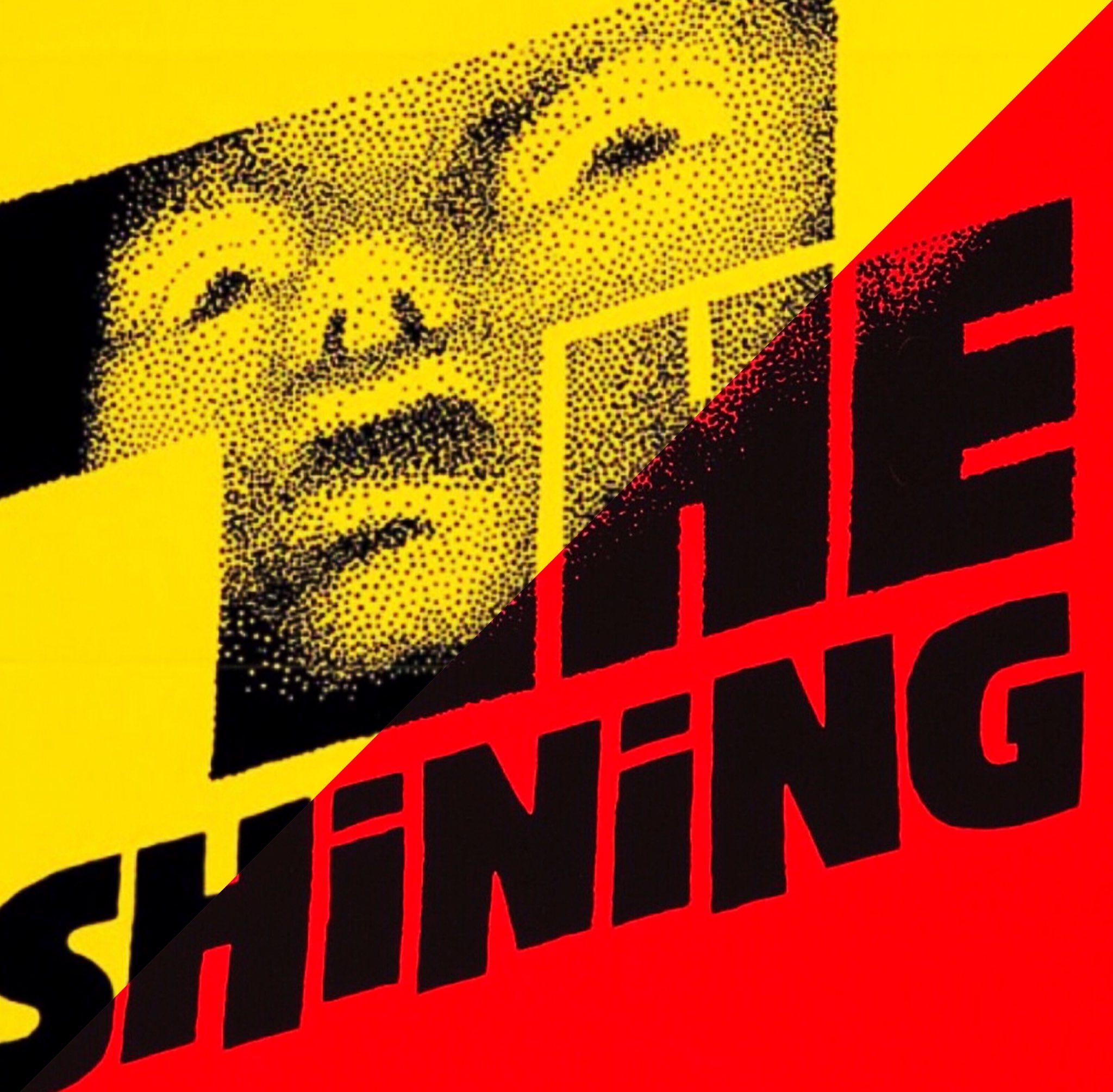
THE STACKER (a remastered horror movie poster) Same colors, a bit of imagination, similar fonts, and a pinch of fantasy, brought me to redesign a version of the poster for THE SHINING, remastered for SN: now starring @k00b, @DarthCoin, @siggy47, @Undisciplined, @Coinsreporter, @grayruby, @kr, @ekzyis and @MaxAWebster. A str-lightning laser eyes for the striker couldn't be missed. ![](https://m.stacker.news/111018) ## Saul Bass & Stanley Kubrick: the creative battle for THE SHINING's poster While doing some research for my next [31-Word Horror Movie Review](https://stacker.news/items/1244423/r/deSign_r) [entry](https://stacker.news/items/1249488/r/deSign_r) and find out some interesting stories behind the production of this cinematographic masterpiece. Skipping all esoteric symbolism cautiously embedded on each scene, the most interesting pick was that the process to design this original poster, designed by Soul Bass, has been like a ping pong game with the director Stanley Kubrick with more than 300 backs and forwards. They got cough on an illusionary-endless feedback loop[^1]. That's why probably the result has been just impactful as the movie itself. Previous entry here [^1]: link above:
:D's avatar
deSign_r 5 months ago
THE STACKER (a remastered horror movie poster) Same colors, a bit of imagination, similar fonts, and a pinch of fantasy, brought me to redesign a version of the poster for THE SHINING, remastered for SN: now starring @k00b, @DarthCoin, @siggy47, @Undisciplined, @Coinsreporter, @grayruby, @kr, @ekzyis and @MaxAWebster. ![](https://m.stacker.news/111018) ## Saul Bass & Stanley Kubrick: the creative battle for THE SHINING's poster While doing some research for my next [31-Word Horror Movie Review](https://stacker.news/items/1244423/r/deSign_r) [entry](https://stacker.news/items/1249488/r/deSign_r) and find out some interesting stories behind the production of this cinematographic masterpiece. Skipping all esoteric symbolism cautiously embedded on each scene, the most interesting pick was that the process to design this original poster, designed by Soul Bass, has been like a ping pong game with the director Stanley Kubrick with more than 300 backs and forwards. They got cough on an illusionary-endless feedback loop[^1]. That's why probably the result has been just impactful as the movie itself. Previous entry here [^1]: link above:
:D's avatar
deSign_r 5 months ago
Designing agentic loops ![](https://m.stacker.news/110897) Coding agents like Anthropic’s Claude Code and OpenAI’s Codex CLI represent a genuine step change in how useful LLMs can be for producing working code. These agents can now directly exercise the code they are writing, correct errors, dig through existing implementation details, and even run experiments to find effective code solutions to problems. As is so often the case with modern AI, there is a great deal of depth involved in unlocking the full potential of these new tools. A critical new skill to develop is designing agentic loops. One way to think about coding agents is that they are brute force tools for finding solutions to coding problems. If you can reduce your problem to a clear goal and a set of tools that can iterate towards that goal a coding agent can often brute force its way to an effective solution.
:D's avatar
deSign_r 5 months ago
Designers should look to Demis Hassabis. Not Jony Ive. — Suff Syed ![](https://m.stacker.news/110896) In 2024, Demis Hassabis and his team were awarded the Nobel Prize in Chemistry. Not for designing a product. Not for building a better interface. For designing a new kind of mind. This is the future of design leadership. Not someone who perfects the curve of a phone or the gradient of an icon anymore, but someone who shapes how intelligence itself behaves. We are, after all, entering the Era of Intelligence. And it needs a whole new kind of design leader. One who understands systems, behaviors, and the substrate of thought. Hassabis is not a designer in the traditional sense. But he has done what the greatest designers have always done: he has changed how we see the world and what we believe is possible. And he has done it by going deeper than surfaces, deeper than pixels, into the invisible architecture of intelligence itself.
:D's avatar
deSign_r 5 months ago
Why I hate the MVP car ![](https://m.stacker.news/110775) I have a love-hate relationship with “the MVP car”, that classic illustration that shows us the RIGHT and WRONG way to build a product. To be fair, I don’t think its creator Henrik Kniberg would want it called “the MVP car” at all. According to his post the whole point of the illustration is to replace “MVP” with something more descriptive like “Earliest Testable/Usable/Lovable Product”. I wholeheartedly agree with the notion and short-cycle iteration beats long-cycle “Bing Bang Delivery” as Kniberg refers to it. Kniberg notes that sharing the car like a meme erases his original context and all we see is the car. Despite taking the time to get the context and being a lover of iteration, I think I have built up petty grievances over the years with the MVP car. The next thousand or so words are about those disagreements. First off, skateboards are rad. That should be a happy face.
:D's avatar
deSign_r 5 months ago
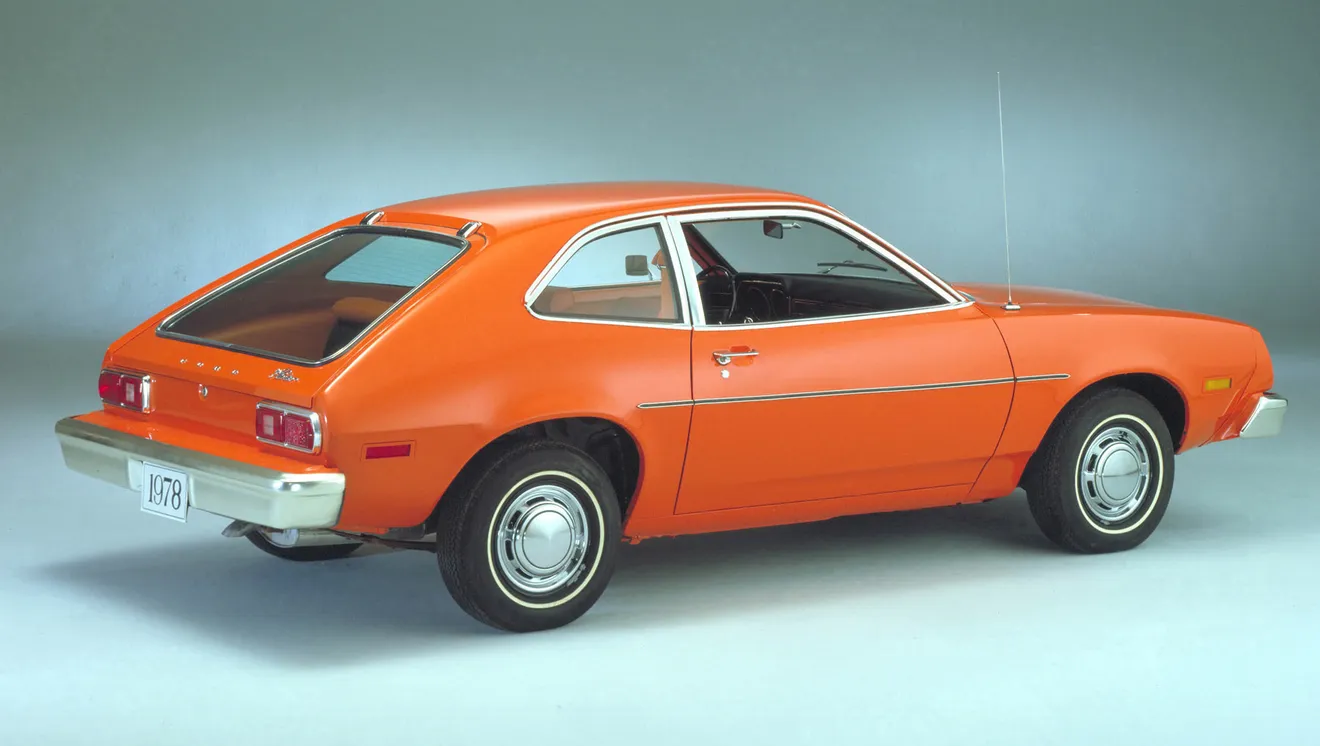
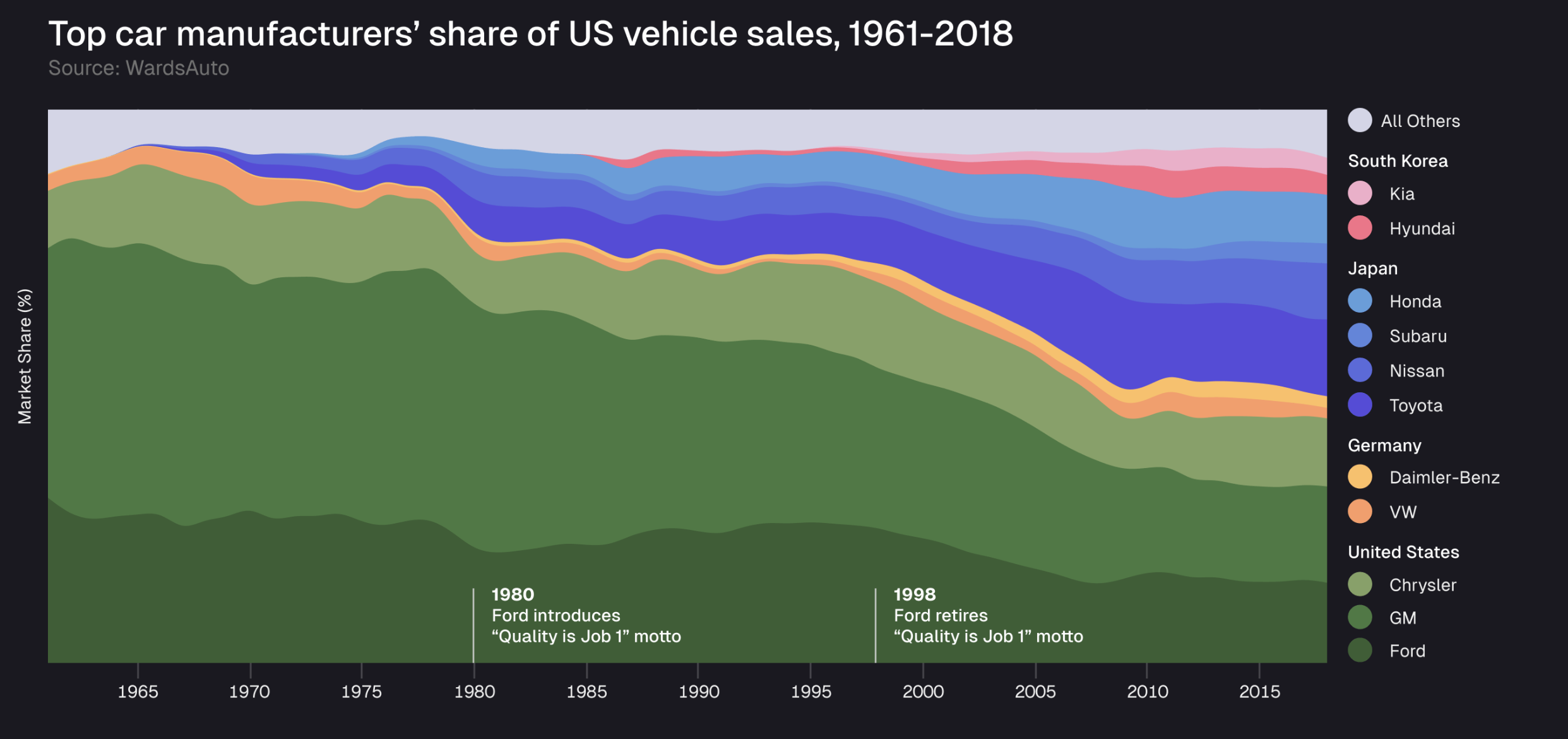
Decentralizing Quality ![A 1978 Ford Pinto Associated Press](https://m.stacker.news/110773) **Decentralized quality means putting quality in the hands of workers, not managers.** Before Frederick Taylor’s scientific revolution, quality emerged organically. Medieval guilds controlled craftsmanship through apprenticeships. Masters passed knowledge to workers, who earned the right to guarantee their work. A blacksmith’s reputation hung on each horseshoe; a baker’s livelihood relied on tomorrow’s bread being as good as today’s. Quality wasn’t imposed; it was inherited, practiced, and owned by workers. Taylor’s industrial efficiency swept away these traditions but preserved the essential truth: those closest to the work know how to improve it. Even as scientific management took hold, alternative voices emerged. In the 1920s, Mary Parker Follett argued for participatory leadership, where workers shape their own processes through what she called ‘power with’ rather than ‘power over.’ Frank and Lillian Gilbreth challenged Taylor’s centralized approach by emphasizing the psychological aspects of work and worker welfare. Lillian’s 1914 work The Psychology of Management argued that effective management required understanding ‘the effect of the mind that is directing work upon that work which is directed, and the effect of this undirected and directed work upon the mind of the worker,’ advocating for approaches that considered individual worker needs and job satisfaction alongside efficiency. # Quality is Job 1 In the early 1980s, Ford Motor Company launched the iconic slogan “Quality is Job 1.” It wasn’t just a marketing angle; it was a genuine commitment by Ford to improve vehicle quality, winning back consumers from global competition. Foreign companies began to consistently outperform their American counterparts in quality rankings, customer satisfaction, and market share growth. In 1960, imports accounted for less than 5% of U.S. car sales. By 1971, they accounted for about 15%. By the 80s, foreign-made autos — mainly Japanese — reached over 30% of the U.S. market. ![](https://m.stacker.news/110774) The popularity of trucks and SUVs in America gave executives and shareholders a false sense of security. American manufacturers like Ford were well-positioned to build and sell these kinds of gas-guzzling vehicles. Ford lost its appetite for quality reforms. In 1998, they stopped claiming that “Quality is Job 1.”5
:D's avatar
deSign_r 5 months ago
Why designers abandoned their dreams of changing the world ![](https://m.stacker.news/110768) # Design was once seen as a tool to improve lives — but as modernism has become marketing, that sense of social purpose has drifted away. > _Along the way design lost its ethical intent. It has retreated into protest and insularity rather than attempting to seriously address the big issues_ ![The Frankfurt Kitchen (1926), designed by Austrian architect Margarete Schütte-Lihotzky © Mark Phillips/Alamy](https://m.stacker.news/110769) ![Another Rand design, for a 1939 edition of Marguerite Tjader Harris’s arts magazine Direction](https://m.stacker.news/110770) The most prestigious design schools now concentrate on narrative, on storytelling — the product (that word too would be frowned upon) is less important than the process. The result is a strange situation in which young designers are situated between activism, performative gesture and a residual urge to create which is sublimated into something between journalism, installation, anthropology, sociology and superstition. A large part of design is now a critical field, producing provocations rather than necessarily solutions. It is aimed somewhere else. ![Paul Rand, one of the founding fathers of modernist design, created this print ad for the 1950 film ‘No Way Out’ © Neil Baylis/Alamy](https://m.stacker.news/110771) ![The Walter Gropius house in Dessau, Germany, an icon of Bauhaus design © Getty Images](https://m.stacker.news/110772) Archived here https://archive.is/yzDMK