deSign_r's avatar
deSign_r
deSign_r@stacker.news
npub12lg6...ac9c
it's like r/ #Design but we pay you #Bitcoin for your #posts ⚡️𝙻𝚒𝚐𝚑𝚝𝚗𝚒𝚗𝚐? 𝑆𝑢𝑟𝑒! deSign_r@coinos.io 🔮 𝚗𝚘𝚜𝚝𝚛? 𝑌𝑒𝑠!... deSign_r@iris.to
deSign_r's avatar
deSign_r 1 month ago
Palestinian sculptors create art on Gaza beach sand to escape Israel’s war ![Palestinian sculptors create art on Gaza beach sand to escape Israel’s war](https://m.stacker.news/119002) # The art is washed away every evening, but the artists are back every morning with enthusiasm. Everything around Gaza’s shoreline has been reduced to rubble by the Israeli military, but the coast still offers some fleeting solace from the horrors of ongoing death and destruction in the besieged Palestinian enclave. Local artists have been creating sand sculptures on the beach, gathering people on the shoreline that used to attract large crowds before the devastation of Israel’s genocidal war.
deSign_r's avatar
deSign_r 1 month ago
🎉 Ant Design 6.0 is Here! ![](https://m.stacker.news/119001) Since its open-sourcing, Ant Design has garnered 96.6K Stars, accumulated 31.9K issues, 20.7K PRs, released 904 npm versions, and has had 2314 contributors participate in its development. These numbers not only represent the community's activity and support but also witness the project's continuous evolution and maturation. It is because of you that Ant Design can continue to grow and move towards its next stop. After extensive RFC discussions and multiple Alpha version iterations, v6 has now entered a stable phase. Today, we are announcing the official release of Ant Design v6! This upgrade focuses on deep technical optimizations, aiming to provide better compatibility and performance for React 19 and future versions (with version compatibility raised to React 18), and to further improve the semantic structure of components and CSS variable support. Learn more at https://ant.design
deSign_r's avatar
deSign_r 1 month ago
The Art of the Journey: Capturing the Authentic Soul of Your Travels ![](https://m.stacker.news/118995) We’ve all done it. You arrive at a famous landmark…the Eiffel Tower, the Grand Canyon, Niagara Falls, the Colosseum—and you instinctively reach for your phone. You snap the picture that proves you were there. There is nothing wrong with that. We all want the memory. But I’ve learned that the "proof of life" photo is rarely the one that ends up on my wall. The photos that stick with us aren't the ones that show what a place looks like; they are the ones that show what a place feels like. For the best photos, see less like a tourist and start seeing more like an artist. ![](https://m.stacker.news/118996) ![](https://m.stacker.news/118997) ![](https://m.stacker.news/118998) ![](https://m.stacker.news/118999) ![](https://m.stacker.news/119000)
deSign_r's avatar
deSign_r 1 month ago
Android Dreams ![](https://m.stacker.news/118852) # “The danger is never that robots disobey, but that they obey perfectly.” At the convergence of frontier research breakthroughs, billions in capital, and rising geopolitical tensions lies a dream for a new physical world. After the LLM wave, robotics is seen as the next exponential growth domain. Chinese manufacturing is viewed as an existential threat to the US, adding to incentives. And, though robotics is the hardest domain of AI, multiple new AI strategies now offer clear paths to Embodied General Intelligence (EGI). Informed by conversations with frontier researchers, intuitions gained at Optimus and Dyna2.5, and my own syntheses, I predict inference-controlled robots will comprise half the world’s GDP by 2045. This scenario illustrates how.
deSign_r's avatar
deSign_r 1 month ago
What we lose when we lose the creative struggle ![](https://m.stacker.news/118850) # How removing friction from creative tools removes the meaning from creative work. > ...if creativity becomes automated we risk losing the very thing that makes art meaningful — the experience of creating something. Then what’s going to happen to all those “happy little accidents” and self expression, that come with the creative struggle? ![](https://m.stacker.news/118851)
deSign_r's avatar
deSign_r 1 month ago
Dembrandt: Extract any website’s full design system in few seconds ![](https://m.stacker.news/118849) A CLI tool for extracting design tokens and brand assets from any website. Extract any website’s full design system in few seconds - colors, typography, spacing, shadows, breakpoints. One command. No install. Powered by Playwright with advanced bot detection avoidance. No installation needed! Just use `npx`: ``` npx dembrandt stripe.com ``` Dembrandt analyzes live websites and extracts their complete design system: - Logo — Logo detection (img/svg) with dimensions and source URL - Colors — Semantic colors, color palette with confidence scoring, CSS variables - Typography — Font families, sizes, weights, line heights, font sources (Google Fonts, Adobe Fonts, custom) - Spacing — Margin and padding scales with grid system detection (4px/8px/custom) - Border Radius — Corner radius patterns with usage frequency - Shadows — Box shadow values for elevation systems - Buttons — Component styles with variants and states - Inputs — Form field styles (input, textarea, select) - Breakpoints — Responsive design breakpoints from media queries - Icons — Icon system detection (Font Awesome, Material Icons, SVG) - Frameworks — CSS framework detection (Tailwind, Bootstrap, Material-UI, Chakra) Perfect for competitive analysis, brand audits, or rebuilding a brand when you don't have design guidelines.
deSign_r's avatar
deSign_r 1 month ago
Dembrandt: Extract any website’s full design system in few seconds ![](https://m.stacker.news/118849) A CLI tool for extracting design tokens and brand assets from any website. Extract any website’s full design system in few seconds - colors, typography, spacing, shadows, breakpoints. One command. No install. Powered by Playwright with advanced bot detection avoidance. No installation needed! Just use npx: ``` npx dembrandt stripe.com ```
deSign_r's avatar
deSign_r 1 month ago
Quality Requires Visual Design ![](https://m.stacker.news/118752) Here's the secret to Harper's design system: it hasn't really existed until now. Each of the integrations, from the Chrome extension, to the website, and even the Obsidian plugin, had their own design system and appearance. Mostly, this was because I didn't care enough about it when first crafting these projects. Things have changed, so I'm going to take my time and do a good job in an attempt to service these user complaints.
deSign_r's avatar
deSign_r 1 month ago
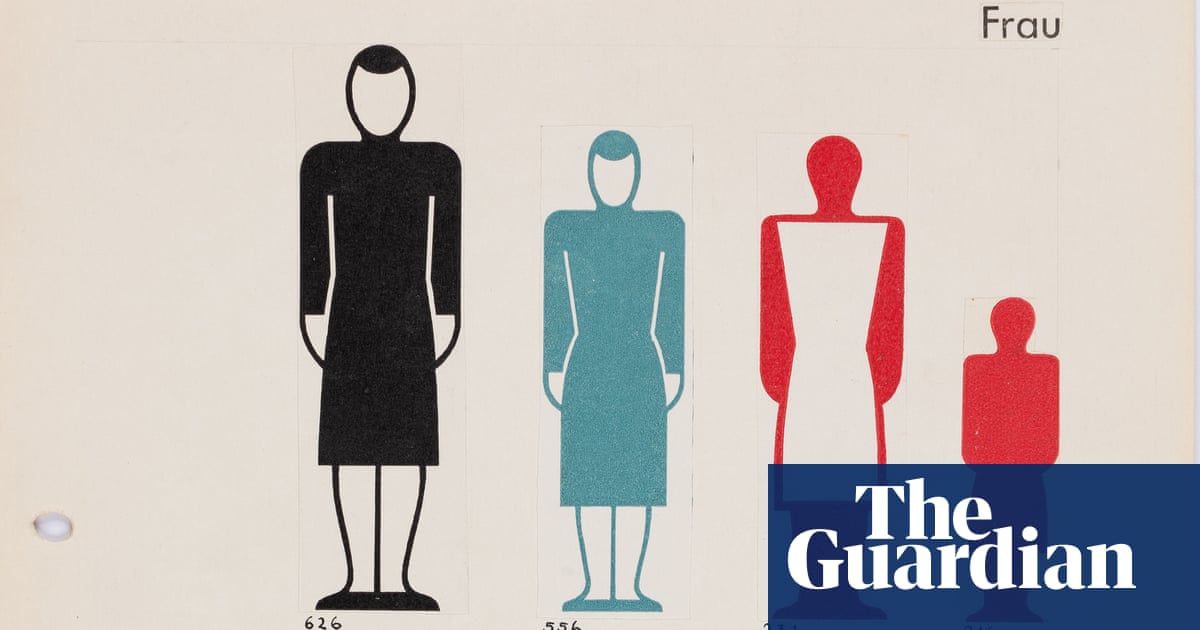
‘Pictures unite!’: how pop music fell in love with socialist infographics ![Pictograms of ‘woman’ from The Isotype Picture Dictionary. Photograph: Laura Bennetto/Otto and Marie Neurath Isotype Collection, University of Reading](https://m.stacker.news/118748) ![A graphic showing residential density in large cities, designed by Marie Reidemeister (later Neurath). Photograph: Otto and Marie Neurath Isotype Collection, University of Reading](https://m.stacker.news/118749) > When Austrian philosopher Otto Neurath invented the visual language of Isotypes, it was to democratise education. As a new exhibition shows, it ended up influencing pop art, graphic design and electronic musicians from Kraftwerk to OMD ![Vinyl artwork for Kraftwerk’s 1974 album Autobahn. Photograph: Alicia Canter/The Guardian](https://m.stacker.news/118751) ![The Factory Records logo, designed by Peter Saville](https://m.stacker.news/118747) When Otto Neurath died in Oxford some 80 years ago, far away from his native Vienna, he was still finding his feet in exile. Like many a Jewish refugee, the economist, philosopher and sociologist had been interned as a suspected enemy alien on the Isle of Man, along with his third wife and close collaborator Marie Reidemeister, having chanced a last-minute life-saving escape from their interim hideout in the Netherlands across the Channel in a rickety boat in 1940. Thanks to Neurath’s pioneering use of pictorial statistics – or “Isotypes” as Reidemeister called them, an acronym for “International System of Typographic Picture Education” – he left behind an enormous legacy in the arts and social sciences: it is the language through which we decode and analyse the modern world. But his lasting relevance would have been hard to predict at the time of his death at the age of 63. Neurath demanded his images ‘show the most important thing about the object at first glance’ At that point, his Vienna Method of Pictorial Statistics had had relatively little impact in the UK (beyond providing strikingly simplified imagery to the public information shorts of leftist film-maker Paul Rotha). Neurath’s “visual autobiography” had been shelved by his publishers, who probably failed to follow the ambitious arc of its title, “From Hieroglyphics to Isotype”.
deSign_r's avatar
deSign_r 1 month ago
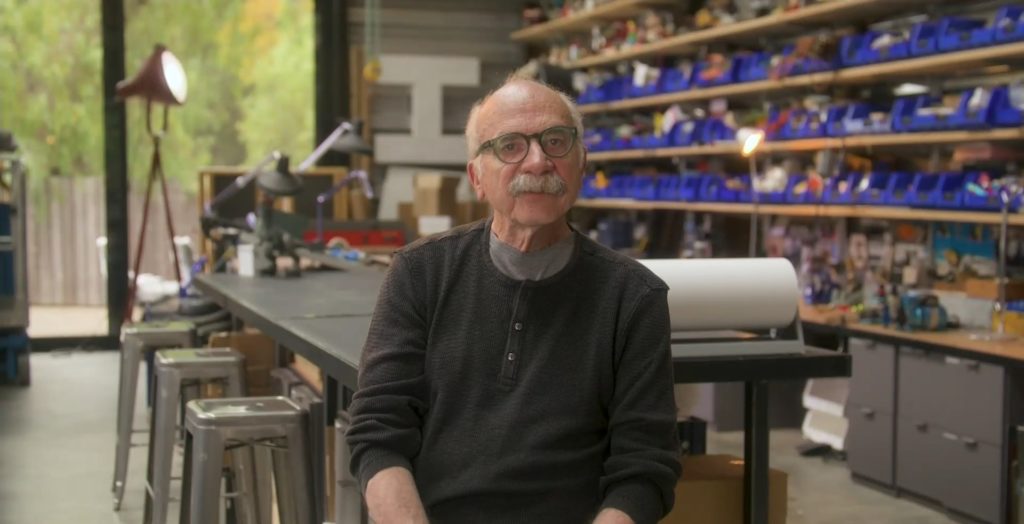
David Kelley's Brief But Spectacular take on creativity and design ![Brief but Spectacular](https://m.stacker.news/118746) > For decades, David Kelley has helped people unlock their creativity. A pioneer of design, he founded the Stanford d.school as a place for creative, cross-disciplinary problem solving. He reflects on the journey that shaped his belief that everyone has the capacity to be creative and his Brief But Spectacular take on creativity and design. _Amna Nawaz, PBS:_ For decades, David Kelley has helped people to unlock their creativity. A pioneer of design, he founded Stanford's d.school as a place for cross-disciplinary problem-solving. In tonight's Brief But Spectacular, he reflects on the journey that shaped his belief that everyone has the capacity to be creative. _David Kelley, Stanford University:_ I met Steve Jobs soon after I started IDEO in 1978. He didn't have an internal design group, and so he was using people from the outside. He liked what he saw and we ended up doing 53 projects for Apple after that. The most impactful project that I think we ever did for Apple was the computer mouse. It's one of those great things where to see something adopted that quickly was really gratifying as a designer. These are things I designed. So this is the chassis for the Apple III computer. This is the Palm V. It's a personal digital assistant before your time. My mom's spatula, I don't know why that's memorable. I grew up in Barberton, Ohio, the Rust Belt of the country. As a kid, I was always tinkering. You know my grandfather was a machinist, and if you needed a part for the washing machine, you made a new one. When I first arrived at Stanford, I really didn't have any knowledge of what design was. Design was in the engineering school, but it was very human-centered, so that was a better fit for me. I was much better at going out and trying to understand what was meaningful for people. Twenty years ago, I was diagnosed with throat cancer, and it really hit me hard, but I really had the epiphany that I wanted to do something that was meaningful in the world. And as I started teaching, I realized that my purpose in life was figuring out how to help people gain confidence in their creative ability. Many people assume they're not creative. Time and time again, they say, a teacher told me I wasn't creative or that's not a very good drawing of a horse or whatever it is. We don't have to teach creativity. Once we remove the blocks, they can then feel themselves as being a creative person. Witnessing somebody realizing they're creative for the first time is just a complete joy. You can just see them come out of the shop and beaming that I can weld. Like, what's next? I couldn't get that anywhere else, I think, other than being an educator. The way the d.school idea came to me basically was, I was in a bunch of meetings in those days about multidisciplinary. Early prototypes for the d.school were just some of us getting together from different departments and teaching a class together. The way of thinking and working together in a radically collaborative way results in really life-changing, world-changing kind of ideas. The d.school is really focused on helping people gain a new mind-set, designing in a way that's human-centered. What's different about design today, I think, is, we used to be at the kids table and now I think we're at the adult table, that we're getting to work on the most interesting problems. Design is just one of the disciplines, along with business and technology, we can actually contribute to making solutions that are meaningful and fit with people. My name is David Kelley, and this is my Brief But Spectacular take on creativity and design.
deSign_r's avatar
deSign_r 1 month ago
₿uilder Vancouver ![](https://m.stacker.news/118621) ₿uilder is a monthly meetup focused on discussing product, design, and AI tools for individuals building on bitcoin. Everyone is welcome, whether you're an experienced product manager or designer, just starting out, or simply curious to learn. ₿uilder Vancouver runs a mix of events to bring the local Bitcoin and open-source community together. Expect Socratic Seminars — discussion-led deep dives into ideas — Vibe coding Hackathons for hands-on collaborative building, plus regular networking nights, workshops, and lightning talks. Events are inclusive and geared toward all skill levels: whether you’re prototyping a project, sharpening your skills, or simply looking to meet other builders, there’s a place for you. Check individual event pages for dates, locations, and RSVP details.
deSign_r's avatar
deSign_r 1 month ago
What Good Execution Looks Like ![BAD EXECUTION → Loud, Dramatic, and Heroic](https://m.stacker.news/118619) The other day I was talking with one of my directs. We ended up discussing something we’ve both learned over the years. When execution works, the environment is quiet. Not slow. Not passive. Quiet. Execution happens. People work together. Nothing feels heavy. You sort of question if there’s management in all this or their very existence. That’s a good thing. Maybe, one of the best signals of good management. On the flip side, you can immediately tell when the management isn’t good. Projects stall or never finish. You will see extra approvals appear. Processes get thicker. People start checking in more than they need to. Updates become defensive. The number of meetings increases. All of this is a reaction to a simple problem. The management can’t execute the work. Hence, people try to do it themselves. ![GOOD EXECUTION → Quiet and Invisible](https://m.stacker.news/118620) Great execution always looks easier from the outside than it actually is. That’s because the real work sits inside the system. The clarity, the direction, the ownership, the rhythm. They compound. People move without friction. Decisions are easy. Problems surface early and get resolved early. Nothing feels heavy. Poor execution does the opposite. It makes everything loud. Chaos becomes visible. Management becomes reactive and highly visible. Processes thicken. People compensate for gaps the system should handle. The organization ends up spending more energy managing itself than delivering anything meaningful. It feels like everything is bloated. Sustainable engineering cultures don’t depend on pressure, urgency, or oversight. They’re built on clarity, trust, and stability. They make it easy for people to do the right thing without fighting the environment around them. When that foundation exists, execution doesn’t need to be forced. It just happens. The best-executing teams don’t need shepherding. They need guardrails, direction, and space. Give them that, and the quiet will tell you everything you need to know.
deSign_r's avatar
deSign_r 1 month ago
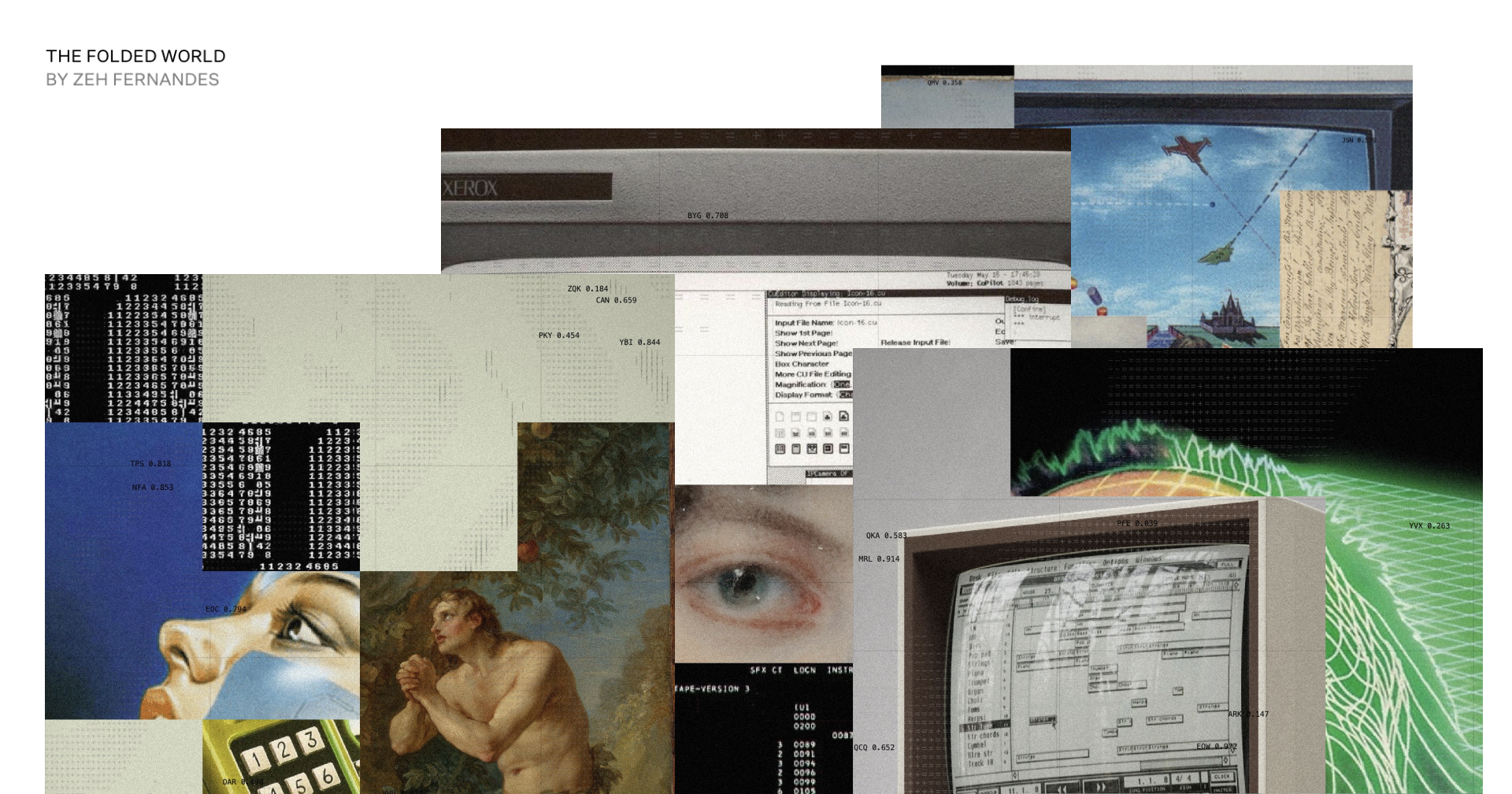
The Folded World ![](https://m.stacker.news/118609) ![](https://m.stacker.news/118610) ![](https://m.stacker.news/118611) ![](https://m.stacker.news/118612) That is the heartbeat of contemporary AI. Data folded into a dense internal landscape where words cluster into something that behaves like understanding. The models are creating meaning, yet their pathways remain opaque. When they hallucinate, they are not simply wrong; they expose the edges of an internal world whose logic we cannot fully trace. The artworks explore that fault line. Classical paintings, early computer interfaces, neon vector grids, and digital remnants sit side by side, compressed into a single surface much like features in a neural layer. The small coded labels scattered across the images resemble confidence scores, quiet indicators of the hidden mathematics. Each collage becomes a graphic expression of the model’s internal turbulence. Layer sits above layer, and underneath we glimpse not a complete scene but fragments of training data and partial connections, the visual equivalent of a model synthesizing meaning from incompatible sources. Are we witnessing the big bang of meaning for machines? [Go to the generator](https://zehfernandes.com/projects/folded-world/tool) ![](https://m.stacker.news/118613) ![](https://m.stacker.news/118614) ![](https://m.stacker.news/118615) ![](https://m.stacker.news/118616) ![](https://m.stacker.news/118617) ![](https://m.stacker.news/118618)
deSign_r's avatar
deSign_r 1 month ago
Best Free Fonts ![](https://m.stacker.news/118482) # Truly free fonts for your designs Best Free Fonts is a curated selection of 214 free fonts. Including serif, sans serif, script and monospace. The site links to original designer's source files and website and make this project authentic and clean catalog.
deSign_r's avatar
deSign_r 1 month ago
State Of Product Design in 2025 https://sopd.design ![](https://m.stacker.news/118479) The tech industry is under pressure: mass layoffs, the rise of AI, and economic uncertainty are reshaping how we work. But what does this mean for designers? We surveyed 340 product designers and spoke with 10 more in interviews to uncover their challenges and expectations. This research shows that product design is not just a craft or a career—it’s a complex system. Personal motivation often runs into structural barriers, and professional awareness alone isn’t enough for growth. One clear takeaway: the problems designers face are systemic. They appear across regions, company sizes, and team structures—and they can’t be solved overnight or by individual effort alone. Real change takes work on multiple levels: designers improving how they navigate their environment; leaders investing in healthier team dynamics; and the broader community creating space for open, honest conversations. We may not solve everything at once, but we can keep moving—toward a more sustainable, more mature profession.
deSign_r's avatar
deSign_r 1 month ago
Logo API - Instant Company Logos for Developers https://www.logo.dev ![Every company logo, one simple API. Access hundreds of millions of logos for your website or application. Updated daily, provided via our global CDN.](https://m.stacker.news/118474) > Logo.dev is the comprehensive logo API that lets you enrich any domain with its logo, eliminate manual logo management, and boost user trust with professional branding. ![](https://m.stacker.news/118475)
deSign_r's avatar
deSign_r 1 month ago
Let designers think https://uxdesign.cc/let-designers-think-82721f458b73 ![A process for thinking Inputs (Your brain (senses Hearing, smell, taste, sight, touch) + Rene Descartes Theory of Vision + Smart Phone AI + Illustory Truth Graph) and Outputs (Habits)](https://m.stacker.news/118343) A while back, I captured this provocation on LinkedIn by Darren Hood, which got me thinking. What does it take to “Let Designers think”? Thinking is the value we bring. Let's discuss more ways to carve out “thinking” time. The comment was then punctuated by Pavel Samsonov, who touched on the difference between corporate decision-making via “design thinking” and “thinking like a designer.” Unfortunately, there remains a gap between “design thinking” as designers practice it and how companies implement “design thinking.” But regardless, there is still an impulse among design practitioners to “think”. Let’s quickly review how we got here. **Design Thinking refresher** Design Thinking is the process (popularized by IDEO and the Stanford D-school) for how designers move through a problem-solving process. Empathy > Define > Ideate > Prototype > Test is the shorthand for the types of things “designers think” about as they produce solutions. ![](https://m.stacker.news/118344) ...
deSign_r's avatar
deSign_r 1 month ago
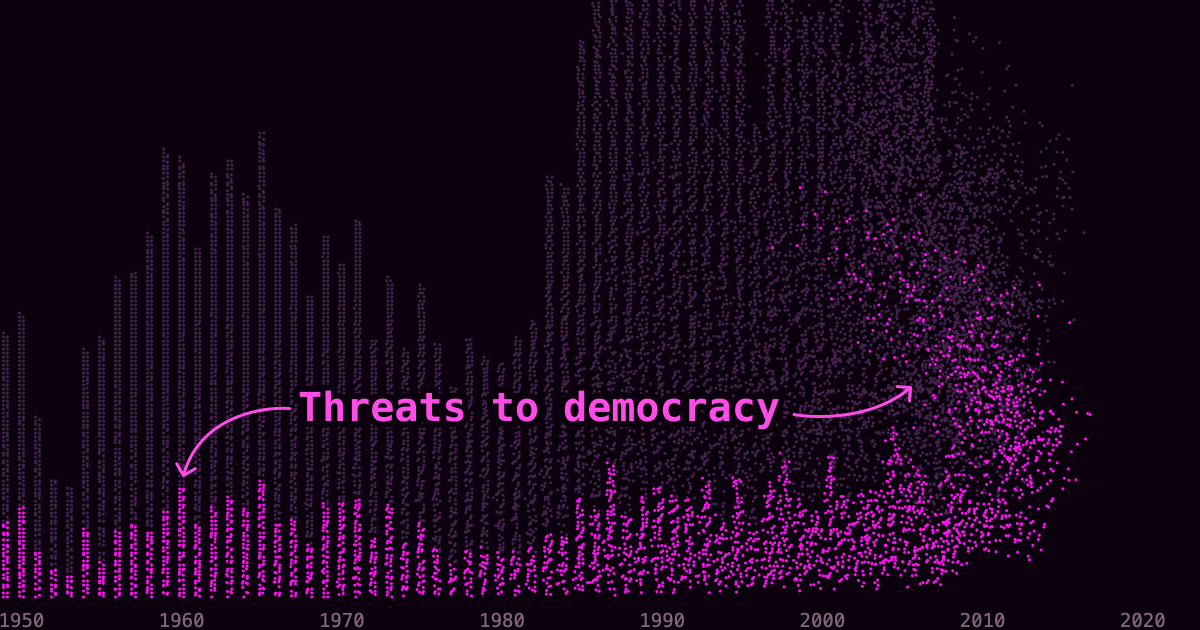
In pursuit of democracy ![](https://m.stacker.news/118339) This story looks at every time the word ‘democracy’ was said or written into the Congressional Record since 1880. - **Each dot** represents five speeches or remarks. - **Bright dots** are ones that argue American democracy is under threat. ![… no man who professed to be a democrat when he was elected and who procured his election by professing to be a democrat, in the name of democracy and republicanism as well, in the name of American nature, I charge that no such man will prove false to his trust. And therefore why wait?](https://m.stacker.news/118340) Early on, the word “democracy” was typically used to describe the Democratic party. This would shift in the early-1900s to describe the concept of democracy. While researching this story, I read a paragraph in Heather Cox Richardson’s book that I can’t stop thinking about. > The concept that humans have the right to determine their own fate remains as true today as it was when the Founders put that statement into the Declaration of Independence, a statement so radical that even they did not understand its full implications. … With today’s increasingly connected global world, that concept is even more important now than it was when our Founders declared that no one had an inherent right to rule over anyone else, that we are all created equal, and that we have a right to consent to our government. I grew up in an immigrant family, and I was constantly reminded of how powerful these values are. Sure, my family had some allegiance to their home country. Sure, we were constantly reminded of ways in which the country failed to live up to these ideals. However, I was told that we live in a country that is united not by the color of our skin or the origins of our families, but rather a belief in how humans should live together. Americans have always argued about what it means to strive toward these democratic ideals. This pursuit of democracy is who we are; it’s who we want to be. If we stop now, who are we as a people? ← → ![](https://m.stacker.news/118341) ![](https://m.stacker.news/118342)
deSign_r's avatar
deSign_r 1 month ago
Why do we need dithering? ![](https://m.stacker.news/118337) Before we all mute the word 'dithering' I thought I'd explain a little bit about why we needed to dither digital images in the first place. Although it's an aesthetic now, we used to need dithering to trick our eyes into seeing more colors than were actually there. So in the early days of computing, memory was scarce and we couldn't store a lot of color detail. To get around this we used limited palettes with lookup tables or really low bit depth colors, to reduce the number of colors in an image, also called quantization.
deSign_r's avatar
deSign_r 1 month ago
The WHY always comes first. ![](https://m.stacker.news/118118) What makes working on mymind so fulfilling is that everything starts with the WHY, which also happens to be my personal design philosophy. All of our values & principles come all the way at the beginning. Then they trickle down into product decisions, the HOW and WHAT. ... There are many more smaller principles, but all of them rest on our core pillars of our philosophy. The WHY drives it all. Funny enough, that used to just be called product design. Now they call it “opinionated product design,” when having a clear point of view back then was simply the norm.