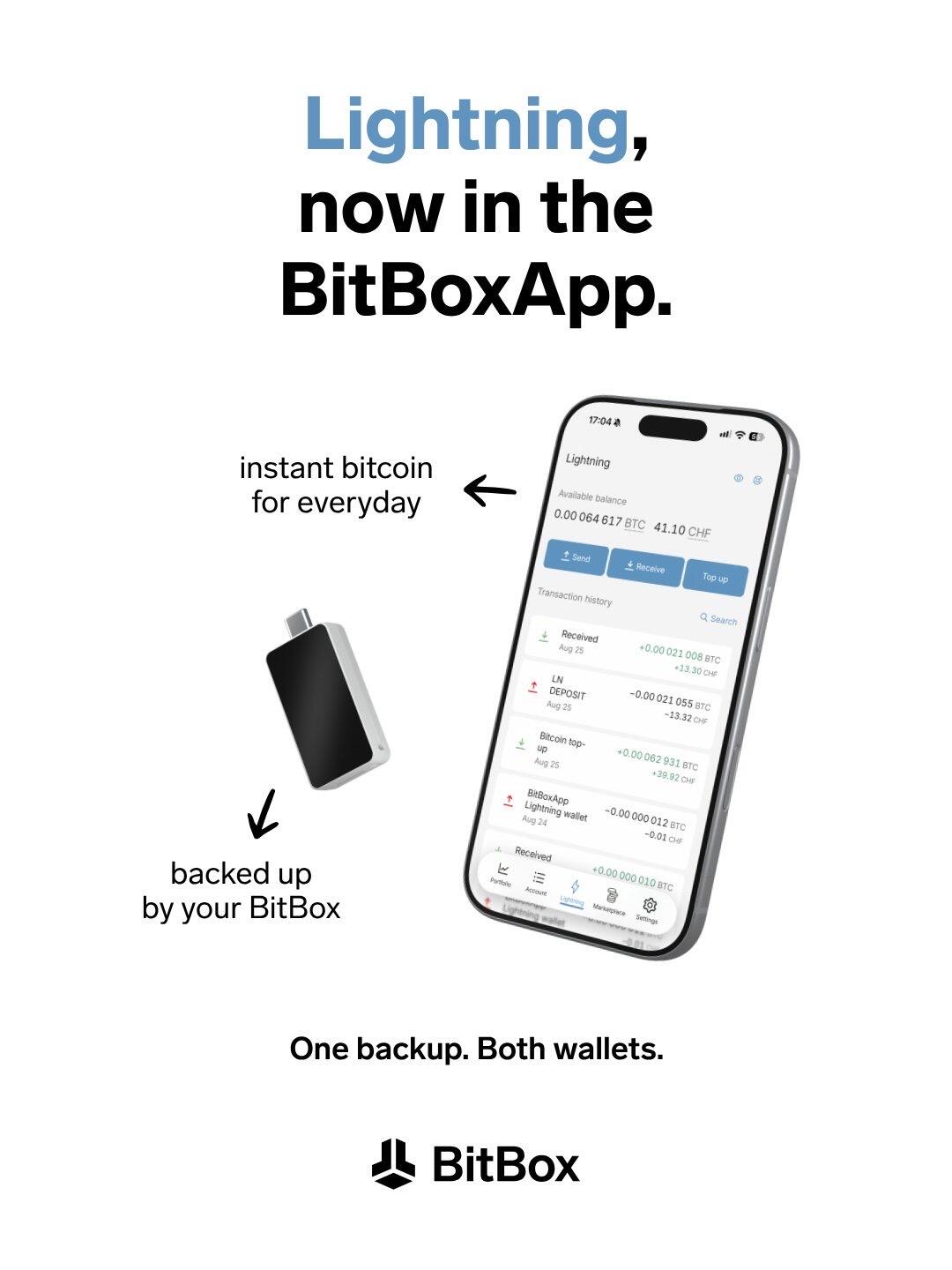
Your hardware wallet doesn't need to come with you to pay for a coffee.
Lightning is now in the BitBoxApp. Public beta, for every BitBox user.
One backup. Both wallets.
More in the comments.
Our preliminary review of the phishing mail that was sent out to our newsletter subscribers about an hour ago found that it is very likely that our newsletter provider got compromised.
Multiple other Bitcoin companies got targeted as well, and it appears that we all share the same newsletter provider.
We sent out a phishing warning to all our newsletter subscribers, contacted the provider and reported the phishing domains. Most of the phishing links appear to have been taken down already.
We are still actively investigating this situation and will update you once we know more.
There is currently a phishing email going around that's pretending to come from us.
Please do not follow the instructions in the email.
We are currently investigating.
If you own a hardware wallet, you probably spent the last few days wondering what you're actually able to check for yourself.
Short answer: more than you'd think.
Here are the questions worth asking any manufacturer (us included):
- Where does the randomness come from?
Every wallet begins as one large random number. If that number is predictable, nothing built on top of it holds.
Ask how many independent sources of entropy the device combines and what happens if one of them turns out to be weak.
- Can I check that the firmware on my device matches the published code?
Reproducible builds let you verify the binary you're running was built from the source you can read.
Worth being precise: that proves the binary matches the source. It does not prove the source is correct.
- Who approves a change before it reaches my device?
Ask whether one person can ship firmware alone, or whether every change needs a second set of eyes.
This is unglamorous and it is where most of the real security lives.
- What happens when they find a bug?
Every manufacturer ships bugs. The question is what the process looks like afterwards.
Ask about the bug bounty. Ask how quickly users were told the last time something was found.
OUR ANSWERS
- The BitBox generates your wallet from five independent sources of entropy: Physical noise from the secure chip, physical noise from the MCU, randomness provided by the host device, a static random number set in the factory and your own device password.
The benefit of mixing entropy: Redundancy. All but one source can be compromised and your seed would still be secure.
- The BitBox firmware supports reproducible builds you can independently verify yourself (link in the comments)
That way you know the firmware you install matches the public source code.
However, it is generally very difficult to verify what code is actually executed on-device.
- All change requests to the BitBox firmware require an approved review by a maintainer to be merged.
- The BitBoxApp and BitBox firmware are fully open-source and part of our bug bounty program (link in the comments )
Bug reports are financially rewarded depending on their severity, encouraging security researchers to actually take a thorough look.
- We announce security updates publically on our channels, including detailed information on the vulnerability and how it might have affected users.
The 20 millionth bitcoin just got mined. 95% of all the bitcoin that will ever exist is now in circulation. The last 1 million will take until 2140.
Self-custody, so you make sure the ones you have are actually yours.
The hardest part of self-custody is the setup anxiety.
That’s why the BitBox uses a microSD card. It creates an instant, verified backup so you can secure your keys now and write down the 24 words later, with a clear head.
Loved by begginers (and the pros helping them) ❤️
For us, it's a no-brainer: wallet first. If you want your bike to be safe, you get a solid lock first.
But we get it, some see it the other way around. What do you think?
You can now grab your BitBox while doing your groceries at REWE Teupe in Dortmund, Germany.
Right next to the fridges. Because cold storage belongs in cold places.