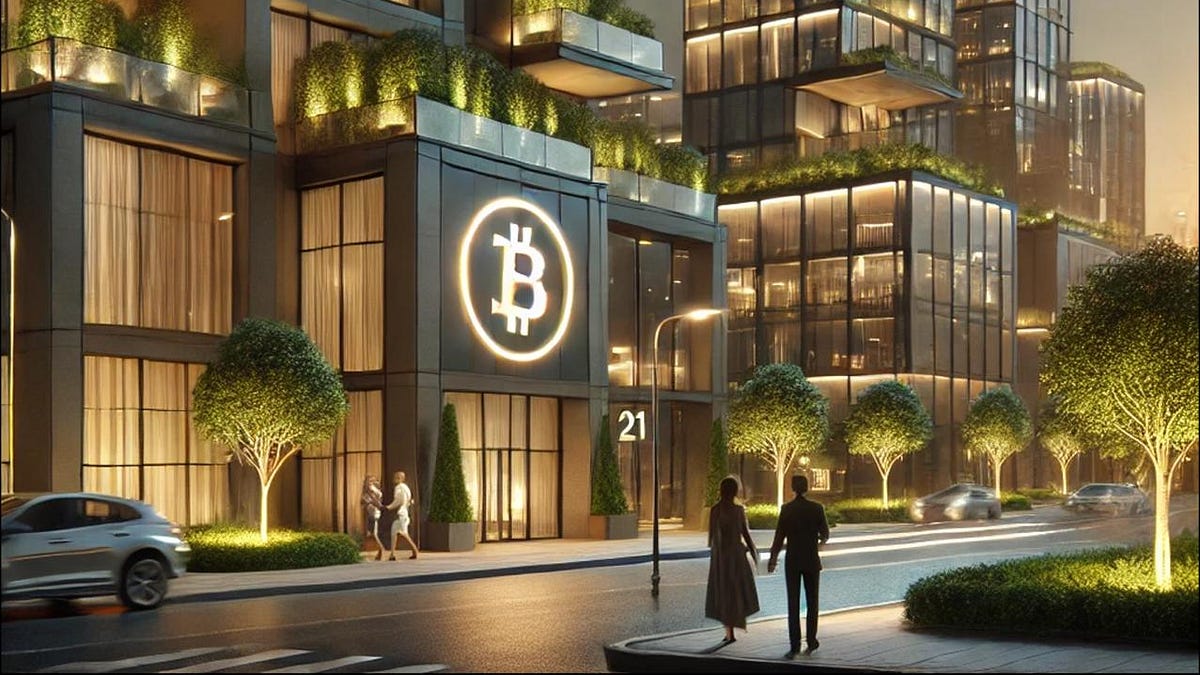
One of the most underrated positive second-order effects of bitcoin is that rents don’t have to keep rising to offset inflation, they can actually stabilize, or even decline over time.
Bitcoin will make housing more affordable.
As bitcoin's utility as collateral becomes more recognized over time, people will realize that it is a better store of value than real estate.
There’s no longer a need to store wealth in property, as BTC can take that role, allowing the monetary premium currently embedded in real estate to flow into Bitcoin and letting property prices return to reflect actual utility.
Even though this is a long process, it’s one of Bitcoin’s most important second-order effects: more affordable housing.
This was my first time speaking to a real estate crowd. 1,000+ RE investors open to learning about Bitcoin.
I was stunned at how openly BTC and its benefits for real estate development and management were embraced.
Clearly, the tide is shifting. ✨🛸

The negative transformation in architecture, often rightly critiqued by Bitcoiners, wasn’t driven solely by fiat money. Both modern architecture and fiat currency are 20th‑century phenomena born of the same push for standardization, industrialization, and modernism
In the late 19th century, architecture, art, and design were deeply rooted in historical styles and maximalism. As the industrial revolution took hold, counter-movements emerged.
Adolf Loos was a radical early‑20th‑century Viennese architect who challenged norms by stripping away all ornamentation he deemed unnecessary. He argued that modernity required a break from the past.
He influenced a generation of architects. Among them was the Swiss architect Le Corbusier, who would become one of the most influential figures in modern architecture.
Simultaneously, the Bauhaus school emerged in Germany in 1919, under the leadership of Walter Gropius, with notable figures such as Ludwig Mies van der Rohe and Marcel Breuer.
Their emphasis on simple, functional forms made a lasting impact on global design, laying the groundwork for what we now consider modern, minimalist architecture. But not all minimalism is equal.
Early Bauhaus designers were arguably aesthetic innovators, but most things created since are not so elegantly designed. Today, the world has been filled with careless, knock-off minimalism, it feels cheap rather than stylish, boring instead of sleek.
We have also moved far away from the round shapes and attention to detail we find in nature. It is no wonder that people leave the city on weekends to reconnect with nature, where the calming effect of green soothes the human nervous system.
We have drifted far from nature. Traditional building materials like clay and wood, along with warm color schemes on both the interiors and exteriors of buildings, as well as the inclusion of gardens and dedicated spaces for the community, children, family life, and work, have largely been relegated to the background.
Coupled with rising costs driven by inflation, the deterioration of housing quality has become a hallmark of modernism.
The pendulum of fashion always swings one way, then another, and each generation reacts to what came before. So what is the future of architecture and design?
In much the same way that the Bauhaus movement standardized design, Bitcoin allows us to go back to a more individual design. Bitcoin’s fixed supply naturally encourages a low time‑preference mindset, with the potential to revive the intergenerational outlook vital for thoughtful design, architecture & urban development.
Under a Bitcoin standard, developers and residents alike would be motivated to invest in high‑quality, durable infrastructure and public spaces that benefit not just today’s generation, but those to come.
As Bitcoin continues to mature and integrate into our financial fabric, it may well catalyze a design and architecture revolution. Where the principles of tradition, modern architecture and sound money converge to create more affordable quality housing.
This was my first time speaking to a real estate crowd. 1,000+ real estate investors learning about Bitcoin.
I was absolutely amazed at how openly Bitcoin and its benefits for real estate development and management were embraced.
A testimonial to the work of
@Tom Karadza and Nick Karadza at Rock Star Real Estate. Thank you for the invitation and the warm welcome.
The crowd was open for pure Bitcoin education, including demos of
@npub1ajlr...zx3q and Bull Bitcoin! Clearly, the tide is shifting. ✨🛸