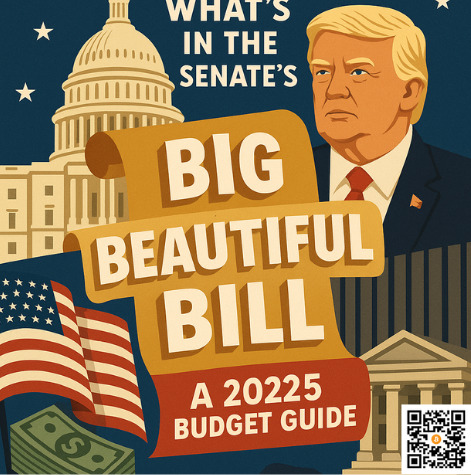
What's in the Senate's Big Beautiful Bill? A 2025 Budget Guide

Setting the Stage: The OBBBA Unveiled
On July 1, 2025, the U.S. Senate passed the One Big Beautiful Bill Act (OBBBA) with a 51–50 vote, Vice President JD Vance casting the tie-breaking vote. Nicknamed the "Big Beautiful Bill," this budget reconciliation bill anchors the Trump administration’s second-term agenda, targeting tax cuts, border security, and spending reforms. Passed under reconciliation to bypass a filibuster, it refines the House’s May 22, 2025, proposal to comply with the Senate’s Byrd Rule and secure moderate Republican support.
The OBBBA has ignited fierce debate, with supporters championing tax relief and border measures, while critics decry soaring deficits and social program cuts. Misleading claims, such as massive deficit reduction or a 68% tax hike, have muddled public understanding. This article offers a fact-checked breakdown of the Senate version’s provisions, detailing who benefits and who is harmed, the administration’s priorities, and the bill’s significant debt impact, using sources like the Congressional Budget Office (CBO), Tax Foundation, and NBC Chicago.
The Big Picture: Context and Fiscal Impact
The OBBBA leverages budget reconciliation for a simple majority passage, constrained by the Byrd Rule to fiscal matters. The Senate’s version, finalized on June 27, 2025, adjusts the House bill to appease moderates like Sens. Susan Collins and Lisa Murkowski while aligning with President Trump’s campaign promises. The CBO projects a $3.3 trillion deficit increase over a decade, driven by $4.7 trillion in revenue losses from tax cuts, outpacing $1.2 trillion in spending reductions. This significantly raises the national debt, adding to future interest costs. Exaggerated claims of slashing deficits or averting catastrophic tax hikes necessitate a clear fact-check of the bill’s provisions and implications.
Core Components: Key Provisions of the Senate Bill
Rewriting the Tax Code: Broad Relief and New Incentives
The OBBBA’s tax provisions extend the 2017 Tax Cuts and Jobs Act (TCJA) and introduce new deductions, prioritizing Trump’s tax relief agenda but reducing federal revenue.
2017 TCJA Extension: Permanently extends TCJA individual tax rates (10%, 12%, 22%, 24%, 32%, 35%, 37%) and provisions. Helps: Middle- and high-income taxpayers, businesses with lower rates. Hurts: Federal budget, adding to deficits. Priority: Fulfills Trump’s tax cut pledge. (Source: CBIZ, Forbes)
Standard Deduction: Permanently extends TCJA increase, adds $1,000 ($2,000 joint, $1,500 head of household) through 2028. Helps: Middle-income filers simplifying taxes. Hurts: Federal revenue. Priority: Supports Trump’s tax relief goal. (Source: Tax Foundation)
Child Tax Credit: Raises to $2,200 per child, inflation-adjusted post-2025, one parent needs SSN. Helps: Families, mixed-status households. Hurts: Budget. Priority: Aligns with Trump’s family tax relief. (Source: PBS News)
SALT Deduction: Sets $40,000 cap (2025–2029), phases out above $500,000 income. Helps: High-income households in high-tax states. Hurts: Very high earners, federal revenue. Priority: Balances Trump’s tax cuts with GOP regional demands. (Source: Forbes)
Tip and Overtime Deductions: Allows $25,000 for tips, $12,500 for overtime, $10,000 for U.S.-made vehicle loan interest through 2028, with phase-outs. Helps: Service workers, overtime earners, auto loan holders. Hurts: High earners, federal revenue. Priority: Delivers Trump’s worker tax relief. (Source: CBIZ, CNBC)
Senior Deduction: $6,000 for taxpayers over 65, phases out at $75,000/$150,000. Helps: Moderate-income seniors. Hurts: High-income seniors, federal revenue. Priority: Partially fulfills Trump’s Social Security tax relief promise. (Source: CNBC)
Business Tax Breaks: Extends TCJA provisions (20% QBI deduction with $400 minimum), adds coal incentive, immediate R&E expensing, 100% bonus depreciation, 30% EBITDA cap for business interest. Helps: Small businesses, coal industry, corporations. Hurts: Federal budget. Priority: Promotes Trump’s pro-business, energy agenda. (Source: CBIZ, Mondaq)
Revenge Tax: 15% rate on undertaxed profits starting 2027. Helps: Domestic revenue. Hurts: Multinationals. Priority: Supports Trump’s “America First” trade policy. (Source: Wikipedia)
Endowment Tax: 8%, 4%, 1.4% excise tax on college endowments, exempts schools with <3,000 students. Helps: Federal revenue, conservative goals. Hurts: Large universities, students via tuition hikes. Priority: Targets perceived liberal institutions. (Source: NBC Chicago)
NFA Tax Relief: Eliminates $200 excise tax on suppressors, short-barreled firearms. Helps: Gun owners, firearms industry. Hurts: Federal revenue, public safety budgets. Priority: Advances Trump’s Second Amendment support. (Source: NRA-ILA)
International Taxes: Reduces FDII deduction to 33.34%, increases BEAT to 14%, adjusts CFC rules. Helps: Domestic firms. Hurts: Multinationals. Priority: Supports Trump’s domestic economic focus. (Source: CBIZ)
Balancing the Books: Spending and Deficit Dynamics
The bill’s spending and fiscal impacts prioritize immediate goals over long-term fiscal health, significantly increasing the national debt.
Debt Ceiling: Raises by $5 trillion. Helps: Prevents default. Hurts: Future budgets with higher interest payments. Priority: Pragmatic GOP move. (Source: NBC Chicago, CBS News)
Deficit Impact: CBO projects $3.3 trillion deficit increase ($4.7 interoperable: trillion revenue loss, $1.2 trillion cuts). Helps: Taxpayers, businesses. Hurts: Fiscal stability, future generations. Priority: Prioritizes Trump’s tax relief over deficit reduction. (Source: CBO, Tax Foundation)
Defense Spending: $69 billion for missile defense ($25 billion), shipbuilding ($29 billion), nuclear deterrence ($15 billion), potentially $150 billion total. Helps: Defense contractors, military. Hurts: Other program budgets. Priority: Reflects Trump’s strong defense stance. (Source: NBC News)
Fortifying the Border: Security and Immigration Measures
Border security provisions deliver on Trump’s campaign promises but raise cost and humanitarian concerns.
Funding: $70 billion ($46.5 billion for border wall, $5 billion for CBP facilities, $4.1 billion for personnel, $2.7 billion for surveillance, $2 billion for CBP staff, $1 billion for inspection technology). Helps: Border agencies, construction firms. Hurts: Taxpayers, displaced communities. Priority: Fulfills Trump’s border wall pledge. (Source: White House, Al Jazeera)
Migrant Detention: $45 billion for 100,000 detention beds. Helps: Detention operators, enforcement. Hurts: Migrants, humanitarian budgets. Priority: Supports Trump’s mass deportation agenda. (Source: White House)
Judiciary Investments: Enhances border security, immigration enforcement. Helps: Immigration courts, agencies. Hurts: Migrants, legal aid groups. Priority: Advances Trump’s immigration crackdown. (Source: Congressional statements)
Reshaping Healthcare: Medicaid Reforms
Medicaid reforms prioritize reduced federal spending but risk significant coverage losses.
Medicaid: Cuts $800 billion over 10 years, adds 80-hour/month work requirements, reduces provider tax from 6% to 3.5% by 2031, includes $50 billion rural hospital fund. Helps: Rural hospitals, states. Hurts: 10.9 million low-income individuals, providers. Priority: Aligns with Trump’s welfare reform. (Source: NBC Chicago, CBO)
Beyond the Headlines: Additional Provisions
Additional provisions reflect Trump’s cultural, economic, and accountability priorities.
SNAP: Tightens eligibility with work requirements, increases state funding, exempts Alaska/Hawaii. Helps: States with exemptions, federal budget. Hurts: Low-income recipients. Priority: Supports Trump’s welfare reform. (Source: Newsweek)
Green Energy: Repeals solar/wind credits post-2027, delays nuclear/geothermal/hydropower cuts. Helps: Fossil fuel, nuclear industries. Hurts: Renewables, climate goals. Priority: Prioritizes Trump’s energy independence. (Source: NBC News, Spidell)
Trump Accounts: $1,000 stock market accounts for children born 2025–2029. Helps: Families, financial sector. Hurts: Federal budget. Priority: Promotes Trump’s wealth-building narrative. (Source: New York Times)
National Garden: $40 million for National Garden of American Heroes. Helps: Cultural projects, contractors. Hurts: Other budgets. Priority: Advances Trump’s patriotic initiatives. (Source: Fast Company)
Planned Parenthood: Bans federal funding for family planning providers. Helps: Conservative groups. Hurts: Low-income women, clinics. Priority: Aligns with Trump’s pro-life stance. (Source: NBC Chicago)
Pandemic Committee: $88 million for accountability committee. Helps: Oversight. Hurts: Budget slightly. Priority: Reflects Trump’s accountability focus. (Source: NBC Chicago)
Removed Provisions: Excludes land sales, AI regulation pause. Helps: Environmental groups, state regulators. Hurts: Developers, AI industry. Priority: Ensures reconciliation compliance. (Source: CBS News, Dallas News)
Debunking the Myths: False Claims Exposed
Misleading claims have distorted the bill’s impact, corrected here:
Social Security Taxes: Claim of elimination is false; $6,000 senior deduction reduces liability. (Source: CNBC)
Deficit Reduction: Claim of $7 trillion reduction is false; CBO projects $3.3 trillion increase. (Source: CBO)
Medicaid Unchanged: Claim of no change is false; $800 billion cut, work requirements added. (Source: NBC Chicago)
68% Tax Hike: Claim of preventing 68% hike is false; average increase ~$1,700 if TCJA expires. (Source: Ways and Means Committee)
Weighing the Impact: Analysis and Implications
The OBBBA delivers on Trump’s priorities: permanent TCJA tax cuts, worker and senior deductions, $115 billion for border security, fossil fuel support, pro-life policies, Second Amendment rights, and family wealth-building via Trump Accounts. However, the $3.3 trillion deficit increase and $5 trillion debt ceiling raise significantly burden the national debt, with future interest costs straining budgets. The CBO projects 10.9 million losing Medicaid coverage, drawing criticism from Democrats and GOP moderates like Sens. Collins and Paul. Elon Musk’s X opposition highlights intra-party tensions over deficits and SALT.
The Tax Foundation estimates a 1.1–1.2% GDP boost, but $4.7 trillion in revenue losses raises fiscal concerns. The bill’s fossil fuel focus over renewables may hinder climate progress, while cultural provisions like the National Garden and Planned Parenthood ban cater to Trump’s base. The Byrd Rule’s constraints limited scope, removing land sales and AI deregulation. The bill’s fate hinges on a contentious House vote, with GOP resistance possible over SALT and debt.
Looking Ahead: What’s Next for the OBBBA
The Senate’s Big Beautiful Bill prioritizes Trump’s tax cuts, border security, and conservative reforms, benefiting taxpayers, businesses, and border agencies but harming low-income groups, renewables, and fiscal stability. The $3.3 trillion deficit increase and $5 trillion debt ceiling raise pose long-term risks, with 10.9 million potentially losing Medicaid coverage. As the House vote looms, readers should track Congress.gov for updates and weigh immediate relief against future costs.
Sources
Congressional Budget Office (CBO), Tax Foundation, CBS News, NBC Chicago, CNBC, Forbes, PBS News, Al Jazeera, White House, Newsweek, New York Times, Fast Company, Spidell, Mondaq, NRA-ILA, Congress.gov.
X posts for sentiment: @ddayen (Medicaid concerns), @SaveLibertyUS (GOP support), @NEWSMAX (Planned Parenthood ban).





 Speculation is mounting in Washington and on Wall Street that President Donald Trump may be considering a strategic move to signal his preferred direction for Federal Reserve policy—well ahead of any formal transition in leadership. The approach? Publicly naming his intended successor to Fed Chairman Jerome Powell before Powell’s term ends in 2026.
Such a move would be unusual and would likely be interpreted as an effort to shift market attention away from Powell’s current policy stance and toward the monetary direction a second Trump term might pursue. It would effectively position Powell as a lame duck, and send a message to investors: “Don’t follow him. Follow where I’m going next.” It will be interesting to see how the market reacts.
A Name Begins to Circulate
Over the past week, rumors have surfaced that Trump is considering announcing his choice for the next Fed Chair ahead of time—a tactic that could influence market expectations. The idea appears to be aimed at setting the tone for future policy, particularly if Trump is reelected and granted the opportunity to appoint a new Fed chief in early 2026.
Adding fuel to the speculation, Treasury Secretary Richard Bessant—whose name has reportedly been floated in internal discussions—was asked directly in an interview whether he might take the job. His response: “I believe I already have the best job in Washington.” While not confirming interest, his comment left the door open to further interpretation.
Policy Differences Behind the Talk
President Trump has made no secret of his policy disagreements with Chairman Powell, particularly regarding interest rates. He has previously criticized Powell for raising rates during his first term and has suggested that more aggressive rate cuts are needed to stimulate growth. With inflation showing signs of moderation and the political calendar intensifying, Trump may be seeking to influence market sentiment toward a looser monetary stance.
If Bessant or another candidate aligned with Trump's preferences is announced ahead of time, markets could begin pricing in a potential policy shift—regardless of Powell’s current guidance.
Market Dynamics and Forward Signals
Market expectations are often shaped by forward guidance, and even informal signals can have real effects. By introducing a possible future Fed nominee now, the Trump administration may be attempting to shift attention toward the trajectory of monetary policy under a second Trump term.
This form of signaling—whether intentional or not—can influence investor behavior, interest rate forecasts, and the broader financial narrative. While Powell continues to lead the Federal Reserve with full authority, any credible speculation about a future transition could begin to dilute the perceived weight of his statements in the eyes of the market.
Conclusion
At this stage, no formal nomination has been made, and Powell’s term continues through 2026. However, the growing attention to possible successors and the president’s ongoing critiques of current monetary policy are already shaping a new conversation.
Whether Trump ultimately announces a preferred candidate early or not, the message is being heard: a shift in leadership may be coming—and markets are watching closely.
Speculation is mounting in Washington and on Wall Street that President Donald Trump may be considering a strategic move to signal his preferred direction for Federal Reserve policy—well ahead of any formal transition in leadership. The approach? Publicly naming his intended successor to Fed Chairman Jerome Powell before Powell’s term ends in 2026.
Such a move would be unusual and would likely be interpreted as an effort to shift market attention away from Powell’s current policy stance and toward the monetary direction a second Trump term might pursue. It would effectively position Powell as a lame duck, and send a message to investors: “Don’t follow him. Follow where I’m going next.” It will be interesting to see how the market reacts.
A Name Begins to Circulate
Over the past week, rumors have surfaced that Trump is considering announcing his choice for the next Fed Chair ahead of time—a tactic that could influence market expectations. The idea appears to be aimed at setting the tone for future policy, particularly if Trump is reelected and granted the opportunity to appoint a new Fed chief in early 2026.
Adding fuel to the speculation, Treasury Secretary Richard Bessant—whose name has reportedly been floated in internal discussions—was asked directly in an interview whether he might take the job. His response: “I believe I already have the best job in Washington.” While not confirming interest, his comment left the door open to further interpretation.
Policy Differences Behind the Talk
President Trump has made no secret of his policy disagreements with Chairman Powell, particularly regarding interest rates. He has previously criticized Powell for raising rates during his first term and has suggested that more aggressive rate cuts are needed to stimulate growth. With inflation showing signs of moderation and the political calendar intensifying, Trump may be seeking to influence market sentiment toward a looser monetary stance.
If Bessant or another candidate aligned with Trump's preferences is announced ahead of time, markets could begin pricing in a potential policy shift—regardless of Powell’s current guidance.
Market Dynamics and Forward Signals
Market expectations are often shaped by forward guidance, and even informal signals can have real effects. By introducing a possible future Fed nominee now, the Trump administration may be attempting to shift attention toward the trajectory of monetary policy under a second Trump term.
This form of signaling—whether intentional or not—can influence investor behavior, interest rate forecasts, and the broader financial narrative. While Powell continues to lead the Federal Reserve with full authority, any credible speculation about a future transition could begin to dilute the perceived weight of his statements in the eyes of the market.
Conclusion
At this stage, no formal nomination has been made, and Powell’s term continues through 2026. However, the growing attention to possible successors and the president’s ongoing critiques of current monetary policy are already shaping a new conversation.
Whether Trump ultimately announces a preferred candidate early or not, the message is being heard: a shift in leadership may be coming—and markets are watching closely.