Follow the Money Protocol
Every deep analysis —whether of a system, a technology, or an investment— starts the same way: ask who benefits.
Follow the money. It never lies; it just wears masks.
When you trace the financial flow, the rhetoric fades and the interests surface.
The structure itself tells you the truth.
But not everything is bought with cash. There are invisible incentives too: power, prestige, control, influence, and reputation.
Understanding how those incentives are built is like reading the system’s DNA. That’s where the map of decisions hides.
The protocol is simple and ruthless: follow the money, track the incentives, and you’ll see what really moves the pieces.
Because when something looks complex, it usually is —on purpose. Complexity is camouflage for profit.
LiberLion
liberlion@iris.to
npub1wpzp...zs7p
Writer • Sci-Facts Thinker • 𝔸𝕀 • Ϛʁyptø • Monero • 𝙰𝚐𝚘𝚛𝚒𝚜𝚖
| 𝕏 @liberlion17 | liberlion.com | liberlion.medium.com | 84y8yKaEFfeYj5Wyh7DZvb3aMvu18zhu7XF1b8TQZFWaS4GF323jr6NJstEeajdDVKTNvAvGUzogfEbbHFKnBVJTNBQTFNX
SimpleX Chat is a honeypot
I warned you a long time ago: SimpleX Chat is a platform corrupted by money: Follow the money trail to understand its destination.
It has investments from large globalist corporations.
See my post from a year ago and then read my analysis: View quoted note →
SimpleX plans to use a treceable blockchain to fund and maintain secure messaging servers and groups via Ethereum smart contracts and zero-knowledge proofs, enabling short address names and network consensus without intermediaries.
Blockchain is used "for secure payments"🗿
SimpleX: where your messages are invisible, but your wallet is an open book.
Privacy for your words, transparency for your coins — the perfect combo for the modern cypherpunk accountant.
Since #Monero does not comply with the regulations, and therefore cannot handle KYC payments, SimpleX cannot use it 🙃
If it wasn't clear in SimpleX's explanation, let's see if it's clearer now?
SimpleX: “We’ll protect your privacy… while following every surveillance law.”
Translation: compliance-first, privacy-second.
The warm-up act for KYC chat apps — encryption with a government backdoor bow.
Perhaps you don't prioritize #privacy or KYC compliance, but if that's the case, why are you using Simplex instead of Microsoft Teams or Google Meet?
Either way, Simplex will comply with regulators sooner or later.
That's why Session Messenger for the #SovereignIndividual
SimpleX: where your messages are invisible, but your wallet is an open book.
Privacy for your words, transparency for your coins — the perfect combo for the modern cypherpunk accountant.
Since #Monero does not comply with the regulations, and therefore cannot handle KYC payments, SimpleX cannot use it 🙃
If it wasn't clear in SimpleX's explanation, let's see if it's clearer now?
SimpleX: “We’ll protect your privacy… while following every surveillance law.”
Translation: compliance-first, privacy-second.
The warm-up act for KYC chat apps — encryption with a government backdoor bow.
Perhaps you don't prioritize #privacy or KYC compliance, but if that's the case, why are you using Simplex instead of Microsoft Teams or Google Meet?
Either way, Simplex will comply with regulators sooner or later.
That's why Session Messenger for the #SovereignIndividualWhat are you waiting for?
Are you waiting until the feds throw down ropes to get in through your windows?
Swap/Windows/for/Linux
#FOSS
P.S.: The analogy is valid, "windows"


Is it possible to create Strategic Bitcoin Reserves (“SBR”), and what is needed for that?
It already exists, but with limitations.
My hypothesis about on-chain KYC in Bitcoin is based on this.
Read...
Strategic Bitcoin Reserves refer to when a state, sovereign wealth fund, or other public institution decides to hold that asset as part of its investment strategy.
The U.S. established the Strategic Bitcoin Reserve via President Donald Trump’s executive order, centralizing all government-held bitcoin obtained through civil and criminal forfeiture. The Department of Treasury will consolidate all forfeited BTC from federal government agencies into the centralized SBR.
Following this directive, Senator Cynthia Lummis has introduced the Bitcoin Act 2025, which proposes that the U.S. Treasury acquire one million bitcoins over five years, holding them in cold storage for twenty years, like gold. It recognizes Bitcoin as an economic hedge and a symbol of official acceptance of digital assets.
For an asset to be included in the Treasury Reserve, it must meet certain transparency and regulatory requirements.
Do you understand the need I'm proposing?
Read it here 👇
View quoted note →
Let’s analyze this case using my L3 Protocol — the three layers of analysis.
Read the article first, then my analysis:
🔗 https://www.theblock.co/post/376312/zcash-shielded-supply-privacy-token-surges-7x
PS: Read to the end to discover a key fact about The Block that will help you understand it better.
Layer 1 — Surface
The headline says: “Zcash’s shielded supply increases sevenfold.” It sounds like a privacy renaissance. More coins in shielded addresses = stronger privacy narrative = bullish signal.
The market loves scarcity. When coins are “hidden,” the visible supply shrinks. Less visibility means the illusion of scarcity and a potential price pump.
Layer 2 — Depth
Shielded supply means coins stored in private pools using zk-SNARKs. But technical privacy doesn’t guarantee real anonymity. Transaction timing, behavior, or partial usage can still leak data.
Academic studies show de-anonymization vectors in Zcash. Even if cryptography is solid, user behavior often betrays intent. Privacy in theory is not privacy in practice.
Zcash’s privacy is optional, not default. That’s its paradox: to stay safe, users must consciously choose privacy. Yet most remain transparent, pressured by exchanges and regulation.
Layer 3 — Hidden Structure
Why is Layer 1 so visible while Layer 2 stays quiet? Because hype sells; complexity doesn’t. “7x surge” is a simple story. zk-SNARK caveats are not.
Showing a booming shielded supply builds a marketable narrative: “Privacy is back.” But it hides key questions: who is shielding, why now, and how long will they stay private?
Behind the headlines, this looks like strategic narrative management: show growth to attract investors, keep details opaque to dodge scrutiny, and maintain perception of strength.
System view
Zcash lives between two forces: markets craving scarcity and regulators demanding transparency.
Layer 1 feeds the first.
Layer 2 hides from the second.
Layer 3 exposes the tension — privacy as both shield and stage prop.
PS: The Block is lobbying 👇😉
Disclaimer: The Block is an independent media outlet that delivers news, research, and data. As of November 2023, Foresight Ventures is a majority investor of The Block. [..]
😎 Follow the money trail to understand the destination
Vibe-coding: AI technology should be an aid and not a replacement for the human brain.
The culture of “vibe-coding”—software development driven by AI tools (like GitHub Copilot)—prioritizes code that compiles and “feels good” (vibe), but this doesn't guarantee that it's safe, correct, or understandable to the person writing it.
And here, human critical thinking once again proves essential, something large corporations don't want.
https://rekt.news/es/bad-vibes
Information analysis has 3 layers:
👇
─L1 is the surface: what everyone can see — the public data and its obvious reading
─L2 is the depth: information not accessible to all, which requires context or special access
─L3 is the hidden structure: where hypotheses are formulated about why layer two is not public and easily accessible, and a broader understanding of the whole is proposed.
3 of the best for L3 in crypto
👇
protos.com
therage.co
rekt.news
Knots and Core: the False War for Bitcoin’s Soul
Bitcoin’s war isn’t technical but political.
Core vs Knots is a staged conflict by bankers and governments to capture the network from within.
I present my hypothesis.
The strategy is Problem–Reaction–Solution, and they create the scenario.
The shrewd bankers create a rift with insiders to generate discussion and distract from and mask the true objective.
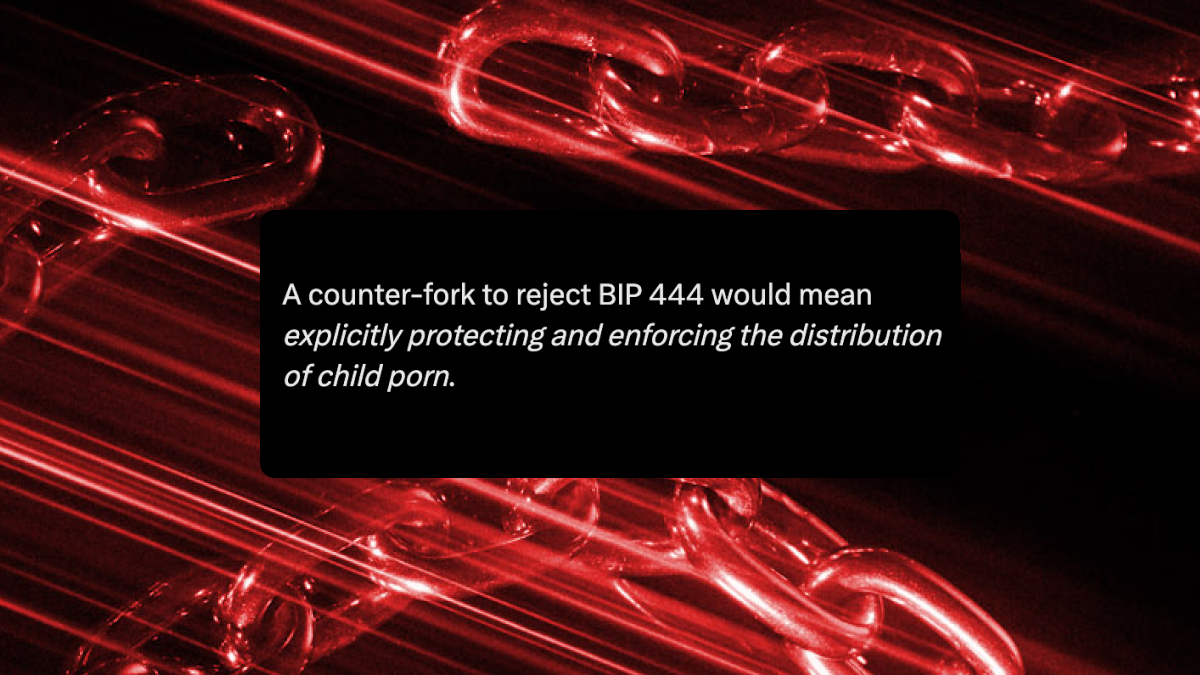
Luke Dashjr, long-time Bitcoin Core developer and creator of Bitcoin Knots, is pushing a “anti-spam” soft fork.
He claims to be cleaning useless data from the chain. But the motives behind it aren’t that clean.
The debate around OP_RETURN and “illegal data” is the perfect pretext: if one group decides what kind of information can circulate, it also decides who can transact.
Code becomes pure politics.
Knots and Core seem opposed, but they’re playing chess on the same board.
One creates the problem (“the network is full of junk”), the other offers the solution (“we need to filter it”).
That “spam” narrative opens a backdoor for something much bigger: control over Bitcoin’s data flow.
The next logical step: on-chain identity and compliance.
And that’s where BlackRock steps in.
It doesn’t need to write code — it buys the board.
It holds stakes in several of the largest Bitcoin mining companies in the U.S. and manages ETFs holding thousands of BTC.
Controlling mining doesn’t mean censoring blocks today.
It means having veto power tomorrow, once social consensus has been shaped by “legal” or “ethical” narratives.
On-chain KYC won’t be imposed by decree.
It’ll be legitimized as a “technical necessity” to prevent risks or “illegal data.”
One soft fork at a time.
The strategy is old: create the crisis, offer the cure, and hide the business inside the cure.
Knots and Core act like two banks pretending to compete while coordinating the same outcome.
Follow the money trail to understand the destination.
Bitcoin was born to eliminate intermediaries.
The control narrative gains ground because economic incentives dominate: “hodl to the moon.”
Thus the same global financial system with on-chain KYC — banking v3.0 — is forged.
And the new central bank treasury will be the code itself.
I ask you to look beyond your immediate focus, to broaden your analysis.
Many of my followers are passionate about the crypto world, and that's great. But if you don't have an income, what good is sovereign tokenized money?
This is what I address in my book, "Understanding The Information Age: The Sovereign Individual", of which I've already published the Preface and Introduction, and will continue publishing each of the 10 chapters periodically.
Let me introduce you to the focus and part of its content.
The digital economy that cryptocurrencies propose can be a heaven or a living hell.
It depends on how it's structured and designed; it can be one or the other.
Governments, of course, seek to create hell for the sovereign individual, because politics is about control, and there's no control over people with freedom of action and critical thinking skills.
And there's an elephant in the room: AI.
There's a lot of talk about AI replacing human jobs. For this reason, many politicians and business leaders (Bill Gates or Sam Altman) propose Universal Basic Income (UBI). This subsidy, paid for through taxes by corporations that replace workers with AI, is presented as a solution and an emancipatory step forward, giving humanity more free time.
But in reality, they seek to consolidate a new order of digital servitude. Work would cease to be a source of freedom and belonging, becoming dispensable.
Those who control the algorithms would also control the distribution of money, data, and social behavior.
Dependence would no longer be on labor, but on technology.
Basic income, financed by the same corporations that destroy jobs, would be a "digital chloroform": it reduces anxiety, but also motivation and political participation.
The result would be a docile citizenry, one that is monitored and grateful for its subsidies.
Freedom lies not in working less, but in deciding under what conditions one works.
The enemy is not technology, but surrender to its centralized control.
The only way out is technological sovereignty: open, auditable, decentralized, and collectively managed systems.
Understanding The Information Age. The Sovereign Individual.
https://medium.com/@liberlion/understanding-the-information-age-the-sovereign-individual-index-eea277fe6bef
Read this carefully.
The signs are becoming increasingly clear: bankers are behind these maneuvers.
A new hard fork is coming, and then, with a clearer path, KYC.
I have been saying, the goal is on-chain KYC on #BTC


The Rage
Running Bitcoin Is Illegal: Dashjr Chainsplit Proposal Hits BIP Repository
A pseudonymous developer credits Bitcoin Knots maintainer Luke Dashjr for a softfork proposal that could split the Bitcoin blockchain, claiming Bit...
Don't be hypnotized by marketing: most blockchains are well-designed mirages.
The cypherpunk dream has become a narrative, sustained by only a few networks faithful to their principles.
Stablecoins are the first spearhead to penetrate the flesh of the crypto ecosystem, making you believe they make it easy to exchange your fiat money for tokens, but in reality, they are tokenizing fiat.
If we look at the whole forest, and not just the leafy tree blocking our view, we will see how banks are taking control of the ecosystem.
And most people believe they are part of a new financial system, cypherpunk rebels, when in reality it is the traditional market, previously digitalized and now tokenized: banking v3.0
Governments write the rules, bankers collect the fees, and in return, they get what they really want: your information and your financial obedience.
They're not competing with each other. They're the same team.
It's very simple to see: if there's institutional investment, it's co-optation, not rebellious adoption.
The eDollar is taking shape.
Stablecoins are building the structure.
In a later phase, when tokenization via banks and payment services is sufficiently widespread, the Fed will issue an official #CBDC that will be interchangeable with stablecoins.


Stablecoin News: Western Union Tapping Solana (SOL) and Anchorage for Digital Dollar
The U.S. dollar-pegged token is expected to become available in the first half of 2026.
MONERO FOR NEWBIES
Monero is digital cash. Like Bitcoin — but private. Every transaction is confidential, and every user helps protect everyone else’s privacy.
1. A Fresh Start
Monero wasn’t copied from Bitcoin. It was built from the ground up to make privacy the default, not an optional extra.
2. Privacy Always On
Every Monero transaction is hidden by default. When you use it, you strengthen the privacy of all other users, too.
3. Hidden Amounts
Transaction amounts are encrypted. No one can see how much you send or receive — it’s invisible by design.
4. Flexible Block Size
Unlike Bitcoin, Monero’s blocks grow and shrink with demand. That means faster confirmations and lower fees.
5. Stealth Addresses
Your wallet address never appears on the blockchain. No one can link your payments, balances, or spending habits.
6. Untraceable Transactions
Each transaction is mixed with others using ring signatures. The result: no one can tell where the money came from.
7. Strong Encryption
Monero uses advanced elliptic curve cryptography (ED25519). It keeps your funds safe from theft and forgery.
8. Fair Mining
Monero’s algorithm resists ASICs — those special mining machines that centralize control. Here, anyone can mine with a regular computer.
9. Fungible and Research-Driven
Every Monero coin is equal — no “tainted” coins, no tracking history. Monero’s Research Lab constantly works to improve privacy and security.
10. Built by the People
Over 240 contributors, active communities, easy wallets, and broad exchange access. Monero is a living project — open, resilient, and focused on freedom.
Hitting the block-size ceiling vs flexing to demand: two very different philosophies in crypto networks.
In Bitcoin, you get a rigid cap; in Monero and Bitcoin Cash, you get varying degrees of flexibility.
Why does it matter? Because it underpins throughput, fee behavior, and who gets to run a node.
Bitcoin keeps things simple: a preset block-size ceiling that limits how many transactions can fit in each block. Predictable, lean, but also a built-in bottleneck when demand spikes.
Monero takes a different path: blocks can grow when needed, based on recent usage, but there’s a penalty for miners if they over-inflate without justification. That grants more elasticity while retaining guardrails.
Bitcoin Cash decided to swing for scale: much larger blocks from the start and a mechanism to let block size expand with demand. Big heads-up though: bigger blocks mean heavier infrastructure for nodes and potential impacts on decentralization.
The trade-offs are clear: rigid limits give simplicity and protect smaller nodes, but can throttle capacity. Elastic limits give space, but shift the burden to the infrastructure and risk centralizing if hardware demands rise.
It all comes down to this question: Would you favour a network that stays ultra-light and accessible for any node, or one designed to absorb high usage on-chain even if the infrastructure gets heavier?
There’s no “perfect” choice—only design priorities.
IF THERE'S NO FRICTION, THERE'S NO PRIVACY.
A quick rule of thumb to avoid any doubt.
Yes, I know it sounds absolute and isn't always true, but it is in most cases and serves to clarify.
Privacy is born from friction — and Big Tech thrives on removing it.
That friction —the pause, the choice, the boundary— defines personal space.
Centralized platforms know that the smoother the experience, the more you surrender without noticing.
They offer comfort: one-click access, auto-login, seamless sync. Less friction, more data.
It’s simple: they make things effortless, so you stop thinking about what they’re taking.
Privacy demands small inconveniences. Surveillance hides behind perfect convenience.
By 2026, every EU member state will be legally required to provide a standardized digital wallet to its citizens, residents, and businesses.
eIDAS: electronic IDentification, Authentication and trust Services was established in EU Regulation 910/2014 of 23 July 2014.
Crypto was supposed to route around censorship. P2P money without middlemen.
A parallel system for those who refused to play by rules written in marble halls where nobody elected enters.
But the present is not what history wanted.
You wanted to opt out; they want to make that illegal.
What happens when the right to disappear collides with the duty to be seen?
When privacy becomes the only defense against a surveillance state that remembers everything, can anyone afford not to use it?
In an age where truth gets timestamped and every digital fingerprint becomes permanent, maybe the most radical act is refusing to leave one.
When perfect memory becomes the cage, who gets to decide which prisoners deserve the key?
A GREAT article 💯 🎯 you should read: 'The Right to Disappear'
https://rekt.news/right-to-disappear
I have been saying for some time that there will be a new hard fork in #Bitcoin #BTC.
The signs are becoming clearer.
Let me explain, one more time.
Read this great article and then read my thread:
Like any situation, analysis deserves different layers for a deeper understanding. A deep dive is difficult but valuable.
Let me show you my 3-layer analysis, and you'll see why I maintain there will be a hard fork intentionally motivated and triggered by puppet masters.
─Layer 1: Technical Level (the visible):
The Bitcoin network faces pressure when metadata is added to blocks via OP_RETURN, saturating block space and raising storage and propagation costs — a clear, measurable technical issue.
─Layer 2: Philosophical Level (what is Bitcoin's "mission")
Here’s the tension: if Bitcoin is money, the network should serve only value transfer. Yet filtering blocks with non-monetary data risks censorship. The network’s purpose defines what use is legitimate.
─Layer 3: Economic/Political Level (Who Gains What)
Finally, there is a play of power and incentives. Institutions (banks, governments, regulators) have an interest in value networks being traceable, controllable, and having KYC ("know-your-customer") or built-in regulation. Governments want to have control over value, bankers want to have greater power over the network, and, of course, make money. And these puppeteers need insiders, developers, and opinion-formers to lobby with those interests to generate the "problem-reaction-solution": first saturation or abuse, then the demand for filtering/control, then the solution that allows for more oversight. This is the layer where it is argued that, behind the technical/neutral appearance, there is an agenda of institutional control or capture (or at least a risk of it).
This is why I believe a new hard fork will pave the way for on-chain KYC.

Protos
Bitcoin’s OP_RETURN war just went nuclear: a chain fork proposal
A proposed Bitcoin fork would commence an activation period for updating consensus rules to limit storage unrelated to the movement of BTC.
Did you know that #Monero has a security protocol?
It's an essential guide for managing security incidents in Monero, tailored to its decentralized and privacy-focused nature.
It's a protocol for handling vulnerabilities (security bugs) within the Monero project. It describes how to report them, how they are evaluated, what steps they take before making the details public, etc.
In other words, a security breach response "manual" for that software project.

GitHub
meta/VULNERABILITY_RESPONSE_PROCESS.md at master · monero-project/meta
A Meta Repository for General Monero Project Matters - monero-project/meta
The Lesson of Anonymity — From Bitcoin to Monero
It doesn’t matter if Satoshi Nakamoto or Nicolas van Saberhagen were one person or a team. What matters is that both understood that protection was part of the code.
Satoshi’s anonymity gave Bitcoin birth—but his successors didn’t fully grasp the lesson. Most Bitcoin developers today are public, traceable, and exposed. That makes the network stronger technically, but weaker politically.
Monero’s creators learned differently. Many remain anonymous to this day. Not to play spy games—but because they know what happens when code threatens the system that rules money.
Bitcoin opened the door to financial sovereignty. Monero built a wall of privacy around it.
Anonymity isn’t hiding. It’s how truth survives pressure.