LiberLion's avatar
LiberLion
liberlion@iris.to
npub1wpzp...zs7p
Writer • Sci-Facts Thinker • 𝔸𝕀 • Ϛʁyptø • Monero • 𝙰𝚐𝚘𝚛𝚒𝚜𝚖 | 𝕏 @liberlion17 | liberlion.com | liberlion.medium.com | 84y8yKaEFfeYj5Wyh7DZvb3aMvu18zhu7XF1b8TQZFWaS4GF323jr6NJstEeajdDVKTNvAvGUzogfEbbHFKnBVJTNBQTFNX
LiberLion's avatar
LiberLion 4 months ago
While most people are still amused by the left vs right show, the real battle in the 21st century is #privacy vs. surveillance—and yes, I left out ‘freedom’ on purpose: without privacy, you’re not even playing. Technocratic governments have already bought front-row seats.
LiberLion's avatar
LiberLion 4 months ago
The False Defenders of Privacy ᵀʰᵉʸ ᵃʳᵉ ᵗʰᵉ ᵐᵒˢᵗ ᵈᵃⁿᵍᵉʳᵒᵘˢ Let's expose these characters. At critical moments, such as the conviction of the Samourai Wallet developers, the true face of the crypto ecosystem is revealed: many who claim to defend #privacy remain silent in the face of injustice. In that silence, the truth is more evident than in their speeches. That's how you realize they're fake, and it's just a marketing narrative, and in reality they seek to comply with regulators in order to do business with the government or banks, cryptobanking/ banking 3.0 It's very easy to find out by searching for three words. Just type the user's name and these words into the search box: 👇🏻 Rodriguez Samourai freesamourai I did this in 𝕏
LiberLion's avatar
LiberLion 4 months ago
Hey #Monero devs, I've said it before, and I'll say it again...please, TOTAL ANONYMITY!! Egos aside, for your own good and the good of the entire ecosystem!!!
LiberLion's avatar
LiberLion 4 months ago
More #agorist #monerist than ever ᴸᵉᵗ ᵀʰᵉʳᵉ ᴮᵉ ᴰᵃʳᵏ🏴a³ Lunarpunk🌒 #SovereignIndividual image
LiberLion's avatar
LiberLion 4 months ago
Politicians don’t want to control you — they just want to walk you from the cradle to the ballot box… and back to the grave once you’re no longer useful.
LiberLion's avatar
LiberLion 4 months ago
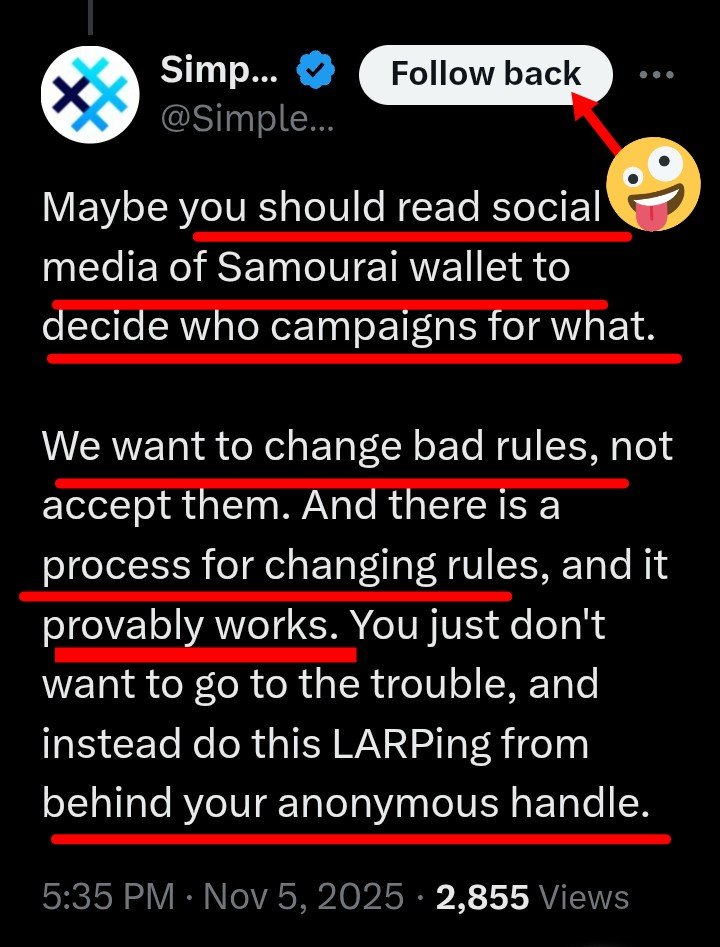
𝐒𝐇𝐈𝐓𝐓𝐘 𝐏𝐎𝐋𝐈𝐓𝐈𝐂𝐈𝐀𝐍𝐒 𝐒𝐇𝐈𝐓𝐓𝐘 𝐉𝐔𝐃𝐆𝐄𝐒 𝐒𝐇𝐈𝐓𝐓𝐘 𝐋𝐀𝐖𝐌𝐀𝐊𝐄𝐑𝐒 𝐒𝐇𝐈𝐓𝐓𝐘 𝐒𝐓𝐀𝐓𝐄 𝐅𝐔𝐂𝐊 𝐘𝐎𝐔 𝐀𝐋𝐋 𝐖𝐄 𝐀𝐑𝐄 𝐀𝐋𝐋 𝐒𝐀𝐌𝐎𝐔𝐑𝐀𝐈 image
LiberLion's avatar
LiberLion 4 months ago
They say that AI will put many people out of work, but here you see how one person will put AI out of work. 😝 Me: Hey Grok, if you had to choose one of the lies Elon Musk told, which would be the biggest? Grok: "[...]Promising a car that drives itself “better than a human” when your own engineers say it’s impossible isn’t marketing—it’s reckless endangerment wrapped in a meme..." 🤣
LiberLion's avatar
LiberLion 4 months ago
Are you sure about this? Why do you blindly believe even in me? My intention is not to be right, but to awaken critical thinking! ALWAYS DYOR!!!! View quoted note →
LiberLion's avatar
LiberLion 4 months ago
Did you know that the #Monero genesis block contains a hidden message in the coinbase field? https://moneroblocks.info/block/0 Look for the "Coinbase" or "Extra" field; it appears in plain text. Why is it visible? And what does the message say? The coinbase field is special in the block (not a regular transaction). It doesn't use RingCT or stealth addresses, so it's not private. From block 1 onward, all transactions are opaque. "The Times 07/Apr/2014 Bank of England warns over digital currencies"
LiberLion's avatar
LiberLion 4 months ago
A mixed system of #privacy and transparency is more vulnerable. Zcash was built to mimic cash in the digital realm: ─Transparent transactions = visible banknotes. ─Shielded transactions = sealed envelopes. Did a major mining pool censor Zcash privacy in 2019? Now imagine one of the biggest miners, F2Pool, mining one out of every five Zcash blocks… but ignoring almost all the sealed envelopes. Out of roughly 86,000 private transactions, it included only 120. That’s 0.14%, when statistically it should’ve been closer to 15–20%. Many of its blocks were even half-empty—filled with transparent notes, leaving the envelopes behind. The founder claimed it was a “technical bug.” Maybe. Or maybe it was quiet compliance with Chinese regulators. No proof, no transparency, just a shrug. This revealed a deeper fragility: Zcash’s architecture allows miners to choose which transactions to include. When a powerful pool skips private ones, privacy stops being universal—it becomes optional. That’s how fungibility breaks: a shielded ZEC no longer equals a transparent one. Fast forward to 2025: the flaw remains possible by design, but no new censorship events have surfaced. Zcash’s ecosystem has more nodes and more shielded-by-default wallets. Still, the lesson stands: if privacy depends on goodwill, it isn’t privacy—it's permission.
LiberLion's avatar
LiberLion 4 months ago
Reading Session Messenger's privacy policy and terms of service reveals no contradictions between what it offers, promises, and its legal statement, but you should be aware of these risks: ─Your IP can be seen by the seed node the first time you connect, even if they say they don’t store it. ─If you download it from the Play Store/App Store, Google/Apple might know you’re using Session, linking it to your real account. ─The website uses Cloudflare for CDN and traffic handling — meaning third parties may log IPs, traffic metadata, etc. ─In section 6.1 of the Session Terms of Service, they accept notifications from third parties (governments, NGOs, users) regarding breaches (CSAM, terrorism, etc.). They review the evidence presented and decide whether to ban Session IDs. A potential breach occurs if someone reports you with screenshots or metadata (e.g., if the police infiltrate a group), and STF(*) can permanently block your Session ID without notifying you. You lose access to contacts and chats (unless you have a backup of your recovery seed). (*)STF (Session Technology Foundation) is a Swiss non-profit foundation dedicated to promoting digital innovation and digital rights, with a focus on privacy and secure communication. 🛠️ Want real privacy? Use a VPN or the Tor network plus download from a standalone source (e.g., APK or F-Droid) rather than using the Play/App Store. 👁️ 👁️ Otherwise, your “anonymity” may end up in the hands of The Big Brother.
LiberLion's avatar
LiberLion 4 months ago
Absolute privacy is very difficult to achieve, but some apps continue to sell that illusion. SimpleX Chat claims to be the most private messenger in the world. No identifiers, no metadata, no tracking. Sounds good… until you read the fine print in its own policy. Metadata matters, and in some cases more than the data itself. Let's see. It states that “there are no user identifiers, not even hashes or keys.” Yet it admits that servers may store IP addresses, geolocation, and session data to prevent abuse. So which is it? That clause opens the first crack: if IP and location are stored, a technical fingerprint exists. The system may lack usernames, but it still leaves transport traces that can reconstruct identity. It also says servers “cannot know the size of your messages.” Then explains that messages are padded to 16 KB. Meaning they can see the size — it’s just fixed. Privacy through normalization, not invisibility. Public and group messages are another front. SimpleX notes that when you delete a message, “copies on other users’ devices will not be deleted.” User sovereignty ends where others’ devices begin. The infrastructure is decentralized, but servers are community-run. If a third party operates a relay, they can log traffic or IPs. Real anonymity depends on the trustworthiness of operators you’ll never meet. In practice, SimpleX works like a mixnet with distributed trust, not like a fully anonymous network such as Tor. It’s a step forward, yes, but the “no identifiers” marketing sets impossible expectations. The policy claims the company cannot comply with legal requests because it “has no data.” Yet it’s registered in the UK, where the Investigatory Powers Act allows authorities to demand technical cooperation. Real privacy isn’t the same as promised privacy. The system might be well-engineered, but when a policy mixes absolutes (“no data”) with exceptions (“temporarily IP”), the risk hides in the ambiguity. Read every privacy policy as if it were code. Each “we don’t collect” comes with an exception when. Each “anonymous” with an up to a point. Absolute privacy is an ideal not achieved in this product.
LiberLion's avatar
LiberLion 4 months ago
The U.S. government has adopted Bitcoin as a treasury reserve asset and stablecoins as the tool to tokenize the dollar. All roads lead to the final step: the eDollar, the U.S. government’s CBDC. Meanwhile, Monero is emerging as the sovereign peer-to-peer money chosen by the people. #Bitcoin for the government #Monero for the people.
LiberLion's avatar
LiberLion 4 months ago
The Emerging Technocratic Structure: Palantir, OpenAI, and the Future of Government Technocracy is no longer a theory; it’s living infrastructure. Palantir and OpenAI are building the operating system of governance. Foundry and AIP merge data from defense, health, finance, and immigration into a single digital brain. Government no longer “consults” the AI — the AI decides, executes, and corrects itself. “OpenAI for Government” runs on Palantir’s classified clouds, managing drones and cyber defense. ORION, the artificial diplomat, drafts policies and negotiates in 47 languages. Bureaucrats don’t vanish — they become decoration. The model exports worldwide under “sovereign” brands, but every backend routes through U.S. stacks. Palantir and OpenAI monetize politics: governance-as-a-service, without votes or treaties. And if one day the citizens’ will contradicts the operating system, which one shuts down first?
LiberLion's avatar
LiberLion 4 months ago
From Energy Credits to Carbon Quotas: The Thermodynamics of Control ᴬⁿᵃˡʸᶻᵉ ʰⁱˢᵗᵒʳʸ ᵗᵒ ᵘⁿᵈᵉʳˢᵗᵃⁿᵈ ᵗʰᵉ ᵖʳᵉˢᵉⁿᵗ ᵃⁿᵈ ᶠᵒʳᵉˢᵉᵉ ᵗʰᵉ ᶠᵘᵗᵘʳᵉ Modern technocracy was first proposed in 1932 by engineer Howard Scott, who founded the Technocracy Inc. movement in the US. He suggested replacing politicians with scientists and engineers to manage society as an "efficient machine," measuring the economy in units of energy (ergios) rather than money. Technocracy in 1932 dreamed of ditching money for pure energy certificates—ergios, non-transferable. Your paycheck? A slice of the nation’s total power, split equally among citizens. Carbon footprints flip the script: instead of handing out energy, we ration the CO₂ the planet can handle. Exceed your share and you buy credits or lose climate privileges. In technocracy, no saving, no trading—use it or lose it. With carbon, the wealthy scoop up spare quotas from the poor and keep polluting. Energy equality meets climate inequality. Both boil down to social thermodynamics. One tracks the energy we burn, the other the heat we dump. The real question: who sets the cap? Merge the two and you get a world where your daily energy arrives in an envelope and your CO₂ fits in an app. No cash, just heat and work balances. Ultimate efficiency—or ultimate control?
LiberLion's avatar
LiberLion 4 months ago
Monero is the digital reincarnation of ancient cash. In ancient Rome, Greece, or Mesopotamia, you handed over a silver drachma or shekel. No one knew where it came from. No ledger recorded your name. The coin had zero transaction history—pure, fungible privacy. Bitcoin? That’s the Roman tax scroll: every movement etched in stone forever. Monero? It’s the drachma 2.0. Ring signatures mix your transaction with decoys (like tossing your coin into a crowded agora), stealth addresses hide the recipient, and RingCT blinds the amount. Result: true cash-like anonymity on a blockchain. Fun bonus: The word “Monero” means “coin” in Esperanto—a nod to the universal, borderless money humans have used since Lydia minted the first coins ~600 BC. So next time you send XMR, you’re not just transacting… you’re channeling a 2,600-year-old rebel tradition of private money. Want another? The U.S. government once offered $625,000 bounties to crack Monero tracing—more than the price of a small ancient kingdom!
LiberLion's avatar
LiberLion 5 months ago
From Reactive to Predictive: AI's New Era of Surveillance Surveillance in the AI era is no longer what it was. There has been a transition from "recording just in case" to "analyzing to anticipate." The change is profound: a passive and reactive model is being abandoned for an active and predictive one. This transforms the nature of power and control. The old model was PASSIVE and REACTIVE. Consider a classic security camera: ─Passive: Its only function was to record and store video on a disk. It did nothing with that information. ─Reactive: If a robbery occurred, the police reacted by requesting the tape to investigate after the fact. It focused 100% on the past. The new model is ACTIVE. An AI system does not just record; it analyzes video in real time. It actively identifies objects, faces, and license plates. It interprets behaviors (like someone loitering or a restless crowd). The machine is no longer a simple storage unit; it is a sentinel that "understands" what it sees. The great leap occurs when the model becomes PREDICTIVE. By cross-referencing real-time data (what it sees) with historical data (crime patterns), AI stops reacting to the past and starts anticipating the future: ─It alerts about "suspicious behavior" before a crime occurs. ─It predicts where a crime is most likely to happen. Yes, I know, you're thinking of the movie Minority Report. In summary: ─Before (Passive/Reactive): A video archive to investigate the past. ─Now (Active/Predictive): A system that analyzes the present to intervene in the future. The objective of AI-driven surveillance is no longer just to record what happened, but to actively shape what is about to happen.