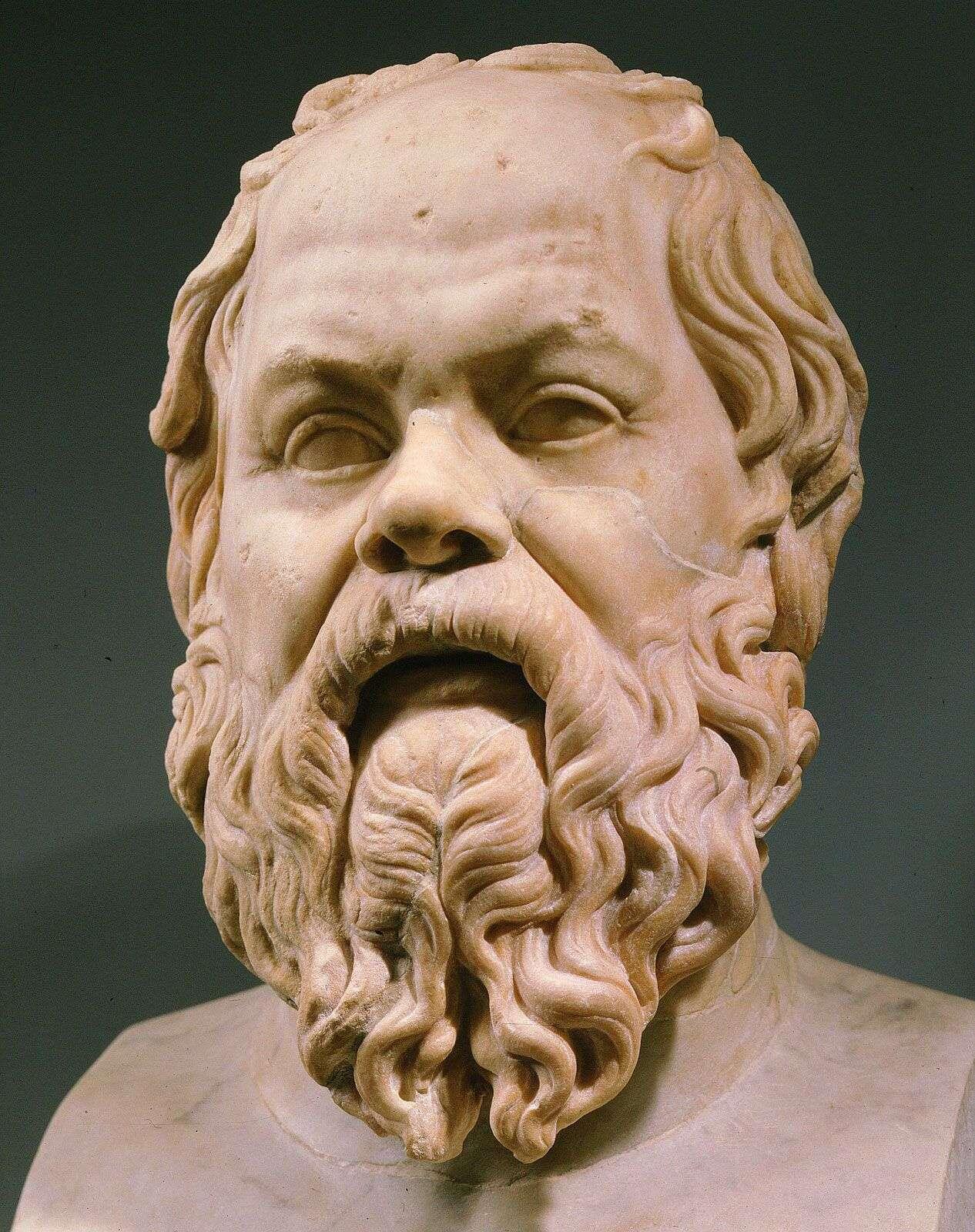
"Once made equal to man, woman becomes his superior."
"I decided that it was not wisdom that enabled [poets] to write their poetry, but a kind of instinct or inspiration, such as you find in seers and prophets who deliver all their sublime messages without knowing in the least what they mean."
"Human nature will not easily find a better helper than Eros"
"God would seem to indicate to us and not allow us to doubt that these beautiful poems are not human or the work of man, but divine and the work of God; and that the poets are only the interpreters of the Gods..."
"He who is unable to live in society, or who has no need because he is sufficient for himself, must be either a beast or a god."
"It is better to change an opinion than to persist in a wrong one."
"Do not do to others what angers you if done to you by others."
"Every action has its pleasures and its price."
"Beware the barrenness of a busy life."
"Give me beauty in the inward soul; may the outward and the inward man be at one."
"The mind is everything; what you think you become."
"My plainness of speech makes them hate me, and what is their hatred but a proof that I am speaking the truth."
"We approach truth only inasmuch as we depart from life. For what do we, who love truth, strive after in life? To free ourselves from the body, and from all the evil that is caused by the life of the body! If so, then how can we fail to be glad when death comes to us? The wise man seeks death all his life and therefore death is not terrible to him."
"And so they grow richer and richer, and the more they think of making a fortune the less they think of virtue; for when riches and virtue are placed together in the scales of the balance, the one always rises as the other falls."
"How many things can I do without?"
"Neither in war nor yet at law ought any man to use every way of escaping death. For often in battle there is no doubt that if a man will throw away his arms, and fall on his knees before his pursuers, he may escape death; and in other dangers there are other ways of escaping death, if a man is willing to say and do anything. The difficulty, my friends, is not in avoiding death, but in avoiding unrighteousness; for that runs faster than death."
"Our youth now love luxury. They have bad manners, contempt for authority; they show disrespect for their elders and love chatter in place of exercise; they no longer rise when elders enter the room; they contradict their parents, chatter before company; gobble up their food and tyrannize their teachers."
"The really important thing is not to live, but to live well. And to live well meant, along with more enjoyable things in life, to live according to your principles."
"I examined the poets, and I look on them as people whose talent overawes both themselves and others, people who present themselves as wise men and are taken as such, when they are nothing of the sort. From poets, I moved to artists. No one was more ignorant about the arts than I; no one was more convinced that artists possessed really beautiful secrets. However, I noticed that their condition was no better than that of the poets and that both of them have the same misconceptions. Because the most skillful among them excel in their specialty, they look upon themselves as the wisest of men. In my eyes, this presumption completely tarnished their knowledge. As a result, putting myself in the place of the oracle and asking myself what I would prefer to be — what I was or what they were, to know what they have learned or to know that I know nothing — I replied to myself and to the god: I wish to remain who I am."
"I thought that as I had failed in the contemplation of true existence, I ought to be careful that I did not lose the eye of my soul; as people may injure their bodily eye by observing and gazing on the sun during an eclipse, unless they take the precaution of looking at the image reflected in the water, or in some similar medium. ...I was afraid that my soul might be blinded altogether if I looked at things with my eyes or tried by the help of my senses to apprehend them. And I thought that I had better had recourse to ideas, and seek in them truth in existence. I dare to say that the simile is not perfect--for I am far from admitting that he who contemplates existence through the medium of ideas, sees them only "through a glass darkly," any more than he who sees them in their working and effects."