Consistently late public transit is self-defeating during a time when American transit agencies try to lure more riders.
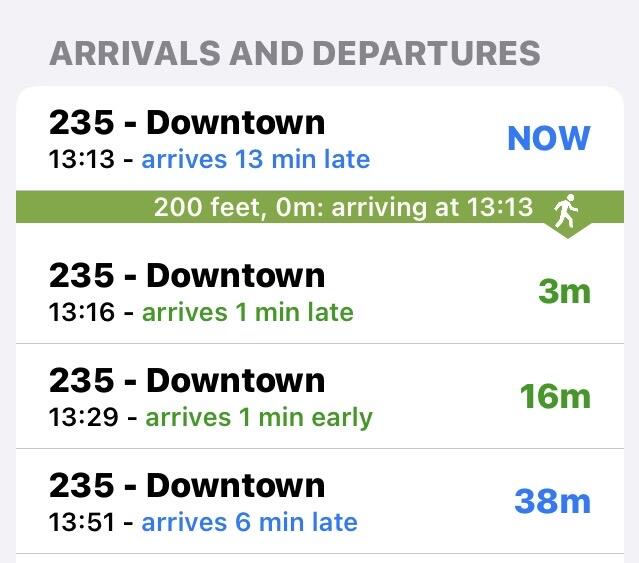
I ride transit several times a week. Usually here in San Diego, the bus is often a little bit late. But sometimes you get those real bad days…
The city of San Diego lately has adopted new rules for community planning. One of the newer ones is allowing alternative planning groups to challenge the existing one. The city believes many of the old guard community planning groups aggressively oppose almost all density projects and public transit enhancements to the chagrin of many. It is argued that the old guard community planning groups membership is inclusive to land-owning elite, and off limits to the broader neighborhood population. The logic follows that renters, minorities and density-minded people, who make up a larger percentage of neighborhood population than the elite, have little to no say in how their neighborhood should grow.
I am no fan of much of what the government in San Diego does, but maybe they’re barking up the right tree with this newer policy.
San Diego city has a budget deficit for the next fiscal year, which I believe starts 1 July. One immediate cut they’ve made is to bus service. For example the airport bus converts to a 1/2 hour schedule after 7pm. Some weekend buses are also 1/2 hour waits now all day.
FREQUENCY is one of the pillars of having a robust transit system. People who have a choice of driving or using the bus will choose the former. No one who has a choice will want to wait 1/2 hour.
…and if the bus is late, which is common, then 1/2 hour becomes 35-40 minute frequency.
#SDMTS #sandiego #transit
Crossing the street in the USA…
1/3 of the sidewalk eaten up by this guy. These types of trucks can be invaluable for construction work, frequent heavy load carries, etc. But otherwise their sheer size make them very impractical in a dense urban setting.
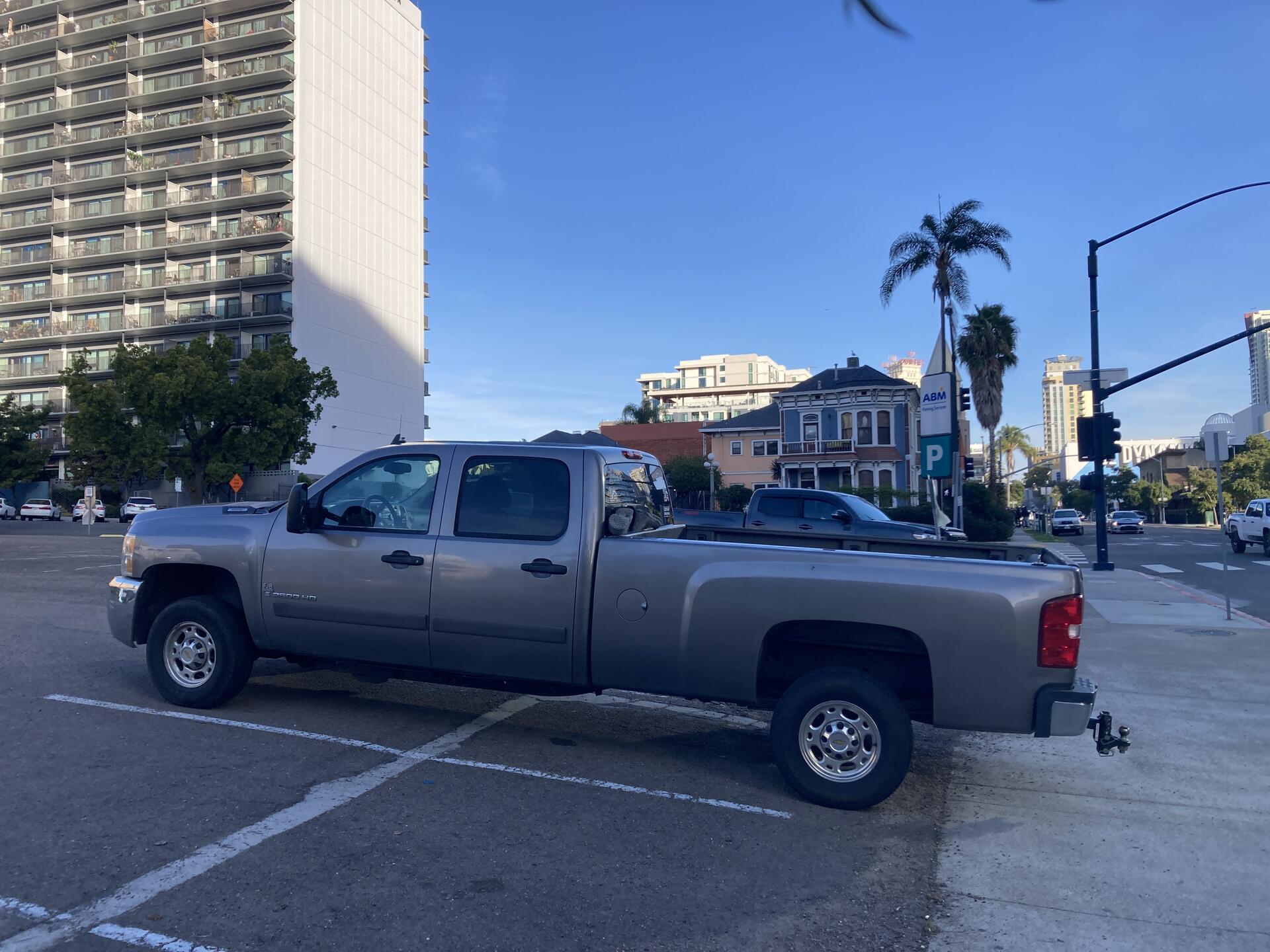
This picture is intended to pair with the prior post…

San Diego city officials have done a lot over the last half century to revitalize downtown. As you can see in this picture it’s mostly been successful.
One thing that has happened in the city’s evolution is the increase in tourism to downtown (of course) and a change in pedestrian safety.
In this picture you can see what has become quite normal: a car parks in a crosswalk by a hotel. Add to this drivers driving way too fast on local streets, and the plague of eScooters flying down sidewalks, and you get a recipe for disaster.
As city center’s re-urbanize city planners and politicians must remember one of the keys that make vibrant downtown neighborhoods great: walkability and bicycle-ability.
Grossmont Center mall in La Mesa, CA is not far from San Diego.
Look at all this asphalt. A few times a year it fills up, but most days a lot of it is empty and baking in the sun.
So why not build dense and affordable housing here? The mall could serve as a “downtown”. Bus and light rail is nearby.

Many cities believe they must have a gimmick to attract tourists.
One such rouse the city of San Diego uses is it’s “world famous “ zoo.
There are many rubs to this topic but one that is particularly evil is a century-old mill tax instituted for maintenance of the zoo. Nowadays the amount is .05 cents for every hundred dollars worth of real estate value a landowner has.
The median home price in San Diego is in the high hundreds of thousands.
The local newspaper San Diego Union Tribune reported on June 27, 2022 that the zoo was raking in almost $18 million dollars with this sneaky tax.
The paper also reported that although most citizens don’t hold zoo passes they still have to pay. They cannot opt out. Even if anyone of them is morally against the imprisoning of animals. Tax payers don’t even get a discount on entry tickets.

Several San Diego neighborhoods are pressing the city to introduce traffic calming measures to induce drivers to slow down.
After all the city has a zero pedestrian death goal by 2025!!!!
Over the recent years San Diego city has been listening to various concerned neighborhood groups about unsafe driving, although not always acting quickly. Bureaucracies are slow and projects are expensive.
But why not start meaningful traffic calming measures sooner? There are some that could be instituted quickly with low cost: turn several stop lighted intersections into red light blinking four way stops. Or change the timing of the stop lights so that they don’t encourage drivers to speed to catch the next green light.
The good news is that the city has been slowly but surely reducing several 3 lane roads to 2 lane roads, creating roundabouts, creating a pedestrian zone in a major tourist area downtown, and set up pedestrian crossing lights on a few busy streets.
In conclusion, I acknowledge we are a suburb nation that needs cars. But we are interested again in our urban city cores. The former has conditioned us to drive a lot, and quickly. The latter encourages walking, public transit and less car use over all.
Several San Diego neighborhoods are pressing the city to introduce traffic calming measures to induce drivers to slow down.
After all the city has a zero pedestrian death goal by 2025!!!!
Over the recent years San Diego city has been listening to various concerned neighborhood groups about unsafe driving, although not always acting quickly. Bureaucracies are slow and projects are expensive.
But why not start meaningful traffic calming measures sooner? There are some that could be instituted quickly with low cost: turn several stop lighted intersections into red light blinking four way stops. Or change the timing of the stop lights so that they don’t encourage drivers to speed to catch the next green light.
The good news is that the city has been slowly but surely reducing several 3 lane roads to 2 lane roads, creating roundabouts, creating a pedestrian zone in a major tourist area downtown, and set up pedestrian crossing lights on a few busy streets.
In conclusion, I acknowledge we are a suburb nation that needs cars. But we are interested again in our urban city cores. The former has conditioned us to drive a lot, and quickly. The latter encourages walking, public transit and less car use over all.
Several San Diego neighborhoods are pressing the city to introduce traffic calming measures to induce drivers to slow down.
After all the city has a zero pedestrian death goal by 2025!!!!
Over the recent years San Diego city has been listening to various concerned neighborhood groups about unsafe driving, although not always acting quickly. Bureaucracies are slow and projects are expensive.
But why not start meaningful traffic calming measures sooner? There are some that could be instituted quickly with low cost: turn several stop lighted intersections into red light blinking four way stops. Or change the timing of the stop lights so that they don’t encourage drivers to speed to catch the next green light.
The good news is that the city has been slowly but surely reducing several 3 lane roads to 2 lane roads, creating roundabouts, creating a pedestrian zone in a major tourist area downtown, and set up pedestrian crossing lights on a few busy streets.
In conclusion, I acknowledge we are a suburb nation that needs cars. But we are interested again in our urban city cores. The former has conditioned us to drive a lot, and quickly. The latter encourages walking, public transit and less car use over all.
Several San Diego neighborhoods are pressing the city to introduce traffic calming measures to induce drivers to slow down.
After all the city has a zero pedestrian death goal by 2025!!!!
Over the recent years San Diego city has been listening to various concerned neighborhood groups about unsafe driving, although not always acting quickly. Bureaucracies are slow and projects are expensive.
But why not start meaningful traffic calming measures sooner? There are some that could be instituted quickly with low cost: turn several stop lighted intersections into red light blinking four way stops. Or change the timing of the stop lights so that they don’t encourage drivers to speed to catch the next green light.
The good news is that the city has been slowly but surely reducing several 3 lane roads to 2 lane roads, creating roundabouts, creating a pedestrian zone in a major tourist area downtown, and set up pedestrian crossing lights on a few busy streets.
In conclusion, I acknowledge we are a suburb nation that needs cars. But we are interested again in our urban city cores. The former has conditioned us to drive a lot, and quickly. The latter encourages walking, public transit and less car use over all.
We will always drive too fast.
It’s crazy that an average car is capable of being driven at 80 mph, or 100 mph, or (for some) 160 mph.
But in neighborhoods the speed limit is often 25 mph or slower.
Problems linked to chronic homelessness in downtown has banded together several business owners in a particularly hard hit area. They are threatening to sue the city if the city doesn’t start enforcing laws on the books to try and prevent homeless-linked crime happening on their doorsteps.
They claim there’s legal precedent from a similar situation in Phoenix.
This burned-out shell was formerly a church called God’s Extended Hand, and mostly served the chronically homeless.
Located in downtown San Diego it’s right on the edge of where recently built high rises meet utter squalor.
The age-old question arises then on to citify the area. Where will the chronically homeless go?
#sandiego #eastvillage

I use public transportation, having given up my car. My family is a one-car family.
No regrets over it.
But I won’t lie, when city buses are constantly late it does start to suck.