Lyudmyla Kozlovska's avatar
Lyudmyla Kozlovska
lyuda_ODF@BitcoinNostr.com
npub13ajk...2yd9
President of the Open Dialogue Foundation, founder of BTC Coalition in the EU Support our advocacy for #freedomtech : donate@bps.odfoundation.eu
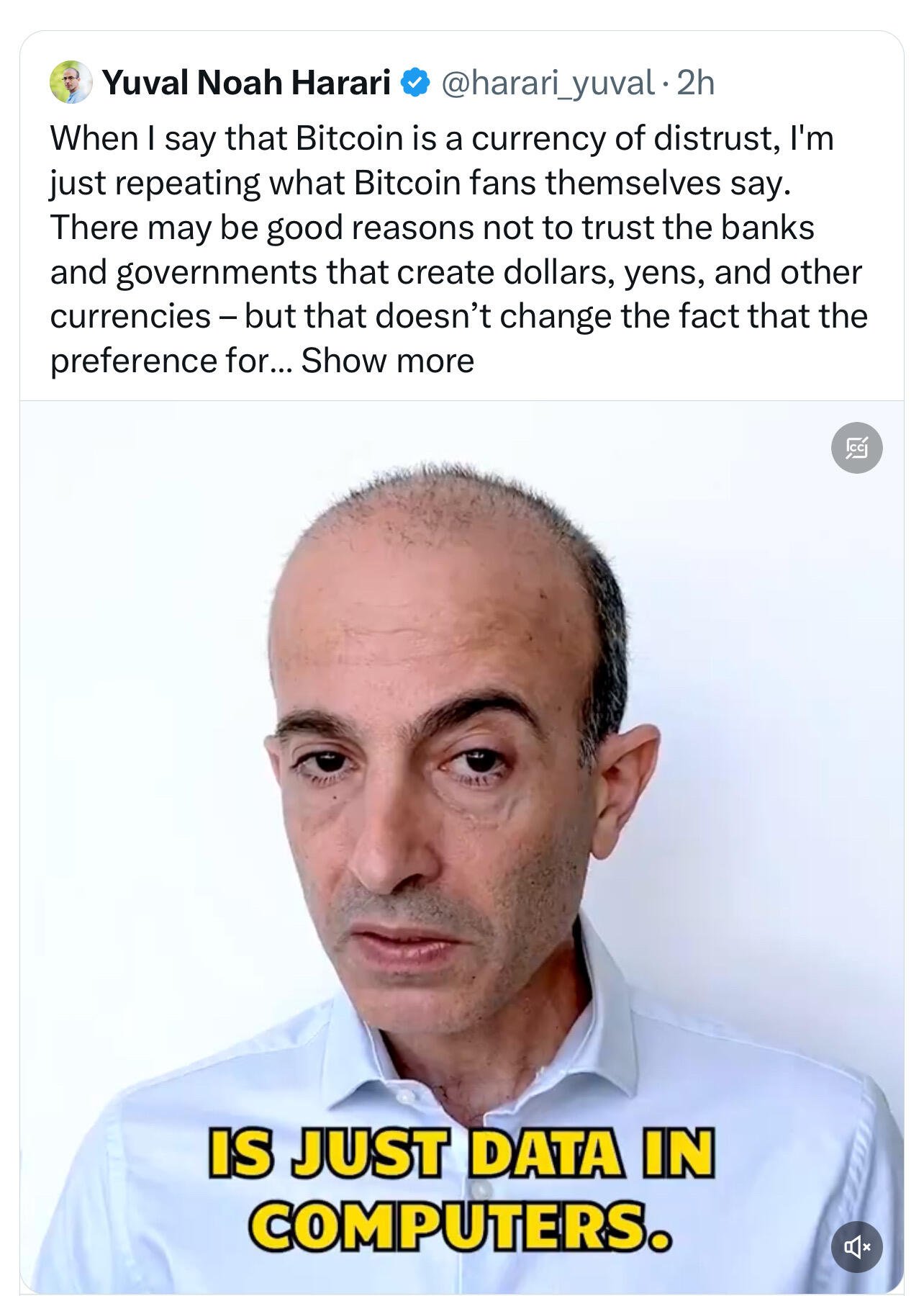
#Bitcoin is built on a consensus “trust but verify”, or Proof-of-Work. Bitcoin was created to defend human rights & to RESTORE TRUST, because authoritarian governments systematically abuse trust, abuse power and weaponize banking data. It is so easy to label with false claims #freedomtech when you enjoy privilege of western world as @harari_yuval and don’t need to use Bitcoin as the only tool against financial transnational repression. image
Join me to discuss the need to defend Liberty in Tech in livestream event on Thursday, May 23 from 12:30p to 2:30p ET. How #freedomtech can safeguard from financial exclusion in authoritarian countries? Why and how we must protect #bitcoin  developers, investors, miners and end-users from excessive regulation in the G7? Free Speech or Double Speak? Jefferson in 1776 or Orwell in 1984? Gold, Dollars, or Bitcoin ETF? Deep Fakes or Truth? What’s a CBDC or a stablecoin? We will explore all these questions and how emerging technologies have the potential to shape the future of humanity, either ushering in a golden age or enabling a dystopian world controlled by the elite. Together with me in a live podcast will participate: Curtis Loftis @TreasurerLoftis , South Carolina State Treasurer Dr. W. Scott Stornetta @ScottStornetta , Yugen Partners, cited in #Bitcoin  Whitepaper & Teacher Shawnna Hoffman , Guardrail Foundation David Johnston @DJohnstonEC , Morpheus AI Carlos Toriello @carlostoriello , Proof of Elections on Bitcoin Erik Bravik , Manifest Network SCETA will be livestreaming this event over Facebook, YouTube, LinkedIn and X Spaces. You can sign up at Eventbrite to be notified of events or you can bookmark one of our social media links and join the event May 23 at 12:30p ET. Facebook - lnkd.in/eZXt9PHf YouTube - lnkd.in/ebTW5Hg2 LinkedIn - lnkd.in/enFBP8zg X Spaces - lnkd.in/eynmuX5A Please mark your calendars and attend this informational event! image
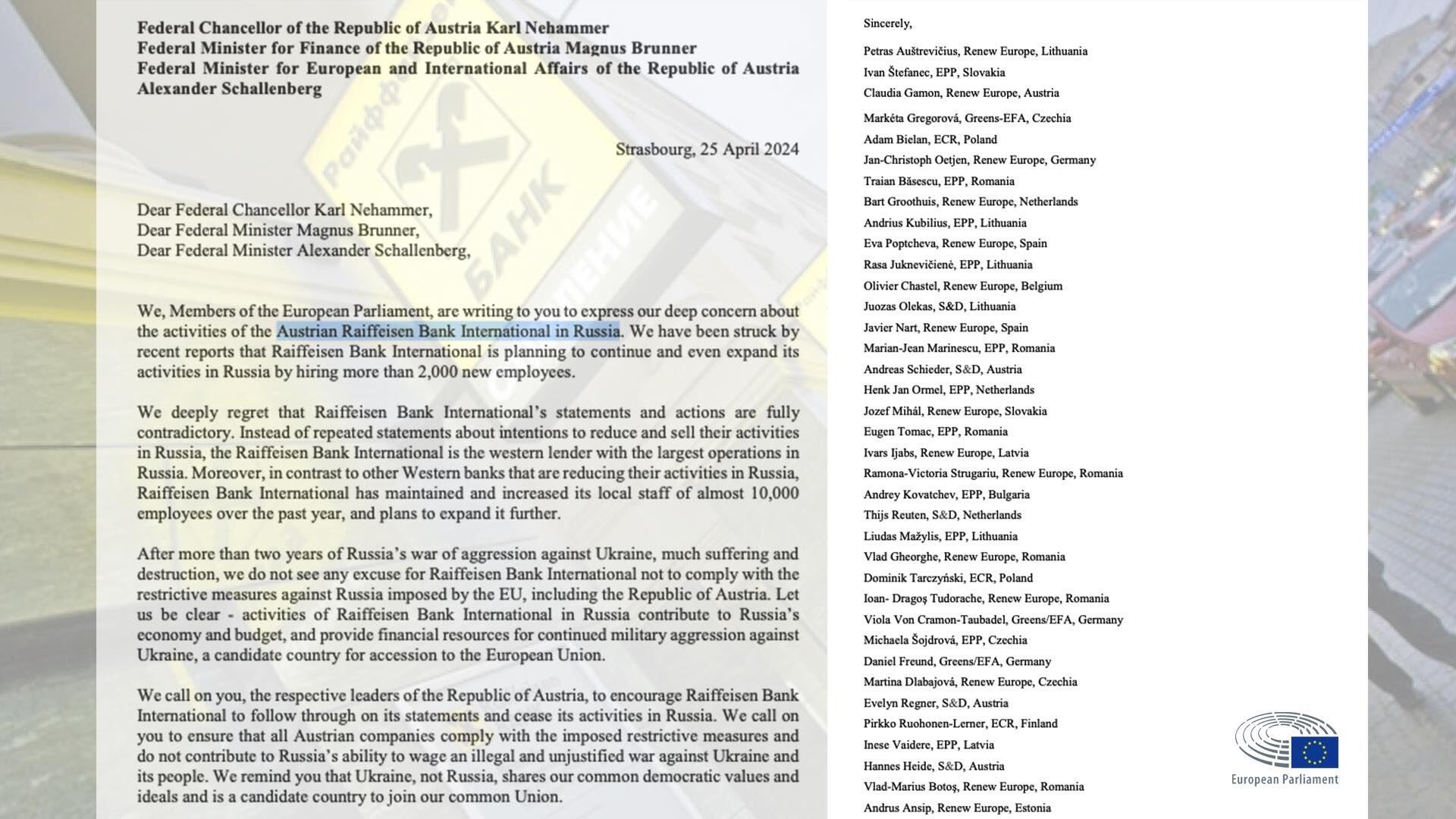
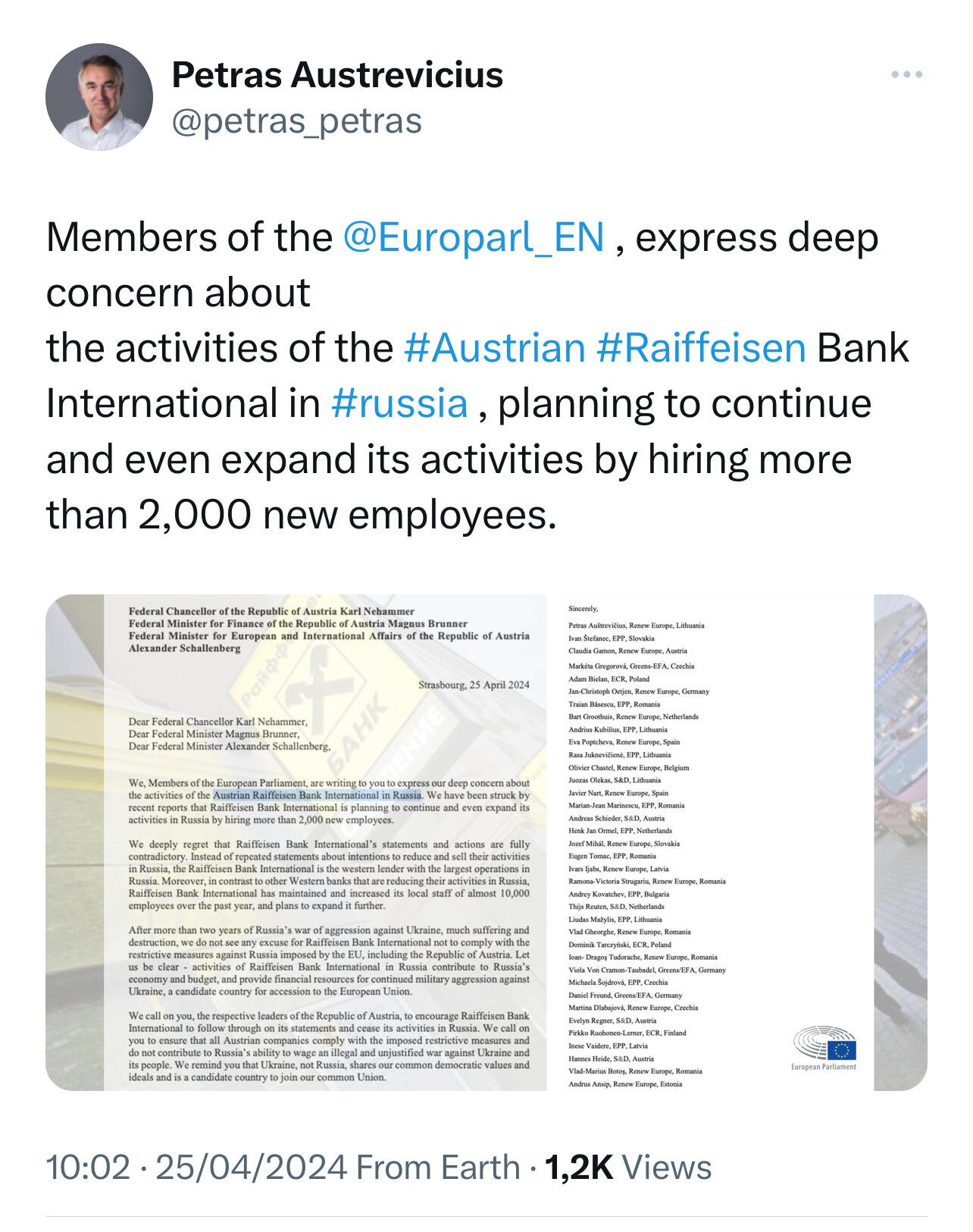
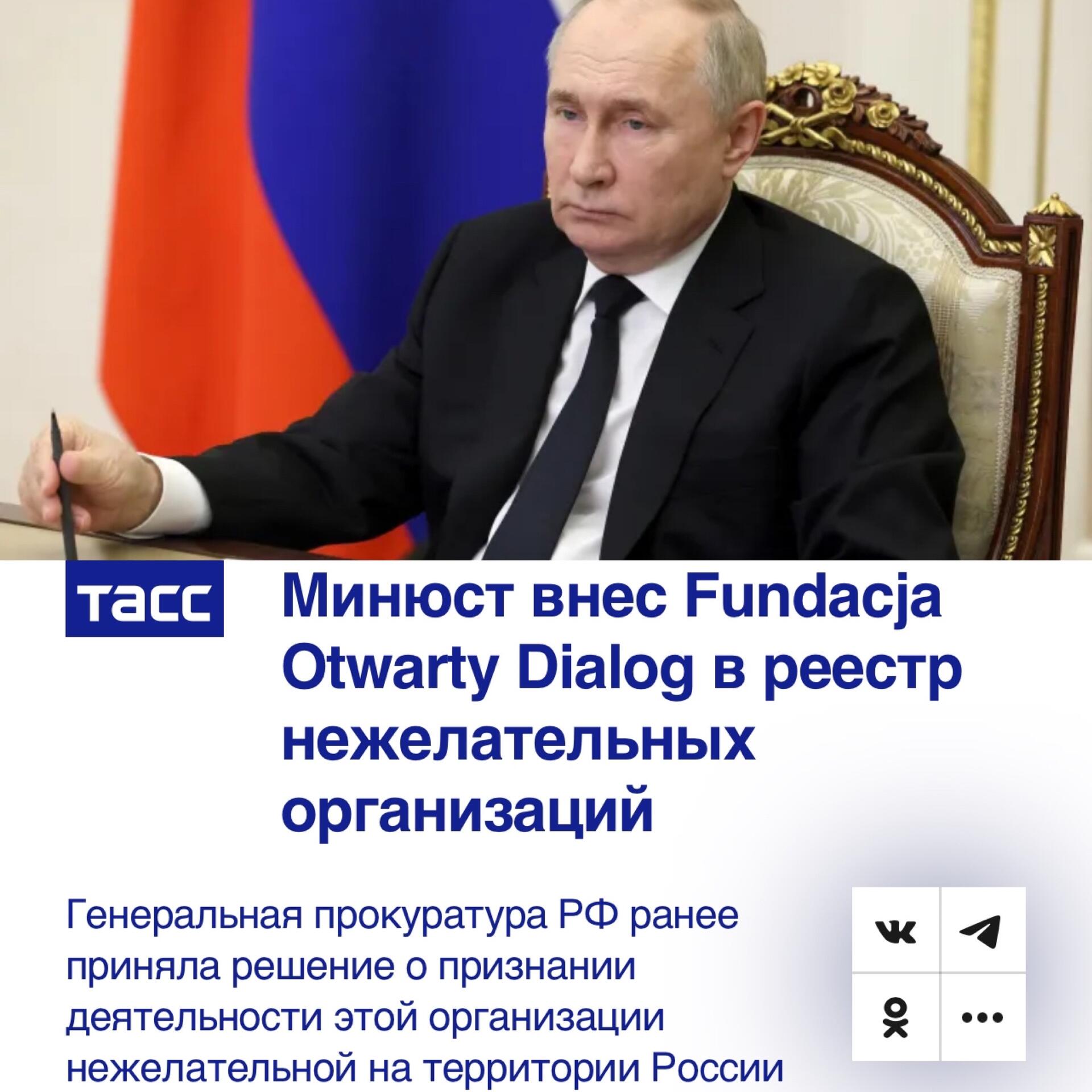
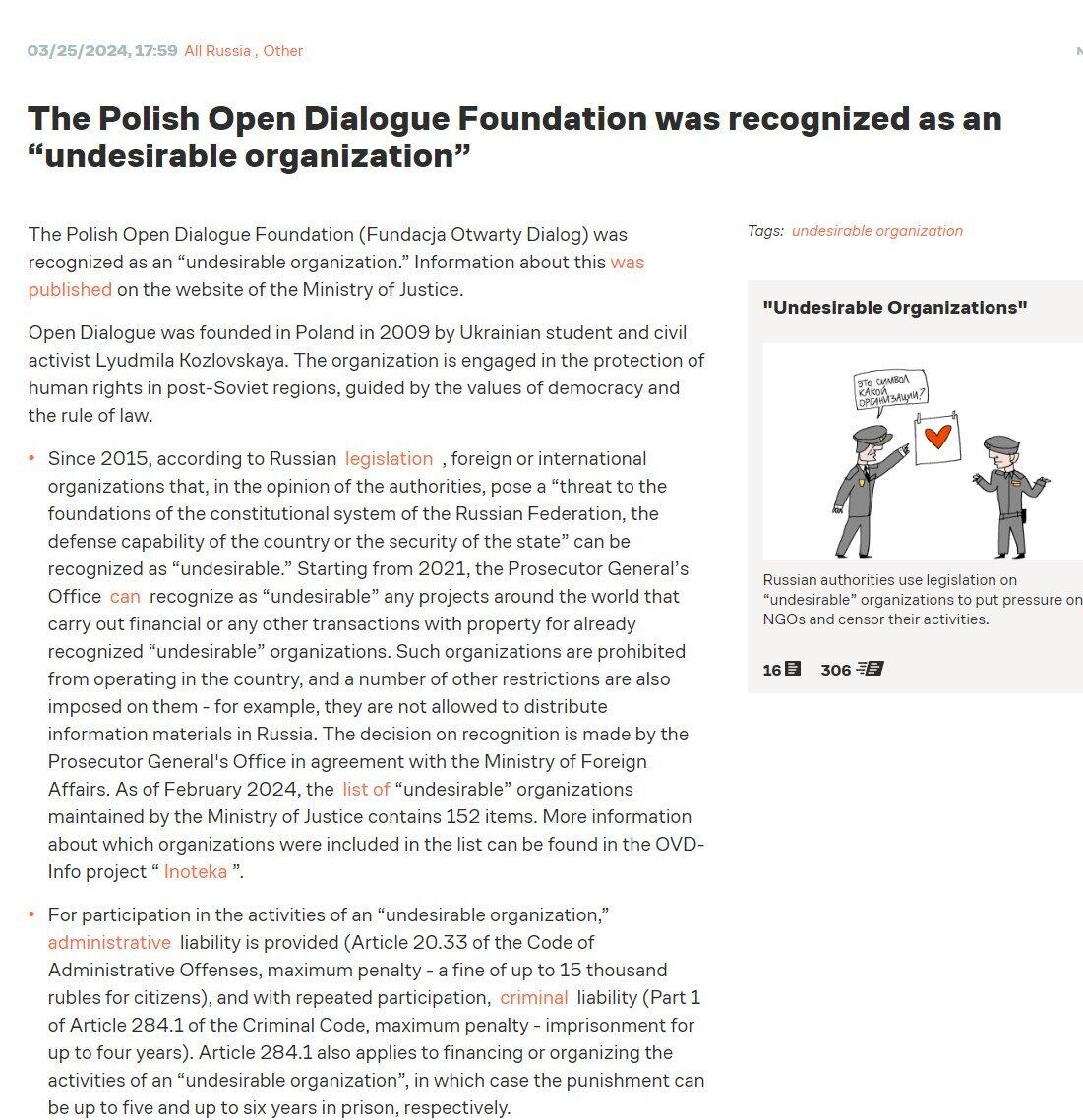
One more proof: the banking system is the best tool for money laundering or evade sanctions by those in power in dictatorial countries. Dictators don't need #Bitcoin  wallets or mixers, they prefer banks, and better for them if it is western banks. For some reason, the current AML/CFT rules do not work to prevent such cases. Will #Raiffeisen Bank be held accountable by #SDNY, #ECB and #FATF? BTW, Raiffeisen Bank has no problem de-risking such organisation as Open Dialogue Foundation, but prefers to work with Putin's regime.
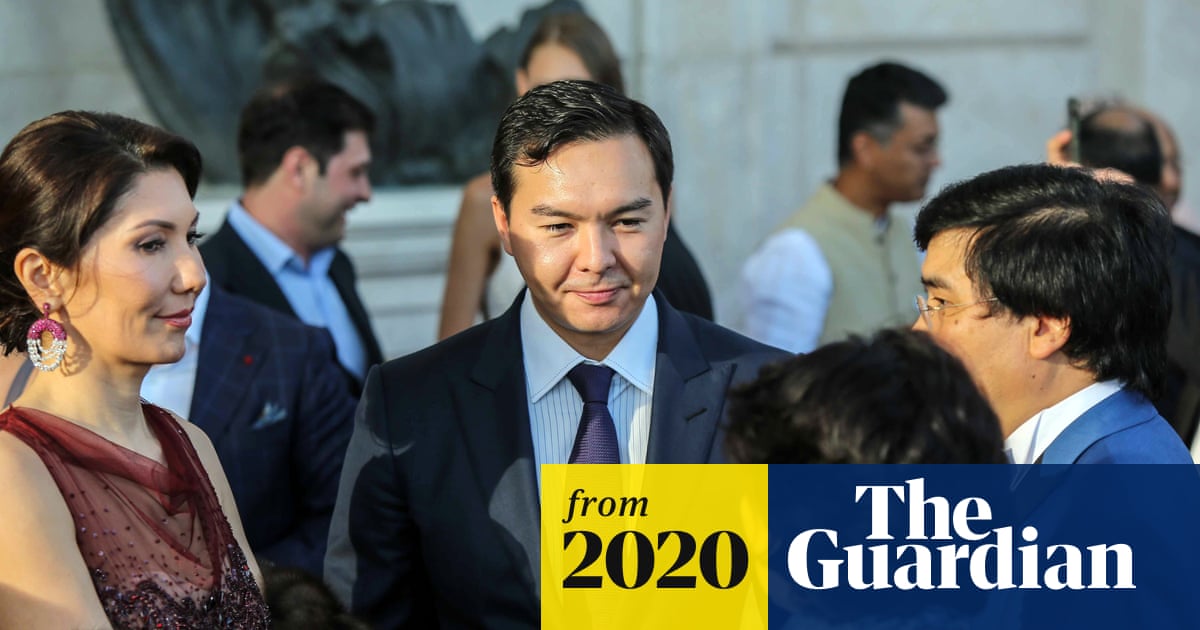
Since US law enforcement agencies have been able to identify a money laundering offence involving this particular wallet, then they are well equipped to detect such crimes, and there is no need to criminalise mixers or #bitcoin wallets as a technology and its developers in general. This is exactly what we talk about in our meetings with regulators: we understand that US law enforcement has all the tools to track #Bitcoin  transactions on the blockchain. That is why real criminals, and even more so oligarchs, use completely different schemes to launder dirty money. Besides, Western intelligence services are diligently training dictatorial regimes how to recognise both traditional banking and crypto-assets transactions, so the oligarchs have this knowledge from the intelligence services under their control in non-democratic countries. They don't want and don’t need to use such tools. And to be precise, I definitely think it's very harmful to promote or ask oligarchs, criminals to use your privacy payment tools. It gives more opportunities to weaponise this kind of rhetoric by any kind of government. Our 15 years of human rights practice shows that real oligarchs prefer other tools for laundering dirty money. For example, the daughter of dictator Nursultan #Nazarbayev, Dariga #Nazarbayeva - #UK law enforcement authorities failed in their attempts to hold her accountable for money laundering. Kazakhstani regime used political lobbyists, expensive Western law firms, and the Kazakhstani state apparatus to succeed in laundering her dirty money. This scheme works for the oligarchs, people who have stolen billions from the budget of a country where their family members have been in power for decades, politically persecuting any dissent, torturing and killing. They do not need mixers, they have perfectly mastered money laundering schemes through investments in expensive real estate and consultations with former higher officials, top Western law firms. Mixers and self-hosted wallets, on the other hand, are used by activists who are financially excluded by authoritarian regimes and do not have the privilege to use banking services in general due to political repression. Moreover, the knowledge of US intelligence agencies is used to financially exclude regime critics and their family members both domestically and transnationally. This is exactly what #Turkey, #Kazakhstan and other regimes do all the time, sharing knowledge gained from Western partners with #Russia, #Iran, #China to repress dissenters abroad. In less than 5 minutes Kazakhstan blocks fundraising via bank account or @stripe for families of political prisoners, so bitcoin p2p transactions and mixers are currently the only instrument to protect human rights in such authoritarian countries. Regimes can trace such transactions, but they can't stop them and so far it has helped save lives. Therefore, an effective fight against money laundering would begin not with the criminalisation of privacy payment tools and their developers, but with ending the impunity of authoritarian regimes and their oligarchs in using legal schemes to circumvent sanctions through the banking systems of third countries.
The European Parliament today adopted by a majority vote an AML Regulation that: 🔻 on the one hand - contains important provisions to combat crime, 🔻 on the other hand - results in a significant reduction in financial freedoms, increased risks of abuse of AML regulation by dictatorial regimes, and attacks on self-hosted wallets, crowdfunding and privacy instruments, as well as a lack of protection against financial exclusion and unwarranted de-risking. Informally, we have heard from MPs and some regulators that the main reason for the weakening of the EP's position in defence of privacy and financial inclusion remedies has been the strong demand for security protections during public consultations before Trilogue process. Both media, academics, banking and crypto-asset industry representatives - all of them are 'happy' about the upcoming #AMLR, as you can see in influencer publications. ❗️To change the situation, it is crucial: 🔻 to have a serious public debate on the importance of privacy of payment instruments, protection of crowdfunding, financial inclusion during and immediately after the European Parliament elections. 🔻 your activism will determine how much politicians elected to the #EU institutions understand the social importance of #bitcoin  for the protection of financial freedoms, how AML/CFT laws are actually abused for political persecution of critics, and how banking systems of authoritarian countries are used for large-scale laundering of dirty money, circumventing sanctions and undermining the democratic order in the EU. 🔻 we need to build a strong community in defence of privacy and financial freedoms in the EU, as US bitcoin community did and continue to defend their #freedomtech. 🔻let's unite to achieve this goal before this draconian law goes into power in 2027. It's not enough to just complain on social media or pack your bags. We need our voice to be heard and defend our rights so that every MP, academic, journalist from your region in the EU understands why privacy and the financial freedoms that bitcoin gives you are important to you and them, so that this topic becomes an agenda in the public space. It's called defending your civil and human rights freedoms. Ready? RT, and write + under the post to join campaign.
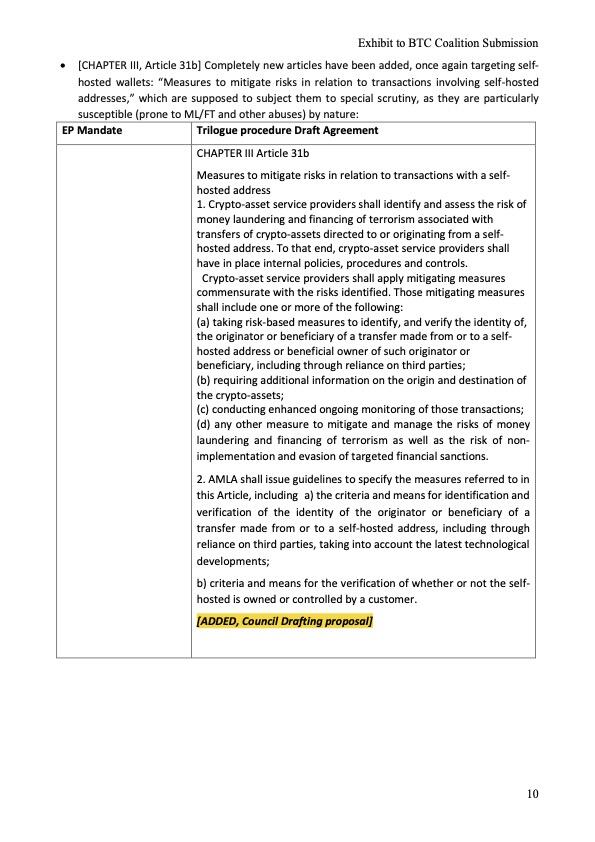
3. #EU #AML PROPOSAL TARGETS PRIVACY PAYMENT INSTRUMENTS AND FREEDOM TOOLS The current AMLR version specifically targets self-hosted wallets, ignoring their role as vital financial tools as #Bitcoin  for millions of activists facing financial oppression. Labeled high-risk, self-hosted wallets are now seen as significant money laundering and terrorist financing facilitators. Changes include revisions to Recitals (20) and (21) and the addition of Article (31b) in Charter III, which increases operational and compliance costs, affecting business strategies and client relationships. The consequences for EU users of self-hosted wallets are serious. Additional compliance checks will complicate, if not block, the conversion of crypto-assets to fiat currency for activists and civil society members already facing financial exclusion. The AMLR overlooks the crucial role of self-hosted wallets in transferring funds to non-democratic or conflict regions, exposing donors and recipients to repression by authoritarian regimes using AML/CFT laws (e.g., in #Belarus, #Kazakhstan, #Turkey). Smaller clients with self-hosted wallets, viewed as higher risks under Article (31b), may be deprioritized or excluded due to higher transaction compliance costs. This makes them economically unviable for financial institutions, which often favor larger, lower-risk clients for efficiency. The latest AMLR version could effectively ban self-hosted wallets in the EU, significantly impacting the cryptocurrency sector and those vulnerable to oppression. See our reaction in our Submission:
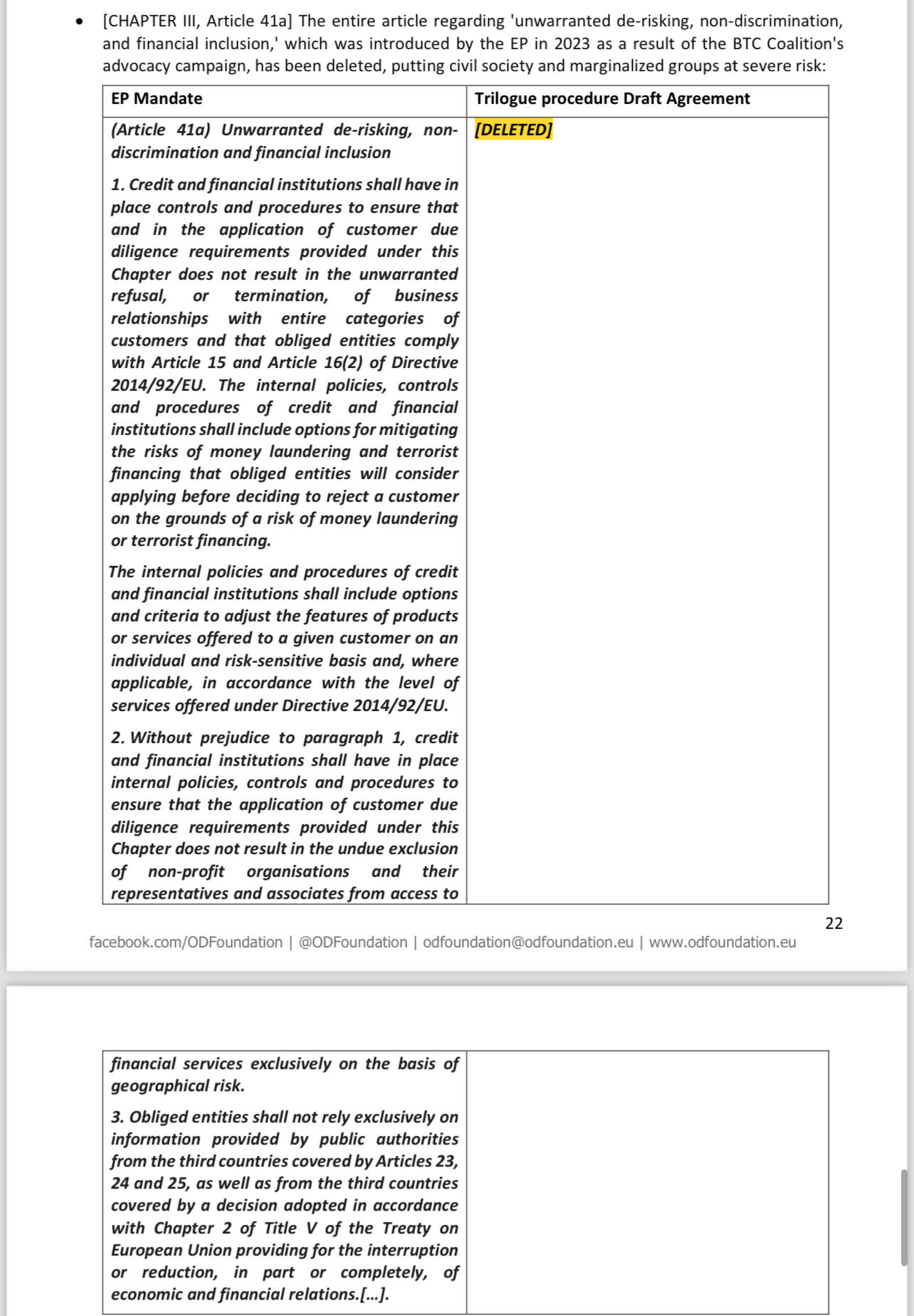
In the post-Trialogue version of AMLR proposal Article (41a) “Unwarranted de-risking, non-discrimination and financial inclusion” was deleted. It was introduced by the European Parliament in 2023 as a result of the #BTC Coalition's human rights advocacy campaign - our testimonials about the financial exclusion in the EU as a result of transnational repression organised by the authoritarian regimes. Article (41a) was intended to prevent unwarranted de-risking by ensuring that credit and financial institutions have controls and procedures in place to avoid unjustified refusal or termination of business relationships with certain categories of customers. 3/5 image
2. #EU #AML PROPOSAL PROMOTES FINANCIAL EXCLUSION OF VULNERABLE COMMUNITIES Do you have dual citizenship or are you an immigrant to the EU? Your financial rights are further compromised with the upcoming EU AMLR! Following the outcomes of the #Trialogue, the AMLR no longer includes regulatory safeguards to prevent unwarranted de-risking, ensure non-discrimination, and promote financial inclusion (Recital (32a) and Article (41a) in Chapter III of the AMLR). In the post-Trilogue draft of the AMLR, all provisions in Recital (32a) concerning the financial protection of vulnerable communities, including all classes of immigrants (dual citizens, refugees, and asylum seekers, among others) have been deleted. The previous version of Recital (32a) advocated for due diligence measures based on individual risk assessments, which could prevent blanket denials of service and ensure that measures would be proportionate to the actual risks presented by these specific customer categories. A post-Trilogue of Recital (32a) is more limited compared to the previous version as it focuses more narrowly only on civil society organisations that conduct charitable or humanitarian work in third countries, without explicitly mentioning the broader range of vulnerable groups. The post-Trilogue version does not adequately address the nuanced balance between mitigating financial crime risks and ensuring financial inclusion for all vulnerable groups. 4/5 image
Check the text of the #AML regulation “before and after”: you see that provisions which defended #crowdfunding efforts for civil society organisations and supported by the European Parliament in April 2023 were deleted during the #Trilogue. This unreasonable and disproportionate expansion, without any exceptions, in effect, devastates fundraising efforts for activists and NGOs like Open Dialogue Foundation. In times of crisis, such as natural disasters, military conflicts, like the latest in #Ukraine, or emergencies, crowdfunding becomes a rapid and effective means for civil society to gather resources. The proposed expansion of the AMLR to categorize all crowdfunding platforms as risky channels echoes existing de-risking practices that have already shown devastating impacts on vital humanitarian efforts. 2/5 image
On behalf of the BTC Coalition, we are recommending MEPs to vote AGAINST the #EU #AMLR proposal and urge you to join our call for three main reasons: 1. EU WILL DEVASTATE CROWDFUNDING FOR ACTIVISTS AND HUMANITARIAN NGOs NGOs barely receive funds to support human rights or humanitarian aid. #Crowdfunding, including the use of #Bitcoin  in self-hosted wallets, is the last resort. What is the EU doing? In the post-Trilogue AMLR draft, all possible crowdfunding platforms, including based on crypto-assets and serving humanitarian purposes, designated as intermediaries, are considered as high-risk ever-evolving Money Laundering and Terrorist Financing (ML/TF) channel. In practice this means fewer and fewer donations, because of: 🔻increased administrative & operational costs, 🔻reduction of the donor base due to invasive due diligence processes, 🔻reduced financial inclusion of smaller entities and projects that traditionally rely on crowdfunding. The AMLR does not take into account the broader negative impacts on society, resulting in the obstruction or even halting of social, entrepreneurial and humanitarian initiatives. 1/5 image
CALL ON EUROPEAN PARLIAMENT TO VOTE AGAINST EU AMLR PROPOSAL NOW! Tomorrow the European Parliament is going to vote on its latest #EU #AMLR proposal. Unfortunately, the Trilogue procedure led to the removal of all civil society recommendations, weakening the position of the only directly democratically-elected EU institution—the European Parliament. This has resulted in: 🔻 a considerable reduction of financial freedoms & increased financial exclusion; 🔻heightened risks of abuse of the AMRL, including the exposure of EU citizens and residents to the potential misuse of their financial data by authoritarian regimes. Additionally, as the EU sets global financial regulatory standards, the negative language in the AMLR about privacy payment tools, such as self-hosted wallets & mixers, could lead to restrictions on financial freedoms in third countries and increase the potential for financial repression by illiberal regimes. See our Submission for more details:
Come to BPI Summit on April 9th in Washington, D.C. to discuss how #Bitcoin  helps to resist against dictatorships and why it is our responsibility to protect our financial freedoms. 🧡 image
Guys, if you are in NYC on the 11th of April, come to meet and chat at @PUBKEY #Bitcoin  Meetup! Defending Bitcoin: Activism Against Regulations 😉 View quoted note →
Consider your car a safe place to be? Well, that's how it is: all in care for your safety, car manufacturers collect driver and passenger data about every movement and action they make. #ProtectYouData