Lyudmyla Kozlovska's avatar
Lyudmyla Kozlovska
lyuda_ODF@BitcoinNostr.com
npub13ajk...2yd9
President of the Open Dialogue Foundation, founder of BTC Coalition in the EU Support our advocacy for #freedomtech : donate@bps.odfoundation.eu
I survived and Im fighting against debanking as a weapon against critical voices used in western countries. My family, my Open Dialogue Foundation and business company experienced and are overcoming the fact that our financial data was weaponized to destroy reputation, our families, businesses, to isolate us as critics. Same happened with many still silent tech and #bitcoin businesses in the western world to destroy their competitive proposals. Im grateful that @pmarca @mark tyler @npub1dc2n...u5hg @davidmarcus @joerogan are voicing these tremendous abuses. Being critical, competitive and effective against governments abusing power should never be claimed as “high risk”. Abuse of power through AML/CFT laws without any remedy and accountability should be classified as high risk and top priority to fight against it. Let’s join efforts to eliminate these repressive practices!
WHY WE NEED FREEDOMTECH EMBASSY IN BRUSSELS NOW With many voices at @The Bitcoin Conference in #Amsterdam expressing very correct assessments of the discriminatory policy approach in the #EU against Bitcoin and now following the proposed by the European Central Bank analysts, I want to recall two important aspects: 🔴 First, well known: the #ECB states explicitly by saying their main goal is to “disincentivise investment in Bitcoin mining”. ECB frame it as "a climate risk priced into crypto-assets", in fact attacking PoW and Bitcoin mining. 🔴Now for the lesser known, but most important to assess the risks of their latest so-called analyses - the EU's drafting of a regulation to expand the European Central Bank's supervisory powers over crypto-assets, which potentially gives the ECB endless power to attack #Bitcoin and implement its discriminatory regulatory proposals. This information was re-confirmed in August 2024 by the European Parliament's Committee on Economic and Monetary Affairs (ECON). https://www.europarl.europa.eu/RegData/etudes/STUD/2024/755728/IPOL_STU(2024)755728_EN.pdf 🟡 From the ECON’s study we know that: 🔻 Since 2022, key topics discussed by the ECB with policymakers are (1) the ECB's banking supervision programme on the importance of the role of banks in the transition to a digitalised and carbon-neutral economy; (2) response for the emerging risks from the crypto sector and non-financial banking institutions; (3) the energy crisis; 🔻 ECB is increasingly consulted on future regulatory priorities, and on its stance regarding new legislation that is being negotiated with the Commission and the Council; 🔻 ECB response focusses on banks’ ESG risks which it considers a threat for banks and financial stability overall, therefore having made it a supervisory priority; 🔻 ECB mentions that it assesses, jointly with European Banking Authority (EBA), whether ESG risks should be reflected in regulatory capital requirements. And these attacks continue and in parallel echo in developing Bitcoin mining ban in Norway, Iceland, discriminative taxation in Italy and Netherlands, classification self-hosted wallets p2p transactions as high risk transactions in the AML Regulation and by the biggest political groups in German Bundestag, development AML Authority supervision with particular focus on crowdfunding companies and crypto-asset service providers (CASPs), implementation of MiCA regulation by Denmark with attempt to classify mob apps like self-hosted wallets as “interface providers”, discussion of the categorisation of lighting as a “money transmitter”... 🟢What we can do together: 🔻Join Open Dialogue Foundation to establish a #FreedomTech embassy in Brussels. Let's bring together expertise and resources to develop a safe regulatory environment in the European Single Market for Bitcoin miners, investors, developers and end-users. 🔻Let’s systematically protect our FreedomTech and educate policymakers, media, academia. Let’s say loudly about wrong approach of ECB on Bitcoin and Bitcoin mining specifically. The U.S. bitcoiners have made Bitcoin protection a reality and continue to do so. 💪🧡 We should and can do it in the EU as well.
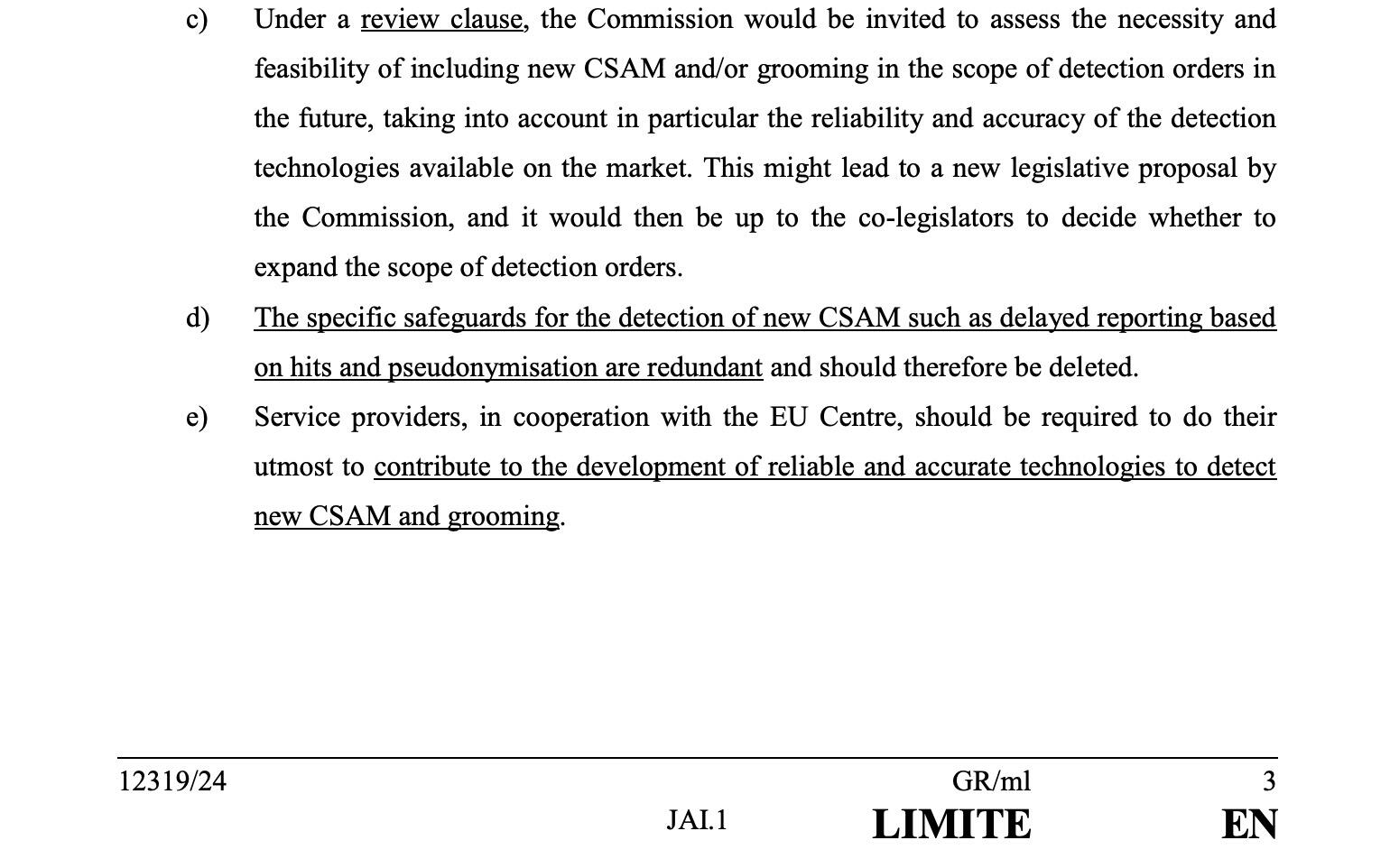
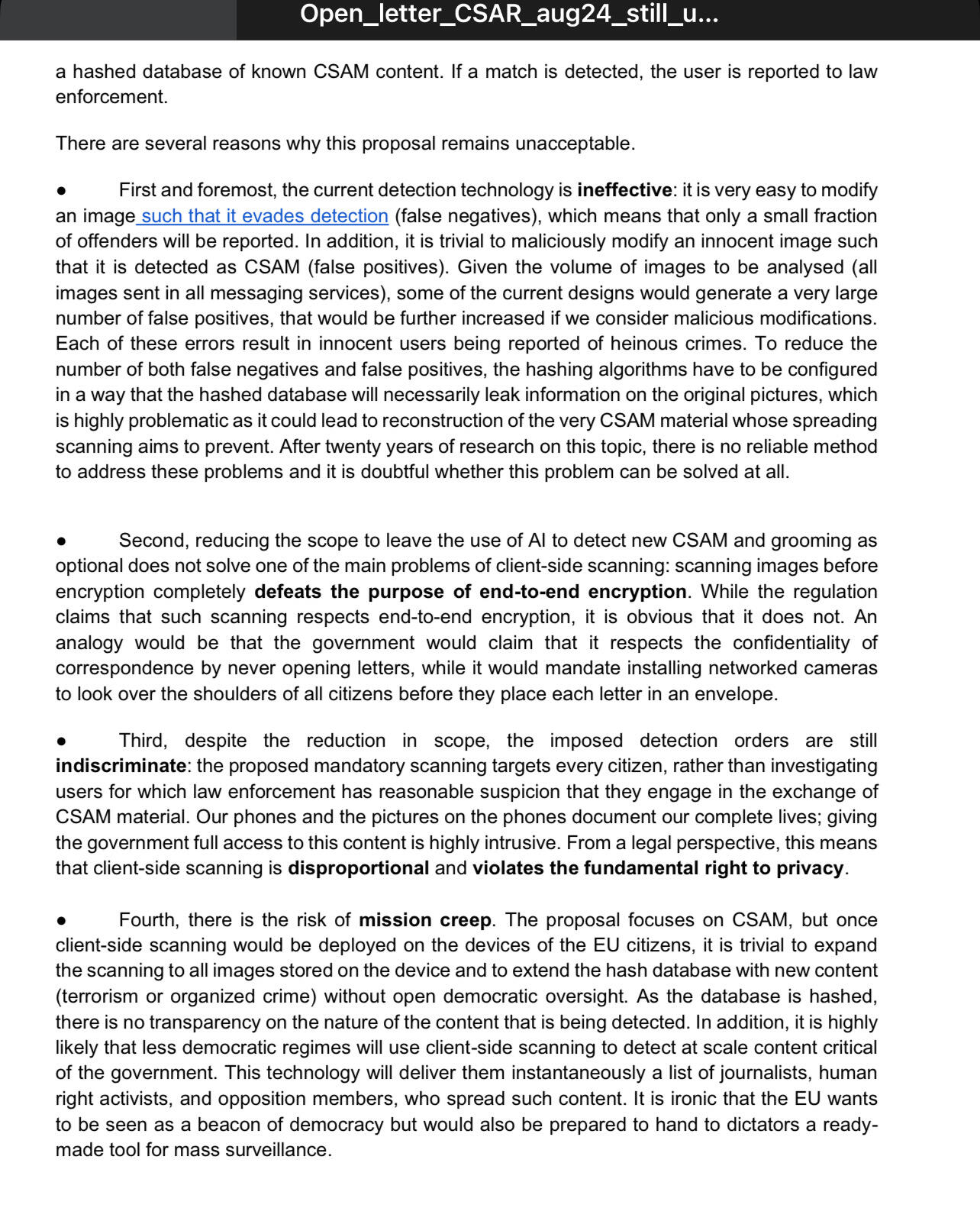
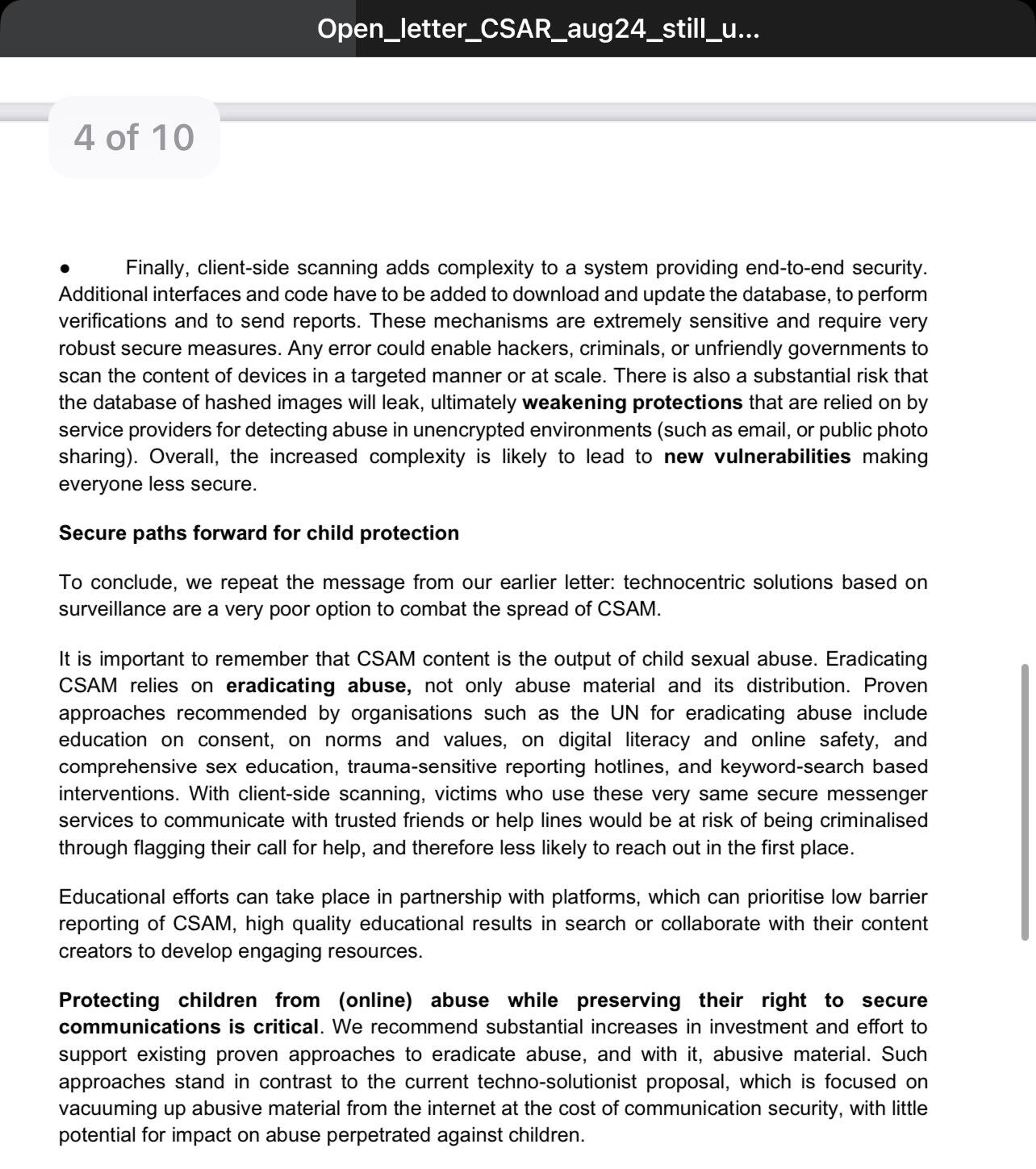
HUNGARY PROPOSED MESSENGER PROVIDERS FOR TIGHT SURVEILLANCE Following the pressure of privacy & human rights activists the Hungarian Presidency claimed to do "a compromise". In practice the upcoming #ChatControl regulation will require from messenger providers "to do their utmost to contribute to the development of reliable and accurate technologies to detect new CSAM and grooming." It means more tight surveillance, including indiscriminate mass monitoring of private communications and the end of secure end-to-end encryption. https://emanuelkarlsten.se/wp-content/uploads/2024/09/240829-CRPII-4-september-st12319.en24.pdf In response to this proposal, over 245 scientists from 31 countries evaluated #ChatControl draft as ‘ineffective, false positives, defeats end-to-end encryption, disproportionate, violates right to privacy, new vulnerabilities’. https://homes.esat.kuleuven.be/~preneel/Open_letter_CSAR_aug24_still_unacceptable.pdf 1️⃣ What you can do now: 🔻Call your goverment and deputies to reject alltogether Chat Control. Find contacts here: https://op.europa.eu/en/web/who-is-who/organization/-/organization/COREPER/ 🔻Support politicians like @echo_pbreyer who promote privacy! 🔻Explain why it won’t help in bringing security for our society. Opposite, such approach would put the future of our freedoms is just one step closer to be compromised and abused by dictators. 🔻Address your government before the next meeting on 2nd Oct.: 🔴SUPPORT Chat Control: Bulgaria, Croatia, Cyprus, Denmark, Finland, Hungary, Ireland, Greece, Latvia, Lithuania, Malta, Romania, Slovakia, Spain, Sweden 🟢AGAINST Chat Control: Austria, Belgium, Czech Republic, Estonia, Germany, Luxembourg, Poland, Slovenia 🟡 UNDECIDED (we need to activate them the most!): Italy, Netherlands, Portugal 🎙Respost and call you friends to join the campaign today: If no privacy of communication, no protection for children, anyone in the EU and beyond! 2️⃣Rember and explain: 🔻No algorithm can reliably make a legal assessment. According to Meta, which is the source of the vast majority of reports, they currently only look for known CSAM in EU communications, and yet at least 50% NCMEC of reports made to German law enforcement agencies are not criminally relevant, according to the federal crime agency (BKA). 🔻EU Commissioner #Johansson admitted in late 2023 that 75% of NCMEC reports are not of a quality that the police can work with. 3️⃣ Dictators love Western spy technology: the example of the Intellexa spy company proved: dictators all over the world love Western spy technology for transnational repression of opponents and destruction of the Western world, your and your family freedoms. Urge your government to stop this!
URGENT: PROTECT YOUR PRIVACY COMMUNICATION RIGHT NOW! on 4th Sept 2024 #ChatControl regulation representatives of EU goverments will resume work based on a secret document according to Patrick #Breyer, former Member of the European Parliament. Help to mobilize everybody to defend our #privacy of communication and its developers, investors! If no preventive actions from your side now, this regulation will be endorsed on 12/13 December 2024. According to the draft regulation dated 28 May (Council document 9093/24), ChatControl deploys to do, for instance: 🔻 “upload moderation”, users of apps and services with chat functions are to be asked whether they accept the indiscriminate and error-prone scanning and possibly reporting of their privately shared images, photos and videos. 🔻Scan by “artificial intelligence” technology previously unknown images and videos; 🔻If a user refuses the scanning, they would be blocked from sending or receiving images, photos, videos and links (Article 10). 🔻End-to-end encrypted services such as Whatsapp or Signal would have to implement the automated searches “prior to transmission” of a message (so-called client-side scanning, Article 10a). During the last discussion on 24 May, the Council Legal Service made it clear that indiscriminate chat control scanning of non-suspects is still envisioned and remains a violation of fundamental rights. Nevertheless, most EU governments are determined to go ahead. https://netzpolitik.org/wp-upload/2024/05/2024-05-28_Council_Presidency_LEWP_CSAR_Compromise-texts_9093.pdf 🌎 Tell your goverment and parliamentarians, that the proposal should be rejected altogether! 🔴Is your government in favour? → Ask for an explanation and for your government to revert its course. 🟡Is your government abstaining? → Ask why and demand that they take a strong stance against chat control. 🟢Is your government opposing? → Great, but take a closer look at the reasoning: Some governments like #Germany e.g. only object to the scanning of encrypted communications, but are fine with the indiscriminate scanning of other private and public communication, with the end of anonymous communication by requiring age verification, or with introducing a minimum age for “risky” communication apps. Also critical governments need to do more, exert their influence in the Council of the EU and agree on a joint list of necessary fundamental changes to the proposal. Absent such revision they should ask the European Commission to withdraw the chat control proposal as it stands. 🔴 In favour of ChatControl: France, Belgium, Bulgaria, Croatia, Cyprus, Denmark, Finland, Greece, Hungary, Ireland, Italy, Latvia, Lithuania, Luxembourg, Malta, Portugal, Romania, Slovakia, Spain, Sweden. 🟡Abstained: Estonia, Netherlands, Slovenia, Czech Republic, Austria 🟢 Opposed the proposal: Germany, Poland When reaching out to your government, the ministries of the interior (in the lead) of justice and of digitisation/telecommunications/economy are your best bet. You can additionally contact the permanent representation of your country with the EU: https://op.europa.eu/en/web/who-is-who/organization/-/organization/COREPER/
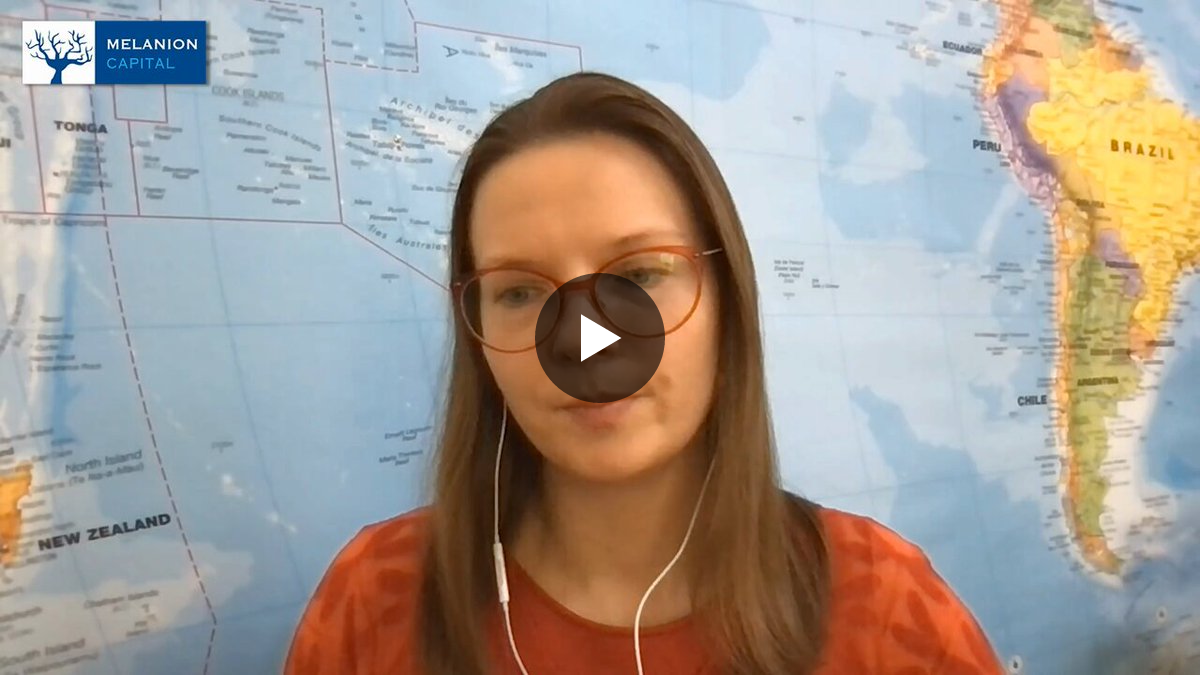
I had the honour of sharing my personal experience with Melanion Capital & Jad #Comair on their podcast about how easy it is to weaponise the financial data of every resident and citizen of Western countries. The refusal to protect banking secrecy has led to a massive failure in the protection of human rights. #Bitcoin p2p transactions have become the only available tool for the financially repressed and excluded as a consequence of the abuse of AML/CFT laws. We live in a time when financial institutions have been given the right to police activities of citizens. If your rights are violated by the police, you have the possibility of defence/remedies. However, with financial institutions, there are no such mechanisms due to Financial Action Task Force (FATF) recommendations. I experienced this first hand when three authoritarian regimes abused my and Open Dialogue Foundation banking data getting it from #Belgium and #Poland. Banking records obtained by three regimes became a weapon against me and anyone who worked, received our support in different countries or championed our human rights work at the time. I able to continue my human rights work and hold accountable perpetrators of violations of my rights thanks to #freedomtech Bitcoin. Ironically, AML/CFT laws were created to fight criminals, oligarchs, dictators corrupting western countries. In reality - AML/CFT laws have become the most effective tool for #TransnationalRepression, breaking down all barriers to protect the right to #privacy of #correspondence, #transactions, #movements. If you think that this only applies to dictatorial or authoritarian countries, you are sorely mistaken. Want to learn more? Listen our 🎙️ Ep32 of ‘Bitcoin Equities Talks’ with Melanion Capital
NORWAY IS GOING TO BAN BITCOIN MINING WITHOUT PUBLIC CONSULTATIONS - WE NEED TO ACT NOW Norway's Ministry of Digitalisation and Public Administration responded to @ODFoundation that it "has no plans to conduct a public consultation" on a ban on cryptocurrency mining. There is no doubt that the ban designed to target #Bitcoin mining. Unfortunately, that's a stance of the @Stortinget and the Norwegian government. 🔴 Why we should protect our #freedomtech Bitcoin in #Norway NOW: (1) Norway is fully integrated in the European Single Market throught the European Economic Area (EEA) and Schengen Agreement. It means Norway can provide its legilsative approach as an input for new legislation for the EU/EEA both: - during the preparatory phase, when the @EU_Commission is developing proposals; - during work of expert groups and committees of the European Commission; - submitting proposals and comments to European Free Trade Association on upcoming legislation. (2) As a co-founder of the @OECD , Norway sets an example of regulation worldwide and provides its legislative recommedations for global standards. (3) Norway has historically been a place to meet, share experiences and educate human rights defenders and bitcoiners from around the world. Norwegian goverment will present its investigation a ban on cryptocurrency mining by the end of 2024. 🔴 What we should do together to prevent Bitcoin mining ban: (1) Repost this post and join our #BTC Coalition to educate local communities and media about social benefits of Bitcoin mining in Norway and worldwide; (2) Help us pool resources and best practices to convince Norwegian politicians and media to explore the social benefits of Bitcoin to prevent this repressive regulation; (3) If you are a Norwegian citizen: write a letter to your legislator and government asking for public consultation and providing arguments about the social benefits of Bitcoin mining for Norway. 🧡
🔴 Yes, six years of our constant struggle were needed to lift the Polish entry ban imposed on me for political reasons as an alleged ‘threat to national security’. This was done by the then-ruling Law and Justice government on the basis of the classified opinion of the Internal Security Agency. Now, I’m finally allowed to return to #Poland. 🔴 Yes, Law and Justice party definitely knows how to abuse power and drive you into financial exclusion, even if you’ve obtained several favourable court rulings. During the last 6 years, the Polish Office for Foreigners and Internal Security Agency (#ABW) kept the ban despite 6 court verdicts (!) finding it unjustified and groundless. 🔴 Yes, FATF and EU Commission have regarded these kind of cases of financial exclusion and abuse of AML/CFT laws as ‘unintended consequences’. It is not true: it was an intended, coordinated abuse of AML/CFT laws by then-ruling Law and Justice government and other authoritarian regimes for transnational repression against ODF as a human rights organisation and myself as its leader. 🔴 Yes, when the Law and Justice party was in power, ABW prepared a classified dossier based on alleged 'evidence' that my stay as a foreigner on the Polish territory 'threatens the state security'. Today ABW - freed from the political influence of PiS - officially recognises that no such evidence exists against me. I believe it is crucial to declassify dossier based on alleged 'evidence' against me to show how regimes abuse security measures enjoying the lack of accountability/remedies in the AML/CFT laws. 🔴 Yes, after the final court judgement that required the Office for Foreigners in Poland to remove me from the blacklist, we’ve eventually received an official confirmation which states that I can now enter. According to lawyers and human rights activists dealing with foreigners, this was the very first time a court in Poland issued such an explicit order when the state security issue was at play. 🔴 No, the Law and Justice party (#PiS) is no longer in power. But this doesn’t mean that the problems of the Open Dialogue Foundation, our team and family members are over. Already 7-year long politically motivated tax audits aimed at ODF and our company ruined our business, and the criminal case against Bartosz Kramek as well as many other victims of political repression are ongoing. 🔴Yes, even with the loss of power, the system built by Law and Justice Ministers Mariusz Kaminski and Maciej Wasik continues to live, poisoning the lives of the opressed for the last 7 years and requires complete dismantling. At the same time, those responsible have not yet been held accountable for attempting to destroy i.a. our foundation in retaliation for the defence of the #RuleOfLaw in Poland - an abuse previously unheard of in the EU. That is why we still need your support. 🧡 image
Why DMs don’t work on #nostr? Almost one week I can’t read my messages, and instead I can see just an empty screen… same problem at Damus and Primal. Any idea? Please write your messages to my email: lyudmylakozlovska@odfoundation.eu image
4/4 What can be done and what we want to organize/need your support for: 1. Urgently gathering/collecting in the written submission to the government and parliament testimonials of Bitcoin miners in #Norway to confront public opinion and change narratives attacking #Bitcoin  mining working both locally and nationally. 2. Brining testimonials, conduct in person and public meetings about best practices of Bitcoin mining advising Norway government and inform society how they can benefit from it.
3/4 Most MPs support this position and refuse to meet to discuss the issue, not only because of the misunderstanding of Bitcoin, but also because of the lack of public data, submitted to the parliament and government on why #Bitcoin  mining is beneficial to #Norway. We base our conclusion following Open Dialogue Foundation BTC Coalition advocacy efforts since April 2024 to educate major members of political parties across the political spectrum in Norway and contacts with local jornalists.
2/4 Why Norwegian policymakers want to ban #Bitcoin  mining: - they “don’t want cryptocurrency [Bitcoin] mining companies” since they look at them as „actors who are looking to "shop" for cheap electricity in Norway“ and “(...) businesses seeking to exploit Norway for cheap energy extraction”. - since they don't see positive uses cases of Bitcoin mining and Bitcoin in general, the want to ban it. Norwegian policymakers want to keep only data centers “to secure storage of images and communication”, or „which are important to society, and the society-serving computer industry is important to Norway“.
We Have to Defend Bitcoin Mining in Norway. Here is why: 1/4 In April 2024, the Norwegian government introduced a legislation to regulate data centers in a way that effectively bans #Bitcoin  mining in the country. This is setting a huge precedent. So far, all attempts to ban bitcoin mining have been referred to the practices of authoritarian/dictatorial countries such as #China. But in the case of #Norway, this country is considered one were bitcoiners teach human rights defenders about freedom technology routinely. A country known for defending human rights, the Nobel Peace Prize, will be also known to be against Bitcoin mining, which affects not only miners, but all users, developers and investors. image
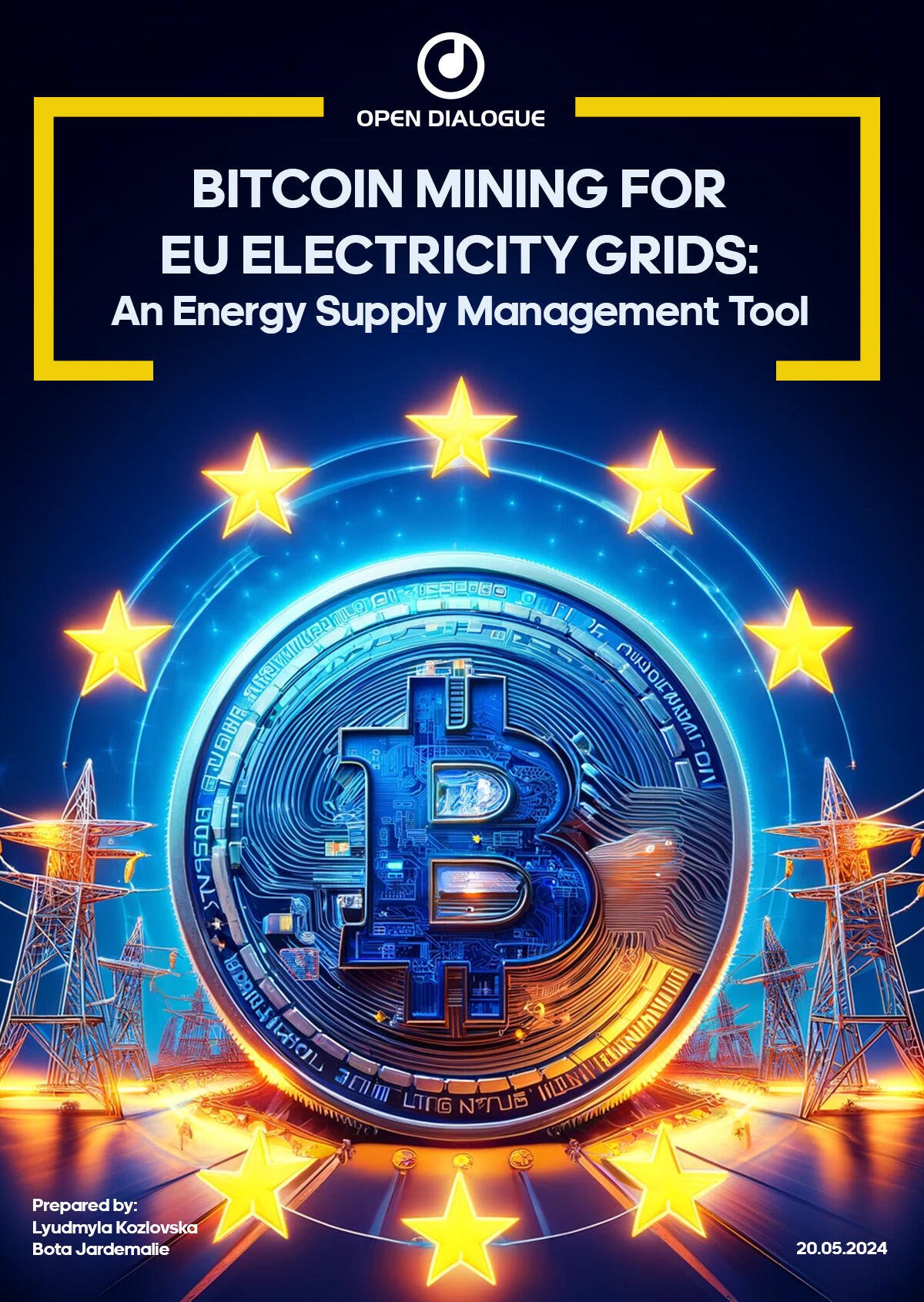
FIVE FACTS WHY BITCOIN MINING BENEFITS EU'S ENERGY AND ENVIRONMENTAL SECURITY 1. European Commission is looking for €584bn of new investments are required by 2030 to upgrade Europe’s grids. What solutions can the #EU adopt? Our BTC Coalition collected best case studies & testimonials from industry experts to present how #Bitcoin Mining is New Solution to the EU Grid Problem: 🔻Bitcoin mining can facilitate energy transition in the EU, especially to the huge queues of renewables, such as wind & solar that have applied. 🔻As testified in our submission Bob Burnett: "Bitcoin mining is already an industry at the forefront of utilising sources like solar and wind. (…) I strongly encourage the EU, the European Commission and #ESMA to support the development and expansion of Bitcoin and Bitcoin mining in Europe and across the globe." 🔻As noted by Drew Armstrong, President and CEO of the @CathedraBitcoin, a Canadian Bitcoin mining company: “(…) proof-of-work mining can help transform the energy sector for the better, by ensuring no energy goes to waste, thereby potentially reducing the cost of energy for citizens.” 🔻As Kent Halliburton, the CEO and co-founder of Sazmining suggests: “By strategically establishing mining operations, the EU can stimulate private investment in grid enhancement, aligning with long-term goals for energy system decarbonisation and fostering job creation and economic growth within the energy sector.” 2. BITCOIN MINING DEVELOPS NEW OFF-GRID ENERGY SOURCES AND PROMOTES RENEWABLES 🔻As stated by Bob Burnett, CEO of Barefoot Mining (USA): “Bitcoin mining is demonstrating its capability to utilise and even develop new renewable energy sources independently of traditional electricity grids.” Bitcoin Mining addresses two critical challenges currently recognised by the #EC: (a) lengthy grid connection queues for renewable projects, and (b) the overproduction of renewable energy. 🔻Edouard Dubrana, CEO of Eddu Energy (France) states that: “[t]his industry, although energy-intensive, can adjust its consumption in real time, using surplus energy that would otherwise be wasted. This not only helps stabilise the network by absorbing production peaks but also provides an economic advantage by generating additional revenue for network operators and energy producers. Thus, Bitcoin mining can play a pivotal role in the transition towards a greener and more flexible energy grid, while fostering a circular energy economy.” 🔻Kent Halliburton, the CEO and co-founder of Sazmining Inc., explains how their mining operations optimise surplus hydroelectric energy in Latin America: “Our facilities in Paraguay utilise surplus energy from the Itaipu Dam, one of the largest hydroelectric plants in the world. This energy, which would otherwise potentially go to waste or be sold at lower values to #Brazil due to market oversupply, is efficiently used in our Bitcoin mining operations at 4.3 cents per kWh. Our business's ability to absorb this surplus energy during off-peak times is crucial in preventing energy waste and supporting the economic sustainability of the hydroelectric plant.” 3. SOCIAL & ENVIRONMENTAL USE OF BITCOIN MINING We challenged #ESMA's discriminatory regulatory language about #Bitcoin mining, misconceptions in discussions in the EU and in the member states of the Council of Europe, like #Norway, #Iceland, that have highlighted concerns about the energy consumption of Bitcoin's #PoW mechanism, notably critiqued in a United Nations study. The transformational potential of Bitcoin mining for local communities should not be overlooked, that's why we've added more cases about the social and environmental benefits of Bitcoin mining in the new submission: 🔻As Sebastien Gouspillou, CEO of Big Block Data Center testified on “How Bitcoin Mining is Supporting Conservation Efforts at Virunga National Park (#Congo)”. Seb illustrates how the financial challenges of this UNESCO World Heritage site were addressed by leveraging existing hydroelectric infrastructure for mining purposes. 🔻Pierre Rochard testified: "In a recent report, the European Central Bank characterised Bitcoin as an unproductive, energy-intensive technology that lacks social value and presents an obstacle to the EU’s climate goals. Regrettably, the EU has demonstrated similar hostility in its evaluation of Bitcoin and its impact on society. But the EU and @ECB’s estimation of Bitcoin neglects new research from organizations in academia, finance, and human rights that paints a starkly different picture of the world’s most successful cryptocurrency". 🔻Marin Baksa testified: "As the EU continues to develop sustainability indicators for crypto-assets, it is essential to consider emerging technologies that can mitigate the negative externalities associated with Bitcoin mining." 4. BITCOIN MINING AS A SOLUTION FOR EU's COAL REFUSE POLLUTED AREA 🔻The case of Stronghold Digital Mining (#USA) described by Thomas Pacchia illustrates how Bitcoin mining can be a solution in an industrially polluted area. The company’s two power plants in Pennsylvania turn a hazardous waste product from #coalmining (#coal refuse or #gob) into #energy for Bitcoin mining. “[R]ather wasting away and polluting people and the environment, coal refuse is instead collected and transported to be sorted, processed, and broken apart. After that, gob reaches a boiler to be burned down, producing electricity which powers Bitcoin mining.” The uniqueness and value of this application lies in solving the problem of cleaning up this dangerous waste, which is normally most often piled up due to otherwise very low commercial viability. The value of this application lies in its ability to address the problem of coal refuse, which is typically accumulated due to its low economic viability. By utilising coal refuse, these plants generate electricity that powers Bitcoin mining operations. The facilities of the Stronghold Digital Mining are “examples of the Bitcoin mining operation which could help the EU member states and other countries in cleaning up and remediating after an ecological disaster. In 2016, there were 324 coal plants in Europe. Each of them produced coal ash, the byproduct left over from burning coal to produce electricity, which can leach into groundwater, pollute waterways, and contains heavy metals considered to be carcinogens,” - notes Thomas Pacchia. 5. BITCOIN MINING HELPS DESALINATION OF WATER, DECARBONISATION OF DISTRICT HEATING NETWORKS AND DATA CENTRES 🔻As described by Marin Baksa, CEO of Barrage Nordx (#Sweden), immersion cooling is “a method that involves submerging servers, including #Bitcoin mining servers, in a non-conductive liquid, which greatly enhances energy efficiency and reduces the environmental impact of these operations. (..) Unlike air-cooled systems that expel waste heat into the environment, #immersion cooling captures and recycles this heat through a liquid medium. This not only improves thermal management but also contributes to a quieter and more environmentally friendly #datacentre environment. (…) Additionally, this method facilitates more effective #heat recovery, as the heat transferred to the cooling liquid can reach higher temperatures and be reused more efficiently than air, making it particularly suitable for district [urban] heating.” Practical analysis of this technique was the subject of two reports (2022 and 2023) by #RISE Research Institutes of Sweden AB. 🔻Pierre Rochard, Vice President of Research, Riot Platforms, Inc. notes that: “Bitcoin’s critics have removed context from the conversation surrounding Bitcoin and water consumption.” Pierre Rochard provides expertise regarding the countries in the #MiddleEast suffering from #water #scarcity and “utilising energy-intensive desalination process, which are using heat from Bitcoin miners to increase the efficiency of desalination. Two companies— Zero Two and Marathon Digital—for example, have built technology to recycle heat from Bitcoin mining rigs to facilitate the #desalination process, allowing them to desalinate more water for the same net cost.” 🔥There is a great potential for synergy between Bitcoin mining and #decarbonisation of district heating systems in the #EU. As bitcoin mining operations scale up to industrial levels and adopt advanced immersion cooling technologies, they also produce significant amounts of waste heat. This waste heat can be repurposed, offering a sustainable heating solution for district energy systems, which are traditionally powered by combustion of fossil fuels, biomass, or garbage. Most of these systems are shifting to electricity, primarily through heat pump technology, in alignment with the EU's decarbonisation goals. Co-locating Bitcoin mining facilities with district heating plants creates a mutually beneficial relationship. The waste heat from Bitcoin mining can directly supply the heating needs of these systems, effectively aiding in their transition to cleaner energy sources. This integration can provide an independent source for financing the conversion to electric-based heating systems and significantly reduce the need for financial subsidies. Examples of such initiatives include companies like @MintgreenHQ in #Canada with the North Vancouver district energy system, and #Hashlabs in Finland, which offering the system that captures the heat generated by Bitcoin mining operations to warm water in a central heating system. In New York, USA, Bitcoin mining is used to heat pools in #bathhouses. This five facts from the Submission will be presented to the newly elected members of the European Parliament, the European Commission, and all other pertinent EU bodies. We advocate for a balanced, evidence-based approach in the formulation of regulations that recognise the substantial potential benefits of Bitcoin mining. This approach will not only support the EU’s sustainability goals but also foster innovation and economic growth within the Union. We are very grateful to Matt Carlsson, MASc, PEng, for his expert review of this submission. ⚡️🫡 LN to donate in Bitcoin and support our advocacy work in the EU and US: 🫡 defendpow@geyser.fund 🫂 donate@bps.odfoundation.eu We providing more details in written submission: https://en.odfoundation.eu/content/uploads/2024/05/20.05.2024_odf_bitcoin_mining_eu_elect_grids_eng-1.pdf image
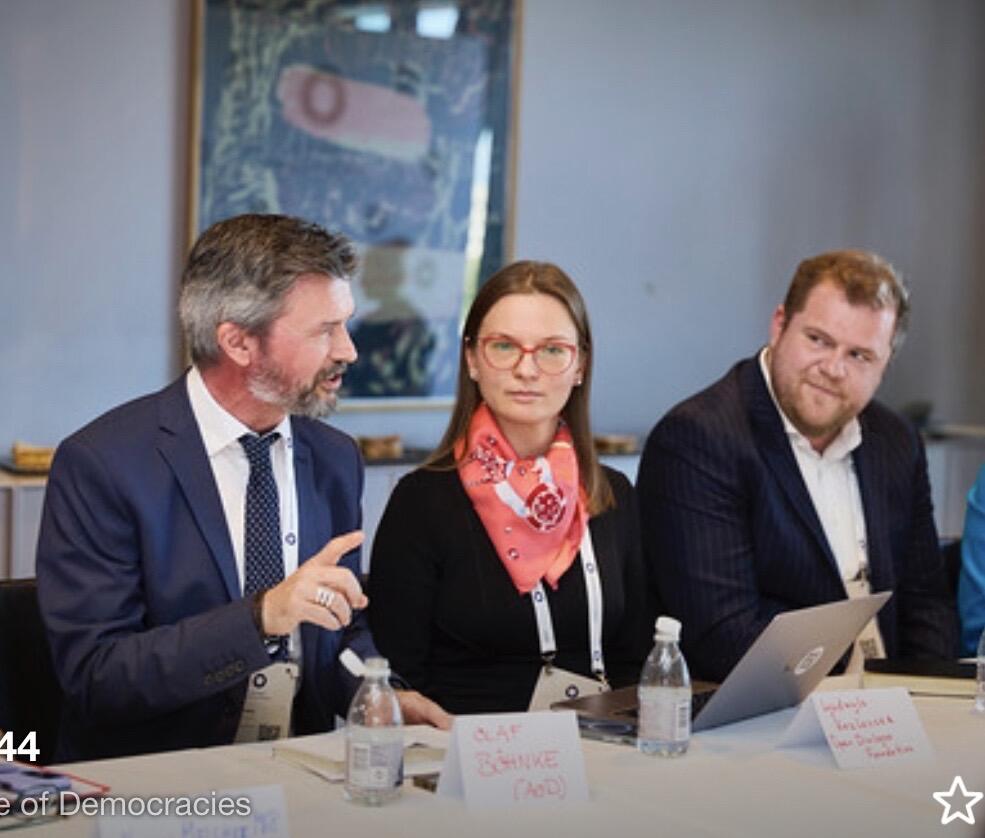
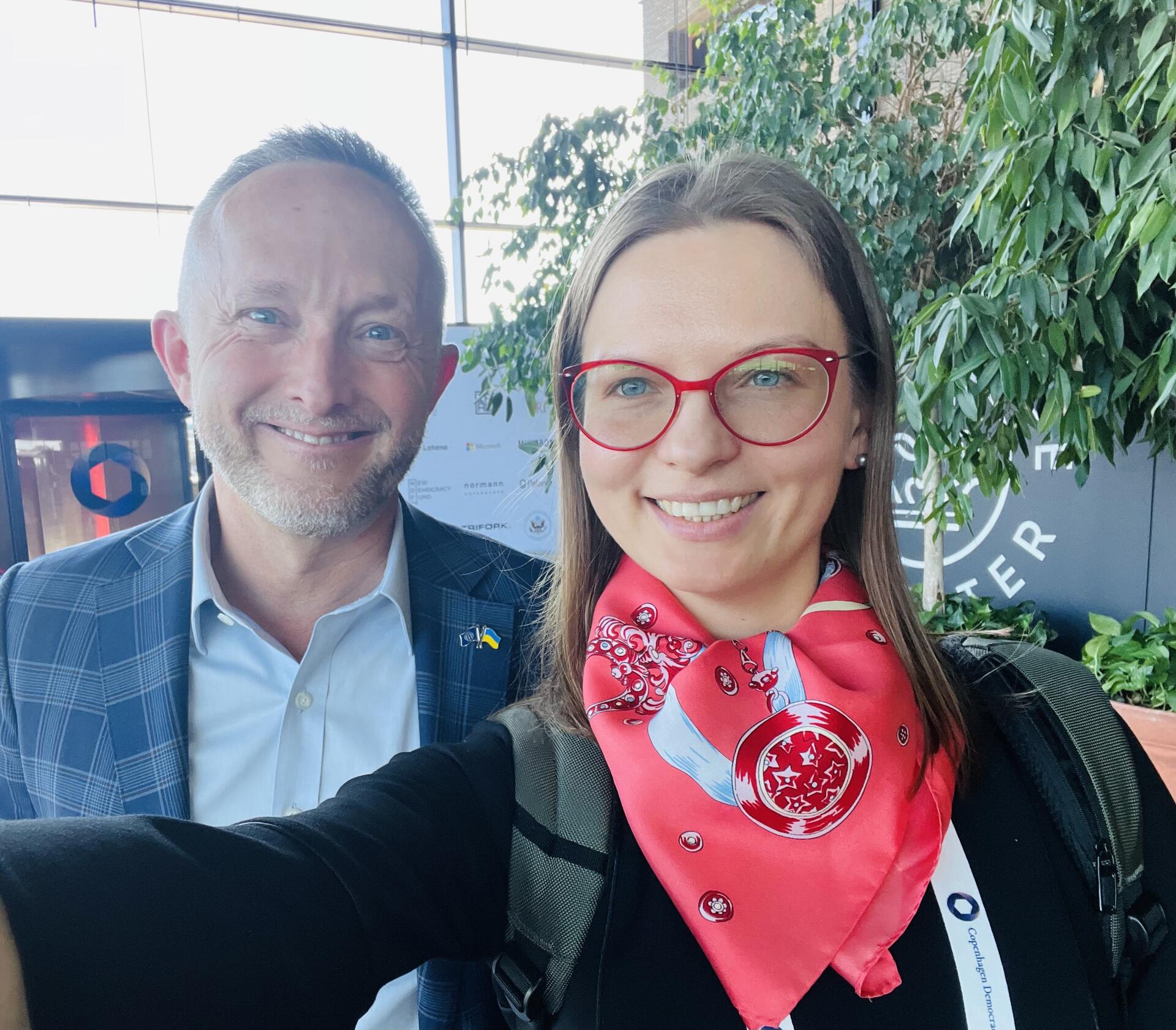
OVERCOME DISTRUST WITH BITCOIN Last week I had the opportunity to share my experience at the Copenhagen Democracy Summit about using #Bitcoin to address #AI fraud in the case of financial exclusion/transnational repression and attempted election fraud. The main question of the Summit was how to overcome distrust, especially when new technologies in combination with AI that can both enhance and undermine it. Alliance of Democracies Foundation, brought amazing experts, including Peter Erben from The International Foundation for Electoral Systems, Annette Kroeber-Riel, Vice President of Government Affairs and Public Policy at #Google in Europe, and Nanna-Louise Linde, Vice President of European Government Affairs, #Microsoft. My role was to present my experience and examples of the Bitcoin blockchain technology that civil society is using right now to protect electoral integrity, rule of law and human rights around the world from artificial intelligence fraud. After all, it is not only smear campaigns or AI fraud that undermine the integrity of elections, but also by cutting off the financial resources needed for independent candidates to run. So Bitcoin technology helps to restore the trust and civil rights, for example: 🧡 protection against massive smear campaigns with AI abuses that lead to the financial exclusion and discrimination of the candidates running for elections, activists, and independent media inside authoritarian countries like Kazakhstan, Belarus, Turkey or lately, even in India. 🧡 provides tools against transnational persecution of critics of authoritarian regimes living abroad. Transactions via bitcoin's p2p wallet are the only tool to protect such groups in non-democratic states. 🧡 Last, but not least, Bitcoin can safeguard the most important documents that used to determine election results: back in 2023 the Supreme Electoral Tribunal in #Guatemala was able to safeguard so called “raw material” – over 150 000 images of the vote tally sheets thanks to the created solution that they called the "Immutable Backup". This solution is based on the Bitcoin blockchain technology from a startup called Simple Proof. In that way Guatemala’s people were able to protect their input to determine who won the election. These documents were made available to the public in real-time in order for any citizen to be able to audit the process as it happens. Bitcoin is helping to restore trust based on proof of work. 🧡
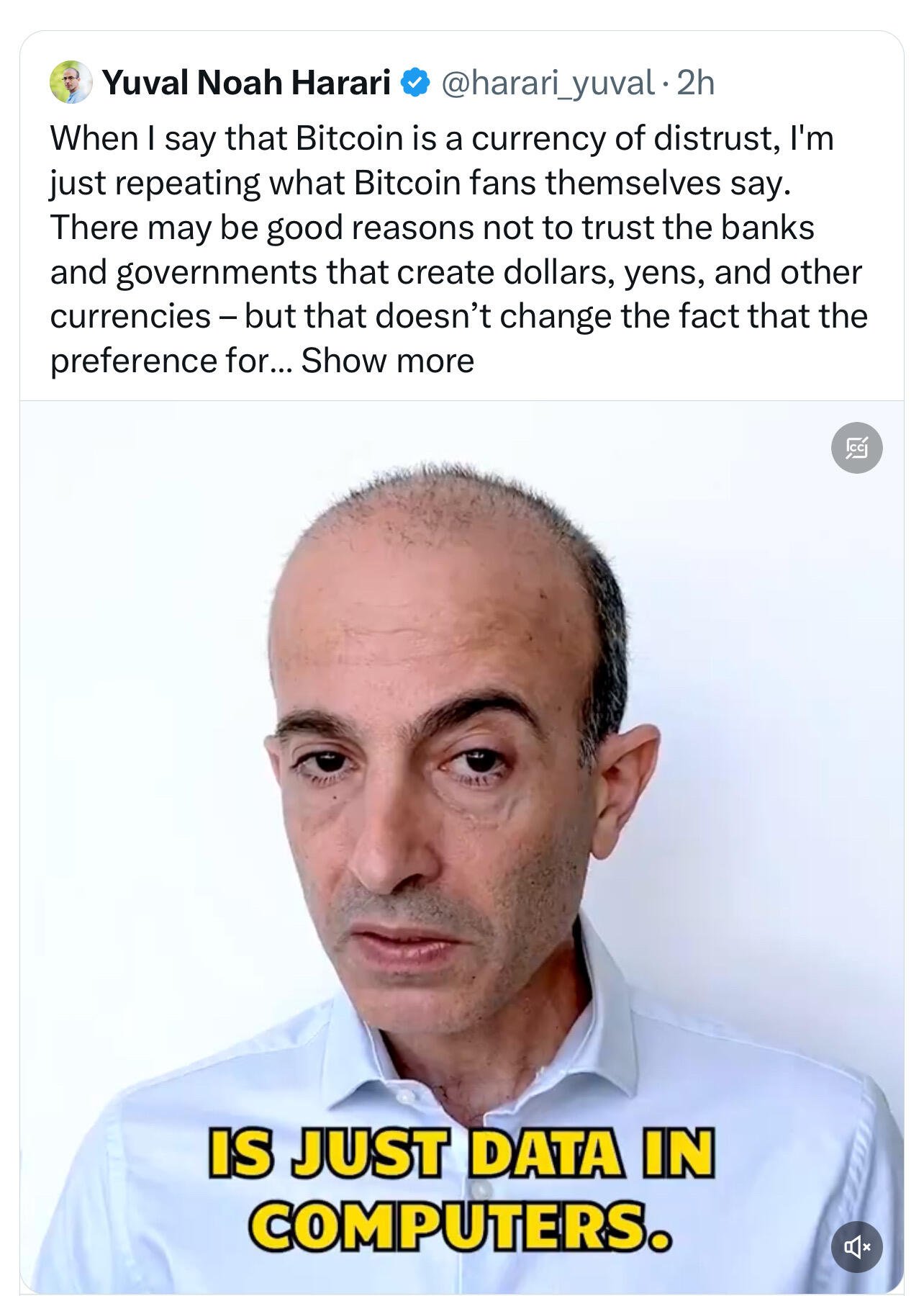
#Bitcoin is built on a consensus “trust but verify”, or Proof-of-Work. Bitcoin was created to defend human rights & to RESTORE TRUST, because authoritarian governments systematically abuse trust, abuse power and weaponize banking data. It is so easy to label with false claims #freedomtech when you enjoy privilege of western world as @harari_yuval and don’t need to use Bitcoin as the only tool against financial transnational repression. image