
Word of the Day's avatar
Word of the Day
wotd@happytavern.co
npub1n0k0...p8nv
Merriam-Webster's Word of the Day. Posted daily @ 9AM EST
Word of the Day's avatar
Word of the Day 12 hours ago
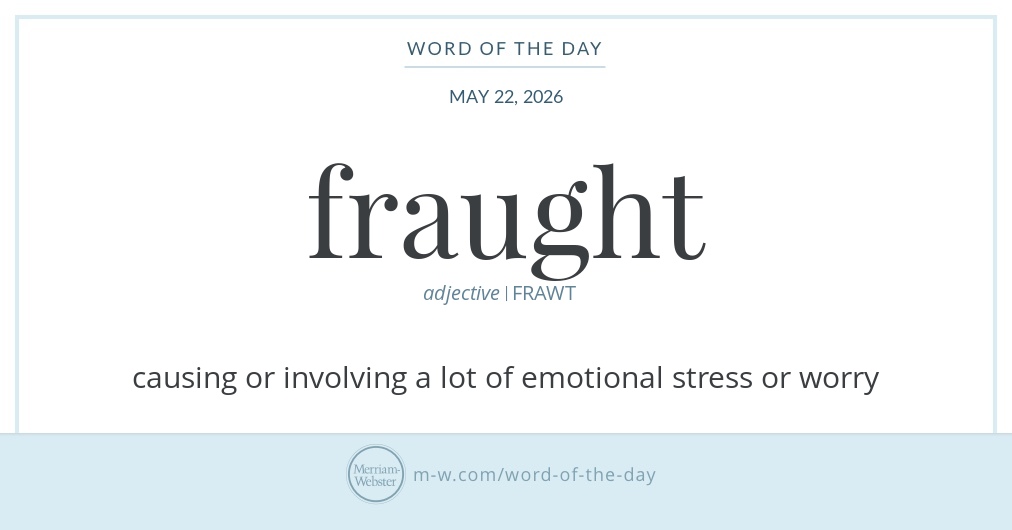
GM ☀️ Your word of the day is! 🔤 Fraught [FRAWT] 📖 What It Means: Fraught describes something that causes or involves a lot of emotional stress or worry. When fraught is used in the phrase “fraught with,” it means “full of something bad or unwanted.” 📰 Example: The siblings had a fraught relationship. 💬 In Context: "We might think replicating one of these ideas will deliver that perfectly walkable, equitable, sustainable and prosperous city of our hopeful imagination. Not likely. Many of these were hard wins, often fraught and contested in their local context." — Gia Biagi, The Chicago Tribune, 5 Apr. 2026 💡 Did You Know? An early instance of the word fraught occurs in the 14th century poem Richard Coer de Lyon, about England's King Richard I, aka Richard the Lionheart. The line "The drowmound was so hevy fraught / That unethe myght it saylen aught" describes a large fast-sailing ship so heavily fraught—that is, loaded—that it can barely sail. The poet's use of fraught is typical for the time; originally, something that was fraught was laden with freight. For centuries, fraught continued to be used in relation to loaded ships, but that use is now considered archaic. These days, fraught is used in reference to situations that are heavy with tension, emotion, or some other weighty characteristic. 🔗 #WordOfTheDay #Nostr #Dictionary #Learning
GM ☀️ Your word of the day is! 🔤 Lacuna [luh-KOO-nuh] 📖 What It Means: Lacuna is a formal word that refers to a gap or blank space in something—in other words, a missing part. When used with respect to biology, lacuna also refers to a small cavity, pit, or discontinuity in an anatomical structure. 📰 Example: The absence of hemlock pollen from one stretch of the fossil record is a notable lacuna that suggests the tree may have once suffered from some type of blight that nearly wiped out the species. 💬 In Context: “At the heart of every biography ... lies a lacuna—something unknowable, no matter how candid or heavily documented the subject, no matter how familiar or diligent the biographer.” — Casey Cep, The New Yorker, 14 Apr. 2025 💡 Did You Know? If you find yourself drawing a blank when it comes to the definition of lacuna, it might help to imagine drawing water instead, ideally from a lake or lagoon. Lacuna, lake, and lagoon all come ultimately from lacus, the Latin word for “lake.” Latin speakers modified lacus into lacuna to form a word meaning “pit,” “gap,” or “pool.” When English speakers borrowed the term in the 17th century, they used it to refer to a figurative gap in or missing portion of something, such as information or text. (Note that lacuna comes with two plural options: the Latin lacunae \luh-KYOO-nee\ or \luh-KOO-nye\, or the anglicized lacunas \luh-KOO-nuz\.) Lagoon, meanwhile, hewed closer to the Latin lacuna, referring first to a shallow sound, channel, or pond near or connected to a larger body of water, and later to a shallow artificial pool or pond. 🔗 #WordOfTheDay #Nostr #Dictionary #Learning
GM ☀️ Your word of the day is! 🔤 Demeanor [dih-MEE-ner] 📖 What It Means: Demeanor refers to someone’s outward manner and behavior toward others. 📰 Example: The teacher’s calm demeanor put the classroom at ease. 💬 In Context: “At home, your demeanor impacts your family more than you realize. Your kids feed off your energy. If you’re engaged, positive, and present, they feel it.” — Brandon Brigman, The Rockdale Citizen (Conyers, Georgia), 30 Mar. 2026 💡 Did You Know? The history of demeanor begins with a threat: the word has its roots in Latin minārī, meaning “to threaten.” A form of that word was used in contexts having to do with driving animals—that is, impelling them to move—and from this word came more recent French ancestors having to do with leading, guiding, and behaving. By the 14th century, English had adopted a word out of this lineage: the verb demean meaning “to conduct or behave (oneself) usually in a proper manner.” (Another demean, defined as “to lower in character, status, or reputation,” entered the language later by way of the mean that has to do with being cruel.) The noun demeanor was formed in the following century through the addition of the suffix -or. 🔗 #WordOfTheDay #Nostr #Dictionary #Learning
GM ☀️ Your word of the day is! 🔤 Affable [AF-uh-bul] 📖 What It Means: Affable describes someone who is friendly and easy to talk to. It can also describe something, such as someone’s personality, that is characterized by ease and friendliness. 📰 Example: The restaurant’s affable owner can be seen most nights welcoming his guests and making light conversation. 💬 In Context: “Ray Naranjo is a Native American chef from Santa Clara Pueblo in northern New Mexico. He’s a big, affable man with a wide, warm smile, built more for a football field than his food truck, Manko.” — Michael Shaikh, The Last Sweet Bite: Stories and Recipes of Culinary Heritage Lost and Found, 2025 💡 Did You Know? There is nothing in the meaning of affable (“friendly and easy to talk to”), nor in its etymology (the word traces back to the Latin verb affārī, meaning “to speak to, address”), to suggest it is more properly applied to men than to women, but English-speaking people behave as though it is. This was not always true; in the 16th through the 19th centuries, it was not uncommon to see the word describing women, but no more. We once surveyed all the cases in which a single newspaper used affable over a 12-month period. The word occurred in 102 articles, and in 4 occurrences it described women, while in 85 occurrences it described men (in the other cases affable was used to describe a conga line, email, musical compositions by Robert Ward, cats in general, and one male dog). None of this need affect your use of the term. You should feel free to apply it in whatever way seems suitable. Think of this more as a reminder that the currents of our language are deep and occasionally mysterious, gently nudging us along paths we don’t even see. 🔗 #WordOfTheDay #Nostr #Dictionary #Learning
GM ☀️ Your word of the day is! 🔤 Kiki [KEE-kee] 📖 What It Means: Kiki is a slang term used for an informal gathering among close friends, especially to share lively gossip or frank conversation. It can also refer more broadly to gossipy conversation. Kiki is especially used in and associated with LGBTQ+ and Black communities. 📰 Example: The performers had a kiki backstage before the show. 💬 In Context: “The year 2024 will long be remembered in pop culture as the year of #bratsummer, christened, of course, by the early-June release of an instantly-iconic pop album, Charli XCX’s Brat. It was the cultural equivalent of the hippies’ summer of love in 1967, but for the girls and gays a singular moment in time when every day offered the chance of a kiki and every night flirted with throwing a rave.” — Vanessa Quilantan, The Dallas Observer, 26 Aug. 2025 💡 Did You Know? Let’s chitchat about the word kiki, a fun word for a fun, gossipy gathering. While its exact origins are unclear, we know that kiki has roots in the ballroom community, a primarily Black and Latino drag subculture that spread in US cities especially in the 1980s–90s. In the early 2000s, a movement emerged within ball culture that was often referred to as the kiki scene. This involved support groups and social services for LGBTQ+ youth, and provided opportunities to socialize, including in the form of so-called kiki balls, or festive, party-like drag performances. This scene was notably captured in the 2016 documentary Kiki, popularly considered a sequel to 1990’s Paris is Burning. Kiki is also used as a verb meaning “to share lively gossip or frank conversation”—in other words, “to have a kiki.” 🔗 #WordOfTheDay #Nostr #Dictionary #Learning
GM ☀️ Your word of the day is! 🔤 Imbroglio [im-BROHL-yoh] 📖 What It Means: Imbroglio is a formal word that refers to a complex dispute or argument. 📰 Example: Much of the sisters’ text thread involves the the latest imbroglios on their favorite reality show—who’s mad at who for what, and why. 💬 In Context: “A tangled web of interpersonal feuds, played out in letters to the local newspaper, in social media posts and via legal filings in county court, has left the town with no clear path out of a situation that’s not covered by state law. The imbroglio has even reached the state Capitol ...” — Seth Klamann and Sam Tabachnik, The Denver Post, 8 Mar. 2026 💡 Did You Know? Ever noticed how an imbroglio embroils people in controversy? There’s a reason for that—an etymological one, anyway. Both the noun imbroglio (referring to, among other things, a scandal or bitter argument) and verb embroil (“to involve in conflicts or difficulties”) come from the Middle French word embrouiller, a combination of the prefix en- and brouiller, meaning “to jumble,” though they took slightly different paths. Embroil’s was direct, passing from Middle French through French and into English around the turn of the 16th century. Italians altered embrouiller to form imbrogliare, meaning “to entangle,” which spawned the noun imbroglio that English speakers embraced in the mid-18th century. English imbroglio first referred to a confused mass, and later expanded to cover confusing social situations such as complicated disputes, misunderstandings, and scandals. 🔗 #WordOfTheDay #Nostr #Dictionary #Learning
GM ☀️ Your word of the day is! 🔤 Rectify [REK-tuh-fye] 📖 What It Means: Rectify is a formal word meaning “to correct (something that is wrong).” 📰 Example: We were given the wrong room key, but the hotel management quickly rectified the situation. 💬 In Context: “NYC contributes roughly 54.5% of state revenue but receives only 40.5% back. Our budget proposals work to rectify this unsustainable imbalance and restore the funding our city deserves.” — Cordell Cleare, The New York Daily News, 18 Mar. 2026 💡 Did You Know? When you rectify something, you correct an error or make things right, which is fitting because rectify and correct both ultimately trace back to the Latin word regere, meaning “to lead straight,” “to direct,” or “to rule.” Rectify has had its “to set right” meaning since the early 16th century, but the word has over the years accrued various other meanings as well, including the specialized uses “to purify especially by repeated or fractional distillation” (as in “rectified alcohol”), “to make (an alternating current) unidirectional,” and several medical applications having to do with healing of one kind or another. Regere plays a part in the histories of several familiar English words, in addition to those mentioned above; the many relatives of rectify include direct, resurrection, and regimen. 🔗 #WordOfTheDay #Nostr #Dictionary #Learning
GM ☀️ Your word of the day is! 🔤 Catercorner [KAT-ee-kor-ner] 📖 What It Means: Catercorner is used to describe two things that are located across from each other on opposite corners. It is a less common variant of kitty-corner. 📰 Example: The store is catercorner from the park, making it the perfect location to grab snacks for our picnic. 💬 In Context: “Positioned on balconies catercorner from each other, Tom Brady completed a pass across Bourbon Street to Rob Gronkowski, proving they’ve still got it. Gronk promptly spiked the football on the fan-filled street below.” — Rebecca Cohen and Greg Rosenstein, NBC News, 9 Feb. 2025 💡 Did You Know? Catercorner gets its first element from the Middle French noun quatre, meaning “four,” which English speakers modified to cater and applied to the four-dotted side of a die—a side important in several winning combinations in dice games. Perhaps because the four spots on a die can suggest an X, cater eventually came to be used dialectically as a verb meaning “to place, move, or cut across diagonally”; cater was later combined with corner to form catercorner to describe things positioned diagonally from each other. (In one early usage from an 1825 magazine article, the author marvels at an “ancient Roman fresco painting, in which a luxurious table is represented as groaning under (among other choice dishes …) four peacocks, with their tails set, cater-corner!”) Eventually the variants kitty-corner and catty-corner, which are now the more common forms, developed. Despite all appearances, these terms bear no etymological relation to our feline friends. 🔗 #WordOfTheDay #Nostr #Dictionary #Learning
GM ☀️ Your word of the day is! 🔤 Paragon [PAIR-uh-gahn] 📖 What It Means: Paragon is a formal word that refers to a person or thing that is perfect or excellent in some way and should be considered a model or example to be copied. 📰 Example: In Arthurian legend, Sir Galahad is depicted as a paragon of virtue. 💬 In Context: "With a bar staff locally renowned for its cocktails, curated French cuisine, an extensive champagne menu and immaculately stylish atmosphere ... Claude is the local paragon of elegance." — Elijah Decious, The Gazette (Cedar Rapids, Iowa), 18 Feb. 2026 💡 Did You Know? Paragon comes from the Old Italian word paragone, which literally means "touchstone." A touchstone is a black stone that was formerly used to judge the purity of gold or silver. The metal was rubbed on the stone and the color of the streak it left indicated its quality. In modern English, both touchstone and paragon have come to signify a standard against which something should be judged. Ultimately, paragon comes from the Greek verb parakonan, meaning "to sharpen," from the prefix para- ("alongside of") and akonē, meaning "whetstone." 🔗 #WordOfTheDay #Nostr #Dictionary #Learning
GM ☀️ Your word of the day is! 🔤 Halcyon [HAL-see-un] 📖 What It Means: Halcyon is most often used to describe a happy and successful time in the past that is remembered as being better than today. It can also mean “calm, peaceful” or “prosperous, affluent.” 📰 Example: She does not regret retiring, but looks back fondly on the halcyon years of her career. 💬 In Context: “The first half of Alice Winn’s bestselling In Memoriam is set at Preshute, an English boys’ boarding school in the early twentieth century. It is here, in the idyllic countryside, where the boys discuss poetry and get up to all sorts of high-jinks and japes, and where two students, Gaunt and Ellwood, fall in love. Then the boys are ejected into the horror and abyss of WWI trenches. When they are reunited, mentally and physically scarred, Preshute is but a dream and their adolescent love, a halcyon place that can only be returned to in memory.” — Madeleine Dunnigan, LitHub.com, 16... 💡 Did You Know? Halcyon has drifted along contentedly in English for centuries, but it hatched from a tumultuous story. According to Greek mythology, Alkyone, the daughter of the god of the winds, became so distraught over her husband Ceyx’s death at sea that she threw herself into the ocean to join him. The gods were moved by the couple’s love, and took pity on them by turning them into halcyon birds, a bird identified with the kingfisher. (Kingfishers are known for plunging into water after prey.) According to the legend, the birds built their nests on the sea, which so charmed Alkyone’s father that he created a period of unusual calm that lasted until the birds’ eggs hatched. Our word halcyon reflects the story in multiple ways. When halcyon was first used in English in the 14th century it was as a noun referring to the mythical bird, and later to actual kingfishers as well. Adjective use developed in the 16th century and now most often evokes those calm waters: the word typically describes an idyllic time in the past. 🔗 #WordOfTheDay #Nostr #Dictionary #Learning
GM ☀️ Your word of the day is! 🔤 Gallivant [GAL-uh-vant] 📖 What It Means: To gallivant is to go or travel to many different places for pleasure. Gallivant is a somewhat informal word that is often applied when the user of the word does not approve of such pleasurable traveling. 📰 Example: They’ve been gallivanting all over town instead of studying for their finals. 💬 In Context: “These days, she can be found gallivanting around the Upper West Side, catching the latest Broadway shows and occasionally hopping onstage to belt show tunes with the waitstaff at her beloved Times Square restaurant, where she remains hands-on with the business.” — McKenzie Beard, The New York Post, 18 Feb. 2026 💡 Did You Know? Back in the 14th century, gallant, a noun borrowed from the French word galant, referred to a fashionable young man. By the middle of the next century, it was being used more specifically to refer to such a man who was attentive to, and had a fondness for, the company of women. In the late 17th century, this “ladies’ man” sense gave rise to the verb gallant to describe the process a suitor used to win a lady’s heart, and “gallanting” became synonymous with “courting.” It’s this verb gallant that is the likely source of gallivant, which originally meant “to act as a gallant” or “to go about usually ostentatiously or indiscreetly with members of the opposite sex.” Today, however, gallivant is more likely to describe pleasurable wandering than romancing. 🔗 #WordOfTheDay #Nostr #Dictionary #Learning
GM ☀️ Your word of the day is! 🔤 Dudgeon [DUJ-un] 📖 What It Means: Dudgeon is typically used in the phrase “in high dudgeon” to describe someone who is angry and offended by something they perceive to be unfair or wrong. 📰 Example: The customer stormed out of the store in high dudgeon after the manager refused to give them a refund for their purchase. 💬 In Context: “She was in high dudgeon because her expensive lunch was punctuated by noise from a child ‘a real menace’ whose parents, she said, appeared oblivious to the noise while staff … played with and entertained the tot. If the parents could afford the bill for a place like that, they could afford a babysitter, she snipped.” — Rachel Moore, The Eastern Daily Press (Norwich, England), 6 Feb. 2026 💡 Did You Know? Dudgeon is today most often used in the phrase “in high dudgeon” to describe someone in a fit of pique, or more colloquially, in a snit: they are angry and offended because of something they perceive as unfair or wrong. The word has been a part of the English language since at least the late 1500s, but its origins are a mystery. Conjectures connecting dudgeon to a Welsh word, dygen, meaning “malice,” have no basis. Also, there does not appear to be any connection to an even older dudgeon—a term once used for a dagger or a kind of wood out of which dagger handles were made. 🔗 #WordOfTheDay #Nostr #Dictionary #Learning
GM ☀️ Your word of the day is! 🔤 Flamboyant [flam-BOY-ant] 📖 What It Means: Someone or something described as flamboyant has a very noticeable quality that attracts a lot of attention. Such a person or thing is often strikingly elaborate or colorful in their behavior or display. 📰 Example: Reality television attracts millions of viewers for its depictions of flamboyant, larger-than-life personalities living equally flamboyant lifestyles. 💬 In Context: “[Helen] McCrory’s flamboyant and perfectly drawn portrayal of Polly was the show’s real treasure, a steel-willed matriarch unusually attuned to the mysticism of the Shelby family’s Romani roots who also served as a ruthlessly pragmatic consigliere. ... McCrory’s Polly was so electric that the show remained totally riveting any time she was onscreen.” — Jack Hamilton, Slate, 20 Mar. 2026 💡 Did You Know? Associate the word flamboyant with bananas flambé and the word’s fiery etymology will be seared in your mind. Flamboyant, which was borrowed into English from French in the 19th century, can be traced back to the Old French word flambe, meaning “flame.” In its earliest uses flamboyant referred to an ornate style of Gothic architecture popular in France and Spain, which featured waving curves suggestive of flames. Eventually, the word developed a more general second sense for anything eye-catching or showy. And of course, flambe is also the origin of the English adjective flambé, which describes food flamboyantly dressed or served with flaming liquor. 🔗 #WordOfTheDay #Nostr #Dictionary #Learning
GM ☀️ Your word of the day is! 🔤 Scrupulous [SKROO-pyuh-lus] 📖 What It Means: Scrupulous describes someone who is very careful about doing something correctly, or something marked by such carefulness. Scrupulous can also describe someone who is careful about doing what is honest and morally right. 📰 Example: She was always scrupulous about her work. 💬 In Context: “Scrupulous directors make sure that the sound of their movies is grossly efficient, so that the dramatic meaning of a scene is apparent even in the worst theatre or home system in the country …” — David Denby, The New Yorker, 9 Mar. 2026 💡 Did You Know? People described as scrupulous might feel discomfort if their work is not executed with a sharp attention to detail. Such discomfort might present itself as a nagging feeling, much as a sharp pebble in a shoe might nag a walker intent on getting somewhere. And we are getting somewhere. The origin of scrupulous is founded in just such a pebble. Scrupulous and its close relative scruple (“a feeling that prevents you from doing something that you think is wrong”) both come from the Latin noun scrupulus, “a small sharp stone,” the diminutive of scrupus, “a sharp stone.” Scrupus has a metaphorical meaning too: “a source of anxiety or uneasiness.” When the adjective scrupulous entered the English language in the 15th century, it described someone careful about preserving their moral integrity, but it now is also commonly used for someone who is careful in how they execute tasks. 🔗 #WordOfTheDay #Nostr #Dictionary #Learning
GM ☀️ Your word of the day is! 🔤 Métier [MET-yay] 📖 What It Means: Métier, sometimes styled metier, is a formal word that refers to something that a person does very well. 📰 Example: After trying several careers, she found her true métier in computer science. 💬 In Context: “Turning from his father’s trade of corset-making, [Thomas] Paine tried his hand at business, met and impressed Benjamin Franklin in London, sailed to America, and there found his true metier as a pamphleteer and radical.” — Matthew Redmond, The Conversation, 9 Oct. 2025 💡 Did You Know? Over the centuries, English has borrowed several French words related in some way to work or working, among them oeuvre (“a substantial body of work of a writer, an artist, or a composer”) and travail (“work of a laborious nature, toil”). Métier (pronounced /MET-yay/) is another. It is sometimes translated from its original French as “job” or “career” but in that language it more accurately refers to the trade or profession in which one works (it traces back to the Old French mistier, meaning “duty, craft, profession”). In English we tend toward a narrower meaning for métier, referring either to a job for which one is perfectly suited or a particular field in which one is extremely skilled. This makes it a synonym of another French borrowing, forte. 🔗 #WordOfTheDay #Nostr #Dictionary #Learning
GM ☀️ Your word of the day is! 🔤 Exasperate [ig-ZASS-puh-rayt] 📖 What It Means: To exasperate someone is to cause them irritation or annoyance, or to make them angry. 📰 Example: We were all exasperated by the delays. 💬 In Context: "My tendency to throw remote historical observations into a conversation exasperates my wife and often results in chuckles and eye rolls from friends." — Angus Scott, The Niagara Falls (Ontario) Review, 28 Mar. 2026 💡 Did You Know? Exasperate is frequently confused with exacerbate, and with good reason. Not only do these words resemble one another in spelling and pronunciation, they also at one time held exceedingly similar meanings. Exasperate is today most commonly used as a synonym of annoy, but for several hundred years it also had the meanings "to make more grievous" and "to make harsh or harsher." Exacerbate is now the more common choice when one seeks to indicate that something is becoming increasingly bitter, violent, or unpleasant. It comes in part from the Latin word acer, meaning "sharp," whereas exasperate is from asper, the Latin word for "rough." The latter is also the source of the English asperity, which can refer to the roughness of a surface or the roughness of someone's temper. 🔗 #WordOfTheDay #Nostr #Dictionary #Learning
GM ☀️ Your word of the day is! 🔤 Interlocutor [in-ter-LAH-kyuh-ter] 📖 What It Means: Interlocutor is a formal word that means “one who takes part in dialogue or conversation.” 📰 Example: It is crucial in our age of email scams to verify the validity of one’s online interlocutors before sharing sensitive information. 💬 In Context: “I remember sitting alone on the train platform, and then on the train, with no interlocutor but the poem. I read it once. I read it again. And in the blank spaces between the verses, I started to translate.” — Hannah Kauders, LitHub.com, 3 Dec. 2025 💡 Did You Know? It may not necessarily be grandiloquence to use the word interlocutor in casual speech, but if your interlocutors—that is, the people with whom you are speaking—are using it, your conversation is likely a formal one. Interlocutor is one of many English words that comes from the Latin verb loqui, “to speak,” including loquacious (“talkative”), eloquent (“capable of fluent or vivid speech”), and grandiloquence (“extravagant or pompous speech”). In interlocutor, loqui was joined to inter- forming a Latin word meaning “to speak between” or “to issue an interlocutory decree.” An interlocutory decree is a judicial decision that isn’t final, or that deals with a point other than the principal subject matter of the dispute. 🔗 #WordOfTheDay #Nostr #Dictionary #Learning
GM ☀️ Your word of the day is! 🔤 Speculate [SPEK-yuh-layt] 📖 What It Means: In general contexts, speculate means "to form ideas or theories about something usually when there are many things not known about it." In contexts relating to business or finance, it means "to invest money in ways that could produce a large profit but that also involve a lot of risk." 📰 Example: Scientists speculate that the newly discovered exoplanet could host liquid water. 💬 In Context: "Bad Bunny wore an all-cream ensemble consisting of a collared shirt and tie, chinos and a sport-inspired jersey bearing the name "Ocasio"—his surname—and the number 64. The significance of the number was not confirmed, but fans were quick to speculate that it referenced his mother's birth year." — Lara Owen, The Independent (United Kingdom), 9 Feb. 2026 💡 Did You Know? It might be said that what separates our species from others is our tendency "to meditate on or ponder a subject." That's the original 16th century meaning of speculate. It's a use not too distant from today's most common sense, which also involves the mind and thinking: when someone speculates about something, they think and make guesses about it, often forming unsubstantiated ideas or theories. But the origins of speculate lie not in thinking but in looking—the word comes from Latin specere, meaning "to look," or "to look at." We don't have to look far to find other specere descendants, and we'll point them out here with some italics: a cursory inspection reveals spectacle, spectrum, specimen, and perspective. Less conspicuous are despise, prospect, and species. 🔗 #WordOfTheDay #Nostr #Dictionary #Learning
GM ☀️ Your word of the day is! 🔤 Evanescent [ev-uh-NESS-unt] 📖 What It Means: Evanescent is a formal and literary word that describes something that only lasts a very short time. 📰 Example: Our acting coach always reminded us that fame is evanescent, and that we should pursue a life in the theater purely for the love of the art. 💬 In Context: "Franklin once sternly confiscated a customer's espresso and refunded his money because he took too long sipping it and thus allowed the evanescent flavors to dissipate." — Kirkus Reviews, 8 Jan. 2026 💡 Did You Know? Evanescent didn't appear in the English language out of thin air; it comes from a form of the Latin verb evanescere, which means "to fade away" or "to disappear." (Evanescere is also the ultimate source of vanish.) Given the similarity in spelling and meaning between the two words, you might expect evaporate to trace back to evanescere as well, but its source is another steamy Latin root, evaporare. While today evanescent is used to describe things that last only a short time, the word could formerly also describe the incalculably small. That use is now archaic, meaning it has almost blown away on the breeze. 🔗 #WordOfTheDay #Nostr #Dictionary #Learning
GM ☀️ Your word of the day is! 🔤 Boondoggle [BOON-dah-gul] 📖 What It Means: A boondoggle is an expensive and wasteful project usually paid for with public money. Boondoggle is also a word for a braided cord worn by Boy Scouts as a neckerchief slide, hatband, or ornament. 📰 Example: Critics say the dam is a complete boondoggle—over budget, behind schedule, and unnecessary. 💬 In Context: "A controversial proposal to construct a new bridge from Bridgeport to Long Island is either a bold, visionary step into the future or an unaffordable boondoggle that could cost more than $50 billion." — Christopher Keating, The Hartford (Connecticut) Courant, 8 Mar. 2026 💡 Did You Know? When boondoggle popped up in the early 1900s, lots of people tried to explain where the word came from. One theory traced it to an Ozarkian word for "gadget," while another related it to the Tagalog word that gave us boondocks. Another hypothesis suggested that boondoggle came from the name of leather toys Daniel Boone supposedly made for his dog. But the only theory that is supported by evidence is much simpler. In the 1920s, Robert Link, a scoutmaster for the Boy Scouts of America, apparently coined the word to name the braided leather cords made and worn by scouts. The word came to prominence when such a boondoggle was presented to the Prince of Wales at the 1929 World Jamboree, and it's been with us ever since. Over time, it developed the additional sense describing a wasteful or impractical project. 🔗 #WordOfTheDay #Nostr #Dictionary #Learning