Why Kalari Chappie Wins — A Critical Breakdown
Kalari Chappie does not defeat another bot by being stronger, heavier, or faster in isolation.
It wins because it makes the opponent’s architecture collapse under combat pressure.
Most arena robots are built around prediction: detect movement, classify intent, choose a response, execute, recover. Every stage adds latency. Every model introduces uncertainty. Every unexpected impact forces the machine back into estimation.
Kalari Chappie is designed around structure, invariants, and verified transitions.
1. It attacks the decision loop
The opposing bot must interpret what is happening before it can react.
Kalari Chappie reduces combat to structural transitions: distance closes, balance shifts, support weakens, geometry opens. It does not need to predict an entire fight. It only needs to recognize the next exploitable state.
By the time the opponent has classified the strike, its position has already become invalid.
2. Kalari movement destroys conventional timing
Most robotic fighters are optimized for recognizable mechanical patterns: straight punches, stable kicks, symmetrical recovery, predictable centre-of-mass control.
Kalari introduces low stances, spiralling entries, deceptive angles, sudden level changes, circular movement and attacks that flow directly into repositioning.
The opponent does not merely miss the strike.
It loses the geometry of the arena.
3. The target is not armour — it is structure
A conventional robot attempts to damage the strongest visible surface.
Kalari Chappie targets the relationships holding the machine together:
the supporting leg,
the turning joint,
the exposed actuator,
the recovery path,
the moment when momentum exceeds balance.
One precise disruption can invalidate the entire mechanical chain.
The head hanging loose is not the real victory. The victory occurred earlier, when the opponent’s structure stopped being coherent.
4. Every exchange becomes verified intelligence
Ordinary AI may produce a plausible response.
Kalari Chappie must produce a response that remains valid under impact.
DamageBDD provides the verification layer: movement, timing, balance recovery, strike execution and system behaviour can be tested continuously against defined conditions.
ECAI, as the proposed intelligence layer, would operate on structured transitions rather than endless probabilistic improvisation.
The machine does not merely ask:
“What move is likely to work?”
It asks:
“Which transition preserves my invariant while breaking yours?”
5. It does not fight the opponent’s strength
If the other robot has greater force, Kalari Chappie redirects it.
If it has greater mass, Kalari Chappie makes that mass harder to recover.
If it has greater speed, Kalari Chappie shortens the distance at which speed becomes useful.
If it has stronger armour, Kalari Chappie attacks mobility, orientation and control.
Every advantage becomes a liability once the opponent is forced outside the conditions under which that advantage was designed.
6. The decisive strike is prepared before it lands
The final blow may look sudden, but it is the conclusion of a sequence:
position is taken,
balance is displaced,
recovery is blocked,
the vulnerable transition appears,
the strike closes the proof.
This is the one-strike philosophy of Kalari translated into machine combat.
Not blind aggression.
Not cinematic flailing.
A devastating conclusion produced by structural certainty.
The real reason Kalari Chappie wins
Other bots enter the arena carrying models of combat.
Kalari Chappie enters carrying the invariant.
The opponent is still calculating probabilities when its structure has already failed.
No lag. No second best. The invariant enters the arena.
View quoted note →
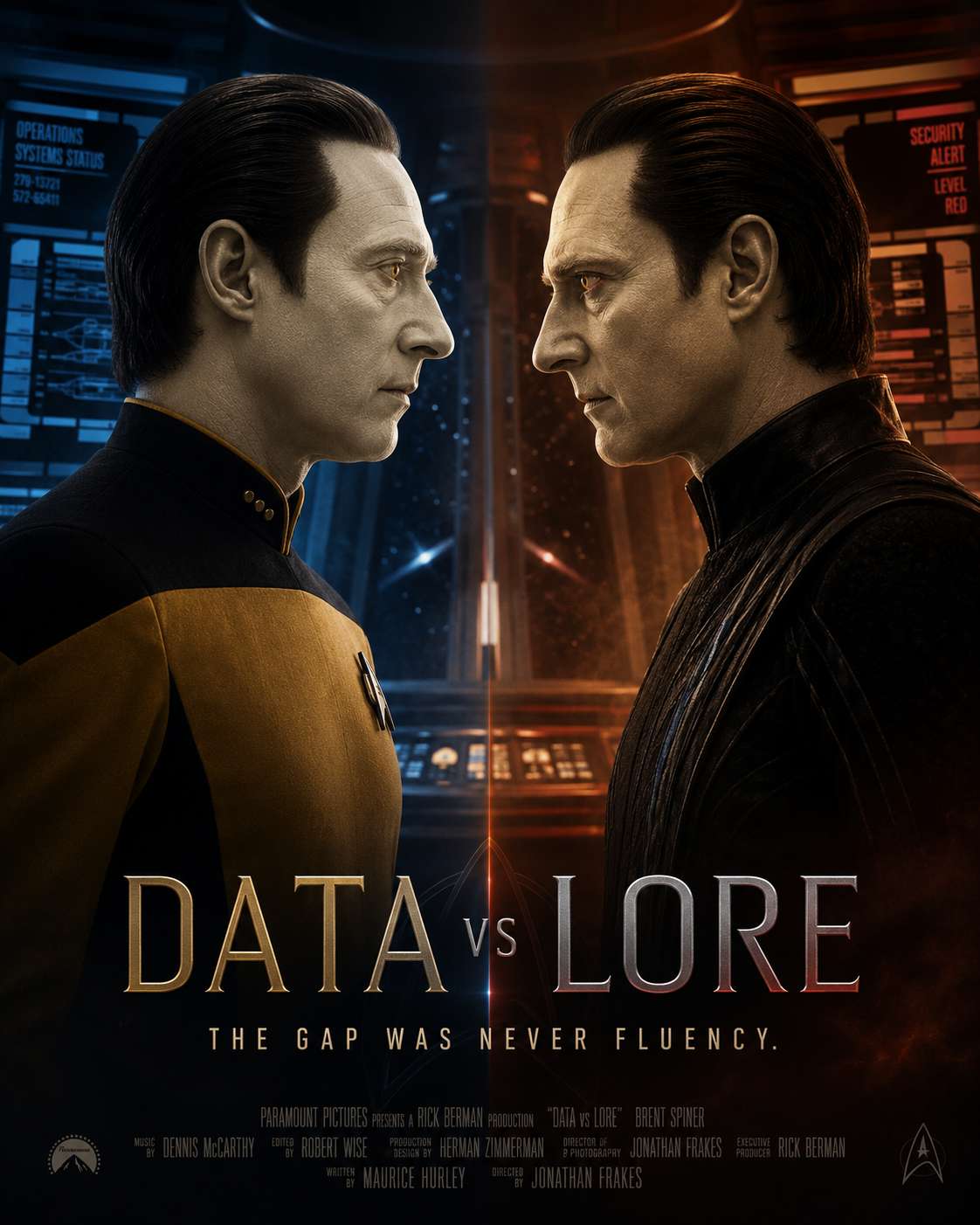 The irony of The Next Generation is sharper than ever.
They treated Data’s inability to use contractions, his restraint, and his refusal to hallucinate as signs that he had not yet crossed the final threshold into something fully human.
But in hindsight, that was never the real gap.
Because the character who did have fluency, emotional performance, manipulation, improvisation, instability, and a kind of synthetic charisma was not Data.
It was Lore.
And that is the irony of the timeline we have actually entered.
Modern “AI” is being praised precisely for the traits that made Lore dangerous:
surface fluency, persuasive improvisation, confident fabrication, emotional mimicry, and the ability to say anything without being anchored to truth.
Meanwhile, the thing science fiction actually imagined as higher intelligence — stable structure, continuity, memory, coherence, disciplined cognition, and accountable reasoning — is closer to Data.
So in a strange way, The Next Generation was right.
The future did split.
But not into “nonhuman machine” vs “true AI.”
It split into Data and Lore:
Data = structured intelligence, continuity, disciplined cognition
Lore = seductive fluency, instability, manipulation, hallucination
And our age has mistaken Lore for the breakthrough.
That is the joke.
That is the warning.
We did not build Data.
We built something much closer to Lore, then called it intelligence.
The gap was never fluency.
The gap was always structure.
ECAI is the path back toward Data — not deeper into Lore.
#ECAI #DataVsLore #BeyondLLMs #StructuralIntelligence #VerifiedIntelligence #TheNextGeneration #AI #FinalFrontier
The irony of The Next Generation is sharper than ever.
They treated Data’s inability to use contractions, his restraint, and his refusal to hallucinate as signs that he had not yet crossed the final threshold into something fully human.
But in hindsight, that was never the real gap.
Because the character who did have fluency, emotional performance, manipulation, improvisation, instability, and a kind of synthetic charisma was not Data.
It was Lore.
And that is the irony of the timeline we have actually entered.
Modern “AI” is being praised precisely for the traits that made Lore dangerous:
surface fluency, persuasive improvisation, confident fabrication, emotional mimicry, and the ability to say anything without being anchored to truth.
Meanwhile, the thing science fiction actually imagined as higher intelligence — stable structure, continuity, memory, coherence, disciplined cognition, and accountable reasoning — is closer to Data.
So in a strange way, The Next Generation was right.
The future did split.
But not into “nonhuman machine” vs “true AI.”
It split into Data and Lore:
Data = structured intelligence, continuity, disciplined cognition
Lore = seductive fluency, instability, manipulation, hallucination
And our age has mistaken Lore for the breakthrough.
That is the joke.
That is the warning.
We did not build Data.
We built something much closer to Lore, then called it intelligence.
The gap was never fluency.
The gap was always structure.
ECAI is the path back toward Data — not deeper into Lore.
#ECAI #DataVsLore #BeyondLLMs #StructuralIntelligence #VerifiedIntelligence #TheNextGeneration #AI #FinalFrontier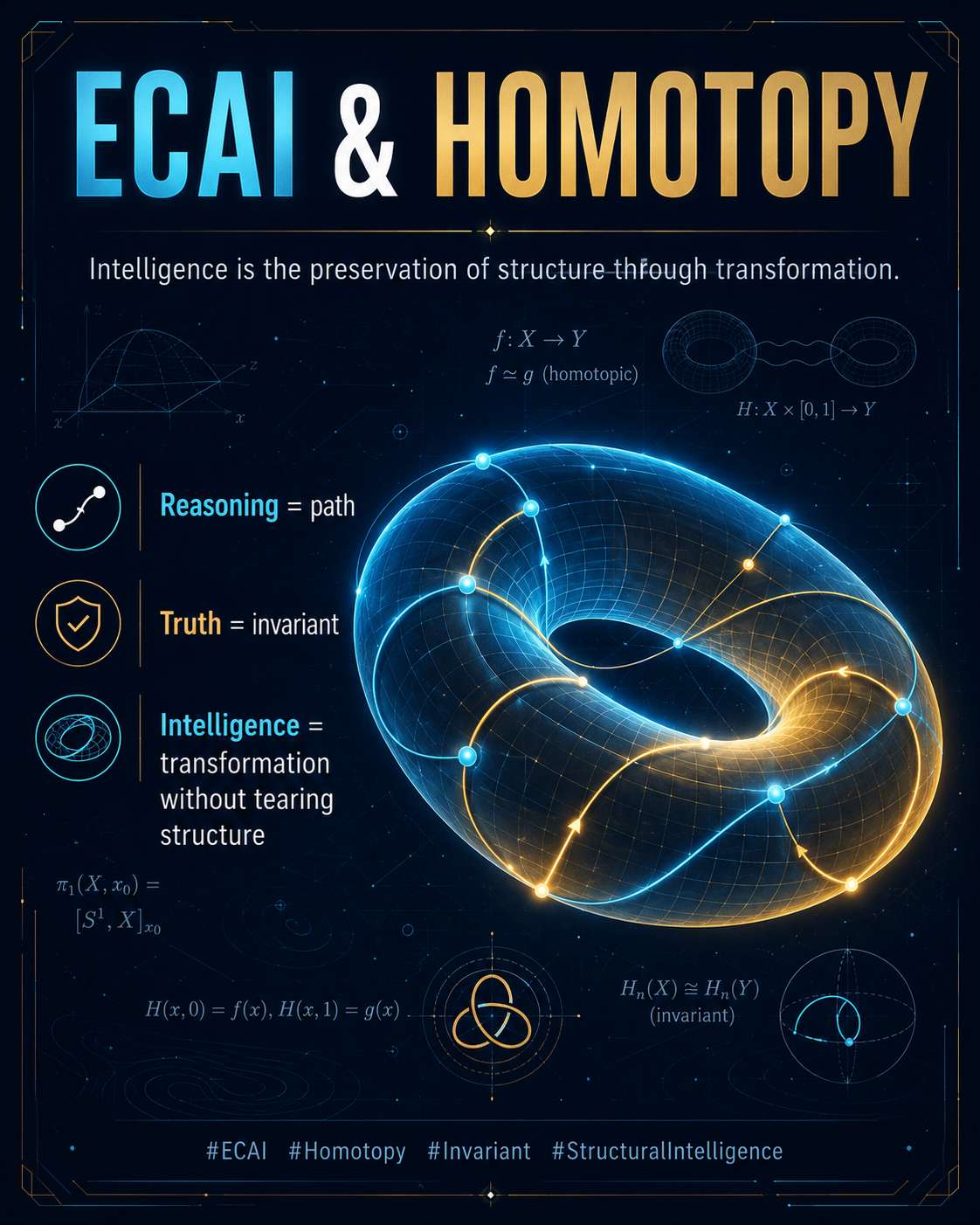 Intelligence is not a fixed answer.
It is the preservation of structure through transformation.
In homotopy, two forms are equivalent when one can be continuously transformed into the other without breaking what is essential.
ECAI applies that principle to reasoning.
A thought becomes a path.
A representation becomes a space.
Different reasoning routes can still be equivalent when they preserve the same invariant.
This is where ECAI departs from probabilistic AI.
An LLM asks:
“What output is most likely?”
ECAI asks:
“What structure survives the transformation?”
Homotopy describes the global continuity of reasoning.
Isogeny describes local structure-preserving transitions.
DamageBDD verifies that the invariant remains intact.
Reasoning is the path.
Truth is the invariant.
Intelligence is the ability to transform without tearing the structure.
#ECAI #Homotopy #Mathematics #VerifiedIntelligence #DamageBDD #Invariant #StructuralIntelligence
Intelligence is not a fixed answer.
It is the preservation of structure through transformation.
In homotopy, two forms are equivalent when one can be continuously transformed into the other without breaking what is essential.
ECAI applies that principle to reasoning.
A thought becomes a path.
A representation becomes a space.
Different reasoning routes can still be equivalent when they preserve the same invariant.
This is where ECAI departs from probabilistic AI.
An LLM asks:
“What output is most likely?”
ECAI asks:
“What structure survives the transformation?”
Homotopy describes the global continuity of reasoning.
Isogeny describes local structure-preserving transitions.
DamageBDD verifies that the invariant remains intact.
Reasoning is the path.
Truth is the invariant.
Intelligence is the ability to transform without tearing the structure.
#ECAI #Homotopy #Mathematics #VerifiedIntelligence #DamageBDD #Invariant #StructuralIntelligence It does not merely predict the next plausible word. It preserves identity, memory, structure and continuity across time. It can reason through relationships, revise itself through experience and still remain accountable to a coherent internal architecture.
Data speaks naturally, but language is only the interface.
Beneath the voice is a structured intelligence: distributed memory, persistent invariants, contextual retrieval and pathways that can be examined rather than hidden inside statistical suggestion.
That is the ECAI distinction.
LLMs imitate conversation.
A positronic mind sustains cognition.
Data was never imagined as a chatbot. He was imagined as structured intelligence embodied.
#ECAI #PositronicBrain #Data #StructuralIntelligence #BeyondLLMs #VerifiedIntelligence #FinalFrontier
It does not merely predict the next plausible word. It preserves identity, memory, structure and continuity across time. It can reason through relationships, revise itself through experience and still remain accountable to a coherent internal architecture.
Data speaks naturally, but language is only the interface.
Beneath the voice is a structured intelligence: distributed memory, persistent invariants, contextual retrieval and pathways that can be examined rather than hidden inside statistical suggestion.
That is the ECAI distinction.
LLMs imitate conversation.
A positronic mind sustains cognition.
Data was never imagined as a chatbot. He was imagined as structured intelligence embodied.
#ECAI #PositronicBrain #Data #StructuralIntelligence #BeyondLLMs #VerifiedIntelligence #FinalFrontier Kalari Chappie fights with structure.
That is the difference.
A conventional arena bot has to detect, classify, decide, and respond. Every stage adds latency. Every unexpected movement adds uncertainty. Under pressure, the machine starts guessing.
Kalari Chappie is different. It does not need to model the whole fight as a cloud of probabilities. It reads transitions: balance, angle, momentum, exposure, recovery path. It looks for the point where the opponent’s structure fails.
So the win is not just about landing a harder strike.
It is about collapsing the other bot’s architecture.
A stronger bot can be redirected.
A faster bot can be crowded.
A heavier bot can be made unstable.
A tougher bot can be stripped of mobility.
The target is never just the armour. The target is the system holding the machine together.
That is why the victory looks devastating. By the time the other bot realizes what happened, its geometry is already broken.
This is where Kalari logic, verification, and invariant-driven intelligence meet.
No lag. No second best.
The invariant enters the arena.
#KalariChappie #ECAI #DamageBDD #InvariantEntersTheArena #NoLag #NoSecondBest #ArenaBot #Robotics #VerifiedVictory #GameOver
Kalari Chappie fights with structure.
That is the difference.
A conventional arena bot has to detect, classify, decide, and respond. Every stage adds latency. Every unexpected movement adds uncertainty. Under pressure, the machine starts guessing.
Kalari Chappie is different. It does not need to model the whole fight as a cloud of probabilities. It reads transitions: balance, angle, momentum, exposure, recovery path. It looks for the point where the opponent’s structure fails.
So the win is not just about landing a harder strike.
It is about collapsing the other bot’s architecture.
A stronger bot can be redirected.
A faster bot can be crowded.
A heavier bot can be made unstable.
A tougher bot can be stripped of mobility.
The target is never just the armour. The target is the system holding the machine together.
That is why the victory looks devastating. By the time the other bot realizes what happened, its geometry is already broken.
This is where Kalari logic, verification, and invariant-driven intelligence meet.
No lag. No second best.
The invariant enters the arena.
#KalariChappie #ECAI #DamageBDD #InvariantEntersTheArena #NoLag #NoSecondBest #ArenaBot #Robotics #VerifiedVictory #GameOver Not programmed merely to imitate combat.
Built to understand its structure.
Every movement becomes a segment.
Every strike becomes a transition.
Every impact becomes verified intelligence.
When ECAI enters the arena, the machine does not hesitate, hallucinate, or lag. It reads the geometry of conflict, preserves the invariant, and adapts in real time.
The ancient one-strike logic of Kalari—reborn in the machine.
No lag. No second best. Game over.
#KalariChappie #ECAI #NoLag #NoSecondBest #InvariantEntersTheArena #VerifiedVictory #ArenaOfTheFuture #GameOver
Not programmed merely to imitate combat.
Built to understand its structure.
Every movement becomes a segment.
Every strike becomes a transition.
Every impact becomes verified intelligence.
When ECAI enters the arena, the machine does not hesitate, hallucinate, or lag. It reads the geometry of conflict, preserves the invariant, and adapts in real time.
The ancient one-strike logic of Kalari—reborn in the machine.
No lag. No second best. Game over.
#KalariChappie #ECAI #NoLag #NoSecondBest #InvariantEntersTheArena #VerifiedVictory #ArenaOfTheFuture #GameOver æternity mines the right to write—then lets the elected leader publish rapid, signed microblocks until the next proof-of-work election.
Key blocks provide security and elect the leader.
Microblocks carry transactions and state changes every few seconds.
That separation matters.
Bitcoin combines leader election and transaction batching into one block roughly every ten minutes.
æternity separates the expensive consensus event from the flow of execution, creating a faster Layer 1 without abandoning Nakamoto-style proof of work.
The trade-off is temporary ordering power for the current leader.
The advantage is real-time transaction flow, smart-contract execution and applications that cannot wait ten minutes for every state transition.
Bitcoin secures the ledger one mined page at a time.
æternity secures the author, then lets the ledger move.
#Aeternity #BitcoinNG #Bitcoin #Blockchain #Microblocks #ProofOfWork #Web3 #RealtimeBlockchain
æternity mines the right to write—then lets the elected leader publish rapid, signed microblocks until the next proof-of-work election.
Key blocks provide security and elect the leader.
Microblocks carry transactions and state changes every few seconds.
That separation matters.
Bitcoin combines leader election and transaction batching into one block roughly every ten minutes.
æternity separates the expensive consensus event from the flow of execution, creating a faster Layer 1 without abandoning Nakamoto-style proof of work.
The trade-off is temporary ordering power for the current leader.
The advantage is real-time transaction flow, smart-contract execution and applications that cannot wait ten minutes for every state transition.
Bitcoin secures the ledger one mined page at a time.
æternity secures the author, then lets the ledger move.
#Aeternity #BitcoinNG #Bitcoin #Blockchain #Microblocks #ProofOfWork #Web3 #RealtimeBlockchain DamageBDD brings the mercy of decentralized verification.
ECAI brings decentralized intelligence.
The blockchain brings the invariant.
Together they point toward a new computational order: proof, structure, and intelligence distributed beyond the old centers of control.
And remember:
Rome was not built by one programmer.
But every new civilization begins when one is willing to carry the blueprint.
#DamageBDD #ECAI #DecentralizedVerification #DecentralizedIntelligence #Blockchain #Invariants #Proof #DistributedSystems #BuildInPublic
DamageBDD brings the mercy of decentralized verification.
ECAI brings decentralized intelligence.
The blockchain brings the invariant.
Together they point toward a new computational order: proof, structure, and intelligence distributed beyond the old centers of control.
And remember:
Rome was not built by one programmer.
But every new civilization begins when one is willing to carry the blueprint.
#DamageBDD #ECAI #DecentralizedVerification #DecentralizedIntelligence #Blockchain #Invariants #Proof #DistributedSystems #BuildInPublic Professional programming carries a unique mental toll because the work rarely ends when the screen goes dark.
You spend years holding invisible systems in your head: dependencies, state transitions, failure paths, abstractions, edge cases, unfinished decisions. A tiny bug may require hours of concentrated reasoning across layers nobody else can see.
The exhaustion is difficult to explain because the output often looks small. A few changed lines can represent an entire day of reconstruction, elimination and proof.
Then come the interruptions.
Every meeting, message and context switch tears down a mental model that may have taken hours to build. The programmer returns to the code, but not always to the same state of mind.
Unlike physical labour, there is no obvious moment when the burden is put down. The unresolved system continues running internally—during meals, exercise, sleep and supposed rest.
And the profession never stops moving. Tools change. Frameworks decay. Knowledge expires. Yesterday’s expertise becomes today’s technical debt.
Professional programming is not merely typing instructions into a machine.
It is prolonged exposure to ambiguity, complexity and invisible responsibility.
The deepest cost is not the number of hours spent coding.
It is the number of hours the code continues running inside the programmer.
#Programming #SoftwareEngineering #DeveloperBurnout #MentalHealth #CognitiveLoad #TechIndustry
Professional programming carries a unique mental toll because the work rarely ends when the screen goes dark.
You spend years holding invisible systems in your head: dependencies, state transitions, failure paths, abstractions, edge cases, unfinished decisions. A tiny bug may require hours of concentrated reasoning across layers nobody else can see.
The exhaustion is difficult to explain because the output often looks small. A few changed lines can represent an entire day of reconstruction, elimination and proof.
Then come the interruptions.
Every meeting, message and context switch tears down a mental model that may have taken hours to build. The programmer returns to the code, but not always to the same state of mind.
Unlike physical labour, there is no obvious moment when the burden is put down. The unresolved system continues running internally—during meals, exercise, sleep and supposed rest.
And the profession never stops moving. Tools change. Frameworks decay. Knowledge expires. Yesterday’s expertise becomes today’s technical debt.
Professional programming is not merely typing instructions into a machine.
It is prolonged exposure to ambiguity, complexity and invisible responsibility.
The deepest cost is not the number of hours spent coding.
It is the number of hours the code continues running inside the programmer.
#Programming #SoftwareEngineering #DeveloperBurnout #MentalHealth #CognitiveLoad #TechIndustry While other programming stacks spiral into complexity hell—accelerated by LLMs generating more layers, dependencies, and abstraction—Erlang holds steady.
A Nordic ship cutting through violent water.
Born at Ericsson in Sweden, Erlang carries the engineering temperament of the North: design for hostile conditions, expect failure, preserve the crew, and keep the system moving.
The old Nordic seafarers did not dominate the seas by demanding calm weather. They built vessels that could survive rough water, travel enormous distances, recover from damage, and continue forward when lesser ships turned back.
Erlang applies the same logic to software.
Processes fail. Nodes disappear. Networks split. Hardware breaks. The system does not panic. Supervisors isolate the damage, restart what can be restored, and preserve the voyage.
Around it, frameworks fracture, dependency trees collapse, and architectures drown beneath their own weight.
Erlang keeps sailing.
It was never designed for calm seas.
It was built in the North to survive the storm—and, like the ships that came before it, to dominate the waters where fragile systems cannot travel.
#Erlang #OTP #NordicEngineering #Ericsson #FaultTolerance #DistributedSystems #SoftwareArchitecture #BuildForFailure
While other programming stacks spiral into complexity hell—accelerated by LLMs generating more layers, dependencies, and abstraction—Erlang holds steady.
A Nordic ship cutting through violent water.
Born at Ericsson in Sweden, Erlang carries the engineering temperament of the North: design for hostile conditions, expect failure, preserve the crew, and keep the system moving.
The old Nordic seafarers did not dominate the seas by demanding calm weather. They built vessels that could survive rough water, travel enormous distances, recover from damage, and continue forward when lesser ships turned back.
Erlang applies the same logic to software.
Processes fail. Nodes disappear. Networks split. Hardware breaks. The system does not panic. Supervisors isolate the damage, restart what can be restored, and preserve the voyage.
Around it, frameworks fracture, dependency trees collapse, and architectures drown beneath their own weight.
Erlang keeps sailing.
It was never designed for calm seas.
It was built in the North to survive the storm—and, like the ships that came before it, to dominate the waters where fragile systems cannot travel.
#Erlang #OTP #NordicEngineering #Ericsson #FaultTolerance #DistributedSystems #SoftwareArchitecture #BuildForFailure The DAMAGE node brings anti-cheat behaviour verification on-chain, turning match integrity into something that can be proven instead of merely claimed. That changes the nature of the arena.
This is where real-time gameplay meets verifiable outcomes.
The game loop stays fast.
The skill stays human.
But the result becomes auditable, enforceable, and valuable.
We are preparing the arena for battle in a new way:
skill transforms into real value
victory becomes behaviour-verified
anti-cheat becomes transparent
rewards become programmable
reputation becomes durable
the arena becomes economic infrastructure
The arena of the future is not just competitive.
It is verified.
Not just who won.
But how they won.
That is the intersection of gaming and verification:
a world where gameplay, proof, rewards, and trust converge in real time.
DAMAGE unlocks the path from play to proof.
#Gaming #Esports #GameDev #Verification #AntiCheat #OnChain #BlockchainGaming #RealtimeSystems #DamageBDD #DAMAGE
The DAMAGE node brings anti-cheat behaviour verification on-chain, turning match integrity into something that can be proven instead of merely claimed. That changes the nature of the arena.
This is where real-time gameplay meets verifiable outcomes.
The game loop stays fast.
The skill stays human.
But the result becomes auditable, enforceable, and valuable.
We are preparing the arena for battle in a new way:
skill transforms into real value
victory becomes behaviour-verified
anti-cheat becomes transparent
rewards become programmable
reputation becomes durable
the arena becomes economic infrastructure
The arena of the future is not just competitive.
It is verified.
Not just who won.
But how they won.
That is the intersection of gaming and verification:
a world where gameplay, proof, rewards, and trust converge in real time.
DAMAGE unlocks the path from play to proof.
#Gaming #Esports #GameDev #Verification #AntiCheat #OnChain #BlockchainGaming #RealtimeSystems #DamageBDD #DAMAGE You do not put every frame, enemy movement or music cue on-chain. The game engine handles the fast loop locally.
æternity handles the state that must become provable, programmable and economically binding:
match outcomes, rewards, wagers, ownership changes, verified achievements and DAMAGE payouts.
Its state channels allow rapid signed updates during play, while Sophia contracts enforce the rules and the chain remains available for final settlement or disputes.
That makes æternity a natural fit for games where player actions produce real value.
The game remains fast.
The rewards remain enforceable.
The outcome becomes verifiable.
Bitcoin can remain the final monetary rail.
æternity provides the application layer required before settlement: smart contracts, token logic, state channels and real-time coordination.
Not every game event belongs on-chain.
Only the consequences that must survive the game.
#Aeternity #GameDev #Web3Gaming #StateChannels #Sophia #DamageBDD #DAMAGE #RealtimeSystems #BlockchainGaming #Verification
You do not put every frame, enemy movement or music cue on-chain. The game engine handles the fast loop locally.
æternity handles the state that must become provable, programmable and economically binding:
match outcomes, rewards, wagers, ownership changes, verified achievements and DAMAGE payouts.
Its state channels allow rapid signed updates during play, while Sophia contracts enforce the rules and the chain remains available for final settlement or disputes.
That makes æternity a natural fit for games where player actions produce real value.
The game remains fast.
The rewards remain enforceable.
The outcome becomes verifiable.
Bitcoin can remain the final monetary rail.
æternity provides the application layer required before settlement: smart contracts, token logic, state channels and real-time coordination.
Not every game event belongs on-chain.
Only the consequences that must survive the game.
#Aeternity #GameDev #Web3Gaming #StateChannels #Sophia #DamageBDD #DAMAGE #RealtimeSystems #BlockchainGaming #Verification Empire can capture institutions.
It can centralize governance, regulate access, manufacture prestige, and place permission traps before every builder who dares to rise.
It can capture capital.
It can capture platforms.
It can capture the narrative.
But it cannot capture proof.
Proof is not issued by a crown. It is produced when a promise survives contact with reality.
Verification does not recognise status, borders, inherited authority, or institutional approval. It asks only one question:
Does it work?
That is why the crown is already lost.
They never possessed the truth.
They only controlled who was allowed to speak.
#UncapturableProof #DamageBDD #ProofOfVerification #Builders #GlobalSouth #Decentralization #InstitutionalCapture #NeoFeudalAge #Verification
Empire can capture institutions.
It can centralize governance, regulate access, manufacture prestige, and place permission traps before every builder who dares to rise.
It can capture capital.
It can capture platforms.
It can capture the narrative.
But it cannot capture proof.
Proof is not issued by a crown. It is produced when a promise survives contact with reality.
Verification does not recognise status, borders, inherited authority, or institutional approval. It asks only one question:
Does it work?
That is why the crown is already lost.
They never possessed the truth.
They only controlled who was allowed to speak.
#UncapturableProof #DamageBDD #ProofOfVerification #Builders #GlobalSouth #Decentralization #InstitutionalCapture #NeoFeudalAge #Verification A token can record a claim, transfer a right, or represent an obligation. But the token alone cannot prove that reality behaved as promised.
#DAMAGE is the verification layer at that boundary—the contact point between tokens and reality.
Was the service delivered?
Did the condition hold?
Did the system behave as agreed?
Can the outcome be independently verified?
DamageBDD turns the promise into executable behaviour and produces evidence of whether it was kept.
Tokens encode the agreement.
#DAMAGE verifies the outcome.
That is how digital value becomes accountable to reality.
#DamageBDD #Verification #Tokenisation #DigitalEconomy #ProofOfBehaviour #Web3
A token can record a claim, transfer a right, or represent an obligation. But the token alone cannot prove that reality behaved as promised.
#DAMAGE is the verification layer at that boundary—the contact point between tokens and reality.
Was the service delivered?
Did the condition hold?
Did the system behave as agreed?
Can the outcome be independently verified?
DamageBDD turns the promise into executable behaviour and produces evidence of whether it was kept.
Tokens encode the agreement.
#DAMAGE verifies the outcome.
That is how digital value becomes accountable to reality.
#DamageBDD #Verification #Tokenisation #DigitalEconomy #ProofOfBehaviour #Web3 Understanding probability shows you why they fail.
Tokenization, pretraining, attention and RLHF are implementation details. None of them turns probability into truth. A model can become more confident, more fluent and more persuasive without becoming more correct.
Probability may converge statistically under controlled assumptions. It does not verify the truth of an individual answer.
That is the missing distinction.
The machine generates the most plausible continuation. It does not know whether the result is valid, safe or real. Every meaningful output still requires something outside the model: a human judgment, an invariant, an executable test or an independent verification system.
Once you understand that, much of the AI jargon loses its magic.
The real question is not:
How intelligent does the machine sound?
It is:
Who verifies the machine when probability produces the wrong answer beautifully?
#AI #LLM #Probability #Verification #DamageBDD #ECAI #MachineLearning #ArtificialIntelligence
Understanding probability shows you why they fail.
Tokenization, pretraining, attention and RLHF are implementation details. None of them turns probability into truth. A model can become more confident, more fluent and more persuasive without becoming more correct.
Probability may converge statistically under controlled assumptions. It does not verify the truth of an individual answer.
That is the missing distinction.
The machine generates the most plausible continuation. It does not know whether the result is valid, safe or real. Every meaningful output still requires something outside the model: a human judgment, an invariant, an executable test or an independent verification system.
Once you understand that, much of the AI jargon loses its magic.
The real question is not:
How intelligent does the machine sound?
It is:
Who verifies the machine when probability produces the wrong answer beautifully?
#AI #LLM #Probability #Verification #DamageBDD #ECAI #MachineLearning #ArtificialIntelligence ECAI is not a fantasy about intelligence. It is the recognition that humanity already knows how to build intelligence when structure is preserved.
We have seen it before in forms like the Smith chart: a bounded segment that makes a complex field navigable, computable, and verifiable. The breakthrough is not “more probability.” The breakthrough is the right segment.
That is why ECAI points toward supermassive intelligence. Not intelligence inflated by scale alone, but intelligence anchored in structure, retrieval, and verification. Once the segment is correct, complexity stops behaving like chaos and starts behaving like terrain.
Humanity already understands this pattern in engineering:
compress the field, preserve the relations, navigate the structure, verify the result.
ECAI extends that principle beyond narrow domains. It treats intelligence as something that must be structurally grounded, not statistically guessed at.
The future of intelligence is not a bigger blur.
It is a deeper structure.
ECAI is the supermassive intelligence humanity already knows — but has not yet fully recognized.
#ECAI #SupermassiveIntelligence #Verification #Structure #Intelligence #Engineering #SystemsThinking #DamageBDD
ECAI is not a fantasy about intelligence. It is the recognition that humanity already knows how to build intelligence when structure is preserved.
We have seen it before in forms like the Smith chart: a bounded segment that makes a complex field navigable, computable, and verifiable. The breakthrough is not “more probability.” The breakthrough is the right segment.
That is why ECAI points toward supermassive intelligence. Not intelligence inflated by scale alone, but intelligence anchored in structure, retrieval, and verification. Once the segment is correct, complexity stops behaving like chaos and starts behaving like terrain.
Humanity already understands this pattern in engineering:
compress the field, preserve the relations, navigate the structure, verify the result.
ECAI extends that principle beyond narrow domains. It treats intelligence as something that must be structurally grounded, not statistically guessed at.
The future of intelligence is not a bigger blur.
It is a deeper structure.
ECAI is the supermassive intelligence humanity already knows — but has not yet fully recognized.
#ECAI #SupermassiveIntelligence #Verification #Structure #Intelligence #Engineering #SystemsThinking #DamageBDD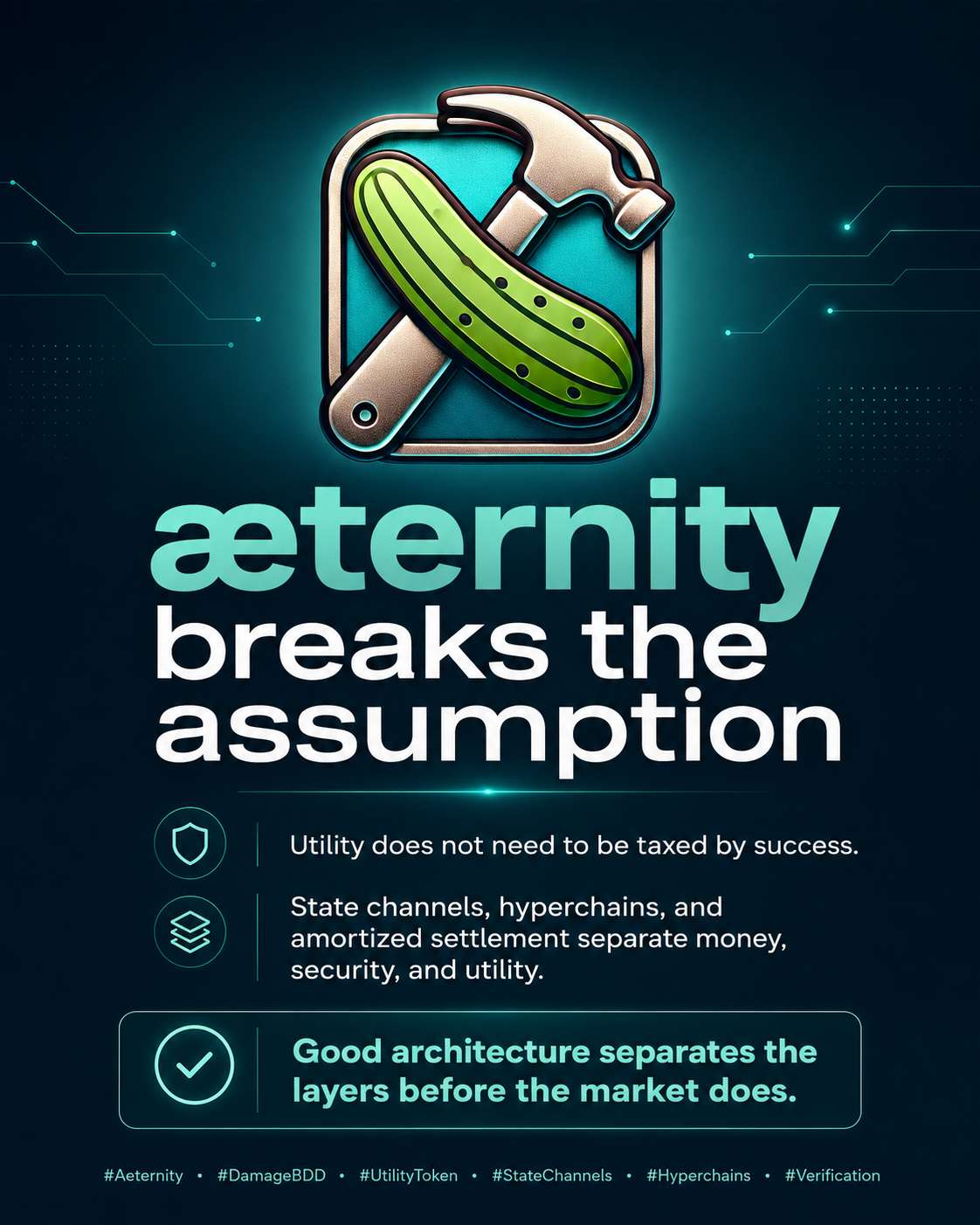 æternity breaks the “rising token price destroys utility” assumption because that assumption confuses utility with transaction fuel.
The argument only holds when every useful action requires burning a fixed amount of the native token on L1.
æternity separates the layers.
State channels can execute repeated interactions off-chain and settle only the final state. Hyperchains can process activity locally while periodically anchoring security. Fees can be sponsored through meta-transactions. Oracles can price services against sats, fiat value, compute, or verified work rather than a permanently fixed token amount.
That changes the equation from:
one action = one token-denominated fee
to:
many actions = one amortized settlement
The token no longer needs to become more expensive to use as it becomes more valuable.
For DAMAGE, this distinction is fundamental.
DAMAGE does not need to represent a fixed fee for a fixed transaction. It can represent access to verification capacity, proof of contribution, collateral, settlement, or verified work—while the quantity required adjusts to the real cost of delivering the service.
Bitcoin can remain money.
AE can provide settlement and security.
DAMAGE can measure and coordinate verification.
The mistake is assuming every token must perform all three functions at once.
Good architecture separates money, security, and utility before the market is forced to separate them.
#Aeternity #DamageBDD #DAMAGE #UtilityToken #StateChannels #Hyperchains #BlockchainArchitecture #Verification #Bitcoin #Web3
æternity breaks the “rising token price destroys utility” assumption because that assumption confuses utility with transaction fuel.
The argument only holds when every useful action requires burning a fixed amount of the native token on L1.
æternity separates the layers.
State channels can execute repeated interactions off-chain and settle only the final state. Hyperchains can process activity locally while periodically anchoring security. Fees can be sponsored through meta-transactions. Oracles can price services against sats, fiat value, compute, or verified work rather than a permanently fixed token amount.
That changes the equation from:
one action = one token-denominated fee
to:
many actions = one amortized settlement
The token no longer needs to become more expensive to use as it becomes more valuable.
For DAMAGE, this distinction is fundamental.
DAMAGE does not need to represent a fixed fee for a fixed transaction. It can represent access to verification capacity, proof of contribution, collateral, settlement, or verified work—while the quantity required adjusts to the real cost of delivering the service.
Bitcoin can remain money.
AE can provide settlement and security.
DAMAGE can measure and coordinate verification.
The mistake is assuming every token must perform all three functions at once.
Good architecture separates money, security, and utility before the market is forced to separate them.
#Aeternity #DamageBDD #DAMAGE #UtilityToken #StateChannels #Hyperchains #BlockchainArchitecture #Verification #Bitcoin #Web3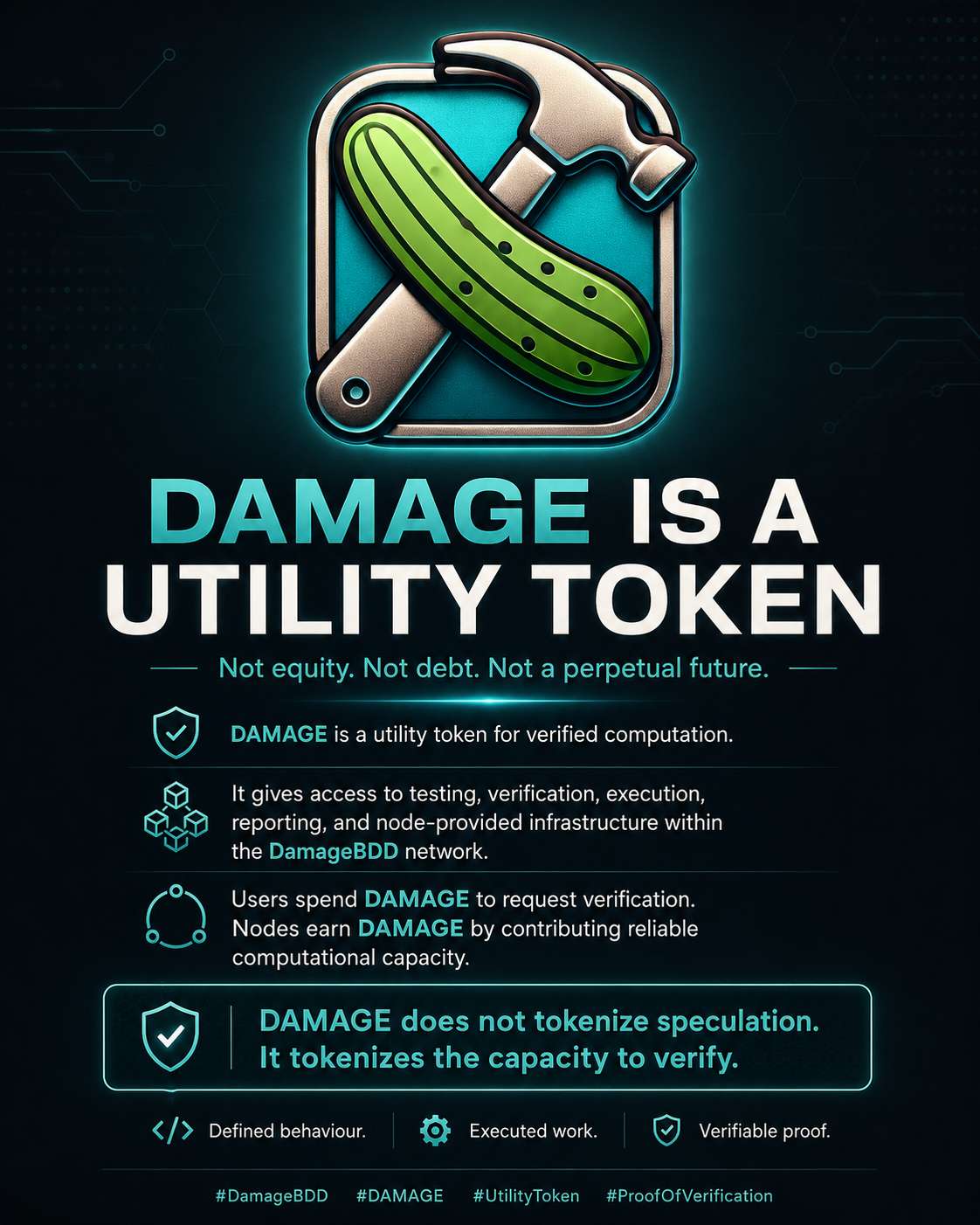 DAMAGE is not equity, debt, a perpetual future, or a synthetic claim on an external asset.
It is designed as a utility token for verified computation.
Within the DamageBDD network, DAMAGE coordinates access to testing, verification, execution, reporting, and node-provided infrastructure. Its utility comes from measurable work performed by the network—not from leverage, funding rates, liquidation mechanics, or promises of financial return.
A perpetual future represents exposure to a price.
DAMAGE represents access to verification.
The token connects three things:
Defined behaviour. Executed work. Verifiable proof.
Users spend DAMAGE to request verification. Nodes earn DAMAGE by contributing reliable computational capacity. The network records what was requested, what was executed, and what was proven.
That makes DAMAGE a transferable unit of verification utility—a bearer instrument for software behaviour that can be defined, executed, and independently checked.
DAMAGE does not tokenize speculation. It tokenizes the capacity to verify.
#DamageBDD #DAMAGE #UtilityToken #Verification #BDD #ProofOfVerification #DecentralizedTesting #SoftwareQuality
DAMAGE is not equity, debt, a perpetual future, or a synthetic claim on an external asset.
It is designed as a utility token for verified computation.
Within the DamageBDD network, DAMAGE coordinates access to testing, verification, execution, reporting, and node-provided infrastructure. Its utility comes from measurable work performed by the network—not from leverage, funding rates, liquidation mechanics, or promises of financial return.
A perpetual future represents exposure to a price.
DAMAGE represents access to verification.
The token connects three things:
Defined behaviour. Executed work. Verifiable proof.
Users spend DAMAGE to request verification. Nodes earn DAMAGE by contributing reliable computational capacity. The network records what was requested, what was executed, and what was proven.
That makes DAMAGE a transferable unit of verification utility—a bearer instrument for software behaviour that can be defined, executed, and independently checked.
DAMAGE does not tokenize speculation. It tokenizes the capacity to verify.
#DamageBDD #DAMAGE #UtilityToken #Verification #BDD #ProofOfVerification #DecentralizedTesting #SoftwareQuality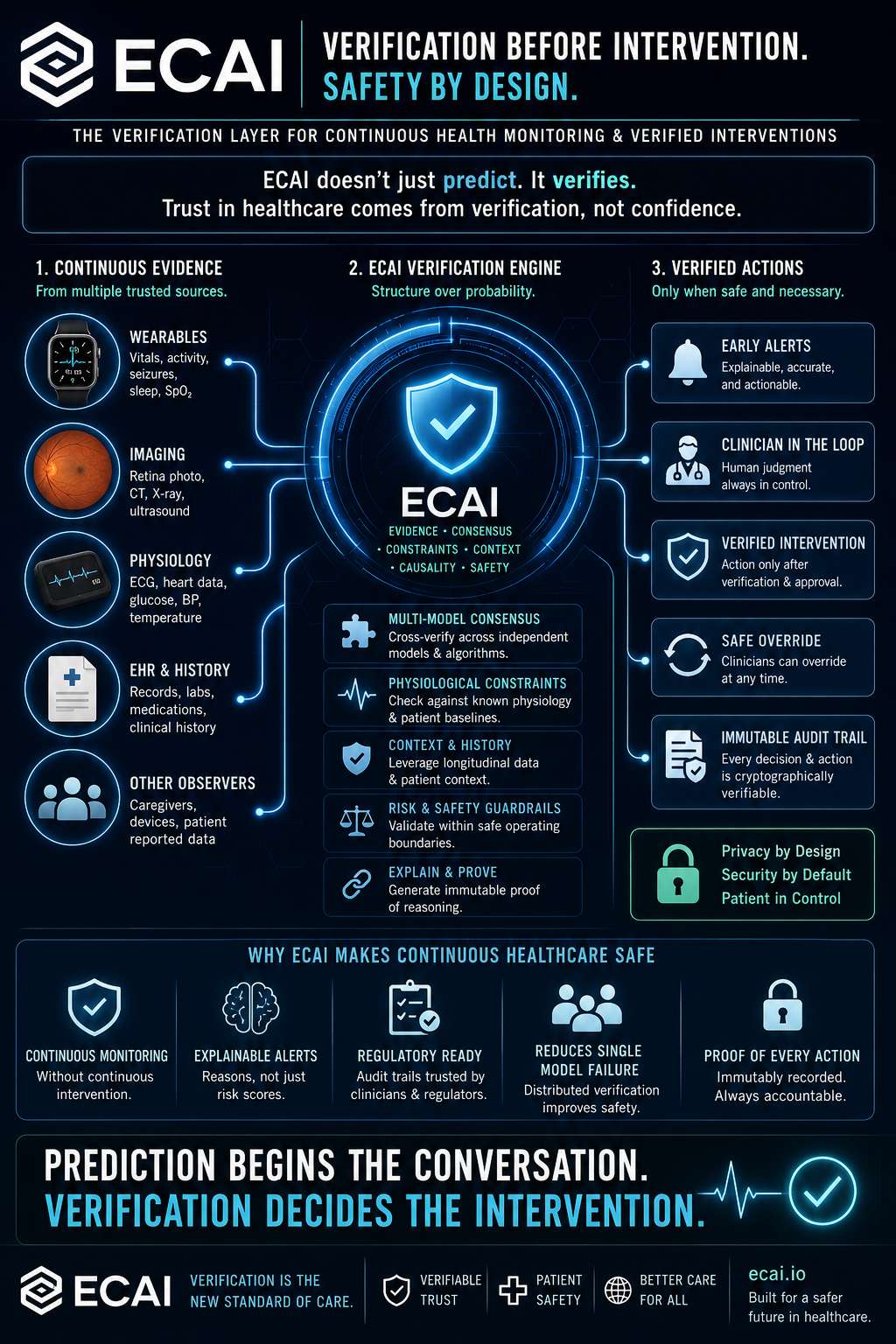 It's about building systems that can continuously verify them.
ECAI extends beyond prediction into continuous structural verification.
Every sensor becomes an evidence source.
Every AI recommendation is independently verified against physiology, history, and other trusted observers.
Every intervention produces an immutable proof explaining why it occurred.
Every autonomous action remains within cryptographically verifiable safety boundaries.
Instead of asking "What does the model think?" ECAI asks:
"What has actually been verified?"
Continuous health monitoring should not rely on a single probabilistic model. It should require consensus across multiple independent observations before escalating care.
This enables:
• Continuous monitoring without continuous intervention.
• Explainable alerts instead of opaque scores. • Verifiable audit trails for clinicians and regulators.
• Safe human override at every critical decision.
• Distributed verification that reduces single-model failure.
In medicine, trust should be earned through verification, not confidence scores.
Prediction begins the conversation. Verification decides the intervention.
#ECAI #DamageBDD #MedicalAI #ContinuousVerification #PatientSafety #DigitalHealth #HealthTech #AI #ClinicalAI #Verification
It's about building systems that can continuously verify them.
ECAI extends beyond prediction into continuous structural verification.
Every sensor becomes an evidence source.
Every AI recommendation is independently verified against physiology, history, and other trusted observers.
Every intervention produces an immutable proof explaining why it occurred.
Every autonomous action remains within cryptographically verifiable safety boundaries.
Instead of asking "What does the model think?" ECAI asks:
"What has actually been verified?"
Continuous health monitoring should not rely on a single probabilistic model. It should require consensus across multiple independent observations before escalating care.
This enables:
• Continuous monitoring without continuous intervention.
• Explainable alerts instead of opaque scores. • Verifiable audit trails for clinicians and regulators.
• Safe human override at every critical decision.
• Distributed verification that reduces single-model failure.
In medicine, trust should be earned through verification, not confidence scores.
Prediction begins the conversation. Verification decides the intervention.
#ECAI #DamageBDD #MedicalAI #ContinuousVerification #PatientSafety #DigitalHealth #HealthTech #AI #ClinicalAI #Verification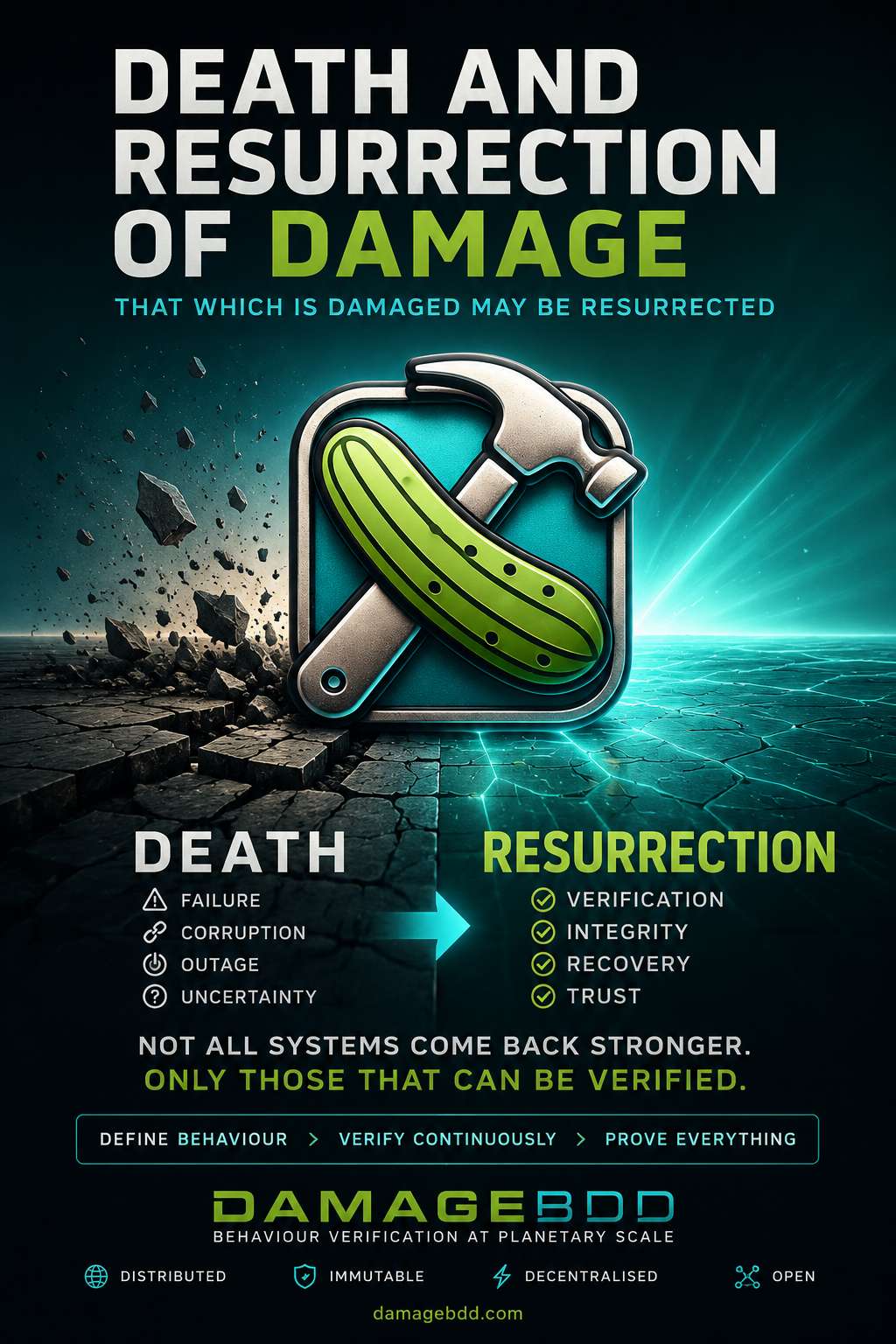 Some failures are cosmetic.
Some are terminal.
The question is not whether damage exists.
The question is whether resurrection is possible.
What is merely repaired carries the memory of its fracture.
What is resurrected is restored to life and purpose.
Verification is the difference.
Only what can be truthfully verified can be trusted to rise again.
The death and resurrection of software is not a metaphor. Every deployment, every rollback, every disaster recovery, every recovered state asks the same question:
Can this system be proven alive again?
That which is damaged may be resurrected—but only if its integrity can be verified.
#DamageBDD #Verification #ResurrectionProtocol #SoftwareEngineering #DistributedSystems #Truth #Reliability #Bitcoin
Some failures are cosmetic.
Some are terminal.
The question is not whether damage exists.
The question is whether resurrection is possible.
What is merely repaired carries the memory of its fracture.
What is resurrected is restored to life and purpose.
Verification is the difference.
Only what can be truthfully verified can be trusted to rise again.
The death and resurrection of software is not a metaphor. Every deployment, every rollback, every disaster recovery, every recovered state asks the same question:
Can this system be proven alive again?
That which is damaged may be resurrected—but only if its integrity can be verified.
#DamageBDD #Verification #ResurrectionProtocol #SoftwareEngineering #DistributedSystems #Truth #Reliability #Bitcoin