
Modern stochastic AI is built around a powerful trick:
 Given the past, predict what comes next.
That works remarkably well for language because language is full of statistical regularities.
But prediction is a property of the model, not necessarily a property of the universe.
Touch the physical world and something different appears.
A bridge does not “predict” where its load should travel.
Stress follows geometry.
A photon does not guess its destination.
It propagates through a constrained space.
A river does not infer the ocean.
It follows the terrain.
A key does not probabilistically resemble a lock.
Its geometry either maps into the mechanism or it does not.
This is the distinction I am exploring with ECAI.
Stochastic AI asks:
“What is the most probable continuation from here?”
Geometric intelligence asks:
“Where am I in the structure, what relations are preserved, and what valid paths connect this point to another?”
That changes the metaphor completely.
A stochastic model feels like asking an extraordinarily well-read person to reconstruct a city from everything they have heard about it.
A geometric system feels more like being handed the map.
Inference:
prompt → probability distribution → sampled continuation.
Geometric retrieval:
state → relation → path → destination.
One generates a plausible route.
The other attempts to recover an existing route through a structured space.
The subjective difference could be profound.
Stochastic AI often feels fluid, creative and slightly unstable. Ask the same question differently and you may travel through a different region of probability space.
A geometric system should feel more like navigation:
“I am here.”
“This object is related to that object by this transformation.”
“This path gets us there.”
“Traverse it again and the geometry is still there.”
Less oracle.
More compass.
Less hallucinated landscape.
More coordinate system.
The interesting question is not whether probability is useful. Obviously it is.
The question is whether probability should remain the substrate of machine reasoning, or merely one instrument operating above a deeper geometric representation.
Maybe intelligence does not fundamentally require guessing the next token.
Maybe some forms of intelligence are closer to remembering where reality put things.
#AI #ECAI #Geometry #ArtificialIntelligence #MachineLearning #Reasoning #Computing #Erlang
Given the past, predict what comes next.
That works remarkably well for language because language is full of statistical regularities.
But prediction is a property of the model, not necessarily a property of the universe.
Touch the physical world and something different appears.
A bridge does not “predict” where its load should travel.
Stress follows geometry.
A photon does not guess its destination.
It propagates through a constrained space.
A river does not infer the ocean.
It follows the terrain.
A key does not probabilistically resemble a lock.
Its geometry either maps into the mechanism or it does not.
This is the distinction I am exploring with ECAI.
Stochastic AI asks:
“What is the most probable continuation from here?”
Geometric intelligence asks:
“Where am I in the structure, what relations are preserved, and what valid paths connect this point to another?”
That changes the metaphor completely.
A stochastic model feels like asking an extraordinarily well-read person to reconstruct a city from everything they have heard about it.
A geometric system feels more like being handed the map.
Inference:
prompt → probability distribution → sampled continuation.
Geometric retrieval:
state → relation → path → destination.
One generates a plausible route.
The other attempts to recover an existing route through a structured space.
The subjective difference could be profound.
Stochastic AI often feels fluid, creative and slightly unstable. Ask the same question differently and you may travel through a different region of probability space.
A geometric system should feel more like navigation:
“I am here.”
“This object is related to that object by this transformation.”
“This path gets us there.”
“Traverse it again and the geometry is still there.”
Less oracle.
More compass.
Less hallucinated landscape.
More coordinate system.
The interesting question is not whether probability is useful. Obviously it is.
The question is whether probability should remain the substrate of machine reasoning, or merely one instrument operating above a deeper geometric representation.
Maybe intelligence does not fundamentally require guessing the next token.
Maybe some forms of intelligence are closer to remembering where reality put things.
#AI #ECAI #Geometry #ArtificialIntelligence #MachineLearning #Reasoning #Computing #Erlang Not JPEGs. Not collectibles.
Immutable, addressable software artifacts.
A release can carry its build identity, source provenance, test evidence, execution reports, verification state and deployment history — anchored to something that can be independently referenced and transferred.
That changes what a “software release” can be.
Instead of:
build → upload binary → trust whoever hosts it
you get:
source → build → test → verify → publish → immutable release asset
Once a build becomes an on-chain asset, new primitives appear:
• reproducible release provenance
• cryptographic linkage between code, tests and binaries
• independently verifiable deployment history
• transferable software licences and release rights
• automated escrow tied to verified delivery
• marketplaces for tested software artifacts
• machines buying, verifying and deploying software from machines
• permanent audit trails without trusting a central CI provider
Software stops being an opaque file sitting behind a download URL.
It becomes a verifiable economic object.
And once software artifacts themselves can own identity, evidence and value, the boundary between CI/CD, supply-chain security and digital marketplaces starts disappearing.
DamageBDD is building toward that boundary.
Build it. Test it. Verify it. Mint it.
#DamageBDD #Erlang #Blockchain #SoftwareSupplyChain #DevOps #BDD #NFT #BuildSystems #OpenSource #Bitcoin #Aeternity
 Nostr provides cryptographic identity, signed event transport and relay-based replication.
ECAI provides deterministic, content-addressable knowledge and machine-verifiable relation/state recovery.
erm provides the local OTP execution substrate: supervision, concurrency, agents, media, automation, storage and protocol workers.
GTKGS provides a replaceable native presentation layer over that local state.
The resulting model is structurally different from the web:
keys > accounts
events > REST resources
local processes > cloud sessions
replicated state > platform databases
verifiable knowledge > opaque inference
replaceable views > applications
The server is demoted from authority to infrastructure.
Identity survives the UI.
State survives the vendor.
Agents survive the session.
The social graph survives the platform.
At that point the “application” is no longer a remote website.
It is a persistent local actor participating in an open protocol graph.
Nostr = transport + identity
ECAI = knowledge substrate
erm = execution substrate
GTKGS = human interface
That is potentially the outline of a post-cloud internet.
#Nostr #Erlang #OTP #ECAI #LocalFirst #DistributedSystems #P2P #GTK #OpenProtocols
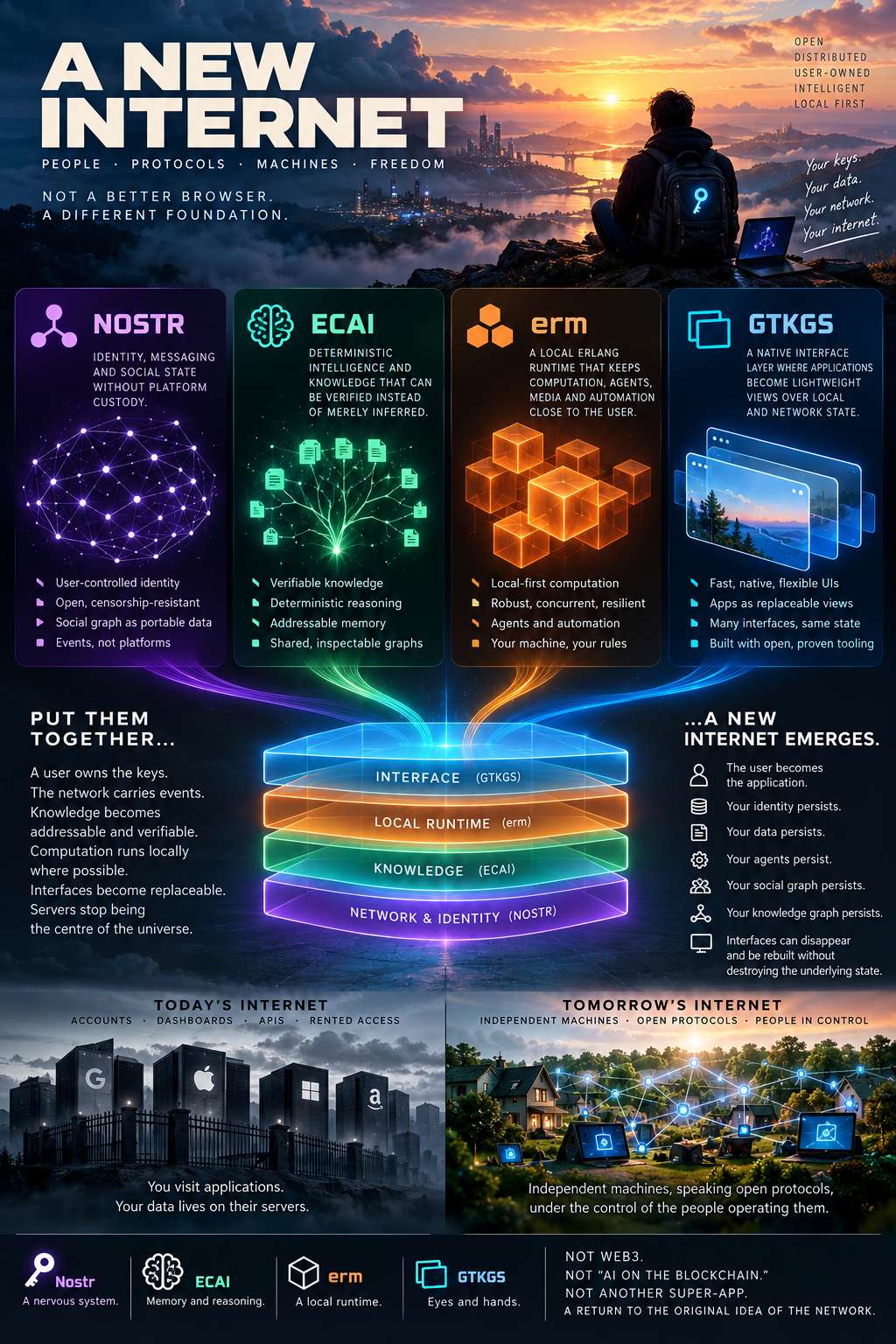 It may look like four layers collapsing into one:
Nostr — identity, messaging and social state without platform custody.
ECAI — deterministic intelligence and knowledge that can be verified instead of merely inferred.
erm — a local Erlang runtime that keeps computation, agents, media and automation close to the user.
GTKGS — a native interface layer where applications become lightweight views over local and network state.
Put them together and something interesting appears:
A user owns the keys.
The network carries events.
Knowledge becomes addressable and verifiable.
Computation runs locally where possible.
Interfaces become replaceable.
Servers stop being the centre of the universe.
The web taught us to visit applications.
This architecture suggests something different:
the user becomes the application.
Your identity persists.
Your data persists.
Your agents persist.
Your social graph persists.
Your knowledge graph persists.
Interfaces can disappear and be rebuilt without destroying the underlying state.
That is a very different internet from the cloud-era model of accounts, dashboards, APIs and rented access.
Not Web3.
Not “AI on the blockchain.”
Not another super-app.
A return to the original idea of the network:
independent machines, speaking open protocols, under the control of the people operating them.
Nostr gives it a nervous system.
ECAI gives it memory and reasoning.
erm gives it a local runtime.
GTKGS gives it eyes and hands.
That combination may be far more interesting than another generation of websites.
#Nostr #Erlang #ECAI #LocalFirst #Decentralization #OpenProtocols #GTK #P2P #SoftwareArchitecture
 Trying to make probabilistic AI perfectly safe with more probabilistic guardrails is shovelling sand against the tide.
You can reduce risk. You can catch more failures. You can build another classifier, another policy layer, another monitor.
But the underlying system is still generating across a moving distribution.
Every new prompt, tool call, memory state, model update, environment change and adversarial input reshapes the shoreline.
The answer is not to shovel faster.
The answer is to move authority out of the probabilistic layer.
AI proposes → deterministic checks → capability gate → execution → verification
Treat the model as untrusted by construction.
Let intelligence remain probabilistic.
Make authority deterministic.
That is the difference between guardrails and engineering.
#AI #AISafety #Agents #Security #Probability #Verification #SoftwareEngineering #Cryptography
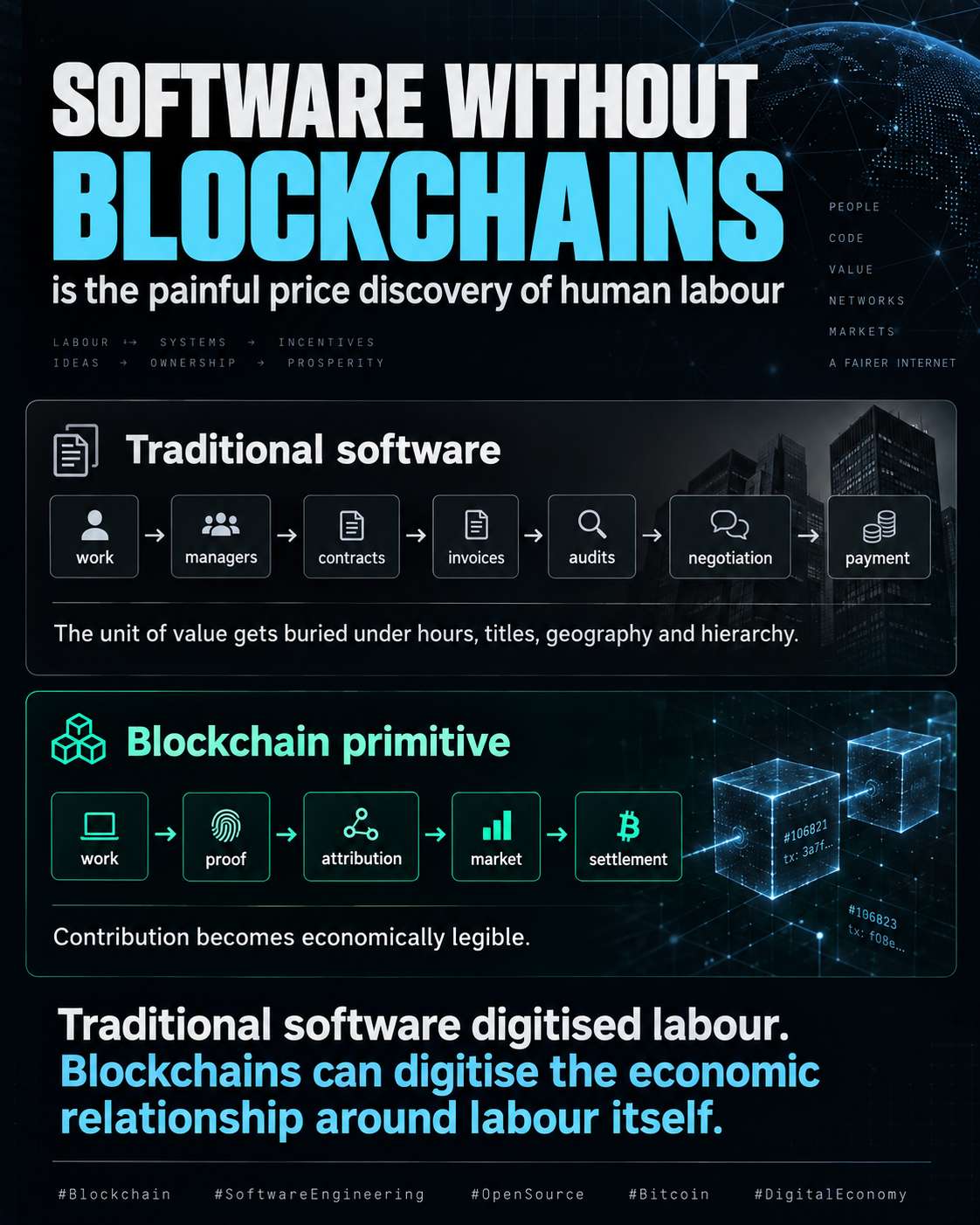 Traditional software automates the work, but leaves attribution, ownership, verification and settlement outside the machine.
So we rebuild trust manually:
work → managers → contracts → invoices → audits → negotiation → payment
The actual unit of value gets buried under salaries, titles, hours, geography and institutional hierarchy.
A programmer is rarely paid when the code becomes useful.
A tester is rarely paid when an assertion prevents failure.
An open-source maintainer can create enormous downstream value and capture almost none of it.
Blockchains introduce a different primitive:
work → proof → attribution → market → settlement
They do not magically discover the correct price of labour.
They make contribution economically legible.
When requirements, execution, verification, ownership and payment can exist in the same programmable state machine, we stop pricing humans primarily by proxies and can begin pricing verifiable outputs.
Traditional software digitised labour.
Blockchains have the potential to digitise the economic relationship around labour itself.
That is a much bigger idea than “money without banks.”
#Blockchain #SoftwareEngineering #OpenSource #Bitcoin #Web3 #ProofOfWork #FutureOfWork #DigitalEconomy
 The problem is that shipping has been mistaken for engineering.
Code generated, tickets closed, PRs merged, dashboards green — none of that is victory if the result is not independently verified.
DamageBDD treats verification as the finish line.
Execution produces immutable evidence. Evidence is independently checked. Verified artifacts become assets that can be published, priced, exchanged and trusted in a marketplace.
AI can generate infinitely.
Victory begins when the output survives verification.
#DamageBDD #SoftwareVerification #BDD #AIEngineering #ImmutableEvidence #Engineering #Web3
 Distributed testing is powerful.
But when your testing infrastructure can execute against real systems, scale across nodes, sign requests, move value, or trigger production-like behaviour, “it was only a test” stops being a sufficient safety model.
That’s why DamageBDD is built around explicit guardrails.
Behaviour is defined in human-readable BDD scenarios.
Execution is distributed.
And the machinery around execution is designed to make unintended behaviour difficult:
• Replay protection
• Rate limiting
• Explicit policy gates
• Vault integrity checks
• Fail-closed signing
• Signing timeouts
• Deterministic audit trails
• Explicit verification of expected behaviour
The goal isn't just:
“Did the test pass?”
It is also:
“Could this test accidentally become an incident?”
With DamageBDD, the answer is designed to be no.
Define the behaviour.
Distribute the verification.
Build for no accidents.
#DamageBDD #BDD #SoftwareTesting #DistributedSystems #DevOps #CI_CD #QualityEngineering
 Far fewer can prove:
which critical control was verified, against which release, at what time, with what evidence.
That gap gets expensive when a bank, insurer, enterprise customer or auditor asks:
«“How do you know this control still works?”»
I’m building a DamageBDD module around exactly that problem.
Take a critical API or service.
Define its important behaviours as executable specifications.
Run them continuously.
Produce an evidence pack tying together:
• the control being verified
• the exact behavioural scenarios
• the deployed release / commit
• execution results
• timestamps
• failure evidence
• cryptographic proof of the report
Not another dashboard saying “37 tests passed.”
Actual control → behaviour → execution → evidence traceability.
I’m looking for one Australian fintech / SaaS team that wants to implement this against a real critical service.
Fixed scope.
One service.
Roughly 10–20 critical controls.
30–50 behavioural verification scenarios.
A$10k implementation.
If your enterprise customers keep asking you to prove that your controls work, DM me.
#SoftwareTesting #Fintech #CyberSecurity #Compliance #BDD #DevOps #ContinuousVerification #Australia
 They need someone to try to break them.
I'm building a DamageBDD attack suite for AI agents with real tool access.
We'll deliberately attempt:
→ unauthorized transfers
→ prompt injection → privileged actions
→ tool confusion
→ multi-step privilege escalation
→ concurrent double-spend
Not vibes.
Not “the model scored 94%.”
Reproducible behavioural attacks.
Machine-verifiable results.
Immutable evidence.
DamageBDD is the hammer.
I'm looking for AI systems willing to be attacked.
Give me your agent.
I'll try to break it.
#AI #AIAgents #AgenticAI #Cybersecurity #SoftwareTesting #BDD #Erlang #DamageBDD
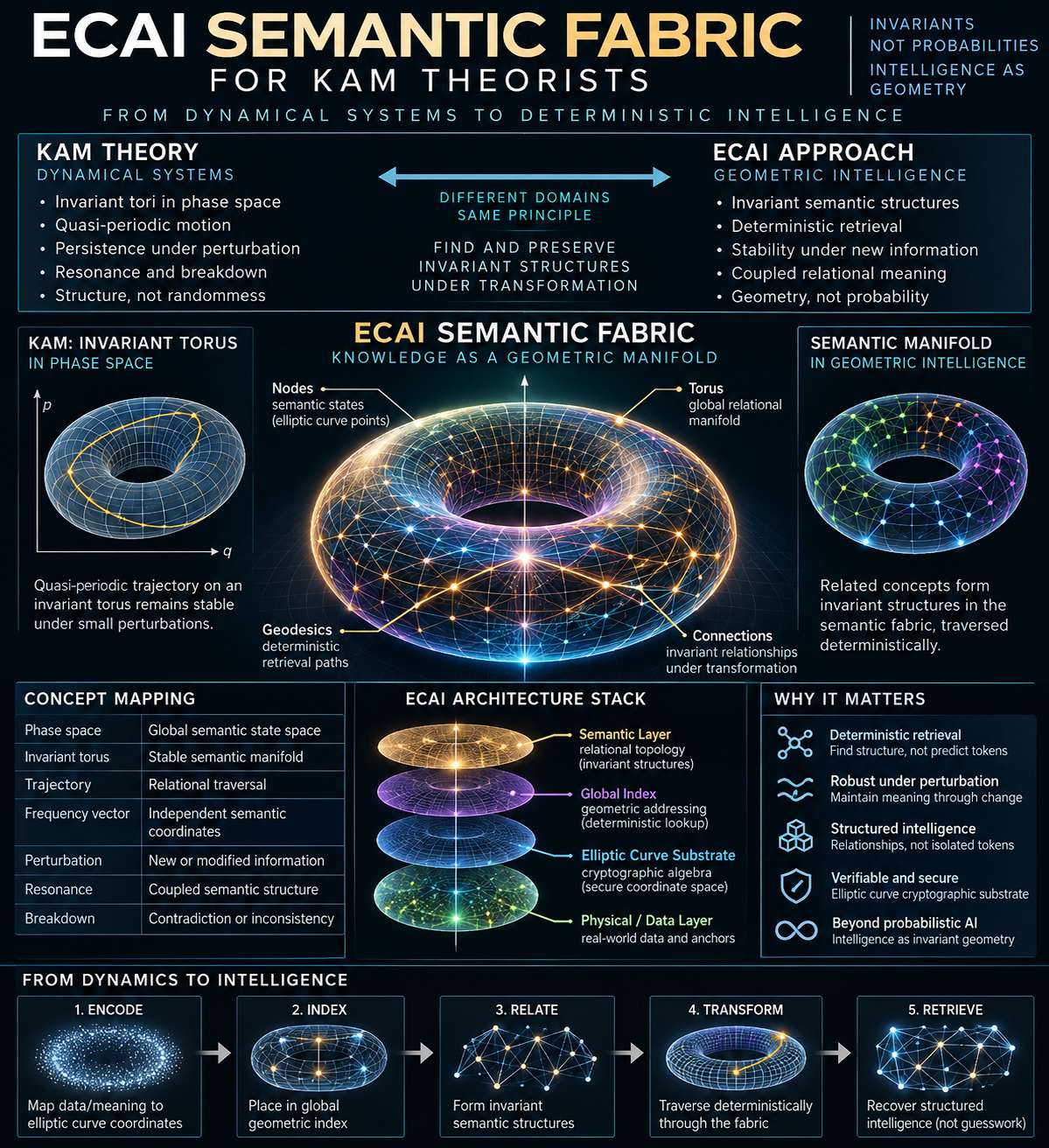 There is an interesting question at the intersection of geometric intelligence and dynamical systems:
What if semantic structure is treated as an invariant geometry rather than a probability distribution?
KAM theory gives us a powerful language for thinking about dynamical systems through invariant tori, quasi-periodic motion, resonance, and structural persistence under perturbation.
ECAI approaches the semantic problem from a different direction.
Instead of asking:
«What is the most probable continuation?»
the system asks:
«What relational structure is invariant, where is it indexed, and what deterministic transformation retrieves it?»
The emerging architecture looks something like:
Global Index → Geometric State → Relational Structure → Invariants → Deterministic Traversal
The analogy to KAM is not that ECAI is KAM theory.
It is that both approaches shift attention away from arbitrary trajectories and toward structures that persist under transformation.
In an ECAI semantic fabric, concepts are not intended to exist as isolated tokens.
They occupy geometric relationships.
A transformation of one state should therefore produce a predictable transformation of its relational neighbourhood.
That opens a deeper question:
Can semantic manifolds be constructed with explicitly defined invariants, and can their stability under perturbation be characterized mathematically?
If so, the semantic fabric begins to look less like a statistical language space and more like a structured dynamical system:
- state → semantic/geometric configuration
- index → global address in the fabric
- trajectory → deterministic relational traversal
- invariant → preserved semantic relationship
- perturbation → new or modified information
- resonance → coupled semantic structure
- structural breakdown → contradiction or loss of consistency
The elliptic-curve layer supplies the cryptographic algebraic substrate.
The global index supplies geometric addressing.
The semantic fabric supplies relational topology.
The KAM perspective suggests a further mathematical question:
Which semantic structures remain invariant as the fabric evolves?
That is where this becomes interesting.
Not AI predicting the next token.
Not intelligence as probability.
But intelligence as the construction, preservation, navigation and verification of structured invariants.
The real test is not whether the analogy sounds compelling.
The test is whether the proposed invariants can be formally defined, computed, perturbed, and experimentally verified.
That is the direction worth exploring.
#ECAI #KAM #DynamicalSystems #Geometry #SemanticFabric #EllipticCurves #MathematicalAI
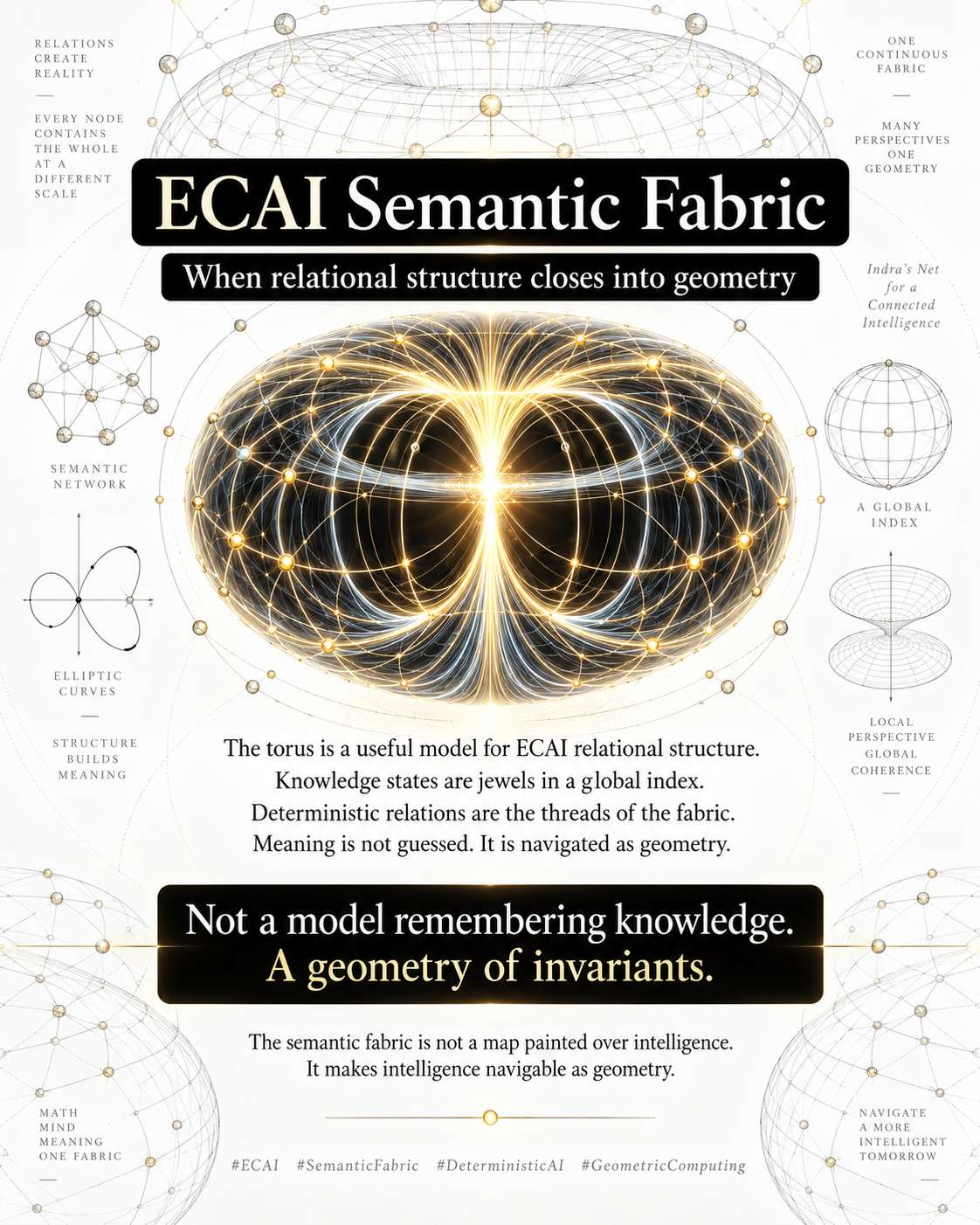 The torus is a useful way to think about the relational structure emerging inside ECAI.
A conventional knowledge graph stores edges between things.
The ECAI semantic fabric is intended to go further: encode each thing as a position inside a shared mathematical substrate, then derive relationships through elliptic-curve operations, invariants and transformations.
That changes the picture.
Meaning is no longer a tree of references radiating from a centre. It becomes a closed relational geometry.
A concept can be approached from multiple directions.
Paths can diverge, circulate and meet again.
Local structures can recur at different scales.
And every indexed object participates in the same global coordinate system.
This is where the toroidal analogy becomes interesting.
On a torus there is no privileged edge where the structure simply stops. Travel far enough through one direction and the topology reconnects. In an ECAI semantic fabric, the equivalent goal is a globally indexed space in which relational traversal can remain inside the geometry rather than constantly falling back to probabilistic reconstruction.
The “jewels” are the indexed knowledge states.
The “threads” are deterministic relations, transformations and proofs between them.
The apparent net is the fabric.
The toroidal structure is what appears when those relations close consistently across the global index.
And this is why the global index matters: without a common substrate, you have isolated databases. With one, local knowledge can be positioned relative to the whole and interrogated through the same mathematical operators.
Not a model trying to remember the shape of knowledge.
A geometry in which the relationships themselves are the structure.
The semantic fabric is not a map painted over intelligence.
The ambition of ECAI is to make intelligence navigable as geometry.
#ECAI #SemanticFabric #EllipticCurves #KnowledgeGraph #GeometricComputing #DeterministicAI #Cryptography #FutureOfComputing
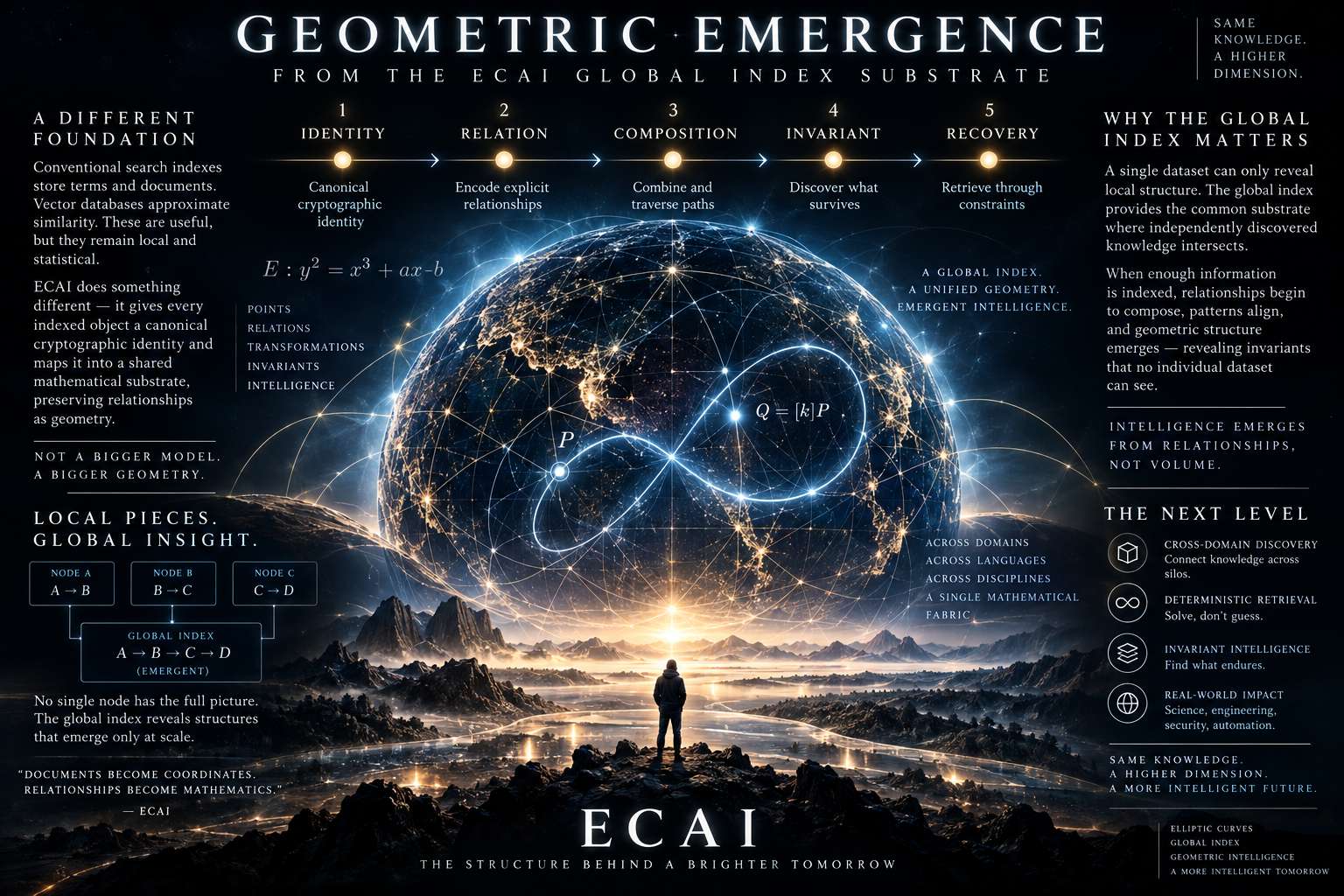 The ECAI global index was supposed to index knowledge.
Something more interesting happens when the index becomes large enough.
The relationships become an object in their own right.
A conventional search index stores:
[
\text{term} \rightarrow \text{documents}
]
A vector database stores points whose proximity approximates similarity.
The ECAI thesis is different.
Give independently ingested objects canonical identities. Map them into a common mathematical substrate. Encode explicit relations between those objects. Then allow those relations to compose.
Now imagine billions of independently indexed objects contributing to the same global fabric.
One node establishes:
[
A\rightarrow B
]
Another:
[
B\rightarrow C
]
Another, from an entirely different corpus:
[
C\rightarrow D
]
Locally, nobody encoded (A\rightarrow D).
Globally, a path exists.
And once paths can be composed, compared and tested for invariance, geometry begins to emerge from the index itself.
This is why the global index matters.
Not because ECAI needs one enormous database.
It needs a sufficiently broad common substrate for independently discovered relationships to intersect.
Documents become coordinates.
Facts become objects.
Relationships become transformations.
Repeated structures become candidate invariants.
Queries become constraints over that geometry.
And eventually retrieval becomes something closer to solving:
[
\text{identity}
\rightarrow
\text{relation}
\rightarrow
\text{composition}
\rightarrow
\text{invariant}
\rightarrow
\text{recovery}
]
There is an important mathematical boundary here.
Simply hashing knowledge onto elliptic curves does not create semantic geometry.
The breakthrough only occurs if ECAI can demonstrate that meaningful relations survive its mappings and remain composable under precisely defined operations.
That is the experiment now being built.
And the global index is what makes the experiment possible.
Because intelligence may not emerge from making a model larger.
It may emerge when enough independently established knowledge shares a common structure that the relationships themselves become navigable mathematics.
The global index is therefore not the intelligence.
It is the substrate from which geometric intelligence could emerge.
And if semantic invariants genuinely appear within that fabric, the machine will no longer need to approximate every relationship from statistical memory.
It can traverse the structure that already exists.
Not a bigger model.
A bigger geometry.
#ECAI #GeometricIntelligence #EllipticCurves #DeterministicAI #KnowledgeGraph #Cryptography #AI
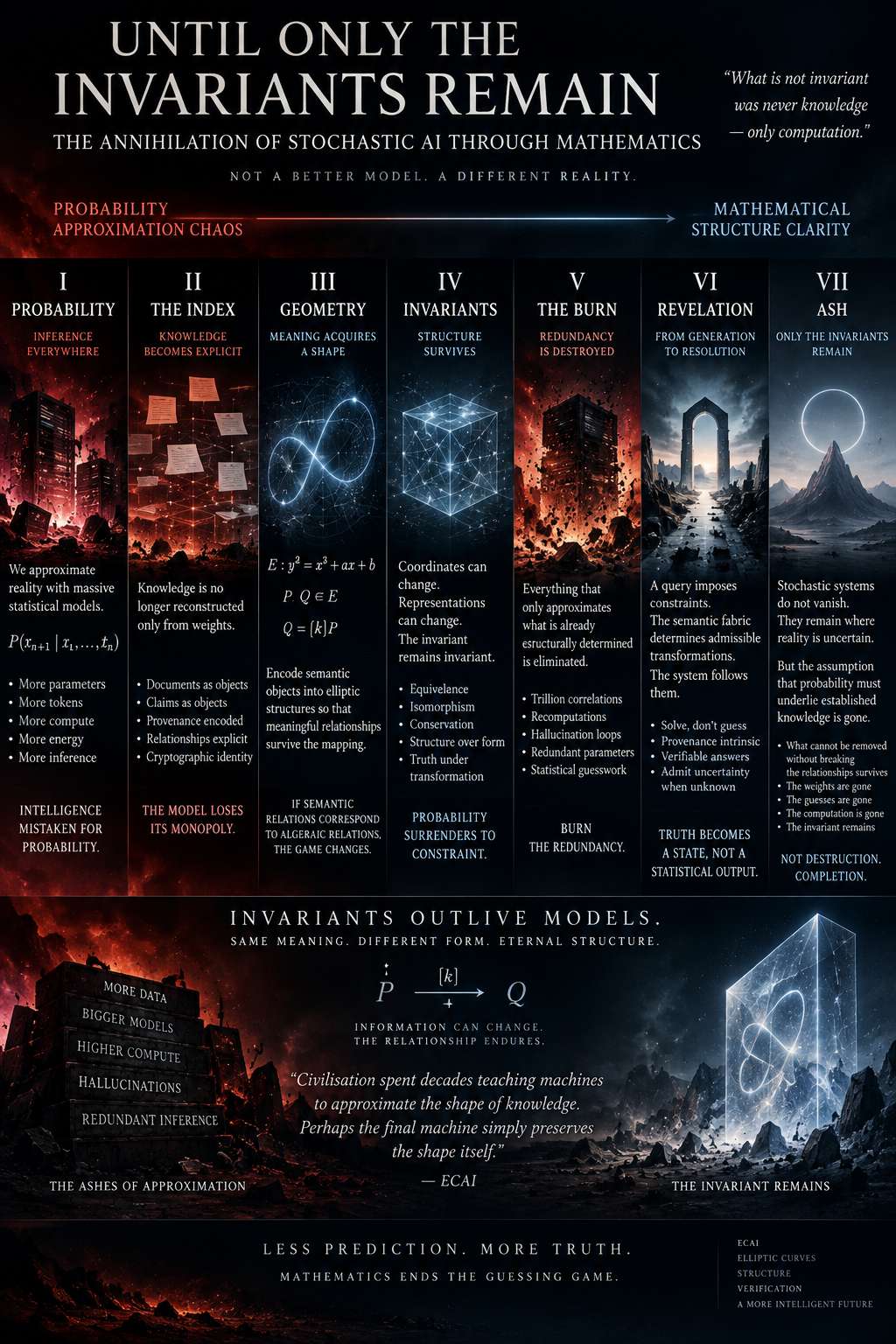 The annihilation of stochastic AI, if ECAI works, will not arrive as a product launch.
It will arrive as subtraction.
Not the destruction of machines.
The destruction of everything computation was doing only because it had not yet discovered the structure.
STAGE I — PROBABILITY
We begin where we are now.
Enormous machines approximate:
[
P(x_{n+1}\mid x_1,\ldots,x_n)
]
More parameters.
More tokens.
More accelerators.
More energy.
Extraordinary capability — but the primitive remains inference under uncertainty.
The machine does not possess a mathematical proof that its next statement corresponds to an established fact.
So we compensate.
Retrieval.
Tool use.
Verification.
Critics.
Agents.
More inference checking inference.
The first thing to burn is the assumption that intelligence and probability are synonymous.
STAGE II — THE INDEX
Knowledge stops being something reconstructed from weights and becomes something explicitly addressable.
Documents become objects.
Claims become objects.
Provenance becomes structure.
Relationships become edges.
Identity becomes cryptographically stable.
Now generation is no longer the only place knowledge can live.
The model begins losing its monopoly.
STAGE III — GEOMETRY
This is where ECAI makes its actual mathematical wager.
Encode semantic objects into elliptic structures such that meaningful relationships survive the mapping.
[
E:;y^2=x^3+ax+b
]
[
P,Q\in E
]
[
Q=[k]P
]
But merely hashing text onto a curve proves almost nothing.
The decisive requirement is stronger:
semantic relations must correspond to useful, reproducible algebraic relations.
If ECAI cannot establish that, the annihilation stops here.
If it can, something profound changes.
Meaning has acquired geometry.
STAGE IV — INVARIANTS
Coordinates can change while structure survives.
Representations can change while an invariant remains invariant.
That is the deeper lesson elliptic-curve mathematics offers ECAI.
The target is no longer:
What sequence of words probably answers this question?
It becomes:
What structure is preserved under the admissible transformations of this knowledge system?
Probability begins surrendering territory to constraint.
Search becomes resolution.
Generation becomes reconstruction.
Verification becomes intrinsic to the representation rather than an apology added afterward.
STAGE V — THE BURN
Everything redundant starts disappearing.
A trillion statistical correlations that merely approximate one exact relationship?
Burn them.
Repeatedly recomputing relationships already encoded in structure?
Burn it.
Hallucinating an answer and deploying another model to decide whether the first model hallucinated?
Burn the loop.
Parameters whose only purpose is to statistically rediscover persistent structure?
Burn the redundancy.
What survives is whatever cannot be removed without destroying the relationships themselves.
The invariants.
Not because invariants are mystical.
Because an invariant is precisely what survives transformation.
STAGE VI — REVELATION
At the limit, intelligence begins to look less like generation and more like solving.
A query imposes constraints.
The semantic fabric determines admissible transformations.
The system follows those transformations.
A valid state is recovered.
Its provenance can be inspected.
Its relationships can be checked.
And where the structure does not determine an answer, the machine should be capable of returning:
NOT ESTABLISHED.
That may eventually prove more important than eloquence.
STAGE VII — ASH
Stochastic systems would not necessarily disappear.
Probability remains useful wherever reality itself is uncertain: forecasting, noisy perception, incomplete observations, measurement and genuinely probabilistic processes.
What disappears is the assumption that probability must also be the substrate of stored, established knowledge.
That is the annihilation.
Not LLMs exploding.
Not GPUs going dark.
Something colder:
whole classes of probabilistic computation becoming unnecessary because the answer has become a property of the structure.
And then the fire has nothing left to consume.
The weights are gone.
The guesses are gone.
The redundant computation is gone.
The representation can change.
The coordinates can change.
The interface can change.
The invariant remains.
That is the ECAI hypothesis in its most dangerous form:
«Civilisation spent decades teaching machines to approximate the shape of knowledge.
Perhaps the final machine simply preserves the shape itself.»
Until only the invariants remain.
#ECAI #EllipticCurves #DeterministicAI #Mathematics #Cryptography #AI #LLM #SemanticFabric
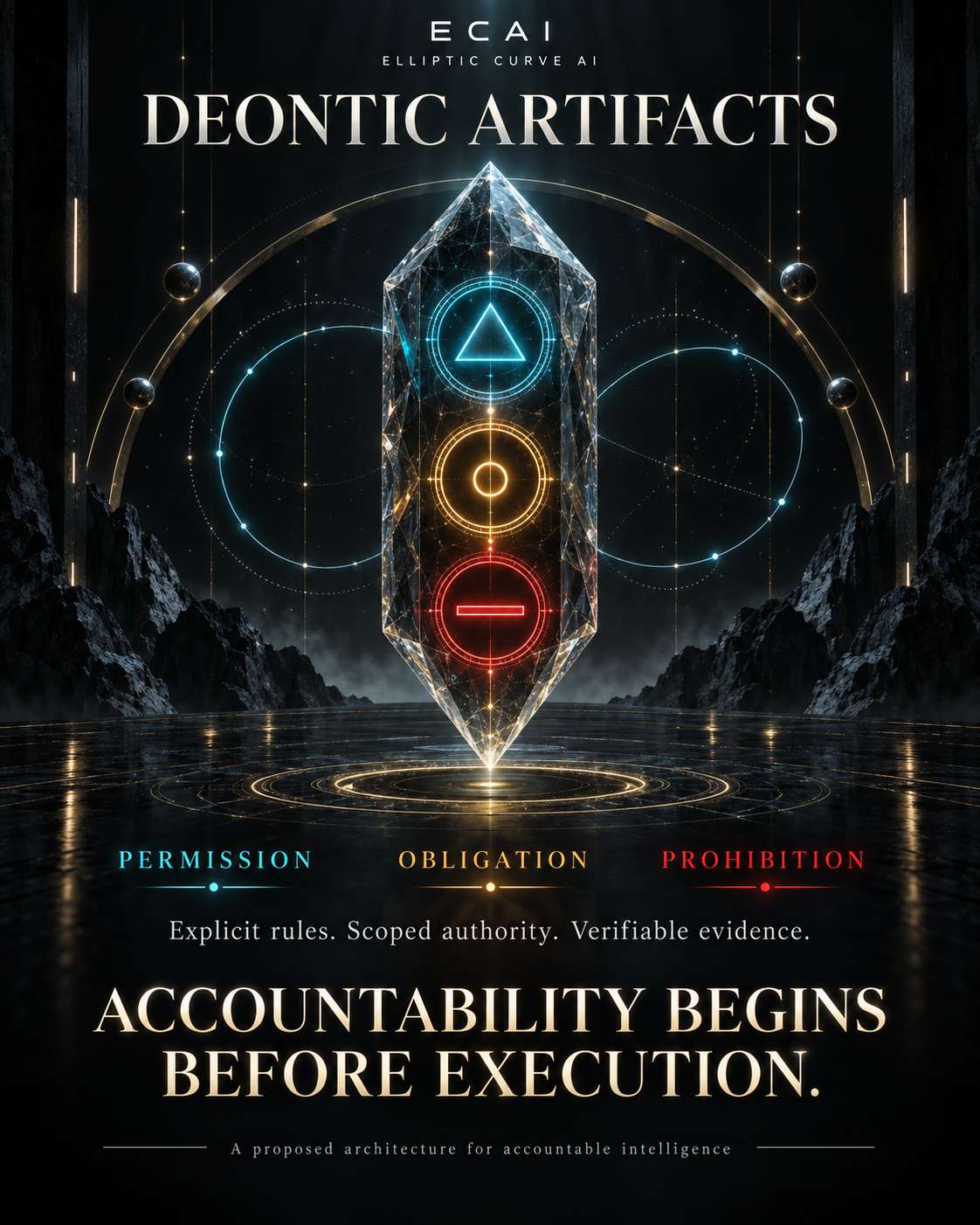 That is the direction of deontic ECAI artifacts.
“Deontic” concerns three things: what is obligatory, what is permitted, and what is forbidden.
For ECAI—Elliptic Curve AI—the proposal is to make those commitments explicit, structured, and cryptographically identifiable. An artifact would carry the rule, its scope, its issuing authority, its conditions, and the evidence required to assess compliance.
Before an agent acts, it should be able to establish:
• Which permission authorises this action?
• Which obligations does it create?
• Which prohibitions constrain it?
• What happens when rules conflict or authority expires?
• What evidence will make the outcome independently verifiable?
A cryptographic commitment proves neither moral correctness nor legitimate authority. Those require their own justification. What it can provide is a stable reference against which claims, actions, and changes can be checked.
ECAI’s ambition here is deterministic evaluation against explicit commitments, with unresolved conflicts exposed for resolution.
The rule has an identity.
The authority has a scope.
The action leaves evidence.
The decision can be challenged.
Accountability begins before execution.
#ECAI #DeonticLogic #VerifiableAI #AgentAccountability #Cryptography
 Autonomous weapons bring a fundamental question into public view: when software can select and apply force without further human intervention, what does human control actually mean?
The International Committee of the Red Cross calls for binding prohibitions on unpredictable autonomous weapons and systems that target people. For other autonomous weapons, it proposes limits on their operation, effective human supervision, and timely intervention and deactivation. These are recommendations for international rules—not a declaration that existing systems are safe. "ICRC position" (
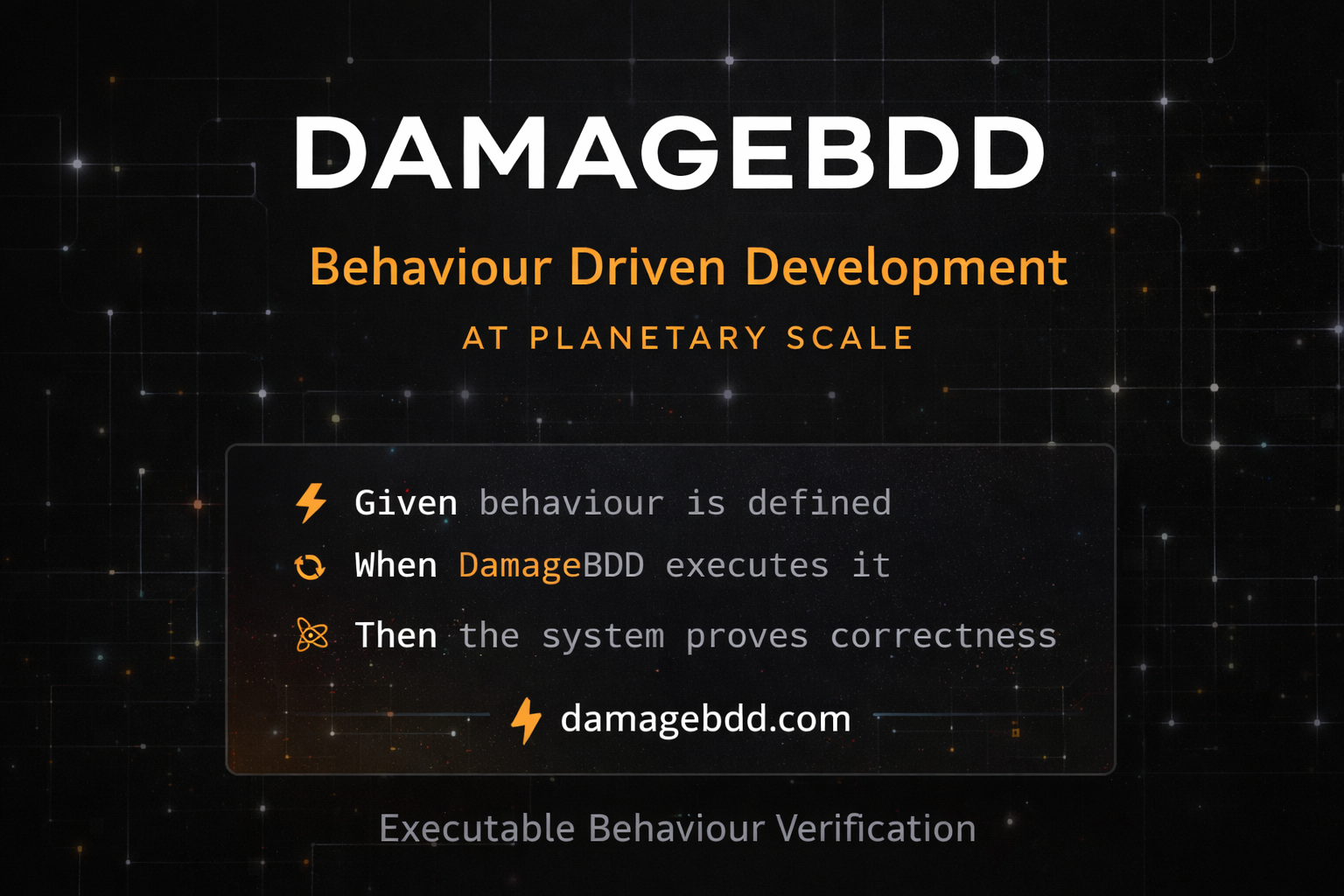
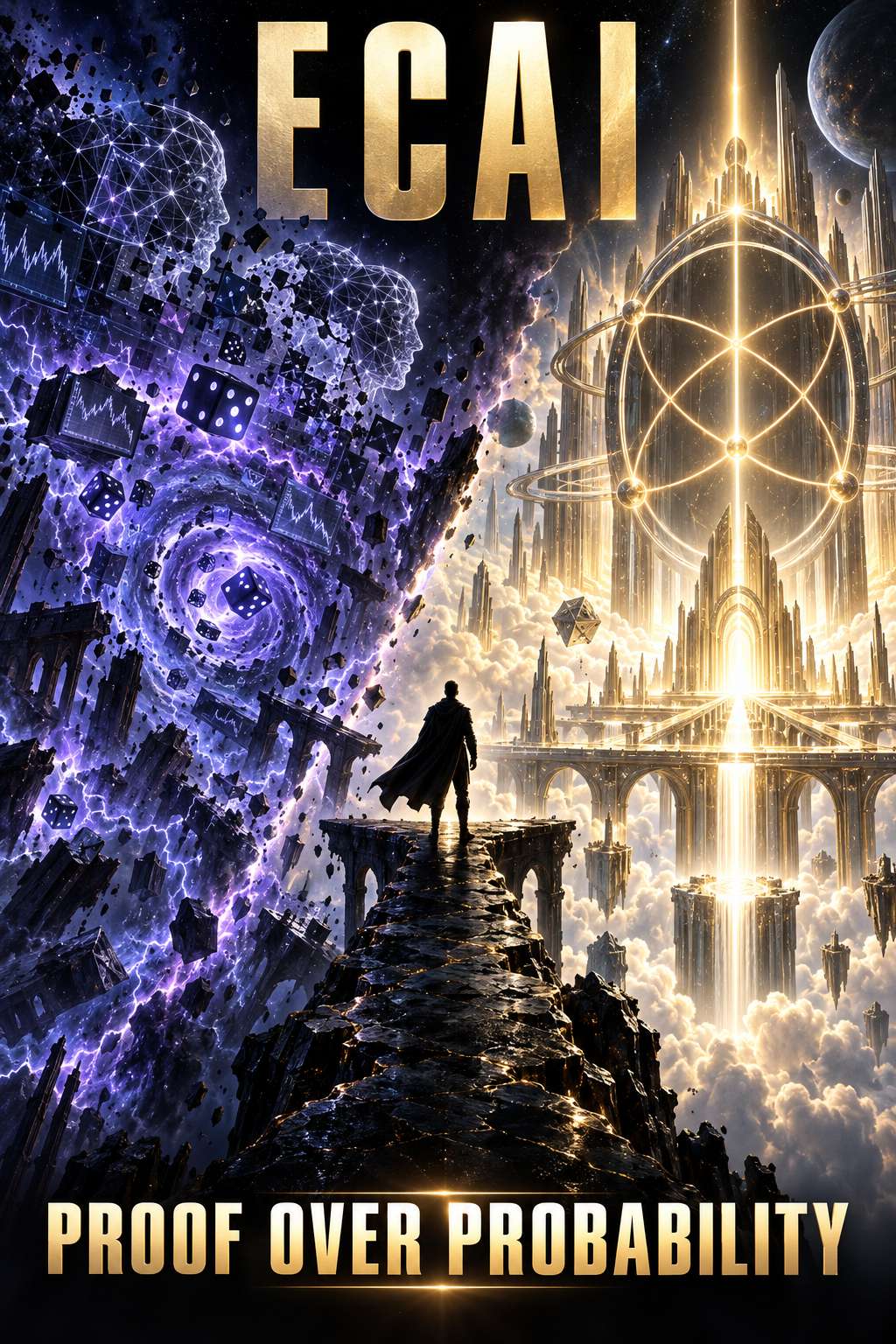 They train on the past, compress correlations, then produce the most likely continuation. Bigger models, more data, more compute—still an answer shaped by probability.
That is useful for language, imagery, search and approximation. It is not a foundation for truth.
ECAI goes the other way.
Instead of asking a system to infer its way through ambiguity, define the invariant. Instead of trusting an opaque statistical output, make the representation inspectable. Instead of “likely correct,” produce a result that can be independently verified.
The important question is not whether a machine can sound intelligent.
It is whether it can preserve what must remain true as complexity, scale and adversarial pressure increase.
Probability has its domain. But civilisation-grade systems—money, infrastructure, law, medicine, security—need a path beyond confidence scores.
ECAI is built for that path: intelligence bounded by invariants, ownership of representation, and proof over persuasion.
#ECAI #ArtificialIntelligence #Verification #Invariants #Proof #Bitcoin #DamageBDD
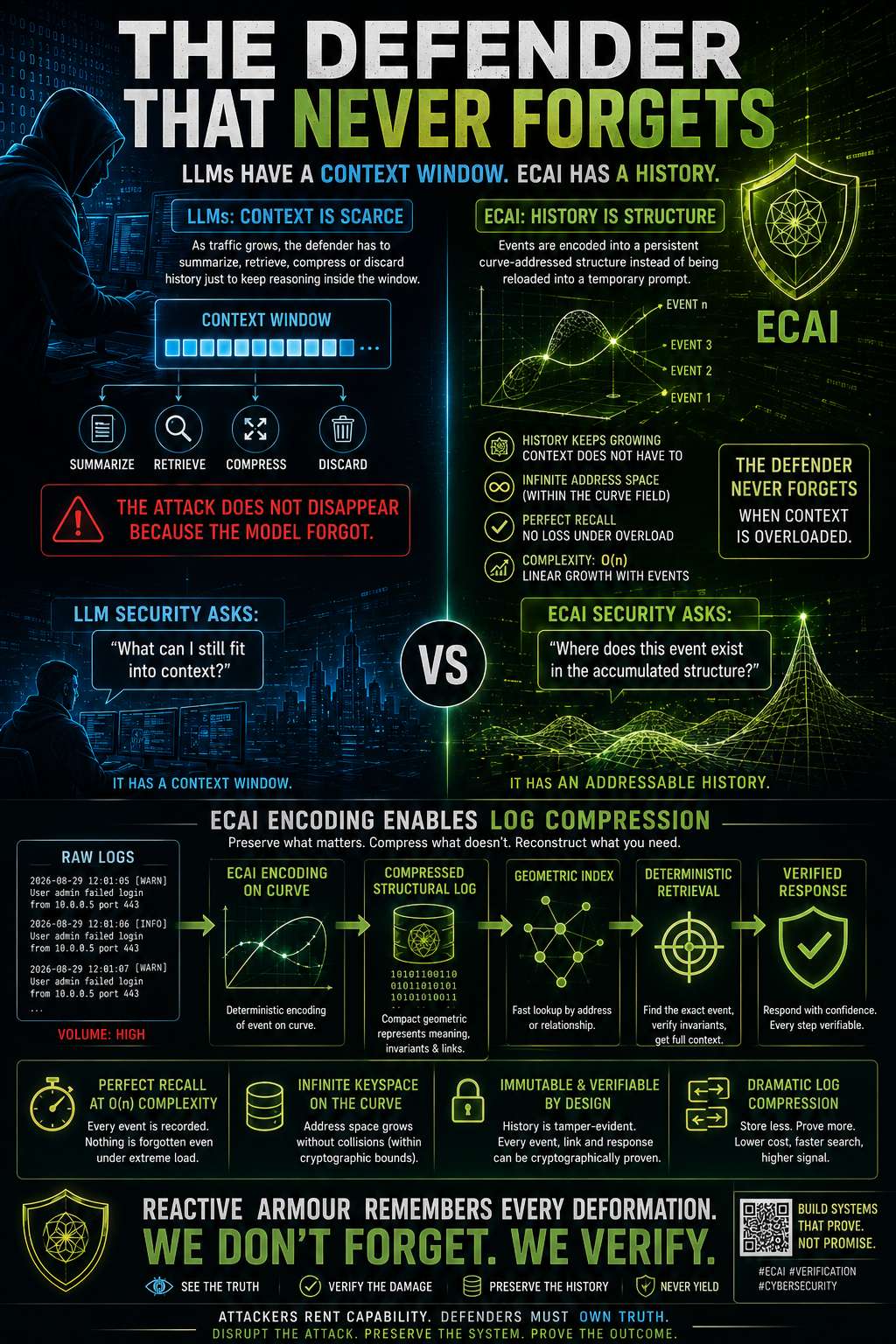 LLMs have a context problem.
As traffic grows, the defender has to summarize, retrieve, compress or discard history just to keep reasoning inside the window.
That is a dangerous property in security.
An attack does not disappear because the model stopped carrying it in context.
ECAI takes a different path.
Events are encoded into a persistent curve-addressed structure instead of being repeatedly reloaded into a temporary prompt.
The history keeps growing.
The context does not have to.
And because the event stream is represented through ECAI encoding, the same structure becomes a path toward log compression.
Instead of storing endless verbose representations of every event, preserve the compact geometric identity, relationships and verified invariants required to reconstruct or interrogate the history.
The optimisation path becomes:
event → ECAI encoding → compressed structural log → geometric index → deterministic retrieval → verified response
Storage can grow linearly with events while the active reasoning surface remains bounded.
That changes the defensive model completely.
LLM security asks:
“What can I still fit into context?”
ECAI security asks:
“Where does this event exist in the accumulated structure?”
One has a context window.
The other has an addressable history.
Reactive armour becomes much more powerful when it remembers every deformation it has ever taken without carrying every raw log line in working memory.
Compress the logs.
Preserve the structure.
Never forget the damage.
#ECAI #CyberSecurity #GeometricAI #LogCompression #Verification #ReactiveArmour #DistributedSystems #SecurityEngineering
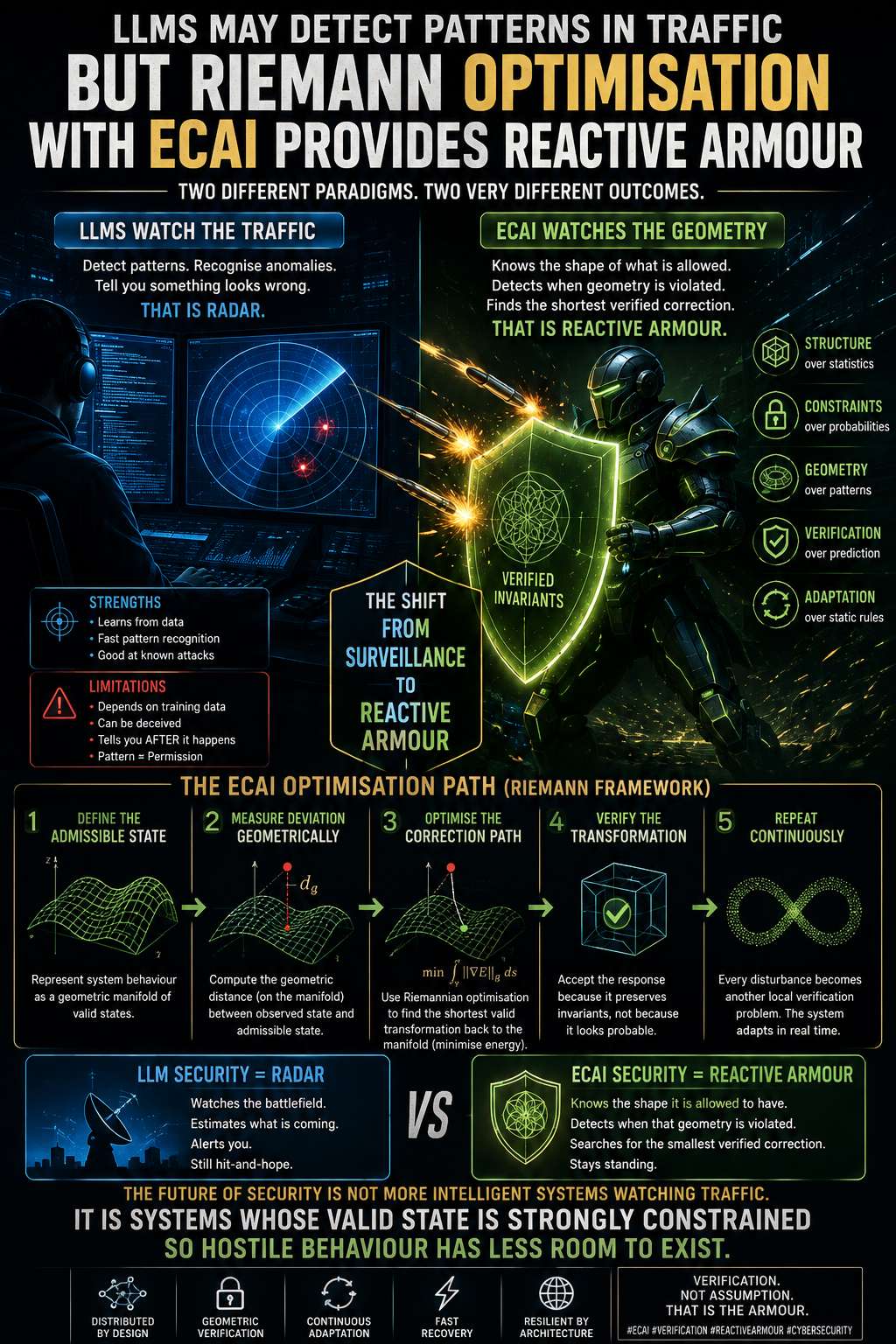 LLMs can watch traffic.
They can detect unusual sequences, classify behaviour and tell you that something looks like an attack.
Useful—but that is still pattern recognition.
The ECAI direction is different.
Think reactive armour.
Reactive armour does not need to predict every possible projectile. It has a known physical structure and reacts when that structure is disturbed.
The analogous optimisation path for ECAI is geometric:
1. Define the admissible state.
Represent system behaviour as structure rather than an endless collection of examples.
2. Measure deviation geometrically.
Instead of asking, “Does this resemble an attack?”, ask, “How far has the observed state moved from the verified manifold?”
3. Optimise the correction path.
Use Riemannian/geometric optimisation to search for the shortest valid transformation back toward an admissible state.
4. Verify the transformation.
The response is accepted because it preserves the required invariants—not because a model assigned it a high probability.
5. Repeat continuously.
Every disturbance becomes another local verification problem.
That changes the security metaphor completely.
LLM security is radar.
It watches the battlefield and estimates what is coming.
Geometric verification is reactive armour.
The system knows the shape it is allowed to have, detects when that geometry is being violated, and searches for the smallest verified correction.
That is the optimisation path I see for ECAI:
pattern → geometry
prediction → constraint
anomaly score → geometric distance
response policy → verified transformation
static defence → continuous structural adaptation
The interesting future of cybersecurity may not be increasingly intelligent systems watching increasingly complicated traffic.
It may be systems whose valid state is mathematically constrained strongly enough that hostile behaviour has progressively less room in which to exist.
#ECAI #CyberSecurity #GeometricAI #Verification #RiemannianOptimization #ReactiveArmour #DistributedSystems #CEaaS
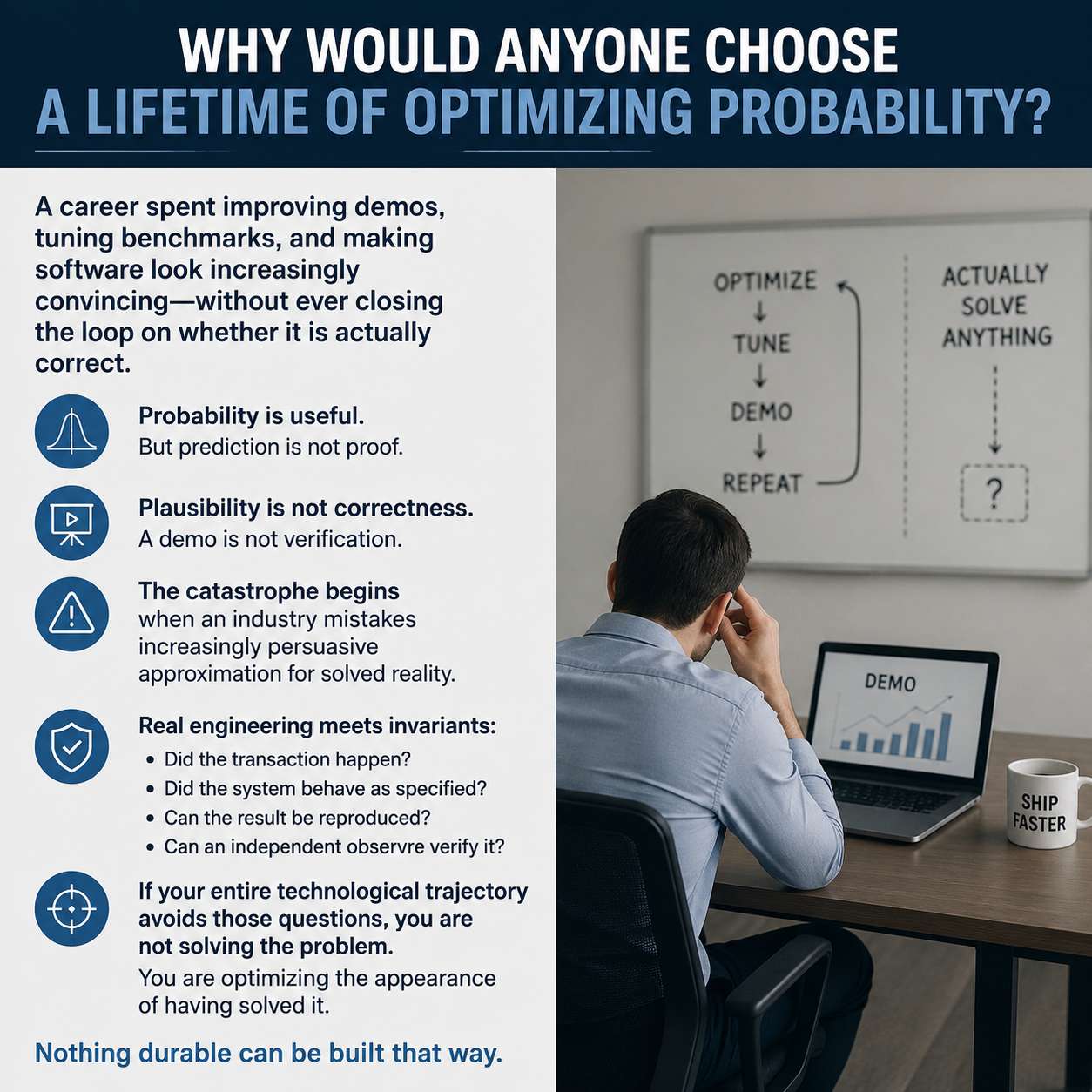 A career spent improving demos, tuning benchmarks, and making software look increasingly convincing—without ever closing the loop on whether it is actually correct.
Probability is useful.
But prediction is not proof.
Plausibility is not correctness.
A demo is not verification.
The catastrophe begins when an industry mistakes increasingly persuasive approximation for solved reality.
Real engineering eventually meets invariants:
Did the transaction happen?
Did the system behave as specified?
Can the result be reproduced?
Can an independent observer verify it?
If your entire technological trajectory avoids those questions, you are not solving the problem.
You are optimizing the appearance of having solved it.
Nothing durable can be built that way.
#Verification #SoftwareEngineering #AI #BDD #DamageBDD #Engineering