Christian. Grantmaker. 20 years in Istanbul. Philosophy → MPA → Grant Making → Bitcoin & AI. Writing about where trust lives — and what happens when it moves.
Coldcard is where the real lesson lives, not the fork.
A covenant isn’t about limiting what Bitcoin can become at the protocol level — it’s about limiting what your Bitcoin can do at the wallet level. One valid destination: your estate protocol, your trust, your family. A compromised signer stops being a catastrophe and becomes an inconvenience. The attacker gets a signature. They don’t get a destination.
~$200M didn’t have to be lost. It had to be moved somewhere it was never going to be allowed to go.
No soft fork required to start down this road. That matters more than it sounds like it should.
New: “A Staging Ground & Covenants”
A watershed writing experience.
I said yes to Fort Worth before I knew why — then wrote my way into the reason. That reason went back to an earthquake in Turkey and $50k in relief funds frozen for 18 months.
That became 108 essays on money, sovereignty, Girard, Banfield, Plantinga — none of it planned.
This week: TGFB episode #79 with Jordan Bush, and my novel Honest Weights is nearly done.
Being early enough to count among the first hundred is its own kind of honor — separate from being the best voice in the room.
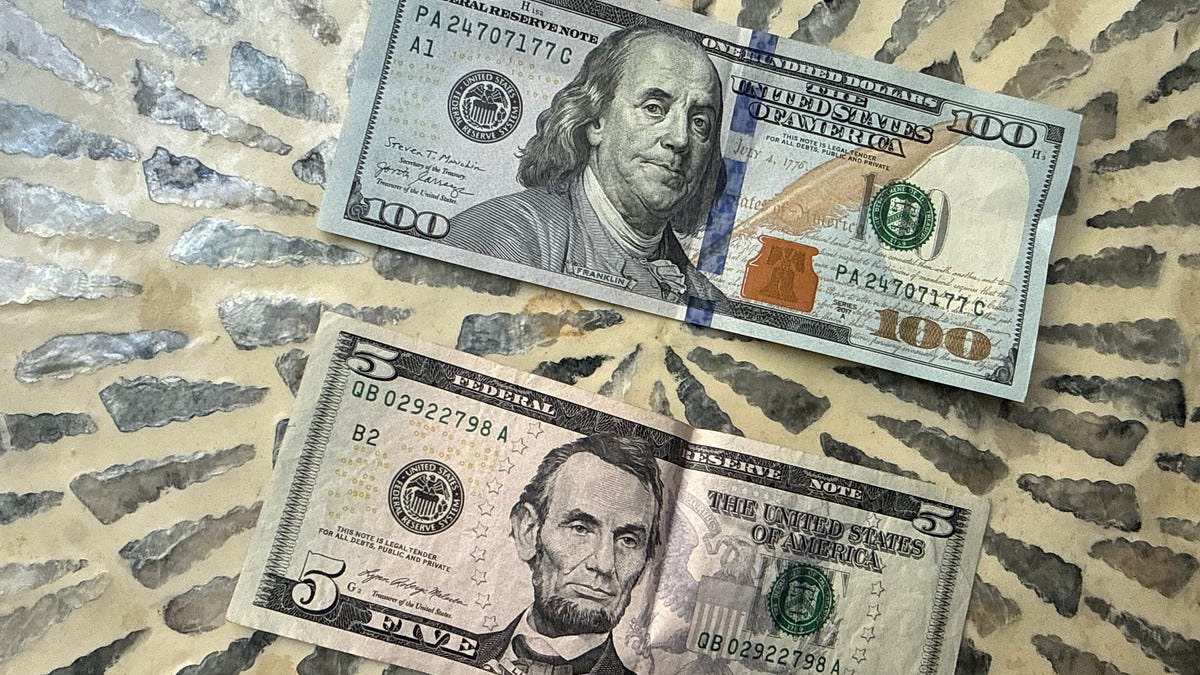
A $5 bill and a $100 bill are the same paper. We just agreed one’s worth 20x the other. Move it to a screen and even the paper disappears — it’s just a number telling you what an hour of your life is worth.
The lira sits near 48 to the dollar right now. I have Turkish friends staying with us who are excited to shop an outlet mall here — his family exports textiles for a living, and it’s still cheaper to buy clothes in Indiana than at home. That’s the felt need, live, in my guest room.
Ten days ago Turkish prosecutors raided a religious community and found 200kg of gold in one man’s safe. A government that runs out of currency to print eventually starts looking for assets to take instead. Rhymes with 2016, with Lebanon, with 1933.
A bitcoin is still just one bitcoin. 21M of them, 100M sats each, same as day one. What moves when the price moves is the dollar underneath it. Most days “bitcoin’s volatility” is really the dollar’s.
We don’t need more essays explaining why the dollar is fragile. We need stories that put a reader in the kitchen with a family before the crisis arrives.
Full essay:
Indianapolis has no river worth the name, no port, no reason to exist on paper. It lost the canal bet, lost the auto bet to Detroit — and losing might be exactly why it had the capital and nerve left for the county merger, the stadium with no team, the NCAA move.
Two hundred years of honest bets. I want to add one more: a real Bitcoin circular economy here, the kind El Zonte built on a stretch of coastline nobody had heard of.
The City That Keeps Betting →
Banfield spent a summer in a poor Italian village in 1958 trying to figure out why it stayed poor. His answer: radius of trust. Every system has a boundary past which cooperation quietly stops. That used to be villages. Now it’s messaging apps.
I went looking for something Nostr-native to actually use for group texts. Tried 0xchat — right protocol, dead TestFlight link. Looked at Keet — true P2P, but still someone else’s infrastructure. Landed for now on Buzz, Dorsey’s Block-backed client, mostly because it’s the first thing I’ve found where the architecture and the resources to maintain it actually match.
Then mid-draft, Apple pulled Telegram over CSAM — caught it, acted in a day. Which complicates things: the same central authority that can silence a platform with no vote also just protected someone. A protocol with nobody in the middle has nobody positioned to do that either.
I don’t think the gap closes. I think you just choose which one you’re willing to live with.
Part 3 of the honest weights series.
Leviticus 19:36 assumes something specific: the lie and the check on the lie live in the same object. You weigh the coin yourself.
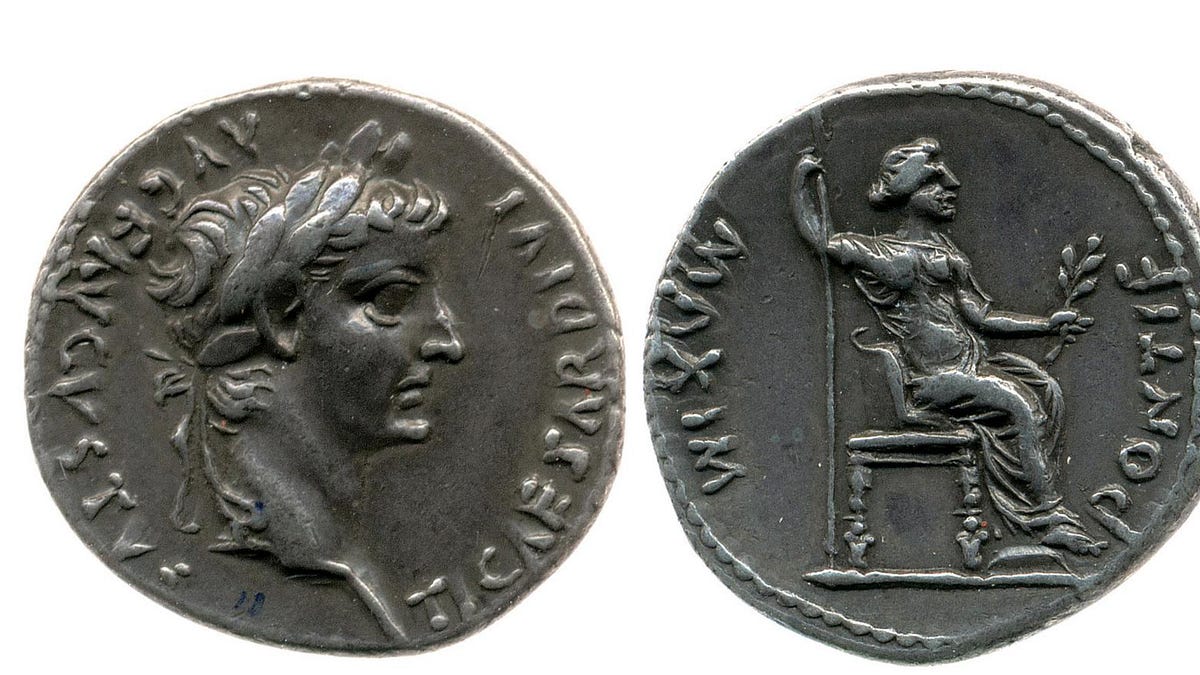
Nero debased the denarius from ~98% silver to under 90 in a single reign — a physical lie, but still a physical one. A merchant could catch it.
Jekyll Island moved the lie one level back. Not in the metal anymore — in the room where the rules for all future metal get written. No minutes kept. Twenty years before anyone admitted the trip happened.
Dialog — Thiel and Hoffman’s invite-only network, exposed this year when its membership rolls turned up unsecured in its own site code — is a level back from that. No legislative output. No vote to organize against. Just a room whose function is building the trust that makes future closed rooms possible.
Coin to cabin to cocktail hour. Each step moves the dishonesty further from anything a citizen can weigh.
Bitcoin doesn’t cure the desire for the room — that’s Girardian, not monetary. What it removes is the room’s power over the weight in your pocket. 21 million isn’t a policy set by whoever’s at the retreat. It’s math, and every node checks it without asking permission.
BIP-110 did not activate. The miners did not signal. Knut Svanholm wrote an honest retrospective landing on two explanations: capture, or insufficient economic weight.
Samson Mow read it and mostly agreed on the diagnosis, then made a claim I think is wrong: that nodes cannot and should not be able to influence the network.
A node that rejects an invalid block is influence. It’s the only kind that doesn’t need permission. Mempool policy failed because it depends on convention and buy-in. The supply cap has never been tested that way, because everyone already knows how that fight ends.
This piece works through where Mow is right (soft signals are cheap, that’s why thresholds are 95%), where the UASF/SegWit precedent complicates his “iatrogenic” charge, and a succession problem with Knots and Ocean that I don’t think anyone’s naming yet.
New essay up: “The Trust Problem Was Never About Bitcoin”
I keep having the same conversation with smart, careful people who can’t separate Bitcoin from the crypto carnival — not because they lack information, but because of something Girard’s mimetic theory explains better than any data point could.
The crowd never copied Bitcoin’s fixed supply or its decentralization. They copied the going up. That’s how you get a thousand imitators mimicking the surface signal without the substance underneath — and when the mimetic crisis broke in 2022, the crowd found its scapegoats: FTX, Celsius, Terra Luna.
But the scapegoat mechanism only works if the crowd stays convinced the victim deserved it. Bitcoin kept producing blocks. No CEO to prosecute, no foundation to discredit, no pre-mine to expose.
Added an editor’s note up top: I wrote this before BIP-110’s fork fully played out. The mimetic desire argument still holds. The monolith claim — no center to capture — is under more pressure now, given what pool concentration and capital-market dependence suggest about convergent institutional capture.
Read it as a snapshot, not a final word.
They brought Jesus a coin. He didn't bring one himself.
Render to Caesar gets read as a tidy balance — a little for Caesar, a lot for God. But that's not the only thing Jesus said about power. Herod's slaughter of the infants, "not so among you," the temple tax, Pilate's borrowed authority — it all points the same direction, against Romans 13's two verses on obedience.
Read the Gospels first. Let Paul answer to them.
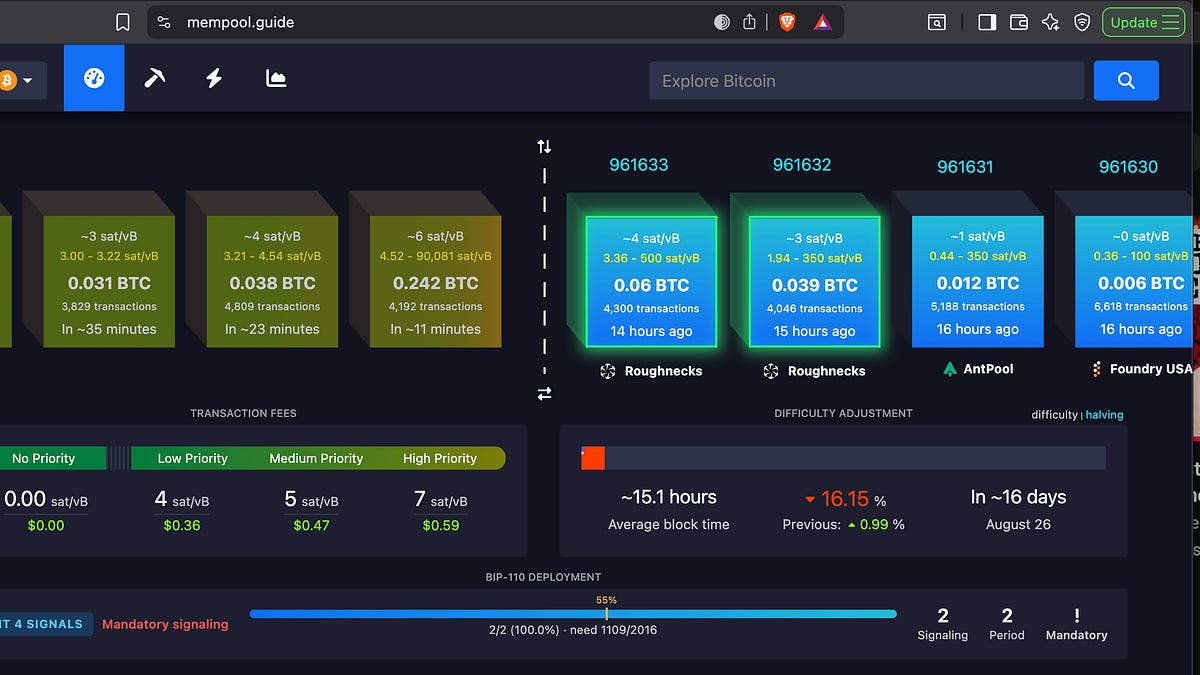
BIP-110’s mandatory signaling window opened at block 961,632 yesterday. Signaling had been under 3% against a 55% threshold — the split was the expected outcome, not a surprise, and it happened exactly the way the mechanism said it would.
What wasn’t expected, at least by me: how fast “this is over” got said, including by me, less than a day into a multi-week window. I wrote about the danger of urgency substituting for judgment ten days ago. I watched myself do the thing anyway.
This morning: one pool, Roughnecks, still mining the enforcing chain alone. ~15hr block times against Bitcoin’s normal 10. A pulse, not a groundswell — but a pulse building fee pressure that could still change a miner’s math over the coming weeks before September 6.
Screenshots from my own node included. Not predicting an outcome. Just watching, and naming what running an enforcing node actually is: the only vote a node operator gets to cast.
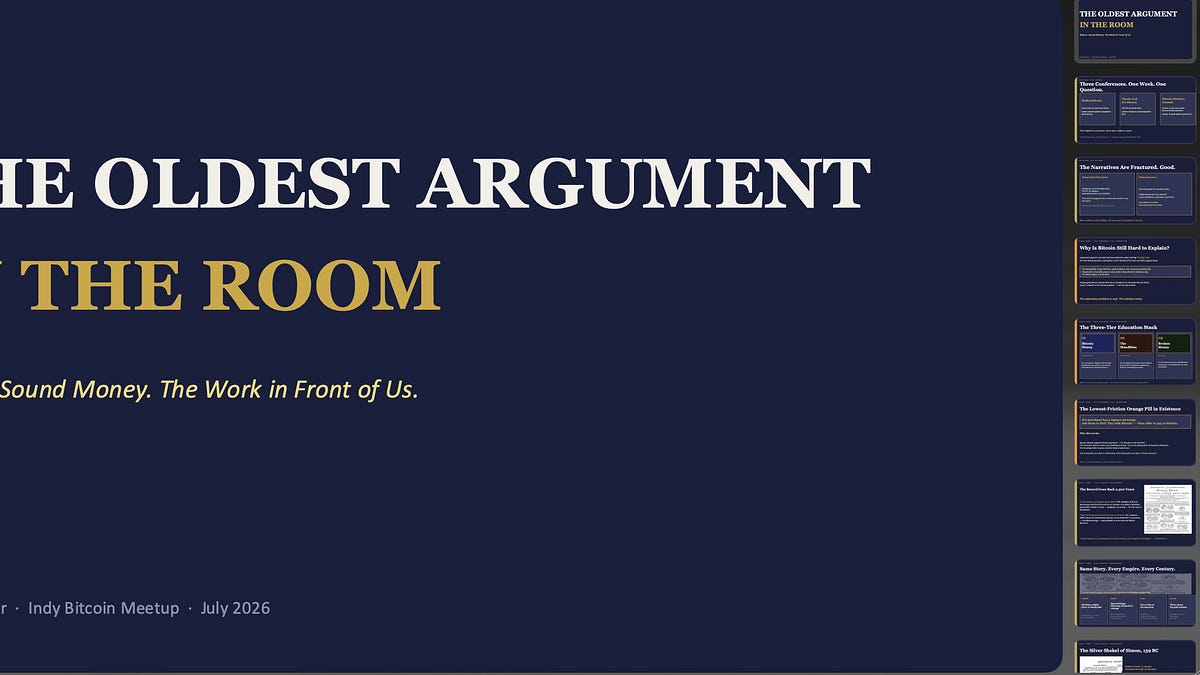
Abraham weighed 400 shekels of silver for a burial cave. Weighed, not coined. Not trusted because a king said to trust it.
That’s the oldest argument for sound money there is, and it hasn’t changed in 2,500 years.
Notes and slides from my Indy Bitcoin Meetup talk:
Money is a language. Which is why it’s so hard to think clearly about — you can’t step outside it to examine it, the way you can step outside a sentence.
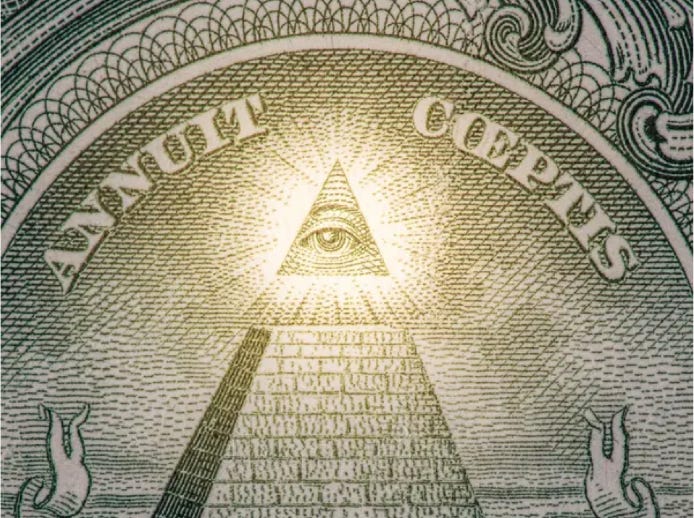
New essay: the mistranslation of 1 Timothy 6:10, the thaler-to-dollar drift, and the eye on the pyramid nobody reads anymore.
What happens to the 1 in 5 American households outside the banking system when USDT becomes USAT and USAT becomes the only authorized dollar?
They fall into an informal economy that’s already closing its exits.
Bitcoin Beach proved there’s a third option.
Moral failure rarely feels like failure while it’s happening.
Eichmann had a career. Andrea Sachs had ambitions. The priest and Levite had reasons. Demas began as a faithful co-worker.
Each step made sense in isolation.
The self that might have said no gets gradually replaced by a function.
Sixth and final digest in this series — mimetic desire, institutional capture, and the discipline of noticing the drift before it becomes the destination.
We are building tools that know before we do, decide before we can, and form us before we notice.
Nine essays on AI and formation: prediction markets that manufacture outcomes instead of forecasting them, the Samourai case and the collapse of responsibility, Postman’s warning updated for the age of delegation, and what happened when Kierkegaard’s Fear and Trembling got uploaded to a machine.
The tools aren’t the threat. Formation is.
Knowledge isn’t a stack of proofs. It’s a structure you already live inside.
Plantinga called it warrant. Alston called it doxastic practice. Abraham lived it on a mountain, then proved it the next morning in a marketplace, weighing silver honestly.
New digest is up. Eight essays. One argument.
Audio overview on Fanfares, 500 sats.
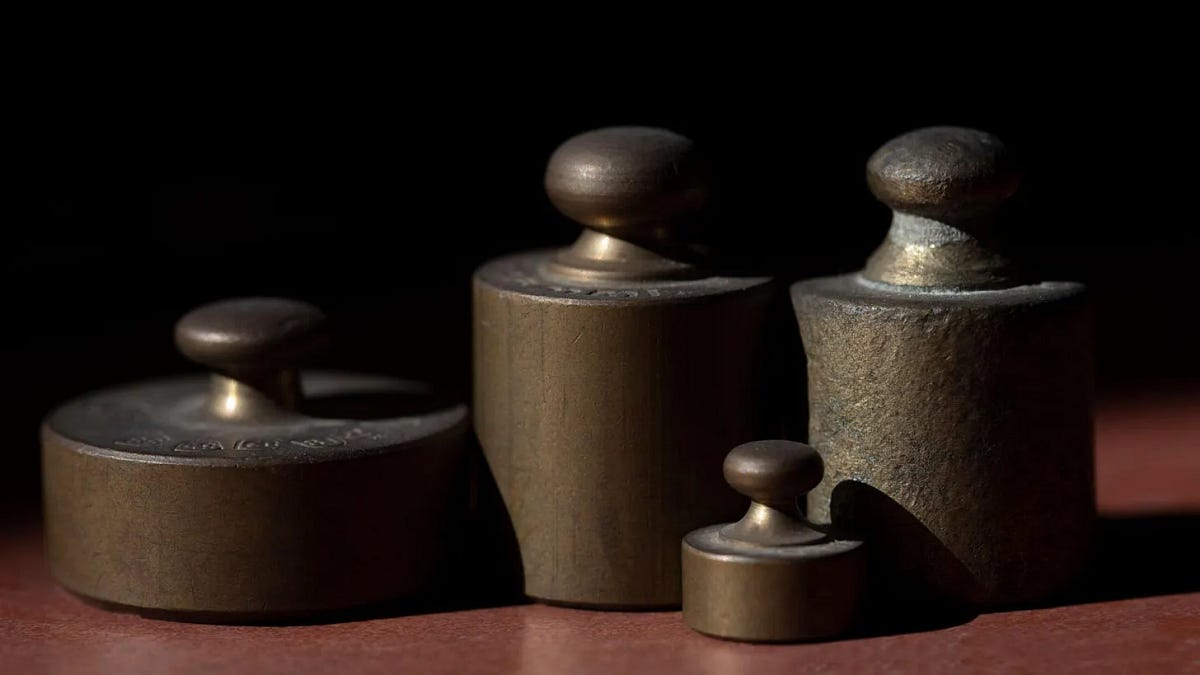
Honest weights and measures show up in Leviticus, Proverbs, Deuteronomy. Not as economic policy. As moral requirement.
Bitcoin is the newest expression of the same idea. Not a religion. A protocol that makes falsifying the scale technically impossible.
21 essays on sound money, Scripture, and the radius of trust. Audio companion on Fanfares, 500 sats.
Audio companion for this digest is on @fanfares_io — two AI hosts working through twenty essays in twenty-five minutes. Grateful for a Bitcoin-native way to publish long-form audio without asking permission from a platform that extracts it.
Institutions are not buildings. They are agreements.
Eighteen essays, March to June, tracing one argument: what actually holds a system together when trust starts to drift. First thematic digest is live.
paulweaver34.substack.com/p/the-shifting-physical-architecture