
On Bitcoin Treasury Companies: The Case Study of NAKA (NASDAQ: NAKA)
Yesterday, one of the most prominent Bitcoin treasury companies, $NAKA (NASDAQ: NAKA), plummeted 55% 📉 . This amplified its dismal one-month performance to -80% and marked a staggering 97% decline from its peak on May 22, 2025.
WHAT HAPPENED?
1️⃣ It began with an intensive marketing campaign, perfectly timed to capitalize on the "Bitcoin treasury companies" wave.
2️⃣ The stock price rose on very low volume before skyrocketing to over $30 per share in May 2025. There are unconfirmed allegations of wash trading—price manipulation by individuals connected to the company—which would have been straightforward to execute given the low volume-to-market-cap ratio at the time.
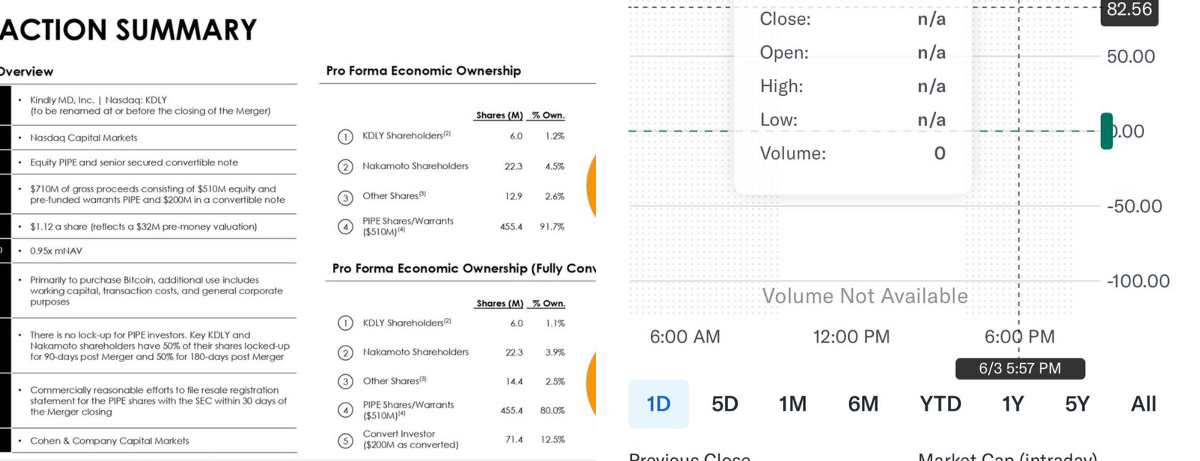
3️⃣ $NAKA sold a significant amount of equity (equivalent to over 80% of its fully diluted market cap) in mid-2025 at $1.12 USD per share.
4️⃣ Investors who acquired this equity at $1.12 were positioned for a massive 20x profit when the market price exceeded $20. Savvy investors hedged this enormous profit by shorting the stock.
5️⃣ Eventually, these shares began unlocking—allowing them to be sold on the open market—after 90 days, right around now.
6️⃣ The stock price collapsed, with the $1.12 level acting like a magnet pulling it downward.
This has left many retail investors, who bought shares in the $10-30 range during the hype, feeling rug-pulled. However, if private equity holders are sitting on substantial profits relative to the current public stock price, there's a strong likelihood they'll take those gains, triggering market collapses.
Several other Bitcoin treasury companies face similar large unlocks in the near future (e.g., as noted by @Pledditor on X regarding $ASST).
You can try to make an extra buck on Bitcoin treasury companies, OR you could simply buy Bitcoin, hold it in self-custody, and relax. 🌈
Further Reading:
🔶 Who bought $NAKA private equity?, from @Pledditor:  🔶 Great research from @bigmagicdao, from early June 2025:
  #BitcoinTreasury #Bitcoin #Crypto #StockMarket #Investing

X (formerly Twitter)
Pledditor (@Pledditor) on X
Names that stood out to me:
Jameson Lopp: 1,340,000 shares of $NAKA
Balaji Srinivasan: 273,038 shares of $NAKA
David Bailey: 11,160,572 shares of ...
X (formerly Twitter)
Molly (@bigmagicdao) on X
Naka’s PIPE investors got in at $1.12 with no lockup—455M shares. At $20, they’re sitting on a 20x. But with average daily volume around $2M,...


 MONETARY PRISONER'S DILEMMA: BITCOIN AND NATION-STATES
A monetary prisoner’s dilemma explores four distinct scenarios:
1) Every nation-state buys Bitcoin.
First come, first served. Demand from nation-states pushes the price higher, accelerating transition to the Bitcoin Standard. Early adopters accumulate more at lower prices, while laggards are left to accumulate less at higher prices. International trade increasingly settles in neutral reserve assets like Bitcoin or gold. Countries will either accumulate significant amounts of Bitcoin cheaply or need to generate it through a trade surplus.
2 and 3) Some nation-states buy Bitcoin, while others do not.
Countries that purchased Bitcoin use it for trade settlement with one another, while non-adopting countries continue moving away from USD settlement towards gold. Countries using Bitcoin for trade settlement become more competitive and prosperous due to:
1. The devaluation of gold caused by new supplies of both physical and paper gold entering the market.
2. The high costs associated with transporting and verifying physical gold (e.g., melting and recasting).
4) No nation-state buys Bitcoin.
(purely theoretical: Bhutan is already mining Bitcoin, and El Salvador is both buying and mining it.)
Individuals, businesses, and funds continue accumulating new supply, driving adoption forward without government involvement. As an increasing amount of wealth secured in Bitcoin (which cannot be debased), money printing becomes ever more difficult and eventually impossible. Without money printing, twin deficits (trade and budget deficits) can no longer be financed, leading to a significant reduction in government size worldwide. This shrinkage of government is a welcome change for a large portion of citizens.
Genuine question: Which scenario do you prefer, and why?
MONETARY PRISONER'S DILEMMA: BITCOIN AND NATION-STATES
A monetary prisoner’s dilemma explores four distinct scenarios:
1) Every nation-state buys Bitcoin.
First come, first served. Demand from nation-states pushes the price higher, accelerating transition to the Bitcoin Standard. Early adopters accumulate more at lower prices, while laggards are left to accumulate less at higher prices. International trade increasingly settles in neutral reserve assets like Bitcoin or gold. Countries will either accumulate significant amounts of Bitcoin cheaply or need to generate it through a trade surplus.
2 and 3) Some nation-states buy Bitcoin, while others do not.
Countries that purchased Bitcoin use it for trade settlement with one another, while non-adopting countries continue moving away from USD settlement towards gold. Countries using Bitcoin for trade settlement become more competitive and prosperous due to:
1. The devaluation of gold caused by new supplies of both physical and paper gold entering the market.
2. The high costs associated with transporting and verifying physical gold (e.g., melting and recasting).
4) No nation-state buys Bitcoin.
(purely theoretical: Bhutan is already mining Bitcoin, and El Salvador is both buying and mining it.)
Individuals, businesses, and funds continue accumulating new supply, driving adoption forward without government involvement. As an increasing amount of wealth secured in Bitcoin (which cannot be debased), money printing becomes ever more difficult and eventually impossible. Without money printing, twin deficits (trade and budget deficits) can no longer be financed, leading to a significant reduction in government size worldwide. This shrinkage of government is a welcome change for a large portion of citizens.
Genuine question: Which scenario do you prefer, and why?
