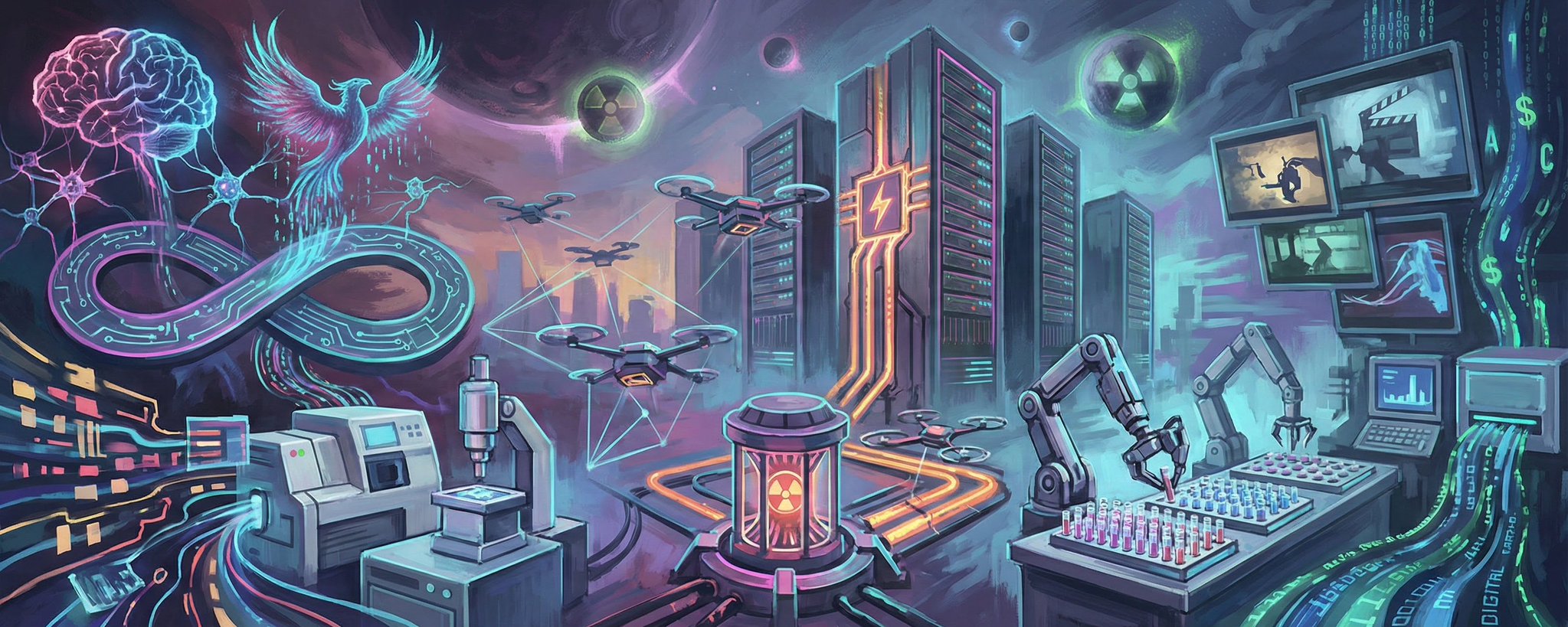
Science and business are moving fast, but some old rules are still slowing things down.
In the world of medicine, scientists are now able to "program" our bodies' instructions without changing our actual DNA, which could help cure diseases more easily.
While the U.S. used to lead everything, China is now creating a huge portion of the world's new medicines.
Up in space, companies like SpaceX have become more valuable than the biggest military companies, and they are planning to send massive amounts of supplies into orbit very soon.
However, while some are looking at the stars, others are stuck in the past; for example, a court in Germany recently banned robots from working on Sundays because of a law that is over 1,700 years old.
William K⚡Santiago🔑☢️
williamsantiago@getalby.com
npub1h3fz...96sj
CEO, C4 CCSSA at PrivKey LLC, Blockchain strategist, cybersecurity.
The Mission: The Separation of Money and State.
The computer chip world is going through a massive shake-up.
For a long time, Apple was the "big boss" because of iPhones, but now Nvidia is taking over the top spot because everyone wants their chips for Artificial Intelligence (AI).
Investors are so excited about this change that when Nvidia bought a smaller company called Groq, their own value shot up by more than the cost of the deal almost instantly.
Experts think the whole chip industry will make over $1 trillion next year, but there is one big problem: memory.
There isn't enough high-speed memory to keep up with these powerful chips, and big tech companies are getting so desperate that they are firing bosses who can't find enough and sending new teams to live in South Korea just to beg the factories there for more supplies.
Essentially, the world of work and fiat currency is going through a massive shift because of AI.
We are seeing a huge drop in jobs for computer programmers because technology is starting to write the code itself, and some experts think almost any job done on a computer might eventually be handled by AI "agents."
While these traditional jobs are disappearing, massive amounts of fiat currency are flowing into building the giant power plants and computer systems needed to run AI.
At the same time, the world of digital sound money (Bitcoin) & digital fiat currency (crypto) is becoming a part of the regular banking system.
In short, money is moving away from paying people to do tasks and moving toward building the powerful machines that can do those tasks instead.
People used to think AI was smart if it could pass a human test or a school exam. Now, those goals have changed. People are basically admitting that the next big challenge for AI isn't beating humans—it’s solving math problems that have stumped the world for centuries.
At the same time, the physical world is catching up. In Beijing, robots called Linkerbots are actually building and testing their own robotic hands. This means robots are starting to build themselves, which is a major step toward machines that can keep making more of themselves without any help from us.
Bitcoin POS
Configure your Point of Sale
Bitcoin POS
Bitcoin Point of Sale - Receive Lightning payments directly to your wallet with low fees. Easy setup, shareable links for staff, no middleman.
South Korea introduces mandatory facial recognition scans for purchasing mobile SIM cards to reduce scams.
Get
Silent Link
or
Phreeli
Silent Link
Phreeli - Privacy By Design Wireless.
Your privacy is Phreeli
Dallas Fed President suggests swapping out the federal funds rate target for something more robust.
Classic move: just shift the goalposts so nobody ever really "loses" the inflation game.
This is exactly why we need sound money. Real sound digital money: Bitcoin!
Dallas Fed President: It’s Time to Replace the Fed’s Interest Rate Target | The Daily Economy
Building a Lunar Mass Driver: How Starship, AI Robots, and Bitcoin Lightning Could Launch the Off-World Economy


Building a Lunar Mass Driver: How Starship, AI Robots, and Bitcoin Lightning Could Launch the Off-World Economy
The dream in one sentence
"The broad point is that only the strong survive was correct. We are entering the endgame of crypto having any reason to exist.
My thesis as to why it exists at all is a combination of a novel vector for gambling and an affinity scam.
Bitcoin is extremely difficult to even begin to understand, and even though what it fundamentally 'fixes' is money printing, its novelty ironically lends itself to confusing the uninitiated and impatient with meaningless appeals to 'blockchain technology' that manifest as attempts to print money." -- Allen Farrington
Allen Farrington's article is a follow-up to his earlier piece “Only the Strong Survive,” and it poses a blunt question: If Bitcoin can now fulfill virtually everything the broader crypto space originally promised—programmable money, scalable payments, DeFi primitives, and more—then does the rest of the altcoin casino really have any reason left to exist?
On the Bitcoin side, the piece highlights whether the combination of Arkade (built on the Ark protocol), Lightning Network, and e-cash systems could be the true endgame for real programmability and a global, self-custodial banking layer directly on Bitcoin.
I've always seen this as the ultimate outcome, ever since my early research into distributed blockchains back in 2011. From the beginning, it felt clear to me that Bitcoin's design would eventually layer up to handle everything else claimed by later chains—without compromising soundness, decentralization, or self-custody.
Article: 
Proton Drive
Securely store, share, and access your important files and photos. Anytime, anywhere.
The Marshall Islands has rolled out the world's first national universal basic income (UBI) program that includes a cryptocurrency payment option.
Citizens can receive quarterly payments of around $200—either through traditional methods like bank transfers or checks, or as a US dollar-pegged stablecoin via a government digital wallet—to help combat rising living costs in this remote Pacific nation.
This is a pretty innovative move, especially for reaching people on far-flung islands.
Universal Basic Income (UBI)—and perhaps Universal Basic Services (like guaranteed healthcare, education, housing, and transit)—really starts to look practical when you zoom out: as AI and humanoid robots handle more and more jobs, something like this could ease the shift into an economy where humans aren't required for every task. It's essentially a live experiment for all those theories about how automation will reshape society.

the Guardian
Marshall Islands launches world’s first universal basic income scheme offering cryptocurrency
Quarterly payments of $200 to be offered via stablecoin or traditional currency in a scheme designed to ease cost of living pressures in the Pacifi...
I just used @coderabbitai for my code review, and it's fantastic! It's free for OSS and offers a free trial for the proprietary code. Check it out: 

AI Code Reviews | CodeRabbit | Try for Free
AI-first pull request reviewer with context-aware feedback, line-by-line code suggestions, and real-time chat.
Today, we're celebrating Bitcoin's HODL Day! Don't be a weak-handed lettuce — stay strong and become a diamond hand! 💎🚀
###################
The mind is the ruler of the soul.
###################
The intelligence explosion
Pay attention!

X (formerly Twitter)
Dr. Alex Wissner-Gross (@alexwg) on X
Welcome to December 16, 2025
Traditional banks are like dinosaurs—slow and outdated. Unless they undergo a radical transformation, they'll face extinction.
Meanwhile, PayPal is taking a big step toward becoming more bank-like by applying for a US banking license (specifically, a Utah-chartered industrial bank charter).
Here's the FT article on it:
This move lets them expand small-business lending directly, offer interest-bearing savings, and tap into a friendlier regulatory vibe.
Fintechs evolving while legacy players lag—classic disruption in action!
Client Challenge
DTCC - Issuance and Wallets & Issuance and Wallets Overview
At PrivKey, we built a simple REST proxy that lets web apps easily use Lightning Labs' Taproot Assets daemon. It adds CORS support and makes authentication much simpler.
We recently presented in Atlanta, GA, introducing our open-source product that any financial institution, central bank, or even an entire country can adopt and use.
It's nearly identical to the DTCC Issuance and Wallets Overview shown in the link above. The key differences are that it's fully decentralized, operates as a Layer 2 solution, and is secured directly by Layer 1 Bitcoin—with no humans or federated third parties involved.
Future of Financial Services
GitHub
GitHub - privkeyio/taproot-assets-rest-gateway: REST Proxy for Taproot Assets
REST Proxy for Taproot Assets. Contribute to privkeyio/taproot-assets-rest-gateway development by creating an account on GitHub.
test
Could your wallet, node, or even hardware suddenly be labeled “unlicensed financial activity”?
The Human Rights Foundation’s latest *Financial Freedom* report dives into the sweeping new laws emerging in places like the UAE and Belarus—revealing how these tactics are seeping into Western “financial stability” narratives, KYC requirements for social media, and the push for digital IDs.
This article unpacks the tools—from DIY hardware to Lightning Network and e-cash—that could be the difference between staying banked, getting blocked, or achieving true financial sovereignty.
Article:
HRF’s Weekly Financial Freedom Report #99


Human Rights Foundation
HRF's Weekly Financial Freedom Report #99
Happy Thanksgiving, readers! Today, we reflect on the financial repression so many face around the world, and how brave and creative minds are push...
Stablecoin Adoption Could Stifle Central Bank Control, IMF Warns
Stablecoins have the potential to broaden individuals’ access to financial services, but that may come at the cost of central banks, per IMF.
Stablecoins represent the next major challenge to the survival and justification of central banks.

Decrypt
Stablecoin Adoption Could Stifle Central Bank Control, IMF Warns - Decrypt
Stablecoins have the potential to broaden individuals’ access to financial services, but that may come at the cost of central banks, per IMF.
As a true Bitcoiner, I live by these core principles:
— Self-sovereignty above all: I hold my own private keys and treat any form of custody like it’s radioactive.
— Run my own full node: I personally verify every rule and every transaction myself, strengthening the network and never outsourcing trust to someone else’s server.
— Bitcoin mine, no matter how small: Even if it’s just a tiny rig or a lottery ticket setup, I directly contribute to securing the network instead of sitting on the sidelines.
— Understand Bitcoin at its deepest level: I get the hard-coded scarcity, true decentralization, unbreakable immutability, and why sound money must be separated from the state.
— Actually use Bitcoin as money: I spend and receive bitcoin in real life whenever it makes sense, instead of just hoarding it like a collectible.
— Give back to the ecosystem: I teach newcomers, support open-source projects, defend privacy tools, or help build censorship-resistant infrastructure—whatever I can do to make Bitcoin stronger.
— Long-term stewardship mindset: I don’t see Bitcoin as just another investment; I see it as one of the most important technological, economic, and philosophical inventions in human history, and I act accordingly.