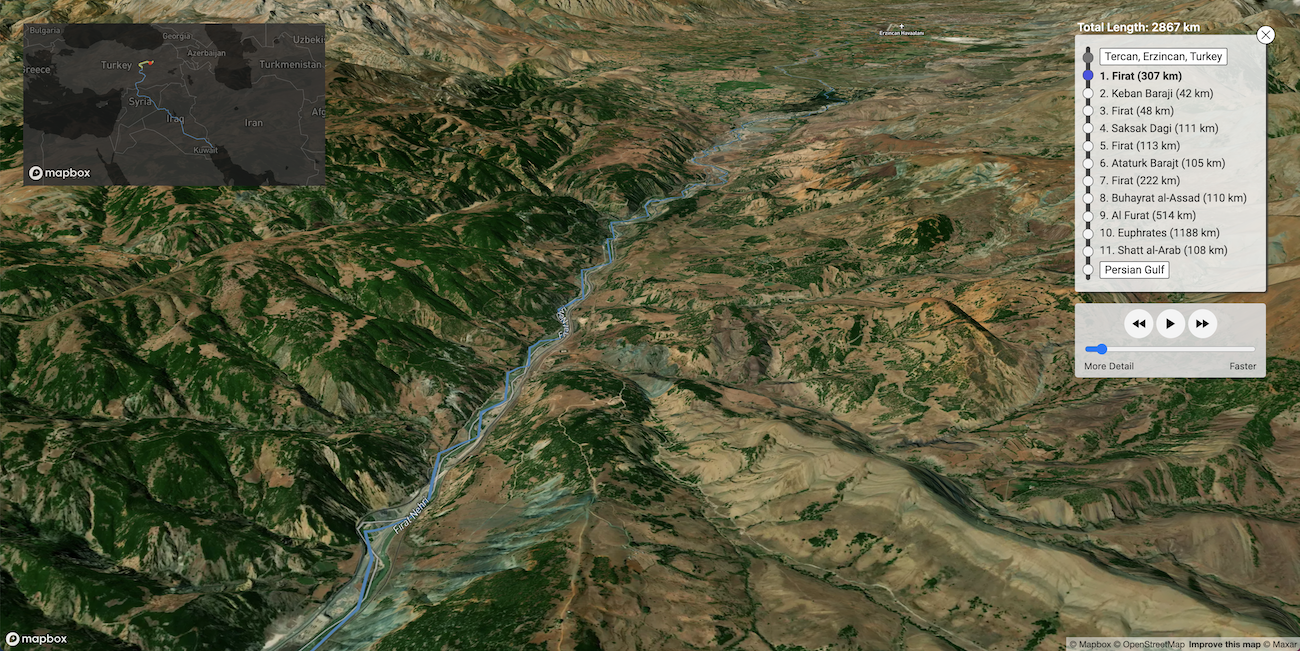
Watch the path of a raindrop from anywhere in the world
https://river-runner-global.samlearner.com/
Uses USGS/MERIT Basin data to visualize the path of a rain droplet to its endpoint.
https://github.com/sdl60660/river-runner/tree/global

originally posted at https://stacker.news/items/868256
nym
nym@primal.net
npub1hn4z...htl5
Notes (12)
Trump Is Going to Pump Our Bags to Kingdom Come
https://archive.ph/kQYMY
A guy, stool-bound inside the front door of PubKey, a Bitcoin-themed bar in Manhattan’s Greenwich Village, motioned for my ID. I reached for my wallet. But wait—turns out he wasn’t actually working the door. “We’re just trying to get people,” he told me, chortling. Epic prank, sir!
Hence got, I made my way to the bar’s backroom for a panel called “Coin Based: Concepts of a Plan for Nation-State Bitcoin Adoption.” “My how things have changed,” read the online event page. “Ideas that only a few weeks ago were laughed at by pundits and commentators are now on the table.”
It was time to decide what exactly the crypto community desires from the Trump administration on a policy level, and a few dozen guys had gathered to listen to a four-guy panel debate potential legislative achievements that could define Trump 2.0. It was off to an annoying start, as expected, but money buys you that right, even digital money.
originally posted at https://stacker.news/items/867859
Is NixOS truly reproducible?
https://luj.fr/blog/is-nixos-truly-reproducible.html
Build reproducibility is often considered as a de facto feature provided by functional package managers like Nix. Although the functional package manager model has important assets in the quest for build reproducibility (like reproducibility of build environments for example1), it is clear among practitioners that Nix does not guarantee that all its builds achieve bitwise reproducibility. In fact, it is not complicated to write a Nix package that builds an artifact non-deterministically.
originally posted at https://stacker.news/items/867193
Marginalia – A search engine that prioritizes non-commercial content
https://marginalia-search.com/
Marginalia Search is an independent open source Internet search engine operating out of Sweden. It is principally developed and operated by Viktor Lofgren .
**Philosophy**
The need for discovery
Nothing you do to try to make the web a better place matters if nobody can find what you did. There are a lot of precious websites out there that deserve an audience, but instead are languishing in obscurity.
This makes alternative discovery mechanisms an urgent priority of the free and independent web, both document search as well as blog and RSS-feed discovery.
It's time to build
None of this is new. How long have been talking about the decrepit state of the web? How many pages of essays have been written, how long have we waited for the planets to align and the web somehow to fix itself? Seems very clear talking and writing isn’t going to fix the web. Rallies or pleas to the government isn’t going to fix the web either. Not even AI or Elon Musk is going to fix the web.
New search and discovery mechanisms stubbornly refuse to manifest almost no matter what we do, until we actually go build the things. You do not need VC funding, or a San Fransisco address, or even someone’s permission.
This is how it’s always been. Things exist on the web because someone built them. As a consequence, if you want something to exist on the web, you go build it.
Traditional information retrieval
A search engine’s ability to answer natural language queries comes at the cost of its ability to discover websites. The more human the answers become, the less human the results become. This has lead to a web that feels both small and lonely.
Natural language search is likely a dead end that will be consumed by GPT-style interfaces. Traditional Information Retrieval approaches still offer capabilities that have largely become lost in the rush toward natural language search by major search engines.
The need for multiple search engines
In practice, most alternative search engines are backed by Google or Bing, or authoritarian states such as Russia and China. The lack of diversity in search engines makes it terrifyingly easy to censor information on the web, even if this is not intentional, having every major search engine be based in United States imposes a significant cultural bias on the rest of the world using these services.
Marginalia isn’t seeking to replace Bing or Google, but to complement them, to provide a minority report that keeps them honest.
Business model
Web search has traditionally been difficult to monetize, which has pushed many search engines to go the route of advertisement, to the detriment of the search results.
The project is independent in that it has no loans, no investors looking for a payday, no strings attached anywhere to pressure it into doing anything than providing as much and as good internet search as it is capable of.
The marginalia search engine is designed to be very cheap to run and operate, and the goal is to provide outsized value, and thus be able to scrape by on donations, grants and commercial API-deals with other search engines.
The project currently has bills in the ballpark of $200/month, meaning it can keep operating even if funding runs completely dry, although this would cause development to stall almost completely.
originally posted at https://stacker.news/items/865190
#GOMA
nostr:note1e4559ad3ut8y33462gekdft7h77dg6vlvt7z84dax0n9letmgurqhkgx4y
Chimera Linux works toward a simplified desktop [LWN.net]
https://lwn.net/Articles/1004324/
Chimera Linux is a new distribution designed to be "simple, transparent, and easy to pick up". The distribution is built from scratch, and recently announced its first beta release. While the documentation and installation process are both a bit rough, the project already provides a usable desktop with plenty of useful software — one built primarily on tools adopted from BSD.
Chimera Linux was started by "q66" (who previously worked on Void Linux) in 2021 with the goal of creating a modern distribution that could "eliminate legacy cruft where possible" to provide a simple, practical desktop. In service of that goal, the project is based on BSD tools. Chimera's frequently asked questions page explains that unlike other projects that use those tools for licensing reasons, project picked BSD tools for their smaller code size and reduced complexity. Bootstrapping a modern Linux distribution is quite complex, with many packages that depend on other packages; using BSD tools allowed the project to avoid a lot of that complexity. For example, Chimera uses musl as its C library, which cuts out a lot of dependencies from the GNU C library.

originally posted at https://stacker.news/items/864527
Open Heart Protocol
https://openheart.fyi
The Open Heart protocol lets an anonymous user sends an emoji reaction to a URL.
originally posted at https://stacker.news/items/863733
Oracle Linux is the best local VM for MacBooks
https://xeiaso.net/notes/2025/k8s-dev-mac-oracle-linux/
> Part of working on Anubis means that I need a local Linux environment on my MacBook. Ideally, I want Kubernetes so that I have a somewhat cromulent setup. Most of my experience using a local Kubernetes cluster on a MacBook is with Docker Desktop. I have a love/hate relationship with Docker Desktop. Historically it's been a battery hog and caused some really weird issues.
> I tried to use Docker Desktop on my MacBook again and not only was it a battery hog like I remembered; whenever the Kubernetes cluster is running the machine fails to go to sleep when I close it. I haven't been able to diagnose this despite help from mac expert friends in an infosec shitposting slack. I've resigned myself to just shutting down the Docker Desktop app when I don't immediately need Docker.
> I have found a solution thanks to a very unlikely Linux distribution: Oracle Linux. Oracle Linux is downstream of Red Hat Enterprise Linux, and more importantly they ship a "no thinking required" template for UTM. Just download the aarch64 UTM image from their cloud images page, extract it somewhere, rename the .utm file to the name of your VM, double click, copy the password, log in, change your password on first login, and bam. You get a Linux environment.
originally posted at https://stacker.news/items/863703

#GOMA
nostr:note189e55zw7pgna3m9ak8jc6ldyckpeavlfcj74md94lxstjqmwhjls7alr9j
Goodnight Nostr, catch you on the flip side.
This
nostr:note1z9fa86cprs0fu6qdazmajxh634vmjjx375mxyud37f5ar7dz3z6q02d6ag