GM
Just had a quick look what happens each time bitcoin add a zero to the USD price after a halving.

0.1 #bitcoin ₿ is the delux Christmas 🎁 this year, a life of freedom you will always be remembered for giving.
Also available,1M sats (0.01btc)
That’s not all, 262k sats for the lifetime allocation of sats per person on earth.
Give the gift of forever.
Unified theory of energy tokens

@ODELL is mainstream

The previous 2 cycles, bitcoin models over estimated the returns. This cycle seems like the one where everyone is underestimating them.
(Except
@Samson Mow)

Dear [Friend's Name],
I've been exploring some intriguing connections between Bitcoin, thermodynamics, and complex systems theory. While some of these ideas are speculative, I believe they offer valuable perspectives for understanding Bitcoin's unique properties and its place in the broader economic and technological landscape.
Central to this exploration is the concept of entropy from thermodynamics. As you know, entropy is a measure of the disorder or randomness in a system, and the second law of thermodynamics states that the total entropy of an isolated system always increases over time. This principle has led some researchers to consider entropy as a kind of "universal currency" - a fundamental cost for any process in the universe.
When we apply this concept to Bitcoin, we can analyze the energy expended in mining from a thermodynamic perspective. The proof-of-work system effectively transforms electrical energy into a digital asset, and this process is irreversible, aligning with the concept of entropy increase. However, unlike traditional energy expenditures, Bitcoin mining results in the creation of a highly ordered information structure - the blockchain.
This has led me to consider a conceptual model of Bitcoin as a form of "information crystallization," where the energy used in mining is transformed into a structured digital asset. While this is more of a metaphorical construct than a proven physical phenomenon, it provides an interesting framework for analyzing Bitcoin's relationship to energy and information theory.
I've also been considering parallels between Bitcoin's consensus mechanism and concepts from quantum mechanics, specifically the idea of wave function collapse. In quantum systems, a particle exists in a superposition of states until measured, at which point the wave function collapses into a definite state. Analogously, a Bitcoin transaction exists in an uncertain state until it's confirmed in a block. While this is certainly not a direct equivalence - the mechanisms are fundamentally different - the analogy might provide insights into the nature of certainty and consensus in distributed systems.
Applying concepts from complexity theory to Bitcoin's development also shows promise. The Bitcoin network, with its numerous interacting nodes and emergent behaviors, fits the definition of a complex adaptive system. For example, we can observe self-organization in how the network adjusts to changes in mining difficulty, or how trading behavior responds to halving events. These phenomena align with key principles of complexity theory, such as emergence and non-linear dynamics.
It's crucial to note that Bitcoin's unique characteristics - its fixed supply, specific consensus mechanism, and network effects - set it apart from other cryptocurrencies and traditional financial systems. These distinctions are essential when applying these theoretical frameworks to understand Bitcoin's behavior and evolution.
Lastly, I've been considering the nature of money itself as a system of information and trust. From this perspective, Bitcoin's transparent and programmable nature might indeed represent an evolution in how we conceptualize and implement money. However, this idea needs to be grounded in established economic theories and empirical evidence to move beyond mere speculation.
I believe these interdisciplinary approaches, while still largely theoretical, could open up new avenues for understanding and analyzing Bitcoin and other distributed systems. They might help us develop more sophisticated models for predicting network behavior, assessing energy efficiency, or designing future protocols.
I'm keen to hear your thoughts on these ideas. Do you see potential applications or pitfalls in applying these concepts to Bitcoin or distributed systems in general? Your critical perspective would be invaluable in refining these concepts and identifying areas for further research.
Looking forward to your insights,
[Your Name]
If we feel our power being taken pieces by piece, day by day, policy decision after policy decision. It's comforting to know that a system designed to protect what economic energy we have earned from exactly this type of existential attack. Bitcoin is the protector of economic energy, and that protection allows for the retention of our cultural energy.
The Miner as an Engine
A bitcoin miner is a thermodynamic engine. Just as a traditional heat engine converts thermal energy into mechanical work, a bitcoin miner converts electrical energy into computational work and heat.
Input: Electrical energy (low entropy, highly ordered)
Outputs: Computational work (maintaining the bitcoin blockchain, creating new bitcoins)
Heat (high entropy, dispersed energy)
The Second Law of Thermodynamics
states that the entropy of an isolated system always increases over time. Bitcoin mining exemplifies this principle. The process starts with low entropy electrical energy, concentrated in the power supply. Some of this energy becomes ordered information in the bitcoin blockchain. A significant portion is converted to heat, increasing the overall entropy of the system.
This increase in entropy is not just a byproduct but a fundamental aspect of the mining process. The heat generated by miners is a direct manifestation of this entropy increase, making it an integral part of the system rather than waste.
Like traditional heat engines, the Bitcoin mining process is irreversible. You cannot convert the generated heat back into the original electrical energy or computational work. This irreversibility describes entropy increase and is part of the nature of the energy transformations involved in mining.
Just as with traditional engines, there are theoretical and practical limits to the efficiency of miners. Not all the input energy can be converted to useful work (in this case, hashing). This limitation is the same thermodynamic principles that govern the efficiency of any energy conversion process.
Consider the entire Bitcoin network as a distributed thermodynamic engine. A global system that converts electrical energy into digital value and heat, with an overall increase in entropy.
Bitcoin miners are not miners, they are engines. Engines that convert electricity into digital scarcity and heat. This is the definition of an engine, it converts low entropy energy into higher entropy energy, usually for a specific purpose.
Anyone else trying to keep followers:following ratio roughly even?
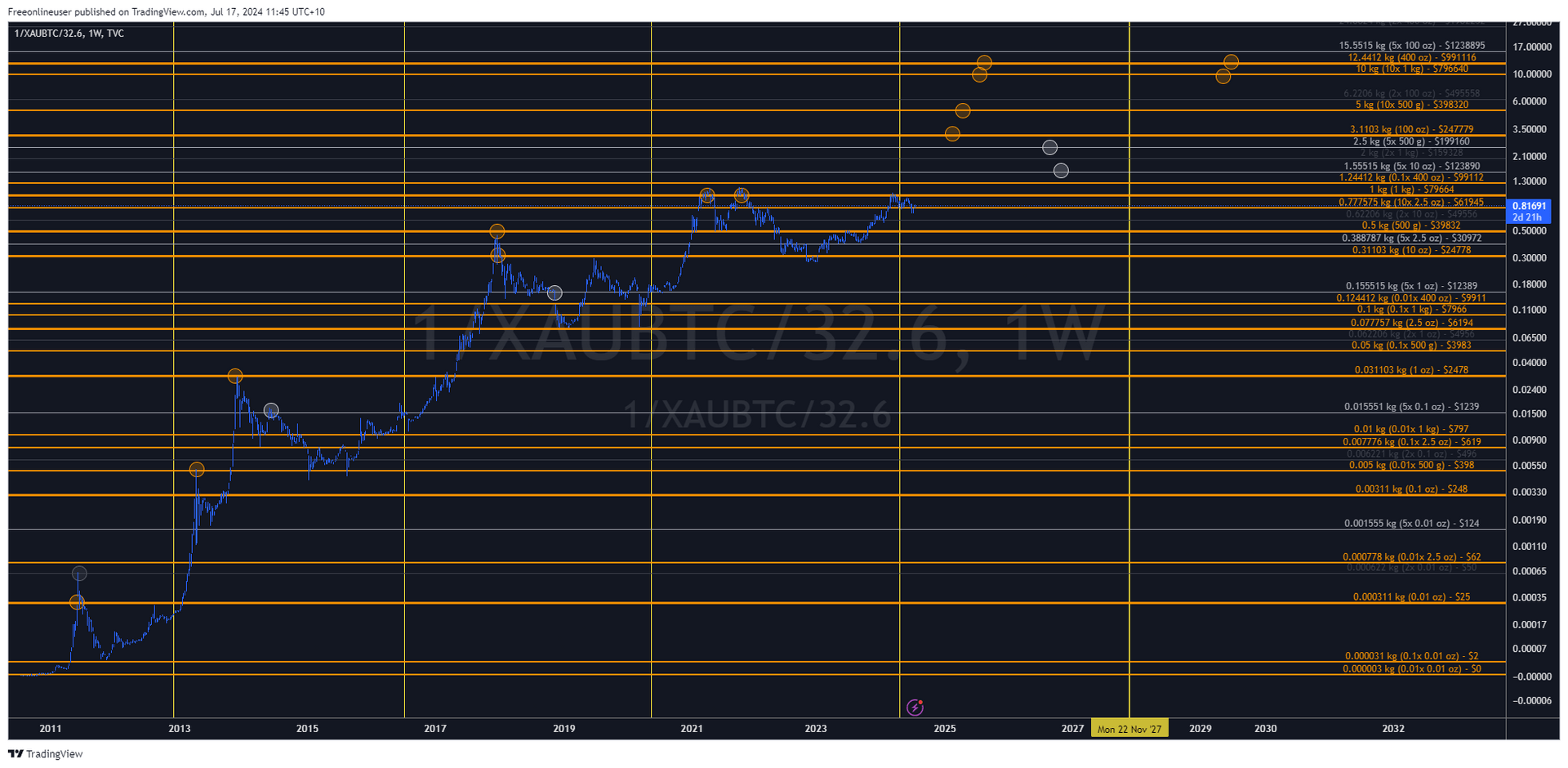
This is a chart of bitcoin unit bias intersecting with gold unit bias. Enjoy.
The transition from gold to the worlds hardest money will happen at a speed determined by the issuance rate set by Satoshi in the bitcoin code. It's clear to me from this chart that during this transition humans will continue to use phycological biases to decide how to enter this new asset class. A trader sees they can buy a 1oz gold bar for 1btc and takes the trade.
The future circles are not a prediction, just an example of how these levels may come into play in the future bull runs. $1M btc could occur in the next cycle or two. Gold is represented in kg on the y axis, and the prices on each line are based on current gold price.
This is a pine script indicator I built for myself in tradingview. It shows commonly traded gold units, and the major multiples and division of these units. I made a similar indicator that I enjoy, that represents the same lines as they move dynamically with gold price on the standard btcusd chart.
When nationstates adopt bitcoin they won’t need to charge taxes.
Just a thought - If you find yourself relating to a tv character, it might be because a tv writer fully understands and can describe a simple psychological delusion, and you are currently stuck in this particular delusion. To some you might come across as an NPC. This idea attracts me to eccentric people, and to behaving with more eccentricity.
Digitally Tangible
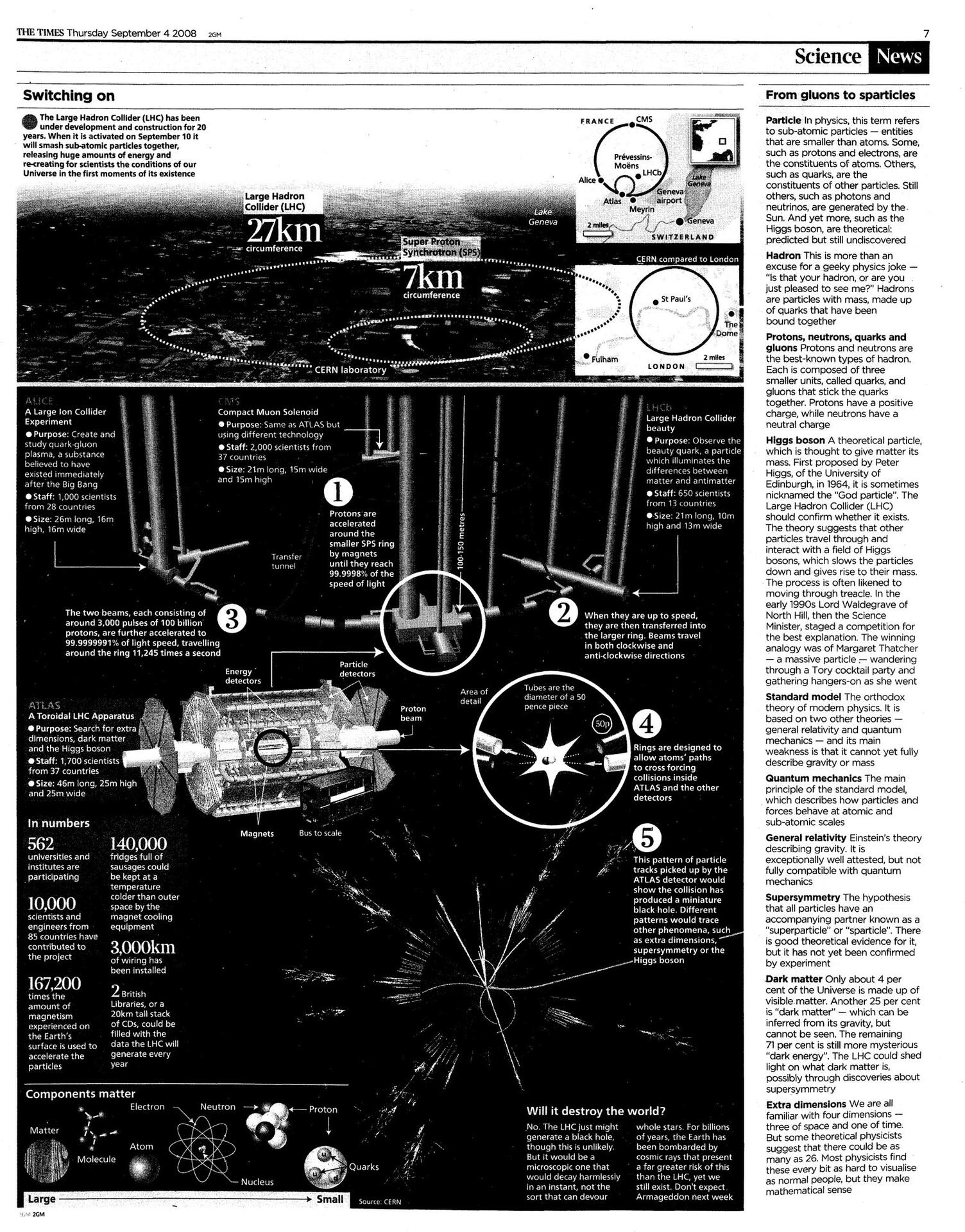
Jan 3rd 2009 The Times newspaper print 69523 was referenced in #Bitcoin genesis block
Significantly, 121 days prior that date was Sep 4 2008 print 69420
Please take a moment to notice the feature story inside 69420
Thankyou future Satoshi.