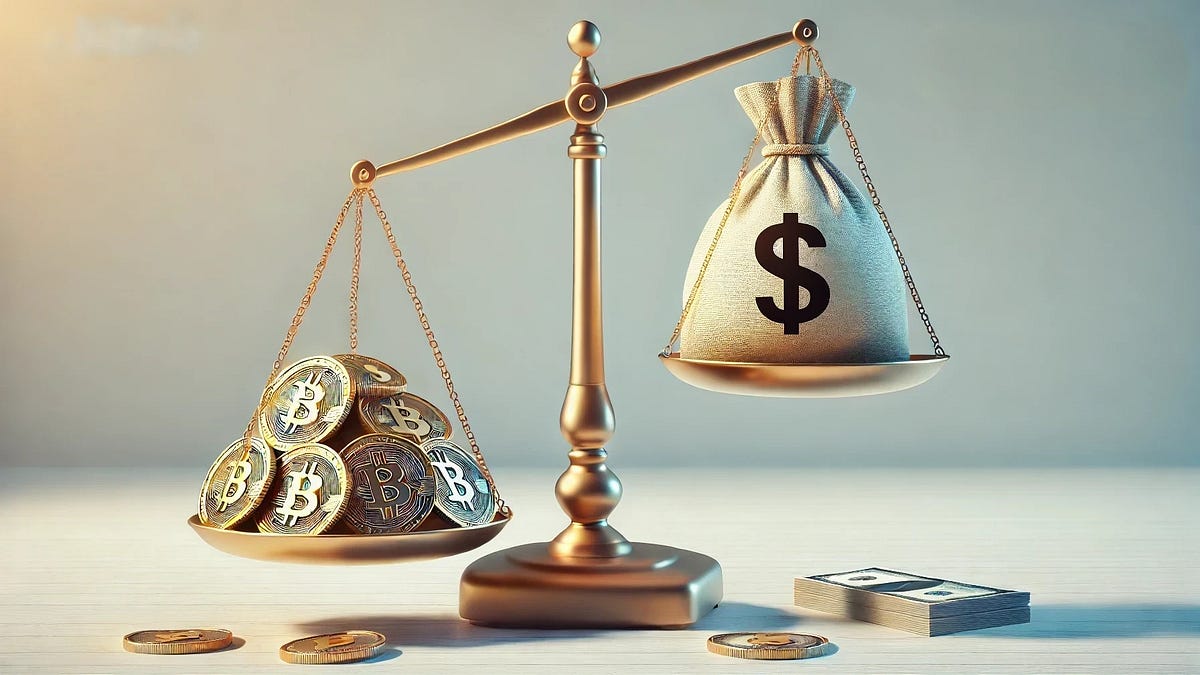
Even if you take an initial 1% allocation to bitcoin, here's what most likely will happen:
Your 1% grows to 3%
AND
You start to understand bitcoin better
THEN
Your 3% grows to 5%
AND
You add an add'l 5% bc you understand bitcoin better
Allocate ➡️ Understand ➡️ Growth 🔁
Trey
tshodl@nostrplebs.com
npub1m6y9...e2p9
VP, Sales, Unchained | Advisor to Cantilever | FIRE 🤝 Bitcoin | Banker turned bitcoiner: previously Truist, MetLife, Goldman Sachs, Deloitte
Helping bitcoiners achieve financial independence and FIRE practitioners understand bitcoin at firebtc.substack.com
My buddy has $270,000 sitting in a bank account earning 0.00%. 😱
He thinks he's being safe. I told him he’s guaranteed to lose.
FIRE BTC Issue 23: "Cash is Trash" is live.
👇 Here's what I'd do instead:
firebtc.substack.com/p/cash-is-trash
My dad just reminded me of this card I gave him as a kid. Classic!


Gold bugs are typically loud about bitcoin's lack of intrinsic value. Gold is used in jewelry and electronics, among other goods in the real world. And yet gold’s market value exceeds its industrial use value many times over.
What gives?
I explore the myth of "intrinsic value" in the latest issue of FIRE BTC 👇


🙃 The Intrinsic Value Myth
FIRE BTC Issue #22 - A common critique of bitcoin, refuted
An AI bot that automatically extracts a readable and usable recipe from the SEO-optimized hellscape of a normal recipe webpage.
A buddy of mine showed me yesterday that he has $270,000 sitting in cash in an account that pays 0% interest.
I told him that's crazy.
He asked what I would do with it.
I told him by the end of Monday, I would have $270k less cash and $270k more bitcoin.
We are not the same.
🌯 Financing a $12 burrito 🌯
Pay $1 per month for a year and save the unpaid dollars at @River earning 3.8% paid in BTC over the course of the year.
You earn ~$0.25 of BTC which then grows at 20%+ annually.
In 21 years, your burrito is free.
You're welcome.
The market doesn't yet understand the significance of the Strategic Bitcoin Reserve.
The SBR signals that the U.S. views bitcoin not just as a financial asset but as a geopolitical tool to defend its hegemony.
Nation-states watching the U.S. accumulate bitcoin will likely feel pressure to secure their own reserves, especially resource-rich or politically isolated countries that need alternatives to the U.S. dollar system. Some have already started.
This will accelerate a global bitcoin accumulation race, and the market is not even close to bullish enough.
888,888 blocks and no signs of stopping.
There is no top.
Lips are inflating faster than the money supply.


Buying $12,000 per year ($1k per month) at a modest 14% annual CAGR for bitcoin is $276,000 after 10 years.
Do this for another 10 years, your stack is worth $1.25m.
Do it for another 10 years, your stack is worth $4.9m.
Anyone can do this.
The lesson?
START TODAY.
🙃 The Intrinsic Value Myth
Some bitcoin skeptics confidently claim it has no intrinsic value, as if that alone makes it worthless and ends the debate.
I refute this common critique in the latest issue of FIREBTC. Check it out and subscribe!


🙃 The Intrinsic Value Myth
FIRE BTC Issue #22 - A common critique of bitcoin, refuted
Contrary to conventional monetary theory, bitcoin may need to be adopted as a unit of account before it can fully function as a medium of exchange.
The key driver behind this shift is the opportunity cost of not holding bitcoin, which incentivizes individuals and businesses to seek payment in bitcoin and price goods in bitcoin terms. As this shift occurs, bitcoin’s circulation naturally increases, reinforcing its role as a true global currency. In this way, unit of account adoption acts as a catalyst rather than a final step, unlocking bitcoin’s potential as a widely used medium of exchange.
The conventional progression of monetary adoption follows a three-step sequence: store of value → medium of exchange → unit of account. However, in the case of bitcoin, this order may be reversed in key respects. Specifically, bitcoin’s adoption as a unit of account can act as a forcing function for its adoption as a medium of exchange, driven by the opportunity cost of not holding bitcoin in an environment of increasing monetary debasement.
Historically, new forms of money first emerge as a store of value, later transition into a medium of exchange, and only after widespread acceptance do they become a unit of account. This is because:
- A money must first be trusted to hold its value before it is widely accepted in trade.
- Only after mass adoption as a means of payment do people start thinking in terms of that currency, allowing it to function as a pricing standard.
Bitcoin has so far followed the first step—acting as a store of value—but has struggled to gain traction as a medium of exchange. The key reason for this is its high volatility and the strong incentives to hold rather than spend.
However, a shift in how bitcoin is perceived—toward viewing it as a unit of account—could serve as a necessary precursor for its medium-of-exchange adoption.
Economic actors (individuals, businesses, and institutions) make financial decisions based on opportunity cost—what they forgo by choosing one option over another. As bitcoin’s price appreciates over time relative to fiat currencies:
- Individuals and businesses increasingly recognize the cost of holding and transacting in depreciating fiat currencies.
- They begin to demand bitcoin as payment rather than accepting fiat, since bitcoin is expected to preserve and potentially increase in value.
- Workers, contractors, and service providers start asking for bitcoin-denominated payments to retain their purchasing power.
This shift in incentives begins to change how people think about money. Instead of measuring prices in fiat and converting to bitcoin, they start thinking directly in bitcoin terms—a hallmark of unit of account adoption.
Once a critical mass of people starts pricing and negotiating in bitcoin terms, medium-of-exchange adoption follows naturally:
- If businesses begin denominating goods and services in bitcoin, the need to convert back to fiat decreases.
- As more people receive wages, contracts, and invoices in bitcoin, it becomes easier to spend directly in bitcoin.
- Bitcoin transactions increase, improving liquidity, reducing volatility, and reinforcing its utility as a means of exchange.
In this sense, unit of account adoption serves as a forcing function:
- By thinking in bitcoin terms, individuals and businesses normalize Bitcoin transactions.
- This reduces friction in using bitcoin for daily transactions, accelerating its adoption as a medium of exchange.
Discuss 👇
🧩 Is the 4% Rule Still Relevant for Bitcoin? 🔥
The 4% rule is the standard for financial independence. What happens when you factor in BTC’s explosive growth & volatility?
Can bitcoin lower your target number?
I break it down in FIRE BTC Issue 21.


🧩 Is the 4% Rule Relevant to Bitcoin?
FIRE BTC Issue #21 - Finding your FIRE number with bitcoin
We did it, fam! We survived the great bear market of the last week of February, 2025. Well, we thought we did, but even a well-timed tweet from Trump couldn’t saved the price in the near term.
In the depths of this pullback, bitcoin fell almost 30% from the all-time high of $109k, hitting as low as $78k. So far. Many people have been freaking out, calling this the end of the post-halving cycle and the start of the next prolonged bear market.
While disconcerting, these types of swings are very common. Bitcoin is notorious for its price volatility, and then when it happens, people act like it’s the end of the world.
A more constructive reaction is to take a step back, remind yourself of the bigger picture, and recognize the opportunity being presented.


🩸 Blood in the Streets
FIRE BTC #20 - Taking advantage of market corrections
The recent volatility in bitcoin is a reminder not to get too overconfident when thing's are going your way.
Trying to outperform bitcoin will likely give you financial diarrhea.
View quoted note →
🤢 Montezuma's Revenge
FIRE BTC Issue #19 - Greed comes back to bite
-----------------------------
I just got back from a resort in Mexico.
Beautiful weather, great food, all-inclusive — my kind of vacation. I even got to play a round of golf down there. All the while, it was cold and dreary at home. Perfect timing to get away.
We had smooth travel home. No issues getting to the airport, no flight delays. All good.
Then it hit me. “Montezuma’s Revenge”, a.k.a. “traveler’s diarrhea”, is commonly experienced by Americans traveling to Mexico and is caused by exposure to unfamiliar bacteria in the local food and water. Needless to say, this type of sickness is not fun — I’ll spare you the details of what I experienced.
Montezuma’s Revenge is symbolic for retribution after overindulgence. When you’re living it up in a beautiful place like Mexico, and the margaritas are flowing like the salmon of Capistrano (lol Dumb and Dumber reference), it’s easy to get a little careless.
Sometimes things seem like they’re on easy mode — everything’s going your way. Like when bitcoin goes from $20k to $60k to $100k within the course of two years and you’ve been stacking hard to reach your FIRE goal. It’s working, and you’re feeling good. You’re pretty freaking smart, eh?
So you think, “I’m good at this, and I bet I can outperform bitcoin.”
I’m here to tell you: That’s the margaritas talking…
Here are a few things that are sure to give you financial diarrhea and slow down your path to FIRE.
-----------------------------
🔧 Buying bitcoin on leverage
Leverage can be a great thing for your finances if done correctly. In fact, I always look for ways to use the debt-based fiat system we live in to my benefit.
What I mean by “buying bitcoin on leverage” is using margin-style, callable debt at high levels.
Some exchanges offer 5:1, 10:1, 20:1, or even 100:1 leverage on bitcoin. Any of these options are hugely risky, and you are virtually guaranteed to lose your money. Avoid at all costs.
A safer way to buy bitcoin on leverage might be to borrow against your home or against your bitcoin stack. Just be very careful. When the market is ripping, this can feel very easy. But if your timing is off, you’ll be feeling a lot of stress.
I’ve touched this stove before…
🕰️ Timing the market
I’m not a good trader. My timing is pretty terrible. I know this because I’ve spent way too much time, energy, and money trying to be good at trading.
I don’t think I’m alone. You’re probably not a good trader either. Thinking you can time the market by selling at the top and only buying at the bottom will most likely lead to you owning less bitcoin than you otherwise would.
Missing the best 10 days of bitcoin price movement each year puts you in a losing position. You can’t afford to do this.
The old adage, “Time in the market beats timing the market”, is true for 99% of us. This is core to the FIRE approach.
📉 Trading other assets to get more bitcoin
There’s always another sexy trade out there trying to grab your attention and your capital.
Here are a few recent examples:
The Magnificent Seven
Memecoins
XRP (talk about diarrhea…….)
MSTR (Strategy, formerly known as MicroStrategy)
Of course, some of these have more merit than others.
The Mag Seven has been a powerhouse in the traditional finance world, driving most of the gains in the stock market. However, all of these have underperformed bitcoin over the long term.
I’m a MSTR believer and I own some. But trying to trade MSTR, especially with options, in an effort to end up with more bitcoin, will like lead to less, not more. There was recently a LOT of hype around this trade. I’m not immune to it…
Memecoins and XRP should be considered outright scams and should be avoided at all costs. Good luck trying to get the timing right or have the inside knowledge needed to dump on the pump.
Just stay humble and stack sats.
-----------------------------
Montezuma’s Revenge is inspired by the historical episode of the Spanish Conquistador, Hernán Cortés. When he met the Aztec Empire in the 1500’s, its ruler, Montezuma II, thought Cortés might be a god and showered him with gifts, including gold. But instead of satisfying the Spaniards, this only fueled their greed for more. Montezuma’s attempts to appease them backfired, and his empire was eventually conquered. Centuries later, though, foreigners continue to receive the payback for Cortés overstepping his bounds in the form of Montezuma’s Revenge.
It’s easy to be tempted to overindulge when things are good. We are all susceptible to it. This is where having a clearly laid plan to achieve your financial goals comes into play.
I’m feeling better now, but this recent sickness, and the recent volatility in the bitcoin market, gave me a firm reminder to resist the temptation to overindulge.
-----------------------------
That’s it for this week. Thanks for reading!
If you enjoyed this content, make sure to subscribe to the FIRE BTC newsletter so you'll get each new issue delivered to your inbox.


🤢 Montezuma's Revenge
FIRE BTC Issue #19 - Greed comes back to bite
Is it possible to pay zero income taxes after you retire? YES!
View quoted note →
We like the stock


🤩 Tax Free FIRE
FIRE BTC Issue #18 - A zero-tax FIRE strategy
👇👇
I hate taxes. All of them.
Don’t give me your “Who will build the roads?” or “What if your house catches on fire?” or “They protect us from evil people in the world.” excuses…I don’t buy them.
That said, taxes are a reality we have to deal with. Like living in a credit-based fiat financial system, there are ways to use the rules of the tax system to your advantage.
Today’s issue of FIRE BTC is inspired by a reader who recently achieved FIRE and turned me on to an interesting post on X by The Money Cruncher:

“The tax code is built for investors, not W-2 employees.” This line caught my eye.
Pursuing FIRE means building a savings portfolio to fund your lifestyle once you retire. If the tax code is built for people like us FIRE practitioners, then understanding it can help us reach our goals faster and leave us in a wealthier position.
Money Cruncher’s thread lays out a way to live tax-free up to a certain point, assuming you have stopped working. It leverages the rules around long-term capital gains (LTCG) and the available tax deductions to minimize or even eliminate your federal tax bill.
I’m by no means an expert on tax optimization (or licensed to give tax advice), so make sure you consult with a tax professional on this kind of stuff. OK, here’s how it works…
-----------------------------
🧐 Leveraging the LTCG rules
The tax code encourages long-term investment by providing lower tax rates on long-term gains relative to short-term investments.
Short‑term capital gains are taxed as ordinary income, which means that they follow the regular federal income tax brackets. In other words, if you sell an asset held for one year or less, the profit you make will be added to your other income and taxed at your marginal ordinary income tax rate. The 2025 federal income tax brackets range from 10% to 37% in a graduated manner — highway robbery!!
Luckily, by the time you reach FIRE, your savings portfolio will consist of investments held for more than one year, which benefit from a more favorable tax treatment. When you sell an investment that you’ve held for more than one year, the gains are taxed at special long-term capital gains rates of 0%, 15%, or 20% depending on your taxable income.
That last bit is important.
You may have built your savings portfolio through W-2 wages, which are subject to ordinary income tax rates (10% - 37%) like short-term capital gains highlighted above, plus payroll taxes for Social Security and Medicare. However, if you reach your FIRE goal and stop working, that W-2 income goes away, and you’ll be living off your savings portfolio that is filled with investments that are only subject to long-term capital gains.
When those long-term investments are sold, their realized gains contribute to your income. This is where the special tax brackets for LTCG kick in.
For 2025, the 0% LTCG tax bracket applies to taxable incomes up to approximately $48,350 (single filers) and $96,700 (married filing jointly).
Even better, you can subtract the standard deduction ($15,000 for singles and $30,000 for joint filers) before taxable income is calculated. This means you could realize up to $125,000 in capital gains and still owe zero federal tax after deductions.
This doesn’t include income you may also have from Roth tax-advantaged accounts, which are not subject to taxes upon qualified withdrawal.
BONUS: If you live in a no-income-tax state such as Florida, Texas, or Wyoming, you could potentially pay zero in both federal and state taxes on your investment income!
📝 Things to Keep in Mind
🔸Dividends count as income – If you hold stock index funds or other investments that throw off dividends, those dividend payments are included in your income calculation. Of course, bitcoin doesn’t produce dividends.
🔸Beware of tax law changes – Some provisions, such as those from the 2017 Tax Cuts and Jobs Act, expire after 2025, potentially altering tax brackets and deductions. The tax laws can change over time, so it’s important to stay abreast of how the landscape shifts.
🔸Consider state taxes – If you live in a state with income taxes, this strategy may still save you money, but it won’t be completely tax-free.
🔸$125k may not be enough for you – Those of us who take a “fat FIRE” view of the world may plan to spend more than $125k each year. In that case, the 15% or 20% LTCG tax brackets may apply to excess income above $125k.
This type of in-the-weeds, technical approach to managing finances is not something I normally focus on. I’m a big-picture kind of guy, and I prefer to focus on letting an excess of wealth enable the lifestyle I want instead of operating in a perfectly optimal manner.
A lot of FIRE practitioners take a different view, and they love finding loopholes and optimizations with this kind of stuff, whether it’s related to taxes, credit card points, etc.
Regardless, the ability to live off capital gains instead of wages is right down the middle for those pursuing FIRE, so we should understand it and take advantage of the rules.
-----------------------------
Thanks for reading! 🙏
If you enjoyed this content, make sure to subscribe to the FIRE BTC newsletter so you'll get each new issue delivered to your inbox.
firebtc.substack.com/p/tax-free-fire

X (formerly Twitter)
The Money Cruncher, CPA (@money_cruncher) on X
You could make $150,000/year and pay $0 in taxes.
This is because the tax code is built for investors, not W-2 employees.
Let me explain how it w...