Trey's avatar
Trey
tshodl@nostrplebs.com
npub1m6y9...e2p9
VP, Sales, Unchained | Advisor to Cantilever | FIRE 🤝 Bitcoin | Banker turned bitcoiner: previously Truist, MetLife, Goldman Sachs, Deloitte Helping bitcoiners achieve financial independence and FIRE practitioners understand bitcoin at https://www.firebtc.io/
Trey's avatar
trey 2 weeks ago
Bitcoin maxis love to invoke Laszlo's $700M pizza purchase as proof you should never spend bitcoin. But they're getting opportunity cost completely backward. The common argument goes like this: "Don't spend bitcoin because it'll be worth $1M someday. Spend your dollars instead—they lose value anyway." Sounds plausible. It's also wrong. A $100 expense costs you $100 regardless of whether you pay in BTC or cash. The opportunity cost is the spending itself, not the medium. Here's what most people miss: You can spend bitcoin and immediately replace it with the cash you didn't spend. The "spend and replace" method achieves the same end result as just spending cash—your BTC stack stays intact. The real question isn't which money to spend. It's whether the expense is necessary or makes your life meaningfully better. Everything else is waste that delays financial independence. For FIRE practitioners, every expense cuts two ways at once: money spent could have been saved, and your FIRE number increases by 25x that expense under the 4% rule. Stop obsessing over which currency to use. Start questioning whether you should be spending at all. ---

Trey's avatar
trey 2 weeks ago
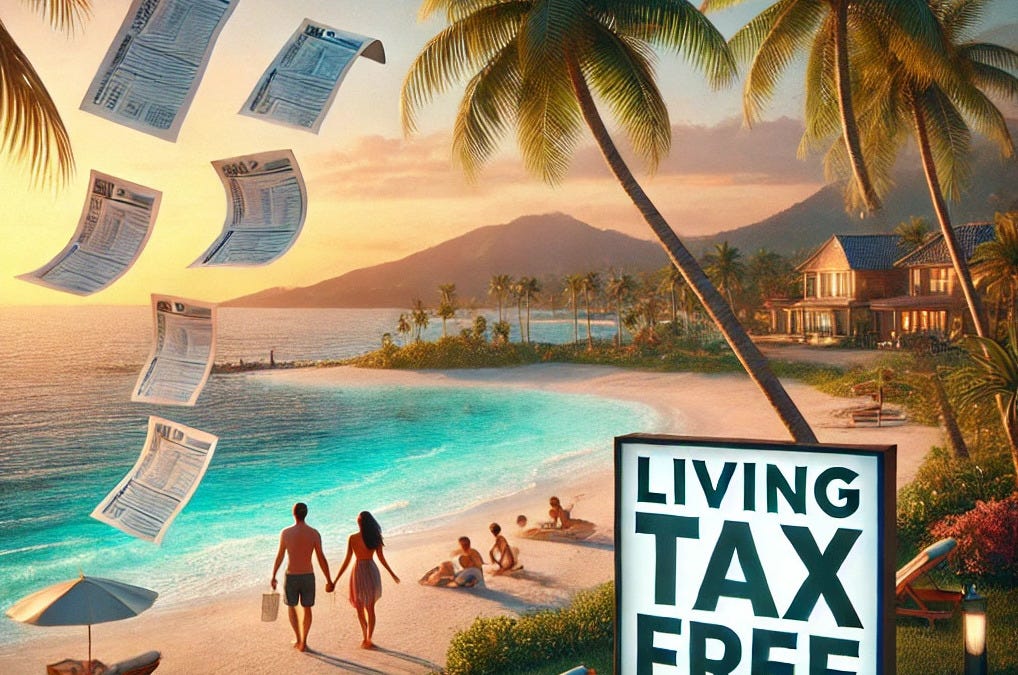
The tax code is built for investors, not W-2 employees. If you reach FIRE and stop working, your W-2 income disappears. Now you're living off long-term capital gains from your portfolio, which are taxed at 0%, 15%, or 20% instead of the ordinary 10-37% income tax brackets. For 2025, the 0% LTCG bracket applies to taxable incomes up to $96,700 for married filers. Add the $30,000 standard deduction, and you could realize $126,700 in capital gains while paying zero federal tax. If you live in Florida, Texas, or Wyoming (no state income tax), you pay nothing to anyone. Most FIRE practitioners obsess over 401(k) contribution limits and tax-deferred accounts. They're optimizing for the accumulation phase while ignoring how they'll actually fund their lifestyle in retirement. The real tax advantage isn't deferral—it's living off assets that qualify for LTCG treatment. Bitcoin holders have an edge here. Dividends count as income, so if you hold dividend-paying index funds, those payments reduce your available room in the 0% bracket. Bitcoin has no yield, so the entire $126k can come from realized gains on bitcoin sales. Tax laws can change, and if you're planning fat FIRE above $125k/year, you'll hit the 15% or 20% brackets. But the structure is there: the tax code rewards people who build wealth through long-term investment and live off capital appreciation. ---
Trey's avatar
trey 2 weeks ago
The tax code is built for investors, not W-2 employees. If you reach FIRE and stop working, your W-2 income disappears. Now you're living off long-term capital gains from your portfolio, which are taxed at 0%, 15%, or 20% instead of the ordinary 10-37% income tax brackets. For 2025, the 0% LTCG bracket applies to taxable incomes up to $96,700 for married filers. Add the $30,000 standard deduction, and you could realize $126,700 in capital gains while paying zero federal tax. If you live in Florida, Texas, or Wyoming (no state income tax), you pay nothing to anyone. Most FIRE practitioners obsess over 401(k) contribution limits and tax-deferred accounts. They're optimizing for the accumulation phase while ignoring how they'll actually fund their lifestyle in retirement. The real tax advantage isn't deferral—it's living off assets that qualify for LTCG treatment. Bitcoin holders have an edge here. Dividends count as income, so if you hold dividend-paying index funds, those payments reduce your available room in the 0% bracket. Bitcoin has no yield, so the entire $126k can come from realized gains on bitcoin sales. Tax laws can change, and if you're planning fat FIRE above $125k/year, you'll hit the 15% or 20% brackets. But the structure is there: the tax code rewards people who build wealth through long-term investment and live off capital appreciation. ---
Trey's avatar
trey 3 weeks ago
Gold was sound money for thousands of years. Fixed supply, global trust, no manipulation. But it had a fatal flaw: it was too slow and too seizeable. When governments needed to override gold's constraints during wars, they just took it. Gold lives in vaults. Vaults can be raided. Fiat solved gold's speed problem but broke its fairness. Suddenly money could move instantly, but only a few actors could create it. Central banks, commercial banks, governments. They printed first for themselves. The result: rampant expansion, distorted signals, and inequality baked into the system. Fiat trained us to think short-term because saving gets punished through debasement. It enabled massive wars and debt cycles. Power centralized in ways that would've been impossible under sound money. But fiat served a purpose. It was the bridge we needed to cross. It bought us time to build global trade, communication, and coordination systems. It got us to the digital age. Now we have something better. Bitcoin restores gold's fixed supply and integrity while delivering fiat's speed. It's self-custodied, permissionless, anti-fragile. The more it's attacked, the stronger it becomes. Bitcoin completes the arc. It doesn't erase the past. It transcends it. ---
Trey's avatar
trey 3 weeks ago
My friend Hal showed me his bank account. $270,000 sitting in cash. Earning 0.00% interest. He's a smart guy with a successful career. But that money is melting away in real-time. Cash is trash. The fiat monetary system requires continuous credit expansion to function. They keep printing more money, which pushes its value toward zero. You see this in rising costs for housing, education, healthcare — things that are hard to supply abundantly. Holding cash means guaranteed losses. Hal's got options: • High-yield savings (3.5%-4.5%) — at least slows the bleeding • Bitcoin yield account (River pays 3.8% in sats) — stack bitcoin while holding liquidity • Stock index funds (VTI averages 8-10%) — liquid, low-maintenance • Real estate — good for some, but illiquid and high-maintenance • Bitcoin — highest growth potential if you can handle volatility I told Hal what I'd do with $270k of toxic cash: turn it into bitcoin by the end of the next business day. He probably shouldn't do that. Zero allocation, no conviction, can't handle the volatility yet. But me? We're at an inflection point in bitcoin's adoption. Any day we could wake up to news that the US government or Meta bought a substantial amount, and the price doubles. When that happens, I don't want cash burning a hole in my pocket. ---
Trey's avatar
trey 3 weeks ago
I see FIRE folks adding international funds to their portfolios for "global exposure." They're paying extra fees and adding complexity while missing what's already there. When you own VTI, you already own the world economy. Apple makes half its revenue overseas. Same with NVIDIA, Google, Meta. The S&P 500 isn't a collection of American companies—it's a collection of global businesses headquartered in America. JL Collins and John Bogle were right about this. US stock funds give you global exposure without the extra risk and fees of international funds. But there's something even better. Bitcoin is the only truly borderless asset. Not tied to any country or economy. No counterparty risk. No management fees eating your returns. Available 24/7 anywhere in the world. You can hold it directly without anyone's permission. The FIRE community figured out that international funds are unnecessary complexity. Time to realize that bitcoin is the simplest global exposure of all. ---
Trey's avatar
trey 3 weeks ago
I see people spending 40 years working toward traditional retirement, missing the point entirely. Your real job isn't your title. It's turning labor into compounding assets that replace your paycheck. The traditional path says work until 65, save in retirement accounts, hope it works out. The FIRE approach flips it: be ruthlessly intentional about spending, stack assets early, let compounding do the heavy lifting. A focused 4-5 year stacking sprint can buy back a decade of your life. The work you do in those first years has exponentially more impact than anything you'll do later. Time-box it. Make it a team plan. Hit the sprint hard, build the compounding machine, then enjoy more of your income while you're young enough to use it. And here's the piece most FIRE plans miss entirely: sovereignty. If you're relying exclusively on stocks and bonds, you're fully reliant on the financial system—holding IOUs gated by intermediaries. SVB was a wake-up call. Boardrooms realized they might not make payroll over a weekend. Bitcoin gives you unilateral control. No intermediaries. No permission required. Even if you're early in the journey, hold some bitcoin you control directly alongside your stock portfolio. Sovereignty is the missing pillar in traditional FIRE.
Trey's avatar
trey 3 weeks ago
The FIRE community's blind spot: over-allocating to tax-advantaged retirement accounts. I see people locking 80% of their wealth in 401(k)s and IRAs they can't touch until 59½ without a 10% penalty plus income taxes. They're optimizing for tax efficiency while destroying optionality. If you retire at 45 needing $60k/year, you need ~$900k in accessible funds just to survive until penalty-free withdrawals. Most FIRE pursuers don't have that balance. These retirement account guardrails were designed for average workers who can't control their spending. If you have the discipline to pursue FIRE, you don't need the government limiting your access to your own money. My approach: capture the employer match, then stack sats in self-custody. Accessible anytime. No age restrictions. No permission required. You don't need guardrails. You need optionality.
Trey's avatar
trey 0 months ago
Hey @primal any issues reported with your LN URL? It seems to be down for me.
Trey's avatar
trey 1 month ago
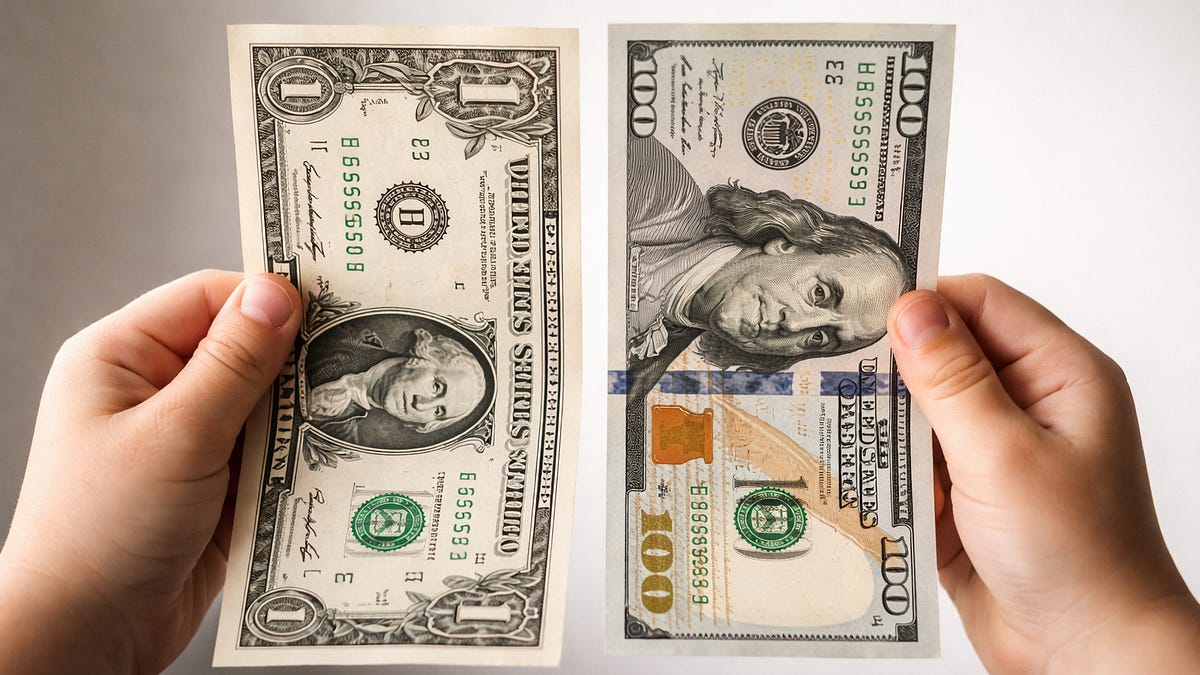
My kids looked at a $1 bill and a $100 bill side by side. Same paper. Same texture. Same material. "Why is one worth more if they're exactly the same?" It's the kind of question that exposes something adults have learned to ignore. We've accepted the premise so completely that we never question it anymore. The answer—and what it reveals about the difference between fiat and bitcoin—is this week's FIRE BTC topic.
Trey's avatar
trey 1 month ago
Controversial take: We need to step back from the emotional framing of the “housing affordability crisis” and look at it through a longer-term, structural lens. Homeownership played an outsized role in wealth creation for prior generations, but it did so under a very specific set of conditions that no longer exist in the same way. When the environment changes, it is a mistake to assume the same strategies must remain optimal. Much of what people perceive as housing “outperformance” is actually the result of leverage and forced savings, not superior returns. Over decades, homeowners inject large amounts of additional capital, accept illiquidity, and take on concentrated risk. When compared honestly, housing succeeded less because it was a great asset and more because it bundled leverage, inflation protection, and lifestyle consumption into a single, default savings vehicle. The decline in housing affordability does not automatically mean future generations are doomed to be poorer. The opportunity set has shifted. Work is more flexible, capital requirements to build businesses are lower, and wealth creation is no longer as tightly coupled to owning physical property. Homeownership still has real personal and lifestyle value, and for many people it will continue to make sense. The mistake is treating it as a financial inevitability or a moral benchmark. The broader point is about adaptation: the rules have changed, and building wealth today requires clearer thinking, flexibility, and a willingness to move beyond models optimized for a different era. I dive deeper into this topic and run the numbers in the most recent issue of FIRE BTC. You can check it out here: Don’t forget to subscribe if you found this interesting. I hit your inbox each week with takes on personal finance and bitcoin.
Trey's avatar
trey 2 months ago
Your brain runs on less power than a dim light bulb—about 20 watts. Yet that tiny energy budget supports a level of cognition that megawatt-scale AI clusters still struggle to match. This contrast reveals a fundamental design principle: The most capable systems are not the ones with the most resources. They are the ones with the best constraints. We see this same divide in the monetary world: 🔸 Fiat Money behaves like a massive AI cluster. It relies on complexity, constant intervention, and brute force scale. It is expansion-driven, mirroring bureaucracy. 🔸 Bitcoin behaves like the human brain. It operates within hard limits, simple rules, and decentralized validation. It is constraint-driven, mirroring biology. One design leads to noise and fragility. The other leads to signal and stability. In my latest piece for FIRE BTC, I explore why nature’s most efficient systems reveal Bitcoin’s deepest strength—and why architecture matters more than energy consumption. Read the full article here:
Trey's avatar
trey 3 months ago
Elon Musk and me have combined pay packages over $1 trillion. Wild.
Trey's avatar
trey 3 months ago
The economy isn’t just unequal — it’s split in two. One side owns assets, leverages credit, and rides the wave of monetary expansion. The other works harder each year just to stand still. That’s the K-shaped economy. And it’s not new — it’s the natural outcome of fiat money. Your future doesn’t have to follow the lower arm. Learn how to climb the upper one 👉
Trey's avatar
trey 3 months ago
They say fortune favors the bold—but it’s deeper than that. Every intentional action we take tilts the odds of our future. Over time, those small ripples compound into a new reality. Bitcoin works in much the same way. It replaces uncertainty with certainty—giving us the foundation to act boldly toward financial independence. This week’s FIRE BTC explores how bold action shapes your universe (and how Bitcoin amplifies it). 👉 Read the full post:
Trey's avatar
trey 4 months ago
Most people don’t have an “emergency fund.” They have a fear fund — cash that melts while inflation compounds against them. In Emergency Economics, I break down why the “safe” choice of holding cash might be your biggest financial mistake — and how to build true resilience through rational, compounding assets instead of fear-based ones. Read it here 👇