Trey's avatar
Trey
tshodl@nostrplebs.com
npub1m6y9...e2p9
Bitcoin + FIRE | Newsletter: firebtc.io | VP Sales @unchained
Trey's avatar
Trey 2 weeks ago
Governments are slow. That's actually an advantage if you're paying attention. The US signed an executive order establishing a Strategic Bitcoin Reserve. El Salvador has been stacking daily since 2021. Bhutan has been quietly mining since 2019. The direction is clear — the question is no longer whether nations will hold bitcoin, but how much and how fast. The part that matters for individuals: by the time a government passes legislation, funds it, builds custody infrastructure, and actually starts acquiring — people who started stacking years earlier have already secured their position at a fraction of the cost. The US has the executive order on paper but hasn't meaningfully acted on it yet. That lag is your window. You don't need congressional approval to build your own strategic reserve. You don't need a committee or a feasibility study. You just need a plan and the discipline to execute it. One approach: match your cash emergency fund with a bitcoin position. If you keep $24,000 in cash reserves, aim to build $24,000 in bitcoin. That gives you a meaningful seed position while you learn the asset and get comfortable with the volatility. Most people who start there end up wanting to keep going. Nations and corporations move slowly by design. Individuals don't have that constraint. — This week only: 21% off annual FIRE BTC subscriptions → firebtc.io/spring26 I wrote a full breakdown of how to build your own bitcoin strategic reserve → firebtc.io/p/build-your-strategic-bitcoin-reserve

Trey's avatar
Trey 2 weeks ago
I'm running my first-ever subscription sale on FIRE BTC this week — 21% off an annual paid subscription. I've published 70+ deep dives on building financial independence with bitcoin as your primary savings vehicle. The paid side is where I get into real portfolio decisions, actual numbers from my own FIRE plan, and the kind of analysis I can only write when the audience is serious about this path. The free posts cover the big ideas. The paid posts are the implementation layer — withdrawal strategies I'm actually using, how I stress-tested my plan through a 75% drawdown, the math behind borrowing against bitcoin instead of selling it, and real-time portfolio moves like buying STRC with borrowed money. If you've been reading the free posts and wondering what's behind the paywall, this is the cheapest entry point you'll get. Annual subscription is normally $80/year. This week it's $63.20 — works out to about $5.27/month. You know why the discount is 21%. Offer runs through April 6. Lock it in here → firebtc.io/spring26
Trey's avatar
Trey 3 weeks ago
21 million. That's the only number in finance guaranteed to never change. Every other variable in your FIRE plan — inflation, interest rates, tax policy, purchasing power — shifts unpredictably. You build a 20-year plan on assumptions that could break next quarter. Bitcoin removes that uncertainty. Fixed supply, proof-of-work security, cryptographic ownership, a decentralized network no one controls. Not promises from a CEO or central bank — mathematical properties enforced by energy and code. When you pair that foundation with consistent action — stacking every paycheck, optimizing spending, staying disciplined through drawdowns — the odds start stacking in your favor. Every dollar redirected, every sat accumulated, every month you hold your line compounds over years into something no spreadsheet could have predicted. Consistent action in a chosen direction creates its own gravity. The people who reach financial independence aren't the luckiest. They saw the path clearly, committed, and let time and math handle the rest. I explore how bold action and bitcoin's certainty compound your FIRE journey →
Trey's avatar
Trey 3 weeks ago
$5,000 today can fully fund a year of your retirement at 95. When you flip the FIRE model on its head — starting from the end of your life and working backward — the numbers get concrete fast. Most people save toward a vague milestone on the horizon. What if instead of building up to retirement, you were buying your life back one year at a time, starting from the end? At 40, assuming $80K/year and a life expectancy of 95, your first dollar funds your final year. Fifty-five years of compounding means ~$5,000 covers it. Each subsequent year costs more as the runway shortens — but the math is surprisingly manageable framed this way. Instead of chasing a moving target, you're closing a measurable gap between today and 95. Every dollar saved pulls that finish line closer to the present. Bitcoin fits perfectly as the long-duration asset you hold longest, giving it maximum runway to compress the timeline. Weaker assets fund early retirement years while bitcoin keeps compounding. Financial independence is the moment that gap disappears completely. I break down the full reverse FIRE model — with the math — in FIRE BTC →
Trey's avatar
Trey 3 weeks ago
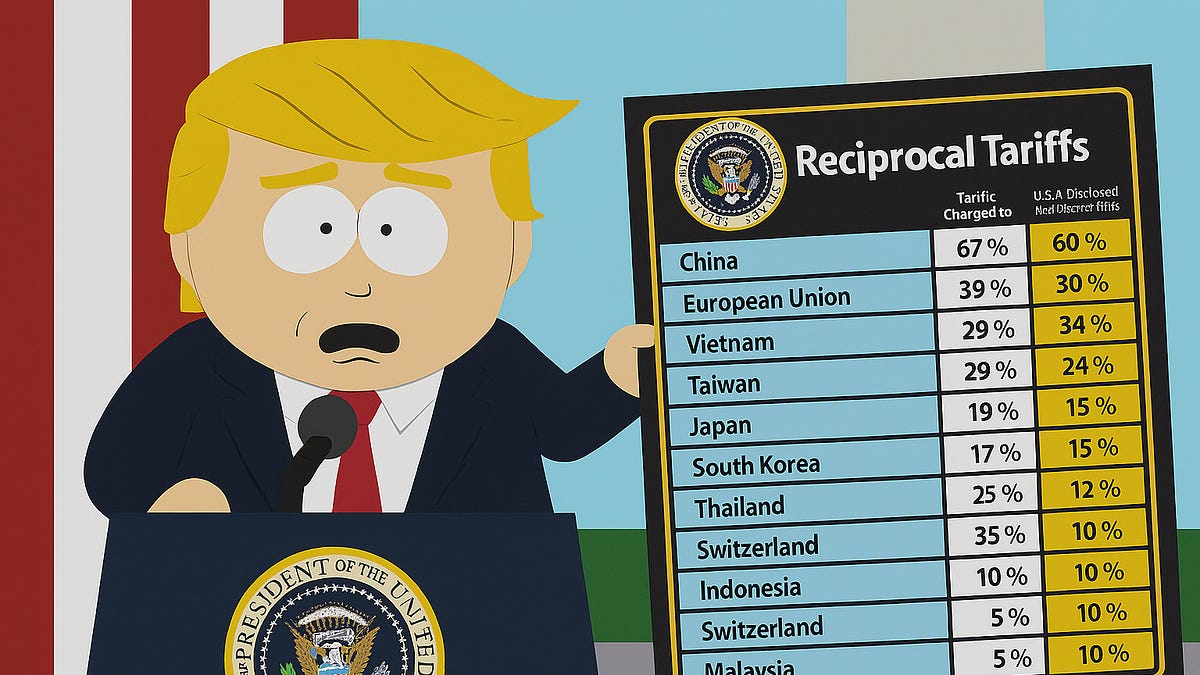
The U.S. has run a trade deficit for 50 straight years. Most people think that's a policy failure. It's actually a structural requirement of running the world's reserve currency. When every country needs dollars to settle trade and hold reserves, the only way to supply them globally is for America to import more than it exports. Economists call this the Triffin Dilemma. This creates a brutal paradox for anyone trying to "fix" the deficit through tariffs. If you actually balance trade, you choke off the global dollar supply — triggering credit crunches, collapsing currencies, and cascading defaults on dollar-denominated debt worldwide. The most likely response to that crisis? More money printing to flood the system with liquidity, exactly like the COVID response. The Triffin Dilemma has no clean exit within the current monetary system. You either run deficits forever or break the global financial plumbing trying to stop. Bitcoin sits outside this trap entirely, and every print-squeeze-print cycle makes that harder to ignore. I unpacked the full Triffin Dilemma and what it means for your bitcoin thesis in FIRE BTC →
Trey's avatar
Trey 3 weeks ago
The FIRE movement has a savings problem hiding in plain sight. You can track every dollar, optimize your tax brackets, max out your 401(k) and Roth, and build a beautiful spreadsheet showing you'll hit financial independence at 42. But all that math rests on one big assumption: the dollars you're saving will hold their value, or that index funds will outrun inflation forever. I moderated a panel at Bitcoin 2025 with Jim Crider, Brian Harrington, and Morgen Rochard on this exact tension. Morgen put it bluntly: FIRE influencers spend their lives tracking every penny and don't even own the right money. A 25x savings goal denominated in a currency that loses purchasing power every year is a plan built on sand. We've confused investing with saving — pouring money into VTI and VTSAX because the money itself is broken, not because these are safe havens. Bitcoin fixes the foundation. It lets you actually save instead of constantly investing just to tread water. If you're already disciplined enough to pursue FIRE, adding bitcoin to your plan completes the picture. Six takeaways from our Bitcoin 2025 panel in FIRE BTC →
Trey's avatar
Trey 3 weeks ago
For every 1% you shift from index funds to bitcoin, your portfolio's total return over 8 years increased by 9.61%. I ran the analysis: $100/week, split between VTI and BTC at various allocations, tracked over two full halving cycles. At 0% bitcoin, index funds do their job. At 10%, the numbers pull away. At 100% bitcoin, the portfolio grew to nearly 7x the all-index version. Same $41,800 contributed — the only variable was allocation. The traditional FIRE playbook says buy VTI and chill. I followed that for years, and it works. But when I examined what bitcoin actually does inside a savings portfolio — fixed supply, global liquidity, adoption-driven appreciation — the math pointed clearly in one direction. Volatility is part of the deal. Bitcoin saw an 84% drawdown during this window, but consistent weekly buys turned those drawdowns into fuel for the long-term outperformance. Your savings rate matters and your time horizon matters, but your allocation decision might matter most of all. I break down the full 8-year data across every allocation level in FIRE BTC →
Trey's avatar
Trey 3 weeks ago
For every 1% you shift from index funds to bitcoin, your portfolio's total return over 8 years increased by 9.61%. I ran the analysis: $100/week, split between VTI and BTC at various allocations, tracked over two full halving cycles. At 0% bitcoin, index funds do their job. At 10%, the numbers pull away. At 100% bitcoin, the portfolio grew to nearly 7x the all-index version. Same $41,800 contributed — the only variable was allocation. The traditional FIRE playbook says buy VTI and chill. I followed that for years, and it works. But when I examined what bitcoin actually does inside a savings portfolio — fixed supply, global liquidity, adoption-driven appreciation — the math pointed clearly in one direction. Volatility is part of the deal. Bitcoin saw an 84% drawdown during this window, but consistent weekly buys turned those drawdowns into fuel for the long-term outperformance. Your savings rate matters and your time horizon matters, but your allocation decision might matter most of all. I break down the full 8-year data across every allocation level in FIRE BTC →
Trey's avatar
Trey 3 weeks ago
🎙️ New podcast episode just went live. I talked with Chris Drzyzga — a 15-year commercial real estate veteran who sold most of his RE portfolio to stack bitcoin. We got into why bitcoin is dethroning real estate as the default store of value, the broken CRE cycle, and his four-pillar framework for bitcoin-native real estate. One highlight: Chris teaching his kids to "save the good money, spend the bad money." That one stuck with me. 🎧 Thursday's newsletter is the companion piece — breaking down the passive income myth in real estate. Free issue, so share it with anyone on the fence about subscribing.
Trey's avatar
Trey 3 weeks ago
Your brain runs on 20 watts — less than a dim lightbulb. Modern AI clusters consume megawatts and still can't match what those 20 watts produce. Architecture under constraint explains the difference. The brain can't request more compute or expand its memory with hardware upgrades. Those hard limits forced evolution to build something elegant: billions of simple components following local rules, fault-tolerant, self-repairing, capable of creativity with almost no overhead. Money follows the same design split. Fiat operates like an AI cluster — central banks, regulators, commercial banks, courts, and political bodies all adjusting levers in real time. Massive institutional overhead producing monetary signals that still get noisy and distorted. Bitcoin operates like the brain. Fixed rules, fixed supply, decentralized validation. No committees reinterpreting policy. A difficulty adjustment that keeps the system balanced regardless of external conditions. The most capable systems have never been the ones with unlimited resources. They're the ones where constraints force elegance. I explore this constraint-driven framework across biology, AI, and money in FIRE BTC →
Trey's avatar
Trey 3 weeks ago
Every time bitcoin rips, my phone lights up with the same question: "How's it going in crypto?" I don't work in crypto. I work in bitcoin. And the gap between the two is enormous. Bitcoin solves a fundamental problem — money controlled by a handful of institutions who debase your savings to fund wars, bail out banks, and expand their own power. It's permissionless, decentralized, and can't be printed into oblivion. Crypto? Solutions looking for problems. NFTs pretending to transfer ownership of infinitely copyable images. DeFi that's neither decentralized nor finance. Tokenized real estate that creates more complexity than it removes. When bitcoin pumps, thousands of altcoins ride its coattails. You'll hear about some kid turning $500 into $5M on a dog coin. You won't hear about the timing required to buy right, sell right, and extract liquidity from a paper-thin market — all while fighting your own greed. FIRE is a low time preference game. Methodical wealth building over time, risk kept to a minimum. Chasing a 1000x on a meme coin is the exact opposite of that. Bitcoin is the signal. Everything else is noise. I break down why bitcoin is the only asset that belongs in a FIRE portfolio →
Trey's avatar
Trey 0 months ago
Gold just crossed $30 trillion in total value — the first asset in history to reach that number. Gold bugs are taking a well-deserved victory lap. But their strongest argument actually works against them. They point to gold's real-world utility — electronics, jewelry, space tech — as proof of its superiority as money. About 50% of gold demand comes from jewelry and 7-10% from industrial use. That means gold's price gets pulled around by consumer spending and manufacturing cycles instead of reflecting pure monetary demand. When prices rise, miners dig faster, expanding supply. Every ounce turned into a necklace or circuit board leaves monetary circulation permanently. The very features gold bugs celebrate are what fragment and dilute its monetary base. Sound money should derive its value from one thing: people choosing to hold it as money. Bitcoin has no jewelry demand. No industrial applications. No competing use cases dragging its price off course. Its supply is fixed at 21 million — no gold rush, no asteroid mining, no technological advance will ever change that number. Gold was the best money the physical world could produce. Bitcoin is what happens when money finally moves at the speed of light. I break down why gold's "utility" is actually its monetary weakness — and why bitcoin's lack of it is a feature → firebtc.io/p/gloating-goldbugs
Trey's avatar
Trey 0 months ago
$100,000 per year in retirement expenses. Under the 4% rule, that means selling bitcoin annually — paying capital gains taxes, shrinking your stack, and reducing the compounding that got you to FIRE in the first place. There's another approach worth understanding: borrow against your bitcoin instead of selling it. A bitcoin-backed loan gives you dollars now while your BTC keeps working. If the price appreciates faster than your interest rate over the loan term, you end up selling less bitcoin at maturity than you would have upfront. The fiat system runs on debt — might as well use it to your advantage. The discipline is in risk management. Keep collateral to a small fraction of your total stack, plan for interest payments and margin calls, and scrutinize your lender's custody model. BlockFi and Celsius showed what happens when you skip that step. Banks are slowly entering bitcoin lending. When they arrive at scale, rates should compress and terms improve. Until then, borrow conservatively and never leverage more than you can reinforce. I break down the full strategy — interest coverage, collateral management, and counterparty risk — in FIRE BTC →
Trey's avatar
Trey 1 month ago
The first 5 years of saving carry more weight than the next 15 combined. Most people spread their effort evenly across a 30-year career, with the same contribution rate at 25 as at 50. Compounding doesn't reward that kind of consistency — it rewards front-loading. The dollars you stack early have decades to multiply, while the dollars you stack at 55 barely keep up with inflation. I think about this as a stacking sprint: a focused 4-5 year window where you get ruthless about spending, automate savings into bitcoin, and track your progress weekly. Not a permanent lifestyle — just long enough to build the compounding machine that generates wealth on your behalf. Two things make this particularly effective with bitcoin. You're stacking an asset with a fixed supply while monetary expansion accelerates around it. And you hold it directly — no intermediary, no permission slip, no bank deciding whether you can access your own money. Compress your effort into the front end and the back end handles itself. A few years of intentional stacking can buy back a full decade of freedom. I go deeper on stacking sprints, sovereignty, and the math behind buying back time →
Trey's avatar
Trey 1 month ago
Scott Adams wasn't the best artist, writer, or businessman. But he stacked all three into a career that made him a multimillionaire. He called it "talent stacking" — you don't need to be world-class at any one thing. You just need to be top 25% at several complementary skills and let the combination do the work. The same principle drives FIRE. You don't need an insane income or superhuman savings discipline. Being reasonably good at both — earning well and deploying capital into bitcoin — compounds into something almost impossible to compete with. Adams' other big idea hits even harder: winners run systems, not goals. A goal says "I need $2M to retire." A system says "I DCA 50% of every paycheck into BTC and let it compound." The goal leaves you failing until you cross the finish line. The system means you're winning every time you execute it. I built my FIRE strategy around this — automatic savings, weekly bitcoin stacking, repeatable processes that don't depend on willpower or market timing. Set up the system once, let it run, and the number takes care of itself. The full breakdown on talent stacking, systems thinking, and where I part ways with Adams on debt and bonds →
Trey's avatar
Trey 1 month ago
In 2018, a Harvard economist went on CNBC and predicted bitcoin would fall to $100. Today it trades above $72,000 — and Harvard's own endowment quietly allocated $100 million to a bitcoin ETF. The pattern keeps repeating: the most credentialed voices in finance dismiss bitcoin, not because they lack intelligence, but because truly understanding it requires questioning the system that built their careers. Central banks, monetary policy, fiat stability — these aren't just topics they study. They're the foundation of their entire professional identity. So when bitcoin works exactly as designed — permissionless, borderless, censorship-resistant — they don't see strength. They see a threat to the worldview that earned them tenure. Meanwhile, adoption moves on two fronts: from the bottom up through individual savers pursuing financial independence, and from the top down through sovereign funds and endowment allocators. The people who built reputations dismissing bitcoin are now managing portfolios that hold it. Reality doesn't wait for academic approval. I break down why the credentialed class keeps getting bitcoin wrong → firebtc.io/p/harvard-humbled
Trey's avatar
Trey 1 month ago
Every decision you make narrows the infinite set of possible futures down to fewer, more favorable ones. Think of it like quantum physics — before you act, every outcome exists simultaneously. The moment you take a deliberate step, you collapse possibilities toward the ones aligned with your direction. I think of this as probability distortion. Bold, consistent action doesn't guarantee outcomes, but it puts a thumb on the scale. Each intentional move — stacking sats, optimizing spending, learning — feeds energy into your chosen trajectory. The compounding happens in your portfolio and your conviction simultaneously. Early actions feel small, but four years of disciplined effort builds momentum that carries you through bear markets and noise. Bitcoin amplifies this because it replaces fiat's ocean of uncertainty with mathematical certainty — a fixed supply of 21 million, proof-of-work security, and unforgeable ownership give you a foundation you can actually build on. Fortune favors the bold, but especially the bold who build on solid ground. I break down the full framework of probability distortion and the stacking sprint →
Trey's avatar
Trey 1 month ago
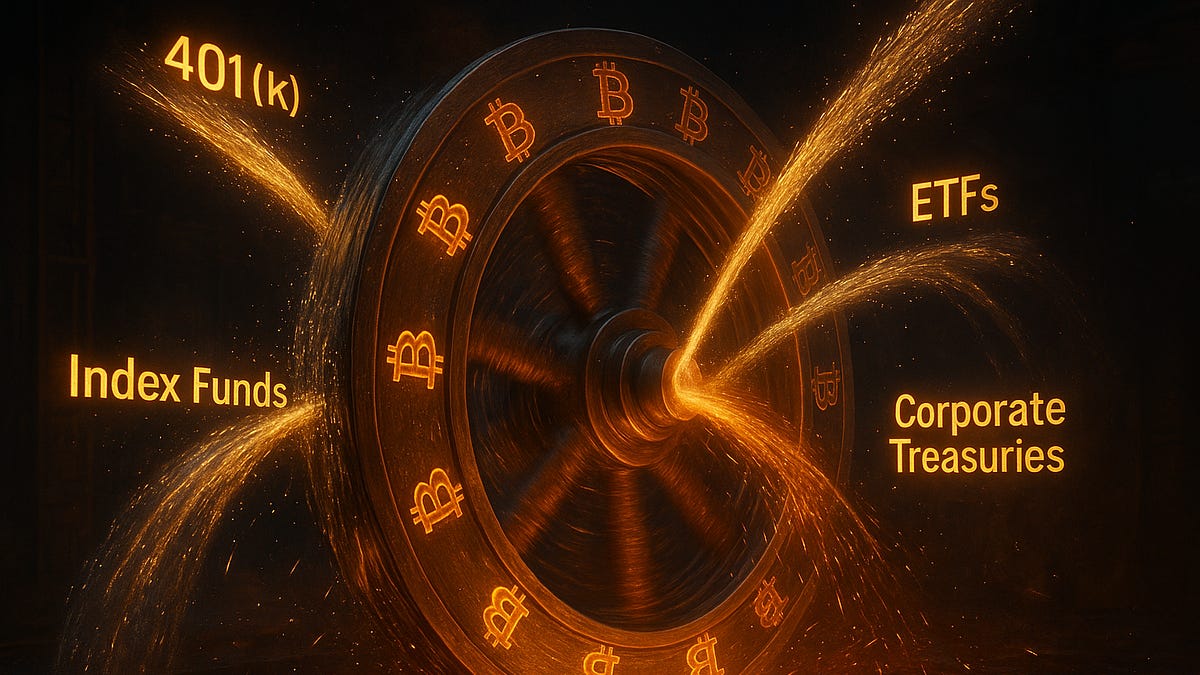
Three S&P 500 companies hold bitcoin on their balance sheets — Block, Coinbase, and Tesla. Strategy could be next. GameStop bought $500M of BTC. If you own index funds, you're gaining bitcoin exposure whether you planned to or not. Every time a public company adds BTC to its treasury, index funds holding that stock absorb bitcoin exposure automatically. Your 401(k), your IRA, your brokerage account — all quietly stacking sats without an active decision from you. This creates a self-reinforcing flywheel: bitcoin rises → these companies grow → they become a bigger piece of the index → more passive capital flows in → they buy more bitcoin → bitcoin rises further. The FIRE community has long dismissed bitcoin while investing heavily in VTI. Now VTI itself is becoming a bitcoin vehicle through the companies it holds. Mr. Money Mustache called bitcoin "stupid" — his portfolio is accumulating BTC exposure anyway. The era where bitcoin required an active choice is ending — now it's flowing into portfolios on autopilot. I break down the passive bitcoin flywheel — how ETFs, 401(k)s, and index funds are making bitcoin adoption automatic →
Trey's avatar
Trey 1 month ago
The Triffin Dilemma explains why the U.S. has run a trade deficit for decades — and why fixing it could trigger the next global financial crisis. Every country needs dollars to trade, which keeps the dollar strong. Strong dollar means cheap imports and expensive exports. The trade deficit is the structural cost of running the world's reserve currency. Trump's tariffs aim to reverse this — close the deficit, bring factories home, and rebuild American industry. But eliminating the trade deficit cuts off the dollars the global economy runs on. Fewer dollars flowing out means a liquidity squeeze — credit crunches, collapsing trade finance, and cascading defaults on dollar-denominated debt worldwide. The likely response is more money printing, bigger deficits, and stimulus — the same COVID playbook. Either the U.S. keeps running deficits to supply the world with dollars, or it fixes the deficit and prints more to prevent a meltdown. Both paths lead to more dollar creation.
Trey's avatar
Trey 1 month ago
Most mornings I spend 10 minutes over coffee running my numbers — cash flow, portfolio value, expenses. A spreadsheet updates my FIRE number with the 4% rule and shows if I'm on track. I don't bother with budgeting apps or tracking every charge. I follow the cash, keep the balance lean, and push the rest into bitcoin. The real story shows up in the trendlines. FIRE folks love to overcomplicate this. Track every purchase to the cent, optimize every loyalty point, stress over every tax scenario. Bitcoiners do the same with on-chain analytics — MVRV, exchange balances, hash rate — as if enough charts will reveal what happens next. Most of that is just spreadsheet theater. It feels productive, but it doesn't actually move you forward. Bitcoin gives you radical financial transparency. You can verify the monetary policy, audit the full ledger, and validate your own wealth with no third party. That system-level transparency is where the real value lives, not in obsessing over which metric to watch.