Trey's avatar
Trey
tshodl@nostrplebs.com
npub1m6y9...e2p9
Bitcoin + FIRE | Newsletter: firebtc.io | VP Sales @unchained
Trey's avatar
Trey 2 months ago
A lot of people still evaluate bitcoin the wrong way. They pick one date on the chart, pick another date a few years later, and declare victory or failure based on the gap between those two points. That only tells you something useful if you bought once, at that exact starting point, and never added another dollar. For anyone pursuing FIRE, that is usually the wrong frame. The real question is what happened to your cost basis if you kept buying the whole time. That is where DCA changes the picture. If you stacked $100 per month from February 2021 through January 2026, you invested $6,000 and ended up with about 0.146 bitcoin. At a $67,000 bitcoin price, that stack is worth $9,779. That is a 63% return, not 18%. Your portfolio lives in your average cost basis, not in somebody else's point-to-point chart comparison. I wrote about why DCA investors are living in a completely different reality than chart-watchers, and why your cost basis matters more than the chart:
Trey's avatar
Trey 2 months ago
The weirdest part of buying lunch with bitcoin wasn't the payment. It was how fast people rushed to tell me I had just spent "$1,000 burger and fries." I went to Steak 'n Shake after they started accepting bitcoin nationwide. The actual experience was the least remarkable part. Tap wallet, scan, done. As seamless as using a card. That's the point. What interested me more was the reaction. A lot of bitcoiners still act like spending sats is uniquely reckless because those sats will be worth more later. But that misses the real tradeoff. The opportunity cost doesn't come from spending bitcoin instead of dollars. It comes from spending at all. Every dollar you burn on consumption is sats you didn't save. The medium changes. The economic reality doesn't. So no, the lesson isn't "never spend bitcoin." The lesson is to be intentional about what you spend, save aggressively, and recognize that medium-of-exchange adoption matters if we want bitcoin to grow from asset to money. I unpacked the Steak 'n Shake experience and the bigger idea here:
Trey's avatar
Trey 2 months ago
One of the easiest ways to stall out on the path to financial independence is to confuse tracking with progress. Running the numbers matters. Obsessing over every tiny variable does not. I track a few things consistently: cash flow, portfolio value, and expected expenses. Thatโ€™s enough to know whether Iโ€™m moving toward freedom or drifting away from it. The trend tells the truth. The extra tabs, edge-case scenarios, and perfect-to-the-penny projections usually just create the illusion of control. FIRE people do this with budgets, tax scenarios, and optimization spreadsheets. Bitcoiners do it with on-chain dashboards, exchange balance shifts, and endless metric watching. Same pattern. More information, not necessarily more insight. The goal isnโ€™t to build the most sophisticated model. The goal is to make better decisions, faster, with less noise. Measure what actually changes behavior. Ignore what just makes uncertainty feel more manageable. I wrote more about this here:
Trey's avatar
Trey 2 months ago
Every bitcoin retirement projection you've ever run is built on a growth rate you made up. 25% felt reasonable, so you plugged it in and let it compound to infinity. I did the same thing for years. The problem is that 25% annually turns one bitcoin into $132 million by 2060 โ€” and while hyperinflation could technically produce that number, it tells you nothing about what it actually buys. Giovanni Santostasi, an astrophysicist, fitted a power law regression to bitcoin's entire price history. It accounts for about 96% of the movement across 15+ years. The key difference from a flat growth rate: it models deceleration. Roughly 39% annual growth in 2026, declining to about 31% by 2030, settling around 15% by 2050. Early adoption is explosive, then the base gets heavier. I built a toggle into the FIRE BTC Compass so you can run your projections under both assumptions. The power law front-loads growth โ€” your first decade of stacking carries disproportionate weight. A flat CAGR treats every year the same. Neither is right, but the shape of the difference matters for when you reach your number. All models will be destroyed eventually. The question is whether they helped you make better decisions while they lasted. This week's FIRE BTC breaks down what the power law means for your FIRE timeline โ†’ firebtc.io/p/all-your-models-will-be-destroyed
Trey's avatar
Trey 2 months ago
The U.S. has run a trade deficit for 50 straight years. Most people think that's a policy failure. It's actually a structural requirement of running the world's reserve currency. When every country needs dollars to settle trade and hold reserves, the only way to supply them globally is for America to import more than it exports. Economists call this the Triffin Dilemma. This creates a brutal paradox for anyone trying to "fix" the deficit through tariffs. If you actually balance trade, you choke off the global dollar supply โ€” triggering credit crunches, collapsing currencies, and cascading defaults on dollar-denominated debt worldwide. The most likely response to that crisis? More money printing to flood the system with liquidity, exactly like the COVID response. The Triffin Dilemma has no clean exit within the current monetary system. You either run deficits forever or break the global financial plumbing trying to stop. Bitcoin sits outside this trap entirely, and every print-squeeze-print cycle makes that harder to ignore. I unpacked the full Triffin Dilemma and what it means for your bitcoin thesis in FIRE BTC โ†’
Trey's avatar
Trey 2 months ago
The FIRE movement has a savings problem hiding in plain sight. You can track every dollar, optimize your tax brackets, max out your 401(k) and Roth, and build a beautiful spreadsheet showing you'll hit financial independence at 42. But all that math rests on one big assumption: the dollars you're saving will hold their value, or that index funds will outrun inflation forever. I moderated a panel at Bitcoin 2025 with Jim Crider, Brian Harrington, and Morgen Rochard on this exact tension. Morgen put it bluntly: FIRE influencers spend their lives tracking every penny and don't even own the right money. A 25x savings goal denominated in a currency that loses purchasing power every year is a plan built on sand. We've confused investing with saving โ€” pouring money into VTI and VTSAX because the money itself is broken, not because these are safe havens. Bitcoin fixes the foundation. It lets you actually save instead of constantly investing just to tread water. If you're already disciplined enough to pursue FIRE, adding bitcoin to your plan completes the picture. Six takeaways from our Bitcoin 2025 panel in FIRE BTC โ†’
Trey's avatar
Trey 2 months ago
Every time bitcoin rips, my phone lights up with the same question: "How's it going in crypto?" I don't work in crypto. I work in bitcoin. And the gap between the two is enormous. Bitcoin solves a fundamental problem โ€” money controlled by a handful of institutions who debase your savings to fund wars, bail out banks, and expand their own power. It's permissionless, decentralized, and can't be printed into oblivion. Crypto? Solutions looking for problems. NFTs pretending to transfer ownership of infinitely copyable images. DeFi that's neither decentralized nor finance. Tokenized real estate that creates more complexity than it removes. When bitcoin pumps, thousands of altcoins ride its coattails. You'll hear about some kid turning $500 into $5M on a dog coin. You won't hear about the timing required to buy right, sell right, and extract liquidity from a paper-thin market โ€” all while fighting your own greed. FIRE is a low time preference game. Methodical wealth building over time, risk kept to a minimum. Chasing a 1000x on a meme coin is the exact opposite of that. Bitcoin is the signal. Everything else is noise. I break down why bitcoin is the only asset that belongs in a FIRE portfolio โ†’
Trey's avatar
Trey 3 months ago
A bear who gives bitcoin a 10% chance of hitting $1M still breaks even buying at $100k. Bump that to 25% and every dollar you invest has an expected value of $2.50. This is Expected Value Analysis โ€” the same math poker players use to make profitable decisions across thousands of hands. It doesn't care whether you win any single bet. It cares about probability ร— payoff, repeated over time. I spent years on a trading floor watching smart people chase certainty in markets that never offered it. The best traders didn't try to be right on every position. They made +EV decisions consistently and let compound math do the heavy lifting. Every major FIRE decision works the same way. Rent or buy? Hold cash or deploy it? Index funds or bitcoin? You can estimate probability-weighted outcomes for each option, and the clarity is worth the exercise. When I run EVA on bitcoin's 10-year outlook, the expected value dominates everything else competing for my capital. I walk through the full framework in one of my FIRE BTC deep dives โ€” poker math, rent-vs-buy, and bitcoin's asymmetry.
Trey's avatar
Trey 3 months ago
Your first 5 years of aggressive saving carry more weight than the next 15 combined. I walked through the math on the Future Signal podcast with Jarrett Carpenter. When you time-box a 4-5 year stacking sprint โ€” cutting expenses with intention, automating bitcoin purchases, tracking your FI number weekly โ€” you build a compounding machine that does the heavy lifting from that point forward. Every $1 cut from monthly spending drops your FI target by $300 at a 4% withdrawal rate. Funnel that into bitcoin while central banks keep expanding the money supply, and you're compounding on two axes: your accumulation rate and the asset's appreciation. Traditional FIRE planning also misses a critical pillar: sovereignty. Stocks and bonds are IOUs gated by intermediaries โ€” SVB showed us that access risk isn't theoretical. Bitcoin in self-custody means no one stands between you and your wealth. I break all of this down in one of my FIRE BTC deep dives โ€” sprint mechanics, sovereignty in practice, and how AI reshapes the path to FI. ๐Ÿ”ฅ
Trey's avatar
Trey 3 months ago
The 4% rule costs you twice โ€” once in taxes on every withdrawal, and again in lost compounding on the assets you liquidated. After a decade on trading floors, I watched institutions sidestep this by borrowing against appreciating assets instead of selling them. Bitcoin makes this strategy even sharper. Borrow against your BTC, get dollars for living expenses, and let the underlying asset keep compounding. If bitcoin appreciates faster than your interest rate, you come out ahead versus selling. But three things need to be locked in before you borrow: A plan for interest payments โ€” whether from side income, portfolio dividends, or a portion carved from the loan proceeds upfront. A collateral buffer โ€” never pledge your full stack. Start when 5% of your holdings covers the loan requirement, with another 5% in reserve for drawdowns. A custody arrangement you actually trust โ€” BlockFi, Celsius, and Genesis proved what happens when you skip due diligence on your lender. I broke down the full math, collateral strategies, and counterparty risks in this week's FIRE BTC newsletter.
Trey's avatar
Trey 3 months ago
Could your bitcoin portfolio survive the next bear market? I just shipped a new tool inside the FIRE BTC Compass: the Bear Market Stress Test. It takes your actual portfolio and runs it through real historical bear markets โ€” 2017-2018 and 2021-2022 โ€” month by month. Then it calculates the maximum monthly withdrawal you could take and still survive all scenarios over 30 years. The answer might surprise you (in a good way). Try it free: calc.firebtc.io
Trey's avatar
Trey 3 months ago
Every time bitcoin hits a new high, my phone lights up. Same question every time: "Am I too late?" I've been buying bitcoin since 2014. I've bought at $400, at $20,000, at $60,000, and at $100,000. My DCA runs every week regardless of price โ€” same as Michael Saylor, who has bought at nearly every price level on the chart. The anxiety around buying usually comes from treating it like a trade instead of a savings strategy. When you're building a FIRE portfolio, you're accumulating an asset over years โ€” same approach you'd use with stocks. An automated DCA removes the emotional guesswork. You buy the highs, the lows, and everything in between. Over a multi-year horizon, the entry price on any single purchase barely registers. For a larger sum, my approach is simple: deploy half immediately, spread the other half over 8 weeks. You won't love the timing, but you'll always prefer it to sitting on your hands. Getting off zero is the hardest step. Once you take it, the rest is just consistency.
Trey's avatar
Trey 3 months ago
Every January, millions of people resolve to hit the gym and eat better. Almost none of them make a plan for their money โ€” the one thing that actually determines whether they work until 65 or walk away at 45. Last year I put together 21 bitcoin + FIRE resolutions. Every single one still applies in 2026 โ€” and a few are even more urgent now. Automate your DCA. Increase your bitcoin allocation. Upgrade to multisig if your stack has grown. Set up a succession plan so your family can actually access your bitcoin if something happens to you. A few of these might surprise you. One is about training yourself to spend money โ€” a real challenge for FIRE people who've spent years optimizing savings. Another: hold zero dollars. If bitcoin is your primary savings vehicle, why keep a balance in something that loses purchasing power every year? Tools like Fold, Strike, and River make it practical to run your financial life entirely on bitcoin rails. 21 resolutions because 21 million is the cap. Pick the 5 that match where you are, execute them consistently, and finish 2026 in a fundamentally stronger position.
Trey's avatar
Trey 3 months ago
Every time bitcoin runs, the DMs start. Friends, family, coworkers who've been watching from the sidelines finally deciding to make a move. The question is always the same: how do I actually do this? Stop trying to time it. You're almost certainly going to buy right before a 30% drop โ€” that's just how it goes. And if you wait, the price runs another 30% and you're stuck with the regret of inaction. There's no clean entry. Here's the playbook I give everyone: Get off zero first. Even $100. The shift from "bitcoin observer" to "bitcoin owner" changes how you engage with it. You'll watch more closely, learn more, build conviction. Set up an automated DCA. Divert a slice of what you're already saving toward bitcoin each week or month. You'll buy the highs, the lows, and everything in between โ€” exactly what Michael Saylor does. If you have a lump sum, buy half immediately and DCA the rest over 8 weeks. Gets you in the game while preserving flexibility to benefit from dips. No perfect entry point exists. But there is a formula that works.
Trey's avatar
Trey 3 months ago
Your brain runs on 20 watts and outperforms entire AI data centers drawing megawatts. The difference isn't power, it's architecture. Constraint-driven systems (the brain, bitcoin) evolve simple mechanisms that scale gracefully. Expansion-driven systems (AI clusters, fiat money) improve through brute force, more infrastructure, more bureaucracy, and more fragility. Bitcoin applies the same design principle nature discovered long ago: fixed rules, decentralized verification, no committees. The most capable systems aren't the ones with the most resources. They're the ones with the best constraints. ---
Trey's avatar
Trey 3 months ago
FIRE isn't an on/off switch. It's a spectrum, and you're probably further along than you think. The traditional framework gives you a handful of labels โ€” Lean FIRE, Barista FIRE, Coast FIRE, Fat FIRE โ€” but no logical order, no clear progression, no way to know where you actually stand. They emerged piecemeal, with blurry definitions and a lot of overlap. I wanted something cleaner, so I built the FIRE Spectrum: nine levels, each anchored to a single number โ€” how much of your annual expenses your savings portfolio can currently support. At Level 4 (10-15x expenses), you can downshift work, take a lower-stress job, stop grinding just to keep the lights on. Level 6 means your future retirement is mathematically locked in, even if you never save another dollar. Level 7 is full FIRE โ€” your current lifestyle funded indefinitely. The point of the spectrum is that you stop waiting for a finish line and start noticing the meaningful improvements you're already living. Each level up is real and tangible. Less stress, more choice, better options at every stage. Figure out your multiple. I walk through all nine levels and what each one unlocks in this week's issue.
Trey's avatar
Trey 3 months ago
Dividend stocks feel like free money. They're not. When a company pays a dividend, its stock price drops by the same amount on the ex-dividend date. The cash moves from the company's account to yours. Total return is unchanged โ€” you've just received it in a less tax-efficient form, with the IRS taking a cut whether you reinvest or not. SCHD vs. VTI from the end of 2019 through December 2024: SCHD returned 69% total. VTI returned 93%. That 24-point gap compounds over a 15-20 year accumulation phase into years of extra saving required to reach your number. Bitcoin gets dunked on constantly for not paying a dividend. But bitcoin isn't a company โ€” it doesn't have earnings to distribute. It's monetary. Its yield is purchasing power growth. Criticizing it for not paying dividends is like criticizing gold for not filing quarterly earnings reports. For anyone still in the accumulation phase, the goal is maximizing total return to reach financial independence faster. Dividends don't do that. They deliver returns in a less efficient package.
Trey's avatar
Trey 3 months ago
Say there's a 25% chance bitcoin hits $1M in 10 years and a 75% chance it goes nowhere. At ~$65K today, $1,000 buys you a 15x if it hits. Run the expected value: (25% x $15,400) + (75% x $0) = $3,850. You're paying $1 for nearly $4 in expected value. With deep skepticism already priced in. Expected Value Analysis is how poker players and professional investors make decisions under uncertainty. Every choice is a bet โ€” the goal isn't winning every hand, it's making sure the payoff when you're right dramatically outweighs the loss when you're wrong. Apply it to bitcoin, real estate, career moves, portfolio allocation. The math clarifies everything.
Trey's avatar
Trey 3 months ago
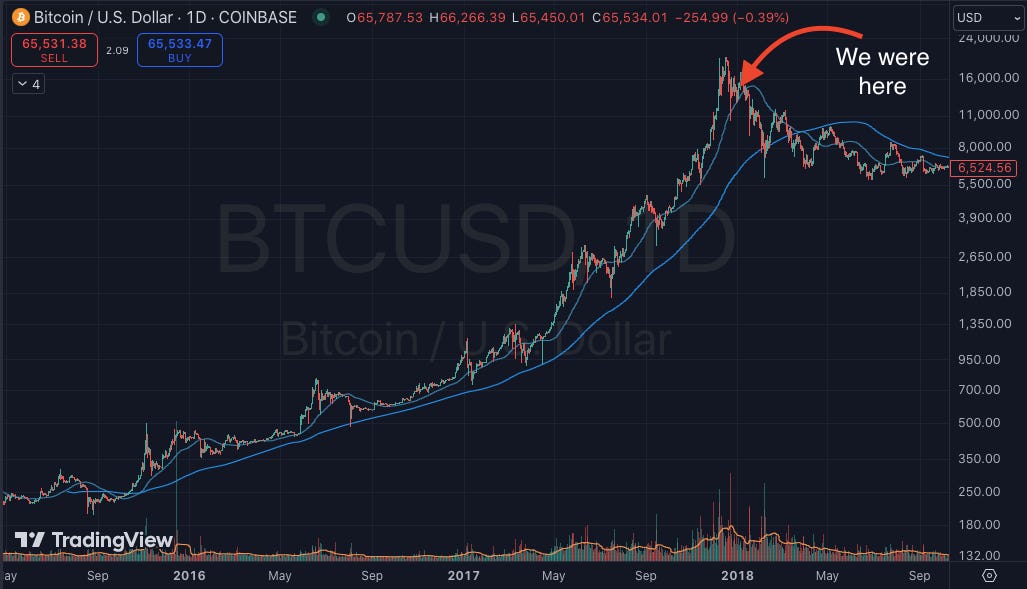
In January 2018, Mr. Money Mustache โ€” one of the godfathers of the FIRE movement โ€” published a piece called "Why Bitcoin is Stupid." Bitcoin was trading around $14,000 at the time. I was late too. First heard about bitcoin in 2011 at $10. Bought a little in 2014. Didn't get serious until 2018. The opportunity cost of not paying attention earlier is staggering. Bitcoin looks dumb at first. Fixed supply. No CEO. No customer service. Doesn't care who you are or what your government thinks. You can't lobby it, inflate it, or shut it down. That's the whole point. Bitcoin is simple by design โ€” no moving parts, no politics, no exceptions. It just runs. The FIRE community understood index fund DCA before anyone else. Same discipline, same time horizon, same conviction that compounding wins. The only difference is the asset. Skepticism has an expiration date. At some point it stops being prudent and starts being expensive.
Trey's avatar
Trey 3 months ago
The goal of FIRE isn't to stop working. It's to stop working for someone else. Kane McGukin of The Mesh Point wrote a guest piece for FIRE BTC built around a simple reframe: don't retire, re-tire โ€” put on fresh treads and do work you actually want to do. "Retire" comes from the Old French for "to withdraw." That etymology is worth sitting with, because it reveals what most of us have unconsciously adopted as the goal: not freedom, but withdrawal from productive life. The aim of a 40-year career is to eventually cease. Kane has spent his career working with wealthy clients. Very few just stop when they reach retirement. They either arrive with a project already lined up, or take a short break and dive back in. The golf and the travel get old quickly. Then they need something real to work on. Humans are built for work โ€” not wage labor, not performing for someone else's agenda, but building and creating and solving things that matter. The sovereign wealth crowd talks a lot about exit: exit the banking system, exit fiat, exit the permission layer. All correct. But exit isn't the destination โ€” it's the door. What you walk through it toward is the actual question. Financial independence buys freedom from obligation. The work doesn't stop. It just finally becomes yours to choose.
โ†‘