
Your FIRE plan can work perfectly on paper and still fail when you need access to your money.
FIRE planning focuses on savings, diversification, taxes, sequence risk, and withdrawals. But a sufficient balance doesn't guarantee control. If every asset sits behind a bank, broker, plan administrator, or custodian, each withdrawal still depends on an institution processing your request.
Usually, that arrangement works. This isn't a claim that the financial system is always hostile. The more ordinary risk is a transfer hold, compliance review, false fraud flag, trading restriction, or account closure arriving at the wrong moment. A low-probability access problem can still do real damage when your plan depends on timely access.
Self-custodied bitcoin addresses that specific gap. When you hold the keys, access to that portion of your wealth doesn't depend on a bank or broker granting permission. Bitcoin held through an exchange or ETF doesn't offer the same protection because a custodian remains in the middle.
You don't need to move your entire portfolio onto a hardware wallet. Start by mapping who controls access to each major asset, then decide whether keeping a deliberate portion outside the permissioned system improves your plan.
For years, the most expensive shoes I owned cost about $100.
Then I spent around $800 on a pair of Ferragamos. I loved them and could easily afford them, but the purchase still felt wasteful.
Years of saving had built one muscle. Buying the shoes forced me to flex another: using the money once I had enough.
FIRE gives us a clear playbook: save, invest, and let compounding work. But when the portfolio is doing most of the work, another invested dollar may add less to your life than using it while the opportunity still exists.
Ground that permission in a plan. Know how many years of expenses your portfolio could cover without growth. Keep the flexibility to earn more or cut expenses.
Then weigh financial risk against expiration risk. The money for a family trip may still exist in 20 years. This version of your family won't. Bitcoin makes every expense's opportunity cost visible, but bitcoin is money, and money is a tool.
If spending still feels wrong, start with a bounded $50 or $100 purchase you genuinely want. Notice what creates real enjoyment. Build the spending muscle with the same intention you used to build the saving muscle.
Protect the future, then use some of the freedom you built while you can:

The $800 Shoes That Changed How I Think About FIRE
FIRE BTC Issue #88 - Financial independence isn't complete until you can use the freedom you've built.
Buying shares in a bitcoin treasury company isn't the same as buying bitcoin. You're buying a corporate-finance vehicle built around bitcoin, and the wrapper can change your result.
Start with entry price. If the company trades above the value of its bitcoin holdings, bitcoin can rise while that premium compresses. If the company trades at a discount, closing that gap can add to your return. Either way, the stock has a second moving part beyond bitcoin's price.
Then look at the capital structure. Debt, preferred stock, and convertibles give other investors claims ahead of common shareholders. A long drawdown can let financing costs grind away at common equity, while restrictive debt or collateral terms can create something worse: forced bitcoin sales near the bottom. Good management may use the same tools to add bitcoin per share, but that outcome depends on execution rather than the asset alone.
So don't stop at “I’m bullish on bitcoin.” Before buying the stock, compare the company's market value with its bitcoin holdings. Then list every senior claim, its cost, and the conditions that could force a sale. If you can't explain how the wrapper behaves during a deep drawdown, you haven't finished analyzing the investment.
Financial independence can feel like a distant number, but the first useful input is sitting in your bank and credit card statements. You need to understand what your life actually costs.
Every recurring expense affects the plan twice. It leaves less income available to save and invest today, and it increases the portfolio value required to support your lifestyle later. That’s why intentional spending has more leverage than a generic budget exercise. You’re defining both your current savings capacity and the future your assets will need to fund.
Start with one month of spending. Review it line by line and separate what genuinely supports your life from what no longer deserves a recurring claim on your income. The goal isn’t to strip away everything you enjoy. It’s to make the tradeoff visible, choose deliberately, and set a savings rate you can sustain.
Once you know your expenses, financial independence stops being a vague ambition. You have a real input for your portfolio target and a practical way to start moving toward it.
Using AI inside the same old workflow may make a task faster, but it doesn't create much leverage.
The bigger opportunity is to redesign the work so an agent can handle a bounded step without forcing a human to supervise every move. That requires more than a prompt. The agent needs current context and clear access. Its output needs an objective check. A failed change needs a rollback path, and exceptions need an explicit route back to a person.
Software is a natural place to start because code can often be tested, versioned, monitored, and reversed. The same logic can apply elsewhere, but only when the work is digital, repeatable, verifiable, and safe to undo. Work involving money, trust, or safety deserves tighter limits and human ownership.
Choose one low-risk, repetitive process. Before delegating it, write down what success looks like, how the result will be checked, how a mistake will be reversed, and when a human must step in. If you can't answer those questions, another AI tool won't fix the operating model.
You can save $100 every week for eight years and build two radically different FIRE portfolios depending on what you buy.
I ran that comparison with VTI and bitcoin: 418 weekly contributions, $41,800 total, and BTC allocations ranging from 0% to 100%. Over that period, the 100% bitcoin portfolio grew to almost seven times the size of the 0% bitcoin portfolio. In the analysis, every one-percentage-point increase in bitcoin allocation added 9.61% to total return.
The extra return came with a real cost. Bitcoin fell 84%, 72%, 55%, and 77% during four major drawdowns in the same eight-year window. Consistent weekly buying softened the portfolio-level decline, but it didn’t remove it. In the first drawdown, for example, a portfolio allocated 75% to BTC and 25% to VTI declined 71% while bitcoin fell 84%.
Your distance from financial independence changes the decision. Early in accumulation, a deep correction lets each $100 contribution buy more bitcoin. Near your FI number, the same correction can delay retirement or create sequence-of-withdrawal risk. A higher bitcoin allocation accelerated this historical path to FIRE, but the allocation still had to survive the drawdowns.
See the full allocation comparison and drawdown analysis:

🚀 Supercharge Your FIRE Journey
FIRE BTC Issue #4 - How bitcoin can help you reach FIRE faster
A debt-heavy government has a strong incentive to keep Treasury markets functioning when recession or bond volatility threatens the financing system.
That can make policy support feel like proof that the danger passed. It may only mean the risk moved. Liquidity facilities, asset purchases, or regulatory relief can stabilize funding and support asset prices, while the cost shows up elsewhere through inflation, currency weakness, more leverage, or deeper dependence on the next intervention.
This doesn't mean policymakers can prevent every recession, and it doesn't mean bitcoin or any other scarce asset is guaranteed to rise. Incentive isn't capability, and a long time horizon doesn't erase entry-price, custody, concentration, or liquidity risk.
For anyone building toward financial independence, the threat is mistaking managed stability for durable safety. A resilient plan shouldn't require officials to get every tradeoff right. Keep enough liquidity to avoid forced selling, limit leverage, and hold assets for reasons that still make sense when the policy response arrives late or fails.
If you ask me how much bitcoin you need to retire, the first number I want isn't your bitcoin balance.
It's your annual expenses.
At $80,000 a year, the traditional 25x baseline is roughly $2 million. At $150,000, it's $3.75 million. Those numbers define what the portfolio must support, but they don't finish the calculation.
The second input is your liquid investment portfolio. I wouldn't count primary-home equity unless you plan to sell or borrow against it; it doesn't directly pay your expenses.
The third input is bitcoin as a percentage of liquid assets. A $2 million portfolio with 5% bitcoin has a very different risk profile, upside, and withdrawal-order problem than the same portfolio with 70% bitcoin.
From there, you can separate the portfolio into sleeves: use a 4% lens for traditional assets and an 8% planning lens for bitcoin. The 8% lens isn't a guarantee or a whole-portfolio withdrawal rate. It only becomes useful when cash, traditional assets, income, or spending flexibility can keep you from selling bitcoin into a 70% drawdown.
So how do you combine those three inputs into a target—and keep an early drawdown from forcing you to sell your best asset at the worst time?
Read the full planning framework:

🧭 How Much Bitcoin Do You REALLY Need to Retire?
FIRE BTC Issue #76 - A Bitcoin 2026 panel recap, plus the planning framework I wish we had more time to unpack on stage.
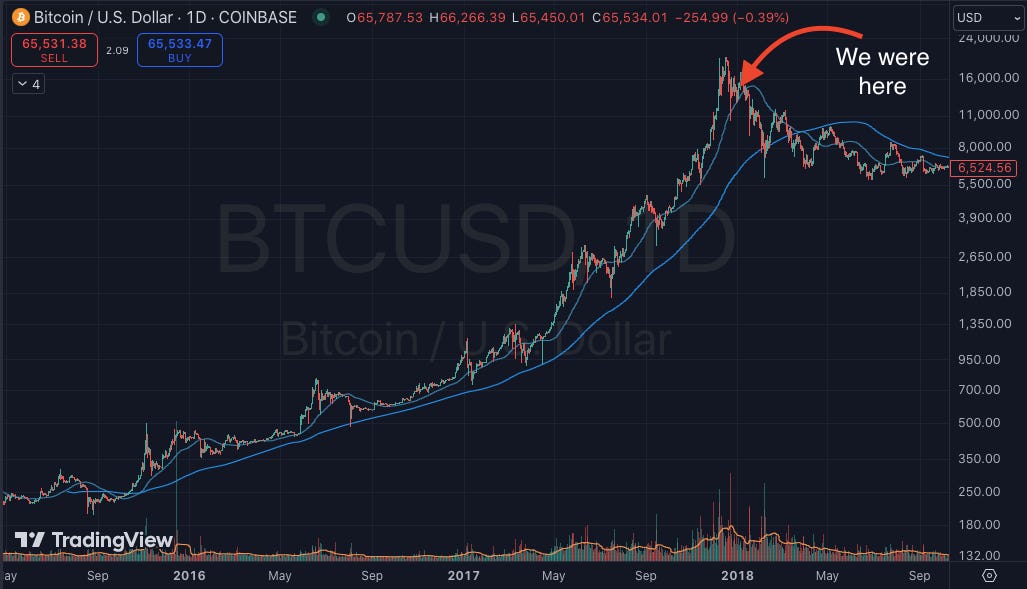
January 2, 2018. Bitcoin had just run from $200 to $20,000 in a few years, and Mr. Money Mustache published “Why Bitcoin is Stupid.”
I understood the skepticism. Bitcoin looks ridiculous before you understand the problem it solves. I first heard about it around $10 in 2011. I bought a little in 2014, stopped, and watched. It took me until 2018–2019 to do the work and start consistently buying. By my estimate, that delay cost me millions (tens of millions?). Many such cases.
What changed my mind was the part that looks stupid: bitcoin is deliberately limited. There will only ever be 21 million. No committee manages the supply. The same rules apply to everyone, from presidents to proletarians.
That simplicity matters for FIRE. In 2019, stock market index funds were my primary savings vehicle and bitcoin was a secondary DCA. As my understanding grew, bitcoin overtook index funds. My aspirational 10-year path to FIRE became reality in less than five.
Bitcoin's refusal to bend is the feature. It turned “magic internet money” into a savings tool I could build a serious financial-independence plan around.
Read how bitcoin's fixed rules changed my FIRE strategy and what made the idea finally click:
Why Bitcoin is Stupid
Issue #1
If you’re pursuing FIRE because you want more control over your days, the goal isn’t merely to retire early or reach a larger portfolio number. The deeper goal is to create an overlap: enough money, enough control of your time, and enough energy to use both while the possibilities are still open.
The traditional timeline often separates those resources. You spend your capable working years trading time for money, then hope to reclaim your days at a conventional retirement age. The balance sheet may improve, but the years and energy spent building it can’t be restored later.
FIRE gives saving and investing a more useful purpose. They’re tools for moving that overlap earlier, whether that eventually means working less, changing careers, building something of your own, or simply being more present. Bitcoin can support the plan by protecting purchasing power, but the asset isn’t the destination. The destination is greater ownership of how you spend a finite life.
So look beyond your FIRE number. Ask whether your next financial move brings money, time, and energy closer together—or grows one by spending down the others.
Last year I presented bitcoin to the CEO and CFO of an S&P 500 company. The engineer CEO saw quantum computing as a major blocker for himself and the company’s balance sheet.
Google published a paper and “Google cracks bitcoin in 9 minutes” became the headline. The paper described a hypothetical machine that doesn’t exist, attacking math bitcoin mining doesn’t use.
Bitcoin uses signatures, not encryption. A powerful enough quantum computer could derive a private key from an exposed public key. It wouldn’t decrypt the network or crack every coin at once.
Today’s best-known machines have roughly 1,000 physical qubits. Google estimates an attack would need fewer than 500,000. The largest number factored with Shor’s algorithm is still 15.
Exposure depends on your address. Reused and Taproot addresses reveal public keys. A single-use SegWit address hides the public key until you spend, leaving an attacker roughly one block to act. Fresh addresses reduce avoidable risk while developers build post-quantum defenses.
Tail risks belong in a FIRE plan, but they don’t automatically invalidate the asset. Understand the threat, hedge what you can, and count the opportunity cost of staying out.
See what quantum actually threatens and what to do now:

🐱 Schrödinger's FUD
FIRE BTC Issue #74 - Is quantum computing a threat to bitcoin?
Buying bitcoin for the first time can feel like a decision between staying at zero and making a major allocation. It isn’t.
Your first purchase doesn’t need to express your final conviction. Its job can be much smaller: turn bitcoin from an abstract debate into something you’re motivated to understand.
Start with an amount small enough that normal volatility won’t materially disrupt your plan. Even $100 can be enough to cross that first psychological barrier, though the right amount depends on your situation. Once you own a little, pay attention to the asset, its price swings, and your own reactions. Learn before you increase the allocation.
If that understanding becomes conviction, an automated dollar-cost averaging plan can help you accumulate consistently instead of waiting for the perfect entry price. If it doesn’t, you haven’t forced a large decision before you’re ready.
You don’t need to go from zero to all-in. Take one measured step, learn from it, and let the size of your commitment follow the quality of your understanding.
A rising dollar chart can make almost any long-term trend look healthy. The harder question is what those dollars can buy.
Lyn Alden’s chart of U.S. GDP denominated in ounces of gold makes that measurement problem visible. Dollar GDP may rise over time, but divide it by the gold price and the line becomes far more volatile, with major peaks and collapses across the last century. Changing the denominator changes the story.
That doesn’t mean gold-denominated GDP is the one true measure of economic progress. Gold has its own cycles, and this chart reflects changes in both U.S. output and the price of gold. But it does expose a weakness in relying on a dollar number alone: the unit being used to measure growth is also changing in purchasing power.
You can apply the same test to claims about your salary, portfolio, or net worth. Compare the dollar trend with gold or a basket of expenses that matters in your actual life. If the apparent progress disappears when you change the denominator, you’ve learned something important about the dollars—and about your plan.
Real estate is worth roughly $393 trillion—nearly 18 times the value of all the gold ever mined.
Some of that price pays for shelter and useful space. But some is monetary premium: wealth parked in property because savers had few credible alternatives.
That matters when you're building a FIRE plan. Your home provides utility. A rental is an operating business wrapped in an illiquid, leveraged asset.
The sales pitch focuses on “passive income.” The reality includes financing, tenants, vacancies, repairs, and repeating the process to turn $100 or $200 of monthly cash flow into something meaningful. Much of the wealth comes from tenants paying down the mortgage, yet that equity stays locked behind a sale or new loan.
Rentals can work for someone with capital, experience, and an appetite to run the business. They're dangerous when a new investor mistakes leverage for easy returns and cash flow for passivity.
Bitcoin and index funds offer a different tradeoff: no tenants, far more liquidity, and the ability to sell a small amount without unloading an entire property. Before buying a rental for FIRE, decide whether you actually want the business—not merely its story.
Read the full analysis:

🏘️ The Passive Income Myth in Real Estate
FIRE BTC Issue #70 - What real estate investors won't tell you — and what a $300M CRE broker told me instead.
Financial independence has a creative payoff that gets far less attention than early retirement: it can become a commission you give yourself.
Artists, musicians, physicians, and other professionals often face the same constraint. The work they want to master may not produce enough income right away, so immediate expenses keep deciding how they spend their time. FIRE changes that equation. Intentional spending and aggressive saving can build a reserve that supports your life while your craft develops. For me, bitcoin can be part of that reserve.
The result isn't a life without work. It's the ability to choose work for mastery, usefulness, or meaning without requiring every hour to pay immediately. You can practice longer, take a thoughtful risk, or pursue a project whose value arrives later.
That is a more compelling picture of financial independence than endless leisure. You're building enough ownership over your time to become your own patron. The portfolio matters, but the transformation is what the portfolio makes possible.
A 40% bitcoin drawdown can turn a FIRE plan into forced selling fast.
You can stack for years, hit your number, leave the paycheck, then watch bitcoin fall 75-85% while the mortgage and grocery bills keep coming. Conviction doesn't cover expenses. A withdrawal plan does.
The 4% rule tells you to save 25 times your annual expenses, but it was built from stock-and-bond history. Bitcoin has routinely suffered deeper drawdowns, and every dollar of spending requires selling part of the asset. That makes sequence-of-returns risk especially dangerous near retirement.
I ran a $1.5 million portfolio with $100,000 in annual expenses through historical bitcoin bear-market patterns. Under the model's assumptions, 100% bitcoin supported $111,816 a year. A 50/50 bitcoin-stock mix supported $195,216. The blended portfolio didn't win because stocks had the better expected return. It won because stocks were sold first, giving bitcoin time to recover instead of forcing sales near the bottom.
That buffer has a cost: less bitcoin means giving up upside when the bear never arrives. Your answer depends on your timeline and flexibility. Index funds, cash, yield instruments, lower spending, or temporary income can all build a bridge through the danger zone.
Stress-test your own bear-market bridge:

🐻 Surviving the Bear
FIRE BTC Issue #69 - What the 4% rule gets wrong about bitcoin — and how to plan for it anyway
A FIRE plan can look diversified while still making one giant bet: that the dollar and Treasury market will remain stable at the same time.
Luke Gromen's argument is that high debt and persistent deficits narrow that path. If policymakers defend the dollar with tighter money, higher yields can strain Treasury financing. If they suppress yields to keep the bond market functioning, they risk weakening the dollar's purchasing power. The exact timing is unknowable, but the tradeoff matters now.
This changes how I think about safety. Cash is exposed to purchasing-power loss. Long-duration bonds are exposed to rising yields. Stocks can be exposed to both through valuations and liquidity. Calling all three diversified doesn't remove the shared policy risk.
You don't need to predict the Fed's next move. You do need to know which part of your FIRE plan fails under each choice. Real resilience comes from holding assets with different monetary exposures and keeping enough flexibility that one policy decision doesn't own your future.
Michael Saylor spent years telling people never to sell bitcoin.
Then Strategy sold 32 BTC, and the internet briefly treated it like a philosophical crisis.
The scale tells a better story. Strategy held 843,738 BTC before the sale, so it sold just 0.003793% of its stack—roughly one bitcoin for every 26,367 it owned. The sale raised $2.5 million, about 1% of a $200 million-plus preferred dividend obligation. Meanwhile, Strategy raised $128.3 million by issuing MSTR and had a $900 million USD reserve.
This wasn't a cash emergency. Strategy was showing institutions that bitcoin could support STRC and its other preferred instruments. It was one funding lever among several.
The household version is simpler. A FIRE portfolio exists to fund your expenses and freedom. You can earn more, spend less, use cash, borrow, or sell. Borrowing preserves bitcoin upside but adds interest, repayment, and margin-call risk. Selling can be cleaner.
I still think bitcoin should be the last asset sold, but last does not mean never. If selling some bitcoin keeps your family stable or buys the freedom you saved it for, the stack is doing its job.
Read the full breakdown and pressure-test what “never sell” means in your own FIRE plan:

🪙 Saylor Sells Some Sats
FIRE BTC Issue #80 - Why Strategy's tiny bitcoin sale was performative, not necessary.
Bitcoin’s role in an AI economy may be much larger than digital gold.
Eric Jackson’s argument is that autonomous software will eventually do a meaningful share of buying, selling, and negotiating. Those agents will need payment rails, but they may also need collateral: an asset lenders can verify, value, and lend against without waiting for a bank to open.
Bitcoin fits that requirement unusually well. Its supply is fixed, and its holdings and transfers can be verified digitally across the same internet-native economy the agents inhabit. If the thesis is right, bitcoin won’t only sit in savings accounts as protection from debasement. It could secure credit used by machines and businesses conducting everyday commerce.
This is still a long-range thesis, not a reason to borrow against your stack today. The lending markets, custody, volatility, and liquidation risk all have to work in the real world. But it changes the question worth asking. Instead of only asking how much gold bitcoin could replace, ask how much economic activity could eventually depend on bitcoin as collateral.
A savings asset preserves optionality. A collateral asset can also help finance what comes next.
Back in 2019 and 2020, Stock-to-Flow convinced me to stack significantly more sats than I otherwise would have. The model eventually broke, but those sats are worth considerably more today.
That experience changed how I think about models. A model doesn't need to predict the future perfectly to improve your decisions, but you do need to understand where its assumptions stop making sense.
Every FIRE calculator asks for a portfolio growth rate. I used a flat 25% bitcoin CAGR in my own planning for years, but carrying that rate to 2060 puts one bitcoin above $132 million. That dollar figure says little about future purchasing power, and constant exponential growth is a poor fit for a maturing network.
The bitcoin power law offers a decelerating alternative. In a 30-year comparison, $10,000 grows faster under the power law and sits roughly 59% ahead of flat 25% around 2035. The paths cross around 2047, then the flat rate pulls ahead because it never slows down.
Neither path is a promise. Run your FIRE plan through both, see how much your date moves, and choose assumptions conservative enough to keep acting when the market refuses to follow the curve. The shape of growth matters because earlier stacking gets more time at higher rates.
See the full comparison and use the framework to stress-test your own FIRE timeline:

📐 All Your Models Will Be Destroyed
FIRE BTC Issue #71 - The Power Law, your FIRE plan, and why being directionally correct beats being precisely wrong