The fastest way to become disappointed with AI is to treat it like a vending machine: put in a prompt, press a button, and expect the correct answer to drop out.
AI doesn't work that way. Its output can change with the context, constraints, examples, role, or model you choose. A weak answer may mean the tool can't do the job, but it may also reveal that your request was vague, an assumption was missing, or you asked the wrong model. One result isn't enough to tell you which explanation is right.
That makes judgment more valuable, not less. AI makes it cheap to explore several directions, compare drafts, and revise your working theory. But abundant output only helps if you can notice what doesn't fit and decide what to test next. Using AI mechanically gives you more words. Using it experimentally can give you better decisions.
When your next output misses, don't immediately accept it or discard the tool. Name the specific failure. Then change one input—add context, tighten a constraint, supply an example, or switch models—and compare the result. One controlled revision will teach you more than hunting for a universal perfect prompt.

npub1m6y9...e2p9
npub1m6y9...e2p9
A $100 investment earning 10% grows to $110 after year one. Leave the full $110 invested, earn another 10%, and you finish year two with $121.
That extra $1 in year two is compounding at work: your return started earning its own return. At first, the difference feels almost pointless. Give it enough time, and the curve changes dramatically.
This is why FIRE is a low time preference game. You don't need one concentrated bet to make you rich overnight. You need a consistent gap between what you earn and spend, productive assets, and enough time for the returns to build on themselves.
The same force can work against you. An unpaid credit card balance compounds too, usually at a brutal interest rate. Compounding doesn't care whether it's growing your portfolio or your debt.
There are three basic levers: start earlier, save more, and improve your rate of return. You won't control every annual result, and past performance doesn't guarantee future performance. But you can control when you begin, how much fuel you add, and which assets you choose.
See how saving, return, and time work together to accelerate your path to financial independence: 
📈 The Power of Compounding
FIRE BTC Issue #3 - The secret weapon behind FIRE
Voting gives you a say inside a system. Exit gives the system a reason to serve you.
A jurisdiction that can keep collecting from you after it raises costs, restricts choices, or delivers poor service gets weak feedback. When residents and capital can leave, bad policy carries a price: the tax base, talent, and investment can move elsewhere.
That doesn't make every exit easy or every small jurisdiction good. Moving has real costs, and switching options can be limited. But the ability to leave changes the relationship. Governance starts facing the same discipline any service provider faces: satisfy the people you serve or lose them.
Financial independence makes that option more credible. Cash reserves, portable income, liquid assets, and money you can hold without a custodian all reduce the price of saying no to an institution that no longer works for you.
Start with one dependency audit. Pick the institution with the most control over your income, money, or mobility. Write down what it can change without your consent, what leaving would cost, and one alternative you could build now. You don't need to leave today. You need to make exit possible before you need it.
If someone asks me privately how much bitcoin they need to retire, the first number I want isn't their bitcoin balance.
I want to know what their life costs.
“One bitcoin,” “6.15 bitcoin,” or 0.1 BTC can be motivating targets. But retirement is a coverage problem: can your accessible portfolio fund your expenses for as long as you need it to?
Start with three inputs. First, annual expenses. Spend $80,000 a year, and the traditional 25x baseline points to roughly $2 million. Spend $150,000, and it points to $3.75 million.
Second, your liquid investment portfolio—not your headline net worth. A $2 million net worth with $1.5 million tied up in home equity leaves only $500,000 available to fund retirement unless you sell or borrow against the house.
Third, your time horizon. If bitcoin needs to fund retirement today, you need a much larger stack than someone with 5, 10, or 15 years for bitcoin to compound.
Bitcoin's return profile, drawdowns, taxes, and withdrawal order all affect the plan, but they don't replace those inputs. Write them down, multiply annual expenses by 25 for a traditional baseline, subtract the liquid assets already available, then translate the remaining gap into a bitcoin target that reflects your runway.
Use the three inputs to build a bitcoin retirement target around your actual life: 
🔢 The 3 Inputs Before Anyone Can Answer "How Much Bitcoin Do I Need?"
FIRE BTC Issue #78 - The answer starts with expenses, liquid assets, and your retirement timeline.
Mr. Money Mustache says bitcoin is like a lucky dice roll because it produces no income. He'd rather own a rental house or business that generates cash flow.
Fair enough. Cash-flowing assets can be great. But that's not how the FIRE strategy he recommends actually works. He tells readers to buy VTSAX, then relies on long-term appreciation and the 4% rule to fund retirement by gradually selling shares.
That's a savings strategy built on future price appreciation. Bitcoin belongs in the same comparison. Its value doesn't come from rent or dividends. It comes from growing demand against a fixed supply of 21 million and the ability to hold and transfer it without a bank or government changing the rules.
You can still decide stocks fit your plan better. But dismissing bitcoin as speculation while treating broad index funds as categorically different avoids the actual question: which asset has the stronger savings properties for your time horizon?
That question has consequences measured in working years. If someone had moved even 10% of their savings from stocks to bitcoin, how much sooner could financial independence have arrived?
Use the full comparison to decide whether bitcoin belongs beside index funds in your FIRE plan: 
🤦♂️ Why Bitcoin is Stupid (Revisited)
FIRE BTC #48 - Mr. Money Mustache doubles down
The first $100,000 invested is a powerful milestone, but it isn't a magic retirement number. Its value comes from what happens next: your capital has time to earn returns, then those returns can earn returns too.
The familiar example is $100,000 growing at 10% a year for 30 years. The ending balance is about $1.74 million, even without another contribution. That's useful arithmetic, not a forecast. A steady 10% return isn't guaranteed, and the example leaves out inflation, taxes, fees, volatility, and your future spending.
The practical lesson is still strong. Early on, most progress comes from what you save. Once you've built a meaningful invested base, compounding can carry more of the load. Starting earlier gives that base more time to work.
If you're building yours, schedule one automatic investment for the day after each paycheck. Pick an amount you can sustain, then increase it when your income or margin improves. The milestone may be $100,000, but the first move is making the next contribution happen without another decision.
The first $100,000 can feel harder than the next because, early on, your contributions are doing almost all the visible work. A strong return on a small portfolio is still a small dollar amount, so steady saving can look like it isn't changing much.
As the balance grows, the same percentage return produces more dollars. At $100,000, an 8% year would add $8,000 before any new contribution. That isn't a promised return or a magic threshold. It's an illustration of when compounding can start to feel like a partner instead of background noise.
The frustrating part is that the habit has to survive long enough for the math to become noticeable. Constantly changing the plan because early progress looks slow interrupts the process that creates momentum.
Choose an amount you can contribute every payday without setting yourself up to quit. Automate it, keep earning and saving, and judge the plan over years rather than days. Your first job isn't to force a spectacular return. It's to build the base that gives future returns something meaningful to work on.
Start with $100,000: invest it in the S&P 500 for 30 years, or put 20% down on a $500,000 home. The headline outcomes look similar, but the paths are completely different.
At historical rates, the S&P 500 compounds that single investment at about 10.1%. Housing assumes 4.3% appreciation, a 6.35% mortgage, and 30 years of payments.
That's why housing can feel like a superior investment. Leverage amplifies the return on your down payment, while the mortgage forces you to keep adding capital. Your final equity reflects both the original $100,000 and decades of payments that reduce the debt.
Then add property taxes, insurance, maintenance, repairs, transaction costs, reduced liquidity, and geographic concentration. Those costs don't appear in a simple home-price chart.
I own my home and wouldn't choose otherwise. Autonomy, stability, and control over your living environment have real value. But those are lifestyle benefits, not proof that a home is always the best wealth-building asset.
Homeownership is one option, not a prerequisite for financial success. Compare the full capital commitment before deciding whether to buy, rent, or invest the difference.
Use the full 30-year comparison to evaluate your housing decision with cleaner math: 
🏠 Homeward Bound
FIRE BTC Issue 61 - Is housing affordability really a crisis?
Scott Bessent’s economic-security argument rests on a simple constraint: the capacity you need in a crisis has to exist before the crisis. Factories, skilled workers, supplier networks, and inventories can look inefficient during calm periods, but they can’t be summoned overnight when a critical supply chain breaks.
The same logic applies to personal financial autonomy. A plan optimized only for the highest expected return or lowest visible cost can become fragile if it depends on one employer, one bank, one platform, or one custodian. Redundancy has a carrying cost. So does dependence when the system you rely on stops working.
Start with a dependency audit. Pick one financial function you can’t afford to lose—income, payments, liquidity, or access to bitcoin—and write down who controls it, what could interrupt it, and what backup you have today. Then improve the weakest link by one step.
Resilience isn’t the absence of efficiency. It’s the decision to preserve enough capacity and control that someone else’s failure doesn’t become your emergency.
I used to think FIRE was all-or-nothing. You're either financially free or you're not. After crossing that threshold, I realized this framing can keep you grinding after your savings start doing the heavy lifting.
A better model is the Stacking Sprint: four focused years of aggressive saving and bitcoin stacking, followed by intentional coasting. Four years lines up with bitcoin's halving cycle, is long enough to change your life, and is short enough to stay motivated.
The math changes as your stack grows. At $120,000 per bitcoin, moving from 0.1 BTC to 0.11 BTC takes $1,200. Moving from 1 BTC to 1.1 BTC takes $12,000. Going from 5 BTC to 5.5 BTC takes $60,000. The same 10% growth gets much harder, especially if bitcoin's price rises.
Front-load your effort while each contribution moves the needle most. Once you've built a strong base, let compounding carry more of the load and loosen your savings rate on purpose. Spend more on travel, hobbies, friends, or comfort without abandoning your FIRE plan.
FIRE teaches you how to save, but not how to spend. A defined sprint gives the hard part an endpoint so you can start living better before retirement.
See how the Stacking Sprint can move your transition from saving to spending forward: 
🏃♂️💨 The Stacking Sprint
FIRE BTC #38 - Four years to financial freedom
Your FIRE plan can work perfectly on paper and still fail when you need access to your money.
FIRE planning focuses on savings, diversification, taxes, sequence risk, and withdrawals. But a sufficient balance doesn't guarantee control. If every asset sits behind a bank, broker, plan administrator, or custodian, each withdrawal still depends on an institution processing your request.
Usually, that arrangement works. This isn't a claim that the financial system is always hostile. The more ordinary risk is a transfer hold, compliance review, false fraud flag, trading restriction, or account closure arriving at the wrong moment. A low-probability access problem can still do real damage when your plan depends on timely access.
Self-custodied bitcoin addresses that specific gap. When you hold the keys, access to that portion of your wealth doesn't depend on a bank or broker granting permission. Bitcoin held through an exchange or ETF doesn't offer the same protection because a custodian remains in the middle.
You don't need to move your entire portfolio onto a hardware wallet. Start by mapping who controls access to each major asset, then decide whether keeping a deliberate portion outside the permissioned system improves your plan.
For years, the most expensive shoes I owned cost about $100.
Then I spent around $800 on a pair of Ferragamos. I loved them and could easily afford them, but the purchase still felt wasteful.
Years of saving had built one muscle. Buying the shoes forced me to flex another: using the money once I had enough.
FIRE gives us a clear playbook: save, invest, and let compounding work. But when the portfolio is doing most of the work, another invested dollar may add less to your life than using it while the opportunity still exists.
Ground that permission in a plan. Know how many years of expenses your portfolio could cover without growth. Keep the flexibility to earn more or cut expenses.
Then weigh financial risk against expiration risk. The money for a family trip may still exist in 20 years. This version of your family won't. Bitcoin makes every expense's opportunity cost visible, but bitcoin is money, and money is a tool.
If spending still feels wrong, start with a bounded $50 or $100 purchase you genuinely want. Notice what creates real enjoyment. Build the spending muscle with the same intention you used to build the saving muscle.
Protect the future, then use some of the freedom you built while you can: 
The $800 Shoes That Changed How I Think About FIRE
FIRE BTC Issue #88 - Financial independence isn't complete until you can use the freedom you've built.
Buying shares in a bitcoin treasury company isn't the same as buying bitcoin. You're buying a corporate-finance vehicle built around bitcoin, and the wrapper can change your result.
Start with entry price. If the company trades above the value of its bitcoin holdings, bitcoin can rise while that premium compresses. If the company trades at a discount, closing that gap can add to your return. Either way, the stock has a second moving part beyond bitcoin's price.
Then look at the capital structure. Debt, preferred stock, and convertibles give other investors claims ahead of common shareholders. A long drawdown can let financing costs grind away at common equity, while restrictive debt or collateral terms can create something worse: forced bitcoin sales near the bottom. Good management may use the same tools to add bitcoin per share, but that outcome depends on execution rather than the asset alone.
So don't stop at “I’m bullish on bitcoin.” Before buying the stock, compare the company's market value with its bitcoin holdings. Then list every senior claim, its cost, and the conditions that could force a sale. If you can't explain how the wrapper behaves during a deep drawdown, you haven't finished analyzing the investment.
Financial independence can feel like a distant number, but the first useful input is sitting in your bank and credit card statements. You need to understand what your life actually costs.
Every recurring expense affects the plan twice. It leaves less income available to save and invest today, and it increases the portfolio value required to support your lifestyle later. That’s why intentional spending has more leverage than a generic budget exercise. You’re defining both your current savings capacity and the future your assets will need to fund.
Start with one month of spending. Review it line by line and separate what genuinely supports your life from what no longer deserves a recurring claim on your income. The goal isn’t to strip away everything you enjoy. It’s to make the tradeoff visible, choose deliberately, and set a savings rate you can sustain.
Once you know your expenses, financial independence stops being a vague ambition. You have a real input for your portfolio target and a practical way to start moving toward it.
Using AI inside the same old workflow may make a task faster, but it doesn't create much leverage.
The bigger opportunity is to redesign the work so an agent can handle a bounded step without forcing a human to supervise every move. That requires more than a prompt. The agent needs current context and clear access. Its output needs an objective check. A failed change needs a rollback path, and exceptions need an explicit route back to a person.
Software is a natural place to start because code can often be tested, versioned, monitored, and reversed. The same logic can apply elsewhere, but only when the work is digital, repeatable, verifiable, and safe to undo. Work involving money, trust, or safety deserves tighter limits and human ownership.
Choose one low-risk, repetitive process. Before delegating it, write down what success looks like, how the result will be checked, how a mistake will be reversed, and when a human must step in. If you can't answer those questions, another AI tool won't fix the operating model.
You can save $100 every week for eight years and build two radically different FIRE portfolios depending on what you buy.
I ran that comparison with VTI and bitcoin: 418 weekly contributions, $41,800 total, and BTC allocations ranging from 0% to 100%. Over that period, the 100% bitcoin portfolio grew to almost seven times the size of the 0% bitcoin portfolio. In the analysis, every one-percentage-point increase in bitcoin allocation added 9.61% to total return.
The extra return came with a real cost. Bitcoin fell 84%, 72%, 55%, and 77% during four major drawdowns in the same eight-year window. Consistent weekly buying softened the portfolio-level decline, but it didn’t remove it. In the first drawdown, for example, a portfolio allocated 75% to BTC and 25% to VTI declined 71% while bitcoin fell 84%.
Your distance from financial independence changes the decision. Early in accumulation, a deep correction lets each $100 contribution buy more bitcoin. Near your FI number, the same correction can delay retirement or create sequence-of-withdrawal risk. A higher bitcoin allocation accelerated this historical path to FIRE, but the allocation still had to survive the drawdowns.
See the full allocation comparison and drawdown analysis: 
🚀 Supercharge Your FIRE Journey
FIRE BTC Issue #4 - How bitcoin can help you reach FIRE faster
A debt-heavy government has a strong incentive to keep Treasury markets functioning when recession or bond volatility threatens the financing system.
That can make policy support feel like proof that the danger passed. It may only mean the risk moved. Liquidity facilities, asset purchases, or regulatory relief can stabilize funding and support asset prices, while the cost shows up elsewhere through inflation, currency weakness, more leverage, or deeper dependence on the next intervention.
This doesn't mean policymakers can prevent every recession, and it doesn't mean bitcoin or any other scarce asset is guaranteed to rise. Incentive isn't capability, and a long time horizon doesn't erase entry-price, custody, concentration, or liquidity risk.
For anyone building toward financial independence, the threat is mistaking managed stability for durable safety. A resilient plan shouldn't require officials to get every tradeoff right. Keep enough liquidity to avoid forced selling, limit leverage, and hold assets for reasons that still make sense when the policy response arrives late or fails.
If you ask me how much bitcoin you need to retire, the first number I want isn't your bitcoin balance.
It's your annual expenses.
At $80,000 a year, the traditional 25x baseline is roughly $2 million. At $150,000, it's $3.75 million. Those numbers define what the portfolio must support, but they don't finish the calculation.
The second input is your liquid investment portfolio. I wouldn't count primary-home equity unless you plan to sell or borrow against it; it doesn't directly pay your expenses.
The third input is bitcoin as a percentage of liquid assets. A $2 million portfolio with 5% bitcoin has a very different risk profile, upside, and withdrawal-order problem than the same portfolio with 70% bitcoin.
From there, you can separate the portfolio into sleeves: use a 4% lens for traditional assets and an 8% planning lens for bitcoin. The 8% lens isn't a guarantee or a whole-portfolio withdrawal rate. It only becomes useful when cash, traditional assets, income, or spending flexibility can keep you from selling bitcoin into a 70% drawdown.
So how do you combine those three inputs into a target—and keep an early drawdown from forcing you to sell your best asset at the worst time?
Read the full planning framework: 
🧭 How Much Bitcoin Do You REALLY Need to Retire?
FIRE BTC Issue #76 - A Bitcoin 2026 panel recap, plus the planning framework I wish we had more time to unpack on stage.
January 2, 2018. Bitcoin had just run from $200 to $20,000 in a few years, and Mr. Money Mustache published “Why Bitcoin is Stupid.”
I understood the skepticism. Bitcoin looks ridiculous before you understand the problem it solves. I first heard about it around $10 in 2011. I bought a little in 2014, stopped, and watched. It took me until 2018–2019 to do the work and start consistently buying. By my estimate, that delay cost me millions (tens of millions?). Many such cases.
What changed my mind was the part that looks stupid: bitcoin is deliberately limited. There will only ever be 21 million. No committee manages the supply. The same rules apply to everyone, from presidents to proletarians.
That simplicity matters for FIRE. In 2019, stock market index funds were my primary savings vehicle and bitcoin was a secondary DCA. As my understanding grew, bitcoin overtook index funds. My aspirational 10-year path to FIRE became reality in less than five.
Bitcoin's refusal to bend is the feature. It turned “magic internet money” into a savings tool I could build a serious financial-independence plan around.
Read how bitcoin's fixed rules changed my FIRE strategy and what made the idea finally click: 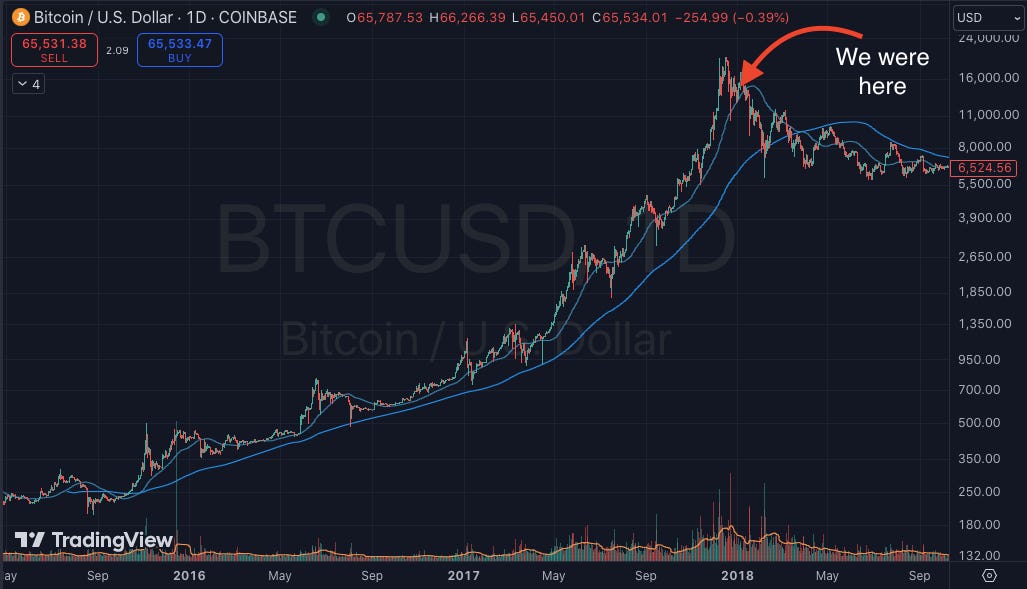
Why Bitcoin is Stupid
Issue #1
If you’re pursuing FIRE because you want more control over your days, the goal isn’t merely to retire early or reach a larger portfolio number. The deeper goal is to create an overlap: enough money, enough control of your time, and enough energy to use both while the possibilities are still open.
The traditional timeline often separates those resources. You spend your capable working years trading time for money, then hope to reclaim your days at a conventional retirement age. The balance sheet may improve, but the years and energy spent building it can’t be restored later.
FIRE gives saving and investing a more useful purpose. They’re tools for moving that overlap earlier, whether that eventually means working less, changing careers, building something of your own, or simply being more present. Bitcoin can support the plan by protecting purchasing power, but the asset isn’t the destination. The destination is greater ownership of how you spend a finite life.
So look beyond your FIRE number. Ask whether your next financial move brings money, time, and energy closer together—or grows one by spending down the others.