Teach 'em young:

Hanging out with Solana
@jack down in Rio 🤣 🤣 🤣


Einstein and Bitcoin
At some point in our lives we have all come across Einstein’s famous energy-mass equivalence equation or, E=mc2. This simple, yet very powerful equation states that energy and mass are one and the same. We experience this formula everyday of our lives from the moment we use a GPS to help us navigate, to the sunlight that we receive from our own Sun. Without us being aware, this equation is embedded in our daily lives and it’s not necessary for us to know or care about, although learning about it can be out of curiosity but not necessity.
The great majority of the world is still unaware of the positive implications that bitcoin is bringing to several aspects of our daily lives; predominantly the financial aspects. We live in a world where fiat currencies (USD, EUR, GBP, JPY, etc.) are being printed without limits, causing all kinds of havoc to our purchasing power across time (i.e. it will require more dollars in the future to buy the same bottle of CocaCola today.) I do see a future where currencies will be priced off bitcoin, which will allow the citizens of all countries to transact with their own currencies in a much cheaper, faster, open and less intermediated manner. This will be possible due to the fact that all currencies will “speak bitcoin,” but no person will really have to hold onto bitcoin if they don’t want to or even know about it. The infrastructure to this system is already in the process of being tested in the Global South and will slowly grow from there.
Fiat currencies have an infinite supply, whereas there will only ever be 21,000,000 bitcoin in circulation. The very simple, yet powerful formula of ∞/21,000,000 (infinity divided by 21,000,000) demonstrates a path of where bitcoin price can go. What happens to bitcoin’s price when you divide large amounts of fiat (or infinite amounts) by 21,000,000 bitcoin? It can only trend up. While there are still several challenges in the road to fiat currencies “speaking bitcoin,” its protection against debasement and severe inflation has already been proven in currencies like the Argentine and Cuban Pesos, Egyptian Pounds and others.
∞/21,000,000 will become as powerful as E=mc2, it will just take more time and when it happens, not that many will really know or care about it, except those that bought bitcoin in anticipation to this.
You can buy BTC on Coinbase (full KYC) for $65,956 or through RoboSats (non-KYC) for $66,495. The difference is 0.81%.
It's a 0.81% premium to retain your anonymity. Yes, please.
Won't regret, very happy with mine
View quoted note →
Bitcoin for Generational Preservation
It is hard to believe that bitcoin can be a hedge against currency devaluations and inflation due to its volatility, but if you zoom out enough and ignore the short term noise, the story is quite different. I admit that I also did not believe that bitcoin could protect purchasing power over time, but I was convinced otherwise by looking at the unfortunate economic circumstances that countries like Argentina, Cuba, Nigeria, Egypt and Ukraine have faced. These countries have all experienced massive currency devaluations over time for various reasons and they have all had the same outcome on their populations: pushing more and more into poverty. This not only affects the current generation, but also further sets back the next generation in terms of their development. Continuing this train of thought, that means the these countries are then in a worse position to compete on the global scale and are doomed to be under the control of the developed world.
Take a look at the attached 5-year graphs that show how much bitcoin has appreciated relative to the following currencies:
Argentine Peso: +30,651%
Cuban Peso: +37,401%
Nigerian Naira: +6,309%
Egyptian Pound: +4,128%
Ukrainian Hryvnia: +2,137%
For reference, bitcoin priced in USD over 5 years has strengthened +1,457%
Said another way, this means that you need less and less bitcoin to acquire the same amount of that specific currency. As currencies get debased by their own central governments and external forces, bitcoin becomes more valuable in local terms. Bitcoin is a beacon of hope and a lifeboat for the populations of these countries that experience such high rates of devaluation over time; its one of the very few ways they can protect their purchasing power to ensure a better quality of life for the next generations. [This last sentence also applies to the developed world, over time]
God's work, well done
View quoted note →Correct. Bitcoin wins when nobody knows its being used
View quoted note →LinkedIn is currently down form whatever reason. What would need to happen for nostr to be down?
Thrilled to share my newest IBEX Podcast!
In this engaging discussion, I talk about the established corridors of traditional finance to the cutting-edge frontier of Bitcoin. We explore Bitcoin's distinctive features, such as its limited supply and status as digital gold, highlighting its viability as both a store of value and an inflation safeguard. I also articulate my enthusiasm for how Bitcoin can transform financial transactions to be more efficient, affordable, and accessible, particularly benefiting emerging markets.
This episode is essential listening for those intrigued by the future of finance, Bitcoin's game-changing role, and the synergy between traditional and digital financial innovation.
Dive in to explore the infinite possibilities that the fusion of finance and technology heralds for our global future.
#Bitcoin #DigitalFinance #WealthManagement #FinancialInnovation #IBEXPodcast
🔗 Youtube:

LinkedIn
This link will take you to a page that’s not on LinkedIn
🔗 Spotify:
LinkedIn
This link will take you to a page that’s not on LinkedIn
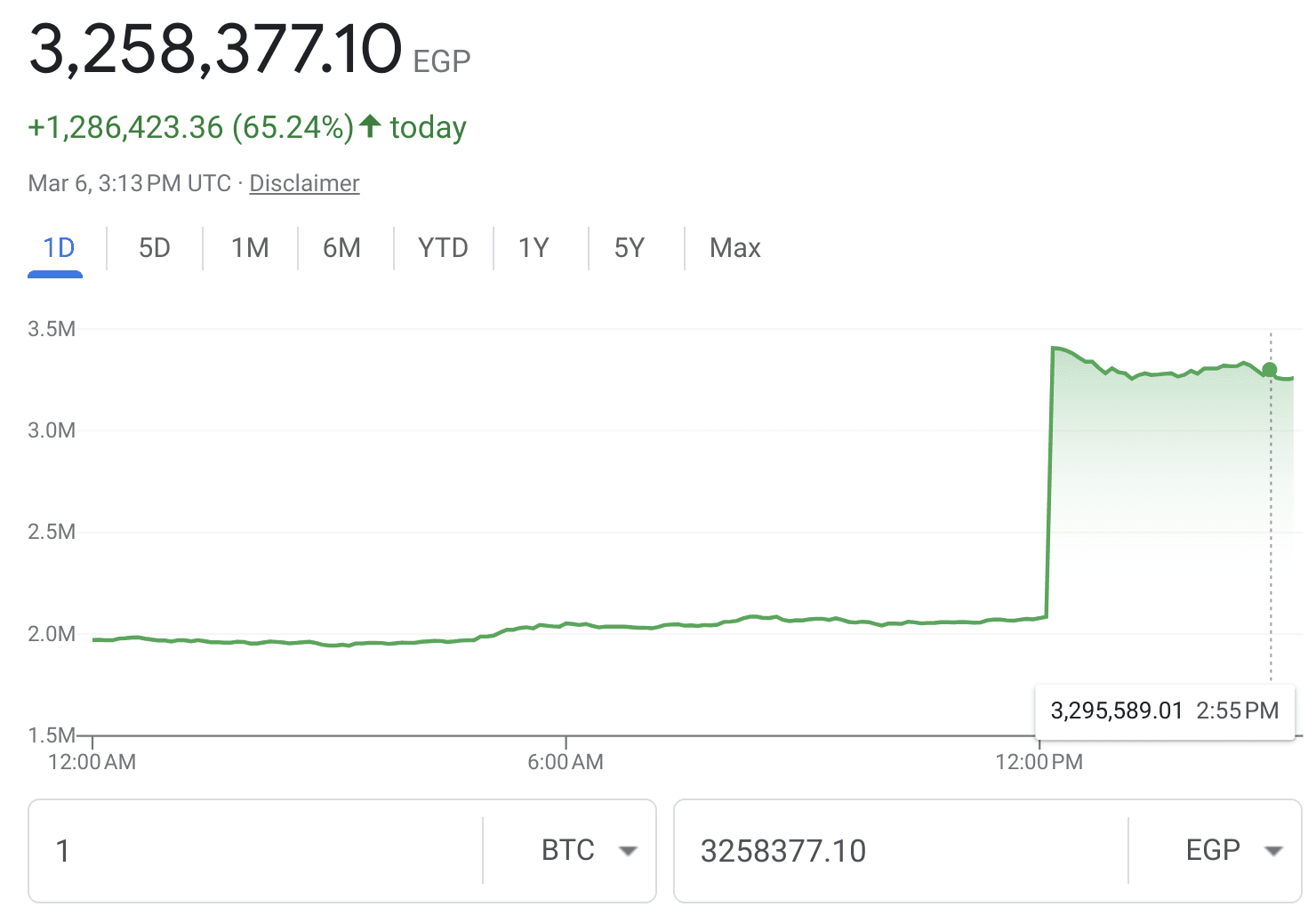
Bitcoin as an inflation hedge working in real time as Egypt had to devalue its currency once again. BTC rose 65% TODAY, priced in Egyptian pounds:
The Two Sides of Bitcoin
Throughout its life, bitcoin’s value has reflected its economic properties which are indisputably great, but I believe that this is only half the story. Bitcoin has several industrial uses cases that few people are aware of and that few companies are leveraging. The following are some examples of the two sides from where bitcoin gets its value:
Economic Properties
It is scarce: There will only ever be 21 million bitcoin issued and no more. While this is not all that’s needed to make something valuable, it’s a key property for hard money.
It can be broken down into smaller pieces: Bitcoin can be owned as one whole coin or divisible to eight decimals (0.00000001). This allows for transactions of all sizes to take place.
It can be taken with you: One can easily take bitcoin across a border or across the street in a digital or hardware wallet or even carry bitcoin in your head just by memorizing a sequence of words. It is much harder to do the same with gold bars.
It cannot be counterfeited: Bitcoin moves on the Bitcoin blockchain, which has proven to be the most secure blockchain in existence, making it nearly impossible for someone to send counterfeited bitcoin. Unfortunately the same cannot be said about gold and fiat currencies.
It can protect purchasing power over time: Even though bitcoin has had its volatile past, with a long enough time horizon, it will most likely hold its purchasing power relative to other goods while fiat currencies will lose their value under the weight of their indebtedness. If in doubt, just take a look at what bitcoin has done when priced in highly devalued currencies such as Egyptian Pounds, Argentine Peso, Ukrainian Hryvnia and Nigerian Naira.
Industrial Use Cases
The Bitcoin blockchain offers the ability for two parties to send bitcoin back and forth albeit at slower speeds; this is by design as the Bitcoin blockchain is the most secure blockchain in existence. It is the base layer where other second layers are built on that solve for speed and other very innovative solutions. There are many examples of industrial use cases and below I highlight some that I believe to be solid drivers that will unlock even more value to the Bitcoin blockchain and thus its price:
Fiat over Lightning Network: A second layer built on top of the Bitcoin blockchain, the Lightning Network makes bitcoin transactions instant, no matter if the parties are next to each other or oceans away. By leveraging this network, two parties can transact using their own currencies, resulting in foreign exchange rates that could potentially be better than the rates offered by traditional financial rails; it is also faster and less bureaucratic. This would allow a business to pay for its raw materials by using its own currency while the foreign supplier would get paid in their own currency. No need to go through various currency conversions which end up being costly and time consuming.
Tokenization over Liquid Network: Another second layer on the Bitcoin blockchain, it can be used to issue and list digital assets. By leveraging this technology, a business can tap into markets that were out of its reach in the traditional system to either sell its goods or raise funds. A real estate developer can issue digital tokens to either raise funds for a new development or sell the digital ownership of its properties.
Miniscript for Institutional Custody: As bitcoin gains more institutional adoption, either for ETFs as we have recently witnessed or for any other use case, centralized custodians will have to improve their custodial practices as they now own more bitcoin with an ever-increasing price. Through a Bitcoin language called Miniscript, the custodial model is switched from bitcoin “lost forever” to “bitcoin recovered at a later time.” This is a setup whereby a large bitcoin custodian can have insurance that if they were to lose the keys to their bitcoin, the protocol itself would return that bitcoin at a predefined time in the future. This offers an extra layer of security to institutions that hold third-party funds, giving an extra piece of mind to end users and helping the bitcoin adoption.
Industrial uses cases do take more time to implement, but when they happen, they will truly unlock more value to bitcoin that has never been priced in before. I foresee the same price action repeating when this happens as to when the ETFs were launched and caused the massive bitcoin rally.
The Benefits and Risks of Stablecoins
Stablecoins are a digital representation of fiat currency which are used to move money cross-border, as cash equivalent by crypto traders and staked in various protocols to earn higher yields than in traditional banking. Stablecoins are the result of a very slow and contained fiat world and through their use, fiat scales to solve for speed and reach. If you take a Guatemalan Quetzal to Turkey, it will most likely be worthless; but if you take a stablecoin, there are higher chances that you will be able to convert it to Turkish Lira. If you were to send a wire transfer from Guatemala to Turkey, it would be extremely costly and time consuming- not to mention that it could be blocked. If instead you send stablecoins, they would be instantly received and could be converted for much cheaper to local currency.
There is another side to stablecoins that investors and everyday users need to be aware of:
- Their intrinsic value is based on the legacy financial system: Stablecoins derive their value from traditional financial assets such as treasuries, repurchase agreements, corporate bonds, cash, etc., all of which are subject to the persistent devaluation of the USD, which in turn transmit the devaluation to the stablecoins themselves.
- They can be censored: Stablecoin issuers have the power to block, censor and reverse transactions if they want or if mandated by a regulatory/court order. While this could be considered a good tool to fight illicit activities, this power could potentially be abused as well.
- Depegs: There have been several cases in the past where a stablecoin’s 1:1 peg is broken. In almost all cases the peg is restored, but this will continue to be a recurring phenomenon. Here are some examples:
USDC depegged from $1 to $0.86 when they announced that 8% of their overall funds backing the USDC token were held at Silicon Valley Bank, which failed in March 2023.
TerraUSD algorithmic stablecoin collapsed from $1 to $0.04 back in May 2022 and its market cap crashed from $41B as the Terra network lost all credibility of its high-yielding Anchor Protocol.
Tether has its history of trading at premiums and discounts throughout various exchanges as well. Some have been massive movements and others have been very small.
Stablecoins have had their role in onboarding more people into crypto and bitcoin but they also come with fine print. Investors and everyday users must be aware of the risks involved, especially in assets stating that their value is “pegged” to something else. Massive depegs can lead to holders losing part if not all of the value of the stablecoin if it never returns back parity; as was the case with TerraUSD.
On the other hand, bitcoin’s value is not pegged to anything else and even though it has experienced strong volatility, I foresee its price increasing and stabilizing into the future as a result of its gold-like, economic properties and its industrial use cases that can facilitate cross-border trade (more on this in the next post).
Age of Empires, Bitcoin and Gold
History has proven that no empire can last forever and when its decline begins, things get very ugly. The empire then fights back harder, radical measures are taken in the interests of national security to try and extend its eventual demise. The world has witnessed many changes in world orders from the Chinese, to the Dutch, the British and currently, the US. In his book “Principles for Dealing with The Changing World Order,” Ray Dalio presents us with a graph demonstrating “The Relative Standing of Great Empires” (graph at the bottom).
His analysis takes into account various aspects that forge, strengthen and weaken an empire, such as education, innovation, military and others. While I find it hard to believe that China will be the next world order, it's very clear that the path the US has embarked on, especially as it relates to money printing and debt issuance is not helping its world standing or the credibility to the US dollar. Furthermore, it’s currently administered by a very polarized political system as well as dealing with other internal conflicts that it needs to urgently address if it wants to retain it global leadership position.
According to Dalio, one of the determinants of an empire entering its decline phase is when it carries large debts and prints money, as can be seen in his graph at the bottom of this note, depicting "The Rise, The Top and The Decline" of an empire.
The US is unfortunately in the phase where it has enjoyed decades of power, abundance and as issuer of the global reserve currency, it has lost sight of its true values and foundation that took it to the top. If this path continues, one of the unfortunate outcomes is the further weakening of the US dollar to the point where it might face a challenger. The US has reached a debt/GDP ratio of about 120%; a point where reversing course is not getting easier and the solution could be quite harsh. That transition period could be painful for fiat denominated investors; and it’s important to understand how one should hedge their fiat exposure.
Bitcoin alongside gold are two great hedging candidates and they both share and differ in their qualities. Even though gold has an extensive track record of holding its value across time, bitcoin shares the same qualities such as durability, fungibility and scarcity but also has its own such as divisibility, portability and verifiability. Aside from these, bitcoin goes further in that it can also be used at its protocol level to solve great pains of cross-border financial transactions. Using bitcoin for these transactions can lead to better foreign exchange rates than banks, it makes financial settlements instant and disintermediates money. This means that bitcoin can be used at an industrial scale, ready to solve real world problems. Although it currently trades as a speculative asset, bitcoin’s value is the sum of its economic qualities and its industrial use potential. Bitcoin is slowly on its way to be the main base layer for faster, cheaper and more open-access money.
It’s hard to fathom a world where the US is not the leader, but if/when that times comes we will all live a very turbulent economic environment where I foresee bitcoin and gold outperforming all other assets.


The Bitcoin ETF
There are plenty of articles detailing the pros and cons about the bitcoin ETF from a investment vehicle’s perspective, but almost no articles about the pros and cons from a bitcoin perspective.
Why The ETF Is a Great Idea (for bitcoin, but not for investors):
- The run up to the ETF launch has indeed generated a lot of noise and news around bitcoin, which is quite positive for the asset itself. This has taken the bitcoin conversation from the dark and smoky rooms of its early days to the family dinner table.
- While there is still not much regulatory clarity around bitcoin and digital assets in the US in general, the fact that there are several ETFs in the “soon to be approved stage,” could potentially bode well for the industry as a whole.
- The asset managers that have submitted their ETFs for approval are some of the biggest and most respected institutions out there. It’s “smart” money that has finally realized the potential that bitcoin has in terms of financial return and demand from investors.
- Bitcoin has gone from being called a tool that facilitates illicit activities to potentially becoming part of every investor’s diversified portfolio with full regulatory backing. This is the same as when nobody believed in the Internet when it was first launched.
Why It’s Better To Own Bitcoin Directly (and not via the ETF):
- When investors buy shares of the ETF, they are basically owning a piece of paper that says that it equals a certain amount of bitcoin, held in custody by a third party. Investors are trusting these third parties’ fiduciary responsibilities that they will keep their bitcoin safe.
- History has shown that no amount of rules and regulation can prevent these institutions from failing, and if they do, investors could be wiped out.
- The amount of bitcoin in custody by these institutions will become honeypots or targets for hackers. Bitcoin and digital asset hacks and exploits will always continue to happen. Investors are better off acquiring bitcoin themselves to then quietly and privately custody it themselves- this last part is understandably still very hard to do for the average investor; however companies like IBEX are here to also guide its clients how to self custody the right way.
- There is still a lot of uncertainty as to what regulation will be like in the US regarding bitcoin and digital assets. In a very dark and (hopefully) unlikely scenario, the US government could confiscate all bitcoin as they did with gold back in 1933 with the Executive Order 6102 as a way to fight the Great Depression. Given the current and massive debt levels of the US government, this scenario could potentially not be too far out.
It is of the utmost importance for anybody considering to invest in the bitcoin ETF to take their time to understand what self-custody is or find the right bitcoin companies, such as IBEX, to guide them.
Current Income and Bitcoin
We have reached a critical point where it is financially irresponsible to ignore Bitcoin; please refer to my previous post. Every investor must take their time to understand Bitcoin’s value and how to position it within an investment portfolio. While there are several ways to own bitcoin or at the very least have indirect exposure to it, one of the “drawbacks” we hear from the families we work with is that bitcoin does not generate income. With a long enough time horizon, bitcoin’s price appreciation could make any income needs irrelevant, but the reality is that many investors need income now rather than wait for the future appreciation.
No matter what happens to interest rates, the ever-growing amount of debt in the system and therefore the fate of the US dollar, income-focused investors need to allocate their portfolios accordingly to generate enough to meet their needs. Combining income-focused investments in traditional finance with bitcoin exposure is key to the composition of any income-focused portfolio. Although income is critical for a great number of investors, there must also be a certain exposure to bitcoin for its price appreciation potential, its revolutionary protocol that allows for a variety of financial and non-financial use cases and its natural hedge against a debt-laden system that has reached unprecedented levels with no signs of stopping.
After years of being anti-bitcoin, big Wall Street firms such as BlackRock, Goldman Sachs, JPMorgan and others have slowly started to reverse course and acknowledge that bitcoin requires attention and even an allocation within an investment portfolio. In his October 2023 investor memo, Howard Marks, a long-term distressed credit investor, emphasized the opportunity that credit investing presents given the current and future economic outlook as it relates to interest rates. What he failed to mention were the consequences of investing in credit within a heavily indebted world that is slowly heading towards a debt spiral. Adding bitcoin to the mix could bring a natural hedge against a very unhappy ending for credit, but in the meantime any investor should take advantage of higher rates, which as Marks mentioned “now approach or exceed the historical returns from equity.”
At IBEX DWM, we have identified partners that we believe have the most suitable strategies that combine credit with bitcoin. We want our families to take advantage of higher rates while simultaneously protecting that cash flow through bitcoin. Our families are used to investing in alternative investments such as private equity and credit and we are not looking to change that model, just add the forward looking component of bitcoin’s disruptive potential and natural hedge, which in the words of BlackRock’s CEO Larry Fink, “has digitized gold.”
Here’s why after more than 10 years of working in traditional finance I decided to dedicate my professional career and life to Bitcoin:
Developing economies need a faster, cheaper and more efficient financial system than what is currently available to them. The current and most promising solutions out there are all based on the legacy financial system which has proven to be slow, expensive, bureaucratic and not available to a great percentage of the world’s population- which needs it the most.
Throughout history, financial institutions have leveraged technology to move money across borders in ways believed to be the most efficient. From the mid-20th century, banks communicated via Telex machines only to be replaced by the SWIFT cooperative utility in 1977, which has not had a revolutionary upgrade ever since.
This is where Bitcoin comes in, as a protocol (or “blockchain”) and as a currency. Bitcoin with a capital “B” refers to the blockchain, whereas bitcoin with a lowercase “b” refers to the currency. The difference between these two is quite important and most people pretend to understand the value of bitcoin and not Bitcoin.
The following is a comparison of layered-based systems across time (with a visual representation at the bottom):
1977, SWIFT: is the base layer upon which the global banking system communicates using its protocol to move money around the world. SWIFT can very loosely be compared to an early version of a blockchain: transactions are submitted by various participants, following the protocol’s rules and these transactions are recorded and stored forever.
2006, Google Translate: is the service functioning as the base layer upon which English is the execution language used to convert to and from other languages.
2008, the Bitcoin Blockchain: is the base layer upon which the Lightning Network communicates using its protocol to move money around the world [same sentence as SWIFT in 1977, written like this on purpose]. Bitcoin is much more efficient and cheaper than SWIFT in that it allows transfers for much smaller amounts and with minute-long settlements rather than hours or days, in local currencies.
Up until now, bitcoin has been traded as a risk asset, being bought alongside stocks when there is optimism in the economy and being sold when investors panic. If there was a deeper understanding of the value within the Bitcoin Protocol (or “Blockchain”), there would be far more buying and much less selling constantly, indefinitely.
This is just one of the use cases for the Bitcoin Blockchain. It is analogous to the Internet Protocol (HTTPS/TCP/IP). If you could have bought shares of “the Internet Protocol” when it first started, what would be the value of those shares today? (Hint: Everything runs on the Internet today).
Owning bitcoin is the equivalent of owning “shares” of a Protocol that is becoming as or even more disruptive than the Internet Protocol itself.


