
**Astronomy Picture of the Day**
31 July 2024
**Leopard Spots on Martian Rocks**
 *Image creditor details unavailable via API. Visit linked page below for full info.*
What is creating these unusual spots? Light-colored spots on Martian rocks, each surrounded by a dark border, were discovered earlier this month by NASA's Perseverance Rover currently exploring Mars. Dubbed leopard spots because of their seemingly similarity to markings on famous Earth-bound predators, these curious patterns are being studied with the possibility they were created by ancient Martian life. The pictured spots measure only millimeters across and were discovered on a larger rock named Cheyava Falls. The exciting but unproven speculation is that long ago, microbes generated energy with chemical reactions that turned rock from red to white while leaving a dark ring, like some similarly appearing spots on Earth rocks. Although other non-biological explanations may ultimately prevail, speculation focusing on this potential biological origin is causing much intrigue. New Mirror: APOD is now available from Brazil in Portuguese
#APOD #Astroeducation #Astrospace #LunarMission #SpaceFacts
*Image creditor details unavailable via API. Visit linked page below for full info.*
What is creating these unusual spots? Light-colored spots on Martian rocks, each surrounded by a dark border, were discovered earlier this month by NASA's Perseverance Rover currently exploring Mars. Dubbed leopard spots because of their seemingly similarity to markings on famous Earth-bound predators, these curious patterns are being studied with the possibility they were created by ancient Martian life. The pictured spots measure only millimeters across and were discovered on a larger rock named Cheyava Falls. The exciting but unproven speculation is that long ago, microbes generated energy with chemical reactions that turned rock from red to white while leaving a dark ring, like some similarly appearing spots on Earth rocks. Although other non-biological explanations may ultimately prevail, speculation focusing on this potential biological origin is causing much intrigue. New Mirror: APOD is now available from Brazil in Portuguese
#APOD #Astroeducation #Astrospace #LunarMission #SpaceFacts
*Image creditor details unavailable via API. Visit linked page below for full info.*
What is creating these unusual spots? Light-colored spots on Martian rocks, each surrounded by a dark border, were discovered earlier this month by NASA's Perseverance Rover currently exploring Mars. Dubbed leopard spots because of their seemingly similarity to markings on famous Earth-bound predators, these curious patterns are being studied with the possibility they were created by ancient Martian life. The pictured spots measure only millimeters across and were discovered on a larger rock named Cheyava Falls. The exciting but unproven speculation is that long ago, microbes generated energy with chemical reactions that turned rock from red to white while leaving a dark ring, like some similarly appearing spots on Earth rocks. Although other non-biological explanations may ultimately prevail, speculation focusing on this potential biological origin is causing much intrigue. New Mirror: APOD is now available from Brazil in Portuguese
#APOD #Astroeducation #Astrospace #LunarMission #SpaceFacts
APOD: 2024 July 31 – Leopard Spots on Martian Rocks
A different astronomy and space science
related image is featured each day, along with a brief explanation.
 *Image creditor details unavailable via API. Visit linked page below for full info.*
To some, it looks like a penguin. But to people who study the universe, it is an interesting example of two big galaxies interacting. Just a few hundred million years ago, the upper NGC 2936 was likely a normal spiral galaxy: spinning, creating stars, and minding its own business. Then it got too close to the massive elliptical galaxy NGC 2937, below, and took a dive. Together known as Arp 142, they are featured in this new Webb infrared image, while a visible light Hubble image appears in comparison. NGC 2936 is not only being deflected, but distorted, by this close gravitational interaction. When massive galaxies pass near each other, gas is typically condensed from which new stars form. A young group of stars appears as the nose of the penguin toward the right of the upper galaxy, while in the center of the spiral, bright stars together appear as an eye. Before a billion years, the two galaxies will likely merge into one larger galaxy. Explore Your Universe: Random APOD Generator
#APOD #Galaxy #Stars #LunarExploration #NASA
*Image creditor details unavailable via API. Visit linked page below for full info.*
To some, it looks like a penguin. But to people who study the universe, it is an interesting example of two big galaxies interacting. Just a few hundred million years ago, the upper NGC 2936 was likely a normal spiral galaxy: spinning, creating stars, and minding its own business. Then it got too close to the massive elliptical galaxy NGC 2937, below, and took a dive. Together known as Arp 142, they are featured in this new Webb infrared image, while a visible light Hubble image appears in comparison. NGC 2936 is not only being deflected, but distorted, by this close gravitational interaction. When massive galaxies pass near each other, gas is typically condensed from which new stars form. A young group of stars appears as the nose of the penguin toward the right of the upper galaxy, while in the center of the spiral, bright stars together appear as an eye. Before a billion years, the two galaxies will likely merge into one larger galaxy. Explore Your Universe: Random APOD Generator
#APOD #Galaxy #Stars #LunarExploration #NASA
 Image Credit & Copyright:
Max Inwood
What's happening above Uluru? A United Nations World Heritage Site, Uluru is an extraordinary 350-meter high mountain in central Australia that rises sharply from nearly flat surroundings. Composed of sandstone, Uluru has slowly formed over the past 300 million years as softer rock eroded away. The Uluru region has been a home to humans for over 22,000 years. Recorded last month, the starry sky above Uluru includes the central band of our Milky Way galaxy, complete with complex dark filaments of dust, bright red emission nebulas, and billions of stars.
#APOD #Astroenthusiast #Astrozone #BlackHoles #Cosmology
Image Credit & Copyright:
Max Inwood
What's happening above Uluru? A United Nations World Heritage Site, Uluru is an extraordinary 350-meter high mountain in central Australia that rises sharply from nearly flat surroundings. Composed of sandstone, Uluru has slowly formed over the past 300 million years as softer rock eroded away. The Uluru region has been a home to humans for over 22,000 years. Recorded last month, the starry sky above Uluru includes the central band of our Milky Way galaxy, complete with complex dark filaments of dust, bright red emission nebulas, and billions of stars.
#APOD #Astroenthusiast #Astrozone #BlackHoles #Cosmology
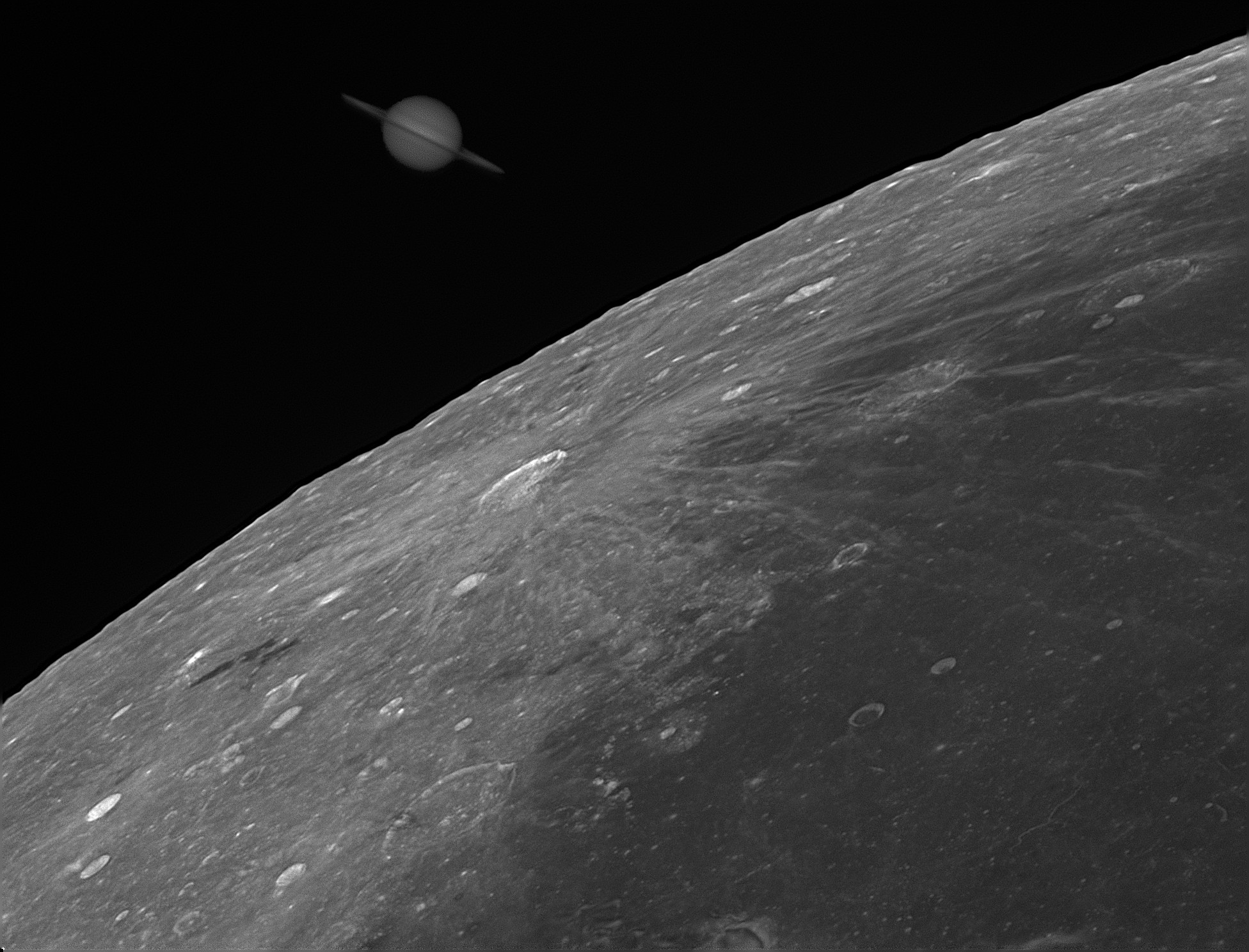 Image Credit & Copyright: Chengcheng Xu
Saturn now rises before midnight in planet Earth's sky. On July 24, the naked-eye planet was in close conjunction, close on the sky, to a waning gibbous Moon. But from some locations on planet Earth the ringed gas giant was occulted, disappearing behind the Moon for about an hour from skies over parts of Asia and Africa. Because the Moon and bright planets wander through the sky near the ecliptic plane, such occultation events are not uncommon, but they can be dramatic. In this telescopic view from Nanjing, Jiangsu, China, Saturn is caught moments before its disappearance behind the lunar disk. The snapshot gives the illusion that Saturn hangs just above Glushko crater, a 43 kilometer diameter, young, ray crater near the Moon's western edge. Of course, the Moon is 400 thousand kilometers away, compared to Saturn's distance of 1.4 billion kilometers.
#APOD #Astrogeology #Galaxy #SpaceResearch #Astrodata
Image Credit & Copyright: Chengcheng Xu
Saturn now rises before midnight in planet Earth's sky. On July 24, the naked-eye planet was in close conjunction, close on the sky, to a waning gibbous Moon. But from some locations on planet Earth the ringed gas giant was occulted, disappearing behind the Moon for about an hour from skies over parts of Asia and Africa. Because the Moon and bright planets wander through the sky near the ecliptic plane, such occultation events are not uncommon, but they can be dramatic. In this telescopic view from Nanjing, Jiangsu, China, Saturn is caught moments before its disappearance behind the lunar disk. The snapshot gives the illusion that Saturn hangs just above Glushko crater, a 43 kilometer diameter, young, ray crater near the Moon's western edge. Of course, the Moon is 400 thousand kilometers away, compared to Saturn's distance of 1.4 billion kilometers.
#APOD #Astrogeology #Galaxy #SpaceResearch #Astrodata
 Image Credit & Copyright: Roberto Marinoni
From our vantage point in the Milky Way Galaxy, we see NGC 6946 face-on. The big, beautiful spiral galaxy is located just 20 million light-years away, behind a veil of foreground dust and stars in the high and far-off constellation Cepheus. In this sharp telescopic portrait, from the core outward the galaxy's colors change from the yellowish light of old stars in the center to young blue star clusters and reddish star forming regions along the loose, fragmented spiral arms. NGC 6946 is also bright in infrared light and rich in gas and dust, exhibiting a high star birth and death rate. In fact, since the early 20th century ten confirmed supernovae, the death explosions of massive stars, were discovered in NGC 6946. Nearly 40,000 light-years across, NGC 6946 is also known as the Fireworks Galaxy.
#APOD #PlanetExploration #NASAInspires #Exploration #SpaceResearch
Image Credit & Copyright: Roberto Marinoni
From our vantage point in the Milky Way Galaxy, we see NGC 6946 face-on. The big, beautiful spiral galaxy is located just 20 million light-years away, behind a veil of foreground dust and stars in the high and far-off constellation Cepheus. In this sharp telescopic portrait, from the core outward the galaxy's colors change from the yellowish light of old stars in the center to young blue star clusters and reddish star forming regions along the loose, fragmented spiral arms. NGC 6946 is also bright in infrared light and rich in gas and dust, exhibiting a high star birth and death rate. In fact, since the early 20th century ten confirmed supernovae, the death explosions of massive stars, were discovered in NGC 6946. Nearly 40,000 light-years across, NGC 6946 is also known as the Fireworks Galaxy.
#APOD #PlanetExploration #NASAInspires #Exploration #SpaceResearch
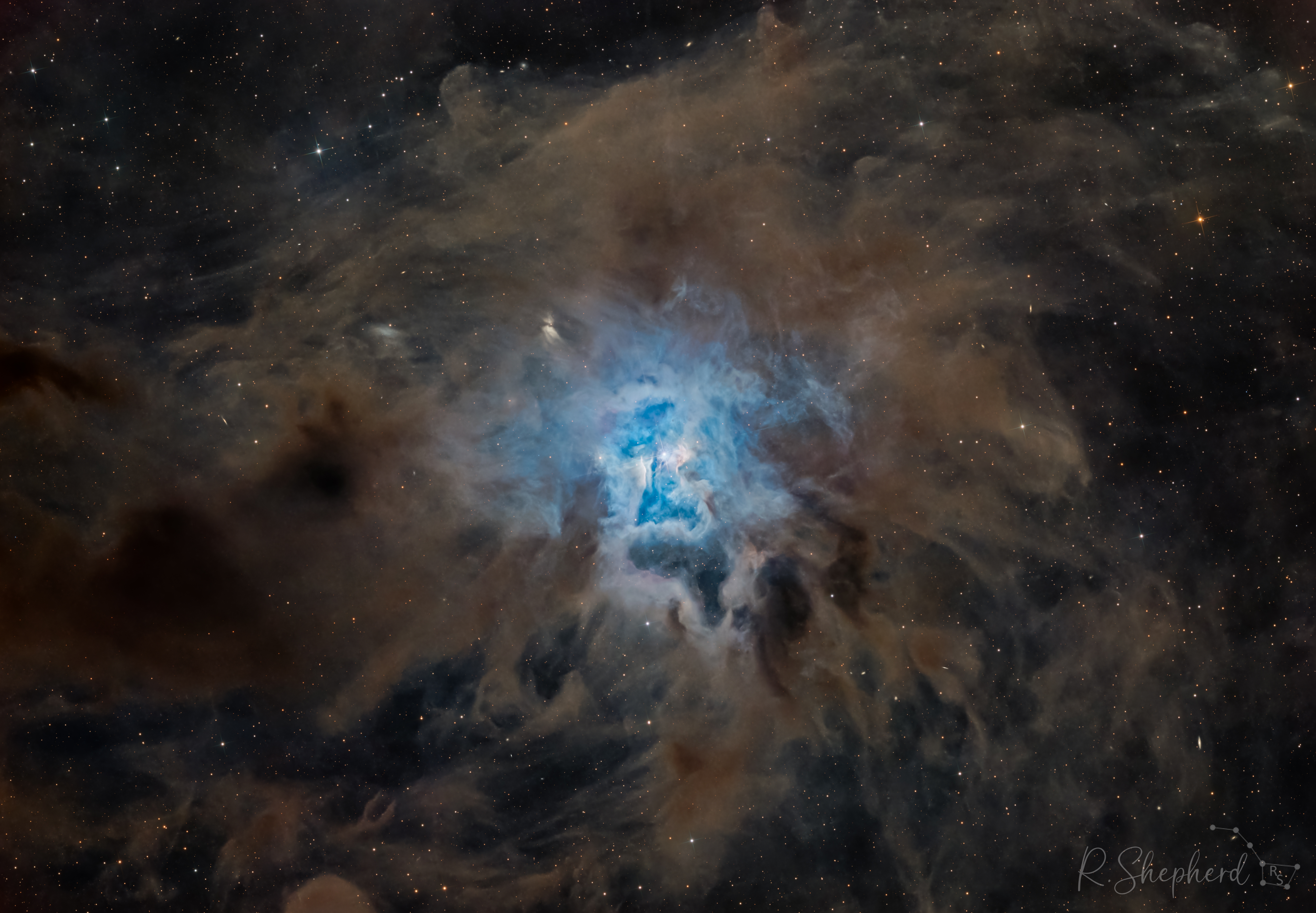 Image Credit & Copyright: Robert Shepherd
These cosmic clouds have blossomed 1,300 light-years away in the fertile starfields of the constellation Cepheus. Called the Iris Nebula, NGC 7023 is not the only nebula to evoke the imagery of flowers. Still, this deep telescopic image shows off the Iris Nebula's range of colors and symmetries embedded in surrounding fields of interstellar dust. Within the Iris itself, dusty nebular material surrounds a hot, young star. The dominant color of the brighter reflection nebula is blue, characteristic of dust grains reflecting starlight. Central filaments of the reflection nebula glow with a faint reddish photoluminescence as some dust grains effectively convert the star's invisible ultraviolet radiation to visible red light. Infrared observations indicate that this nebula contains complex carbon molecules known as PAHs. The dusty blue petals of the Iris Nebula span about six light-years.
#APOD #SpaceResearch #SpaceExploration #Astroeducation #CosmosJourney
Image Credit & Copyright: Robert Shepherd
These cosmic clouds have blossomed 1,300 light-years away in the fertile starfields of the constellation Cepheus. Called the Iris Nebula, NGC 7023 is not the only nebula to evoke the imagery of flowers. Still, this deep telescopic image shows off the Iris Nebula's range of colors and symmetries embedded in surrounding fields of interstellar dust. Within the Iris itself, dusty nebular material surrounds a hot, young star. The dominant color of the brighter reflection nebula is blue, characteristic of dust grains reflecting starlight. Central filaments of the reflection nebula glow with a faint reddish photoluminescence as some dust grains effectively convert the star's invisible ultraviolet radiation to visible red light. Infrared observations indicate that this nebula contains complex carbon molecules known as PAHs. The dusty blue petals of the Iris Nebula span about six light-years.
#APOD #SpaceResearch #SpaceExploration #Astroeducation #CosmosJourney
 *Image creditor details unavailable via API. Visit linked page below for full info.*
Our Moon doesn't really have craters this big. Earth's Moon, Luna, also doesn't naturally show this spikey texture, and its colors are more subtle. But this digital creation is based on reality. The featured image is a digital composite of a good Moon image and surface height data taken from NASA's Lunar Orbiter Laser Altimeter (LOLA) mission -- and then exaggerated for educational understanding. The digital enhancements, for example, accentuate lunar highlands and show more clearly craters that illustrate the tremendous bombardment our Moon has been through during its 4.6-billion-year history. The dark areas, called maria, have fewer craters and were once seas of molten lava. Additionally, the image colors, although based on the moon's real composition, are changed and exaggerated. Here, a blue hue indicates a region that is iron rich, while orange indicates a slight excess of aluminum. Although the Moon has shown the same side to the Earth for billions of years, modern technology is allowing humanity to learn much more about it -- and how it affects the Earth.
#APOD #MilkyWay #Astrophysics #Science #Meteorology
*Image creditor details unavailable via API. Visit linked page below for full info.*
Our Moon doesn't really have craters this big. Earth's Moon, Luna, also doesn't naturally show this spikey texture, and its colors are more subtle. But this digital creation is based on reality. The featured image is a digital composite of a good Moon image and surface height data taken from NASA's Lunar Orbiter Laser Altimeter (LOLA) mission -- and then exaggerated for educational understanding. The digital enhancements, for example, accentuate lunar highlands and show more clearly craters that illustrate the tremendous bombardment our Moon has been through during its 4.6-billion-year history. The dark areas, called maria, have fewer craters and were once seas of molten lava. Additionally, the image colors, although based on the moon's real composition, are changed and exaggerated. Here, a blue hue indicates a region that is iron rich, while orange indicates a slight excess of aluminum. Although the Moon has shown the same side to the Earth for billions of years, modern technology is allowing humanity to learn much more about it -- and how it affects the Earth.
#APOD #MilkyWay #Astrophysics #Science #Meteorology
 *Image creditor details unavailable via API. Visit linked page below for full info.*
What powers the Crab Nebula? A city-sized magnetized neutron star spinning around 30 times a second. Known as the Crab Pulsar, it is the bright spot in the center of the gaseous swirl at the nebula's core. About 10 light-years across, the spectacular picture of the Crab Nebula (M1) frames a swirling central disk and complex filaments of surrounding and expanding glowing gas. The picture combines visible light from the Hubble Space Telescope in red and blue with X-ray light from the Chandra X-ray Observatory shown in white, and diffuse X-ray emission detected by Imaging X-ray Polarimetry Explorer (IXPE) in diffuse purple. The central pulsar powers the Crab Nebula's emission and expansion by slightly slowing its spin rate, which drives out a wind of energetic electrons. The featured image released today, the 25th Anniversary of the launch of NASA's flagship-class X-ray Observatory: Chandra. Many Discoveries: Chandra Celebrates 25th Anniversary
#APOD #SpaceTech #BlackHoles #Universe #SpaceResearch
*Image creditor details unavailable via API. Visit linked page below for full info.*
What powers the Crab Nebula? A city-sized magnetized neutron star spinning around 30 times a second. Known as the Crab Pulsar, it is the bright spot in the center of the gaseous swirl at the nebula's core. About 10 light-years across, the spectacular picture of the Crab Nebula (M1) frames a swirling central disk and complex filaments of surrounding and expanding glowing gas. The picture combines visible light from the Hubble Space Telescope in red and blue with X-ray light from the Chandra X-ray Observatory shown in white, and diffuse X-ray emission detected by Imaging X-ray Polarimetry Explorer (IXPE) in diffuse purple. The central pulsar powers the Crab Nebula's emission and expansion by slightly slowing its spin rate, which drives out a wind of energetic electrons. The featured image released today, the 25th Anniversary of the launch of NASA's flagship-class X-ray Observatory: Chandra. Many Discoveries: Chandra Celebrates 25th Anniversary
#APOD #SpaceTech #BlackHoles #Universe #SpaceResearch
 Image Credit & Copyright:
Chang Lee
Sometimes the dark dust of interstellar space has an angular elegance. Such is the case toward the far-south constellation of Chamaeleon. Normally too faint to see, dark dust is best known for blocking visible light from stars and galaxies behind it. In this 36.6-hour exposure, however, the dust is seen mostly in light of its own, with its strong red and near-infrared colors creating a brown hue. Contrastingly blue, the bright star Beta Chamaeleontis is visible on the upper right, with the dust that surrounds it preferentially reflecting blue light from its primarily blue-white color. All of the pictured stars and dust occur in our own Milky Way Galaxy with one notable exception: the white spot just below Beta Chamaeleontis is the galaxy IC 3104 which lies far in the distance. Interstellar dust is mostly created in the cool atmospheres of giant stars and dispersed into space by stellar light, stellar winds, and stellar explosions such as supernovas.
#APOD #Universe #StarCluster #Stellar #AstronomyFacts
Image Credit & Copyright:
Chang Lee
Sometimes the dark dust of interstellar space has an angular elegance. Such is the case toward the far-south constellation of Chamaeleon. Normally too faint to see, dark dust is best known for blocking visible light from stars and galaxies behind it. In this 36.6-hour exposure, however, the dust is seen mostly in light of its own, with its strong red and near-infrared colors creating a brown hue. Contrastingly blue, the bright star Beta Chamaeleontis is visible on the upper right, with the dust that surrounds it preferentially reflecting blue light from its primarily blue-white color. All of the pictured stars and dust occur in our own Milky Way Galaxy with one notable exception: the white spot just below Beta Chamaeleontis is the galaxy IC 3104 which lies far in the distance. Interstellar dust is mostly created in the cool atmospheres of giant stars and dispersed into space by stellar light, stellar winds, and stellar explosions such as supernovas.
#APOD #Universe #StarCluster #Stellar #AstronomyFacts
 Image Credit & Copyright:
Wayne Pinkston
(LightCrafter Photography)
This rock structure is not only surreal -- it's real. Perhaps the reason it's not more famous is that it is smaller than one might guess: the capstone rock overhangs only a few meters. Even so, the King of Wings outcrop, located in New Mexico, USA, is a fascinating example of an unusual type of rock structure called a hoodoo. Hoodoos may form when a layer of hard rock overlays a layer of eroding softer rock. Figuring out the details of incorporating this hoodoo into a night-sky photoshoot took over a year. Besides waiting for a suitably picturesque night behind a sky with few clouds, the foreground had to be artificially lit just right relative to the natural glow of the background. After much planning and waiting, the final shot, featured here, was taken in May 2016. Mimicking the horizontal bar, the background sky features the band of our Milky Way Galaxy stretching overhead.
#APOD #SpaceObservatory #RocketLaunch #Cosmological #Science
Image Credit & Copyright:
Wayne Pinkston
(LightCrafter Photography)
This rock structure is not only surreal -- it's real. Perhaps the reason it's not more famous is that it is smaller than one might guess: the capstone rock overhangs only a few meters. Even so, the King of Wings outcrop, located in New Mexico, USA, is a fascinating example of an unusual type of rock structure called a hoodoo. Hoodoos may form when a layer of hard rock overlays a layer of eroding softer rock. Figuring out the details of incorporating this hoodoo into a night-sky photoshoot took over a year. Besides waiting for a suitably picturesque night behind a sky with few clouds, the foreground had to be artificially lit just right relative to the natural glow of the background. After much planning and waiting, the final shot, featured here, was taken in May 2016. Mimicking the horizontal bar, the background sky features the band of our Milky Way Galaxy stretching overhead.
#APOD #SpaceObservatory #RocketLaunch #Cosmological #Science
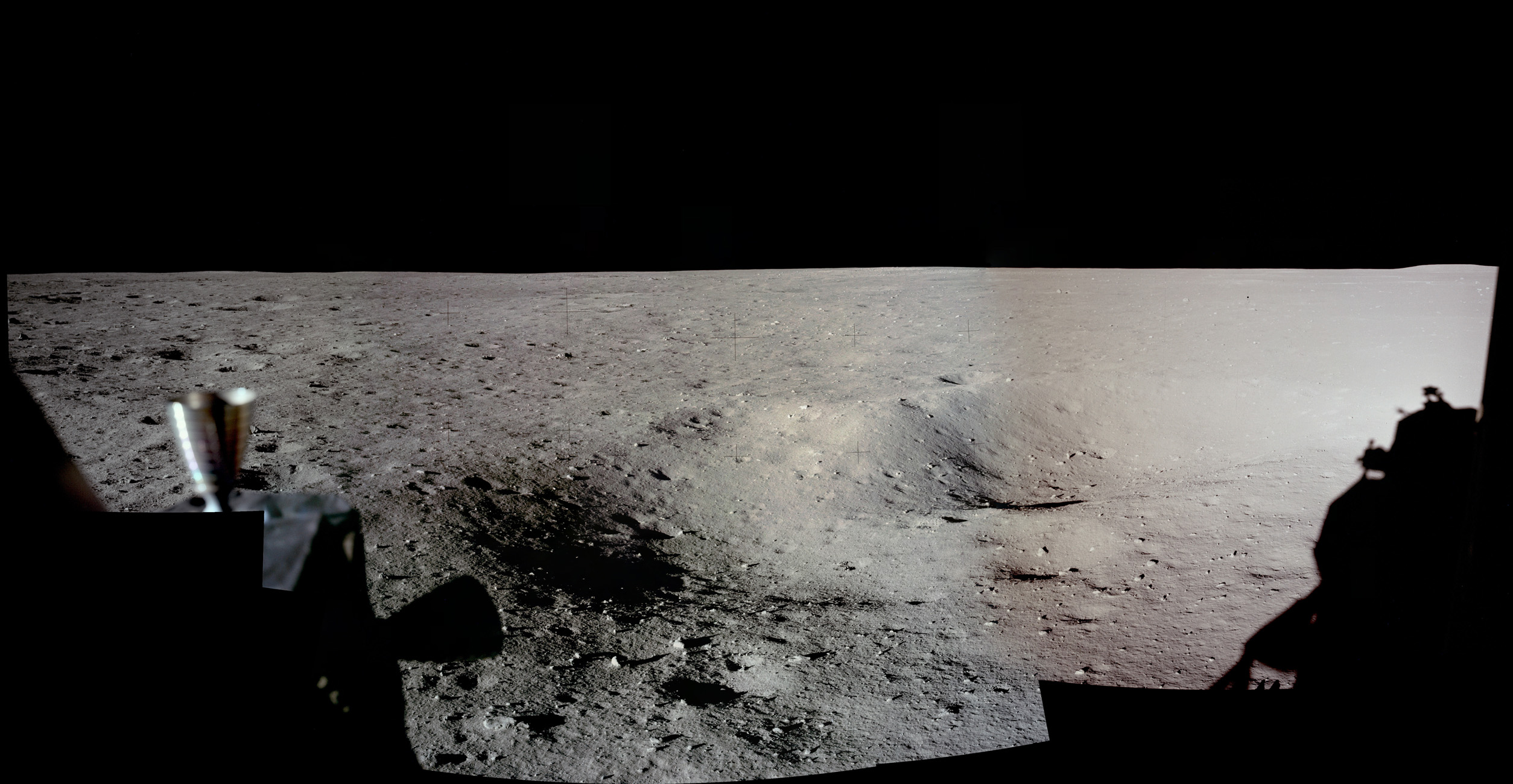 *Image creditor details unavailable via API. Visit linked page below for full info.*
Have you seen a panorama from another world lately? Assembled from high-resolution scans of the original film frames, this one sweeps across the magnificent desolation of the Apollo 11 landing site on the Moon's Sea of Tranquility. The images were taken 55 years ago by Neil Armstrong looking out his window on the Eagle Lunar Module shortly after the July 20, 1969 landing. The frame at the far left (AS11-37-5449) is the first picture taken by a person on another world. Thruster nozzles can be seen in the foreground on the left (toward the south), while at the right (west), the shadow of the Eagle is visible. For scale, the large, shallow crater on the right has a diameter of about 12 meters. Frames taken from the Lunar Module windows about an hour and a half after landing, before walking on the lunar surface, were intended to document the landing site in case an early departure was necessary.
#APOD #SpaceTravel #Astrophoto #Astrocosmos #Astroenthusiast
*Image creditor details unavailable via API. Visit linked page below for full info.*
Have you seen a panorama from another world lately? Assembled from high-resolution scans of the original film frames, this one sweeps across the magnificent desolation of the Apollo 11 landing site on the Moon's Sea of Tranquility. The images were taken 55 years ago by Neil Armstrong looking out his window on the Eagle Lunar Module shortly after the July 20, 1969 landing. The frame at the far left (AS11-37-5449) is the first picture taken by a person on another world. Thruster nozzles can be seen in the foreground on the left (toward the south), while at the right (west), the shadow of the Eagle is visible. For scale, the large, shallow crater on the right has a diameter of about 12 meters. Frames taken from the Lunar Module windows about an hour and a half after landing, before walking on the lunar surface, were intended to document the landing site in case an early departure was necessary.
#APOD #SpaceTravel #Astrophoto #Astrocosmos #Astroenthusiast
 Image Credit & Copyright: Pavel Gabzdyl
For some, these subtle bands of light and shadow stretched across the sky as the Sun set on July 11. Known as anticrepuscular rays, the bands are formed as a large cloud bank near the western horizon cast long shadows through the atmosphere at sunset. Due to the camera's perspective, the bands of light and shadow seem to converge toward the eastern (opposite) horizon at a point seen just above a 14th century hilltop castle near Brno, Czech Republic. In the foreground, denizens of planet Earth are enjoying the region's annual Planet Festival in the park below the Brno Observatory and Planetarium. And while crepuscular and anticrepuscular rays are a relatively common atmospheric phenomenon, this festival's 10 meter diameter inflatable spheres representing bodies of the Solar System are less often seen on planet Earth.
#APOD #Astrozone #SpaceResearch #AstronautLife #NASAInspires
Image Credit & Copyright: Pavel Gabzdyl
For some, these subtle bands of light and shadow stretched across the sky as the Sun set on July 11. Known as anticrepuscular rays, the bands are formed as a large cloud bank near the western horizon cast long shadows through the atmosphere at sunset. Due to the camera's perspective, the bands of light and shadow seem to converge toward the eastern (opposite) horizon at a point seen just above a 14th century hilltop castle near Brno, Czech Republic. In the foreground, denizens of planet Earth are enjoying the region's annual Planet Festival in the park below the Brno Observatory and Planetarium. And while crepuscular and anticrepuscular rays are a relatively common atmospheric phenomenon, this festival's 10 meter diameter inflatable spheres representing bodies of the Solar System are less often seen on planet Earth.
#APOD #Astrozone #SpaceResearch #AstronautLife #NASAInspires
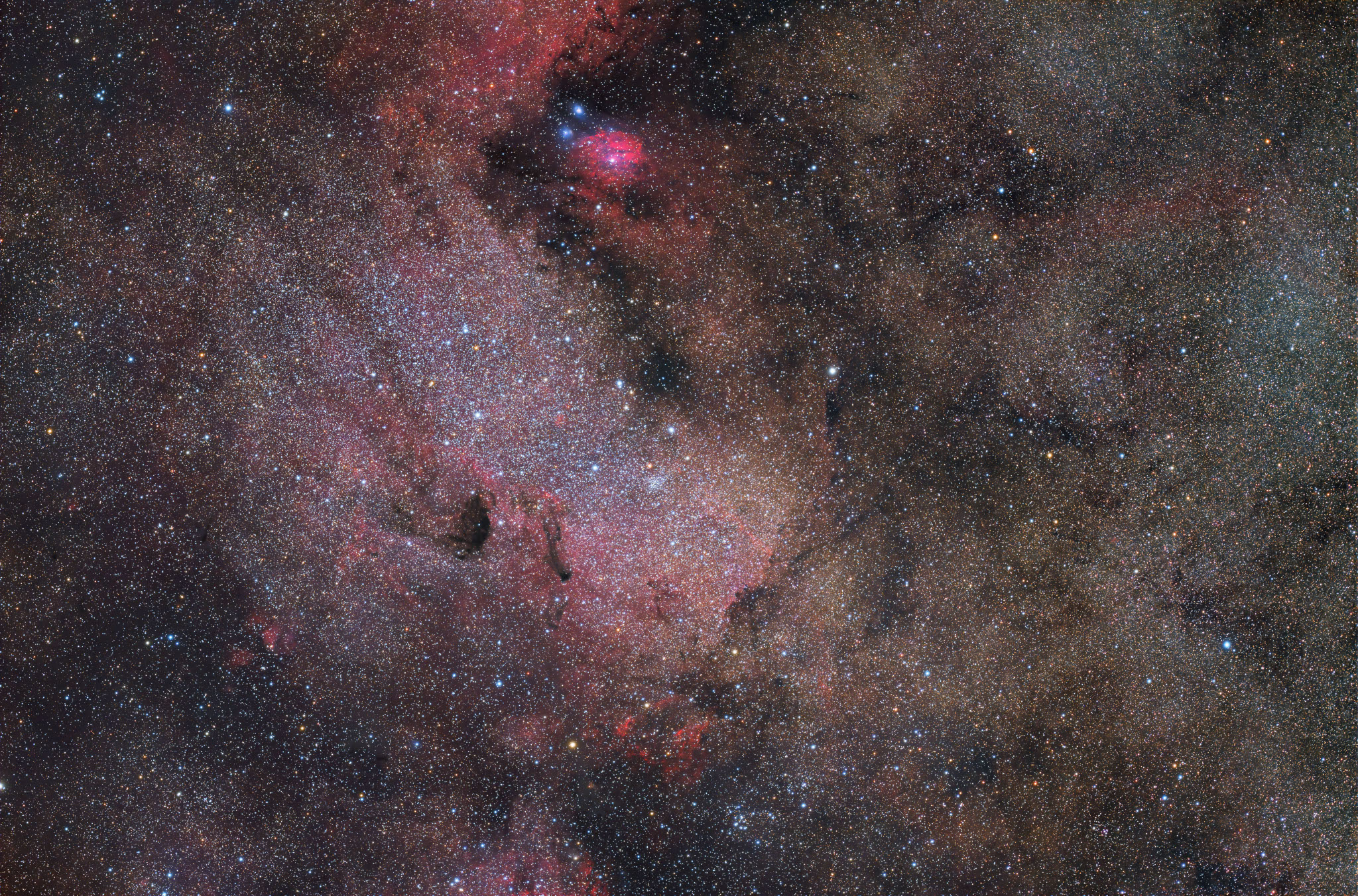 Image Credit & Copyright: Christopher Freeburn
Unlike most entries in Charles Messier's famous catalog of deep sky objects, M24 is not a bright galaxy, star cluster, or nebula. It's a gap in nearby, obscuring interstellar dust clouds that allows a view of the distant stars in the Sagittarius spiral arm of our Milky Way galaxy. Direct your gaze through this gap with binoculars or small telescope and you are looking through a window over 300 light-years wide at stars some 10,000 light-years or more from Earth. Sometimes called the Small Sagittarius Star Cloud, M24's luminous stars are left of center in this gorgeous starscape. Covering over 6 degrees or the width of 12 full moons in the constellation Sagittarius, the telescopic field of view includes dark markings B92 and B93 near the center of M24, along with other clouds of dust and glowing nebulae toward the center of the Milky Way.
#APOD #Astrocosmos #Astroinformatics #Astroengineer #Planetarium
Image Credit & Copyright: Christopher Freeburn
Unlike most entries in Charles Messier's famous catalog of deep sky objects, M24 is not a bright galaxy, star cluster, or nebula. It's a gap in nearby, obscuring interstellar dust clouds that allows a view of the distant stars in the Sagittarius spiral arm of our Milky Way galaxy. Direct your gaze through this gap with binoculars or small telescope and you are looking through a window over 300 light-years wide at stars some 10,000 light-years or more from Earth. Sometimes called the Small Sagittarius Star Cloud, M24's luminous stars are left of center in this gorgeous starscape. Covering over 6 degrees or the width of 12 full moons in the constellation Sagittarius, the telescopic field of view includes dark markings B92 and B93 near the center of M24, along with other clouds of dust and glowing nebulae toward the center of the Milky Way.
#APOD #Astrocosmos #Astroinformatics #Astroengineer #Planetarium
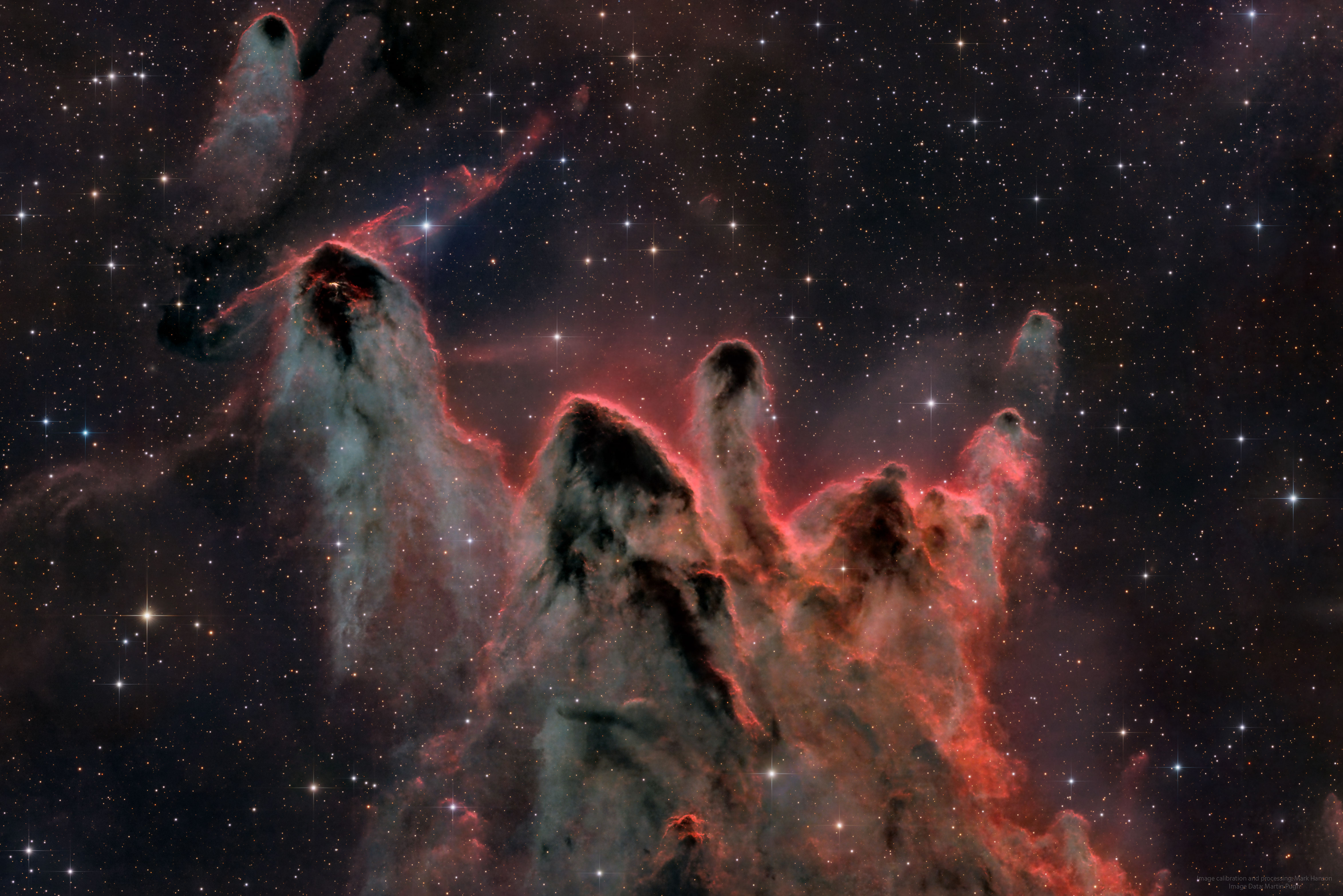 Image Credit & Copyright:
Mark Hanson &
Martin Pugh,
Observatorio El Sauce
What are these unusual interstellar structures? Bright-rimmed, flowing shapes gather near the center of this rich starfield toward the borders of the nautical southern constellations Pupis and Vela. Composed of interstellar gas and dust, the grouping of light-year sized cometary globules is about 1300 light-years distant. Energetic ultraviolet light from nearby hot stars has molded the globules and ionized their bright rims. The globules also stream away from the Vela supernova remnant which may have influenced their swept-back shapes. Within them, cores of cold gas and dust are likely collapsing to form low mass stars, whose formation will ultimately cause the globules to disperse. In fact, cometary globule CG 30 (on the upper left) sports a small reddish glow near its head, a telltale sign of energetic jets from a star in the early stages of formation.
#APOD #Cosmology #LunarMission #AstronomyPhotography #CosmicWonders
Image Credit & Copyright:
Mark Hanson &
Martin Pugh,
Observatorio El Sauce
What are these unusual interstellar structures? Bright-rimmed, flowing shapes gather near the center of this rich starfield toward the borders of the nautical southern constellations Pupis and Vela. Composed of interstellar gas and dust, the grouping of light-year sized cometary globules is about 1300 light-years distant. Energetic ultraviolet light from nearby hot stars has molded the globules and ionized their bright rims. The globules also stream away from the Vela supernova remnant which may have influenced their swept-back shapes. Within them, cores of cold gas and dust are likely collapsing to form low mass stars, whose formation will ultimately cause the globules to disperse. In fact, cometary globule CG 30 (on the upper left) sports a small reddish glow near its head, a telltale sign of energetic jets from a star in the early stages of formation.
#APOD #Cosmology #LunarMission #AstronomyPhotography #CosmicWonders
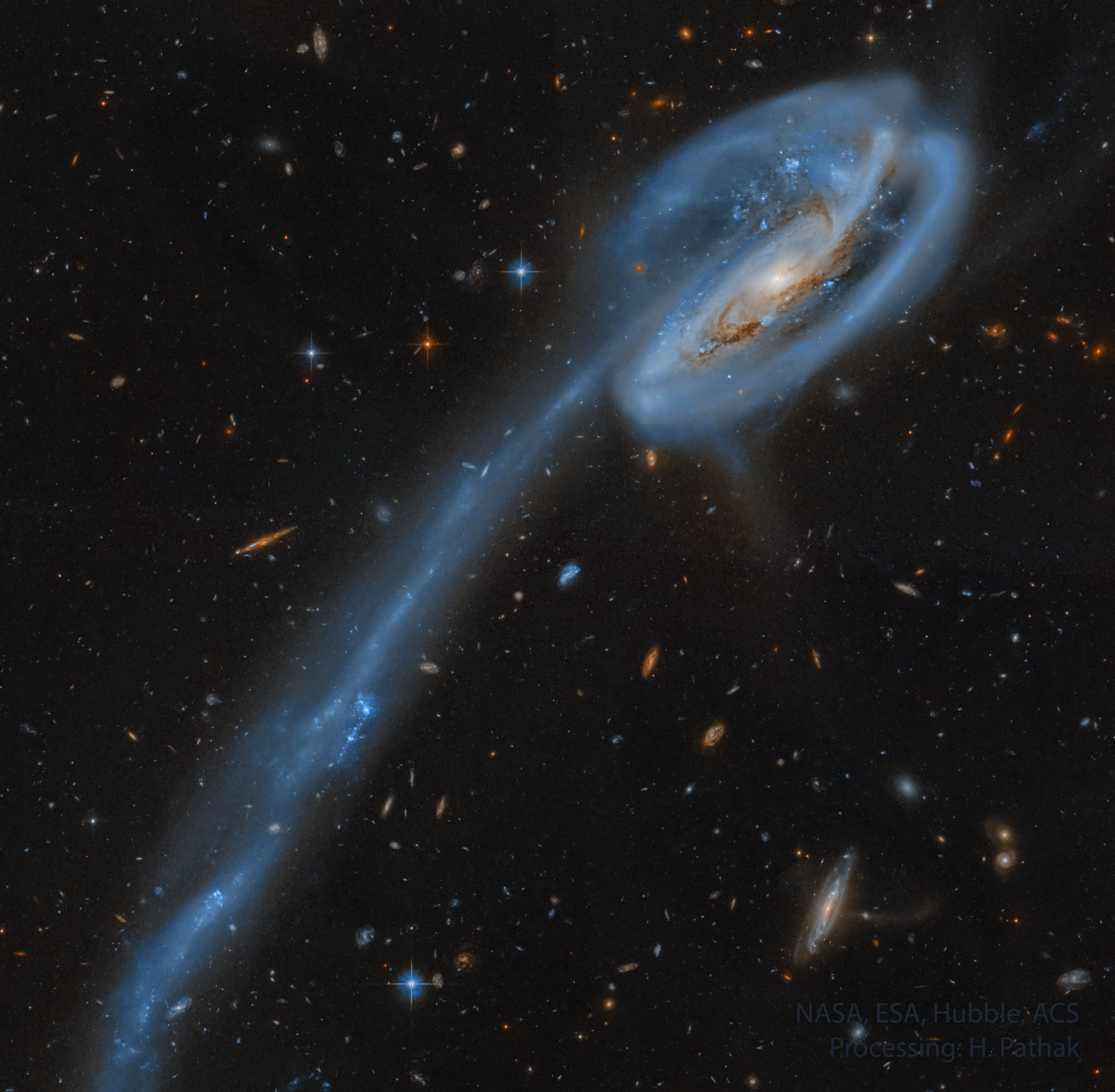 *Image creditor details unavailable via API. Visit linked page below for full info.*
Why does this galaxy have such a long tail? In this stunning vista, based on image data from the Hubble Legacy Archive, distant galaxies form a dramatic backdrop for disrupted spiral galaxy Arp 188, the Tadpole Galaxy. The cosmic tadpole is a mere 420 million light-years distant toward the northern constellation of the Dragon (Draco). Its eye-catching tail is about 280 thousand light-years long and features massive, bright blue star clusters. One story goes that a more compact intruder galaxy crossed in front of Arp 188 - from right to left in this view - and was slung around behind the Tadpole by their gravitational attraction. During the close encounter, tidal forces drew out the spiral galaxy's stars, gas, and dust forming the spectacular tail. The intruder galaxy itself, estimated to lie about 300 thousand light-years behind the Tadpole, can be seen through foreground spiral arms at the upper right. Following its terrestrial namesake, the Tadpole Galaxy will likely lose its tail as it grows older, the tail's star clusters forming smaller satellites of the large spiral galaxy. APOD in world languages: Arabic (IG), Bulgarian, Catalan, Chinese (Beijing), Chinese (Taiwan), Czech, Dutch, Farsi, French, German, Hebrew, Japanese, Portuguese, Russian, Serbian, Slovenian, Spanish, Taiwanese, Turkish, and Ukrainian
#APOD #Astrozone #PlanetExploration #Astronauts #AstronomyFacts
*Image creditor details unavailable via API. Visit linked page below for full info.*
Why does this galaxy have such a long tail? In this stunning vista, based on image data from the Hubble Legacy Archive, distant galaxies form a dramatic backdrop for disrupted spiral galaxy Arp 188, the Tadpole Galaxy. The cosmic tadpole is a mere 420 million light-years distant toward the northern constellation of the Dragon (Draco). Its eye-catching tail is about 280 thousand light-years long and features massive, bright blue star clusters. One story goes that a more compact intruder galaxy crossed in front of Arp 188 - from right to left in this view - and was slung around behind the Tadpole by their gravitational attraction. During the close encounter, tidal forces drew out the spiral galaxy's stars, gas, and dust forming the spectacular tail. The intruder galaxy itself, estimated to lie about 300 thousand light-years behind the Tadpole, can be seen through foreground spiral arms at the upper right. Following its terrestrial namesake, the Tadpole Galaxy will likely lose its tail as it grows older, the tail's star clusters forming smaller satellites of the large spiral galaxy. APOD in world languages: Arabic (IG), Bulgarian, Catalan, Chinese (Beijing), Chinese (Taiwan), Czech, Dutch, Farsi, French, German, Hebrew, Japanese, Portuguese, Russian, Serbian, Slovenian, Spanish, Taiwanese, Turkish, and Ukrainian
#APOD #Astrozone #PlanetExploration #Astronauts #AstronomyFacts
 Image Credit & Copyright:
Aman Chokshi
The galaxy was never in danger. For one thing, the Triangulum galaxy (M33), pictured, is much bigger than the tiny grain of rock at the head of the meteor. For another, the galaxy is much farther away -- in this instance 3 million light years as opposed to only about 0.0003 light seconds. Even so, the meteor's path took it angularly below the galaxy. Also the wind high in Earth's atmosphere blew the meteor's glowing evaporative molecule train away from the galaxy, in angular projection. Still, the astrophotographer was quite lucky to capture both a meteor and a galaxy in a single exposure -- which was subsequently added to two other images of M33 to bring up the spiral galaxy's colors. At the end, the meteor was gone in a second, but the galaxy will last billions of years. Your Sky Surprise: What picture did APOD feature on your birthday? (post 1995)
#APOD #Planetarium #BlackHoleDiscovery #Astrogeek #SpaceTechnology
Image Credit & Copyright:
Aman Chokshi
The galaxy was never in danger. For one thing, the Triangulum galaxy (M33), pictured, is much bigger than the tiny grain of rock at the head of the meteor. For another, the galaxy is much farther away -- in this instance 3 million light years as opposed to only about 0.0003 light seconds. Even so, the meteor's path took it angularly below the galaxy. Also the wind high in Earth's atmosphere blew the meteor's glowing evaporative molecule train away from the galaxy, in angular projection. Still, the astrophotographer was quite lucky to capture both a meteor and a galaxy in a single exposure -- which was subsequently added to two other images of M33 to bring up the spiral galaxy's colors. At the end, the meteor was gone in a second, but the galaxy will last billions of years. Your Sky Surprise: What picture did APOD feature on your birthday? (post 1995)
#APOD #Planetarium #BlackHoleDiscovery #Astrogeek #SpaceTechnology
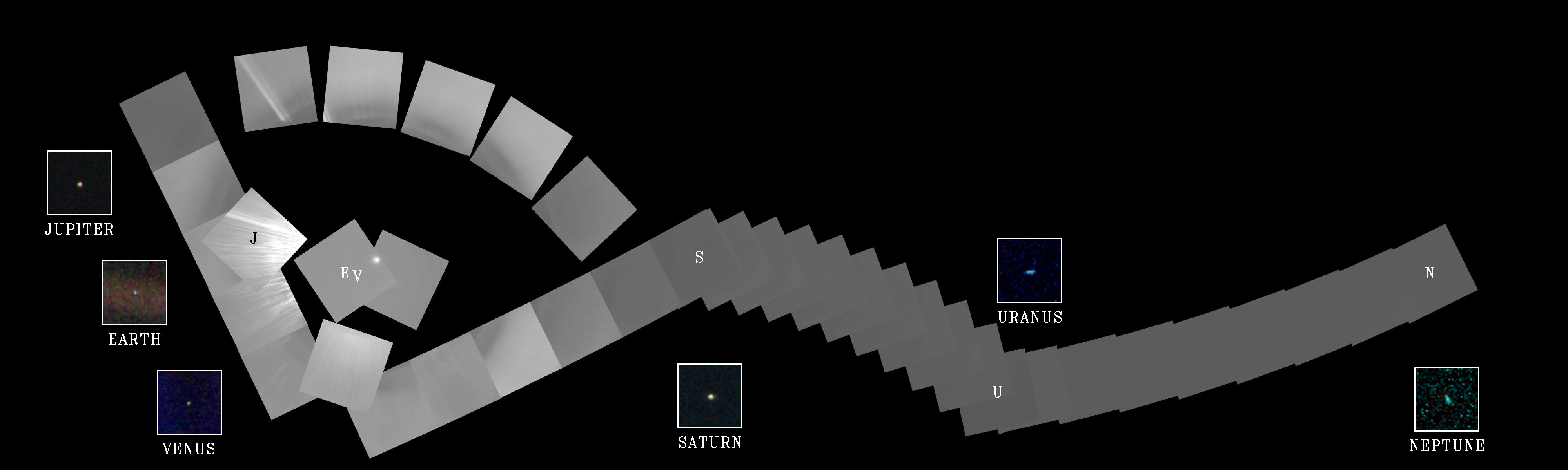 *Image creditor details unavailable via API. Visit linked page below for full info.*
In 1990, cruising four billion miles from the Sun, the Voyager 1 spacecraft looked back to make this first ever Solar System family portrait. The complete portrait is a 60 frame mosaic made from a vantage point 32 degrees above the ecliptic plane. In it, Voyager's wide-angle camera frames sweep through the inner Solar System at the left, linking up with ice giant Neptune, the Solar System's outermost planet, at the far right. Positions for Venus, Earth, Jupiter, Saturn, Uranus, and Neptune are indicated by letters, while the Sun is the bright spot near the center of the circle of frames. The inset frames for each of the planets are from Voyager's narrow-field camera. Unseen in the portrait are Mercury, too close to the Sun to be detected, and Mars, unfortunately hidden by sunlight scattered in the camera's optical system. Closer to the Sun than Neptune at the time, small, faint Pluto's position was not covered. In 2024 Voyager 1, NASA’s longest-running and most-distant spacecraft, is some 15 billion miles away, operating in interstellar space.
#APOD #SpaceExploration #SpaceDiscovery #Astrospace #AstronomyFacts
*Image creditor details unavailable via API. Visit linked page below for full info.*
In 1990, cruising four billion miles from the Sun, the Voyager 1 spacecraft looked back to make this first ever Solar System family portrait. The complete portrait is a 60 frame mosaic made from a vantage point 32 degrees above the ecliptic plane. In it, Voyager's wide-angle camera frames sweep through the inner Solar System at the left, linking up with ice giant Neptune, the Solar System's outermost planet, at the far right. Positions for Venus, Earth, Jupiter, Saturn, Uranus, and Neptune are indicated by letters, while the Sun is the bright spot near the center of the circle of frames. The inset frames for each of the planets are from Voyager's narrow-field camera. Unseen in the portrait are Mercury, too close to the Sun to be detected, and Mars, unfortunately hidden by sunlight scattered in the camera's optical system. Closer to the Sun than Neptune at the time, small, faint Pluto's position was not covered. In 2024 Voyager 1, NASA’s longest-running and most-distant spacecraft, is some 15 billion miles away, operating in interstellar space.
#APOD #SpaceExploration #SpaceDiscovery #Astrospace #AstronomyFacts
 Image Credit & Copyright: Team OURANOS
Planetary nebula Jones-Emberson 1 is the death shroud of a dying Sun-like star. It lies some 1,600 light-years from Earth toward the sharp-eyed constellation Lynx. About 4 light-years across, the expanding remnant of the dying star's atmosphere was shrugged off into interstellar space, as the star's central supply of hydrogen and then helium for fusion was depleted after billions of years. Visible near the center of the planetary nebula is what remains of the stellar core, a blue-hot white dwarf star. Also known as PK 164 +31.1, the nebula is faint and very difficult to glimpse at a telescope's eyepiece. But this deep image combining over 12 hours of exposure time does show it off in exceptional detail. Stars within our own Milky Way galaxy as well as background galaxies across the universe are scattered through the clear field of view. Ephemeral on the cosmic stage, Jones-Emberson 1 will fade away over the next few thousand years. Its hot, central white dwarf star will take billions of years to cool.
#APOD #SpaceAdventures #AstronautLife #SpaceObservatory #SpaceWeather
Image Credit & Copyright: Team OURANOS
Planetary nebula Jones-Emberson 1 is the death shroud of a dying Sun-like star. It lies some 1,600 light-years from Earth toward the sharp-eyed constellation Lynx. About 4 light-years across, the expanding remnant of the dying star's atmosphere was shrugged off into interstellar space, as the star's central supply of hydrogen and then helium for fusion was depleted after billions of years. Visible near the center of the planetary nebula is what remains of the stellar core, a blue-hot white dwarf star. Also known as PK 164 +31.1, the nebula is faint and very difficult to glimpse at a telescope's eyepiece. But this deep image combining over 12 hours of exposure time does show it off in exceptional detail. Stars within our own Milky Way galaxy as well as background galaxies across the universe are scattered through the clear field of view. Ephemeral on the cosmic stage, Jones-Emberson 1 will fade away over the next few thousand years. Its hot, central white dwarf star will take billions of years to cool.
#APOD #SpaceAdventures #AstronautLife #SpaceObservatory #SpaceWeather