
**Astronomy Picture of the Day**
11 March 2026
**Sky Glows over Paranal Observatory**
 Image Credit: Julien Looten
Explanation:
Are lasers from giant telescopes being used to defend the Earth?
No.
Lasers shot
from telescopes are now commonly used to help increase the accuracy of astronomical observations.
In some directions, Earth atmosphere-induced
fluctuations in starlight can indicate how the
air mass over a
telescope is changing, but in other directions, no bright star exists.
In these directions, astronomers can create an
artificial star with a
laser.
Subsequent observations of the artificial
laser guide star can reveal information so detailed
about the changing blurring effects of the
Earth's atmosphere that much of it
can be removed by rapidly flexing a telescope's mirror.
Such adaptive optics techniques allow high-resolution ground-based observations of
real stars,
planets, and
nebulas.
Pictured here, telescopes at
Paranal
Observatory in
Chile
study a colorful sky filled with green
airglow and the
Magellanic Clouds on the left, red
airglow on the right,
and the majestic central band of our
Milky Way Galaxy
arching across the center.
#APOD #ParanalObservatory #LaserGuideStar #AdaptiveOptics #Telescope #Astronomy
Image Credit: Julien Looten
Explanation:
Are lasers from giant telescopes being used to defend the Earth?
No.
Lasers shot
from telescopes are now commonly used to help increase the accuracy of astronomical observations.
In some directions, Earth atmosphere-induced
fluctuations in starlight can indicate how the
air mass over a
telescope is changing, but in other directions, no bright star exists.
In these directions, astronomers can create an
artificial star with a
laser.
Subsequent observations of the artificial
laser guide star can reveal information so detailed
about the changing blurring effects of the
Earth's atmosphere that much of it
can be removed by rapidly flexing a telescope's mirror.
Such adaptive optics techniques allow high-resolution ground-based observations of
real stars,
planets, and
nebulas.
Pictured here, telescopes at
Paranal
Observatory in
Chile
study a colorful sky filled with green
airglow and the
Magellanic Clouds on the left, red
airglow on the right,
and the majestic central band of our
Milky Way Galaxy
arching across the center.
#APOD #ParanalObservatory #LaserGuideStar #AdaptiveOptics #Telescope #Astronomy
Image Credit: Julien Looten
Explanation:
Are lasers from giant telescopes being used to defend the Earth?
No.
Lasers shot
from telescopes are now commonly used to help increase the accuracy of astronomical observations.
In some directions, Earth atmosphere-induced
fluctuations in starlight can indicate how the
air mass over a
telescope is changing, but in other directions, no bright star exists.
In these directions, astronomers can create an
artificial star with a
laser.
Subsequent observations of the artificial
laser guide star can reveal information so detailed
about the changing blurring effects of the
Earth's atmosphere that much of it
can be removed by rapidly flexing a telescope's mirror.
Such adaptive optics techniques allow high-resolution ground-based observations of
real stars,
planets, and
nebulas.
Pictured here, telescopes at
Paranal
Observatory in
Chile
study a colorful sky filled with green
airglow and the
Magellanic Clouds on the left, red
airglow on the right,
and the majestic central band of our
Milky Way Galaxy
arching across the center.
#APOD #ParanalObservatory #LaserGuideStar #AdaptiveOptics #Telescope #Astronomy
APOD: 2026 March 10 – Sky Glows over Paranal Observatory
A different astronomy and space science
related image is featured each day, along with a brief explanation.
 Image Credit: NASA, ESA, CSA, STScI, J. DePasquale, STScI
Explanation:
What's going on inside the head of this nebula?
Dubbed the Exposed
Cranium Nebula for its similarity to the human brain,
what created the nebula remains a mystery.
One thought is that the Cranium Nebula, also known as PMR 1, is a
planetary nebula surrounding a
white dwarf star.
In this mode, the outer atmosphere was expelled when the original
Sun-like star ran out of
central nuclear fuel and contracted.
A competing thought is that the central star is much more massive,
possibly a
Wolf-Rayet star,
that is ejecting gas and
dust via turbulent
stellar winds.
Adding to the
intrigue is the dark vertical central division
and the thin outer gaseous shell.
The featured image was taken by the
Webb Space Telescope in
mid-
infrared light, while a second image, included as a rollover,
is in near-infrared.
Future observations may reveal if this brainy system
will quietly just fade from view or, many years from now,
suddenly erupt in a powerful
supernova.
#APOD #CraniumNebula #WebbTelescope #jwst #DeepSpace #InterstellarGas
Image Credit: NASA, ESA, CSA, STScI, J. DePasquale, STScI
Explanation:
What's going on inside the head of this nebula?
Dubbed the Exposed
Cranium Nebula for its similarity to the human brain,
what created the nebula remains a mystery.
One thought is that the Cranium Nebula, also known as PMR 1, is a
planetary nebula surrounding a
white dwarf star.
In this mode, the outer atmosphere was expelled when the original
Sun-like star ran out of
central nuclear fuel and contracted.
A competing thought is that the central star is much more massive,
possibly a
Wolf-Rayet star,
that is ejecting gas and
dust via turbulent
stellar winds.
Adding to the
intrigue is the dark vertical central division
and the thin outer gaseous shell.
The featured image was taken by the
Webb Space Telescope in
mid-
infrared light, while a second image, included as a rollover,
is in near-infrared.
Future observations may reveal if this brainy system
will quietly just fade from view or, many years from now,
suddenly erupt in a powerful
supernova.
#APOD #CraniumNebula #WebbTelescope #jwst #DeepSpace #InterstellarGas
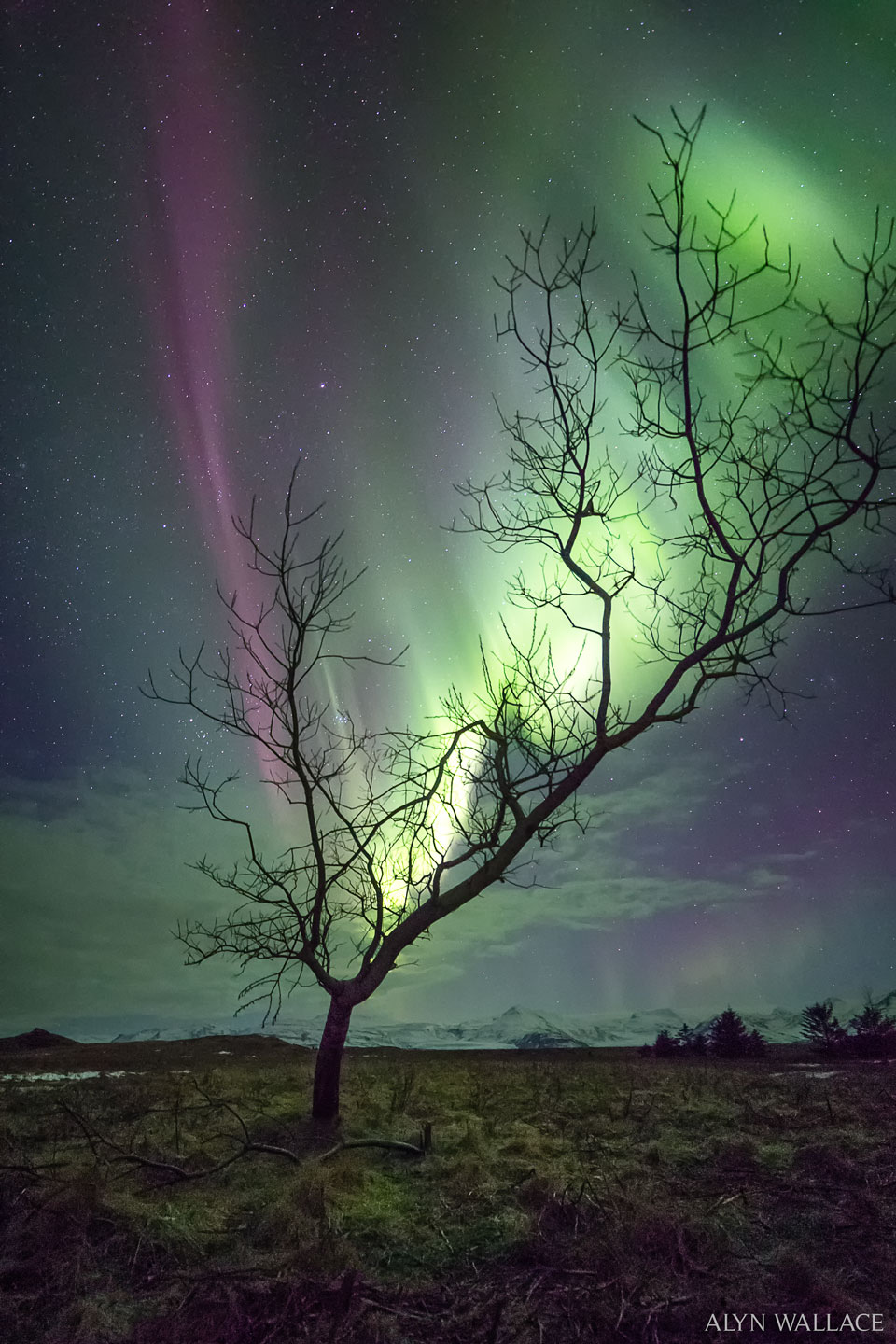 Image Credit: Alyn Wallace
Explanation:
Yes, but can your tree do this?
Pictured is a visual coincidence between the
dark branches of a nearby tree and bright glow of a distant aurora.
The beauty of the
aurora --
combined with how it seemed to mimic a
tree right nearby --
mesmerized the photographer to such a degree that
he momentarily forgot to take pictures.
When viewed at the
right angle, it seemed that this tree had aurora for leaves.
Fortunately, before the aurora morphed into a
different
overall
shape,
he came to his senses and captured the awe-inspiring
momentary coincidence.
Typically triggered by
solar explosions,
aurora are caused by high energy
electrons
impacting the
Earth's atmosphere around 150 kilometers up.
The unusual Earth-sky collaboration was witnessed in March of 2017 in
Iceland.
#APOD #AuroraTree #Aurora #NorthernLights #SolarStorm #Space
Image Credit: Alyn Wallace
Explanation:
Yes, but can your tree do this?
Pictured is a visual coincidence between the
dark branches of a nearby tree and bright glow of a distant aurora.
The beauty of the
aurora --
combined with how it seemed to mimic a
tree right nearby --
mesmerized the photographer to such a degree that
he momentarily forgot to take pictures.
When viewed at the
right angle, it seemed that this tree had aurora for leaves.
Fortunately, before the aurora morphed into a
different
overall
shape,
he came to his senses and captured the awe-inspiring
momentary coincidence.
Typically triggered by
solar explosions,
aurora are caused by high energy
electrons
impacting the
Earth's atmosphere around 150 kilometers up.
The unusual Earth-sky collaboration was witnessed in March of 2017 in
Iceland.
#APOD #AuroraTree #Aurora #NorthernLights #SolarStorm #Space
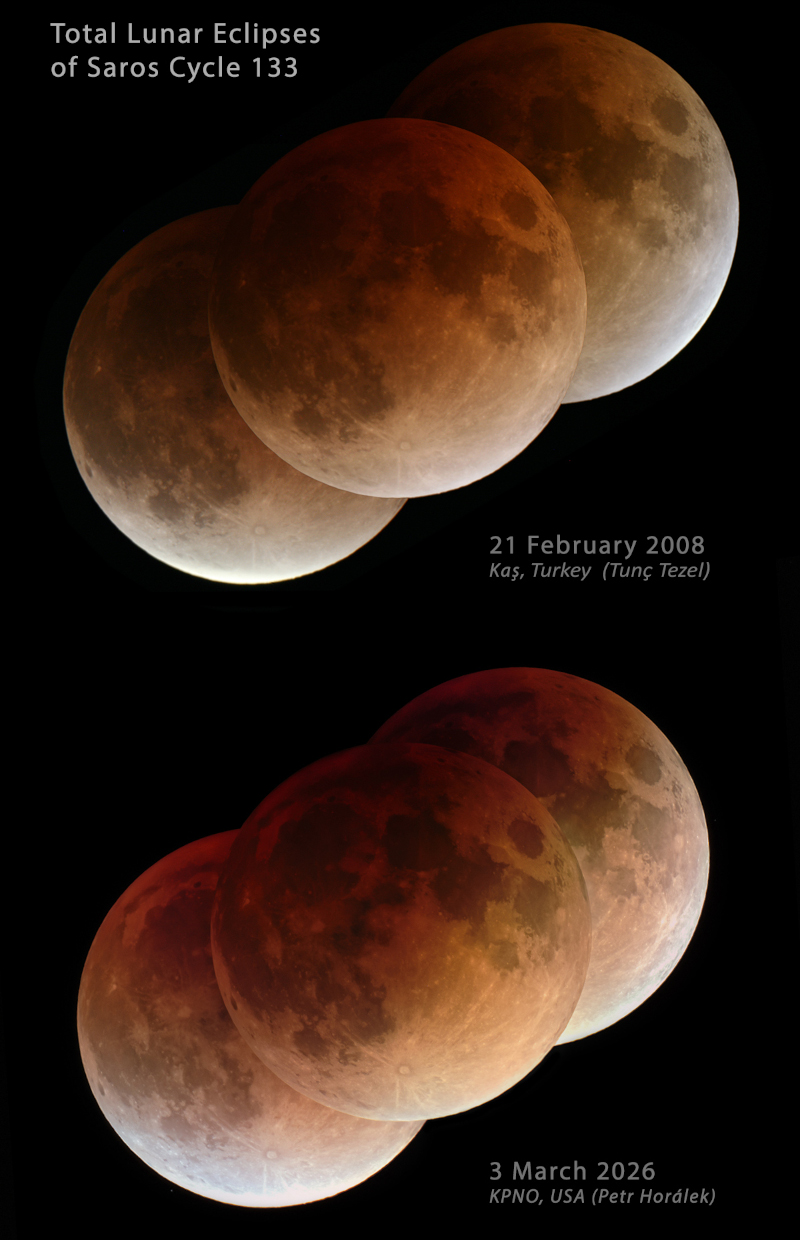 Image Credit: Tunc Tezel, TWAN, Petr Horalek, Institute of Physics in Opava, NOIRLab
Explanation:
Centered on maximum eclipse,
these two total lunar eclipse sequences look almost identical.
Yet the one shown on top is composed of images recorded in
February 2008, while at the bottom is the recent
March 2026 total eclipse
of the Moon.
Why are they so similar?
Because these two total lunar eclipses are from the same Saros cycle.
The Saros cycle
was discovered
historically
from observations of the Moon's orbit.
With a period of 18 years, 11 and 1/3 days,
the cycle predicts when the Sun, Earth,
and Moon all return to the same relative
geometry for a lunar
(or solar) eclipse.
Eclipses separated by one Saros period belong to
the same numbered Saros series, in this case Saros 133.
So expect the next
lunar eclipse in Saros 133 to be
a repeat of this year's March 3 eclipse.
You can watch the next Saros 133 total lunar eclipse on
March 13, 2044.
#APOD #lunarEclipse #Saros133 #TotalLunarEclipse #MoonEvent #CelestialEvent
Image Credit: Tunc Tezel, TWAN, Petr Horalek, Institute of Physics in Opava, NOIRLab
Explanation:
Centered on maximum eclipse,
these two total lunar eclipse sequences look almost identical.
Yet the one shown on top is composed of images recorded in
February 2008, while at the bottom is the recent
March 2026 total eclipse
of the Moon.
Why are they so similar?
Because these two total lunar eclipses are from the same Saros cycle.
The Saros cycle
was discovered
historically
from observations of the Moon's orbit.
With a period of 18 years, 11 and 1/3 days,
the cycle predicts when the Sun, Earth,
and Moon all return to the same relative
geometry for a lunar
(or solar) eclipse.
Eclipses separated by one Saros period belong to
the same numbered Saros series, in this case Saros 133.
So expect the next
lunar eclipse in Saros 133 to be
a repeat of this year's March 3 eclipse.
You can watch the next Saros 133 total lunar eclipse on
March 13, 2044.
#APOD #lunarEclipse #Saros133 #TotalLunarEclipse #MoonEvent #CelestialEvent
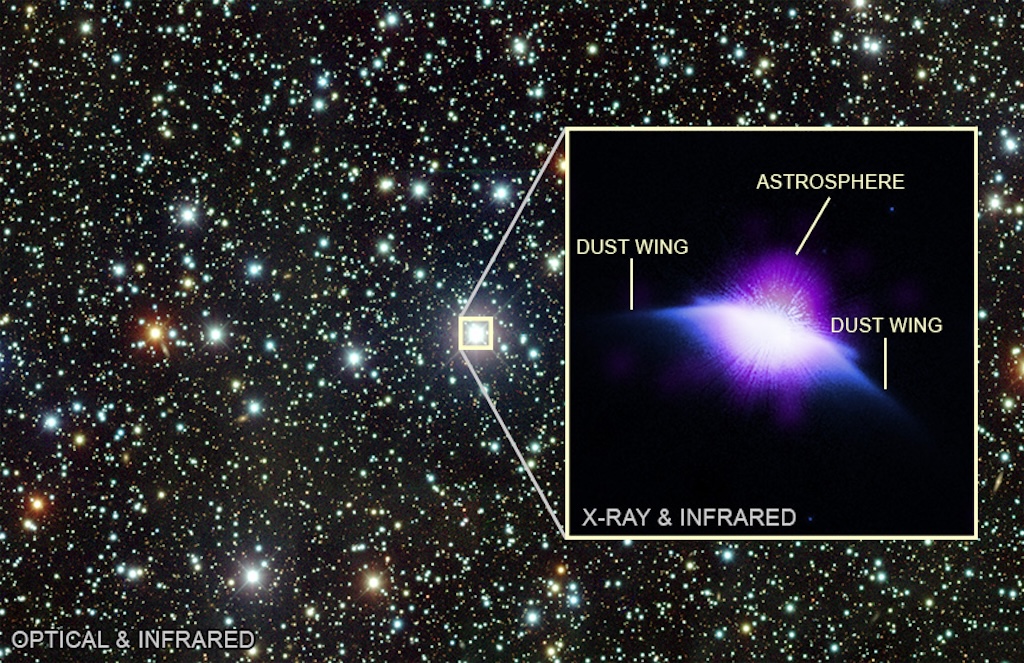 Image Credit: NASA, CXC, Johns Hopkins Univ., NASA, ESA, STIS, NSF, NoirLab, CTIO, DECaPS2, NASA, CXC, Cecilia Chirenti, NASA, GSFC, CRESST II
Explanation:
Do young stars blow bubbles?
The larger view shows a stellar field observed with the
Cerro Tololo Inter-American Observatory
in Chile, and the inset highlights
HD 61005,
a star like our Sun,
only 120 light-years
away.
Much
younger
than the Sun, at just about 100 million years old, it blows a fast and dense
stellar wind
that pushes out the cooler dust and gas that
surrounds it,
forming a bubble called an astrosphere.
The star-blown bubble was
detected
with the
Chandra
X-ray Observatory,
and it has a diameter roughly 200 times the
Earth-Sun distance.
Our Sun has a bubble too, called the
heliosphere, which
protects the planets from
cosmic radiation.
Also shown in the inset is
debris
left behind from star formation, observed by
Hubble.
The debris appears as
wings,
giving the star its nickname: the
Moth.
#APOD #HD61005 #Astrosphere #YoungStars #StellarWind #StellarWindBubbles
Image Credit: NASA, CXC, Johns Hopkins Univ., NASA, ESA, STIS, NSF, NoirLab, CTIO, DECaPS2, NASA, CXC, Cecilia Chirenti, NASA, GSFC, CRESST II
Explanation:
Do young stars blow bubbles?
The larger view shows a stellar field observed with the
Cerro Tololo Inter-American Observatory
in Chile, and the inset highlights
HD 61005,
a star like our Sun,
only 120 light-years
away.
Much
younger
than the Sun, at just about 100 million years old, it blows a fast and dense
stellar wind
that pushes out the cooler dust and gas that
surrounds it,
forming a bubble called an astrosphere.
The star-blown bubble was
detected
with the
Chandra
X-ray Observatory,
and it has a diameter roughly 200 times the
Earth-Sun distance.
Our Sun has a bubble too, called the
heliosphere, which
protects the planets from
cosmic radiation.
Also shown in the inset is
debris
left behind from star formation, observed by
Hubble.
The debris appears as
wings,
giving the star its nickname: the
Moth.
#APOD #HD61005 #Astrosphere #YoungStars #StellarWind #StellarWindBubbles
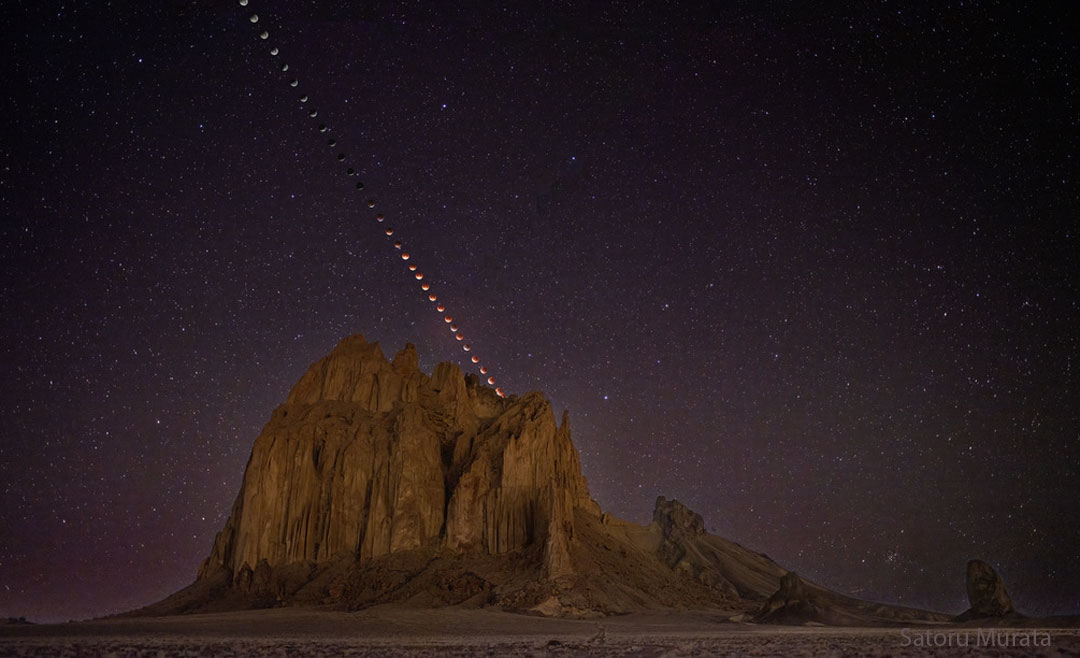 Image Credit: Satoru Murata, Keighley Rockcliffe, NASA, GSFC, CRESST II
Explanation:
Earlier this week, Earth’s shadow swept across the full Moon in the year’s only
total lunar eclipse.
This stunning sequence combines images showing the Moon’s path across the night sky.
Each lunar image captures our planet’s shadow gradually engulfing the Moon, culminating in its red glow.
Sunlight scatters and refracts as it passes through Earth’s atmosphere toward the Moon.
Shorter wavelength light (blue and green) scatters more efficiently, leaving
red, orange, and yellow hues to paint the lunar surface.
Tsé Bit'a'í (”rock with wings”, also known as Shiprock), located in
Navajo Nation, provides a powerful
volcanic foreground central to this photo and
to stories of Navajo origin, adventure, and heroism.
As the first full moon of the lunar new year, this eclipse held significance across cultures.
Visible from East Asia to North America, this eclipse united observers across great distances, a cosmic reminder that we share the same sky.
#APOD #TotalLunarEclipse #TséBit #Shiprock #Moon #EarthShadow
Image Credit: Satoru Murata, Keighley Rockcliffe, NASA, GSFC, CRESST II
Explanation:
Earlier this week, Earth’s shadow swept across the full Moon in the year’s only
total lunar eclipse.
This stunning sequence combines images showing the Moon’s path across the night sky.
Each lunar image captures our planet’s shadow gradually engulfing the Moon, culminating in its red glow.
Sunlight scatters and refracts as it passes through Earth’s atmosphere toward the Moon.
Shorter wavelength light (blue and green) scatters more efficiently, leaving
red, orange, and yellow hues to paint the lunar surface.
Tsé Bit'a'í (”rock with wings”, also known as Shiprock), located in
Navajo Nation, provides a powerful
volcanic foreground central to this photo and
to stories of Navajo origin, adventure, and heroism.
As the first full moon of the lunar new year, this eclipse held significance across cultures.
Visible from East Asia to North America, this eclipse united observers across great distances, a cosmic reminder that we share the same sky.
#APOD #TotalLunarEclipse #TséBit #Shiprock #Moon #EarthShadow
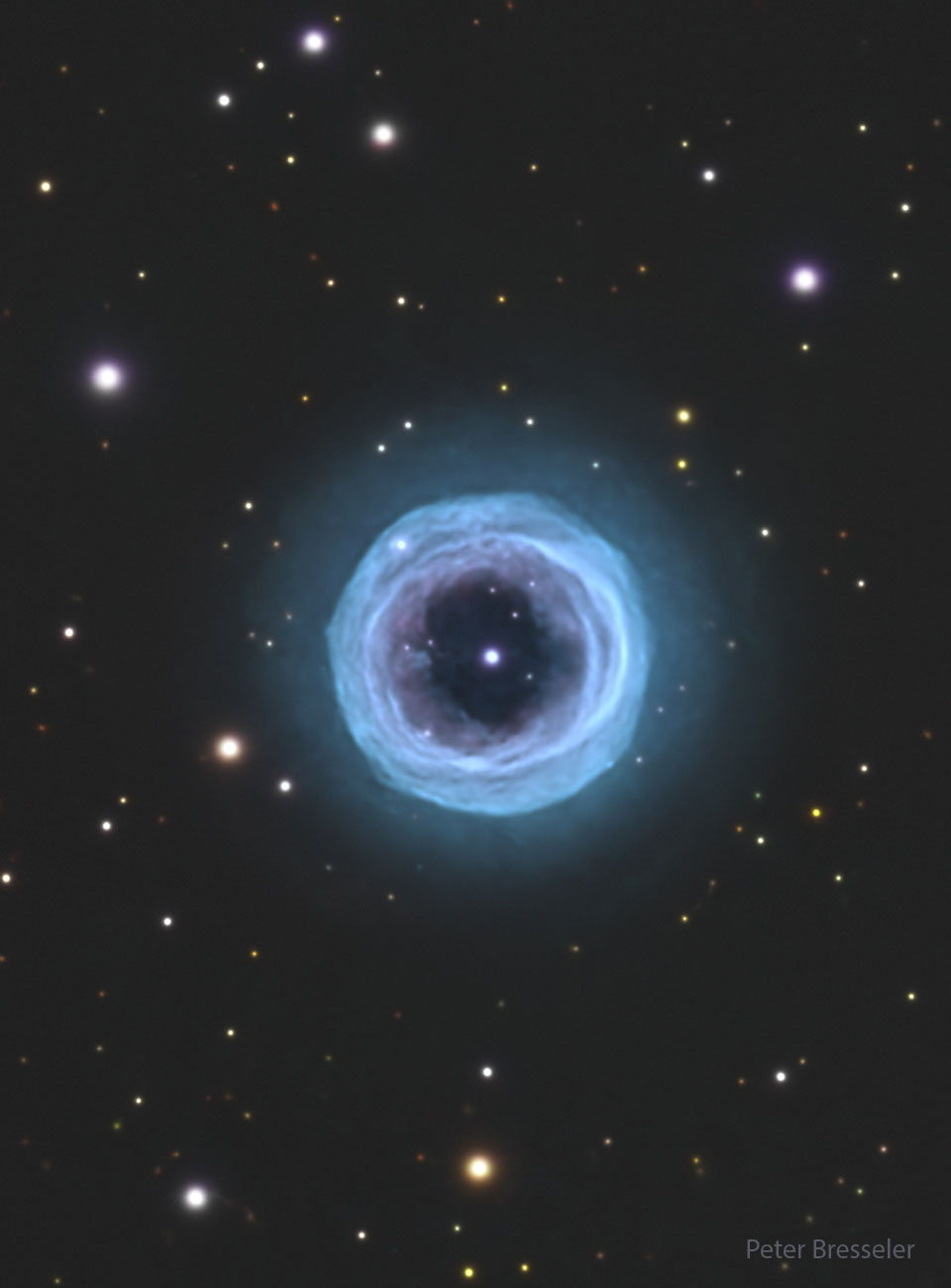 Image Credit: Peter Bresseler, Keighley Rockcliffe, NASA, GSFC, UMBC, CSST, CRESST II
Explanation:
What’s looking back at you isn’t a cosmic eye, but
Shapley 1,
a beautifully symmetric
planetary nebula.
Shapley 1, also known as the
Fine Ring Nebula or
PLN 329+2.1,
bejewels the southern sky constellation of the
Carpenter's Square
(Norma).
The nebula is the result of a star near the mass of our Sun
running out of fuel and shedding its outer layers.
Glowing oxygen from those expelled layers makes up the circular halo.
The bright central point is actually a binary: a
white dwarf, the remaining stellar core after the outer layers are expelled into space, and another star, orbiting each other every 2.9 days.
Shapley 1’s
annular shape is due to our
top-down view of the system and provides insight into the
influence of central stars on planetary nebula structures.
#APOD #Shapley1 #PlanetaryNebula #AnnularNebula #FineRingNebula #PNL329
Image Credit: Peter Bresseler, Keighley Rockcliffe, NASA, GSFC, UMBC, CSST, CRESST II
Explanation:
What’s looking back at you isn’t a cosmic eye, but
Shapley 1,
a beautifully symmetric
planetary nebula.
Shapley 1, also known as the
Fine Ring Nebula or
PLN 329+2.1,
bejewels the southern sky constellation of the
Carpenter's Square
(Norma).
The nebula is the result of a star near the mass of our Sun
running out of fuel and shedding its outer layers.
Glowing oxygen from those expelled layers makes up the circular halo.
The bright central point is actually a binary: a
white dwarf, the remaining stellar core after the outer layers are expelled into space, and another star, orbiting each other every 2.9 days.
Shapley 1’s
annular shape is due to our
top-down view of the system and provides insight into the
influence of central stars on planetary nebula structures.
#APOD #Shapley1 #PlanetaryNebula #AnnularNebula #FineRingNebula #PNL329
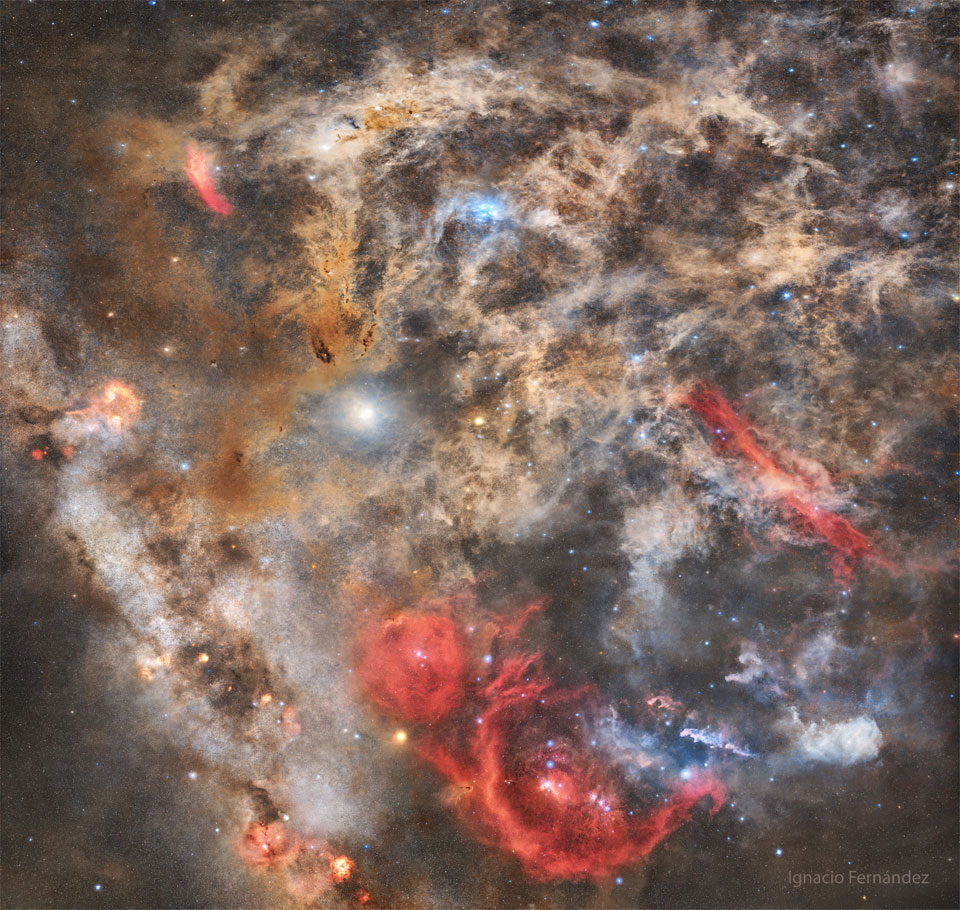 Image Credit: Ignacio Fernández
Explanation:
How well do you know the night sky?
OK, but how well can you identify famous sky objects in a
very deep image?
Either way, here is a test: see if you can find some well-known
night-sky icons
in a deep image filled with filaments of normally faint dust and gas.
This image
contains the
Pleiades star cluster,
Barnard's Loop,
Orion Nebula,
Aldebaran,
Betelgeuse,
Witch Head Nebula,
Eridanus Loop, and the
California Nebula.
To find their real locations,
here is an annotated image version.
The reason this
task might be difficult is similar to
the reason it is initially hard to identify familiar
constellations
in a very
dark sky:
the tapestry of our night sky has an extremely deep
hidden complexity.
The
featured composite
reveals some of
this complexity in a 16 hours of sky exposure in dark skies over
Granada,
Spain.
#APOD #Orion #Pleiades #Dust #Nebula #Stargazing
Image Credit: Ignacio Fernández
Explanation:
How well do you know the night sky?
OK, but how well can you identify famous sky objects in a
very deep image?
Either way, here is a test: see if you can find some well-known
night-sky icons
in a deep image filled with filaments of normally faint dust and gas.
This image
contains the
Pleiades star cluster,
Barnard's Loop,
Orion Nebula,
Aldebaran,
Betelgeuse,
Witch Head Nebula,
Eridanus Loop, and the
California Nebula.
To find their real locations,
here is an annotated image version.
The reason this
task might be difficult is similar to
the reason it is initially hard to identify familiar
constellations
in a very
dark sky:
the tapestry of our night sky has an extremely deep
hidden complexity.
The
featured composite
reveals some of
this complexity in a 16 hours of sky exposure in dark skies over
Granada,
Spain.
#APOD #Orion #Pleiades #Dust #Nebula #Stargazing
 Image Credit: Fabrizio Melandri
Explanation:
Fans of the western sky
after sunset have lately enjoyed this month's
remarkable array of bright planets.
Witnessed from some
locations, on February 18
planet Mercury even appeared to slide
behind the Moon, an event known as a lunar occultation.
These two snapshots, taken in early evening skies
show before and after telescopic views of the rare disappearance of
innermost planet
behind young Moon.
The top panel finds bright Mercury just visible at
the northern (right) edge of the
earthshine-illuminated
lunar disk.
In the bottom panel the bright planet has emerged in
darker skies beyond the Moon's sunlit crescent.
As seen south of Sallisaw, Oklahoma, planet Earth,
this lunar occultation of Mercury lasted only about 3 minutes
(video).
But you can still check out a parade of
planets tonight.
#APOD #lunaroccultation #mercury #Moon #celestialevent #astronomy
Image Credit: Fabrizio Melandri
Explanation:
Fans of the western sky
after sunset have lately enjoyed this month's
remarkable array of bright planets.
Witnessed from some
locations, on February 18
planet Mercury even appeared to slide
behind the Moon, an event known as a lunar occultation.
These two snapshots, taken in early evening skies
show before and after telescopic views of the rare disappearance of
innermost planet
behind young Moon.
The top panel finds bright Mercury just visible at
the northern (right) edge of the
earthshine-illuminated
lunar disk.
In the bottom panel the bright planet has emerged in
darker skies beyond the Moon's sunlit crescent.
As seen south of Sallisaw, Oklahoma, planet Earth,
this lunar occultation of Mercury lasted only about 3 minutes
(video).
But you can still check out a parade of
planets tonight.
#APOD #lunaroccultation #mercury #Moon #celestialevent #astronomy
 Image Credit: Katelyn Beecroft
Explanation:
Normally faint and elusive, the Jellyfish Nebula is caught in
this alluring telescopic field of view.
Floating in the interstellar sea, the nebula is
anchored right and left by two bright stars,
Mu and
Eta
Geminorum, at the foot of the
celestial twins.
The Jellyfish Nebula itself is right of center, seen as a brighter arcing
ridge of emission with dangling tentacles.
In fact, this cosmic jellyfish is part of bubble-shaped
supernova remnant IC 443, the expanding
debris cloud from a
massive star that exploded.
Light from the explosion first reached planet Earth over 30,000 years
ago.
Like its cousin in
astrophysical waters the
Crab Nebula
supernova remnant, the Jellyfish Nebula is
known
to harbor a neutron star, the
ultradense remnant of
the collapsed stellar core.
An emission nebula cataloged as
Sharpless
249 fills the field at the upper left.
The Jellyfish Nebula is about 5,000 light-years away.
At that distance, this image would be about 300 light-years across.
#APOD #Sharpless249 #JellyfishNebula #SupernovaRemnant #IC443 #NeutronStar
Image Credit: Katelyn Beecroft
Explanation:
Normally faint and elusive, the Jellyfish Nebula is caught in
this alluring telescopic field of view.
Floating in the interstellar sea, the nebula is
anchored right and left by two bright stars,
Mu and
Eta
Geminorum, at the foot of the
celestial twins.
The Jellyfish Nebula itself is right of center, seen as a brighter arcing
ridge of emission with dangling tentacles.
In fact, this cosmic jellyfish is part of bubble-shaped
supernova remnant IC 443, the expanding
debris cloud from a
massive star that exploded.
Light from the explosion first reached planet Earth over 30,000 years
ago.
Like its cousin in
astrophysical waters the
Crab Nebula
supernova remnant, the Jellyfish Nebula is
known
to harbor a neutron star, the
ultradense remnant of
the collapsed stellar core.
An emission nebula cataloged as
Sharpless
249 fills the field at the upper left.
The Jellyfish Nebula is about 5,000 light-years away.
At that distance, this image would be about 300 light-years across.
#APOD #Sharpless249 #JellyfishNebula #SupernovaRemnant #IC443 #NeutronStar
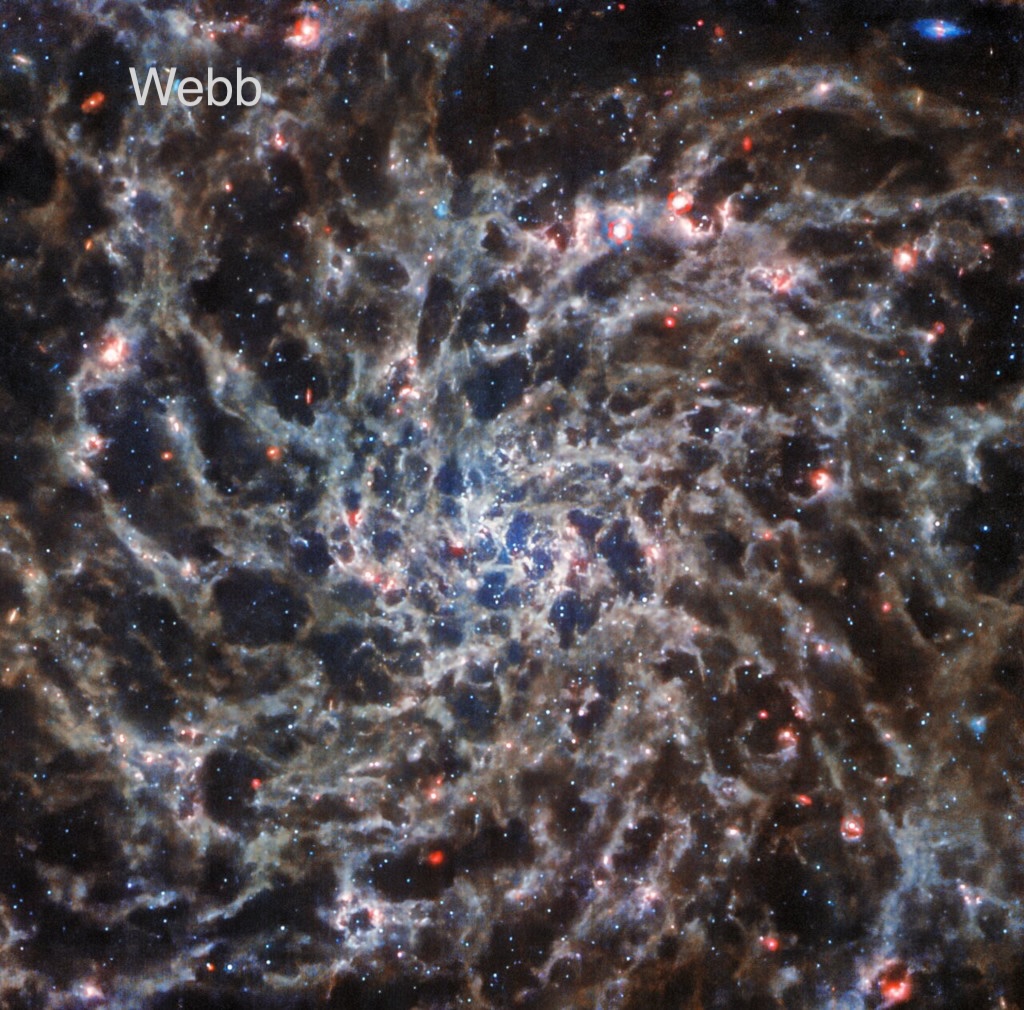 Image Credit: ESA/Webb, NASA, CSA, PHANGS-JWST and PHANGS-HST, Cecilia Chirenti, NASA, GSFC, CRESST II
Explanation:
What does the universe look like through
infrared goggles?
Our eyes can only see
visible light,
but astronomers want to see more.
Today’s APOD shows
spiral galaxy
IC 5332
as seen by two
NASA
telescopes:
Webb in
mid-infrared
and Hubble in
ultraviolet
and visible light.
To toggle between the two space-based views just slide your cursor over
the image
(or follow this link).
The Hubble image highlights the
spiral arms
of the galaxy separated by
dark
regions, whereas the Webb image reveals a finer, more tangled structure.
Interstellar dust
scatters and absorbs light from the stars in the galaxy,
causing the
dark dust lanes
in the Hubble image, and then emits heat in infrared light, so dust
glows
in this Webb image.
The
Mid-InfraRed Instrument
on Webb needs to operate at a chilling temperature of
-266ºC (or - 447ºF), otherwise it would detect infrared radiation from
the telescope itself.
Combining
these observations,
astronomers
connect the “small scale” of gas and stars to the truly large scale of
galactic structure and evolution.
#APOD #Hubble #JamesWebb #Infrared #InfraredAstronomy #DeepSpace
Image Credit: ESA/Webb, NASA, CSA, PHANGS-JWST and PHANGS-HST, Cecilia Chirenti, NASA, GSFC, CRESST II
Explanation:
What does the universe look like through
infrared goggles?
Our eyes can only see
visible light,
but astronomers want to see more.
Today’s APOD shows
spiral galaxy
IC 5332
as seen by two
NASA
telescopes:
Webb in
mid-infrared
and Hubble in
ultraviolet
and visible light.
To toggle between the two space-based views just slide your cursor over
the image
(or follow this link).
The Hubble image highlights the
spiral arms
of the galaxy separated by
dark
regions, whereas the Webb image reveals a finer, more tangled structure.
Interstellar dust
scatters and absorbs light from the stars in the galaxy,
causing the
dark dust lanes
in the Hubble image, and then emits heat in infrared light, so dust
glows
in this Webb image.
The
Mid-InfraRed Instrument
on Webb needs to operate at a chilling temperature of
-266ºC (or - 447ºF), otherwise it would detect infrared radiation from
the telescope itself.
Combining
these observations,
astronomers
connect the “small scale” of gas and stars to the truly large scale of
galactic structure and evolution.
#APOD #Hubble #JamesWebb #Infrared #InfraredAstronomy #DeepSpace
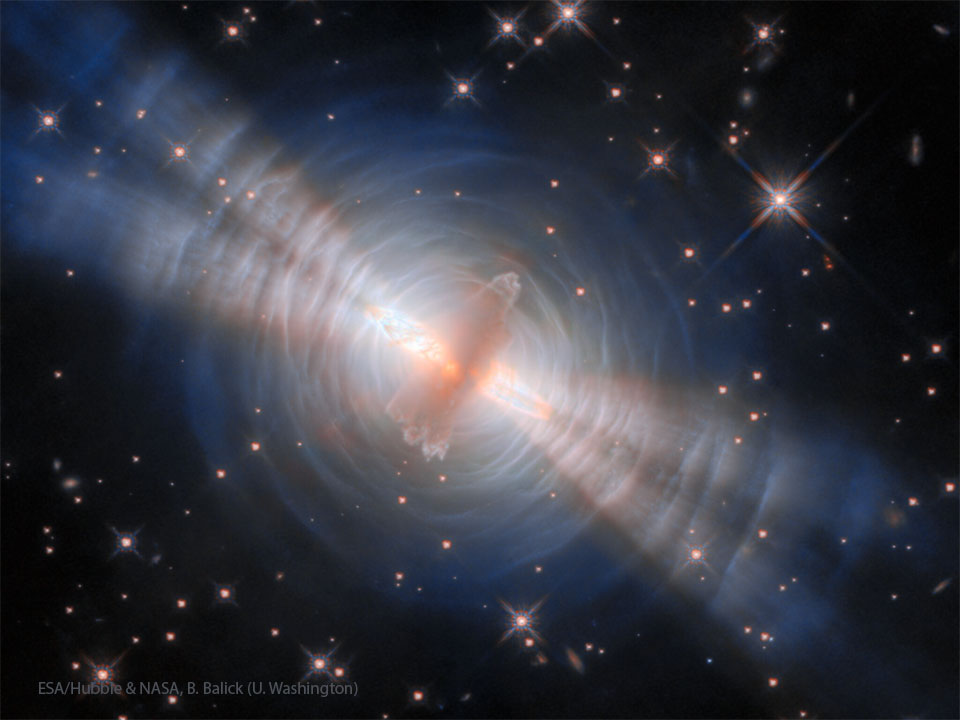 Image Credit: ESA/Hubble, NASA, B. Balick, U. Washington
Explanation:
Ever wonder what it would look like to crack open the Sun?
The
Egg Nebula, a dying
Sun-like star, can unscramble this question.
Pictured is a combination of several visible and
infrared images of the nebula
(also known as RAFGL 2688 or
CRL 2688) taken with the
Hubble Space Telescope.
The star has shed its outer layers, and a
bright, hot core
(or "yolk") now illuminates the milky "egg white"
shells
of gas and dust surrounding the center.
The central lobes and rings are structures of
gas and dust recently ejected into space,
with the dust being dense enough to block our view of the
stellar core.
Light beams emanate from that
blocked core,
escaping through holes carved in the
older ejected material by newer, faster
jets expelled from the
star’s poles.
Astronomers are
still trying to figure out what causes the disks, lobes, and jets during this short (only a few thousand years!) phase of the star’s
evolution, making this an egg-cellent image to study!
#APOD #EggNebula #HubbleSpaceTelescope #Nebula #Space #Astronomy
Image Credit: ESA/Hubble, NASA, B. Balick, U. Washington
Explanation:
Ever wonder what it would look like to crack open the Sun?
The
Egg Nebula, a dying
Sun-like star, can unscramble this question.
Pictured is a combination of several visible and
infrared images of the nebula
(also known as RAFGL 2688 or
CRL 2688) taken with the
Hubble Space Telescope.
The star has shed its outer layers, and a
bright, hot core
(or "yolk") now illuminates the milky "egg white"
shells
of gas and dust surrounding the center.
The central lobes and rings are structures of
gas and dust recently ejected into space,
with the dust being dense enough to block our view of the
stellar core.
Light beams emanate from that
blocked core,
escaping through holes carved in the
older ejected material by newer, faster
jets expelled from the
star’s poles.
Astronomers are
still trying to figure out what causes the disks, lobes, and jets during this short (only a few thousand years!) phase of the star’s
evolution, making this an egg-cellent image to study!
#APOD #EggNebula #HubbleSpaceTelescope #Nebula #Space #Astronomy
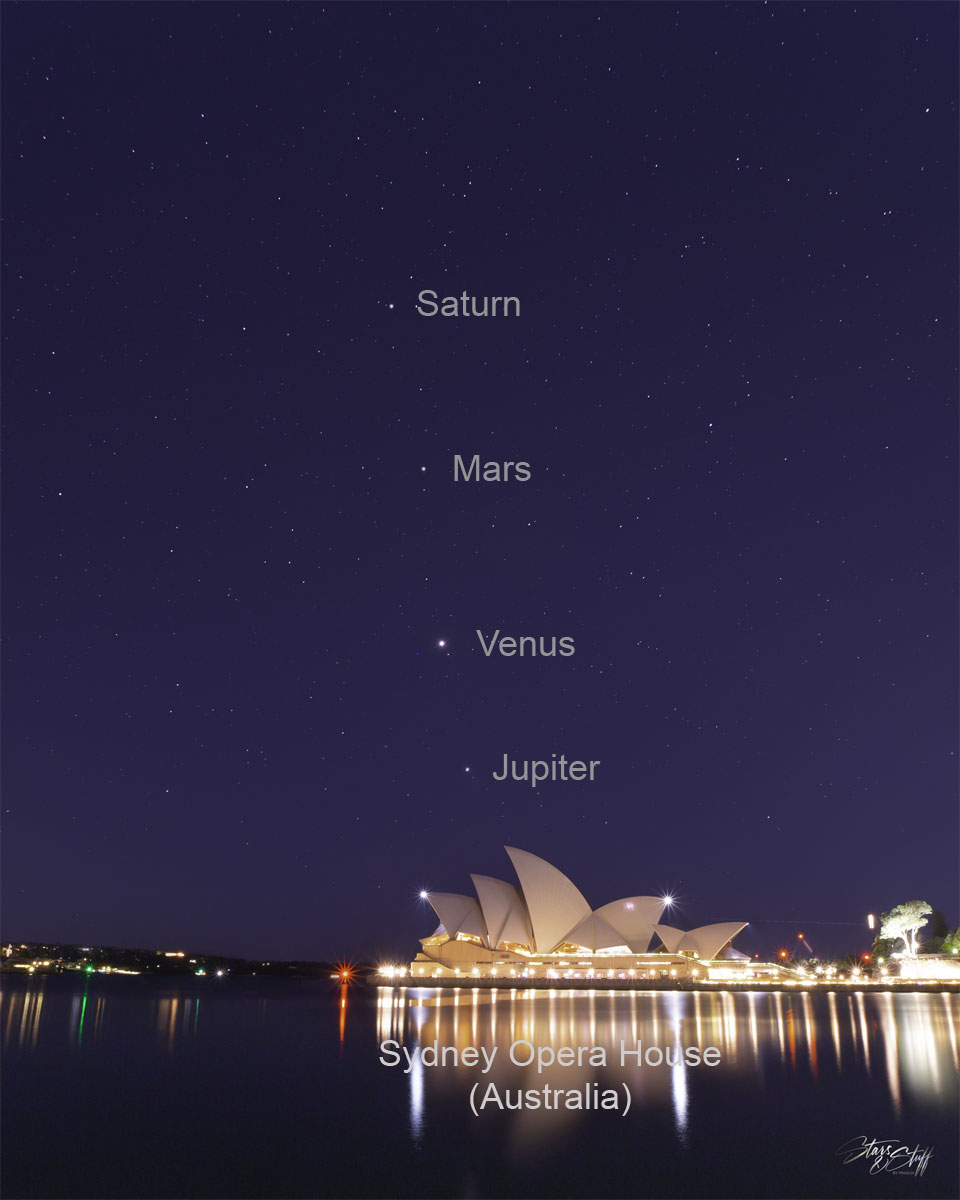 Image Credit: Prasun Agrawal
Explanation:
Look up this week and see a whole bunch of planets.
Just after sunset, looking west (mostly), planets
Mercury,
Venus,
Saturn, and
Jupiter
will all be visible to the unaided eye simultaneously.
If you have a telescope, planets
Uranus and
Neptune can also be seen.
In order up from the horizon, the lineup this week will be
Venus (the brightest),
Mercury,
Saturn,
Neptune, Uranus, and
Jupiter (second brightest).
It doesn't matter where on
Earth
you live because this early evening
planet parade will be visible through
clear skies all around the globe.
The planets will appear to be nearly in a line because they all orbit the
Sun in nearly the same plane: the
ecliptic.
The featured image shows a
similar planet parade that occurred in 2022,
captured over the
Sydney Opera House in southern
Australia.
Although
visible all week, the planets will be most easily seen together this weekend.
#APOD #PlanetParade #Sydney #Mercury #Venus #Saturn
Image Credit: Prasun Agrawal
Explanation:
Look up this week and see a whole bunch of planets.
Just after sunset, looking west (mostly), planets
Mercury,
Venus,
Saturn, and
Jupiter
will all be visible to the unaided eye simultaneously.
If you have a telescope, planets
Uranus and
Neptune can also be seen.
In order up from the horizon, the lineup this week will be
Venus (the brightest),
Mercury,
Saturn,
Neptune, Uranus, and
Jupiter (second brightest).
It doesn't matter where on
Earth
you live because this early evening
planet parade will be visible through
clear skies all around the globe.
The planets will appear to be nearly in a line because they all orbit the
Sun in nearly the same plane: the
ecliptic.
The featured image shows a
similar planet parade that occurred in 2022,
captured over the
Sydney Opera House in southern
Australia.
Although
visible all week, the planets will be most easily seen together this weekend.
#APOD #PlanetParade #Sydney #Mercury #Venus #Saturn
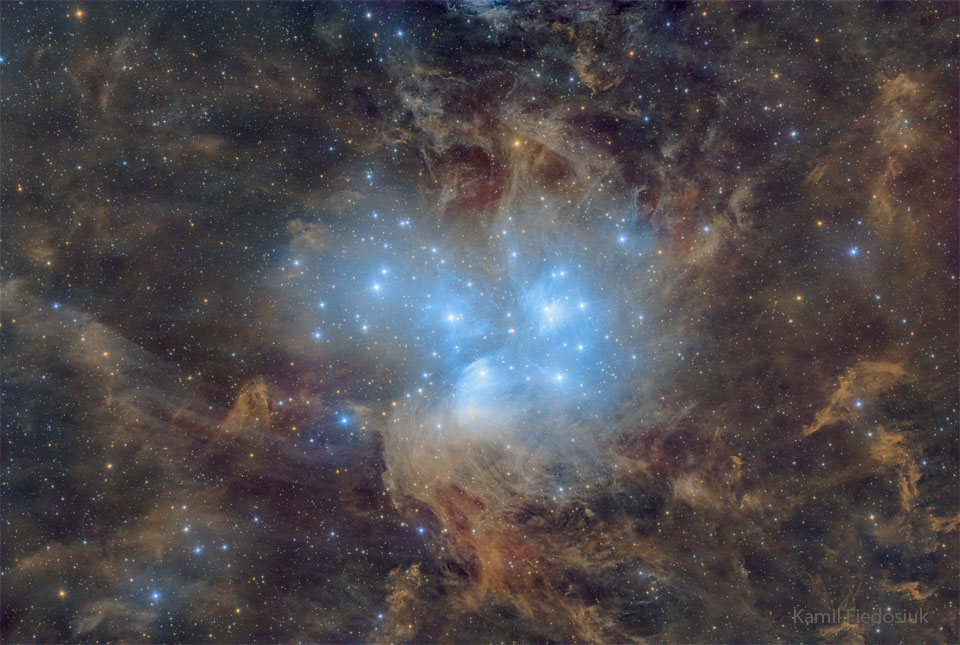 Image Credit: Kamil Fiedosiuk
Explanation:
Have you ever seen the Pleiades star cluster?
Even if you have, you probably have never seen it as large and clear as this.
Perhaps the most famous star cluster on the sky, the bright stars of the
Pleiades
can be seen with the unaided eye even from the depths of a
light-polluted city.
With a long exposure from a dark location, though,
the dust cloud surrounding the
Pleiades star
cluster becomes very evident.
The featured 18-hour exposure, taken from
Bory Tucholskie,
Poland
covers a sky area several times the size of the full
moon.
Also known as the Seven Sisters and
M45,
the Pleiades lies about
400 light years away toward the constellation of the Bull
(Taurus).
A common legend with a
modern twist is that one of the brighter stars faded since the cluster was named, leaving only six of the sister stars visible to the unaided eye.
The actual number of
Pleiades stars visible,
however, may be more or less than seven, depending on the
darkness of the surrounding sky and the
clarity of the observer's eyesight.
#APOD #Pleiades #SevenSisters #StarCluster #OpenCluster #Stargazing
Image Credit: Kamil Fiedosiuk
Explanation:
Have you ever seen the Pleiades star cluster?
Even if you have, you probably have never seen it as large and clear as this.
Perhaps the most famous star cluster on the sky, the bright stars of the
Pleiades
can be seen with the unaided eye even from the depths of a
light-polluted city.
With a long exposure from a dark location, though,
the dust cloud surrounding the
Pleiades star
cluster becomes very evident.
The featured 18-hour exposure, taken from
Bory Tucholskie,
Poland
covers a sky area several times the size of the full
moon.
Also known as the Seven Sisters and
M45,
the Pleiades lies about
400 light years away toward the constellation of the Bull
(Taurus).
A common legend with a
modern twist is that one of the brighter stars faded since the cluster was named, leaving only six of the sister stars visible to the unaided eye.
The actual number of
Pleiades stars visible,
however, may be more or less than seven, depending on the
darkness of the surrounding sky and the
clarity of the observer's eyesight.
#APOD #Pleiades #SevenSisters #StarCluster #OpenCluster #Stargazing
 Image Credit: NASA, JPL, Mars Exploration Rover Mission
Explanation:
What if you saw your shadow on Mars and it wasn't
human?
Then you might be the
Opportunity rover exploring Mars.
Opportunity explored the
Red Planet
from 2004 to 2018, finding
evidence of ancient water,
and sending breathtaking images across the inner
Solar System.
Pictured
here in 2004, Opportunity looks opposite the Sun into
Endurance Crater and sees its own
shadow.
Two wheels are visible on the lower left and right,
while the floor and walls of the unusual crater are
visible in the background.
Caught in a dust storm
in 2018,
Opportunity stopped responding,
and NASA stopped trying to contact it
in 2019 and declared the
ground-breaking mission,
originally planned for only 92 days,
complete.
#APOD #Mars #MarsRover #MartianShadow #MarsSurface #SpaceExploration
Image Credit: NASA, JPL, Mars Exploration Rover Mission
Explanation:
What if you saw your shadow on Mars and it wasn't
human?
Then you might be the
Opportunity rover exploring Mars.
Opportunity explored the
Red Planet
from 2004 to 2018, finding
evidence of ancient water,
and sending breathtaking images across the inner
Solar System.
Pictured
here in 2004, Opportunity looks opposite the Sun into
Endurance Crater and sees its own
shadow.
Two wheels are visible on the lower left and right,
while the floor and walls of the unusual crater are
visible in the background.
Caught in a dust storm
in 2018,
Opportunity stopped responding,
and NASA stopped trying to contact it
in 2019 and declared the
ground-breaking mission,
originally planned for only 92 days,
complete.
#APOD #Mars #MarsRover #MartianShadow #MarsSurface #SpaceExploration
 Image Credit: Tunc Tezel, TWAN
Explanation:
Only two days
after the February New Moon's annular eclipse of the Sun,
a slender lunar crescent poses
above the western horizon after sunset in this wintry twilight skyscape.
Its nightside faintly illuminated by earthshine, the young Moon is
joined by three bright planets
in the mostly clear, early evening skies above the village of
Kirazli, Turkiye.
Inner planet
Venus appears closest
to the horizon.
Near the beginning of its 2026 performance as planet Earth's evening star,
brilliant Venus is seen through the
warm sunset glare near picture center.
Straight above Venus, innermost planet
Mercury is easy to
spot as it stands remarkably high above the horizon even as
the twilight sky is growing dark.
Outer planet
Saturn,
most distant of the naked-eye planets,
is found just left of the Moon's sunlit crescent.
#APOD #Twilight #Moon #Planets #NewMoon #Eclipse
Image Credit: Tunc Tezel, TWAN
Explanation:
Only two days
after the February New Moon's annular eclipse of the Sun,
a slender lunar crescent poses
above the western horizon after sunset in this wintry twilight skyscape.
Its nightside faintly illuminated by earthshine, the young Moon is
joined by three bright planets
in the mostly clear, early evening skies above the village of
Kirazli, Turkiye.
Inner planet
Venus appears closest
to the horizon.
Near the beginning of its 2026 performance as planet Earth's evening star,
brilliant Venus is seen through the
warm sunset glare near picture center.
Straight above Venus, innermost planet
Mercury is easy to
spot as it stands remarkably high above the horizon even as
the twilight sky is growing dark.
Outer planet
Saturn,
most distant of the naked-eye planets,
is found just left of the Moon's sunlit crescent.
#APOD #Twilight #Moon #Planets #NewMoon #Eclipse
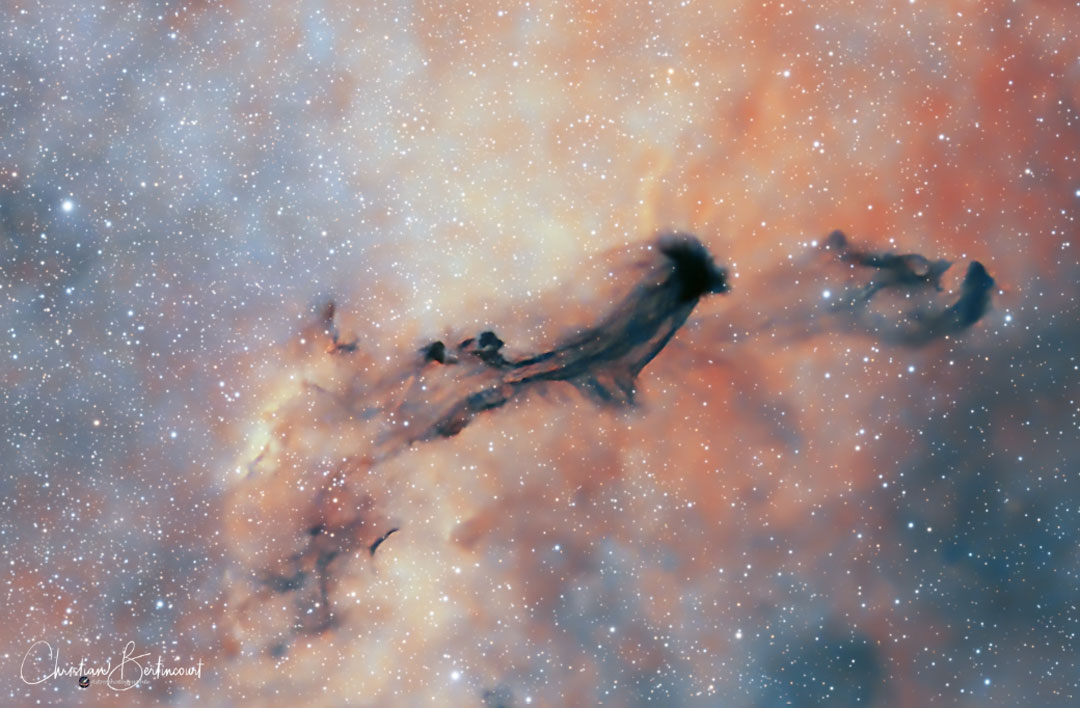 Image Credit: Christian Bertincourt, Keighley Rockcliffe, NASA, GSFC, UMBC, CSST, CRESST II
Explanation:
"A ghost in the Milky Way…” says Christian Bertincourt,
the astrophotographer behind
this striking image of Barnard 93 (B93).
The 93rd entry in
Barnard’s Catalogue of Dark Nebulae, B93 lies within the
Small Sagittarius Star Cloud
(Messier 24),
where its darkness stands in
stark contrast
to bright stars and gas in the background.
In some ways, B93 is really like a
ghost,
because it contains gas and dust that was dispersed by
the deaths of stars, like
supernovas.
B93 appears as a dark void not because it is empty, but because its
dust blocks the light
emitted by more distant stars and glowing gas.
Like other dark nebulas, some gas from
B93,
if dense and
massive enough, will eventually
gravitationally condense to form new stars.
If so, then
once these stars ignite,
B93 will transform from a dark ghost into a brilliant
cradle of newborn stars.
#APOD #B93 #Barnard93 #DarkNebula #MilkyWay #Sagittarius
Image Credit: Christian Bertincourt, Keighley Rockcliffe, NASA, GSFC, UMBC, CSST, CRESST II
Explanation:
"A ghost in the Milky Way…” says Christian Bertincourt,
the astrophotographer behind
this striking image of Barnard 93 (B93).
The 93rd entry in
Barnard’s Catalogue of Dark Nebulae, B93 lies within the
Small Sagittarius Star Cloud
(Messier 24),
where its darkness stands in
stark contrast
to bright stars and gas in the background.
In some ways, B93 is really like a
ghost,
because it contains gas and dust that was dispersed by
the deaths of stars, like
supernovas.
B93 appears as a dark void not because it is empty, but because its
dust blocks the light
emitted by more distant stars and glowing gas.
Like other dark nebulas, some gas from
B93,
if dense and
massive enough, will eventually
gravitationally condense to form new stars.
If so, then
once these stars ignite,
B93 will transform from a dark ghost into a brilliant
cradle of newborn stars.
#APOD #B93 #Barnard93 #DarkNebula #MilkyWay #Sagittarius
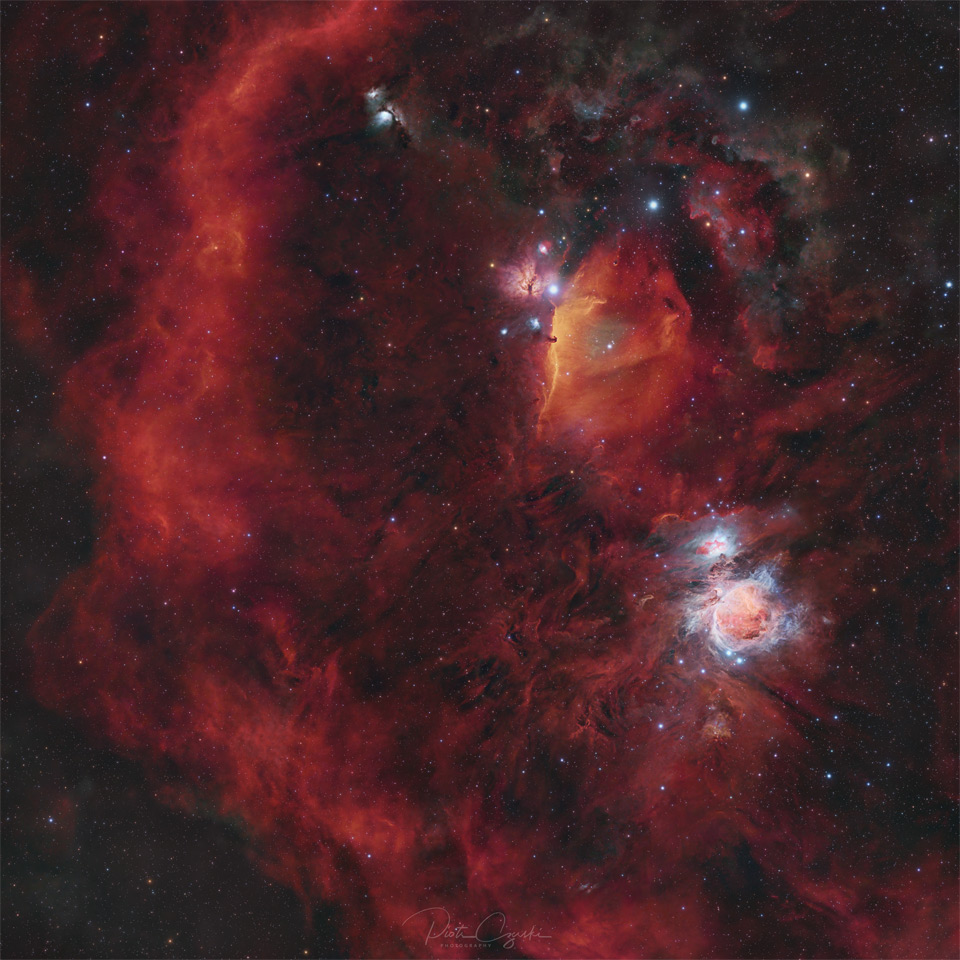 Image Credit: Piotr Czerski
Explanation:
Cradled in red-glowing hydrogen gas, stars are being born in Orion.
These stellar nurseries lie at the edge of the giant
Orion molecular cloud complex, some 1,500
light-years away.
This detailed view spans about 12
degrees across the
center of the well-known constellation, with the
Great Orion Nebula,
the closest large
star-forming region, visible toward the lower right.
The deep mosaic also includes, near the top center,
the Flame Nebula and the
Horsehead Nebula.
Image data acquired with a
hydrogen-alpha filter adds other remarkable features
to this wide-angle cosmic vista:
pervasive tendrils of energized atomic
hydrogen gas and portions of the surrounding
Barnard's Loop.
While the Orion Nebula and many
stars in Orion
are easy to see with the unaided eye, emission from the extensive
interstellar gas is faint and much
harder to record, even in telescopic views of the nebula-rich complex.
#APOD #OrionNebula #HorseheadNebula #FlameNebula #BarnardsLoop #HydrogenAlpha
Image Credit: Piotr Czerski
Explanation:
Cradled in red-glowing hydrogen gas, stars are being born in Orion.
These stellar nurseries lie at the edge of the giant
Orion molecular cloud complex, some 1,500
light-years away.
This detailed view spans about 12
degrees across the
center of the well-known constellation, with the
Great Orion Nebula,
the closest large
star-forming region, visible toward the lower right.
The deep mosaic also includes, near the top center,
the Flame Nebula and the
Horsehead Nebula.
Image data acquired with a
hydrogen-alpha filter adds other remarkable features
to this wide-angle cosmic vista:
pervasive tendrils of energized atomic
hydrogen gas and portions of the surrounding
Barnard's Loop.
While the Orion Nebula and many
stars in Orion
are easy to see with the unaided eye, emission from the extensive
interstellar gas is faint and much
harder to record, even in telescopic views of the nebula-rich complex.
#APOD #OrionNebula #HorseheadNebula #FlameNebula #BarnardsLoop #HydrogenAlpha
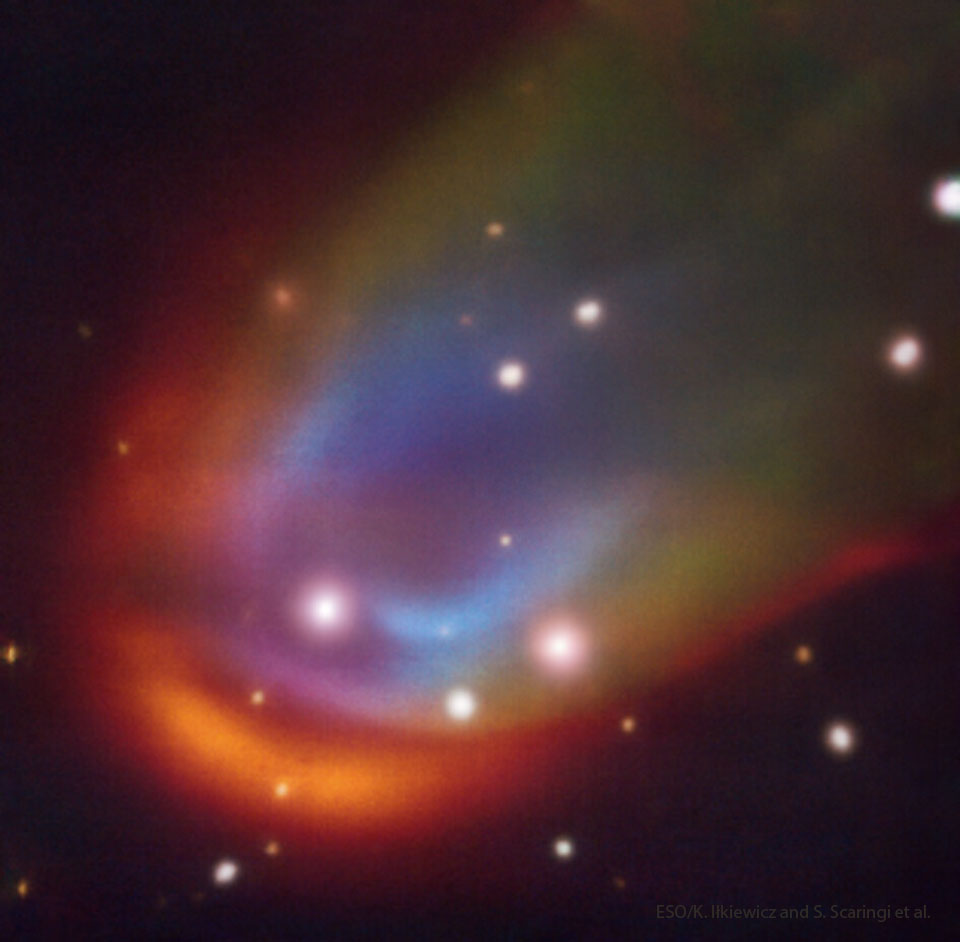 Image Credit: ESO, K. Iłkiewicz, S. Scaringi, et al., Cecilia Chirenti, NASA, GSFC, CRESST II
Explanation:
How is RXJ0528+2838 creating such shock waves?
A recently discovered
white dwarf star,
the farther left of the two largest white spots,
RXJ0528+2838,
was found 730
light-years away from
Earth.
Most stars, when
done fusing nuclei in their cores for energy, become
red giant stars, the cores of which
live on as faint dense
white dwarfs that slowly cool down for the rest of time.
White dwarfs are so dense that the
only thing that stops them from collapsing further is
quantum mechanics.
In about 5 billion years,
our Sun will become a
white dwarf, too.
The featured image, obtained with the
European Southern Observatory’s
Very Large Telescope, shows unexplained
bow shocks around RXJ0528+2838, similar to the
bow wave of water around a fast-moving ship.
Astronomers
don’t yet know what is powering
these shocks, which have existed for at least 1,000 years.
The red, green and blue colors represent trace amounts of glowing
hydrogen,
nitrogen and
oxygen gas.
#APOD #Astronomy #WhiteDwarf #RXJ0528 #AccretionShock #XrayAstronomy
Image Credit: ESO, K. Iłkiewicz, S. Scaringi, et al., Cecilia Chirenti, NASA, GSFC, CRESST II
Explanation:
How is RXJ0528+2838 creating such shock waves?
A recently discovered
white dwarf star,
the farther left of the two largest white spots,
RXJ0528+2838,
was found 730
light-years away from
Earth.
Most stars, when
done fusing nuclei in their cores for energy, become
red giant stars, the cores of which
live on as faint dense
white dwarfs that slowly cool down for the rest of time.
White dwarfs are so dense that the
only thing that stops them from collapsing further is
quantum mechanics.
In about 5 billion years,
our Sun will become a
white dwarf, too.
The featured image, obtained with the
European Southern Observatory’s
Very Large Telescope, shows unexplained
bow shocks around RXJ0528+2838, similar to the
bow wave of water around a fast-moving ship.
Astronomers
don’t yet know what is powering
these shocks, which have existed for at least 1,000 years.
The red, green and blue colors represent trace amounts of glowing
hydrogen,
nitrogen and
oxygen gas.
#APOD #Astronomy #WhiteDwarf #RXJ0528 #AccretionShock #XrayAstronomy
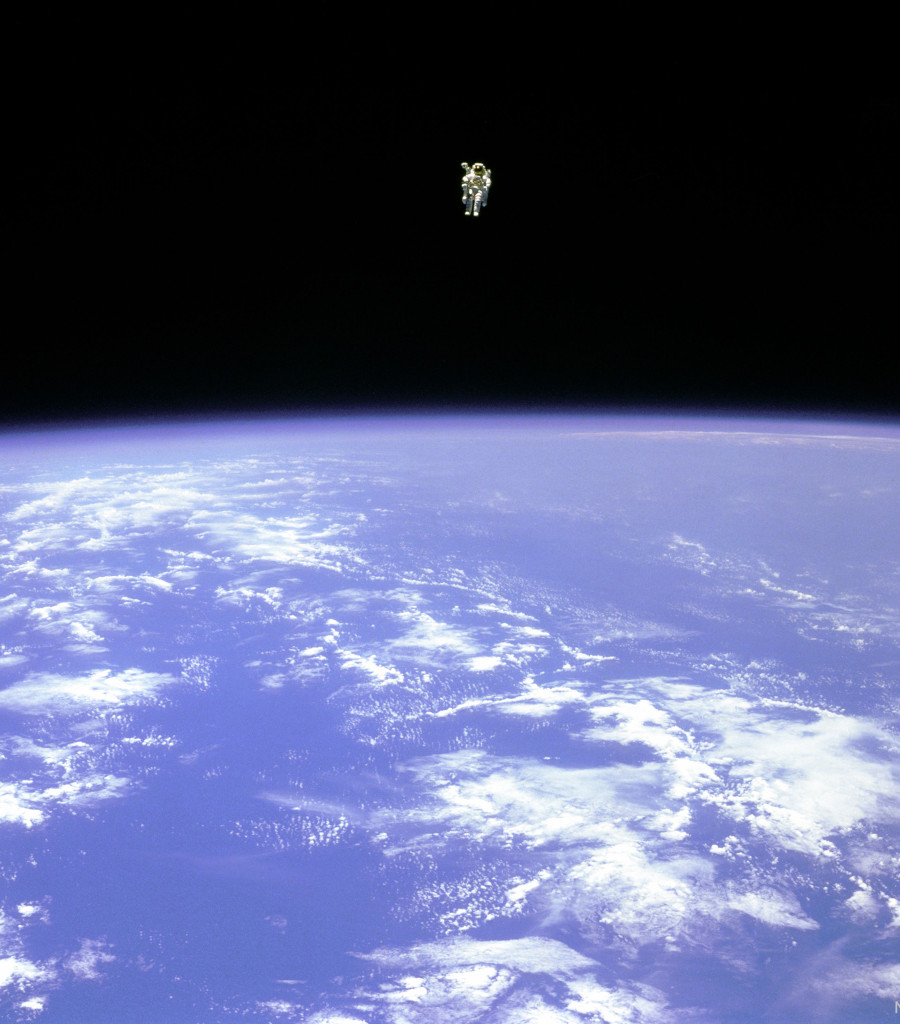 Image Credit: NASA, STS-41B
Explanation:
What would it be like to fly free in space?
About 100 meters from the cargo bay of a
space shuttle,
Bruce McCandless II was living the dream --
floating farther out than anyone had ever been before.
Guided by a
Manned Maneuvering Unit (MMU), astronaut McCandless,
pictured, was
floating free in space.
During Space Shuttle mission
41-B in 1984,
McCandless and fellow
NASA astronaut
Robert Stewart were the first to
experience such an
"untethered space walk".
The MMU worked by shooting jets of
nitrogen
and was used to help deploy and
retrieve satellites.
With a mass over 140 kilograms, an
MMU is heavy
on Earth,
but, like everything, is weightless when drifting in orbit.
The MMU was later replaced with the
SAFER backpack propulsion unit.
#APOD #SpaceTravel #ZeroGravity #Spaceflight #Astronomy #CosmicJourney
Image Credit: NASA, STS-41B
Explanation:
What would it be like to fly free in space?
About 100 meters from the cargo bay of a
space shuttle,
Bruce McCandless II was living the dream --
floating farther out than anyone had ever been before.
Guided by a
Manned Maneuvering Unit (MMU), astronaut McCandless,
pictured, was
floating free in space.
During Space Shuttle mission
41-B in 1984,
McCandless and fellow
NASA astronaut
Robert Stewart were the first to
experience such an
"untethered space walk".
The MMU worked by shooting jets of
nitrogen
and was used to help deploy and
retrieve satellites.
With a mass over 140 kilograms, an
MMU is heavy
on Earth,
but, like everything, is weightless when drifting in orbit.
The MMU was later replaced with the
SAFER backpack propulsion unit.
#APOD #SpaceTravel #ZeroGravity #Spaceflight #Astronomy #CosmicJourney