
**Astronomy Picture of the Day**
03 April 2026
**Caught in the Web: Visualization of a Black Hole Merger in the Tarantula Nebula**
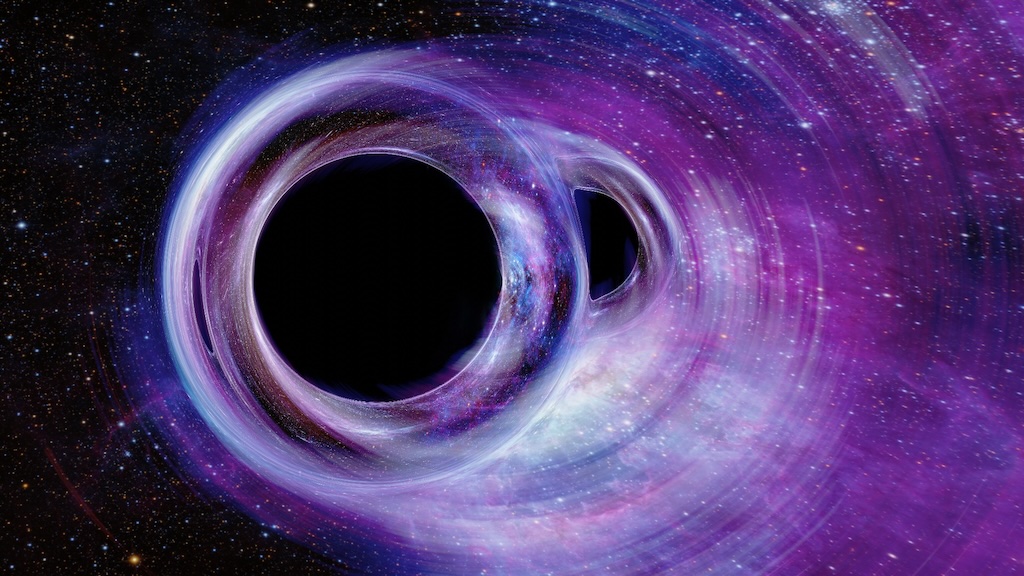 Image Credit: Carl Knox, OzGrav, Swinburne University of Technology, Blake Estes, Christian Sasse, iTelescope.net, Cecilia Chirenti, NASA, GSFC, CRESST II
Explanation:
How can we see what is invisible?
Black holes are not easy to see in the dark cosmic night, but astronomers can find them by analyzing their gravitational effects on matter, light and spacetime.
The featured image shows an illustration that combines a simulation of a black hole binary system in its final "death-dance" with an astrophotography image of the Tarantula Nebula in the background.
Even though black holes don't emit light, they distort the path of light rays, acting like a gravitational lens.
As a result, the nebula appears extremely distorted, forming Einstein rings and multiple images.
Tarantula Nebula lies in the Large Magellanic Cloud, a dwarf galaxy that is one of the satellite galaxies of the Milky Way, 160,000 light-years away.
That is more than 1,000 times closer than any of the binary black hole mergers detected so far.
We'll probably never detect a merger so close to home!
#APOD #BlackHoleMerger #TarantulaNebula #GravitationalWaves #Astrophysics #Cosmology
Image Credit: Carl Knox, OzGrav, Swinburne University of Technology, Blake Estes, Christian Sasse, iTelescope.net, Cecilia Chirenti, NASA, GSFC, CRESST II
Explanation:
How can we see what is invisible?
Black holes are not easy to see in the dark cosmic night, but astronomers can find them by analyzing their gravitational effects on matter, light and spacetime.
The featured image shows an illustration that combines a simulation of a black hole binary system in its final "death-dance" with an astrophotography image of the Tarantula Nebula in the background.
Even though black holes don't emit light, they distort the path of light rays, acting like a gravitational lens.
As a result, the nebula appears extremely distorted, forming Einstein rings and multiple images.
Tarantula Nebula lies in the Large Magellanic Cloud, a dwarf galaxy that is one of the satellite galaxies of the Milky Way, 160,000 light-years away.
That is more than 1,000 times closer than any of the binary black hole mergers detected so far.
We'll probably never detect a merger so close to home!
#APOD #BlackHoleMerger #TarantulaNebula #GravitationalWaves #Astrophysics #Cosmology
Image Credit: Carl Knox, OzGrav, Swinburne University of Technology, Blake Estes, Christian Sasse, iTelescope.net, Cecilia Chirenti, NASA, GSFC, CRESST II
Explanation:
How can we see what is invisible?
Black holes are not easy to see in the dark cosmic night, but astronomers can find them by analyzing their gravitational effects on matter, light and spacetime.
The featured image shows an illustration that combines a simulation of a black hole binary system in its final "death-dance" with an astrophotography image of the Tarantula Nebula in the background.
Even though black holes don't emit light, they distort the path of light rays, acting like a gravitational lens.
As a result, the nebula appears extremely distorted, forming Einstein rings and multiple images.
Tarantula Nebula lies in the Large Magellanic Cloud, a dwarf galaxy that is one of the satellite galaxies of the Milky Way, 160,000 light-years away.
That is more than 1,000 times closer than any of the binary black hole mergers detected so far.
We'll probably never detect a merger so close to home!
#APOD #BlackHoleMerger #TarantulaNebula #GravitationalWaves #Astrophysics #Cosmology
APOD: 2026 April – Caught in the Web
A different astronomy and space science
related image is featured each day, along with a brief explanation.
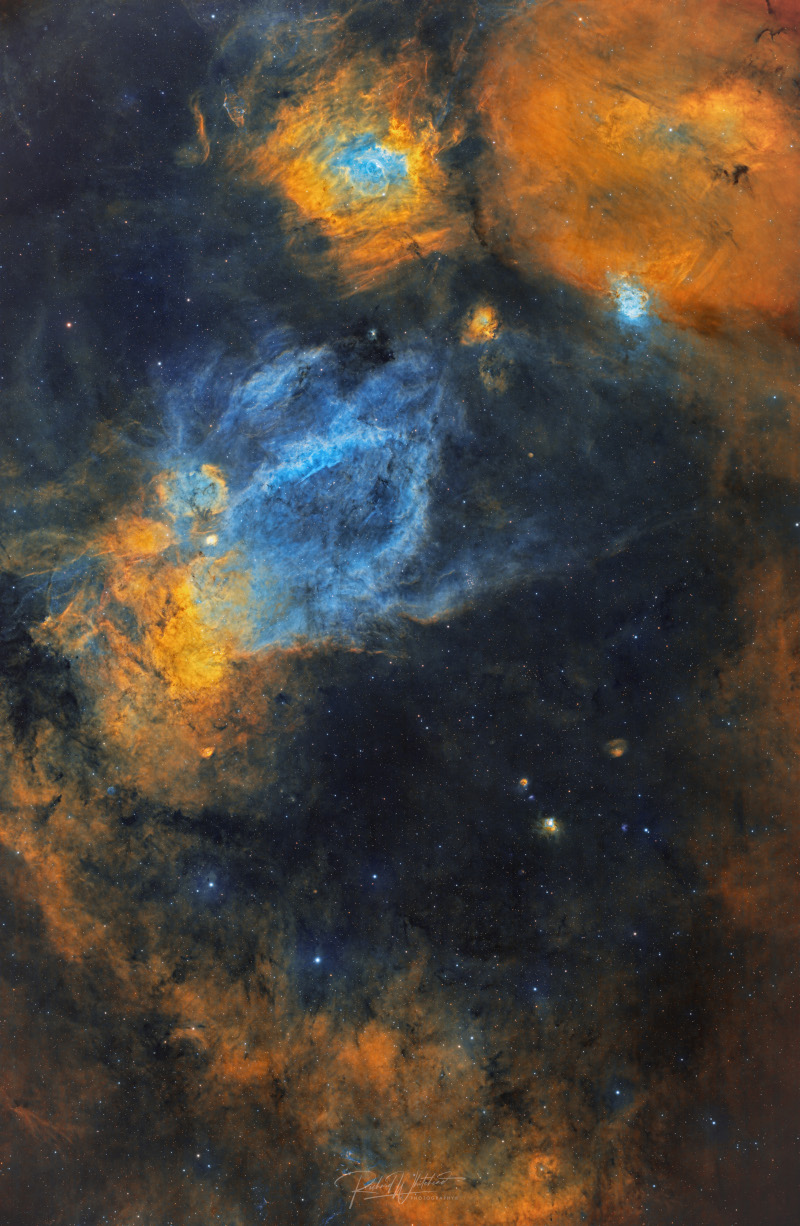 Image Credit: Richard Whitehead, Keighley Rockcliffe, NASA, GSFC, UMBC CSST, CRESST II
Explanation:
What unexpected things do you see when you look up at the night sky? Today’s image resembles an
abstract painting,
with large swaths of color strewn across a cosmic canvas seemingly without design. Despite the image's abstract nature, the
human mind finds patterns,
identifying a large claw reaching up towards a floating bubble. Embedded within these seemingly random structures are the physical laws that govern
how light and matter interact.
The
Claw
(Sh2-157) and
Bubble
(NGC 7635)
Nebulae glow
colors that are mapped
to the yellow and blue shown, indicating the presence of hydrogen and oxygen
ionized by the intense light emitted from stars
several times the mass of the Sun. This image depicts both the chaos and structure of astronomical processes, showing that a common thread between art and science is
to look for the unexpected.
#APOD #Astrophoto #NASAInspires #Space #Astrogeek
Image Credit: Richard Whitehead, Keighley Rockcliffe, NASA, GSFC, UMBC CSST, CRESST II
Explanation:
What unexpected things do you see when you look up at the night sky? Today’s image resembles an
abstract painting,
with large swaths of color strewn across a cosmic canvas seemingly without design. Despite the image's abstract nature, the
human mind finds patterns,
identifying a large claw reaching up towards a floating bubble. Embedded within these seemingly random structures are the physical laws that govern
how light and matter interact.
The
Claw
(Sh2-157) and
Bubble
(NGC 7635)
Nebulae glow
colors that are mapped
to the yellow and blue shown, indicating the presence of hydrogen and oxygen
ionized by the intense light emitted from stars
several times the mass of the Sun. This image depicts both the chaos and structure of astronomical processes, showing that a common thread between art and science is
to look for the unexpected.
#APOD #Astrophoto #NASAInspires #Space #Astrogeek
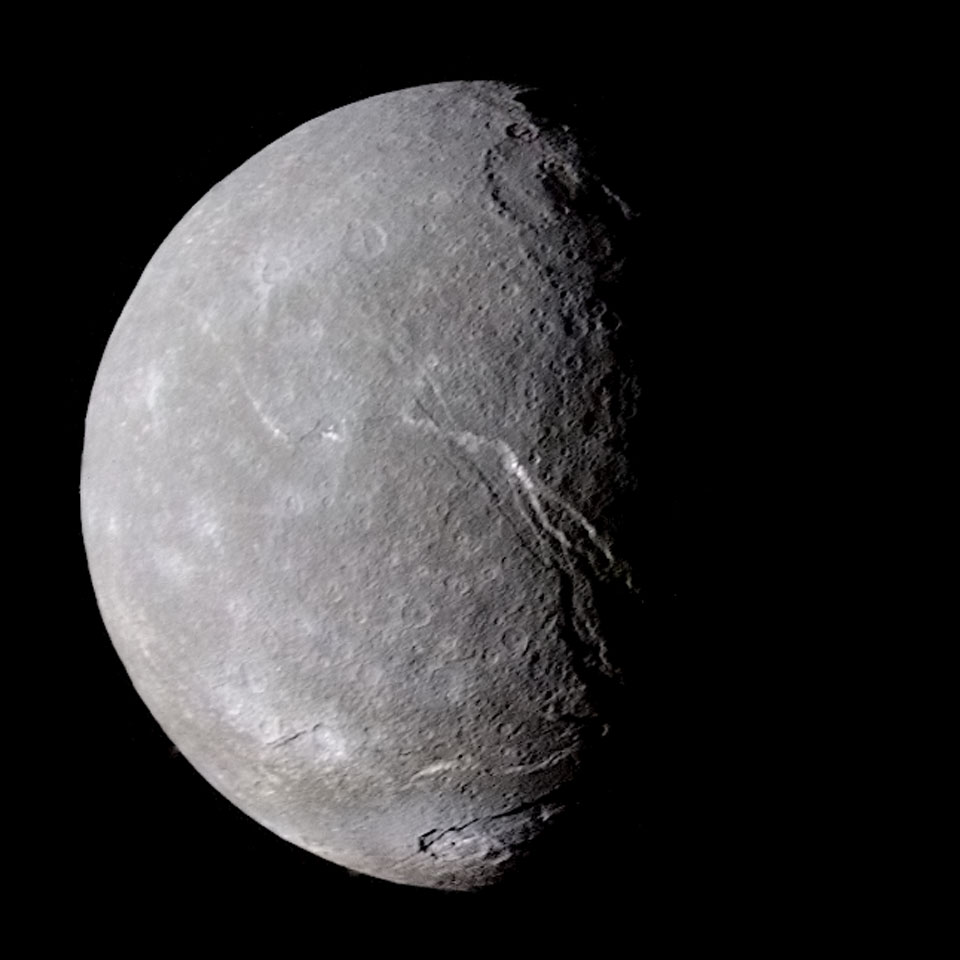 Image Credit: NASA, Voyager 2, zelario12 | License
Explanation:
Titania's tortured terrain is a mix of canyons, cliffs, and craters.
NASA's interplanetary robot spacecraft
Voyager 2 passed the largest moon of
Uranus in 1986 and took the
feature picture.
That the
trenches of Titania
resemble those on another moon of Uranus,
Ariel,
indicate that Titania underwent some violent surface
event possibly related to water
freezing and expanding in its distant past.
Although Titania is Uranus's largest moon,
it is only about half the radius of
Triton -
the largest moon of Uranus's sister planet
Neptune,
which itself is
slightly smaller than
Earth's Moon.
Titania,
discovered by
William Herschel
in 1787, is essentially a large dirty iceball
that is composed of about half water-ice and half rock.
There is recent
speculation that
radioactive heating
melts some underground ice into oceans.
#APOD #Titania #Uranus #Moon #Voyager2 #NASA
Image Credit: NASA, Voyager 2, zelario12 | License
Explanation:
Titania's tortured terrain is a mix of canyons, cliffs, and craters.
NASA's interplanetary robot spacecraft
Voyager 2 passed the largest moon of
Uranus in 1986 and took the
feature picture.
That the
trenches of Titania
resemble those on another moon of Uranus,
Ariel,
indicate that Titania underwent some violent surface
event possibly related to water
freezing and expanding in its distant past.
Although Titania is Uranus's largest moon,
it is only about half the radius of
Triton -
the largest moon of Uranus's sister planet
Neptune,
which itself is
slightly smaller than
Earth's Moon.
Titania,
discovered by
William Herschel
in 1787, is essentially a large dirty iceball
that is composed of about half water-ice and half rock.
There is recent
speculation that
radioactive heating
melts some underground ice into oceans.
#APOD #Titania #Uranus #Moon #Voyager2 #NASA
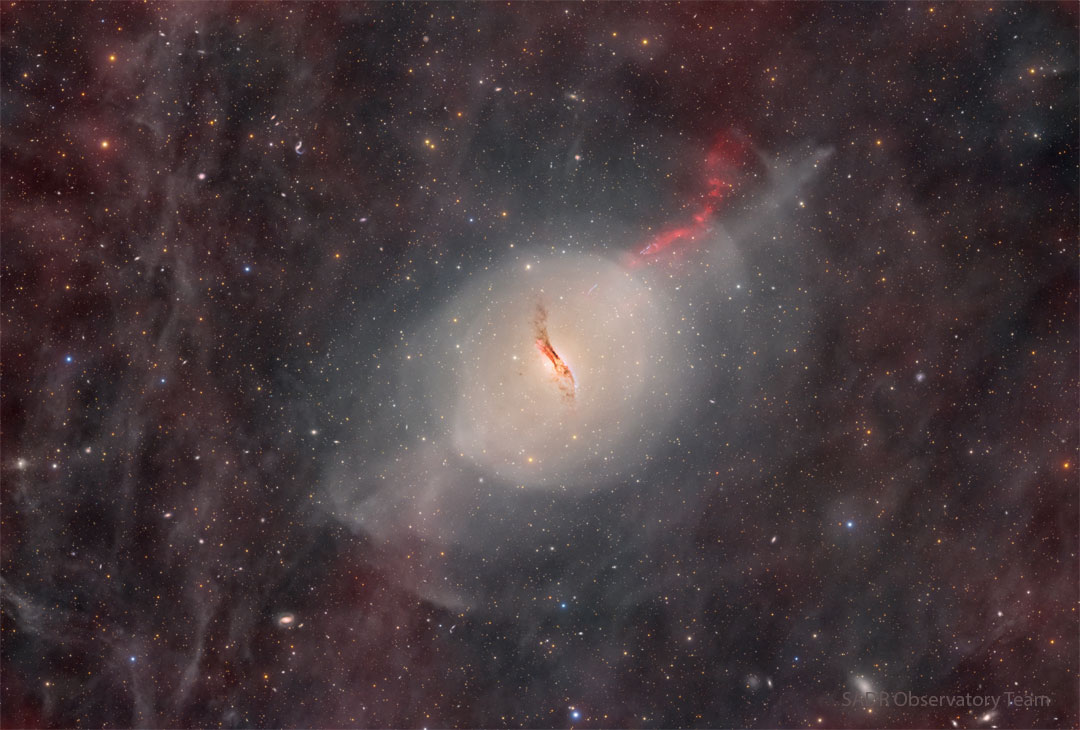 Image Credit: SADR Observatory, J-C Dalouzy
Explanation:
What's happened to the center of this galaxy?
Dramatic dust lanes run across the center of unusual elliptical galaxy
Centaurus A.
These dust lanes are so thick they almost completely obscure the
galaxy's center in
visible light.
This is particularly unusual as
Cen A's
older stars and oval shape are characteristic of a giant
elliptical galaxy, a galaxy type typically low in dark dust.
Pictured in
this deep image
is a complex network of foreground gas and dust, as well as
shells of dim stars and a
jet projecting to the upper right.
Also known as NGC 5128,
Cen A is surely the result of a
galactic collision where many young dust-creating stars were formed.
However, details of the creation of Cen A's unusually
active center and iconic central dust lanes are still
being researched.
Cen A lies only 13 million
light years away, making it the
closest active galaxy.
#APOD #CentaurusA #CenA #EllipticalGalaxy #ActiveGalacticNucleus #AGN
Image Credit: SADR Observatory, J-C Dalouzy
Explanation:
What's happened to the center of this galaxy?
Dramatic dust lanes run across the center of unusual elliptical galaxy
Centaurus A.
These dust lanes are so thick they almost completely obscure the
galaxy's center in
visible light.
This is particularly unusual as
Cen A's
older stars and oval shape are characteristic of a giant
elliptical galaxy, a galaxy type typically low in dark dust.
Pictured in
this deep image
is a complex network of foreground gas and dust, as well as
shells of dim stars and a
jet projecting to the upper right.
Also known as NGC 5128,
Cen A is surely the result of a
galactic collision where many young dust-creating stars were formed.
However, details of the creation of Cen A's unusually
active center and iconic central dust lanes are still
being researched.
Cen A lies only 13 million
light years away, making it the
closest active galaxy.
#APOD #CentaurusA #CenA #EllipticalGalaxy #ActiveGalacticNucleus #AGN
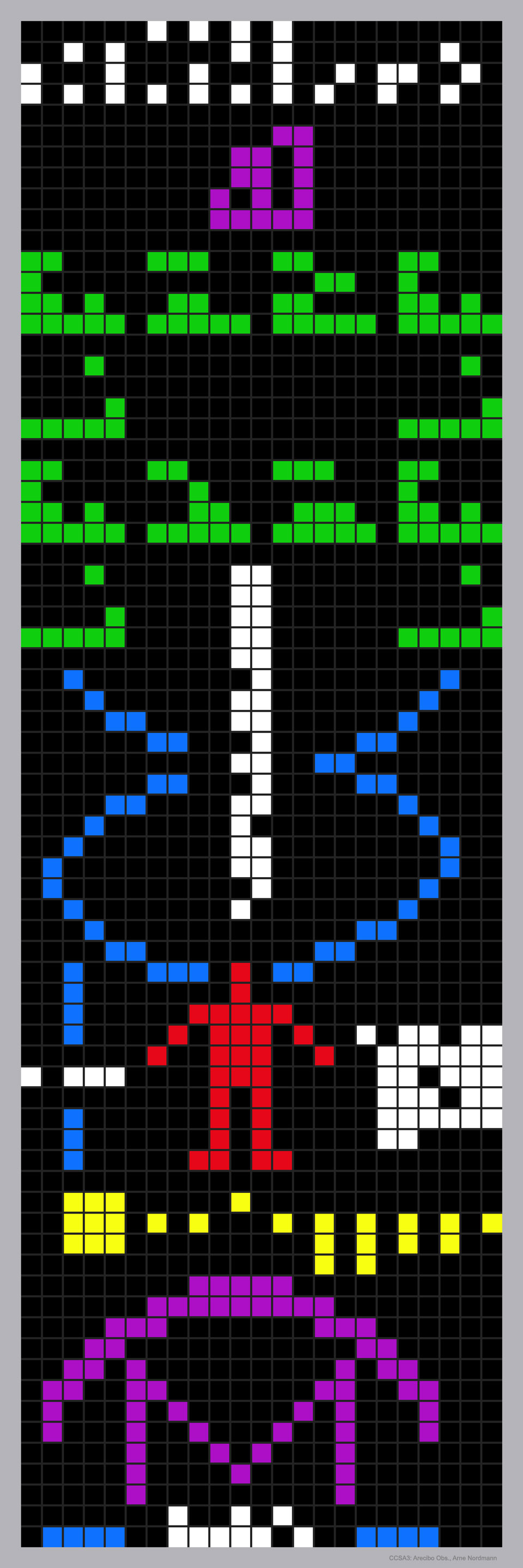 Image Credit: Frank Drake, Arecibo Observatory, Arne Nordmann | License
Explanation:
What are these Earthlings trying to tell us?
The featured message was broadcast from
Earth
towards the globular star cluster
M13 in 1974.
During the dedication of an upgrade to the
Arecibo
Observatory -
then the largest single radio telescope in the world -
a string of 1's and 0's representing the diagram was sent.
This attempt at
extraterrestrial communication
was mostly ceremonial - humanity regularly
broadcasts radio and television signals out into space accidentally.
Even were
this message
received, M13 is so far away we would
have to wait almost 50,000 years to hear an answer.
The featured message gives a few simple facts about humanity and its knowledge:
from left to right are numbers from one to ten, atoms including
hydrogen and
carbon,
some interesting molecules,
DNA, a human with description, basics of our
Solar System,
and basics of the sending telescope.
Several
searches for extraterrestrial intelligence are currently underway.
#APOD #Earth #RedPlanet #InterstellarMessage #SETI #Extraterrestrial
Image Credit: Frank Drake, Arecibo Observatory, Arne Nordmann | License
Explanation:
What are these Earthlings trying to tell us?
The featured message was broadcast from
Earth
towards the globular star cluster
M13 in 1974.
During the dedication of an upgrade to the
Arecibo
Observatory -
then the largest single radio telescope in the world -
a string of 1's and 0's representing the diagram was sent.
This attempt at
extraterrestrial communication
was mostly ceremonial - humanity regularly
broadcasts radio and television signals out into space accidentally.
Even were
this message
received, M13 is so far away we would
have to wait almost 50,000 years to hear an answer.
The featured message gives a few simple facts about humanity and its knowledge:
from left to right are numbers from one to ten, atoms including
hydrogen and
carbon,
some interesting molecules,
DNA, a human with description, basics of our
Solar System,
and basics of the sending telescope.
Several
searches for extraterrestrial intelligence are currently underway.
#APOD #Earth #RedPlanet #InterstellarMessage #SETI #Extraterrestrial
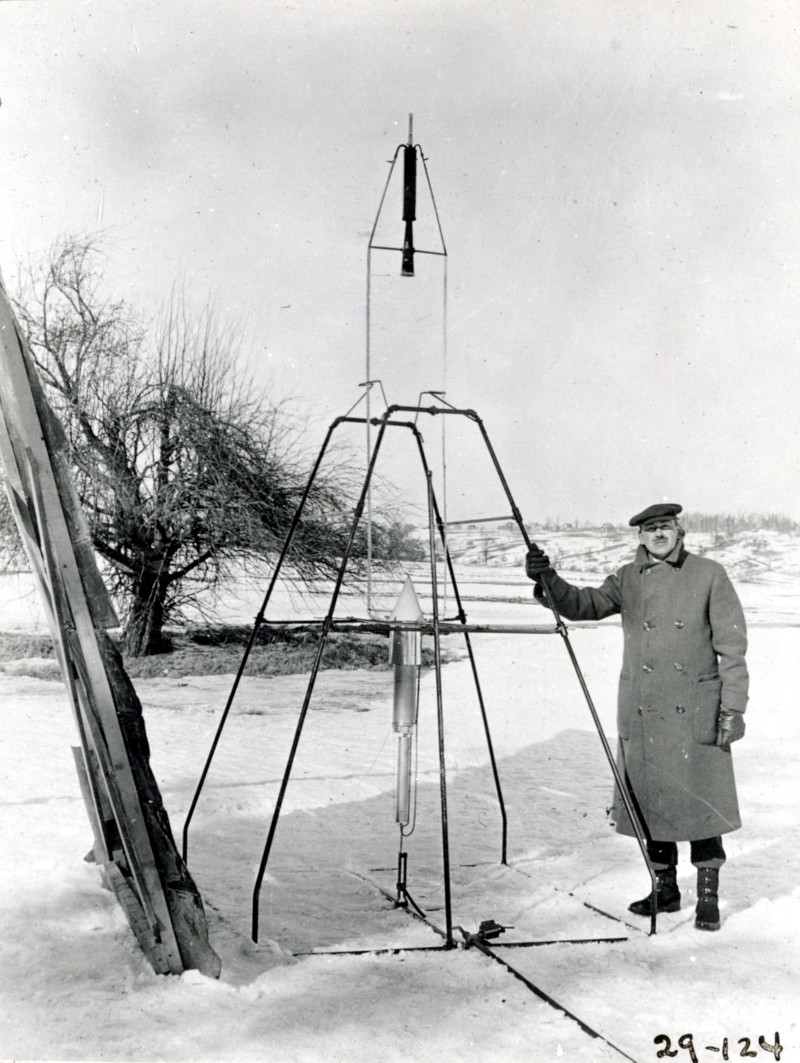 Image Credit: Clark University archive
Explanation:
Robert H. Goddard,
considered the father of modern rocketry, was born in
Worcester Massachusetts in 1882.
As a 16 year old, Goddard read H.G. Wells' science fiction classic
"War Of The Worlds"
and dreamed of space flight.
By 1926
he had designed, built, and flown the world's first liquid fuel rocket.
Launched 100 years ago
on March 16, 1926 from his aunt Effie's
farm in Auburn Massachusetts,
the rocket, dubbed "Nell," rose to an
altitude of 41 feet in a flight that lasted about 2 1/2 seconds.
In
this posed photo,
Goddard stands next to the 10 foot tall rocket, holding
the launch stand frame.
To achieve a stable flight without the need for fins, the rocket's heavy
motor was located at the top, fed by lines from
liquid oxygen and gasoline fuel tanks at the bottom.
Widely recognized as a
gifted experimenter
and
engineering genius,
his
rockets were many years ahead
of their time.
Goddard was awarded over 200 patents in rocket technology,
most of them after his death in 1945.
A liquid fuel rocket constructed on principles
developed by Goddard landed humans on
the Moon in 1969.
#APOD #Cosmos #Astrophoto #Universe Astrophotography
Image Credit: Clark University archive
Explanation:
Robert H. Goddard,
considered the father of modern rocketry, was born in
Worcester Massachusetts in 1882.
As a 16 year old, Goddard read H.G. Wells' science fiction classic
"War Of The Worlds"
and dreamed of space flight.
By 1926
he had designed, built, and flown the world's first liquid fuel rocket.
Launched 100 years ago
on March 16, 1926 from his aunt Effie's
farm in Auburn Massachusetts,
the rocket, dubbed "Nell," rose to an
altitude of 41 feet in a flight that lasted about 2 1/2 seconds.
In
this posed photo,
Goddard stands next to the 10 foot tall rocket, holding
the launch stand frame.
To achieve a stable flight without the need for fins, the rocket's heavy
motor was located at the top, fed by lines from
liquid oxygen and gasoline fuel tanks at the bottom.
Widely recognized as a
gifted experimenter
and
engineering genius,
his
rockets were many years ahead
of their time.
Goddard was awarded over 200 patents in rocket technology,
most of them after his death in 1945.
A liquid fuel rocket constructed on principles
developed by Goddard landed humans on
the Moon in 1969.
#APOD #Cosmos #Astrophoto #Universe Astrophotography
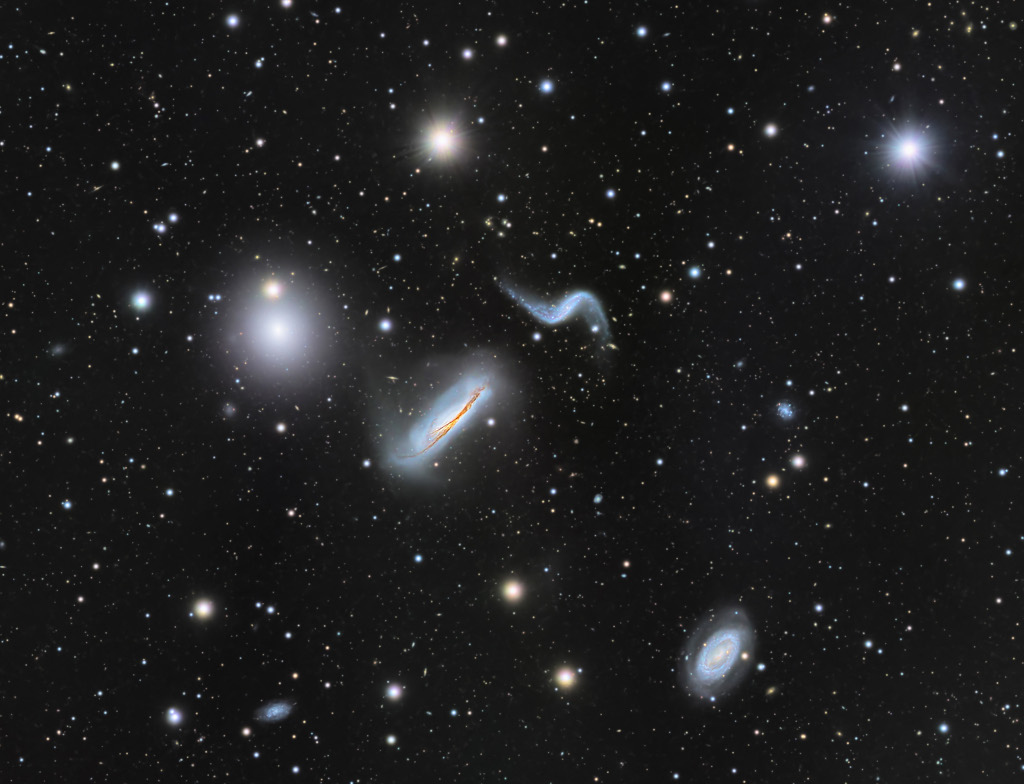 Image Credit: Peter Kennett
Explanation:
Scanning the skies for galaxies, Canadian astronomer
Paul Hickson and colleagues identified some 100 compact
groups of galaxies,
now appropriately called
Hickson Compact Groups.
The four prominent galaxies seen in this intriguing
telescopic skyscape
are one such group, Hickson 44.
The Hickson 44 galaxy group is about 100 million light-years distant,
far beyond the foreground Milky Way stars,
toward the northern springtime constellation Leo.
The two spiral galaxies
in the center of the image are edge-on NGC 3190 with distinctive,
warped dust lanes, and S-shaped NGC 3187.
Along with the bright elliptical, NGC 3193 (left)
they are also known as Arp 316.
The spiral toward the lower right corner is NGC 3185,
the 4th member of the Hickson group.
Like other galaxies in
Hickson groups,
these show signs of distortion and
enhanced star formation,
evidence of a gravitational tug of war that will eventually result in
galaxy mergers on a cosmic timescale.
The merger process is
now understood to be a normal part of the evolution of
galaxies, including our own Milky Way.
For scale, NGC 3190
is about 75,000 light-years across at the estimated
distance of Hickson 44.
#APOD #Hickson44 #CompactGroups #Leo #NGC3190 #NGC3187
Image Credit: Peter Kennett
Explanation:
Scanning the skies for galaxies, Canadian astronomer
Paul Hickson and colleagues identified some 100 compact
groups of galaxies,
now appropriately called
Hickson Compact Groups.
The four prominent galaxies seen in this intriguing
telescopic skyscape
are one such group, Hickson 44.
The Hickson 44 galaxy group is about 100 million light-years distant,
far beyond the foreground Milky Way stars,
toward the northern springtime constellation Leo.
The two spiral galaxies
in the center of the image are edge-on NGC 3190 with distinctive,
warped dust lanes, and S-shaped NGC 3187.
Along with the bright elliptical, NGC 3193 (left)
they are also known as Arp 316.
The spiral toward the lower right corner is NGC 3185,
the 4th member of the Hickson group.
Like other galaxies in
Hickson groups,
these show signs of distortion and
enhanced star formation,
evidence of a gravitational tug of war that will eventually result in
galaxy mergers on a cosmic timescale.
The merger process is
now understood to be a normal part of the evolution of
galaxies, including our own Milky Way.
For scale, NGC 3190
is about 75,000 light-years across at the estimated
distance of Hickson 44.
#APOD #Hickson44 #CompactGroups #Leo #NGC3190 #NGC3187
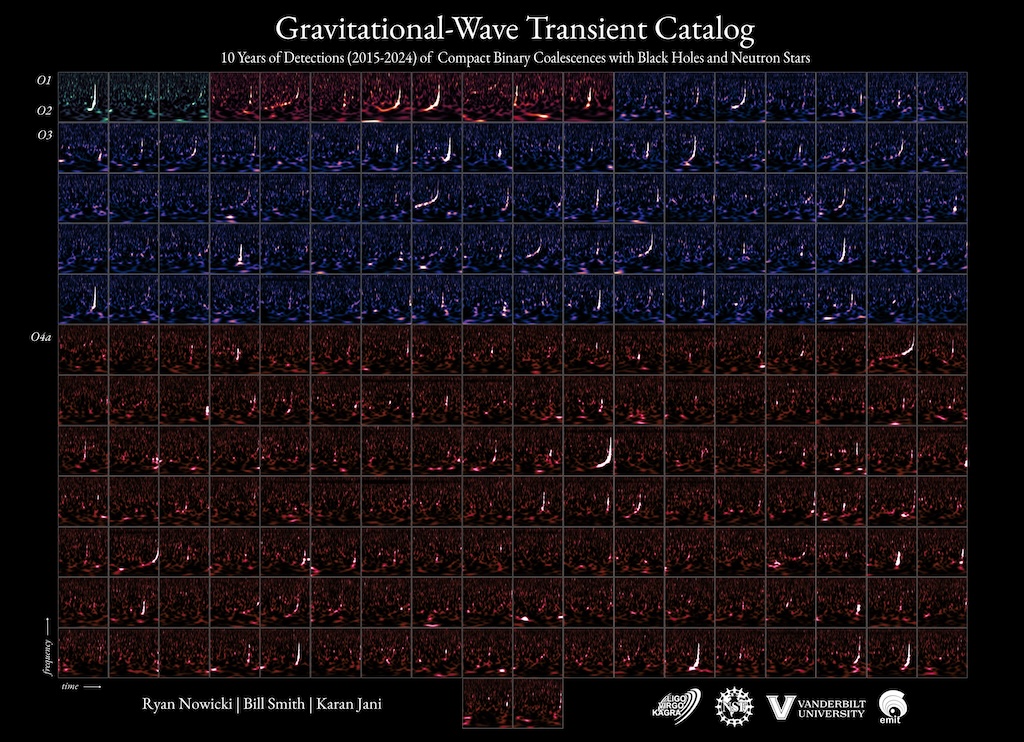 Image Credit: Ryan Nowicki, Bill Smith, Karan Jani, Cecilia Chirenti, NASA, GSFC, CRESST II
Explanation:
What is the sound of two black holes merging in deep space?
Sound waves don't propagate in vacuum, but gravitational waves do.
In 2015 we were able to "hear" them for the first time and confirm one of Albert Einstein's theoretical predictions.
Each square on the grid of the featured image represents one of the gravitational wave detections announced so far by the LIGO-VIRGO-KAGRA Collaboration.
These plots show how the binary pair accelerates in their orbit around each other towards merger: the rising frequency effect is called a "chirp".
Although there are significantly more neutron stars than black holes, most of the detections are binary black hole mergers.
That happens because black holes are heavier and their signals are louder and can be seen farther away, resulting in more detections.
These events are rare, and we don't expect to see one close by in our Galaxy any time soon.
But they are happening continuously throughout the cosmos.
#APOD #BlackHoles #NeutronStars #GravitationalWaves #Astrophysics #Universe
Image Credit: Ryan Nowicki, Bill Smith, Karan Jani, Cecilia Chirenti, NASA, GSFC, CRESST II
Explanation:
What is the sound of two black holes merging in deep space?
Sound waves don't propagate in vacuum, but gravitational waves do.
In 2015 we were able to "hear" them for the first time and confirm one of Albert Einstein's theoretical predictions.
Each square on the grid of the featured image represents one of the gravitational wave detections announced so far by the LIGO-VIRGO-KAGRA Collaboration.
These plots show how the binary pair accelerates in their orbit around each other towards merger: the rising frequency effect is called a "chirp".
Although there are significantly more neutron stars than black holes, most of the detections are binary black hole mergers.
That happens because black holes are heavier and their signals are louder and can be seen farther away, resulting in more detections.
These events are rare, and we don't expect to see one close by in our Galaxy any time soon.
But they are happening continuously throughout the cosmos.
#APOD #BlackHoles #NeutronStars #GravitationalWaves #Astrophysics #Universe
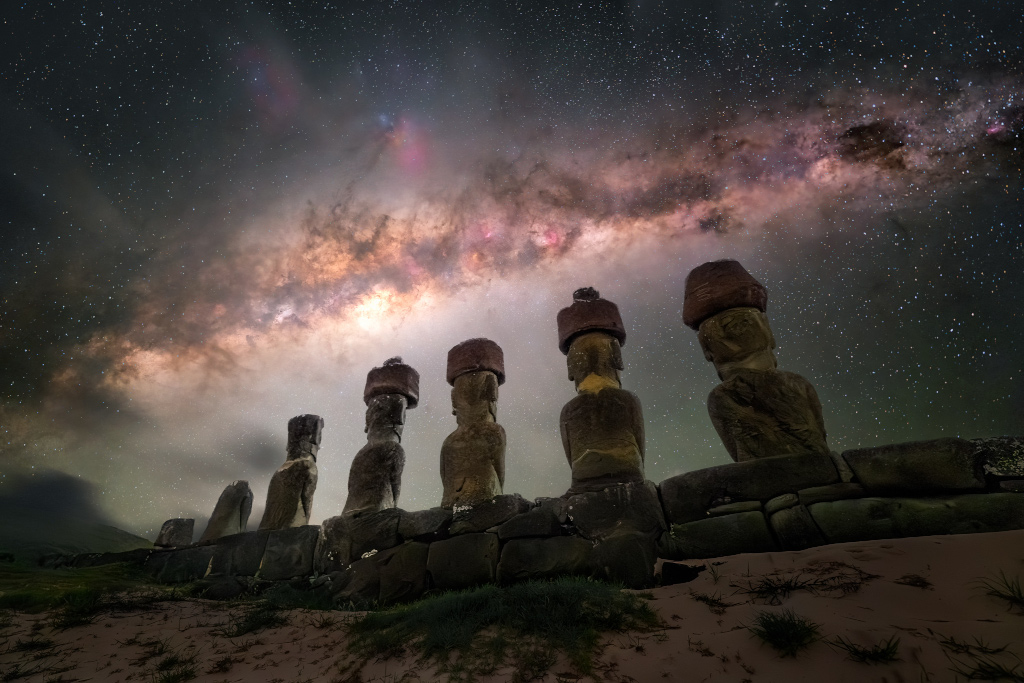 Image Credit: Rositsa Dimitrova, Keighley Rockcliffe, NASA, GSFC, UMBC CSST, CRESST II
Explanation:
In the words of today's astrophotographer, Rositsa Dimitrova, "What have these silent sentinels watched
pass across the sky?" The volcanic
mo'ai
(meaning statue) of
Ahu Tongariki
stand guard over
Rapa Nui
(Isla de Pascua, Easter Island),
a Polynesian island
(annexed by Chile in 1888) located thousands of kilometers off the coast of South America in the Pacific Ocean. Due to the island's remoteness,
the mo'ai,
with their backs to the dark ocean, are able to gaze upon a clear and vibrant night sky.
Pictured,
these
larger-than-life statues
stare at the bright band of
the Milky Way,
partly obscured by
interstellar dust
and blurred by Earth's clouds. Under such clear night skies, the Rapa Nui created observatories and used astronomical observations for
navigation, calendar calibration, celebrations, and more.
Images like this one remind us of
the importance of dark skies,
protecting the land underneath them, and
preserving the culture
that they inspire.
#APOD #RapaNui #MilkyWay #Astrophotography #Astronomy #Space
Image Credit: Rositsa Dimitrova, Keighley Rockcliffe, NASA, GSFC, UMBC CSST, CRESST II
Explanation:
In the words of today's astrophotographer, Rositsa Dimitrova, "What have these silent sentinels watched
pass across the sky?" The volcanic
mo'ai
(meaning statue) of
Ahu Tongariki
stand guard over
Rapa Nui
(Isla de Pascua, Easter Island),
a Polynesian island
(annexed by Chile in 1888) located thousands of kilometers off the coast of South America in the Pacific Ocean. Due to the island's remoteness,
the mo'ai,
with their backs to the dark ocean, are able to gaze upon a clear and vibrant night sky.
Pictured,
these
larger-than-life statues
stare at the bright band of
the Milky Way,
partly obscured by
interstellar dust
and blurred by Earth's clouds. Under such clear night skies, the Rapa Nui created observatories and used astronomical observations for
navigation, calendar calibration, celebrations, and more.
Images like this one remind us of
the importance of dark skies,
protecting the land underneath them, and
preserving the culture
that they inspire.
#APOD #RapaNui #MilkyWay #Astrophotography #Astronomy #Space
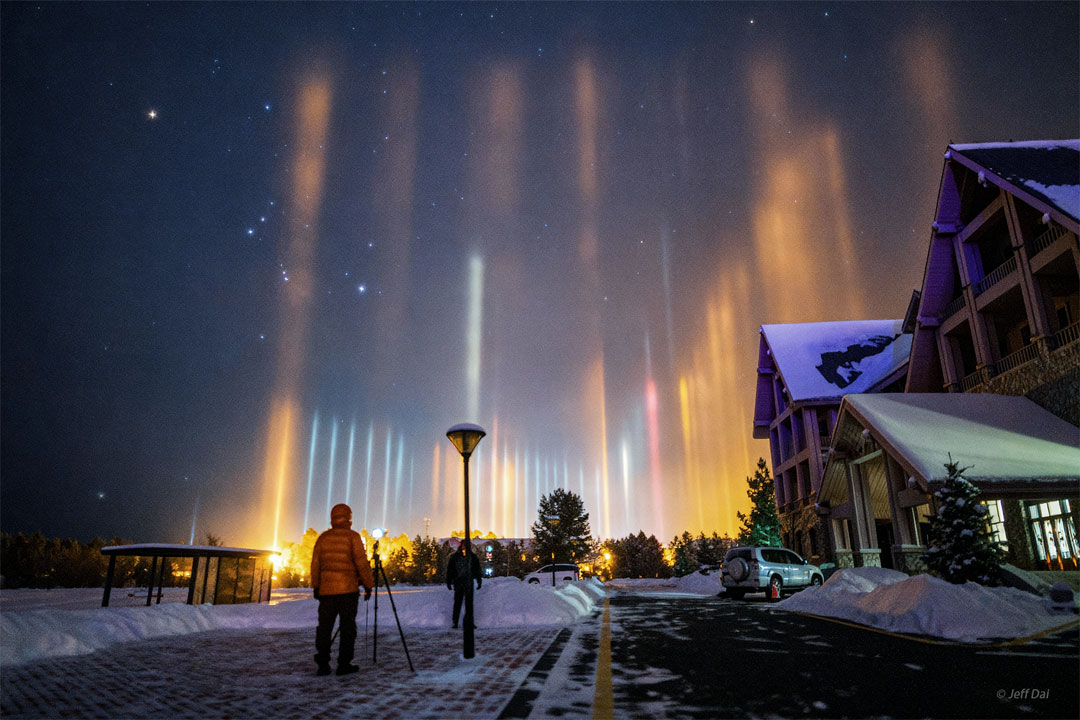 Image Credit: Jeff Dai, TWAN
Explanation:
What's happening at the end of that street?
Pictured here are not
auroras but
light pillars, a phenomenon typically much closer.
In most places on
Earth, a lucky viewer can see a
Sun pillar,
a column of light appearing to extend up from the
Sun
caused by flat fluttering
ice-crystals reflecting sunlight from the
upper atmosphere.
Usually, these ice
crystals
evaporate before reaching the ground.
During freezing temperatures, however,
flat
fluttering
ice crystals may form near the ground and are sometimes known as a
crystal fog.
These small ice crystals may then reflect not the Sun but
ground lights.
The featured image captured not only
numerous light pillars but also the iconic
constellation of Orion, and was taken in
Mohe, the northernmost city in
China.
#APOD lookUp #NASA Astrophotography #Astrophoto
Image Credit: Jeff Dai, TWAN
Explanation:
What's happening at the end of that street?
Pictured here are not
auroras but
light pillars, a phenomenon typically much closer.
In most places on
Earth, a lucky viewer can see a
Sun pillar,
a column of light appearing to extend up from the
Sun
caused by flat fluttering
ice-crystals reflecting sunlight from the
upper atmosphere.
Usually, these ice
crystals
evaporate before reaching the ground.
During freezing temperatures, however,
flat
fluttering
ice crystals may form near the ground and are sometimes known as a
crystal fog.
These small ice crystals may then reflect not the Sun but
ground lights.
The featured image captured not only
numerous light pillars but also the iconic
constellation of Orion, and was taken in
Mohe, the northernmost city in
China.
#APOD lookUp #NASA Astrophotography #Astrophoto
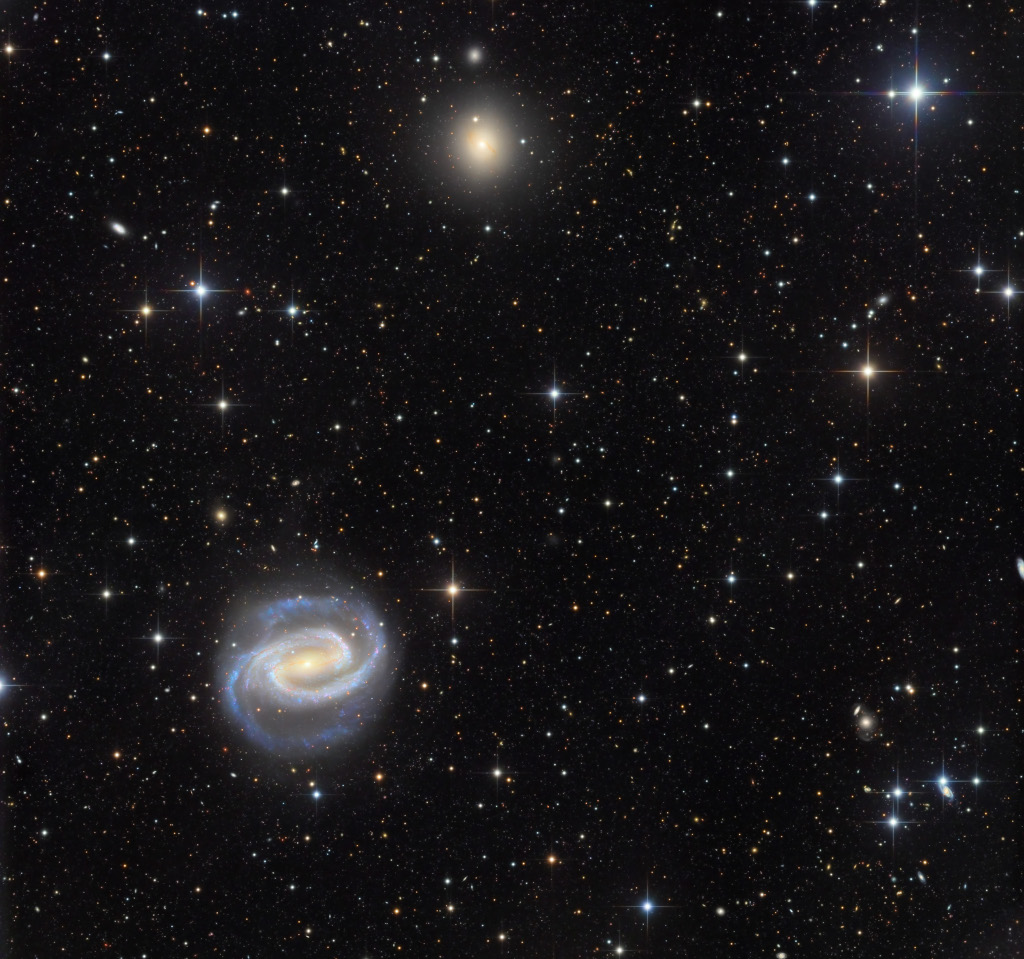 Image Credit: Dietmar Hager and Eric Benson
Explanation:
Spiral NGC 1300 and elliptical NGC 1297 are galaxies that
lie on the banks of the southern constellation
Eridanus (The River).
At 70 million light-years distant or more,
both are members of the
Eridanus Galaxy Cluster.
About 100,000 light-years across, at lower left in this sharp,
galaxy group photo
NGC 1300 is seen face-on
with a prominent central bar and grand, sweeping spiral arms.
Like other
spiral galaxies,
including our own barred spiral Milky Way Galaxy, NGC 1300 is
thought to have a supermassive central black hole.
A contrast in appearance and slightly more distant, NGC 1297 is
the roughly spherical large
elliptical galaxy near the top of the frame.
With little active star formation,
elliptical galaxies
are composed of older populations of stars and are likely
he result of multiple
collisions and mergers with spirals.
#APOD #Astronomy #Astrogeek Astrophotography #Cosmos
Image Credit: Dietmar Hager and Eric Benson
Explanation:
Spiral NGC 1300 and elliptical NGC 1297 are galaxies that
lie on the banks of the southern constellation
Eridanus (The River).
At 70 million light-years distant or more,
both are members of the
Eridanus Galaxy Cluster.
About 100,000 light-years across, at lower left in this sharp,
galaxy group photo
NGC 1300 is seen face-on
with a prominent central bar and grand, sweeping spiral arms.
Like other
spiral galaxies,
including our own barred spiral Milky Way Galaxy, NGC 1300 is
thought to have a supermassive central black hole.
A contrast in appearance and slightly more distant, NGC 1297 is
the roughly spherical large
elliptical galaxy near the top of the frame.
With little active star formation,
elliptical galaxies
are composed of older populations of stars and are likely
he result of multiple
collisions and mergers with spirals.
#APOD #Astronomy #Astrogeek Astrophotography #Cosmos
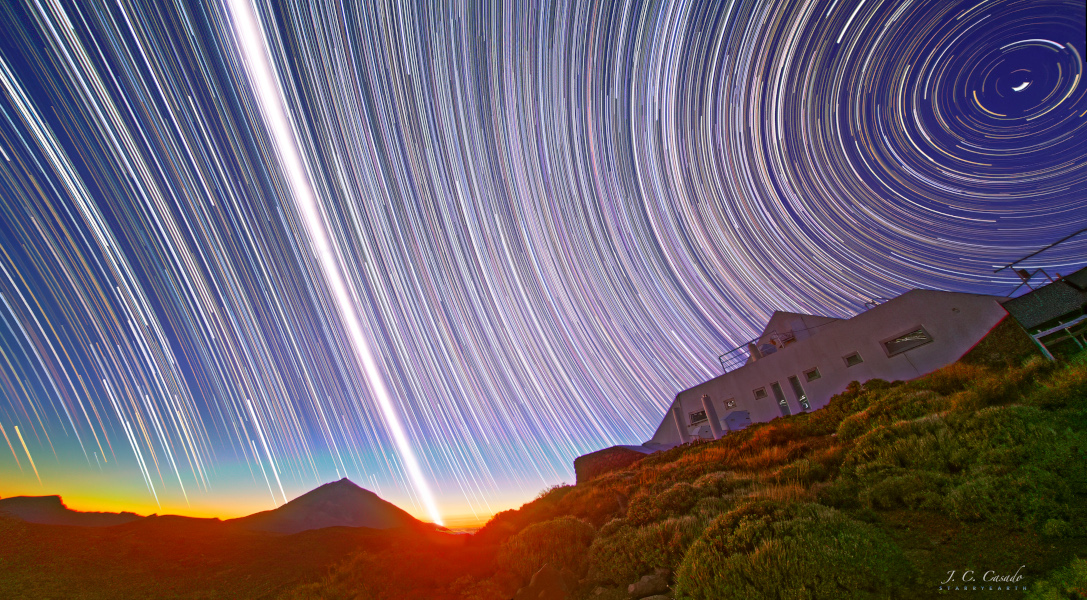 Image Credit: Juan Carlos Casado, Starry Earth, TWAN
Explanation:
The defining astronomical moment
of the equinox today is at 14:46 UTC (March 20).
That's when the Sun
crosses the celestial equator moving north
in its yearly journey through planet Earth's sky, marking
the beginning of spring for our fair planet in the northern
hemisphere and fall in the southern hemisphere.
Then, day and night are nearly equal
around the globe.
In fact, both day and nighttime exposures from a spring equinox at the
Observatorio del Teide
in Tenerife, Canary Islands, Spain, are used in this composited skyscape.
Over 1,000 images were taken with a fisheye lens and merged
in the ambitious equinox project.
The apparent motion of the Sun setting along the celestial equator on
the equinox date follows the bright linear, diagonal track from
the sequence of daytime exposures taken over 6 hours.
After sunset, nighttime exposures recorded startrails,
with the
celestial equator as a linear track and concentric
arcs circling the north celestial pole near Polaris at upper
right and the south celestial pole beyond the lower left edge
(and below the Teide horizon).
The foreground includes the distant
Teide volcano peak
and the
observatory's pyramid-shaped solar laboratory building.
#APOD #SpringEquinox #TeideObservatory #ObservatorioDelTeide #CelestialEquator #Equinox2024
Image Credit: Juan Carlos Casado, Starry Earth, TWAN
Explanation:
The defining astronomical moment
of the equinox today is at 14:46 UTC (March 20).
That's when the Sun
crosses the celestial equator moving north
in its yearly journey through planet Earth's sky, marking
the beginning of spring for our fair planet in the northern
hemisphere and fall in the southern hemisphere.
Then, day and night are nearly equal
around the globe.
In fact, both day and nighttime exposures from a spring equinox at the
Observatorio del Teide
in Tenerife, Canary Islands, Spain, are used in this composited skyscape.
Over 1,000 images were taken with a fisheye lens and merged
in the ambitious equinox project.
The apparent motion of the Sun setting along the celestial equator on
the equinox date follows the bright linear, diagonal track from
the sequence of daytime exposures taken over 6 hours.
After sunset, nighttime exposures recorded startrails,
with the
celestial equator as a linear track and concentric
arcs circling the north celestial pole near Polaris at upper
right and the south celestial pole beyond the lower left edge
(and below the Teide horizon).
The foreground includes the distant
Teide volcano peak
and the
observatory's pyramid-shaped solar laboratory building.
#APOD #SpringEquinox #TeideObservatory #ObservatorioDelTeide #CelestialEquator #Equinox2024
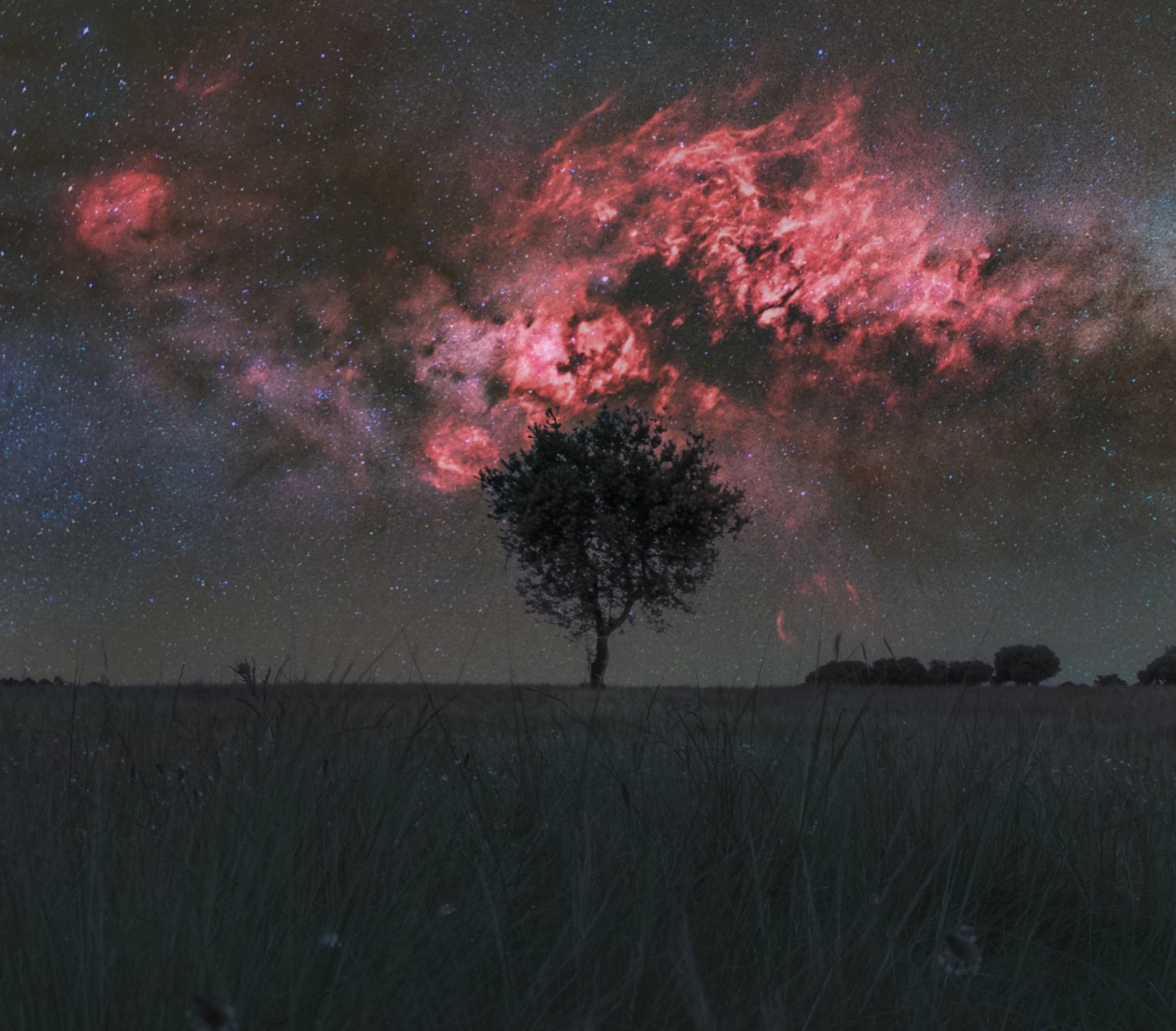 Image Credit: AstroHoracio, Keighley Rockcliffe, NASA, GSFC, UMBC CSST, CRESST II
Explanation:
A lone tree stands in a quiet meadow in
Guadalajara, Spain,
silhouetted against
the Cygnus region
rising above like flames in the night sky.
This deep night skyscape is a composite of exposures that reveals a range of brightness and color human eyes can't quite see on their own.
Spanning over a thousand times the
angular size
of the full moon,
Cygnus
sets the sky afire with
active star formation
where clouds of gas and dust collapse under gravity until
nuclear fusion
ignites and new stars are born.
These stars
ionize
the surrounding hydrogen gas, causing it to
glow crimson,
while tendrils of
interstellar dust
absorb some of that light and cast dark shadows across the sky.
Cygnus is a trove of celestial treasures, notably the
Veil,
Crescent, and
Pelican nebulae,
as well as
Cygnus X-1,
the first confirmed
black hole.
Cygnus continues to yield fresh science, including
a new three-dimensional model
of the
Cygnus Loop
made possible by
the Chandra X-ray Observatory.
#APOD #Cygnus #CygnusRegion #VeilNebula #PelicanNebula #CrescentNebula
Image Credit: AstroHoracio, Keighley Rockcliffe, NASA, GSFC, UMBC CSST, CRESST II
Explanation:
A lone tree stands in a quiet meadow in
Guadalajara, Spain,
silhouetted against
the Cygnus region
rising above like flames in the night sky.
This deep night skyscape is a composite of exposures that reveals a range of brightness and color human eyes can't quite see on their own.
Spanning over a thousand times the
angular size
of the full moon,
Cygnus
sets the sky afire with
active star formation
where clouds of gas and dust collapse under gravity until
nuclear fusion
ignites and new stars are born.
These stars
ionize
the surrounding hydrogen gas, causing it to
glow crimson,
while tendrils of
interstellar dust
absorb some of that light and cast dark shadows across the sky.
Cygnus is a trove of celestial treasures, notably the
Veil,
Crescent, and
Pelican nebulae,
as well as
Cygnus X-1,
the first confirmed
black hole.
Cygnus continues to yield fresh science, including
a new three-dimensional model
of the
Cygnus Loop
made possible by
the Chandra X-ray Observatory.
#APOD #Cygnus #CygnusRegion #VeilNebula #PelicanNebula #CrescentNebula
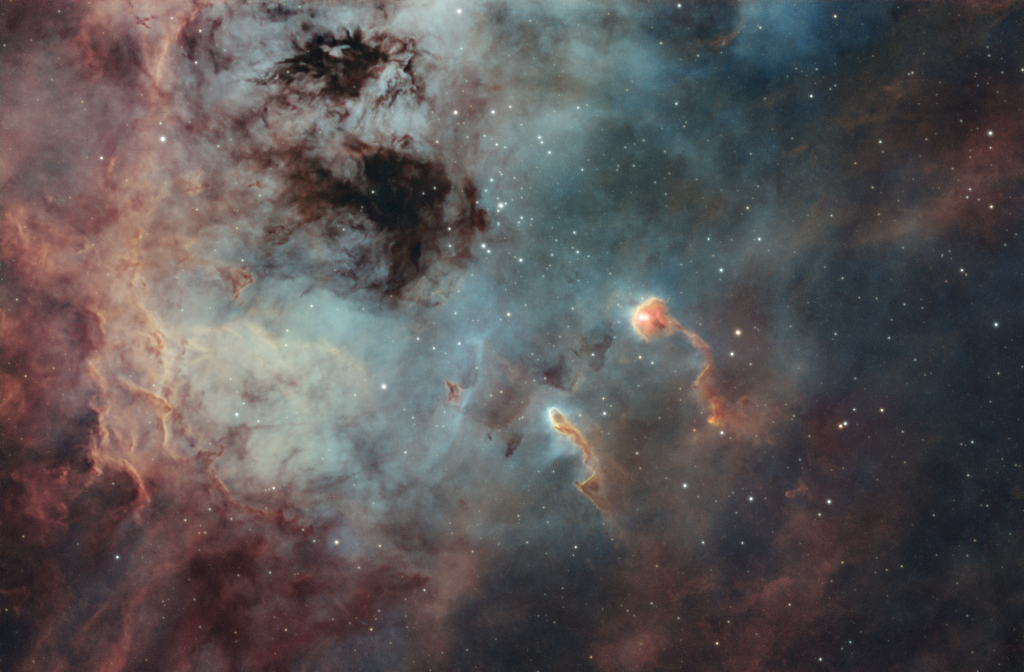 Image Credit: Nico Carver
Explanation:
This telescopic close-up
shows off the central regions of
otherwise faint emission nebula IC 410,
captured under backyard skies.
Presented
in a Hubble color palette,
the image combines visible broadband and narrowband data
with data from the near-infrared.
Below and right of center
are two remarkable inhabitants of the interstellar pond of gas and dust.
the Tadpoles of IC 410.
Partly obscured by foreground dust, the nebula itself surrounds
NGC 1893, a young
galactic cluster of stars.
Formed in the interstellar cloud a mere 4 million years ago, the
intensely hot, bright
cluster stars energize the glowing gas.
But the cosmic tadpoles themselves are
composed of denser cooler gas and dust.
Around 10 light-years long they are likely sites of ongoing
star formation.
Sculpted by stellar winds and radiation their heads are outlined by
bright ridges of ionized gas
while their tails trail away from the cluster's central young stars.
IC 410 lies some 10,000 light-years away,
toward the nebula-rich constellation Auriga.
#APOD #NASA #Astrogeek #NASAInspires #Cosmos
Image Credit: Nico Carver
Explanation:
This telescopic close-up
shows off the central regions of
otherwise faint emission nebula IC 410,
captured under backyard skies.
Presented
in a Hubble color palette,
the image combines visible broadband and narrowband data
with data from the near-infrared.
Below and right of center
are two remarkable inhabitants of the interstellar pond of gas and dust.
the Tadpoles of IC 410.
Partly obscured by foreground dust, the nebula itself surrounds
NGC 1893, a young
galactic cluster of stars.
Formed in the interstellar cloud a mere 4 million years ago, the
intensely hot, bright
cluster stars energize the glowing gas.
But the cosmic tadpoles themselves are
composed of denser cooler gas and dust.
Around 10 light-years long they are likely sites of ongoing
star formation.
Sculpted by stellar winds and radiation their heads are outlined by
bright ridges of ionized gas
while their tails trail away from the cluster's central young stars.
IC 410 lies some 10,000 light-years away,
toward the nebula-rich constellation Auriga.
#APOD #NASA #Astrogeek #NASAInspires #Cosmos
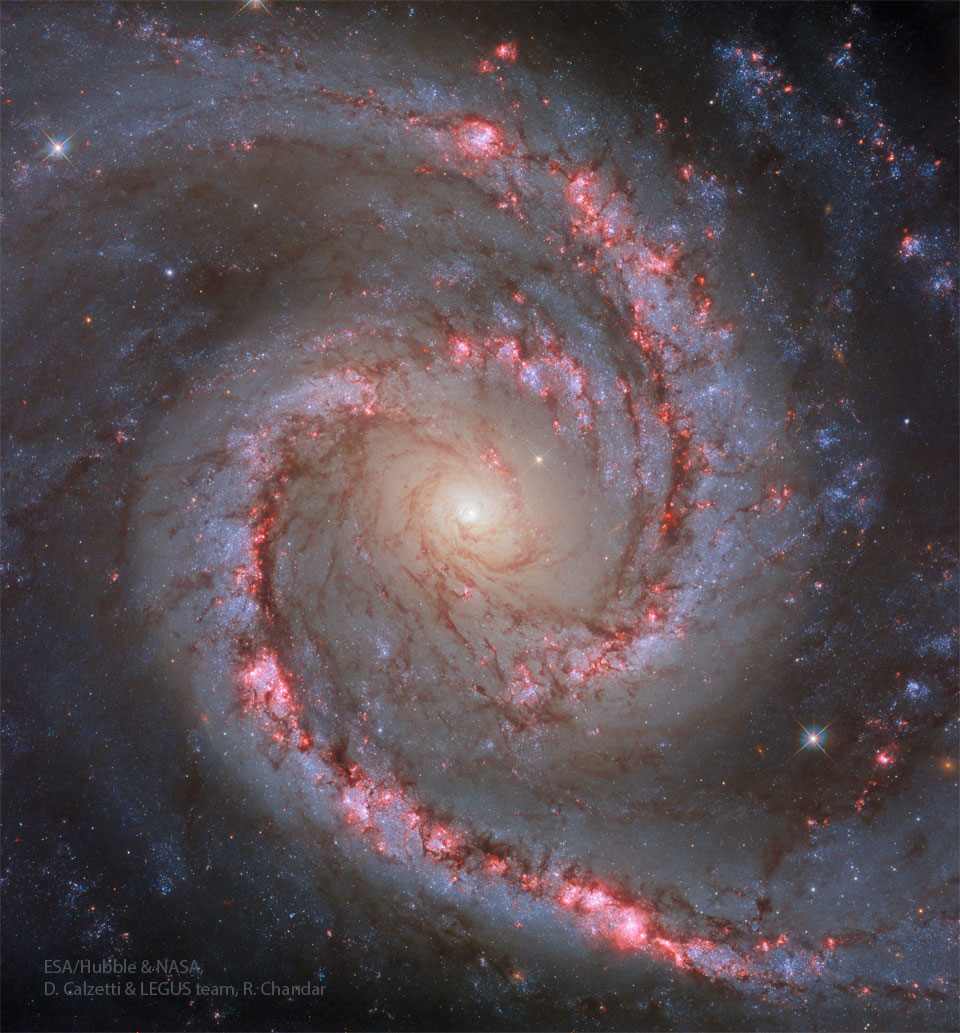 Image Credit: ESA/Hubble, NASA, D. Calzetti, LEGUS, Team, R. Chandar
Explanation:
If not perfect, then this
spiral galaxy
is at least one of the most photogenic.
An island universe containing billions of stars and
situated about 40 million light-years away toward the
constellation of the Dolphinfish
(Dorado),
NGC 1566 presents
a gorgeous face-on view.
Classified as a
grand design spiral,
NGC 1566 shows two prominent and graceful spiral
arms that are traced by bright blue
star clusters,
red emission nebulas,
and dark cosmic dust lanes.
Numerous Hubble Space Telescope images of
NGC 1566
have been taken to study star formation,
supernovas,
and the spiral's
unusually active center.
NGC 1566's flaring center makes the spiral one of the closest and brightest
Seyfert galaxies, likely housing a central
supermassive black hole wreaking havoc on
surrounding stars and gas.
#APOD #NGC1566 #SpanishDancerGalaxy #spiralgalaxy #granddesign #Dorado
Image Credit: ESA/Hubble, NASA, D. Calzetti, LEGUS, Team, R. Chandar
Explanation:
If not perfect, then this
spiral galaxy
is at least one of the most photogenic.
An island universe containing billions of stars and
situated about 40 million light-years away toward the
constellation of the Dolphinfish
(Dorado),
NGC 1566 presents
a gorgeous face-on view.
Classified as a
grand design spiral,
NGC 1566 shows two prominent and graceful spiral
arms that are traced by bright blue
star clusters,
red emission nebulas,
and dark cosmic dust lanes.
Numerous Hubble Space Telescope images of
NGC 1566
have been taken to study star formation,
supernovas,
and the spiral's
unusually active center.
NGC 1566's flaring center makes the spiral one of the closest and brightest
Seyfert galaxies, likely housing a central
supermassive black hole wreaking havoc on
surrounding stars and gas.
#APOD #NGC1566 #SpanishDancerGalaxy #spiralgalaxy #granddesign #Dorado
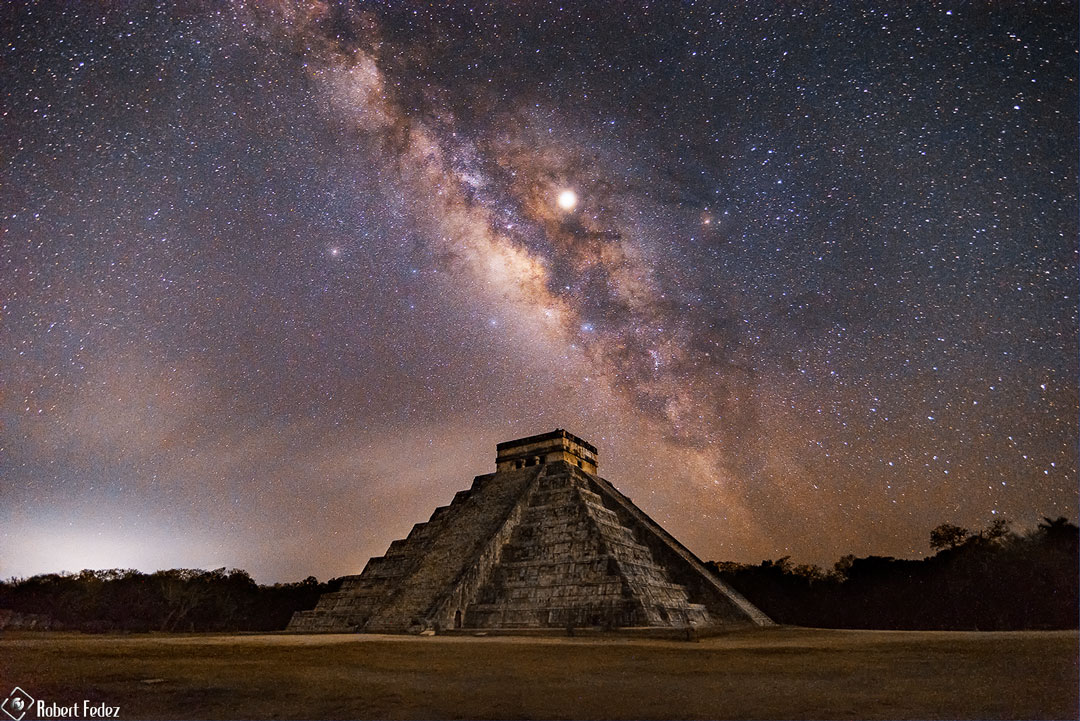 Image Credit: Robert Fedez
Explanation:
To see the feathered serpent
descend
the Mayan pyramid requires exquisite timing.
You must visit
El Castillo -- in
Mexico's
Yucatán Peninsula -- near an
equinox.
Then, during the late afternoon if the sky is clear,
the pyramid's own
shadows create triangles
that merge into the famous illusion of a
slithering viper.
Also known as the
Temple of Kukulkan, the impressive step-pyramid
stands 30 meters tall and 55 meters wide at the base.
Built up as a series of square terraces by the
pre-Columbian civilization between the 9th and 12th century,
the structure can be used as a calendar and is noted for
astronomical alignments.
The featured composite image was captured in 2019 with
Jupiter and Saturn
straddling the diagonal central band of our Milky Way galaxy.
In a few days another
equinox will occur
-- not only at Temple of Kukulcán, but
all over planet Earth.
#APOD #Equinox #MayanAstronomy #Kukulkan #ElCastillo #AstronomicalAlignment
Image Credit: Robert Fedez
Explanation:
To see the feathered serpent
descend
the Mayan pyramid requires exquisite timing.
You must visit
El Castillo -- in
Mexico's
Yucatán Peninsula -- near an
equinox.
Then, during the late afternoon if the sky is clear,
the pyramid's own
shadows create triangles
that merge into the famous illusion of a
slithering viper.
Also known as the
Temple of Kukulkan, the impressive step-pyramid
stands 30 meters tall and 55 meters wide at the base.
Built up as a series of square terraces by the
pre-Columbian civilization between the 9th and 12th century,
the structure can be used as a calendar and is noted for
astronomical alignments.
The featured composite image was captured in 2019 with
Jupiter and Saturn
straddling the diagonal central band of our Milky Way galaxy.
In a few days another
equinox will occur
-- not only at Temple of Kukulcán, but
all over planet Earth.
#APOD #Equinox #MayanAstronomy #Kukulkan #ElCastillo #AstronomicalAlignment
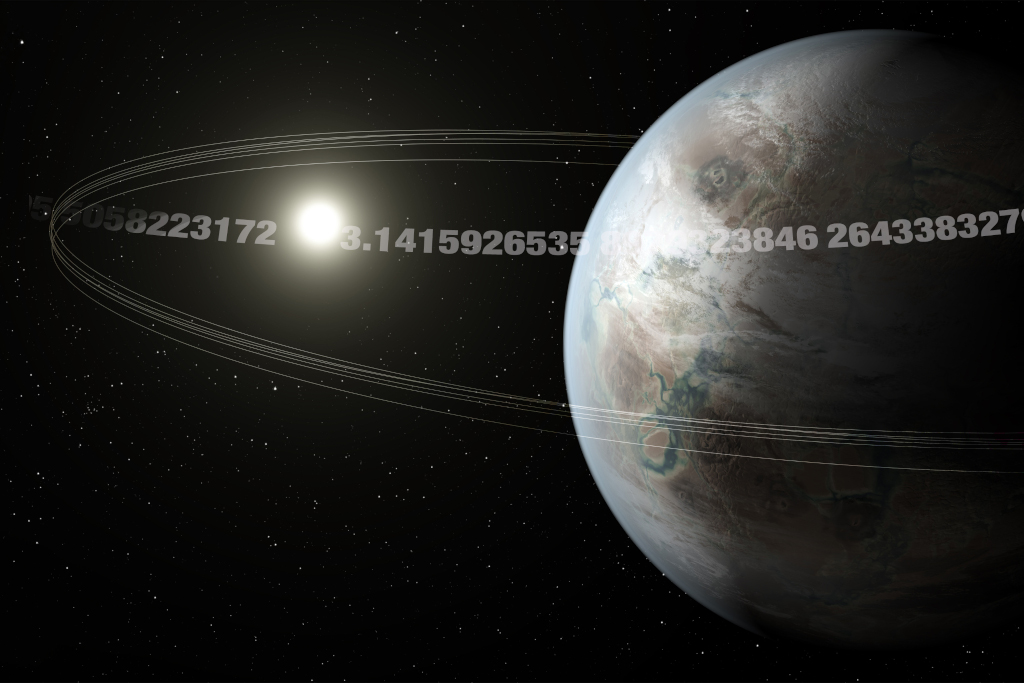 Image Credit: Not provided
Explanation:
Want to visit a planet that has 3.14 days in a year?
Then plan a trip to K2-315b, an earth-sized planet orbiting around
a cool, red, M dwarf star about once every 3.14 days.
The exoplanet's discovery,
based on publicly available data
from the planet-hunting
Kepler Space Telescope's
extended K2 mission, was announced in 2020.
K2-315b's measured orbital period in days is nearly equal to the
extremely
popular irrational
number Pi.
That
puts
the exoplanet so close to its parent star that its
surface is likely very warm,
baking-hot in fact.
And this Pi planet is over 185 light-years away.
So instead of trying to arrange for an
interstellar vacation
to K2-315b, there may be easier and more comfortable ways for you to celebrate
Pi day on planet Earth.
#APOD #K2 #exoplanet #exoplanets #planetaryscience #K2mission
Image Credit: Not provided
Explanation:
Want to visit a planet that has 3.14 days in a year?
Then plan a trip to K2-315b, an earth-sized planet orbiting around
a cool, red, M dwarf star about once every 3.14 days.
The exoplanet's discovery,
based on publicly available data
from the planet-hunting
Kepler Space Telescope's
extended K2 mission, was announced in 2020.
K2-315b's measured orbital period in days is nearly equal to the
extremely
popular irrational
number Pi.
That
puts
the exoplanet so close to its parent star that its
surface is likely very warm,
baking-hot in fact.
And this Pi planet is over 185 light-years away.
So instead of trying to arrange for an
interstellar vacation
to K2-315b, there may be easier and more comfortable ways for you to celebrate
Pi day on planet Earth.
#APOD #K2 #exoplanet #exoplanets #planetaryscience #K2mission
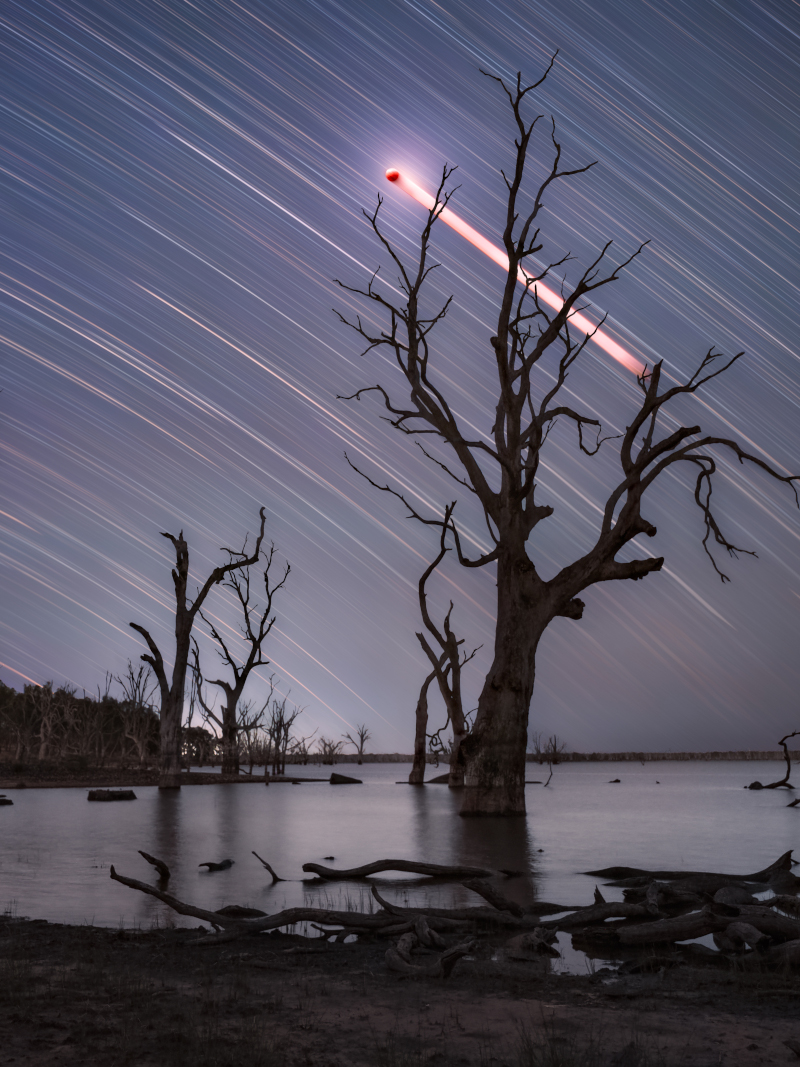 Image Credit: Jason Perry
Explanation:
In this composited night skyscape, stacked exposures trace graceful
star trails above Lake Toolondo, Victoria,
Australia, planet Earth.
Captured while the
lunar eclipse
of March 3 was
in progress,
the exposures used were made during the hour-long
total eclipse phase.
So faint star trails are easily visible along with
the trail of the reddened Moon in the
eclipse-darkened skies
above the lake and trees.
Of course, the apparent motion of Moon and stars revealed in the
timelapse composite
reflect the
Earth's daily rotation
around its axis.
Dramatically punctuating the Moon's trail as totality ended,
a single, separate telephoto image of the totally eclipsed Moon was scaled and
blended into the scene.
#APOD #ToolondoEclipse #LunarEclipse #StarTrails #NightSky #Australia
Image Credit: Jason Perry
Explanation:
In this composited night skyscape, stacked exposures trace graceful
star trails above Lake Toolondo, Victoria,
Australia, planet Earth.
Captured while the
lunar eclipse
of March 3 was
in progress,
the exposures used were made during the hour-long
total eclipse phase.
So faint star trails are easily visible along with
the trail of the reddened Moon in the
eclipse-darkened skies
above the lake and trees.
Of course, the apparent motion of Moon and stars revealed in the
timelapse composite
reflect the
Earth's daily rotation
around its axis.
Dramatically punctuating the Moon's trail as totality ended,
a single, separate telephoto image of the totally eclipsed Moon was scaled and
blended into the scene.
#APOD #ToolondoEclipse #LunarEclipse #StarTrails #NightSky #Australia
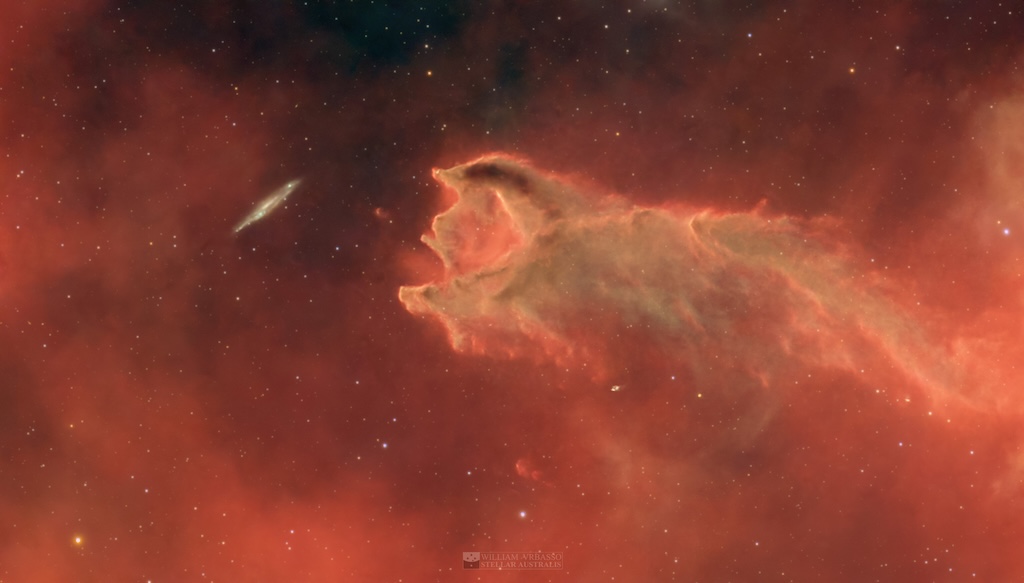 Image Credit: William Vrbasso, Cecilia Chirenti, NASA, GSFC, CRESST II
Explanation:
Is this a cosmic monster ready to devour an unsuspecting galaxy?
Thankfully, that is not the case.
The red “monster” shown in the featured image is Cometary Globule CG 4, 1,300 light-years away in the Constellation Puppis.
CG 4 is a molecular cloud, where hydrogen becomes cold enough to form molecules that can be brought together by gravity to create stars.
The shape of CG 4 resembles that of a comet, but its head is 1.5 light-year in diameter and its tail is 8 light-years long; for comparison, the distance from the Earth to the sun is only 8 light-minutes.
Astronomers believe that the tail of a cometary globule could have been shaped by a nearby supernova explosion or by irradiation from hot, massive stars. Indeed, CG 4 and other nearby globules point away from the Vela Supernova Remnant, at the center of the Gum Nebula.
The edge-on spiral galaxy, ESO 257-19, is more than a hundred million light-years beyond CG 4, and is completely safe from the “monster”.
#APOD #CG4 #Globule #Galaxy #CosmicMonster #InterstellarMedium
Image Credit: William Vrbasso, Cecilia Chirenti, NASA, GSFC, CRESST II
Explanation:
Is this a cosmic monster ready to devour an unsuspecting galaxy?
Thankfully, that is not the case.
The red “monster” shown in the featured image is Cometary Globule CG 4, 1,300 light-years away in the Constellation Puppis.
CG 4 is a molecular cloud, where hydrogen becomes cold enough to form molecules that can be brought together by gravity to create stars.
The shape of CG 4 resembles that of a comet, but its head is 1.5 light-year in diameter and its tail is 8 light-years long; for comparison, the distance from the Earth to the sun is only 8 light-minutes.
Astronomers believe that the tail of a cometary globule could have been shaped by a nearby supernova explosion or by irradiation from hot, massive stars. Indeed, CG 4 and other nearby globules point away from the Vela Supernova Remnant, at the center of the Gum Nebula.
The edge-on spiral galaxy, ESO 257-19, is more than a hundred million light-years beyond CG 4, and is completely safe from the “monster”.
#APOD #CG4 #Globule #Galaxy #CosmicMonster #InterstellarMedium
 Image Credit: Julien Looten
Explanation:
Are lasers from giant telescopes being used to defend the Earth?
No.
Lasers shot
from telescopes are now commonly used to help increase the accuracy of astronomical observations.
In some directions, Earth atmosphere-induced
fluctuations in starlight can indicate how the
air mass over a
telescope is changing, but in other directions, no bright star exists.
In these directions, astronomers can create an
artificial star with a
laser.
Subsequent observations of the artificial
laser guide star can reveal information so detailed
about the changing blurring effects of the
Earth's atmosphere that much of it
can be removed by rapidly flexing a telescope's mirror.
Such adaptive optics techniques allow high-resolution ground-based observations of
real stars,
planets, and
nebulas.
Pictured here, telescopes at
Paranal
Observatory in
Chile
study a colorful sky filled with green
airglow and the
Magellanic Clouds on the left, red
airglow on the right,
and the majestic central band of our
Milky Way Galaxy
arching across the center.
#APOD #ParanalObservatory #LaserGuideStar #AdaptiveOptics #Telescope #Astronomy
Image Credit: Julien Looten
Explanation:
Are lasers from giant telescopes being used to defend the Earth?
No.
Lasers shot
from telescopes are now commonly used to help increase the accuracy of astronomical observations.
In some directions, Earth atmosphere-induced
fluctuations in starlight can indicate how the
air mass over a
telescope is changing, but in other directions, no bright star exists.
In these directions, astronomers can create an
artificial star with a
laser.
Subsequent observations of the artificial
laser guide star can reveal information so detailed
about the changing blurring effects of the
Earth's atmosphere that much of it
can be removed by rapidly flexing a telescope's mirror.
Such adaptive optics techniques allow high-resolution ground-based observations of
real stars,
planets, and
nebulas.
Pictured here, telescopes at
Paranal
Observatory in
Chile
study a colorful sky filled with green
airglow and the
Magellanic Clouds on the left, red
airglow on the right,
and the majestic central band of our
Milky Way Galaxy
arching across the center.
#APOD #ParanalObservatory #LaserGuideStar #AdaptiveOptics #Telescope #Astronomy