
**Astronomy Picture of the Day**
02 May 2026
**Seeing Titan**
Image: 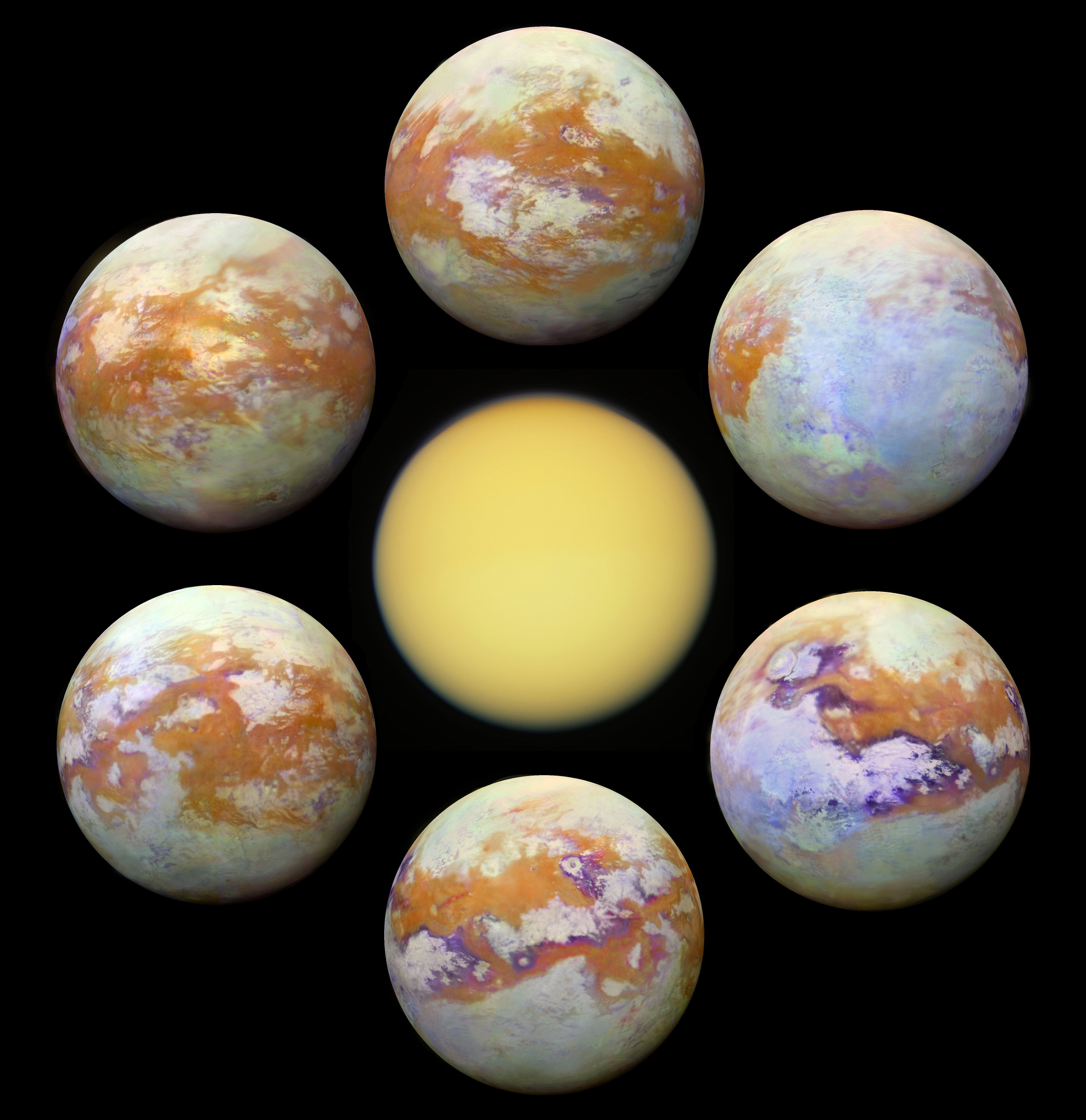 Image Credit: VIMS Team, Univ. Arizona , U. Nantes , ESA , NASA
Shrouded in a thick atmosphere, the surface of Saturn's largest moon, Titan , is really hard to see. Small particles suspended in Titan's upper atmosphere cause an almost impenetrable haze, strongly scattering light at visible wavelengths and hiding surface features from prying eyes. Still, Titan's surface is better imaged at infrared wavelengths, where scattering is weaker and atmospheric absorption is reduced. Arrayed around this visible light image (center) of Titan are some of the clearest global infrared views of the tantalizing moon so far. In false color, the six panels present a consistent processing of 13 years of infrared image data from the Visual and Infrared Mapping Spectrometer (VIMS) on board the Cassini spacecraft orbiting Saturn from 2004 to 2017. They offer a stunning comparison with Cassini's visible light view. NASA's revolutionary rotorcraft mission to Titan's surface is due to launch no earlier than July, 2028.
#APOD #Titan #Saturn #Cassini #VIMS #InfraredAstronomy
Image Credit: VIMS Team, Univ. Arizona , U. Nantes , ESA , NASA
Shrouded in a thick atmosphere, the surface of Saturn's largest moon, Titan , is really hard to see. Small particles suspended in Titan's upper atmosphere cause an almost impenetrable haze, strongly scattering light at visible wavelengths and hiding surface features from prying eyes. Still, Titan's surface is better imaged at infrared wavelengths, where scattering is weaker and atmospheric absorption is reduced. Arrayed around this visible light image (center) of Titan are some of the clearest global infrared views of the tantalizing moon so far. In false color, the six panels present a consistent processing of 13 years of infrared image data from the Visual and Infrared Mapping Spectrometer (VIMS) on board the Cassini spacecraft orbiting Saturn from 2004 to 2017. They offer a stunning comparison with Cassini's visible light view. NASA's revolutionary rotorcraft mission to Titan's surface is due to launch no earlier than July, 2028.
#APOD #Titan #Saturn #Cassini #VIMS #InfraredAstronomy
Image Credit: VIMS Team, Univ. Arizona , U. Nantes , ESA , NASA
Shrouded in a thick atmosphere, the surface of Saturn's largest moon, Titan , is really hard to see. Small particles suspended in Titan's upper atmosphere cause an almost impenetrable haze, strongly scattering light at visible wavelengths and hiding surface features from prying eyes. Still, Titan's surface is better imaged at infrared wavelengths, where scattering is weaker and atmospheric absorption is reduced. Arrayed around this visible light image (center) of Titan are some of the clearest global infrared views of the tantalizing moon so far. In false color, the six panels present a consistent processing of 13 years of infrared image data from the Visual and Infrared Mapping Spectrometer (VIMS) on board the Cassini spacecraft orbiting Saturn from 2004 to 2017. They offer a stunning comparison with Cassini's visible light view. NASA's revolutionary rotorcraft mission to Titan's surface is due to launch no earlier than July, 2028.
#APOD #Titan #Saturn #Cassini #VIMS #InfraredAstronomy
APOD: 2026 May 2 – Seeing Titan
A different astronomy and space science
related image is featured each day, along with a brief explanation.
 Credit: Not provided
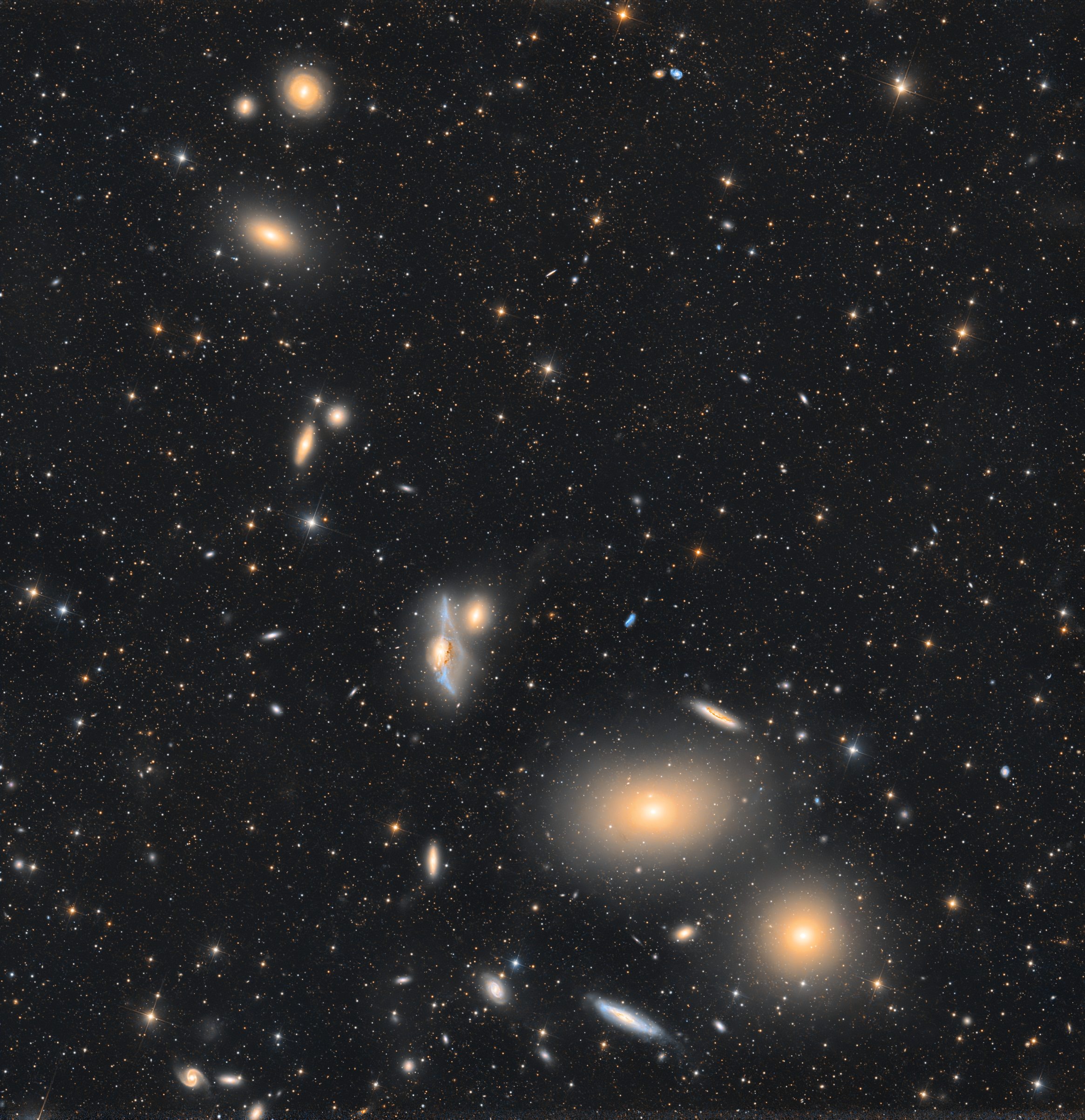
Near the heart of the Virgo Galaxy Cluster , a string of galaxies known as Markarian's Chain stretches across this telescopic field of view. Anchored in the frame at bottom right by prominent lenticular galaxies, M84 (bottom) and M86 , you can follow the chain's gentle arc up and toward the left. Near center you'll spot the pair of interacting galaxies NGC 4438 and NGC 4435, known to some as Markarian's Eyes . An estimated 50 million light-years distant, the Virgo Cluster itself is the nearest galaxy cluster . With up to about 2,000 member galaxies, it has a noticeable gravitational influence on our own Local Group of Galaxies . Within the Virgo Cluster at least seven galaxies in Markarian's Chain appear to move coherently , while others may appear to be part of the chain by chance.
#APOD #MarkarianChain #VirgoCluster #GalaxyCluster #M84 #M86
Credit: Not provided
Near the heart of the Virgo Galaxy Cluster , a string of galaxies known as Markarian's Chain stretches across this telescopic field of view. Anchored in the frame at bottom right by prominent lenticular galaxies, M84 (bottom) and M86 , you can follow the chain's gentle arc up and toward the left. Near center you'll spot the pair of interacting galaxies NGC 4438 and NGC 4435, known to some as Markarian's Eyes . An estimated 50 million light-years distant, the Virgo Cluster itself is the nearest galaxy cluster . With up to about 2,000 member galaxies, it has a noticeable gravitational influence on our own Local Group of Galaxies . Within the Virgo Cluster at least seven galaxies in Markarian's Chain appear to move coherently , while others may appear to be part of the chain by chance.
#APOD #MarkarianChain #VirgoCluster #GalaxyCluster #M84 #M86
 Video Credit: Una Schneck Text: Cecilia Chirenti ( NASA GSFC , UMCP , CRESST II )
Have you ever thought about surfing on an alien world? We can now expand the search for the perfect wave from Earth to the rest of the Solar System, and beyond . Scientists have developed a new model for simulating waves on other planets . Titan is one of the 274 confirmed moons of Saturn to date, and the only object in the solar system (besides Earth) known to have liquid lakes and seas on its surface. The featured video shows a simulation of waves on Earth (right) and on Titan (left), under the same conditions (the scale marker is in meters). A light breeze would create taller, slower-moving waves on Titan than on Earth, because the lakes there are filled with light liquid hydrocarbons , and because of Titan's low gravity and higher atmospheric pressure. In a couple of years, NASA expects to launch the Dragonfly mission, which will travel for 6 years and send a rotorcraft to explore Titan and study its microbial habitability .
#APOD #Titan #Saturn #Moons #PlanetaryScience #AstroPhysics
Video Credit: Una Schneck Text: Cecilia Chirenti ( NASA GSFC , UMCP , CRESST II )
Have you ever thought about surfing on an alien world? We can now expand the search for the perfect wave from Earth to the rest of the Solar System, and beyond . Scientists have developed a new model for simulating waves on other planets . Titan is one of the 274 confirmed moons of Saturn to date, and the only object in the solar system (besides Earth) known to have liquid lakes and seas on its surface. The featured video shows a simulation of waves on Earth (right) and on Titan (left), under the same conditions (the scale marker is in meters). A light breeze would create taller, slower-moving waves on Titan than on Earth, because the lakes there are filled with light liquid hydrocarbons , and because of Titan's low gravity and higher atmospheric pressure. In a couple of years, NASA expects to launch the Dragonfly mission, which will travel for 6 years and send a rotorcraft to explore Titan and study its microbial habitability .
#APOD #Titan #Saturn #Moons #PlanetaryScience #AstroPhysics
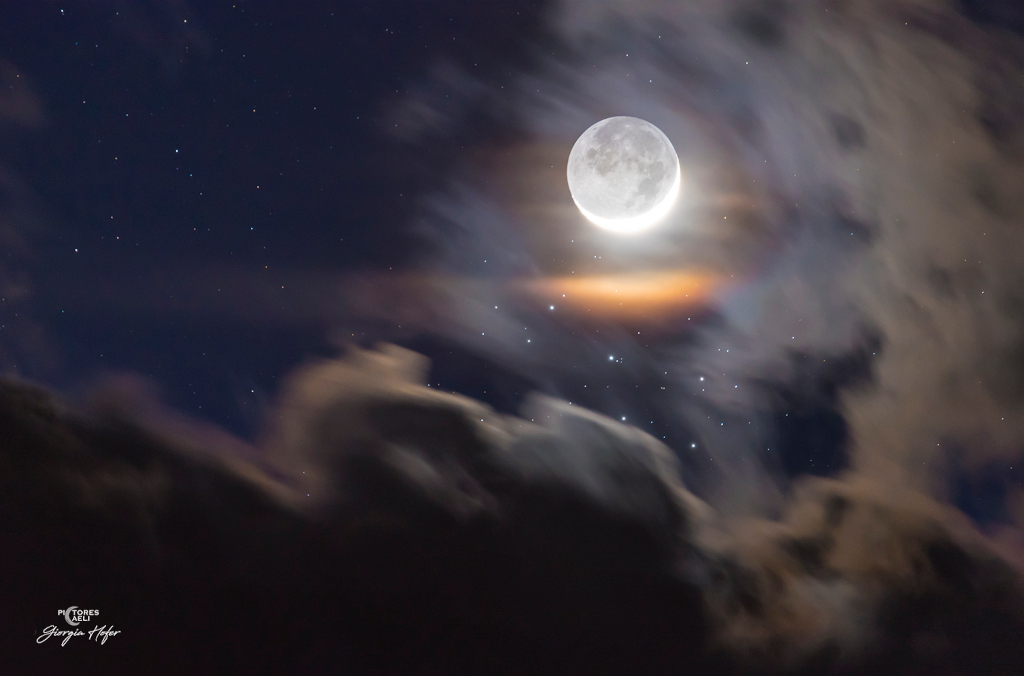 Image Credit: Giorgia Hofer
Explanation:
Sunlit arms of a
crescent moon
seem to embrace the faint lunar
night side in this dramatic celestial view from planet Earth.
The single telephoto exposure tracking the sky was captured on
the night of April 19,
when a two day old Moon was near perigee in its elliptical orbit.
On that date, the young Moon was also close on the sky to the lovely
Pleiades Star Cluster.
With the moonlight dimmed by clouds the Pleiades
sister stars gather
below the Moon's bright crescent, seen through a faint but colorful
lunar corona.
The lunar night side is illuminated
by earthshine,
sunlight reflected from the Earth itself.
The Moon's ashen glow,
also known as the "old moon in the young moon's arms,"
tends to be bright in the northern hemisphere spring.
And for now, the Moon's orbit takes it near the
Pleiades
stars each month in planet Earth's sky,
though their close conjunctions are easiest to
see when the Moon
is near a crescent phase.
#APOD #YoungMoon #Pleiades #Moonlight #Earthshine #CrescentMoon
Image Credit: Giorgia Hofer
Explanation:
Sunlit arms of a
crescent moon
seem to embrace the faint lunar
night side in this dramatic celestial view from planet Earth.
The single telephoto exposure tracking the sky was captured on
the night of April 19,
when a two day old Moon was near perigee in its elliptical orbit.
On that date, the young Moon was also close on the sky to the lovely
Pleiades Star Cluster.
With the moonlight dimmed by clouds the Pleiades
sister stars gather
below the Moon's bright crescent, seen through a faint but colorful
lunar corona.
The lunar night side is illuminated
by earthshine,
sunlight reflected from the Earth itself.
The Moon's ashen glow,
also known as the "old moon in the young moon's arms,"
tends to be bright in the northern hemisphere spring.
And for now, the Moon's orbit takes it near the
Pleiades
stars each month in planet Earth's sky,
though their close conjunctions are easiest to
see when the Moon
is near a crescent phase.
#APOD #YoungMoon #Pleiades #Moonlight #Earthshine #CrescentMoon
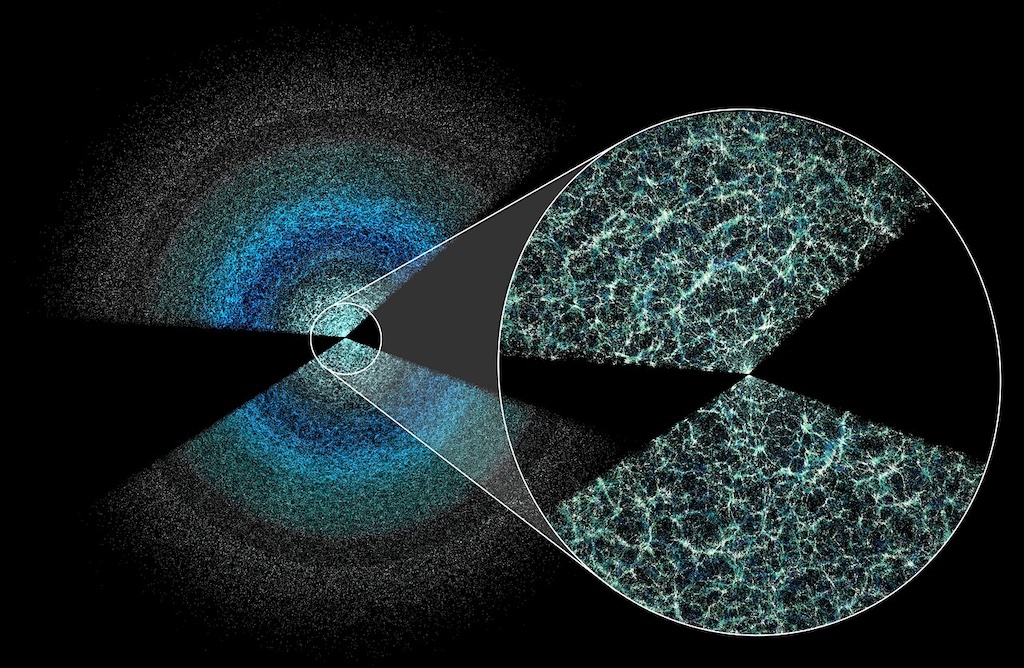 Image Credit: Claire Lamman, DESI collaboration, Cecilia Chirenti, NASA, GSFC, CRESST II
Explanation:
This is a map of the universe.
The Dark Energy Spectroscopic Instrument (DESI) at Kitt Peak National Observatory, Arizona, has finished its five-year survey.
It observed more than 47 million galaxies and quasars and created a 3D map centered on the Earth.
Today's featured image shows a thin slice of these data: the black gaps indicate where our Galaxy obscures distant objects.
The feathery web in the inset shows the large scale structure of the universe.
Light of the most distant galaxies shown here travelled for 11 billion years to reach the Earth.
Galaxies cluster throughout cosmic history under the competing influences of gravity and dark energy, responsible for the accelerated expansion of the universe.
Analysis of early DESI results hinted at the possibility that dark energy, described as a cosmological constant by Albert Einstein, may not be constant after all.
But we still have to wait for the analysis of the now complete dataset.
The nature of dark energy is the biggest mystery of cosmology.
#APOD #LargeScaleStructure #Universe #CosmicWeb #DESI #DarkEnergy
Image Credit: Claire Lamman, DESI collaboration, Cecilia Chirenti, NASA, GSFC, CRESST II
Explanation:
This is a map of the universe.
The Dark Energy Spectroscopic Instrument (DESI) at Kitt Peak National Observatory, Arizona, has finished its five-year survey.
It observed more than 47 million galaxies and quasars and created a 3D map centered on the Earth.
Today's featured image shows a thin slice of these data: the black gaps indicate where our Galaxy obscures distant objects.
The feathery web in the inset shows the large scale structure of the universe.
Light of the most distant galaxies shown here travelled for 11 billion years to reach the Earth.
Galaxies cluster throughout cosmic history under the competing influences of gravity and dark energy, responsible for the accelerated expansion of the universe.
Analysis of early DESI results hinted at the possibility that dark energy, described as a cosmological constant by Albert Einstein, may not be constant after all.
But we still have to wait for the analysis of the now complete dataset.
The nature of dark energy is the biggest mystery of cosmology.
#APOD #LargeScaleStructure #Universe #CosmicWeb #DESI #DarkEnergy
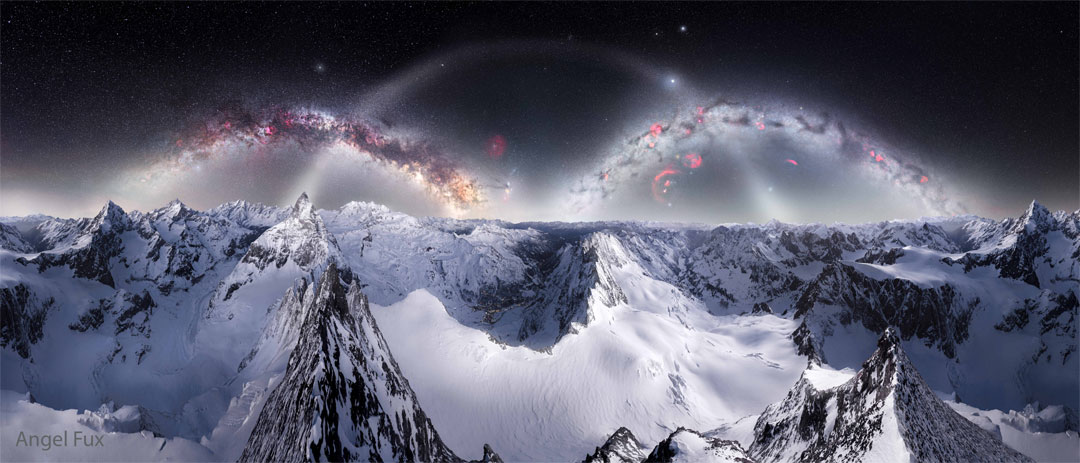 Image Credit: Angel Fux
Explanation:
Why are there three arches across the sky instead of two?
Last month, after being
dropped off by a helicopter at a
high mountain peak in the
Alps near the
Swiss
Italian border,
an adventurous astrophotographer expected two arches of
our Milky Way galaxy to be
visible during the night.
These were the inner arch looking in
toward the center of our galaxy on the left,
visible just before sunrise, and the
outer arch on the
right visible just after sunset.
But there were three arches.
The surprised
astrophotographer soon realized that the sky was
so dark that an
entire arc of faint
zodiacal light was also noticeable --
sunlight scattered by inner
Solar System dust.
And it artfully connected the two Milky Way arches!
The next morning a helicopter picked the astrophotographer back up,
and after 40 hours of processing and combining that night's images, the
featured triple-arch 360-degree panorama resulted.
#APOD #Astronomy #AstronomyCommunity #SkyArch #ArchesOfTheSky #AtmosphericPhysics
Image Credit: Angel Fux
Explanation:
Why are there three arches across the sky instead of two?
Last month, after being
dropped off by a helicopter at a
high mountain peak in the
Alps near the
Swiss
Italian border,
an adventurous astrophotographer expected two arches of
our Milky Way galaxy to be
visible during the night.
These were the inner arch looking in
toward the center of our galaxy on the left,
visible just before sunrise, and the
outer arch on the
right visible just after sunset.
But there were three arches.
The surprised
astrophotographer soon realized that the sky was
so dark that an
entire arc of faint
zodiacal light was also noticeable --
sunlight scattered by inner
Solar System dust.
And it artfully connected the two Milky Way arches!
The next morning a helicopter picked the astrophotographer back up,
and after 40 hours of processing and combining that night's images, the
featured triple-arch 360-degree panorama resulted.
#APOD #Astronomy #AstronomyCommunity #SkyArch #ArchesOfTheSky #AtmosphericPhysics
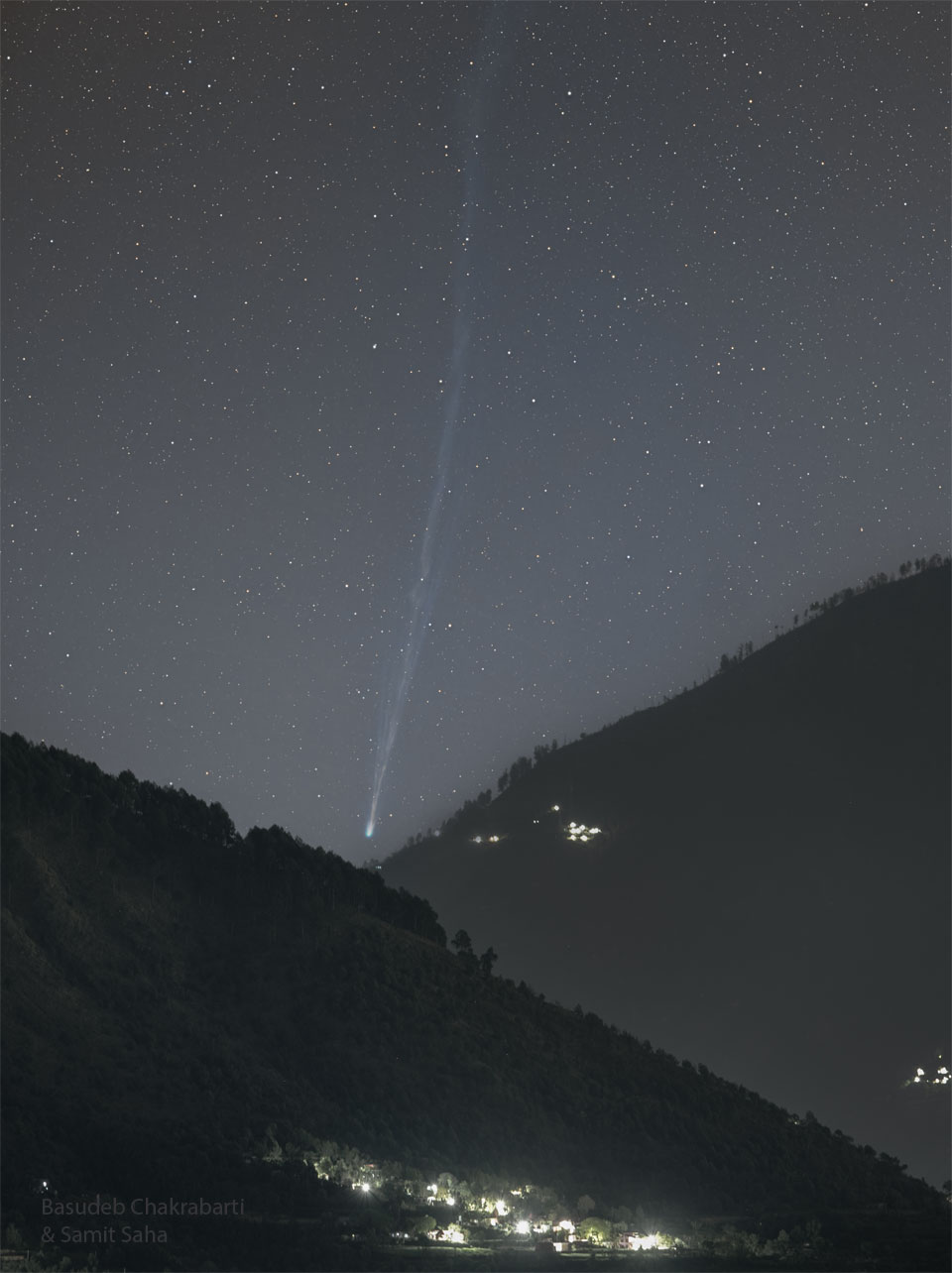 Image Credit: Basudeb Chakrabarti, Samit Saha
Explanation:
The best way to see comet R3 PanSTARRS’s long tail is with a camera.
This week, the
recently brightened comet
appears in northern skies to the east just before dawn,
but is only barely visible to the unaided eye.
The many-degree
ion tail captured on long duration camera exposures
is not unusual for a comet -
it is primarily due to the
Earth's nearly sideways
view of the tail as it points away from the Sun.
In the
featured image taken last week, Comet
C/2025 R3 (PanSTARRS) showed off its flowing tail
through a valley between two peaks in the
Himalayan mountains of
India.
The comet passed its closest to
the Sun yesterday.
As it nears its closest approach to Earth next week, a
bushy
dust tail may become visible.
The comet is slowly moving out of northern skies
and by the end of the month
will be visible after sunset
in southern skies as it fades and
leaves our
Solar System.
#APOD #CometR3 #PanSTARRS #C2025R3 #HimalayanValley #NorthernSkies
Image Credit: Basudeb Chakrabarti, Samit Saha
Explanation:
The best way to see comet R3 PanSTARRS’s long tail is with a camera.
This week, the
recently brightened comet
appears in northern skies to the east just before dawn,
but is only barely visible to the unaided eye.
The many-degree
ion tail captured on long duration camera exposures
is not unusual for a comet -
it is primarily due to the
Earth's nearly sideways
view of the tail as it points away from the Sun.
In the
featured image taken last week, Comet
C/2025 R3 (PanSTARRS) showed off its flowing tail
through a valley between two peaks in the
Himalayan mountains of
India.
The comet passed its closest to
the Sun yesterday.
As it nears its closest approach to Earth next week, a
bushy
dust tail may become visible.
The comet is slowly moving out of northern skies
and by the end of the month
will be visible after sunset
in southern skies as it fades and
leaves our
Solar System.
#APOD #CometR3 #PanSTARRS #C2025R3 #HimalayanValley #NorthernSkies
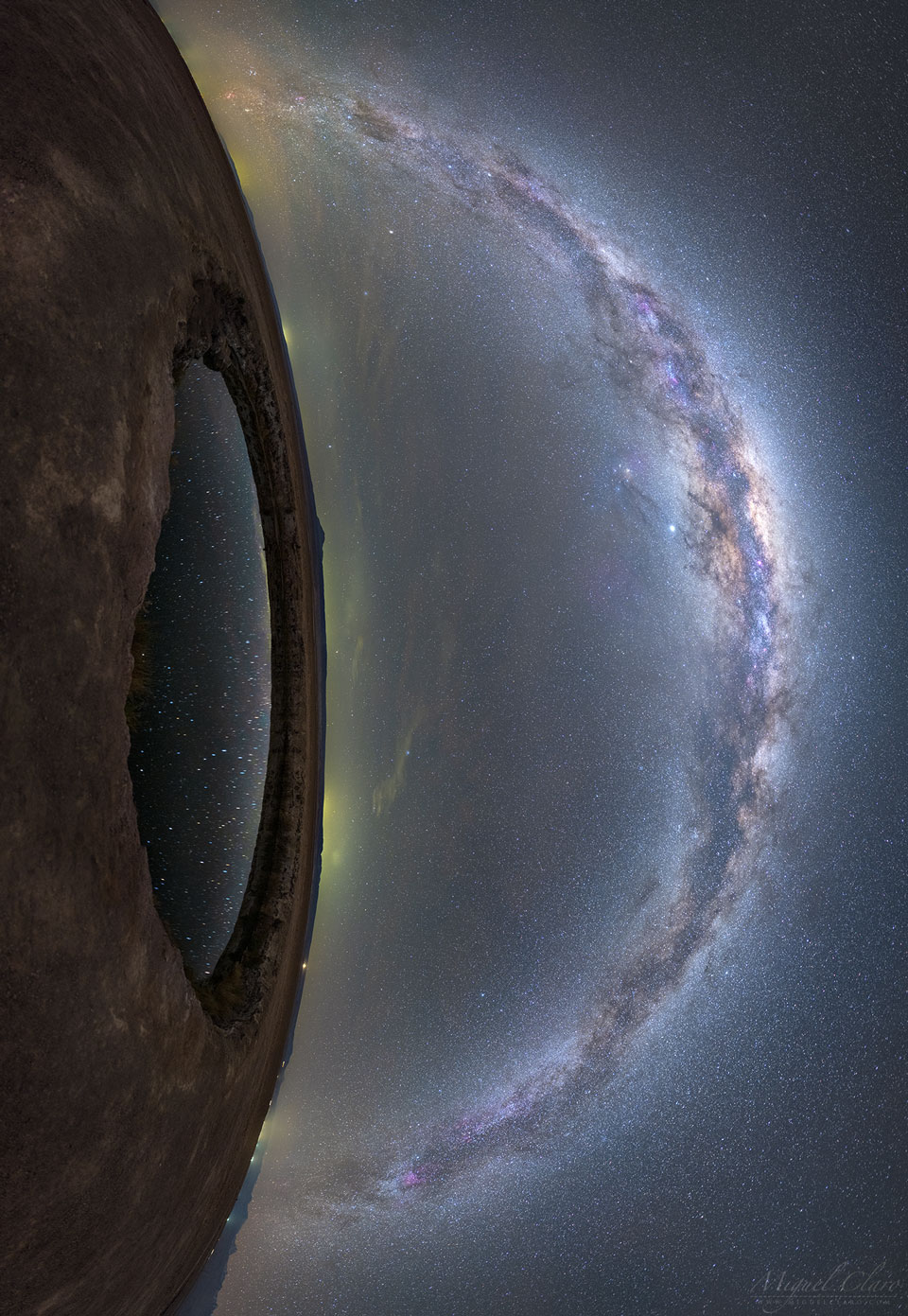 Image Credit: Miguel Claro, TWAN, Dark Sky Alqueva
Explanation:
Have you ever had
stars in your eyes?
It appears that the eye on the left does, and moreover, it appears to be gazing at even more stars.
The
featured 27-frame mosaic was taken in 2019 from
Ojas de Salar in the
Atacama Desert of
Chile.
The eye is actually a small
lagoon captured reflecting the
dark night sky
as the Milky Way Galaxy arched overhead.
The seemingly smooth band of the
Milky Way is really composed of billions of stars,
but decorated with filaments of light-absorbing dust and
red-glowing nebulas.
Additionally, both
Jupiter
(slightly left the galactic arch) and
Saturn
(slightly to the right) are visible.
The lights of small towns dot the
unusual vertical horizon.
The rocky terrain around the
lagoon appears to some more like the surface of
Mars than our
Earth.
#APOD #MilkyWay #Galaxy #Astronomy #Space #Stars
Image Credit: Miguel Claro, TWAN, Dark Sky Alqueva
Explanation:
Have you ever had
stars in your eyes?
It appears that the eye on the left does, and moreover, it appears to be gazing at even more stars.
The
featured 27-frame mosaic was taken in 2019 from
Ojas de Salar in the
Atacama Desert of
Chile.
The eye is actually a small
lagoon captured reflecting the
dark night sky
as the Milky Way Galaxy arched overhead.
The seemingly smooth band of the
Milky Way is really composed of billions of stars,
but decorated with filaments of light-absorbing dust and
red-glowing nebulas.
Additionally, both
Jupiter
(slightly left the galactic arch) and
Saturn
(slightly to the right) are visible.
The lights of small towns dot the
unusual vertical horizon.
The rocky terrain around the
lagoon appears to some more like the surface of
Mars than our
Earth.
#APOD #MilkyWay #Galaxy #Astronomy #Space #Stars
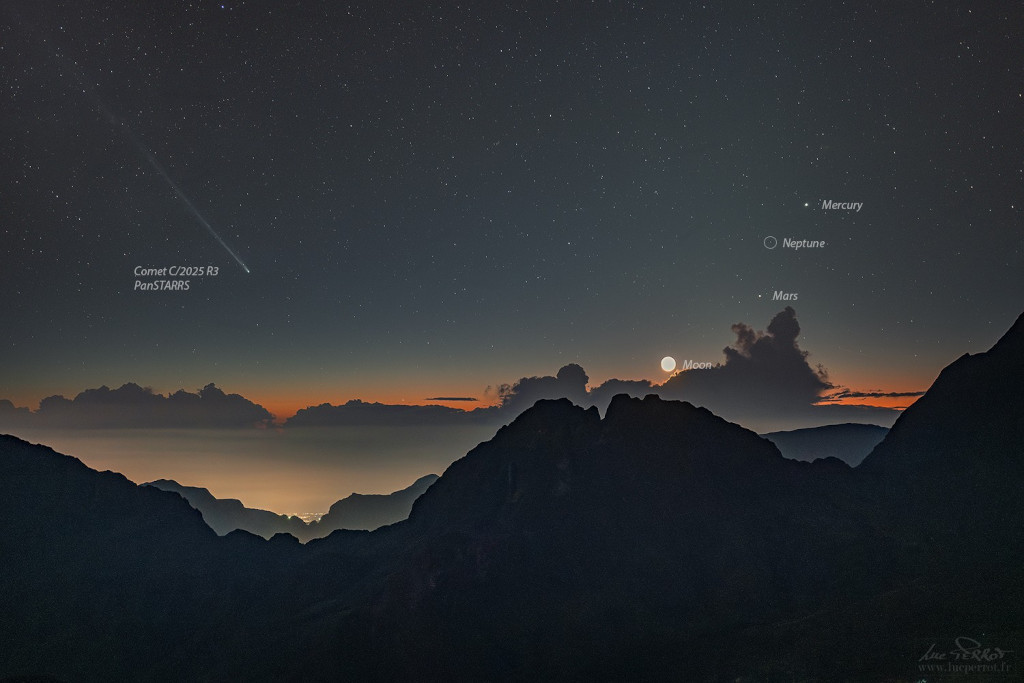 Image Credit: Luc Perrot, TWAN
Explanation:
Near the eastern horizon before sunrise, Comet C/2025 R3
PanSTARRS is getting brighter.
Readily visible in binoculars and small telescopes,
the comet may be just on the verge of naked-eye visibility
from dark sky sites.
Though it was not quite apparent to the eye,
PanSTARRS
is still easy to spot in this camera image taken on April 16.
In the view
from a volcanic peak overlooking France's Reunion Island, planet Earth,
the comet shares eastern predawn skies with
naked-eye planets Mars and Mercury
and fainter Neptune.
Saturn is hiding behind the low cloudbank that doesn't quite hide
an old crescent Moon.
This is a good weekend
for northern hemisphere comet watchers to try to
catch PanSTARRS
an hour or so before sunrise,
as the comet grows brighter approaching its perihelion on
April 19.
On April 26 the comet makes its closest approach to our fair planet
but by then will be difficult to see in the solar glare.
Good views
of this comet PanSTARRS in late April and early May will be from
the southern hemisphere.
#APOD #PanSTARRS #CometC2025R3 #CometWatch #CelestialEvents #NightSky
Image Credit: Luc Perrot, TWAN
Explanation:
Near the eastern horizon before sunrise, Comet C/2025 R3
PanSTARRS is getting brighter.
Readily visible in binoculars and small telescopes,
the comet may be just on the verge of naked-eye visibility
from dark sky sites.
Though it was not quite apparent to the eye,
PanSTARRS
is still easy to spot in this camera image taken on April 16.
In the view
from a volcanic peak overlooking France's Reunion Island, planet Earth,
the comet shares eastern predawn skies with
naked-eye planets Mars and Mercury
and fainter Neptune.
Saturn is hiding behind the low cloudbank that doesn't quite hide
an old crescent Moon.
This is a good weekend
for northern hemisphere comet watchers to try to
catch PanSTARRS
an hour or so before sunrise,
as the comet grows brighter approaching its perihelion on
April 19.
On April 26 the comet makes its closest approach to our fair planet
but by then will be difficult to see in the solar glare.
Good views
of this comet PanSTARRS in late April and early May will be from
the southern hemisphere.
#APOD #PanSTARRS #CometC2025R3 #CometWatch #CelestialEvents #NightSky
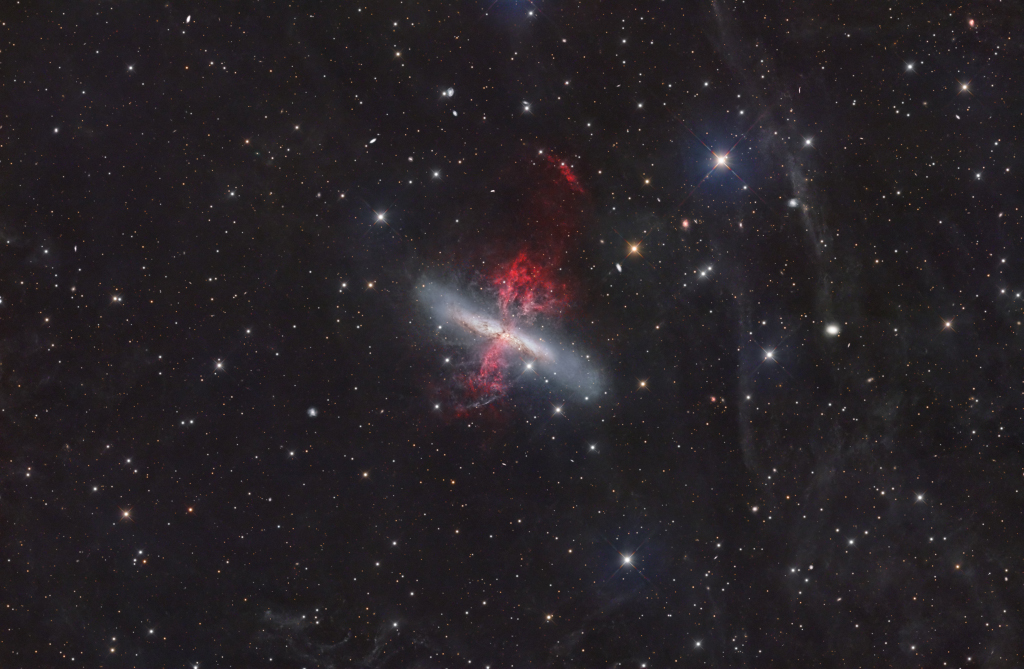 Image Credit: Arnaud Malleval
Explanation:
Messier 82 is a starburst galaxy
with a superwind.
In fact, through supernova explosions and
powerful winds from massive stars,
the burst of star formation in M82
is driving a prodigious outflow.
Evidence for the
superwind
from the galaxy's central regions is clear in the
sharp telescopic portrait.
The composite image includes 33 hours of narrowband data,
highlighting emission from
long outflow filaments of atomic hydrogen gas in reddish hues.
Some of the gas in the superwind,
enriched in heavy elements
forged in the massive stars,
will eventually escape into
intergalactic space.
Triggered by a
close encounter with
nearby large galaxy M81,
the furious burst of star formation in M82 should last about
100 million years or so.
Also known as the Cigar Galaxy for its elongated visual appearance,
M82 is about 30,000 light-years across.
It lies 12 million light-years away near the northern boundary of
Ursa Major.
#APOD #M82 #Messier82 #StarburstGalaxy #Superwind #GalacticOutflow
Image Credit: Arnaud Malleval
Explanation:
Messier 82 is a starburst galaxy
with a superwind.
In fact, through supernova explosions and
powerful winds from massive stars,
the burst of star formation in M82
is driving a prodigious outflow.
Evidence for the
superwind
from the galaxy's central regions is clear in the
sharp telescopic portrait.
The composite image includes 33 hours of narrowband data,
highlighting emission from
long outflow filaments of atomic hydrogen gas in reddish hues.
Some of the gas in the superwind,
enriched in heavy elements
forged in the massive stars,
will eventually escape into
intergalactic space.
Triggered by a
close encounter with
nearby large galaxy M81,
the furious burst of star formation in M82 should last about
100 million years or so.
Also known as the Cigar Galaxy for its elongated visual appearance,
M82 is about 30,000 light-years across.
It lies 12 million light-years away near the northern boundary of
Ursa Major.
#APOD #M82 #Messier82 #StarburstGalaxy #Superwind #GalacticOutflow
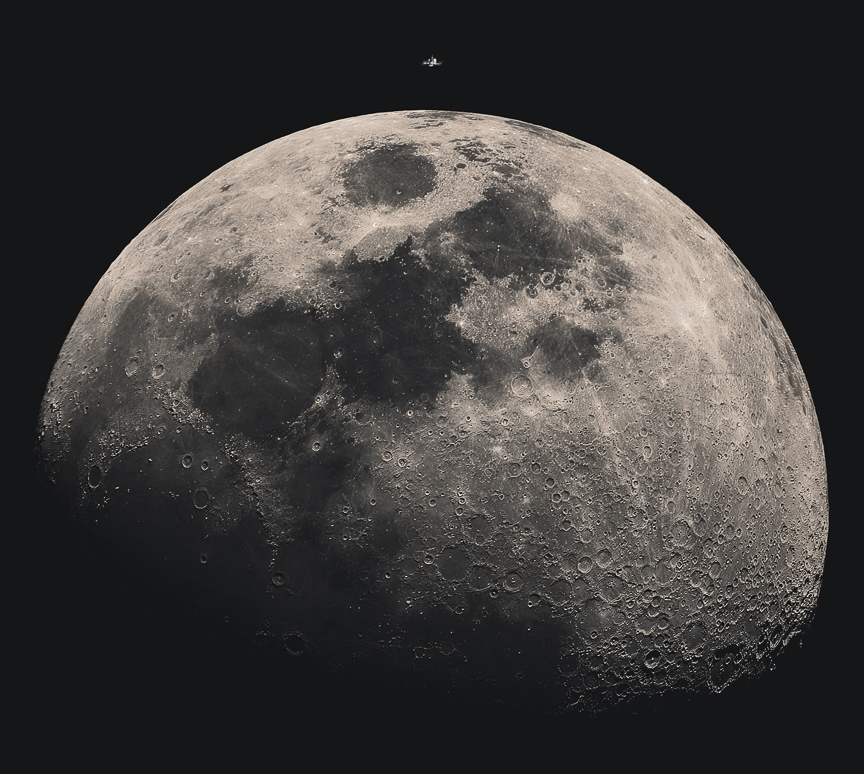 Image Credit: Sébastien Borie, Keighley Rockcliffe, NASA, GSFC, UMBC CSST, CRESST II
Explanation:
Nope, that is not an alien spaceship landing on the Moon! This is an image of
the International Space Station
(ISS) as it begins to transit in front of
the Moon.
The ISS is in
low-Earth orbit
(LEO) where it wizzes around the Earth every 90 minutes.
Orbiting the Earth 16 times per day
for 25 years, the ISS has photobombed many familiar celestial objects including
Venus,
Mars,
Saturn, and
the Sun.
Thousands of experiments
led by researchers from over one hundred countries have been conducted on the ISS.
Growing protein crystals in low gravity was
one of the first
experiments onboard the ISS and continues to contribute to new medical treatments. ISS astronauts study plant growth, water recycling, human health, and more to
support the Artemis missions
which will take humans farther than they’ve ever gone before. Next time you are out and about at night, try to
spot the ISS
zooming across the sky!
#APOD #ISS #MoonTransit #LEO #SpaceStation #SpaceExploration
Image Credit: Sébastien Borie, Keighley Rockcliffe, NASA, GSFC, UMBC CSST, CRESST II
Explanation:
Nope, that is not an alien spaceship landing on the Moon! This is an image of
the International Space Station
(ISS) as it begins to transit in front of
the Moon.
The ISS is in
low-Earth orbit
(LEO) where it wizzes around the Earth every 90 minutes.
Orbiting the Earth 16 times per day
for 25 years, the ISS has photobombed many familiar celestial objects including
Venus,
Mars,
Saturn, and
the Sun.
Thousands of experiments
led by researchers from over one hundred countries have been conducted on the ISS.
Growing protein crystals in low gravity was
one of the first
experiments onboard the ISS and continues to contribute to new medical treatments. ISS astronauts study plant growth, water recycling, human health, and more to
support the Artemis missions
which will take humans farther than they’ve ever gone before. Next time you are out and about at night, try to
spot the ISS
zooming across the sky!
#APOD #ISS #MoonTransit #LEO #SpaceStation #SpaceExploration
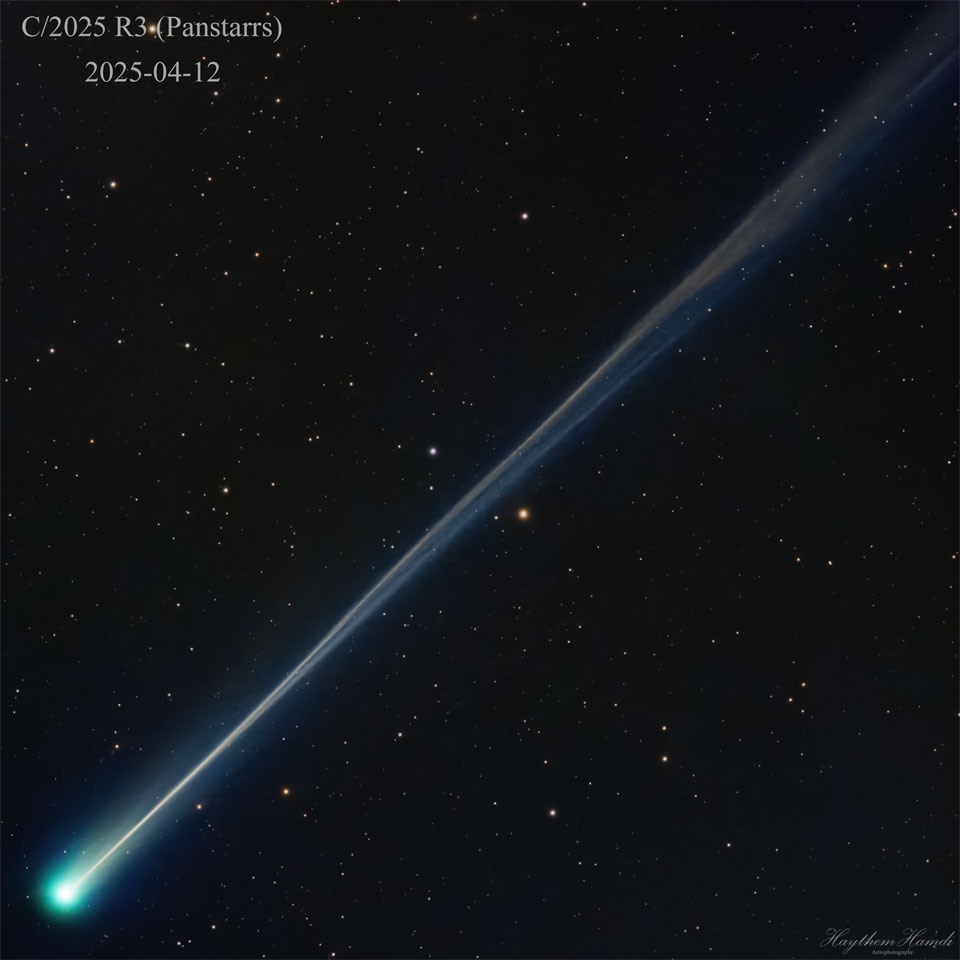 Image Credit: Haythem Hamdi
Explanation:
Why does Comet R3 (PanSTARRS) have a wispy tail?
The newest bright member of the inner Solar System,
Comet C/2025 R3 (PanSTARRS) is already extending an
impressive stream of glowing gas.
This tail starts from an unseen
central nucleus of dirty ice that is likely a few kilometers across.
The nucleus is warmed by the Sun and
emits a cloud of neutral gas into a
coma that
glows light green.
Nuclear gas ionized by
energetic sunlight is pushed away from the
Sun by the
solar wind into an ion tail that
glows light blue.
The wispy nature of the
ion tail is caused by the
constantly changing structure of the solar wind.
Pictured from
Rhode Island,
USA two days ago,
Comet R3 (PanSTARRS)
shows off a many-degree ion tail.
Comet R3 (PanSTARRS) is best seen before dawn from
northern skies for another 10 days, after which it
will be best visible from southern skies.
#APOD #CometR3 #PanSTARRS #Comets #Astronomy #Space
Image Credit: Haythem Hamdi
Explanation:
Why does Comet R3 (PanSTARRS) have a wispy tail?
The newest bright member of the inner Solar System,
Comet C/2025 R3 (PanSTARRS) is already extending an
impressive stream of glowing gas.
This tail starts from an unseen
central nucleus of dirty ice that is likely a few kilometers across.
The nucleus is warmed by the Sun and
emits a cloud of neutral gas into a
coma that
glows light green.
Nuclear gas ionized by
energetic sunlight is pushed away from the
Sun by the
solar wind into an ion tail that
glows light blue.
The wispy nature of the
ion tail is caused by the
constantly changing structure of the solar wind.
Pictured from
Rhode Island,
USA two days ago,
Comet R3 (PanSTARRS)
shows off a many-degree ion tail.
Comet R3 (PanSTARRS) is best seen before dawn from
northern skies for another 10 days, after which it
will be best visible from southern skies.
#APOD #CometR3 #PanSTARRS #Comets #Astronomy #Space
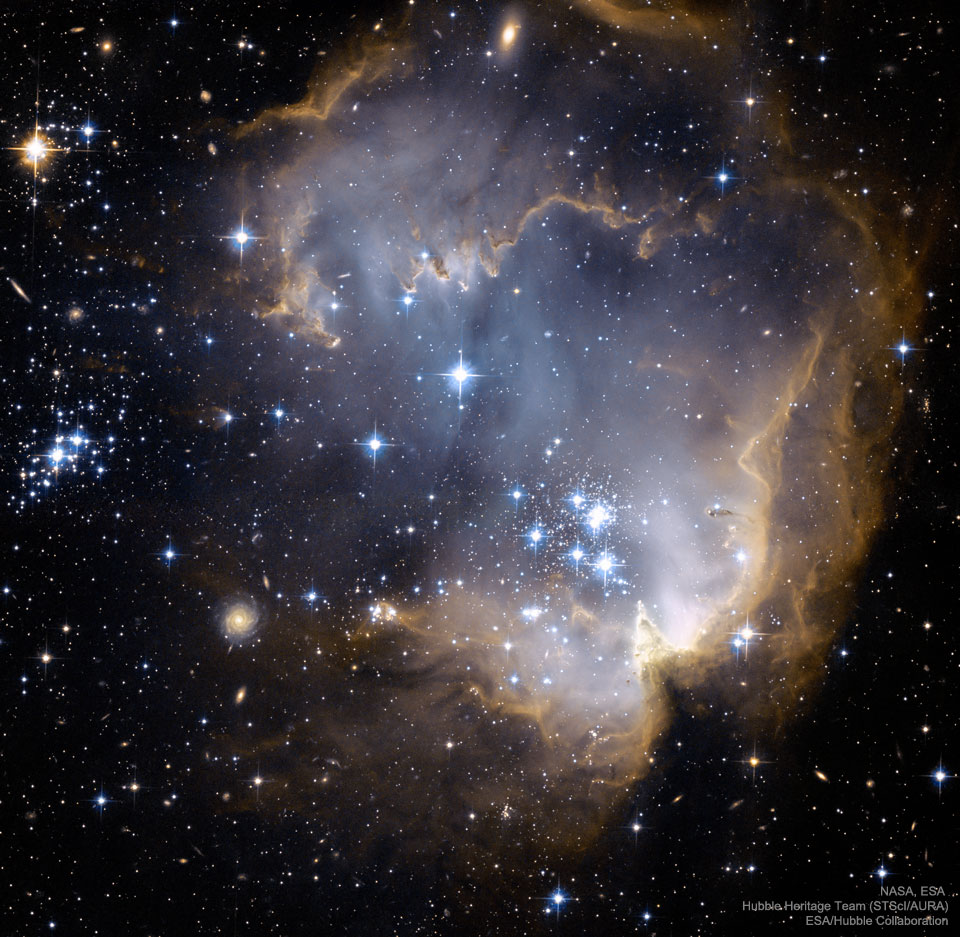 Image Credit: NASA, ESA, Hubble Heritage, STScI, AURA, ESA
Explanation:
The clouds may look like an oyster, and the stars like pearls, but look beyond.
Near the outskirts of the
Small Magellanic Cloud,
a satellite galaxy some 200 thousand light-years distant,
lies 5 million year young star cluster
NGC 602.
Surrounded by natal gas and dust,
NGC 602 is featured in this
stunning Hubble image of the region.
Fantastic ridges and swept
back shapes strongly suggest that
energetic radiation and shock waves from
NGC 602's
massive young stars have eroded the
dusty material
and triggered a progression of
star formation moving away from the cluster's center.
At the estimated distance of the
Small Magellanic Cloud,
the featured picture spans about 200 light-years, but
a tantalizing assortment of background galaxies are also visible in
this sharp
multi-colored view.
The background galaxies are hundreds of
millions of
light-years or more
beyond NGC 602.
#APOD #NGC602 #SmallMagellanicCloud #HubbleSpaceTelescope #StarFormation #YoungStarCluster
Image Credit: NASA, ESA, Hubble Heritage, STScI, AURA, ESA
Explanation:
The clouds may look like an oyster, and the stars like pearls, but look beyond.
Near the outskirts of the
Small Magellanic Cloud,
a satellite galaxy some 200 thousand light-years distant,
lies 5 million year young star cluster
NGC 602.
Surrounded by natal gas and dust,
NGC 602 is featured in this
stunning Hubble image of the region.
Fantastic ridges and swept
back shapes strongly suggest that
energetic radiation and shock waves from
NGC 602's
massive young stars have eroded the
dusty material
and triggered a progression of
star formation moving away from the cluster's center.
At the estimated distance of the
Small Magellanic Cloud,
the featured picture spans about 200 light-years, but
a tantalizing assortment of background galaxies are also visible in
this sharp
multi-colored view.
The background galaxies are hundreds of
millions of
light-years or more
beyond NGC 602.
#APOD #NGC602 #SmallMagellanicCloud #HubbleSpaceTelescope #StarFormation #YoungStarCluster
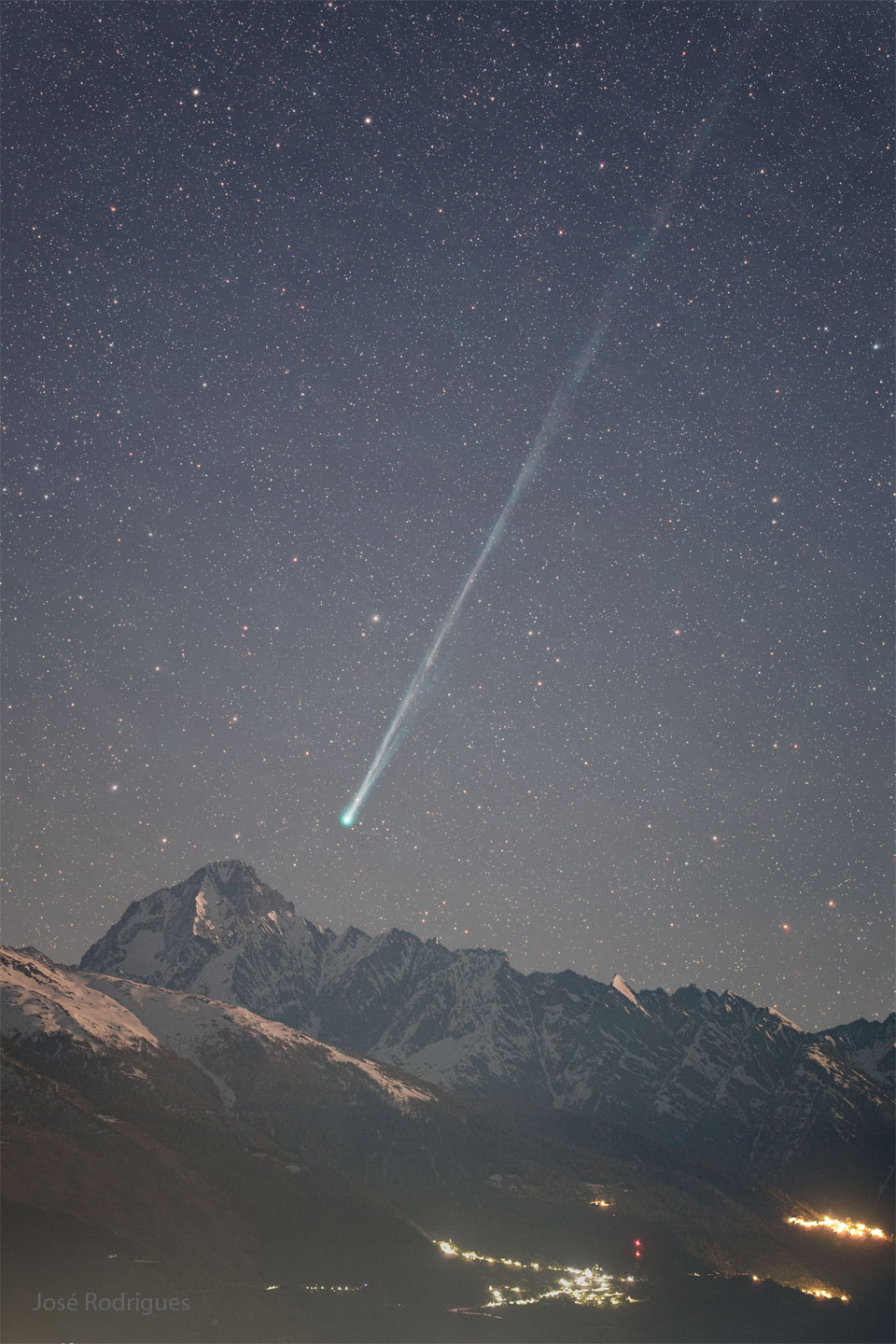 Image Credit: José Rodrigues
Explanation:
Comet R3 is brightening rapidly -- will it survive?
C/2025 R3 (PanSTARRS) has been slowly brightening and
extending an
ion tail since its discovery last year.
This shedding mountain
of dirty ice puts on its best sky show this month,
though, because it passes its closest to both the
Sun (April 19) and the
Earth (April 25).
The
featured image, showing R3 already sporting a
tail extending over 10 degrees,
was taken two nights ago from
Sion,
Switzerland
with the big mountain
Bietschhorn on the left.
Comet R3
will be visible during mid-April before sunrise.
Although the future brightness of any comet is hard to predict,
the brightness of
R3 makes it already a good
camera comet and it may become visible to the
unaided eye in the next week.
Comet R3's physical future is also
unknown because, like
Comet A1 (MAPS) earlier this month, it may
disintegrate when it passes its closest to the Sun.
Or it may live to
leave the Solar System.
#APOD #CometR3 #PanSTARRS #Comet #Astronomy #Astro
Image Credit: José Rodrigues
Explanation:
Comet R3 is brightening rapidly -- will it survive?
C/2025 R3 (PanSTARRS) has been slowly brightening and
extending an
ion tail since its discovery last year.
This shedding mountain
of dirty ice puts on its best sky show this month,
though, because it passes its closest to both the
Sun (April 19) and the
Earth (April 25).
The
featured image, showing R3 already sporting a
tail extending over 10 degrees,
was taken two nights ago from
Sion,
Switzerland
with the big mountain
Bietschhorn on the left.
Comet R3
will be visible during mid-April before sunrise.
Although the future brightness of any comet is hard to predict,
the brightness of
R3 makes it already a good
camera comet and it may become visible to the
unaided eye in the next week.
Comet R3's physical future is also
unknown because, like
Comet A1 (MAPS) earlier this month, it may
disintegrate when it passes its closest to the Sun.
Or it may live to
leave the Solar System.
#APOD #CometR3 #PanSTARRS #Comet #Astronomy #Astro
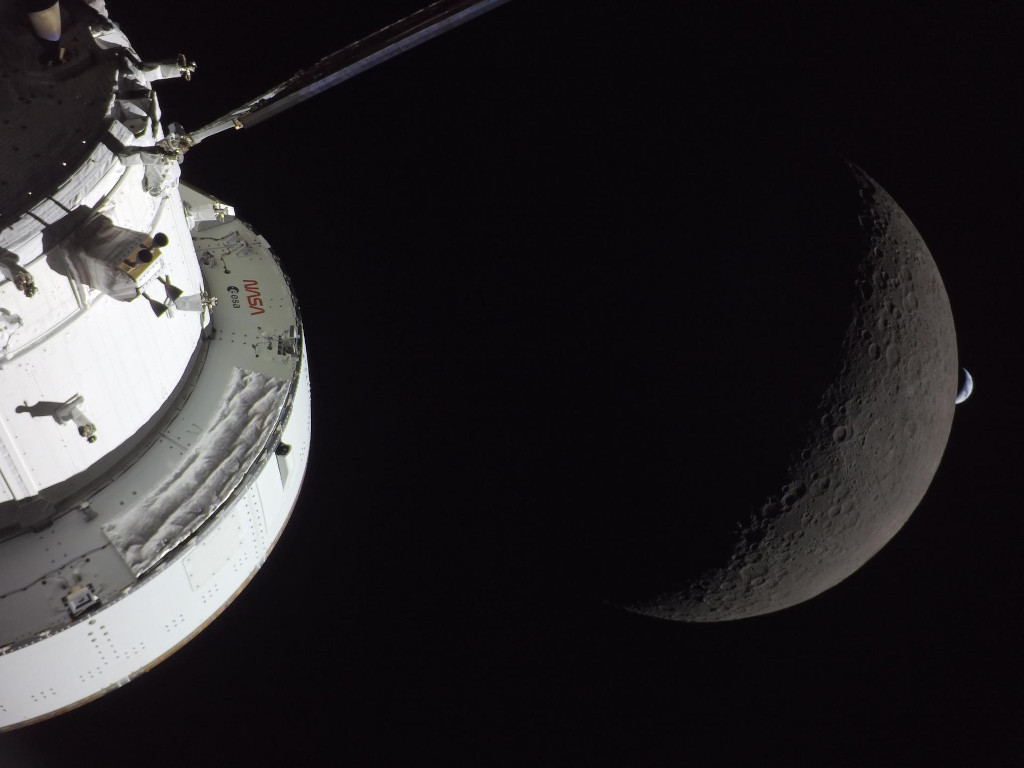 Image Credit: NASA, Artemis II
Explanation:
On flight day 6
(April 6) the Artemis II mission achieved a
historic lunar flyby.
Rounding the lunar far side, the deep space maneuver marked
humanity's first venture to the Moon
since Apollo 17 in 1972.
The Orion spacecraft Integrity reached a maximum distance of nearly
407,000 kilometers, and the
Artemis II crew,
Reid Wiseman, Victor Glover, and Christina Koch, and Jeremy Hansen,
set the record for the farthest distance from Earth
traveled by any human since the
Apollo 13 crew in 1970.
From behind the Moon on flight day 6, a solar array wing camera
recorded this space age selfie,
framing the spacecraft and lunar far side.
Planet Earth, home to the Artemis II crew,
is the small, bright crescent beyond the lunar limb.
The crew safely returned home on Artemis II mission
flight day 10.
#APOD #ArtemisII #FlightDay6 #LunarFlyby #DeepSpace #MoonMission
Image Credit: NASA, Artemis II
Explanation:
On flight day 6
(April 6) the Artemis II mission achieved a
historic lunar flyby.
Rounding the lunar far side, the deep space maneuver marked
humanity's first venture to the Moon
since Apollo 17 in 1972.
The Orion spacecraft Integrity reached a maximum distance of nearly
407,000 kilometers, and the
Artemis II crew,
Reid Wiseman, Victor Glover, and Christina Koch, and Jeremy Hansen,
set the record for the farthest distance from Earth
traveled by any human since the
Apollo 13 crew in 1970.
From behind the Moon on flight day 6, a solar array wing camera
recorded this space age selfie,
framing the spacecraft and lunar far side.
Planet Earth, home to the Artemis II crew,
is the small, bright crescent beyond the lunar limb.
The crew safely returned home on Artemis II mission
flight day 10.
#APOD #ArtemisII #FlightDay6 #LunarFlyby #DeepSpace #MoonMission
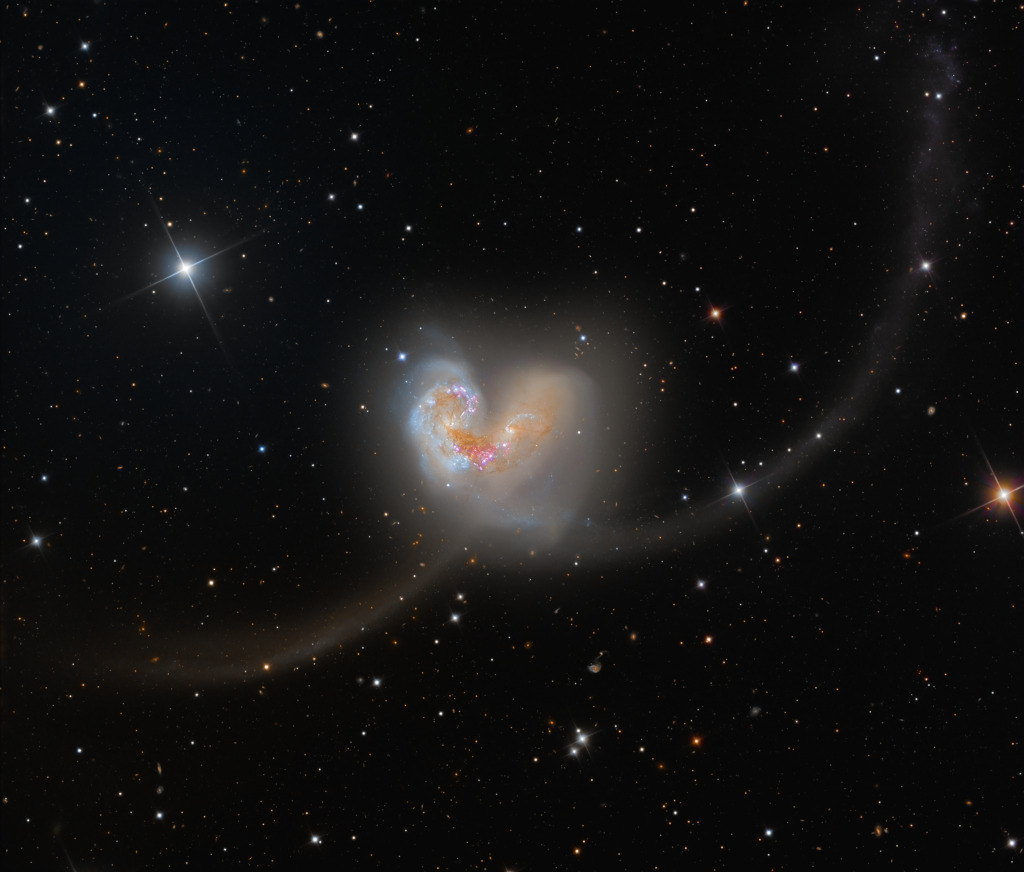 Image Credit: Mike Selby, Roberto Colombari
Explanation:
Some 60 million light-years away in the southerly
constellation
Corvus, two large galaxies are colliding.
Stars in the two galaxies, cataloged as
NGC 4038 and
NGC 4039,
very rarely collide in the course of the
ponderous cataclysm that lasts for hundreds of millions of years.
But the galaxies' large
clouds of molecular gas and dust
often do, triggering
furious episodes of star formation
near the center of the
cosmic wreckage.
Spanning over 50 thousand light-years, this
stunning telescopic frame also reveals new star clusters and
matter flung far from the scene of the accident by
gravitational tidal
forces.
The remarkably
sharp ground-based image
follows the faint tidal tails and distant background galaxies in the
field of view.
The suggestive overall visual appearance of the extended arcing
structures gives the galaxy pair, also known as Arp 244,
its popular name -
The Antennae.
#APOD #AntennaeGalaxies #NGC4038 #NGC4039 #GalaxyCollision #StarFormation
Image Credit: Mike Selby, Roberto Colombari
Explanation:
Some 60 million light-years away in the southerly
constellation
Corvus, two large galaxies are colliding.
Stars in the two galaxies, cataloged as
NGC 4038 and
NGC 4039,
very rarely collide in the course of the
ponderous cataclysm that lasts for hundreds of millions of years.
But the galaxies' large
clouds of molecular gas and dust
often do, triggering
furious episodes of star formation
near the center of the
cosmic wreckage.
Spanning over 50 thousand light-years, this
stunning telescopic frame also reveals new star clusters and
matter flung far from the scene of the accident by
gravitational tidal
forces.
The remarkably
sharp ground-based image
follows the faint tidal tails and distant background galaxies in the
field of view.
The suggestive overall visual appearance of the extended arcing
structures gives the galaxy pair, also known as Arp 244,
its popular name -
The Antennae.
#APOD #AntennaeGalaxies #NGC4038 #NGC4039 #GalaxyCollision #StarFormation
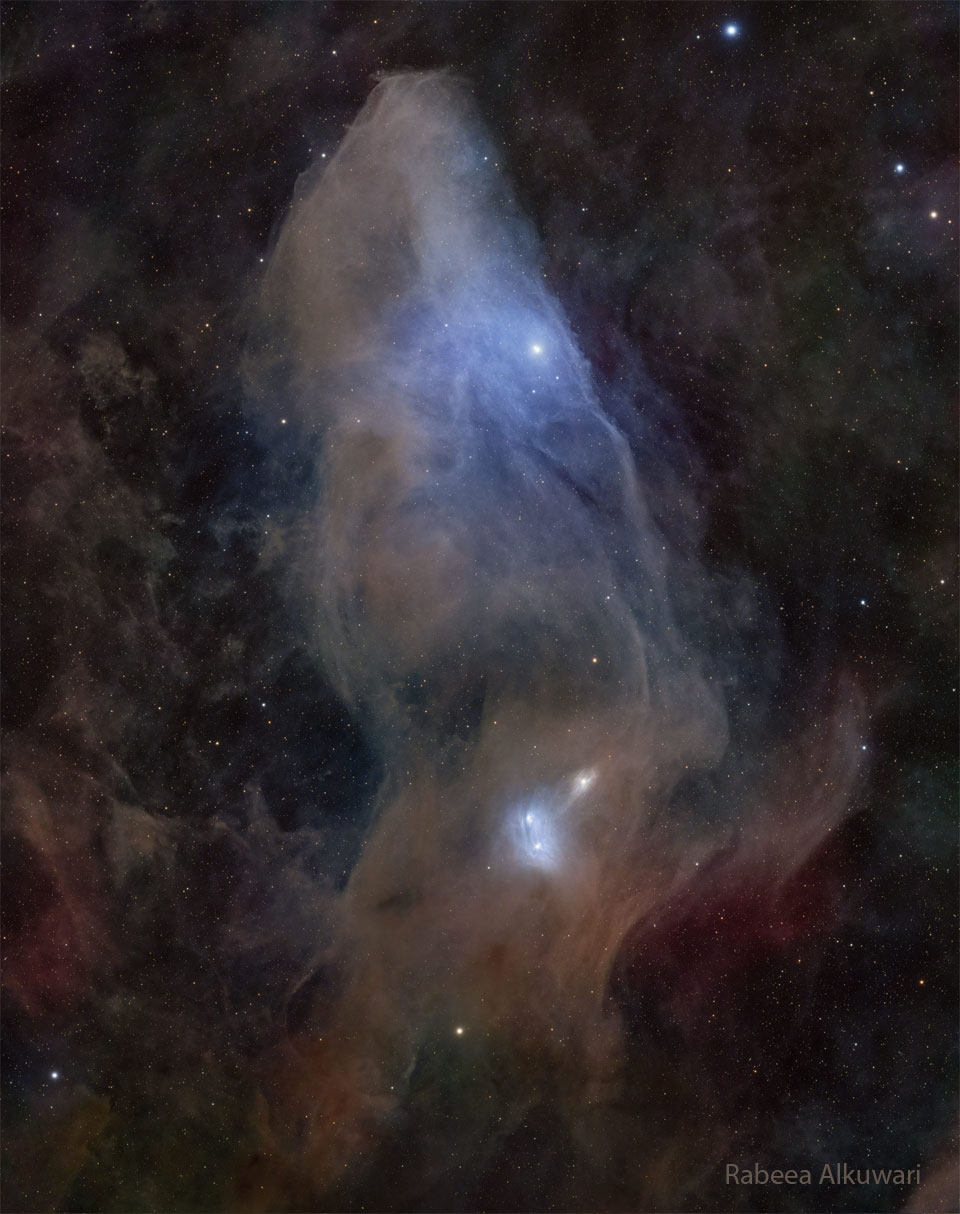 Image Credit: Rabeea Alkuwari
Explanation:
Do you see the horse's head?
What you are seeing is not the famous
Horsehead nebula toward
Orion, but
rather a fainter nebula that only takes on a
familiar form with deeper imaging.
The main part of the
here-imaged
molecular cloud complex is
reflection nebula
IC 4592.
Reflection nebulas are made up of very fine
dust that normally appears dark but can
look quite blue when reflecting the
visible light
of energetic nearby stars.
In this case, the source of much of the reflected light is a star
at the eye of the
horse.
That star is part of
Nu Scorpii,
one of the brighter star systems toward the constellation of the Scorpion
(Scorpius).
A second
reflection nebula dubbed
IC 4601 is visible surrounding
two stars just below the image center.
The featured picture was taken from
Sawda Natheel in
Qatar.
#APOD #IC4592 #BlueHorsehead #ReflectionNebula #HorseheadNebula #SpacePhotography
Image Credit: Rabeea Alkuwari
Explanation:
Do you see the horse's head?
What you are seeing is not the famous
Horsehead nebula toward
Orion, but
rather a fainter nebula that only takes on a
familiar form with deeper imaging.
The main part of the
here-imaged
molecular cloud complex is
reflection nebula
IC 4592.
Reflection nebulas are made up of very fine
dust that normally appears dark but can
look quite blue when reflecting the
visible light
of energetic nearby stars.
In this case, the source of much of the reflected light is a star
at the eye of the
horse.
That star is part of
Nu Scorpii,
one of the brighter star systems toward the constellation of the Scorpion
(Scorpius).
A second
reflection nebula dubbed
IC 4601 is visible surrounding
two stars just below the image center.
The featured picture was taken from
Sawda Natheel in
Qatar.
#APOD #IC4592 #BlueHorsehead #ReflectionNebula #HorseheadNebula #SpacePhotography
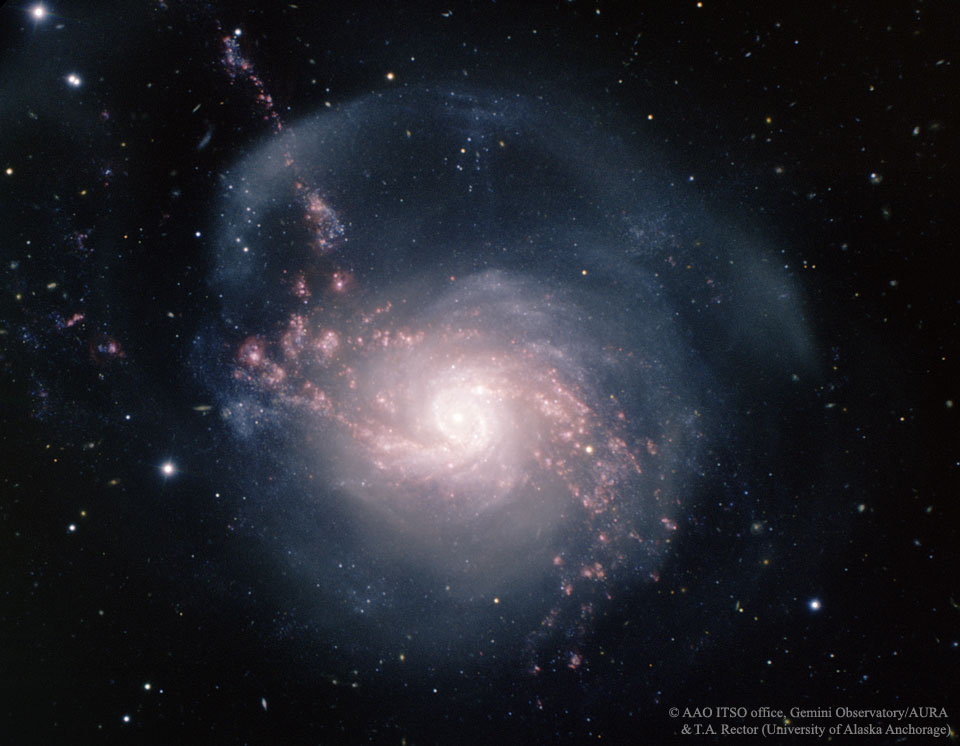 Image Credit: AAO ITSO Office, Gemini Obs., AURA, T. A. Rector, U. Alaska Anchorage
Explanation:
The party is still going on in spiral galaxy NGC 3310.
Roughly 100 million years ago,
NGC 3310 likely
collided with a smaller galaxy
causing the large
spiral galaxy
to light up with a tremendous burst of
star formation.
The changing gravity during the collision created
density waves that compressed existing
clouds of gas and triggered the
star-forming party.
The featured image from the
Gemini North Telescope shows the galaxy in great detail,
color-coded so that pink highlights gas
while white and blue highlight stars.
Some of the
star clusters
in the galaxy are quite young, indicating that
starburst galaxies may remain in
star-burst mode for quite some time.
NGC 3310 spans about 50,000 light years, lies about 50 million light years away,
and is visible with a small telescope towards the constellation of Great Bear
Ursa Major.
#APOD #NGC3310 #StarburstGalaxy #SpiralGalaxy #GalaxyCollision #StarFormation
Image Credit: AAO ITSO Office, Gemini Obs., AURA, T. A. Rector, U. Alaska Anchorage
Explanation:
The party is still going on in spiral galaxy NGC 3310.
Roughly 100 million years ago,
NGC 3310 likely
collided with a smaller galaxy
causing the large
spiral galaxy
to light up with a tremendous burst of
star formation.
The changing gravity during the collision created
density waves that compressed existing
clouds of gas and triggered the
star-forming party.
The featured image from the
Gemini North Telescope shows the galaxy in great detail,
color-coded so that pink highlights gas
while white and blue highlight stars.
Some of the
star clusters
in the galaxy are quite young, indicating that
starburst galaxies may remain in
star-burst mode for quite some time.
NGC 3310 spans about 50,000 light years, lies about 50 million light years away,
and is visible with a small telescope towards the constellation of Great Bear
Ursa Major.
#APOD #NGC3310 #StarburstGalaxy #SpiralGalaxy #GalaxyCollision #StarFormation
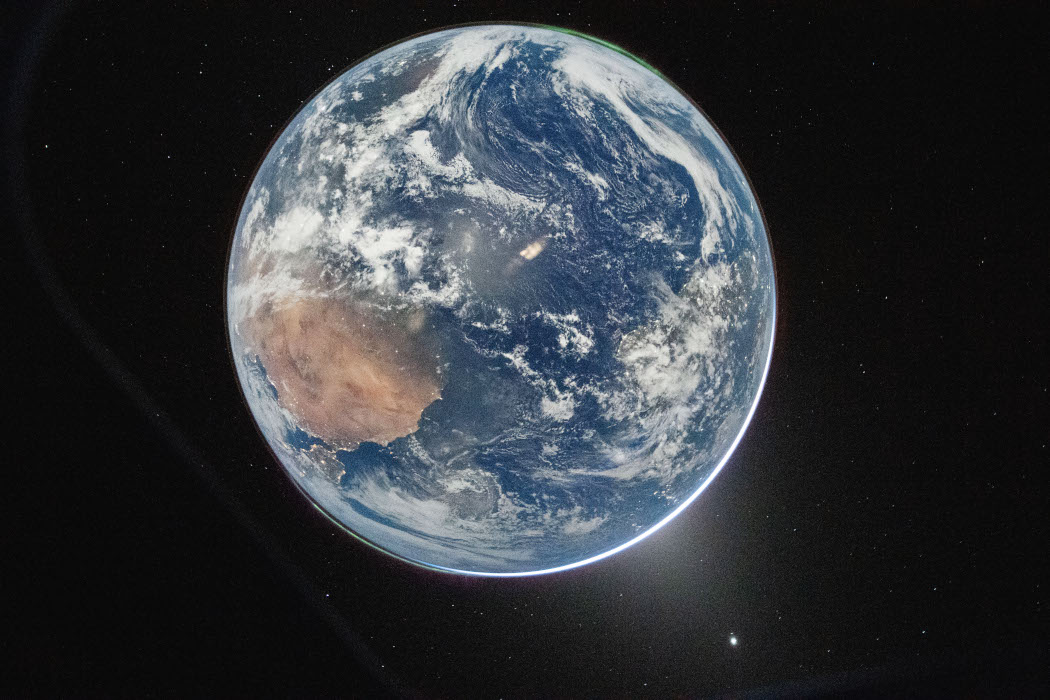 Image Credit: NASA, Reid Wiseman, Artemis II
Explanation:
From pole to pole
our fair planet is captured in this snapshot from space,
an evocative image from a window of the Orion spacecraft Integrity.
From
the
spacecraft's perspective
the Sun is moving behind Earth's bright limb along the lower right.
Africa and the Iberian peninsula are in view on the
pale blue planet's surface, while aurorae crown Earth's
south and
north
poles at top right and bottom left.
Commander Reid Wiseman took the
historic picture on Artemis II
mission flight day 2
(April 2), after the completion of the
planned translunar injection burn.
That burn boosted the spacecraft
out of Earth orbit, sending
Integrity and crew on a trajectory that will take them
around the Moon and back again.
That's a journey
humans last made over
50 years ago.
(Editor's note: Venus is photobombing Wiseman's historic pic. Currently
appearing in our western skies after sunset, the inner planet is
in the frame below and right of Earth's bright limb,
immersed in a faint band of zodiacal light.)
#APOD #OrionSpacecraft #ArtemisII #SpaceExploration #MoonMission #Astronomy
Image Credit: NASA, Reid Wiseman, Artemis II
Explanation:
From pole to pole
our fair planet is captured in this snapshot from space,
an evocative image from a window of the Orion spacecraft Integrity.
From
the
spacecraft's perspective
the Sun is moving behind Earth's bright limb along the lower right.
Africa and the Iberian peninsula are in view on the
pale blue planet's surface, while aurorae crown Earth's
south and
north
poles at top right and bottom left.
Commander Reid Wiseman took the
historic picture on Artemis II
mission flight day 2
(April 2), after the completion of the
planned translunar injection burn.
That burn boosted the spacecraft
out of Earth orbit, sending
Integrity and crew on a trajectory that will take them
around the Moon and back again.
That's a journey
humans last made over
50 years ago.
(Editor's note: Venus is photobombing Wiseman's historic pic. Currently
appearing in our western skies after sunset, the inner planet is
in the frame below and right of Earth's bright limb,
immersed in a faint band of zodiacal light.)
#APOD #OrionSpacecraft #ArtemisII #SpaceExploration #MoonMission #Astronomy
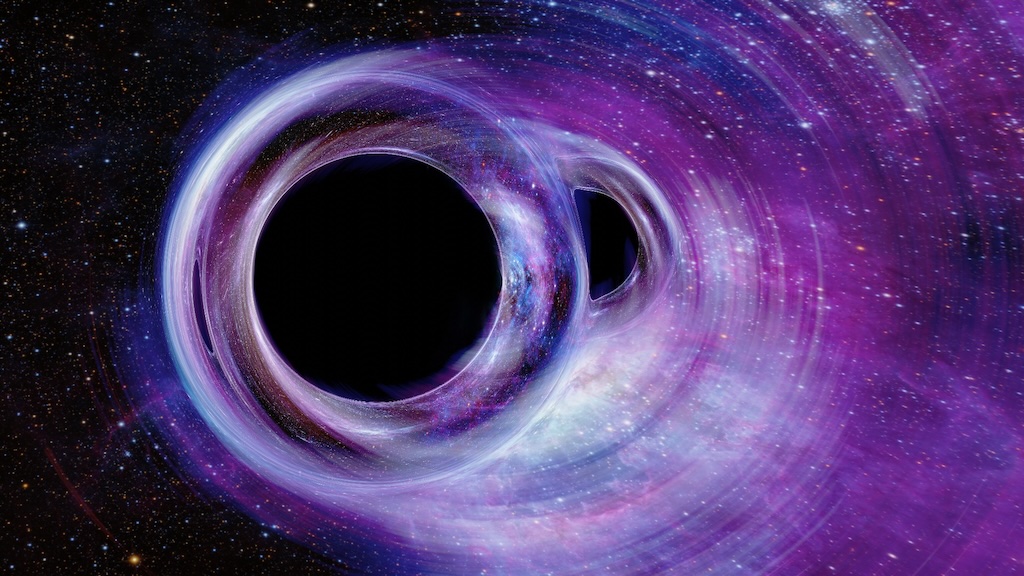 Image Credit: Carl Knox, OzGrav, Swinburne University of Technology, Blake Estes, Christian Sasse, iTelescope.net, Cecilia Chirenti, NASA, GSFC, CRESST II
Explanation:
How can we see what is invisible?
Black holes are not easy to see in the dark cosmic night, but astronomers can find them by analyzing their gravitational effects on matter, light and spacetime.
The featured image shows an illustration that combines a simulation of a black hole binary system in its final "death-dance" with an astrophotography image of the Tarantula Nebula in the background.
Even though black holes don't emit light, they distort the path of light rays, acting like a gravitational lens.
As a result, the nebula appears extremely distorted, forming Einstein rings and multiple images.
Tarantula Nebula lies in the Large Magellanic Cloud, a dwarf galaxy that is one of the satellite galaxies of the Milky Way, 160,000 light-years away.
That is more than 1,000 times closer than any of the binary black hole mergers detected so far.
We'll probably never detect a merger so close to home!
#APOD #BlackHoleMerger #TarantulaNebula #GravitationalWaves #Astrophysics #Cosmology
Image Credit: Carl Knox, OzGrav, Swinburne University of Technology, Blake Estes, Christian Sasse, iTelescope.net, Cecilia Chirenti, NASA, GSFC, CRESST II
Explanation:
How can we see what is invisible?
Black holes are not easy to see in the dark cosmic night, but astronomers can find them by analyzing their gravitational effects on matter, light and spacetime.
The featured image shows an illustration that combines a simulation of a black hole binary system in its final "death-dance" with an astrophotography image of the Tarantula Nebula in the background.
Even though black holes don't emit light, they distort the path of light rays, acting like a gravitational lens.
As a result, the nebula appears extremely distorted, forming Einstein rings and multiple images.
Tarantula Nebula lies in the Large Magellanic Cloud, a dwarf galaxy that is one of the satellite galaxies of the Milky Way, 160,000 light-years away.
That is more than 1,000 times closer than any of the binary black hole mergers detected so far.
We'll probably never detect a merger so close to home!
#APOD #BlackHoleMerger #TarantulaNebula #GravitationalWaves #Astrophysics #Cosmology