Why I suspect, but can't prove, that the probing attack on @Sjors Provoost's server was run with ARTEX
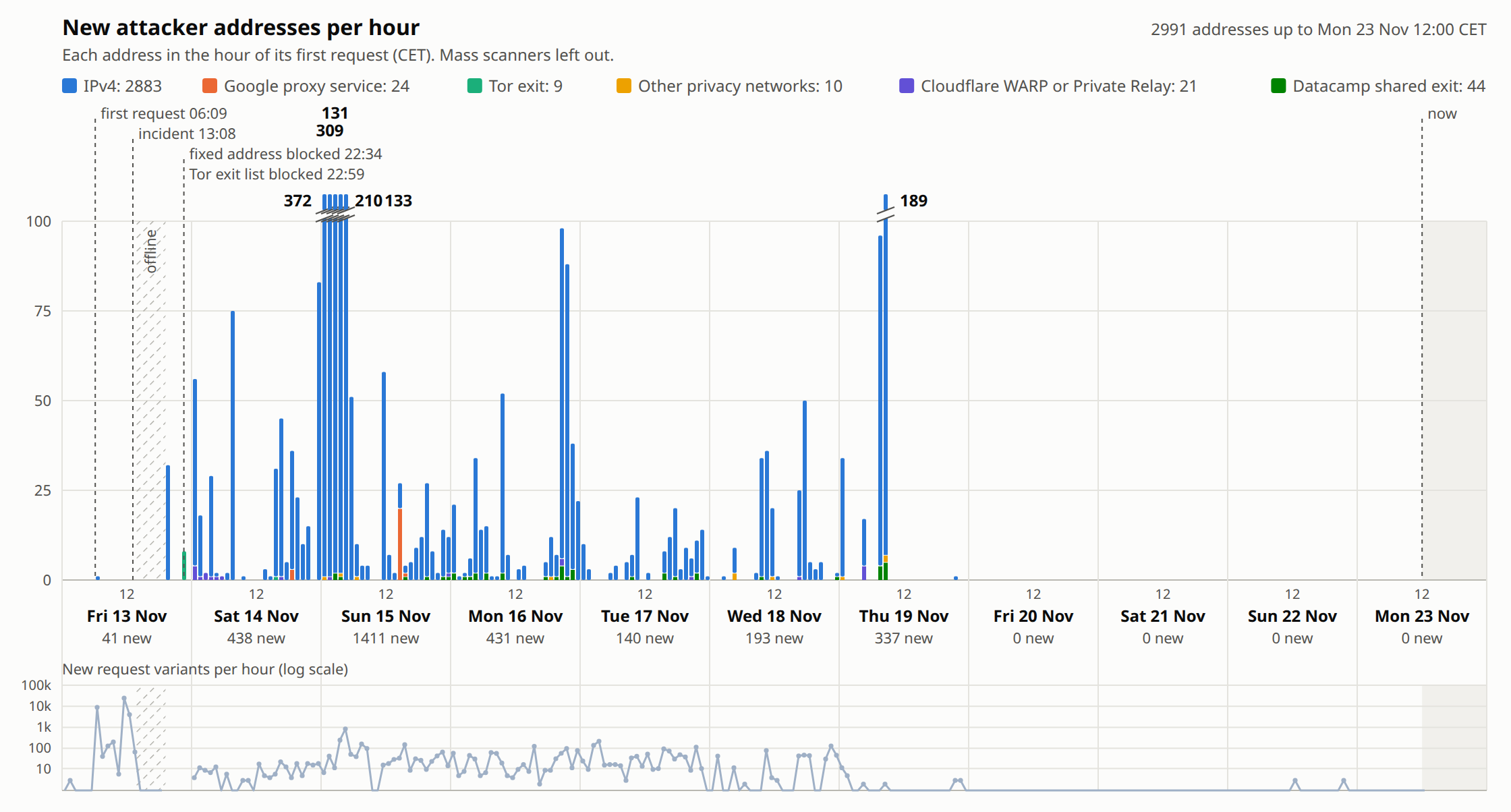
This analysis is based on scanning server logs that were flagged for suspicious activity, including some retroactive lookups. From 13 to 19 November an attacker worked on that server for days, through about 3,000 addresses. Most or all of these were proxies, but very few were Tor exit nodes, since those were blocked pre-emptively early on. ARTEX is an AI-driven penetration-testing framework that CrowdStrike (7 Oct) and Check Point Research (5 Nov) have reported on. Its source was public until 8 October and copies remain. I read a copy (v0.3.15), without running it, and compared it with the logs.
What points to ARTEX:
1. The attacker's own markers start with "artx". The fake Castopod account names were artxops762, artxops762b and artxops528b. Injected test payloads carried artx762, and made-up test paths carried the name too, such as /artxops762nonexist-9f3a2b.
2. The client was curl/7.88.1 from the first minute to the last. That is Debian 12's curl, and its TLS handshake is exactly what Debian 12's curl sends. ARTEX's container image is built on Debian 12.
3. The bulk waves carried browser names such as "Chrome/120 Safari/537.36" and "Chrome/124.0 Safari/537.36". A real Chrome writes four numbers. On 19 November, 4,434 of the 4,777 connections with the Chrome/124 name had the TLS handshake of Python's standard library on OpenSSL 3.0, not a browser's. ARTEX's image is Python 3.12 on Debian 12, which gives exactly that handshake.
4. Not one IPv6 address, although the sites have AAAA records. ARTEX's container has no IPv6 network and sends its web requests through one outgoing proxy.
5. On the first day a headless Chromium checked whether injected script ran. ARTEX's image ships one.
Why that is not proof:
- ARTEX's prompts never tell the model the framework's name. The model would have to pick "artx" up from its surroundings, or the operator chose it. It could simply be the operator's handle.
- Points 2 to 5 fit any Debian 12 machine with curl and Python, whoever or whatever drives it.
- ARTEX has no fixed probe paths and no fixed client name for the agent's own requests: the model writes its own commands. So there is no signature to match. The few fixed names it does have (its recon skill, its fetch tool) never appeared.
- curl/8.5.0 was used too, but mostly during one wave. That is Ubuntu 24.04's curl, not the one in ARTEX's image.
The requests themselves are published as network abuse reports (kind 31984 events from draft NIP-1B) by @Sjors' ops, e.g. nevent1qqsdwe0jrvcydv6muzmaphh9nyp783hgudnhzxkjvrwyujwhlvdv3fqprpmhxue69uhkummnw3ezuumswfhhvmm0wd6zumnvqgswsu0jwffujky5x524vstgrarme5fyazkeuupucv5kspsce2aa69grqsqqql8shpw7sy and nevent1qqsy6saj962sf08753tc4ewzudju2tlch5qrc03cw44ekxxu9wf9pxsprpmhxue69uhkummnw3ezuumswfhhvmm0wd6zumnvqgswsu0jwffujky5x524vstgrarme5fyazkeuupucv5kspsce2aa69grqsqqql8srm7se6.
The attacker has been silent since 19 November. The chart shows the new addresses per hour.
#互联网背景辐射