Steve's avatar
Steve
@steve@BitcoinNostr.com
npub1avxu...qkxk
Books | Buildings | Bombs | ₿itcoin
Steve's avatar
steve 2 years ago
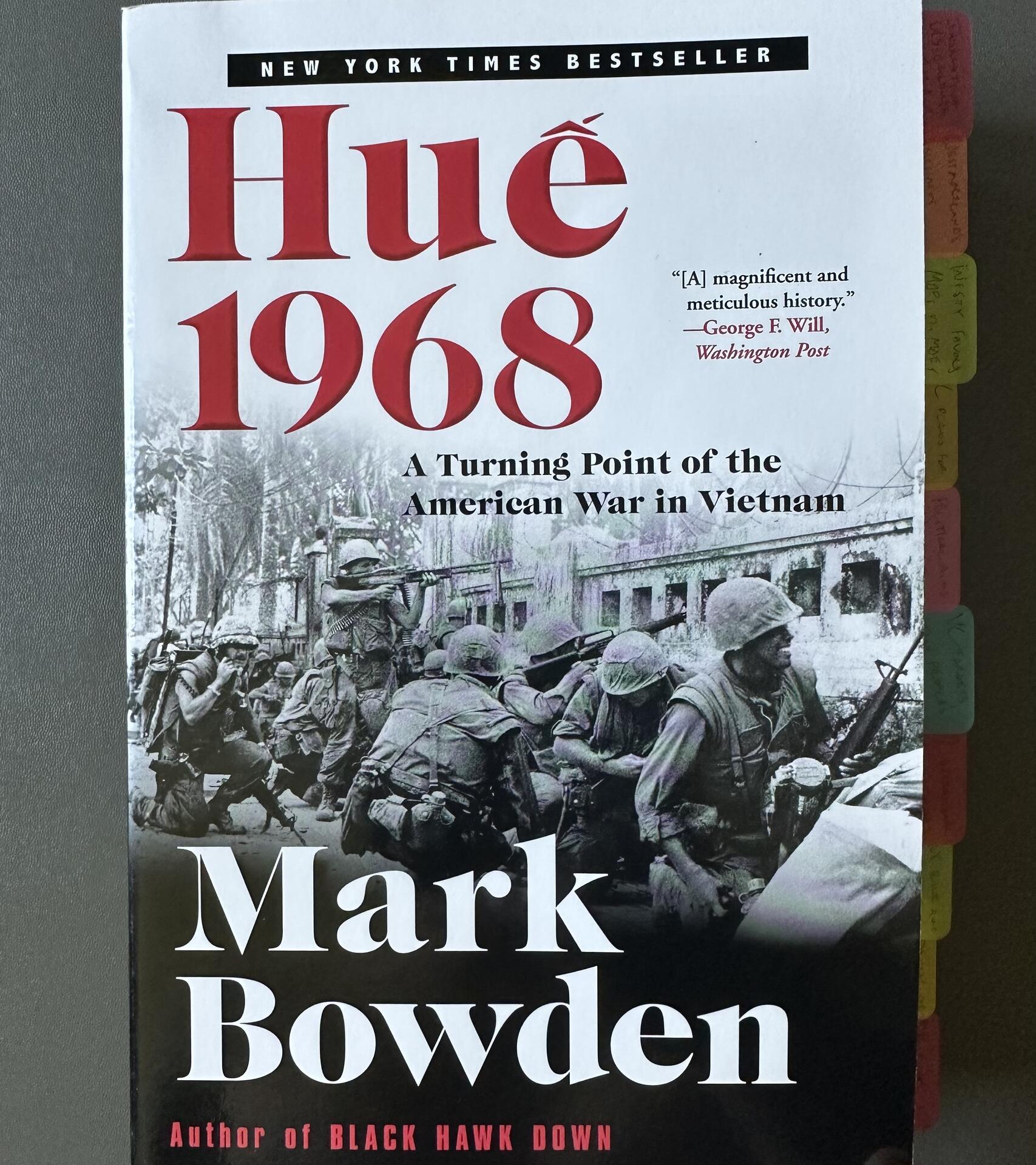
“Huế 1968: A Turning Point of the American War in Vietnam” by Mark Bowden ⭐️⭐️⭐️⭐️ The same journalist who captured the story of Mogadishu in “Black Hawk Down” wrote this incredibly detailed account of what was arguably the Vietnam War’s bloodiest battle. As the historical capital of a once unified Vietnam, Huế is situated just south of the former DMZ separating what was North & South Vietnam. In 1968, Huế was home to one of the Tet Offensive’s pivotal battles as well as some of the worst American blunders of the war. Bowden paints an incredibly detailed portrait of the battle’s horrors thanks to impressive first-hand accounts from both sides of the conflict. The death and destruction witnessed is made more frustrating by the clear folly of American leaders whose “deadly disbelief” of ground truths cost countless lives. Bowden’s book serves up lessons on humility that we ought to internalize today. image
Steve's avatar
steve 2 years ago
“Red Wings Over the Yalu” by Xiaoming Zhang ⭐️⭐️ Most English histories of the Korean War focus primarily on UN forces and the two Korean nations. Less often discussed is the involvement of the fledgling People’s Republic of China. Fresh off the heels of their own civil war, Mao’s PRC embarked on a quest to stand up their own air force: the PLAAF. With Soviet assistance, the PLAAF used the Korean War as a test bed for their organization and tactics. Unlike most western air forces, the PLAAF was designed as a defensive tool on the international scene, but an offensive propaganda tool for domestic affairs. The Korean War remains China’s only conflict since their revolution in the 1940s, so it was not until the PRC observed American air dominance in first Gulf War that they truly embraced reforms and modernization. Zhang’s account provided an interesting perspective but is also painted with bias from his own communist roots. Take it with a grain of salt. image
Steve's avatar
steve 2 years ago
“Destroying the Village: Eisenhower and Thermonuclear War” by Campbell Craig + “To Kill Nations: American Strategy in the Air-Atomic Age and the Rise of Mutually Assured Destruction” by Edward Kaplan ⭐️⭐️⭐️⭐️ Two book reviews in one day?! These two reads cover such similar ground that they deserve to be together 🤝 Eisenhower unfairly got a bad wrap for his “all or nothing” nuclear policy. In actuality, he avoided placing the United States in to any war - limited or not - during his 8 year presidency simply by making his threat of nuclear apocalypse seem real. He placed the US on a hair trigger but internally had no intention of things ever getting that far. The result? Stability and peace. But when Ike leaves office, the younger & more naive Kennedy doesn’t know understand Ike’s deterrence strategy and history shows the record. This period firmly established the Air Force as an independent service and built the foundation for today’s theories of nuclear deterrence. If you didn’t already like Eisenhower for his highway system, you’ll definitely like the ol’ 5-star general after this read ☢️✈️
Steve's avatar
steve 2 years ago
“American Airpower Strategy in Korea, 1950-1953” by Conrad C. Crane ⭐️⭐️⭐️ Having just become an independent service in 1947, the Korean War was the US Air Force’s first opportunity to prove its strategies on the battlefield absent the Army’s thumb. Crane’s historical account covers a fledgling service in the midst of an identity crisis: Strategic Air Command’s (SAC) bombing strategy vs. Tactical Air Command’s (TAC) air interdiction strategy. This intra-service division drove mixed targeting strategies and a need to differentiate between limited and total warfare. Crane’s account is easy to read but does not provide much detail in terms of the chronological events of the Korean War. Despite that, it delivers a good thematically organized account which illustrates the success (and failures) of Air Force’s debut conflict. image
Steve's avatar
steve 2 years ago
“The Candy Bombers” by Andrei Cherny ⭐️⭐️⭐️ Following WWII, the Soviets blockaded Berlin in hopes of cementing communist control over Europe. The US began the Berlin Airlift in response - the largest airlift operation ever conducted, aimed at keeping the population of Berlin from starving. Amidst that turmoil, 1st Lt Gail Halvorsen demonstrated how a singular act of kindness could produce strategic effects where military saber-rattling could not. Dubbed the “Candy Bomber”, Halvorsen began dropping his candy rations out of his cargo plane for the local children during his airlift runs. This simple idea grew into a veritable movement, ultimately swaying the German population in the US’ favor and denying the USSR’s hopes of expanding communism further. Halvorsen’s saga offers a reminder of the soft power that ideas & values can wield on the international stage. In an interesting twist, the “Candy Bomber” proved Douhet’s theories that air power alone could prove decisive in war with one exception: butterfingers were dropped instead of bombs 🍫🍬🍭 image
Steve's avatar
steve 2 years ago
“A Continent Erupts” by Ronald H. Spector ⭐️⭐️⭐️⭐️ The end of WWII created a tremendous power vacuum in East Asia. Former European colonial powers were hollowed out, yet still grasped for the imperial power of years long past. Japanese imperialists were now out of the picture as well. Spector’s book presents a compelling military history that that follows conflicts in Indonesia, Vietnam, China, and Korea during this time. Most interestingly, he explores these nuanced conflicts thru a multitude of perspectives. In doing so, Spector shows that the perceived bi-polarity of the Cold War was in fact a complex web of players in a multi-polar world. The false simplicity that is often taught on the Chinese Civil War, Korean War, Vietnam War, and Indonesian War of Independence couldn’t be further from the truth. This rich history adds important context to the modern world: much of the environment we see today has been foreshadowed. image
Steve's avatar
steve 2 years ago
“Military Strategy: A General Theory of Power Control” by J. C. Wylie ⭐️⭐️⭐️⭐️ J.C. Wylie was a US naval officer who served from WWII in to the early 1970s. In “Military Strategy”, Wylie presents a well-structured argument for a general theory of war that bridges the work of previous theorists, going as far back as Clausewitz. He divides up his arguments by domains and reaches a singular conclusion: war isn’t about destruction, it is about control. Armies, navies, and air forces are all tools meant to leverage some form of control over an adversary. This in turn, reinforces the idea that military strategy is subordinate to a nation’s grand strategy. After all, a state can control another thru economic sanctions or diplomatic coercion just as well as they can employ violence in the field. While I generally agree with Wylie’s thesis, his book does make some glaring generalizations and cherry-picks evidence to suit his point. Despite its analytical flaws, Wylie’s theory is especially useful today in the nuclear age. Plus, it’s a short read at ~140 pages… no excuses! image
Steve's avatar
steve 2 years ago
“The Foundations of the Science of War” by J. F. C. Fuller ⭐️ J.F.C. Fuller was a British Army officer and contemporary of Liddell Hart in the inter-war years following WWI. Where Liddell Hart communicated his theories for success in war well, however, Fuller fails. This work aims to create a taxonomy and pre-science to the conduct of war but offers very little in terms of guidance to the would-be strategist. Fuller creates an exhaustive classification of war in all its elements, effectively embarking on a quest to create a systems theory approach to war. While the concept is interesting, Fuller’s execution is not. His taxonomy is confusing and his personal fascist/racist views bubble up occasionally throughout the text. I will credit Fuller in his limited influence on Liddell Hart: the later theorist took the ideas of the former one and ran with them. I’d avoid this one unless you really love run-on sentences and occultist illustrations. image
Steve's avatar
steve 2 years ago
“Strategy” by B. H. Liddell Hart ⭐️⭐️⭐️⭐️⭐️ Early 20th century military theory was largely built on the shoulders of two giants: Clausewitz & Jomini. That said, it wasn’t until Liddell Hart’s work written after WWI that the field of military theory could reconcile the two Napoleonic giants. Liddell Hart makes the case that throughout history, strategists who take the indirect approach (vs. the head-on, direct one) are usually the victors. He presents a plethora of historical examples that reinforce operational concepts first introduced by Jomini. Interestingly though, he dispels the concept of “decisive battle” and elaborates on the idea of “grand strategy”. Military matters only represent one arrow in a nation’s quiver. Consequently, grand strategy is the art of the statesman in synchronizing all instruments of national power to achieve political objectives. The general must understand their role in this grander mechanism and employ violence appropriately. Liddell Hart was enjoyable to read and his witty quips make his ideas more memorable. Considering the obvious flaws presented by previous theorists, this is a must-read. image
Steve's avatar
steve 2 years ago
“Air Power and Armies” by John Cotesworth Slessor ⭐️⭐️⭐️ Having served during WWI in Britain’s Royal Air Force, Slessor developed his theories with the practical experience from the “Great War”. He departs from Douhet’s assertion that wars can be won with airplanes alone, instead stating that air power’s primary role is to support the army’s advance. Slessor’s thesis is built on the Clausewitzian assumptions that (A) war had to be won by decisive battle and (B) only the land forces could affect such decisive outcomes by occupying terrain. While his breakdown of how to integrate air and land forces was nearly spot-on, Slessor carries over many of the fallacies introduced by ol’ Dead Carl… namely the whole shtick about “decisive battle”. In contrast to Douhet, Slessor presents a more balanced and nuanced approach towards air power that is much more actionable than the Italian generals penchant for bombing civilians. This book builds on the previous theorists’ work so I recommend reading it in sequence. image
Steve's avatar
steve 2 years ago
“The Command of the Air” by Giulio Douhet ⭐️⭐️⭐️ Douhet was an Italian general who theorized about the nature of aerial warfare after witnessing the carnage of trench warfare in WWI. Motivated to never repeat such needless violence again (like many others of his time), Douhet explains how offensive aircraft - employed not just in support of the Army or Navy - can achieve strategic goals and decisive victory. His ideas were well-founded, albeit partially flawed. Douhet accurately characterized the air domain but falls short on how best to employ air forces. History has shown that Douhet’s theories about bombing civilian centers to bring a swift end to wars doesn’t pan out like he expected… people can endure an incredible amount of suffering, not to mention morality is still a thing. For all his flaws, Douhet’s book is still thought-provoking. As radical as his ideas were, they were clearly a product of his time. I wonder what radical ideas are being born form the digital age today?
Steve's avatar
steve 2 years ago
“Principles of Maritime Strategy” by Julian Corbett ⭐️⭐️⭐️⭐️ Sometimes it takes an outside perspective to truly shed light on a subject. Unlike most military theorists, especially naval theorists, Sir Corbett had a non-military background as a British lawyer prior to WWI. His work on maritime strategy builds on Mahan’s treatise but resolves many of the inconsistencies between Mahan’s man-crush on Jomini and the enduring principles put forth by Clausewitz. Corbett’s work views maritime strategy (and consequently the purpose of the Navy) as a holistic effort to pursue the nation’s interests. Gone are the binary, black & white arguments for “decisive battle at sea”… why bother if one can simply use a couple ships to control ocean trade at key points? Corbett’s nuanced view accounts for economics, geopolitics, and the works from the foundational military theorists who pre-dated him. He was ahead of his time by even recommending a Joint Staff to de-conflict the inherent conflicts of interest that Army generals and Navy admirals inherently presented to sovereign rulers. If you had to pick one book on naval strategy, this is it ⚓️ image
Steve's avatar
steve 2 years ago
“On Naval Strategy” by Alfred Thayer Mahan ⭐️⭐️⭐️⭐️ What do you get when a closeted Clausewitzian becomes infatuated with Jomini, then learns to swim? One of the most influential naval theorists in modern history, that’s who! History jokes aside, Mahan earned his influence by transposing common military vernacular related to the land domain, to the sea. Mahan’a overarching thesis is that great nations require wealth to pursue their interests, and that wealth can only result from international ocean trade. Therefore, nations with strong blue-water navies can protect their commercial interests and prosper in all other aspects. Mahan’s case is compelling and his description of the maritime domain is still relevant today. China’s recent naval build-up has arguably been influenced by “Mahanian” principles. This was a compelling read that resonated with modernity. His ties to economics also echo to modern geopolitical experts such as McNeill and Zeihan. Now cue the Gilligan’s Island theme song and get reading 🚢⚓️ image
Steve's avatar
steve 2 years ago
“The Art of War” by Antoine-Henri Jomini ⭐️⭐️⭐️ Always a favorite with Marines & Soldiers, Jomini was a Swiss-born general who served with Napoleon and later Russia’s Army during the former’s namesake wars. Despite being totally inept in command, Jomini displayed brilliance as a staff officer: he synthesized the work of many others into his own framework for war. The result? Jomini’s “Art of War” is not a book on strategy like Clausewitz’ work, but rather a prescriptive how-to guide for approaching war at the operational level. People often take sides between the two theorists, but personally I think they each have their place. Of note, Jomini popularized concepts such as military logistics and “lines of communication” which are still common jargon today. Not gonna lie… Jomini is a narcissistic prick, but there are some pearls of wisdom here if you can sift through his ego. image
Steve's avatar
steve 2 years ago
“On War” by Carl von Clausewitz ⭐️⭐️⭐️⭐️⭐️ “Dead Carl”, as an old professor used to say, was a Prussian general at during the Napoleonic Wars who spent his life developing this work as his seminal treatise on war itself. Unlike Sun Tzu and many other military theorists, Clausewitz doesn’t try to create a how-to guide for winning wars. Instead, he develops a framework for describing the universal elements of all wars: violence, chance, & politics. Clausewitz is most famous for his assertion that war is merely “politics by other means”. Personally, I found his economic analogies fascinating: just as money is used to communicate commercial value, so force is used to communicate political value between states. Clausewitz’ use of the dialectic makes this a tough read at times, but the insights are valuable even in modernity. Give ol’ Dead Carl a fighting chance 💀 image
Steve's avatar
steve 2 years ago
“The Book of Deeds of Arms and of Chivalry” by Christine de Pizan ⭐️⭐️⭐️ Writing in 1410, de Pizan wrote this work as advice to the young ruler of France (much like Sun Tzu). In it, she builds a medieval case for just war on principles laid out by Cicero, Augustine, and Aquinas. Interestingly, de Pizan lays out an international framework for dispute resolution that is similar to the UN framework in use today. In contrast to Eastern international politics, this was possible due to the role that the Catholic Church had above otherwise sovereign states. This hierarchy allowed states to coexist, albeit violently, in pre-Renaissance Europe (provided you were a Christian, of course). Also notable is the fact that de Pizan is a woman writing in a time when the Christian patriarchy was quite literally at its peak. This is an insightful companion to Sun Tzu and gives a global perspective on war & international relations. image
Steve's avatar
steve 2 years ago
“The Seven Military Classics of Ancient China” translated by Ralph Sawyer ⭐️⭐️⭐️ Most of us have heard of Sun Tzu before, but what about Wei Liao or the T’ai Kung’s Six Secret Teachings? Eastern military strategy evolved in an entirely different context from Western culture, but it’s similarities shed light on some irrefutable truths about the nature of war. Regardless of the author, war theorists invariably discuss subjects of politics, humanity, and uncertainty. What’s interesting to me about the Eastern strategists is the grand strategy that underpinned all their advice to ancient emperors: the desire to rule “all under heaven”. In contrast, Western civilizations didn’t have such unlimited ends in mind (or perhaps, they weren’t feasible) and consequently evolved their thinking differently. Do yourself a favor and brush up on Chinese history before tackling these texts… the added context goes a long way towards understanding their nuance. image
Steve's avatar
steve 2 years ago
“The Challenger Launch Decision: Risky Technology, Culture, and Deviance at NASA” by Diane Vaughan ⭐️⭐️⭐️⭐️ In 1986, the Challenger space shuttle exploded 73 seconds after launch and claimed the lives of all 7 crew members onboard. While the initial investigation claimed the cause was amoral technical oversight and mismanagement, Vaughan (a sociologist, by trade) presents a strong case that the fault actually lay in an organizational culture that fostered the “normalization of deviance”. NASA engineers frequently accepted known risks, but also consequently re-established their baselines each time they did so. The consequence? An organization where bureaucracy and technical analysis marched along rationally until finally their new normal allowed the Challenger disaster to occur. Vaughan’s work provides a cautionary tail to the engineer’s penchant for quantifying the world around them and centralizing decision-making. This one hit home with me and is a must-read for anyone working with or within technical fields. image
Steve's avatar
steve 2 years ago
“Just and Unjust Wars” by Michael Walzer ⭐️ What do you get when a political activist from the 1970s (i.e., Vietnam War-era) writes a book aiming to codify the morality of war? You get 381 pages of un-actionable self-contradictions based on false assumptions. Walzer has plenty of gems such as asserting that the reader shouldn’t pity a professional soldier who dies in war because “that’s what they volunteered for” or criticizing free speech rights because people “shouldn’t be allowed to just say anything”. He does earn credit for the sole good point he made: a nation’s citizenry must share in the accountability for war alongside its leaders. See? There’s always a silver lining 🌥️ image
Steve's avatar
steve 2 years ago
“The Pursuit of Power” by William H. McNeill ⭐️⭐️⭐️⭐️ How have geography, demographics, economics, and technology converged to alter the character of warfare over the past 1,000 years? It’s a tough question, I know, but McNeill spent 20 years of research putting together this work to answer it. He explains how China’s preference for command-driven markets originated in the large public works projects they employed to tame the Yellow River. Contrast this to Europe’s laissez-faire development that resulted in more free market economics and you get compelling case studies for the effect that economic preference has on technology development. Sadly, McNeill’s global perspective stops early on and the remainder of the book focuses on the intricacies of the West’s technological march towards modern war. Despite the overly verbose explanation, McNeill’s work is impressive in its depth and draws the best geopolitical connections I’ve seen since reading Zeihan. Definitely worth the read. image