
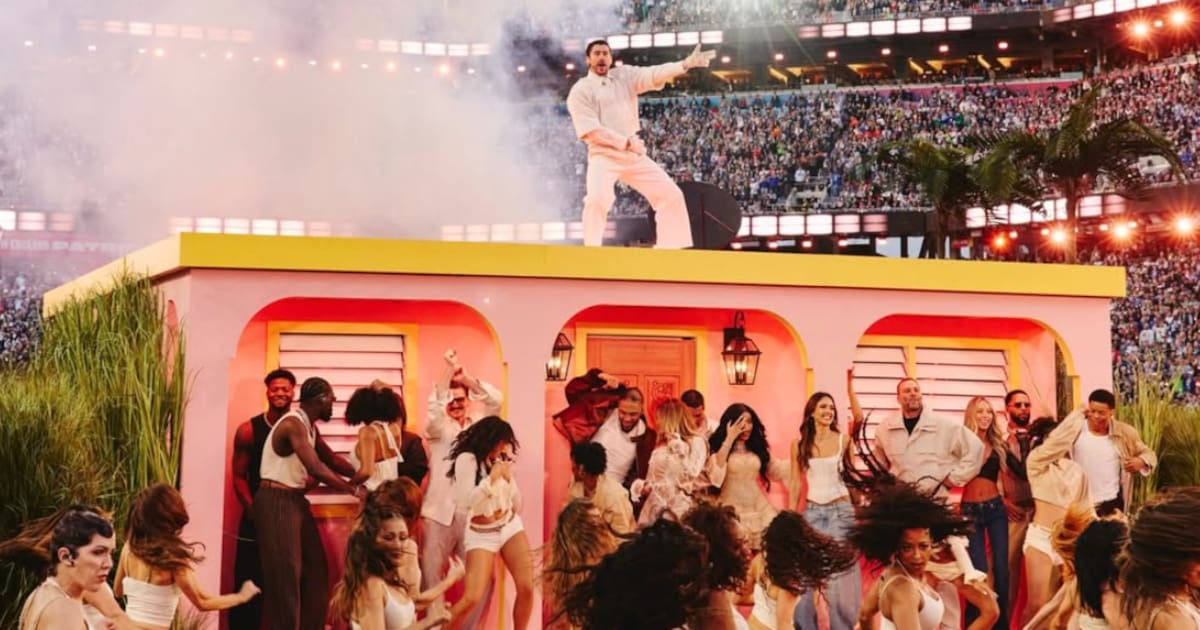
Bad Bunny's Super Bowl Halftime Show Draws Praise and Scrutiny Bad Bunny headlined the Super Bowl LX halftime show with a 13-minute performance heavily rooted in Latin and specifically Puerto Rican imagery, including a prominent casita set piece that doubled as a VIP area for Latino celebrities. Both opposition and government-aligned coverage agree that the show showcased Spanish-language reggaeton and trap hits, featured special appearances by Lady Gaga and Ricky Martin, and was framed by the NFL and the artist as a globally accessible "party" that viewers could enjoy regardless of whether they understood Spanish. Across the spectrum, reports converge that the production was visually ambitious, used dancers and human "plants" as part of the staging, drew massive international viewership, and became a focal point of public debate in the United States.
Outlets from both sides also agree that the performance operated as a high-profile moment of cultural representation for Latin and Puerto Rican identities on one of the world’s most watched stages. Coverage consistently notes Bad Bunny’s stated intent to connect with his roots, the backdrop of his Grammy-winning Spanish-language album, and the NFL’s desire to tap into his global appeal to reach younger and more diverse audiences. There is shared acknowledgment that the show intersected with broader political and social currents, including rising anti-immigrant sentiment and culture-war disputes over language and representation, even as Bad Bunny publicly emphasized enjoyment, emotional connection, and unity over overt political messaging.
Points of Contention
Artistic quality and reception. Opposition-aligned sources highlight Trump’s denunciation of the halftime show as “one of the worst in history,” emphasizing criticism of the choreography, staging, and overall artistic direction as vulgar or low-quality. Government-aligned media instead underscore critical and popular praise, describing the performance as a global phenomenon that emotionally resonated with millions and blended music, culture, and identity in an innovative way. While the opposition spotlights outrage and derision from conservative audiences, government-aligned coverage curates testimonials from performers, participants, and viewers to portray the show as creatively ambitious and widely celebrated.
Cultural representation versus cultural provocation. Opposition coverage frames the strong Puerto Rican and Latin themes, including the Spanish lyrics and casita setting, as alienating to some Americans and, in Trump’s words, a "slap in the face" to the United States. Government-aligned outlets interpret the same elements as a proud celebration of Latinidad, emphasizing how street-party motifs, family-gathering imagery, and migrant-worker references honored everyday Latin American experiences. Where opposition voices imply that such a foregrounding of non-English culture at the Super Bowl is divisive or inappropriate, government-aligned sources present it as overdue recognition and a unifying affirmation of identity for Spanish-speaking communities.
Political meaning and intent. Opposition-aligned media stress complaints from right-wing groups that Bad Bunny’s selection and performance constitute a political statement, reading the inclusion of Spanish, reggaeton, and politically charged songs as deliberate provocation in the context of US culture wars. Government-aligned outlets acknowledge the controversy but foreground the NFL’s and Bad Bunny’s stated goal of throwing a “huge party” and creating an inclusive spectacle that transcends language, treating politics as secondary to entertainment and emotional refuge. In their telling, any political content is framed as a broader message of unity and self-belief across the Americas rather than a partisan intervention aimed at US domestic audiences.
National identity and ownership of the stage. Opposition sources echo Trump’s rhetoric to suggest that prioritizing a Spanish-speaking Puerto Rican artist at the Super Bowl sidelines traditional notions of American identity and disrespects English-speaking viewers, implying that the halftime stage should primarily reflect a more conventional US mainstream. Government-aligned coverage, by contrast, treats Bad Bunny’s presence as emblematic of a changing, more diverse America and highlights how Spanish-language music’s global success makes it a natural fit for a flagship US broadcast. Thus, while the opposition stresses feelings of dispossession or cultural loss, government-aligned outlets argue that expanding who gets to “own” the Super Bowl stage strengthens rather than undermines national identity.
In summary, opposition coverage tends to frame Bad Bunny’s Super Bowl halftime show as aesthetically poor, culturally provocative, and politically charged in a way that disrespects traditional American norms, while government-aligned coverage tends to cast it as a widely acclaimed, emotionally resonant celebration of Latin culture that broadens and unifies the audience rather than dividing it.
https://nicaragua.layer3.press/stories/019c4834-48e4-23a8-723e-25510e0b9c8e