Replies (13)

I am running a knots node just in case but I don't see how 1℅ can become 55% overnight. What am I missing?
BitcoinIsFuture's avatar
BitcoinIsFuture 20 hours ago
The game theory buddy. Bitcoin nodes / Bitcoin node runners define what Bitcoin is. We do it, the Bitcoin node runners. Miners must create Bitcoin compliant blocks but its the Bitcoin nodes that enforce the Bitcoin rules. If Bitcoiners want Bitcoin to become shitcoin full of spam and centralized just like Ethereum and Solana it will happen. But if Bitcoiners want Bitcoin to continue be Freedom Money - THE Global Most Secure Decentralized Unconfiscatable Peer-to-Peer Scarce Hard Sovereign Permissionless Freedom Money, The Greatest Store of Value and The Strongest Hope for Humanity then it will happen despite all the attacks from governments and agencies. We need to hold the line with BIP-110. If few miners that are controlled by governments decide what Bitcoin is then Bitcoin is already centralized and they can do whatever they want - increase the 21 Million limit, increase block size, centralize it more and more, ban certain transactions. But its the nodes that enforce the rules. You can read this part or better the whole artcile from the start. Here you can read why Bitconi nodes are enforcing the rules. https://medium.com/bitcoinerrorlog/who-secures-bitcoin-95b19bbcda3c
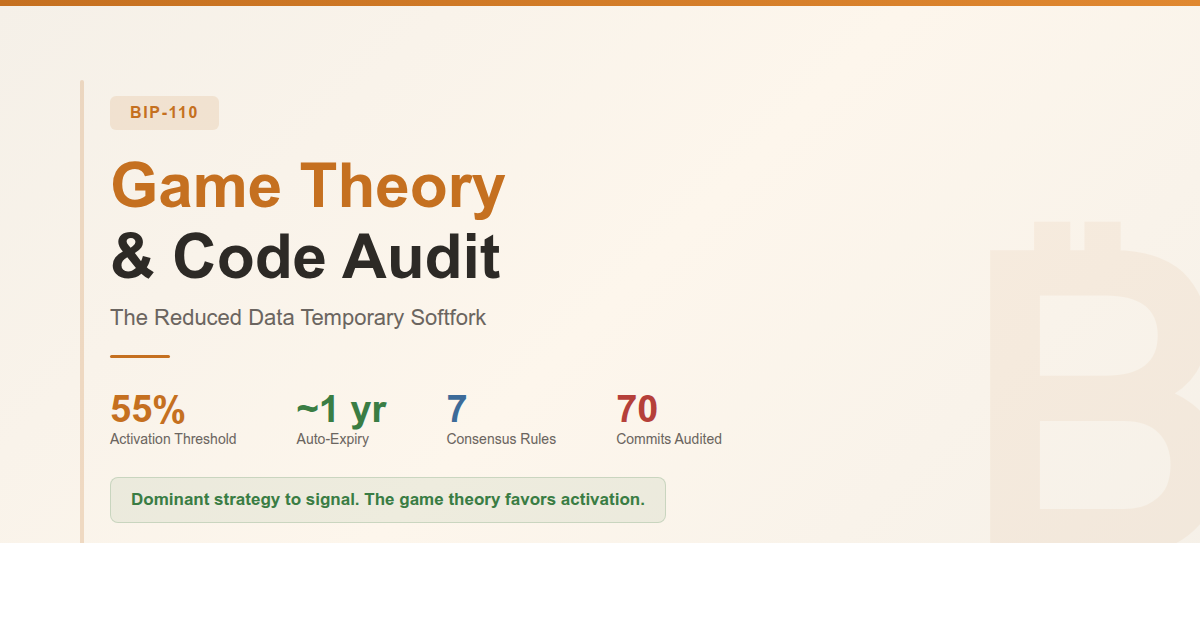

Yes, but I didn't ask for your opinion but how bip-110 can become a reality if only a tiny percentage of nodes is running knots 29.3? I see too much wishful thinking around it and nothing real that can make it successful. What do I get wrong in that regard? #asknostr
BitcoinIsFuture's avatar
BitcoinIsFuture 19 hours ago
Miners who mine BIP-110 incompatible blocks risk their blocks to be rejected by the network and loose their Bitcoin block reward. Miners are incentivized to follow the Bitcoin rules that are enforced by Bitcoin nodes. When you asked you didn't state that you don't ask for my opinion and I also gave you two articles that expalin the same thing as my opinion.
So what I don't get is how only a tiny minority running knots 29.3 will enforce BIP-110 to the majority of nodes running core and not enforcing BIP-110? Why miners will follow the rules of a few nodes running BIP-110? And not the rules of core nodes not enforcing BIP-110?
BitcoinIsFuture's avatar
BitcoinIsFuture 19 hours ago
Its 16+% of the network, not just a few nodes and beside that ALL Bitcoin nodes at this point ACCEPT BIP-110 blocks.
I don't get why and how all bitcoin nodes accept BIP-110. So after the possible activation, core+30 with op_return with that big limit will split the network?
BitcoinIsFuture's avatar
BitcoinIsFuture 19 hours ago
BIP-110 narrows the rules. Small OP_RETURN of up to 80 Bytes are accepted by ALL Bitcoin nodes, including the malware Core V30+. BIP-110 blocks are accepted by ALL Bitcoin nodes at this point in time. Spam blocks with degenerated big jpegs are rejected by 16+% and growing number of Bitcoin nodes. If you are a miner would you risk your mined Bitcoin block to be rejected by the network and loose 3.125 Bitcoins?
So to core nodes to reject BIP-110 what a node runner must do? What action it requires? Adding manually a line in the config file? Miners are already not signaling BIP-110. What will change their minds?
BitcoinIsFuture's avatar
BitcoinIsFuture 19 hours ago
One of the things compromised and corrupted Core can do is get rekt.
I don't like either how they impose practically limitless opreturn and those woke people that have zero sats like Gloria Zao. On the other hand causing a possible hard fork is never healthy for our community.
BitcoinIsFuture's avatar
BitcoinIsFuture 19 hours ago
BIP-110 is a soft fork buddy. It is not a hard fork. BCH and BSV are hard forks, they widen the rules, not narrow them.
It's a softfork until the war has not started and egos flowrish then it's a hardfork. Time will tell