
NASA researchers have developed an artificial-intelligence model that can predict where new active regions will emerge on the Sun up to 12 hours before they become visible. These regions are concentrations of magnetic fields that produce sunspots and can drive solar flares and coronal mass ejections, which may endanger astronauts, disrupt radio communications and interfere with satellites.
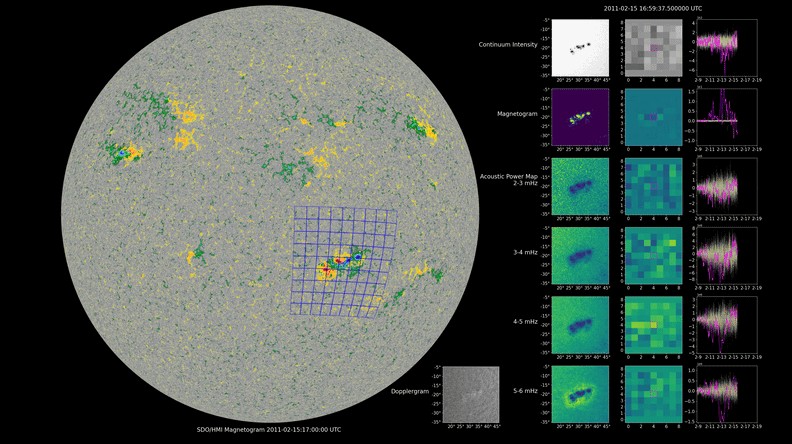
The COFFIES team trained a sliding-window transformer on observations from NASA's Solar Dynamics Observatory, including subtle changes in acoustic waves and magnetic activity linked to sunspot regions rising through the solar interior. The approach can estimate the locations of emerging regions instead of relying only on visible sunspots, potentially giving mission teams more warning of hazardous space weather. The model is not yet ready for operational forecasting; researchers plan to validate it against more solar events before further development.
NASA Science
NASA’s COFFIES Uses AI to Predict Storm-Causing Active Regions
A team with NASA’s COFFIES has developed a novel machine-learning model capable of predicting the emergence of active regions on the Sun up to 12...