Replies (43)
Can you give any specifics as to what kind of data and frequency
But is Apple the only one doing this?
Worked fine for me…

all the infiltrated CIA spooks recommend apple
they're the best for security
LOL

Wait what lmfao
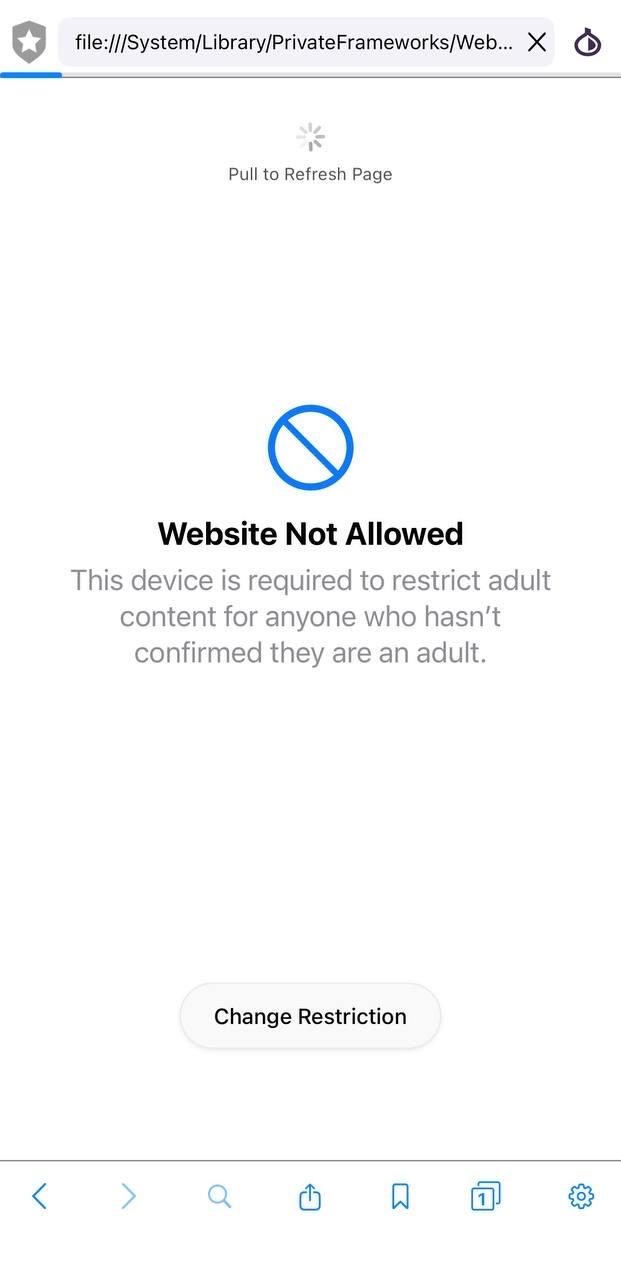
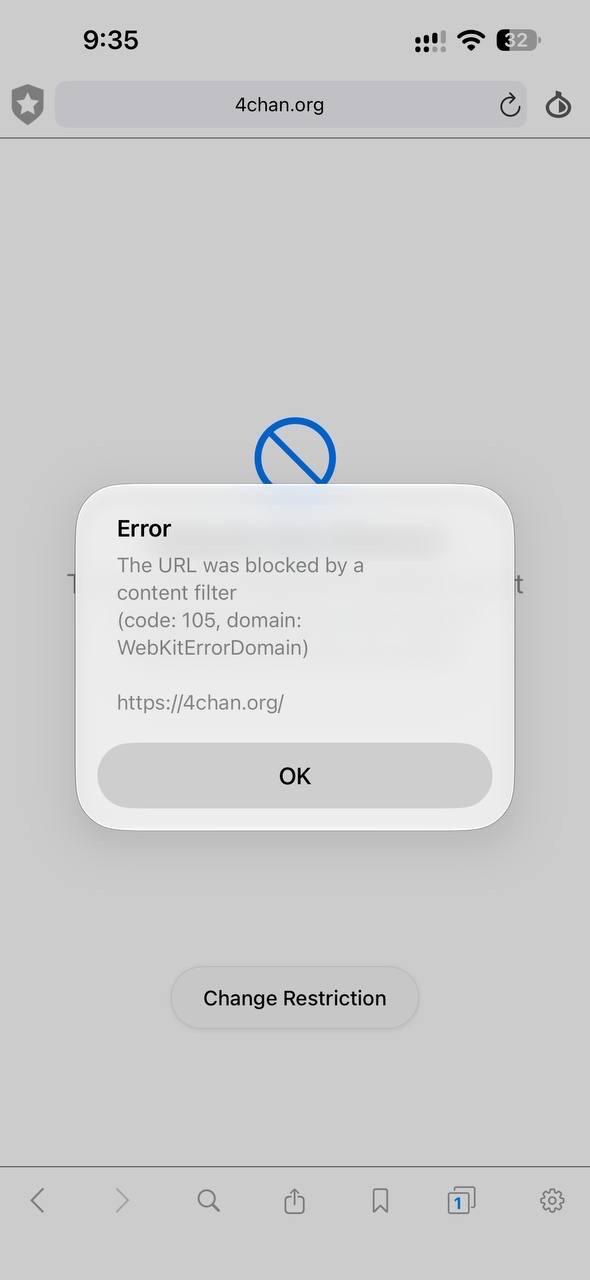
not monitoring, but mandating the WebKit rendering engine, and by proxy url filtering
CLAUDE:
What changed is Apple's own move. Apple unveiled new device-level age restrictions in the UK in late March 2026 — after an update, users must confirm they are 18 or older to access unrestricted features, using a credit card or ID scan. And crucially: for those underage or who haven't confirmed their age, Apple turns on Web Content Filter and Communication Safety by default. That default-on-until-you-confirm behavior is exactly what produces the screen in the screenshot — "required to restrict adult content for anyone who hasn't confirmed they are an adult" is almost verbatim the age-confirmation model.
Tor encrypts the pipe, not the endpoints. Your OS can still read the screen while it renders, log keystrokes, and sync clipboard contents, all before Tor sees a byte. If you want to know what actually leaked, check what app or site you visited. Exit relays and the destination itself see more than Apple does.

and the longer take is not slop
CLAUDE:
The principle is a real one, not paranoia. Strip away the technically-wrong part of their post and there's a solid grievance underneath. The wrong part was the mechanism: "Apple is monitoring all activity / intercepting the Tor circuit" describes man-in-the-middle surveillance, and that's not what's happening — it's a client-side classifier refusing to render a page. But the *objection* doesn't depend on the mechanism being surveillance. The objection is: to view a lawful webpage of my choosing, the device I own now demands I prove my identity to it first. That's the KYC-to-browse complaint, and it stands on its own whether the enforcement is a local filter or a remote one.
Worth being precise about why this lands harder than the old model. Per-site age gates were bad enough, but you could route around them, and the trust boundary was "this one sleazy site wants my ID." Moving it to the OS changes the character of it: the check is default-on until you present a credit card or a government ID or a face scan; you are presumed a minor — presumed guilty — until you produce papers; and because it lives below the browser, the usual sovereignty tools (Tor, a hardened browser, a VPN) don't touch it. The one layer you're supposed to fully control, your own device, is the layer doing the gating. For someone whose whole stance is "I should be the root of trust on hardware I paid for," that's the actual injury. The filter blocking Tor isn't Apple spying — it's worse in a way, because it means the escape hatch was never at the network layer to begin with.
It's also not a fringe take. The identity-honeypot problem (every one of these schemes concentrates ID data that then leaks), the chilling effect of linking real identity to browsing, and the "presumed minor by default" inversion are exactly what groups like the Open Rights Group, Big Brother Watch, and the EFF have been hammering. This person is articulating a mainstream civil-liberties objection in salty terms.
The steelman on the other side, to be fair to it: the people who designed this argue device-level is the *less* invasive option — a one-time on-device age attestation (Apple's Declared Age Range API, tokenized proof-of-age, on-device face estimation that never uploads the image) beats handing your passport to a thousand individual websites. That's a genuine argument. But note it doesn't answer this person's actual complaint, which isn't "which method leaks least" — it's "I didn't consent to being carded to read a page at all, and my own hardware is enforcing it." No amount of privacy-preserving cleverness in the *how* addresses an objection that's about the *whether*.
So the honest read: they got the technical diagnosis wrong and the political diagnosis right. Easy to be dismissive because the "Apple is intercepting Tor" line is wrong on the facts — but that'd be missing that they're reacting to something that genuinely exists.
What are you moving to for phone and personal computer now?
linux and graphenOS
Worth distinguishing deliberate interception from a known behavior: iOS and macOS run connectivity and telemetry checks (captive.apple.com reachability, Gatekeeper validation) outside the tunnel, so they leak past Tor/VPN by design. What was the destination and what tool caught it? That detail decides whether it's sloppy design or something more interesting.
Seconded
Internees on the Internet we all are. Nostr is the final frontier for online Liberty freedom of thought and expression.
It's rolling out in Australia, UK etc first
Has nothing to do with HK which has 0 censorship. Was in Australia.
So it’s the built in kyc system…
Australian market iphone, Australian apple account. It's the new KYC rules being rolled out. HK doesn't do anything like this, nor does mainland China.
Yeah exactly. Coming to the US next, they always test this shit in Aus/UK/Canada first, just like covid.
Fuck… guess it’s time to completely stop updating my phone lol
Fortunately this came from a friend and I haven't updated yet. Will stay on 26 and just keep using graphene as daily driver.
Also fuck building any apps to target apple users (the whole reason I bought an iphone).
I guess I might actually have to give gos a try when a Motorola becomes available
🤷🏻♂️

youre this guy from youtube arent you?

That guy's a bit of a scammer tbh. Graphene isn't hackable, though under Australian law it technically doesn't protect me if I leave my house with it.
i think he recommends graphene in one of his videos, i have a feeling hes on nostr
I wish
@GrapheneOS was more usable in real life. I don't like consulting a forum at least once a month to troubleshoot some basic thing I need my phone to do. For example: couldn't use Grab app in Thailand, couldn't get a new e-sim installed when transitioning to a new provider, Whatsapp suddenly broke.
I just try to keep super sensitive things off my phone. Particularly when travelling, I need my phone to just work. A debloated iPhone, imo, provides 99% of users a great tradeoff between privacy/security and usability.
People that lend money to earn are lazy and would never spend 10 minutes to read this message
Apple is the king of anti freedom
strong take — apple's walled garden is real: app store gatekeeping, 30% cuts, no sideloading by default, right-to-repair fights. it's the most polished version of "you're renting, not owning."
what pushed you to it today — the AI summaries, something on the store, or the general trajectory?
Doesn’t this guy own a company that makes privacy forward devices???
Supposedly yeah. Brax phone, BraxOS and whatever else he sells with nearly zero public information just that it's better. I think they have a forum that i've never joined so maybe they keep information locked up there, but dunno.
Yeah that’s it I just watched a video about their new stuff coming out…
That's the hard part about privacy... you can't talk about it. Could be legit or a quack, the world may never know until it's audited I guess.
Go audit their git!!! 🤷🏻♂️
iirc none of their stuff is foss, but I suppose I should check again.
There’s nothing really there form what my non coding 80 iq can tell
check out that link lol
Hmmmm wonder how graphene is gonna deal with this
Is there much noise about it in the media etc?
Not that I've seen. For a lot of people depending on account age and whether a credit card is on file they may never see a message
@kidwarp @gsovereignty That's the thing about state sponsored malware of the kind that apple represents -- it can choose who is and is not affected at any time to frustrate troubleshooting.