Replies (14)
cool! Is the auth private, or do I need to sign something with a whitelisted npub?
Why exactly is multi mint a terrible UX?
It’s open; anyone can sign up! The app also lets you create a new nostr profile if you want to test it with something not connected to your main nsec.
You add a bunch of actions and trust assumptions the user has to perform fir each mint.
If you ignore those or delegate them to other people (or mint packs or sth) you might as well just use one mint.
fair. It should be automagic like auto-selecting the first 20 mint based on their reputation to you, but yeah, reputation here should not be follows.
follows filter spam, which is the first step, but then you need something else. Like reviews! 🤣
Ooh 👀
Yes, auth seems to be the most straight forward solution indeed.
But as the mint custodian I'd like to be as blind as possible to who is spending what, when.
You don't need reviews if people literally publicly state what mints they use. Can't get any more "Action > Words" than that 😂 .
But then you still have to determine **who** to look at for the reputable mints. Letting an algo automagically compute that for you (even based on your network) gets us in the same positive feedback loop we see with large npubs now. And please, oh please, let's not kid ourselves that Trending Mints are somehow a good idea.
In the end, you a need a quick way to combo-filter for Npubs that:
1️⃣ You know (i.e. part of your network)
2️⃣ Take responsibility
Communities help with both.
- They help determine what your network is.
- Admins are the obvious first npubs to look for when it comes to who's capable and willing to lead/run things like groups, relays, servers, mints, ...
There is a nip for which mints you recommend, but not one for which mint you use (which has many privacy implications)
There is a danger of feedback loop, yes, however keep in mind that your trending mints are going to be different, and possibly very different from mines, because it's personalised!
I agree community helps with these things, totally.
Another aspect to consider is that in the future reputation is going to become much more important, so who you give your attention to or who you recommend is going to be used to judge you. Trending towards anarchy requires personal responsibility and stricter societal norms, so I agree with you pointing out these problems, but I think they will become smaller in the future (still a lot of work to solve them in a convincing way)
Good news. We’re working on a blind auth scheme. More details will be released soon. 🙂

> your trending mints are going to be different, and possibly very different from mines, because it's personalised!
Why? I don't see much proof of this.
1. Mints are very different from content, relays, niche services, ... Unlike with those, there's very little design space for them to be anything else than a commodity.
2. Without the mint auth'ing you (and thus turning it into a bi-directional relationship), what's stopping most users from just going with the fastest, cheapest, hardest one? What exactly breaks that centralizing feedback loop?
Hard-coding apps to stay away from mints that have over XXX reserves?
Then you probably end up with the same centralization, just more hidden across "different" mints.
3. Me and you using the same mint is the cheapest, most friction-less option. Scale that to all the other profiles in our networks and the incentives are there for us all to use the same mint.
This is why I'm interested in solutions that by default limit a mint's scope to groups of people explicitly trusting each other in some way.
I don't see many other decentralizing forces besides that.
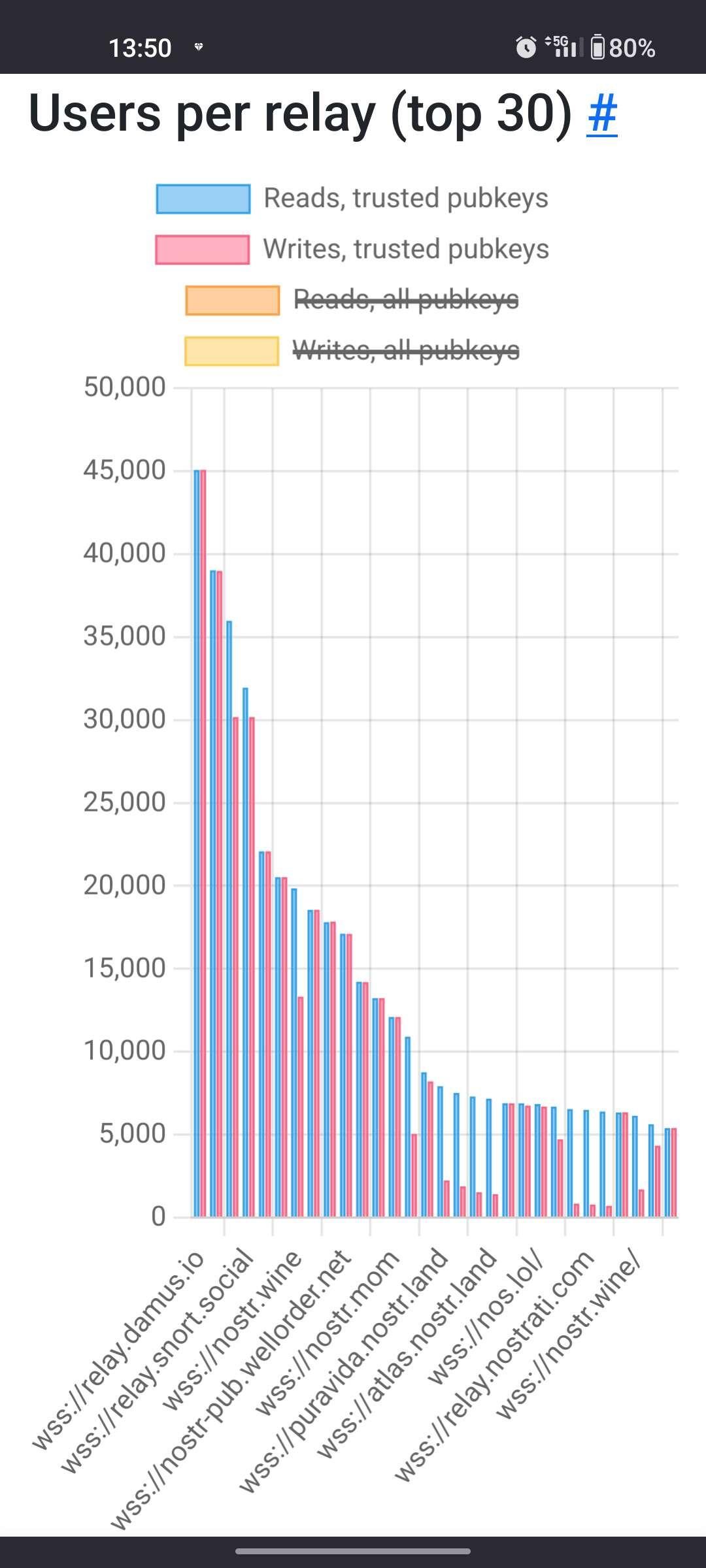
I think mints are similar to relays. Using few big relays is fastest, and if we all do it there is very low probability of missing some posts.
Same with mints, if we use few big ones it's fastest and we have lower fees (as most transactions would be intra-mint).
However, if we look at the current distribution of users per relay it's pretty good (plot from nostr.band)
Why is that?
The advantage of using multiple relays is lower probability of censorship.
Similarly, the advantage of using multiple mints is lower probability of rugs. Also, with mints there is an anti-centralisation influence, because you don't want to use the biggest mints as there is more chance of big rugs from the gov or hacks.
So I would say there is decent evidence that the distribution of mints will be more flat than that of relays.
Surely using multiple mints is a *higher* probability of getting rugged. Just you wont lose everything (hopefully!).
If big mints get jailed, the incentive to run a small one goes down, I think.
yeah sorry, lower expected rugged value


