🌊 SURF 'N TURF 🏝️
-THE BORACAY ISLAND LIFE-

The world's only taxidermized blue whale, known as the Malm Whale, named after the taxidermist August Wilhelm Malm who, with great difficulty, created it in 1865.

It's a unique construction that is still the jewel of the Gothenburg Natural History Museum and one of the most popular museum artifacts in Sweden.

The long strips of skin and blubber are transported, along with the tail, arms, and intestines, to the Gothenburg Museum (the intestines are kept in barrels in the yard, where the tail and fins are arranged on stools and boxes and photographed).
Parts of the whale, including the heart, one eye, larynx, rectum, and parts of the intestines, are preserved with glycerine and alcohol.

The pieces of skin are stored on the floor according to an elaborate system, while the skeleton is being boiled at another location.
Back in the museum, eight fishermen remove 3,400 kilograms of blubber from the skin, which is hung up on wooden frames.

The skin is then treated with specially manufactured brushes (“a radical way to make the skin evenly thick and to tear away the cellular tissue and remove a large part of the oil, without causing the skin to lose anything essential of its strength”) to reach a thickness of roughly a centimeter—a process that will take almost three weeks.
Simultaneously, an equal number of fishermen are working in the yard of the museum to clean the boiled skeleton.
Every part is labeled with copper and brass pins so that it can be put back in the right place.
In the museum, the baleens are salted while waiting for the wooden jaw in which they will be mounted. A sculptor produces a tail and fins of wood, which are dressed with the processed version of the skin.
Source: Cecilia Grönberg and Jonas J. Magnusson
Pictures: The whale as today (Gothenburg Museum of Natural History)
The Malm Whale upon arrival in Gothenburg. Plate from Monographie illustrée du baleinoptère trouvé le 29 Octobre 1865 sur la côte occidentale de Suède, 1867. The photographer was most likely J. P. Peterson, owner of Göteborgs Musei Fotografiska Atelier. Courtesy National Library of Sweden.
The Malm Whale being moved from Ostindiska Huset to its newly built premises at Naturhistoriska Museet at Slottsskogen, 1 November 1918. Photos Elisabet Petersson.
Detail of skin from the Malm Whale, 2002. Photo Cecilia Grönberg & Jonas J. Magnusson.
Credits Goes to the respective
Author ✍️/ Photographer📸
🐇 🕳️

 "It's a good day to dive". 🤿
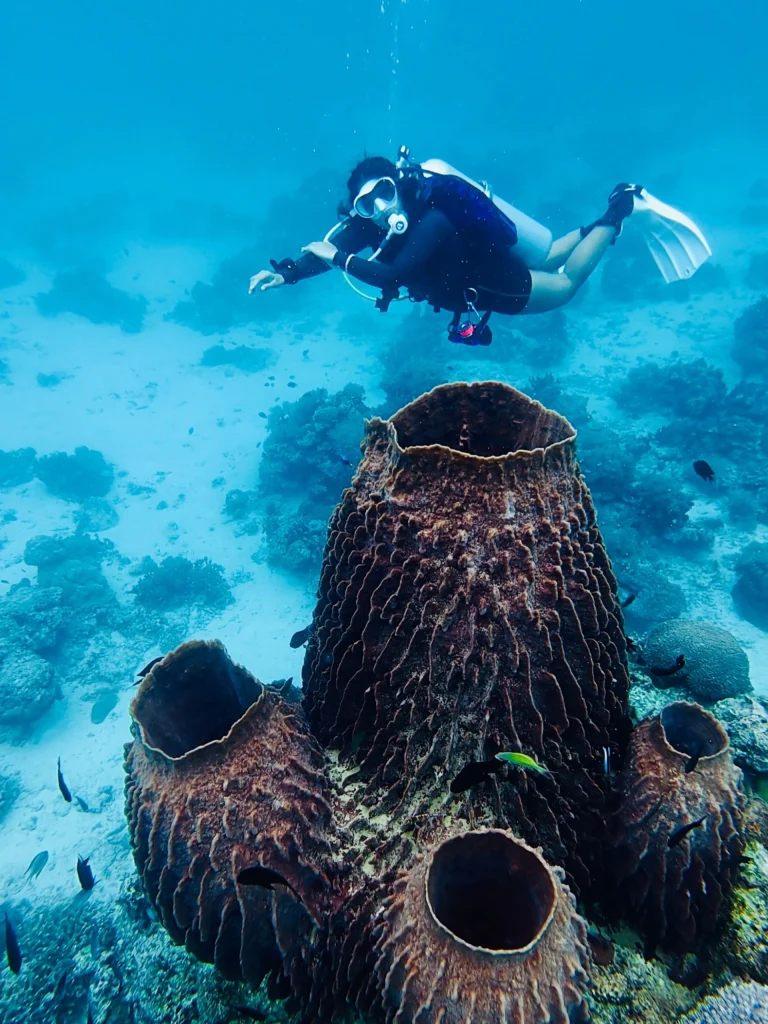


 Credits Goes to the respective
Author ✍️/ Photographer📸
🐇 🕳️
#dive #scuba
Credits Goes to the respective
Author ✍️/ Photographer📸
🐇 🕳️
#dive #scuba Numerous efforts have been made to restore The leaning tower of Pisa to a vertical orientation or at least keep it from falling over. Most of these efforts failed; some worsened the tilt.
 On February 27, 1964, the government of Italy requested aid in preventing the tower from toppling. It was, however, considered important to retain the current tilt, due to the role that this element played in promoting the tourism industry of Pisa.
The tower was closed to the public on January 7, 1990, after more than two decades of stabilisation studies and spurred by the abrupt collapse of the Civic Tower of Pavia in 1989.
The bells were removed to relieve some weight, and cables were cinched around the third level and anchored several hundred meters away. The solution chosen to prevent the collapse of the tower was to slightly straighten it to a safer angle by removing 38 cubic metres (1,342 cubic feet) of soil from underneath the raised end. The tower was straightened by 45 centimetres (17.7 inches), returning to its 1838 position.
After a decade of corrective reconstruction and stabilization efforts, the tower was reopened to the public on December 15, 2001 and was declared stable for at least another 300 years. In total, 70 metric tons (77 short tons) of earth were removed.
Credits Goes to the respective
Author ✍️/ Photographer📸
🐇 🕳️
On February 27, 1964, the government of Italy requested aid in preventing the tower from toppling. It was, however, considered important to retain the current tilt, due to the role that this element played in promoting the tourism industry of Pisa.
The tower was closed to the public on January 7, 1990, after more than two decades of stabilisation studies and spurred by the abrupt collapse of the Civic Tower of Pavia in 1989.
The bells were removed to relieve some weight, and cables were cinched around the third level and anchored several hundred meters away. The solution chosen to prevent the collapse of the tower was to slightly straighten it to a safer angle by removing 38 cubic metres (1,342 cubic feet) of soil from underneath the raised end. The tower was straightened by 45 centimetres (17.7 inches), returning to its 1838 position.
After a decade of corrective reconstruction and stabilization efforts, the tower was reopened to the public on December 15, 2001 and was declared stable for at least another 300 years. In total, 70 metric tons (77 short tons) of earth were removed.
Credits Goes to the respective
Author ✍️/ Photographer📸
🐇 🕳️ The Level Of Detail In This Marble Sculpture By Riccardo Gatti Is Insane.
Credits Goes to the respective
Author ✍️/ Photographer📸
🐇 🕳️
The Level Of Detail In This Marble Sculpture By Riccardo Gatti Is Insane.
Credits Goes to the respective
Author ✍️/ Photographer📸
🐇 🕳️

 1958 Ford Nucléon Bubbletop concept car.


 Hi guys !✨
 My name is Rocío, from Spain! I’m putting together a small trip to French Polynesia September 2026 when we have highest changes to encounter humpback whales and their littles ones (calving season!) and totally legal and ethical to swim with them! 🥰 It’s been a dream of mine for so long!


 $92,511
market price of bitcoin in USD.
$92,511
market price of bitcoin in USD.
 1,081
value of 1 USD measured in satoshis.
Credits Goes to the respective
Author ✍️/ Photographer📸
🐇 🕳️
1,081
value of 1 USD measured in satoshis.
Credits Goes to the respective
Author ✍️/ Photographer📸
🐇 🕳️ GM 🌞
Proof of walk to watch the kitboarders at Bulabog Beach this morning with Amigo and Cypher. A great onshore breeze.
GM 🌞
Proof of walk to watch the kitboarders at Bulabog Beach this morning with Amigo and Cypher. A great onshore breeze.


 Credits Goes to the respective
Author ✍️/ Photographer📸
🐇 🕳️
Credits Goes to the respective
Author ✍️/ Photographer📸
🐇 🕳️ Montecarlo, a hilltop town in Tuscany, Italy, is famous for the Castello di Montecarlo, a 13th-century castle located at the town's highest point.
Originally built for defense, the castle features sturdy stone walls and watchtowers, offering panoramic views of the surrounding countryside and vineyards. The town's signature red-tiled roofs encircle the castle, creating a fairy-tale charm.
Castello di Montecarlo is well-preserved, with fortified walls, a central courtyard, and ancient frescoes. Surrounding the castle, Montecarlo retains its rustic charm with narrow streets and medieval architecture, making it an enchanting destination that beautifully blends history, culture, and the natural beauty of Tuscany
Credits Goes to the respective
Author ✍️/ Photographer📸
🐇 🕳️
Montecarlo, a hilltop town in Tuscany, Italy, is famous for the Castello di Montecarlo, a 13th-century castle located at the town's highest point.
Originally built for defense, the castle features sturdy stone walls and watchtowers, offering panoramic views of the surrounding countryside and vineyards. The town's signature red-tiled roofs encircle the castle, creating a fairy-tale charm.
Castello di Montecarlo is well-preserved, with fortified walls, a central courtyard, and ancient frescoes. Surrounding the castle, Montecarlo retains its rustic charm with narrow streets and medieval architecture, making it an enchanting destination that beautifully blends history, culture, and the natural beauty of Tuscany
Credits Goes to the respective
Author ✍️/ Photographer📸
🐇 🕳️ 1963 BMW 700 by Luigi Colani
1963/4 Colani-BMW 700 is the world’s first vehicle with a self-supporting plastic monocoque car body. Weighing a mere 350kg, the small sportscar with its two-cylinder boxer engine has a Cd factor of 0.22 but hits speeds of 200km/h. The innovative and beautiful vehicle sadly never went into series production.
1963 BMW 700 by Luigi Colani
1963/4 Colani-BMW 700 is the world’s first vehicle with a self-supporting plastic monocoque car body. Weighing a mere 350kg, the small sportscar with its two-cylinder boxer engine has a Cd factor of 0.22 but hits speeds of 200km/h. The innovative and beautiful vehicle sadly never went into series production.
 The BMW 700 Colani weighed 440 kilograms, so despite the miniature 700 cc engine with 32 horsepower, the sports car could accelerate to 200 kilometers per hour. In addition to the body architecture, the Colani prototype featured a streamlined body with a drag coefficient of Cx = 0.22. The project attracted public attention and surprised BMW, but the innovative concept did not become serial: the car remained produced in a single copy.
Credits Goes to the respective
Author ✍️/ Photographer📸
🐇 🕳️
The BMW 700 Colani weighed 440 kilograms, so despite the miniature 700 cc engine with 32 horsepower, the sports car could accelerate to 200 kilometers per hour. In addition to the body architecture, the Colani prototype featured a streamlined body with a drag coefficient of Cx = 0.22. The project attracted public attention and surprised BMW, but the innovative concept did not become serial: the car remained produced in a single copy.
Credits Goes to the respective
Author ✍️/ Photographer📸
🐇 🕳️ Indonesian culture.
Kalumpang traditional csotumes 🇮🇩
Indonesian culture.
Kalumpang traditional csotumes 🇮🇩


