Amboss's avatar
Amboss
_@amboss.space
npub19tcp...nlea
Intelligent Payments for High-Volume Digital Economies. Built on Bitcoin. #lightningnetwork #bitcoin #amboss
Amboss's avatar
Amboss 7 hours ago
Binary search always splits the range in half. That is a fine guess when you know nothing, but Lightning nodes probing a channel's hidden balance usually know something. Splitting where the balance probably is makes probing 3 to 6% more efficient in production. Our researchers built Bayesian Binary Search: it learns where balances are likely to sit, then splits the range where the probability is, not at the midpoint. The paper was published in the peer-reviewed journal Algorithms (MDPI, 2025), in collaboration with Stillmark. It runs in production at Amboss today. The plain-English overview and the paper are in the reply. Overview and paper: image
Amboss's avatar
Amboss yesterday
Lightning Network, week of 2 to 8 November: public capacity held at 3,235 BTC, only 0.3% below the week before, and the average public channel grew 1.5% to 0.098 BTC. That held through the busiest day of forced closes in three years. On 8 November, 1,549 public channels were force-closed, more than double the previous one-day high of 687 on 24 October 2024. They were small: together they held 1.46 BTC, about 94,000 sats each. Losing them barely moved total capacity, and it raised the average size of the channels that remain. The rest of the week looked like October. From Monday to Saturday, 86.2% of closes were cooperative, against 86.1% across October, and node operators opened 1,473 new channels over the seven days. 1.46 BTC force-closed in one day, against 3,235 BTC of public capacity that stayed in place. The weekly charts, including channel and node counts: image
Amboss's avatar
Amboss yesterday
Announcing Hosted Checkout for Amboss Payments! ⚡ Payment cards are more exclusive than ever. Now any business can get paid from anywhere on the globe. Customers pay with Cash App or any Lightning wallet. You receive bitcoin or USDT. Your brand. Our tech. Your name, logo and color, light or dark. No chargebacks. Every payment is final. Live today. Test it in sandbox:
Amboss's avatar
Amboss 2 days ago
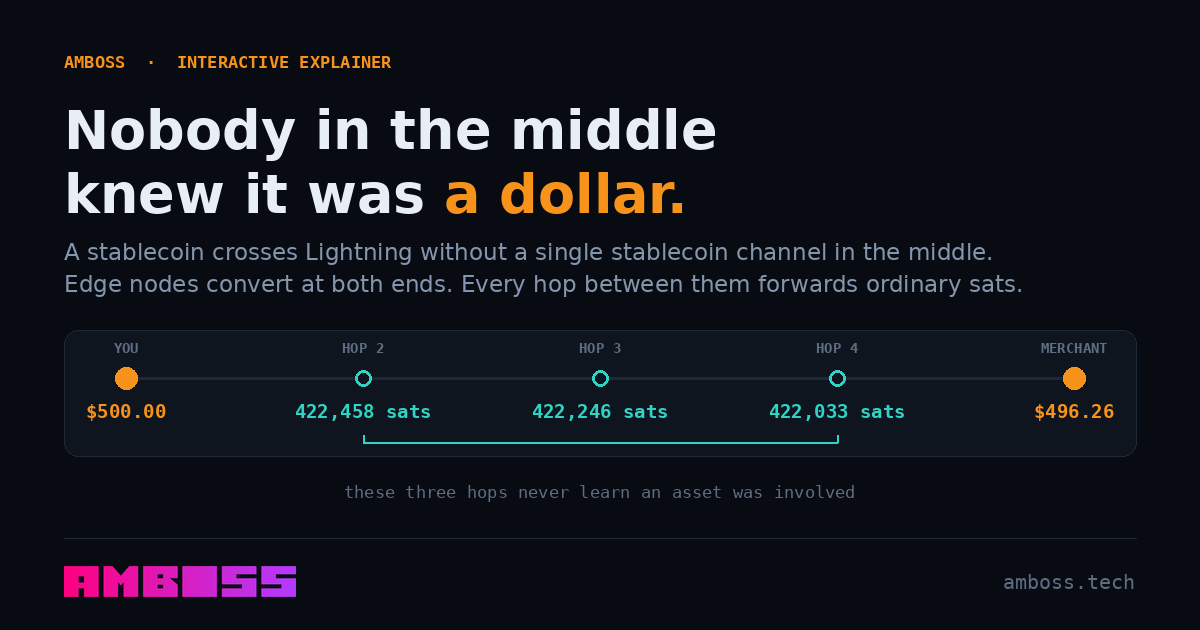
The first question a finance team asks about Bitcoin payments is about price swings. It is a fair question, and the answer is that you do not have to hold bitcoin at all. Bitcoin is the transport. With optional auto-conversion, payments that arrive over Lightning can settle to you as US-dollar stablecoins instead. Invoices are for a fixed amount. The payer covers routing and conversion fees, so the amount you invoice is the amount you receive. Customers pay with the app they already have. Your balance sheet can stay in dollars. How it works: image
Amboss's avatar
Amboss 3 days ago
An AI agent asked a weather service for the Orlando forecast. The service answered "402 Payment Required" with a price. The agent paid less than a cent over Lightning and had its forecast about a second later. No card, no account, no human approval. The proof of payment became the access key. That pattern is L402, and this run used Amboss with Lightning Enable, once in bitcoin and once from a dollar stablecoin balance. Amboss is the payment rail for agent protocols like L402, x402 and MPP. Amazap, a marketplace where AI agents pay per API call, is one example of the model in use. Request, price, payment, proof, data. The case study: image
Amboss's avatar
Amboss 4 days ago
In June 2022 the average public Lightning channel held 0.048 BTC. On 1 November 2026 it held 0.097 BTC, about twice as much. There are fewer public channels than in 2022, but each one is larger. A larger channel can carry a larger payment along a single route, which matters once real business amounts start to move. The figure is public capacity divided by active channels, from the Amboss Space daily series. 0.048 BTC then, 0.097 BTC now. Live network charts: image
Amboss's avatar
Amboss 5 days ago
Node operators bought 17.38 BTC of Lightning liquidity on Magma in October. In October 2025 the figure was 10.48 BTC. That is 66% more in a year. The chart shows every month in between, so you can see the path, not just the two end points. Magma is the Amboss marketplace for inbound liquidity: a seller opens a channel to your node for a fee agreed up front. Across all orders so far, the average price has been 4.42% a year. Want to receive payments on your own node without asking peers one by one? Magma is built for that. Magma: image
Amboss's avatar
Amboss 6 days ago
Picture a merchant taking $1 million a month in card payments with a 10% rolling reserve held for 180 days. Once the reserve fills, about $600,000 of its own revenue is held back at any time. These numbers are illustrative, not from any one processor. The point is the arithmetic: while a rolling reserve is held, the money is earned, yet it cannot be spent. Bitcoin and stablecoin payments through Amboss settle to your own wallet in seconds, with no rolling reserve. With optional auto-conversion, the balance can stay in US-dollar stablecoins. If six months of reserves came back to your balance sheet, where would your team put them first? How Amboss Payments works: image
Amboss's avatar
Amboss 1 week ago
Give a Lightning node a fixed budget. Which channels should it open so that the most payments can flow through it? Our research model, MPFlow, has made 4,640 of those channel-open decisions in production, placing 267.3 BTC across 30 managed nodes. MPFlow treats the question as a machine learning problem. It learns which new channels raise max-flow, a measure of how much value can move between two points in the network. In training, the biggest hubs were taken out, so the model had to learn good placement, not just "connect to the hubs". It now powers peer recommendations at Amboss. Better placement means more payments find a route the first time. The paper and a plain-English summary: image
Amboss's avatar
Amboss 1 week ago
Lightning Network, week of 26 October to 1 November: 1,567 public channels were opened, 7% more than the week before. The average new channel held 0.45 BTC. October as a whole: 6,892 channels opened with 3,102 BTC between them, an average of 0.45 BTC each. That is the largest monthly average of 2026, up from 0.28 BTC in March. Closes were cleaner as well. 86.1% of October's channel closes were cooperative, the highest share of any month this year. A cooperative close avoids the waiting period and extra on-chain cost of a forced close. 0.45 BTC per new channel, and 86 in every 100 October closes agreed by both sides. The full weekly table, including public capacity and node counts: image
Amboss's avatar
Amboss 1 week ago
On 1 April 2026, Visa lowered the dispute ratio that marks a merchant as "excessive" from 2.2% to 1.5% in the US, EU, Canada and Asia Pacific. Above it, each counted fraud report or dispute carries an $8 fee. The rule applies once a merchant has more than 1,500 fraud reports and disputes in a month. For high-volume, high-risk merchants such as iGaming operators, that line can sit close, and the fee comes on top of the reversed payment. Lightning payments work differently. A completed payment is final, so there are no card chargebacks to count. When a customer needs a refund, you send a new payment under your own policy. Amboss adds Bitcoin and stablecoin payments to the cashier you already run, next to cards. How it works for iGaming operators: image
Amboss's avatar
Amboss 1 week ago
When a Lightning payment crosses a public channel, the node forwarding it can charge a fee. On 2 November 2026 the median fee rate across 65,101 public channel fee policies was 50 parts per million, or 0.005%. On a $1,000 payment, that is 5 cents for each channel that forwards it, plus a median base fee of 1 satoshi. The median has stayed at 50 ppm in the Amboss Space snapshots for the past day, week and month. For a payments team, this is the network layer of the cost: what routing nodes charge to pass a payment along. The sender pays it. A route can cross more than one channel, so the total depends on the path the payment takes. It is not a merchant fee. Amboss Payments pricing is tailored to your volume and is not the network fee rate. 50 ppm is the middle of the public network today: half of all channel fee policies charge that or less. Live Lightning fee rates and network charts: image
Amboss's avatar
Amboss 1 month ago
What's built on Taproot Assets? Four things you can use today: 1) Issuance: mint and burn in @thunderhubio 2) Spot trading: pick your peer and price 3) Liquidity providing: Taproot LSP on Rails 4) Cross-asset payments: Payments API + TypeScript SDK amboss.tech
Amboss's avatar
Amboss 3 months ago
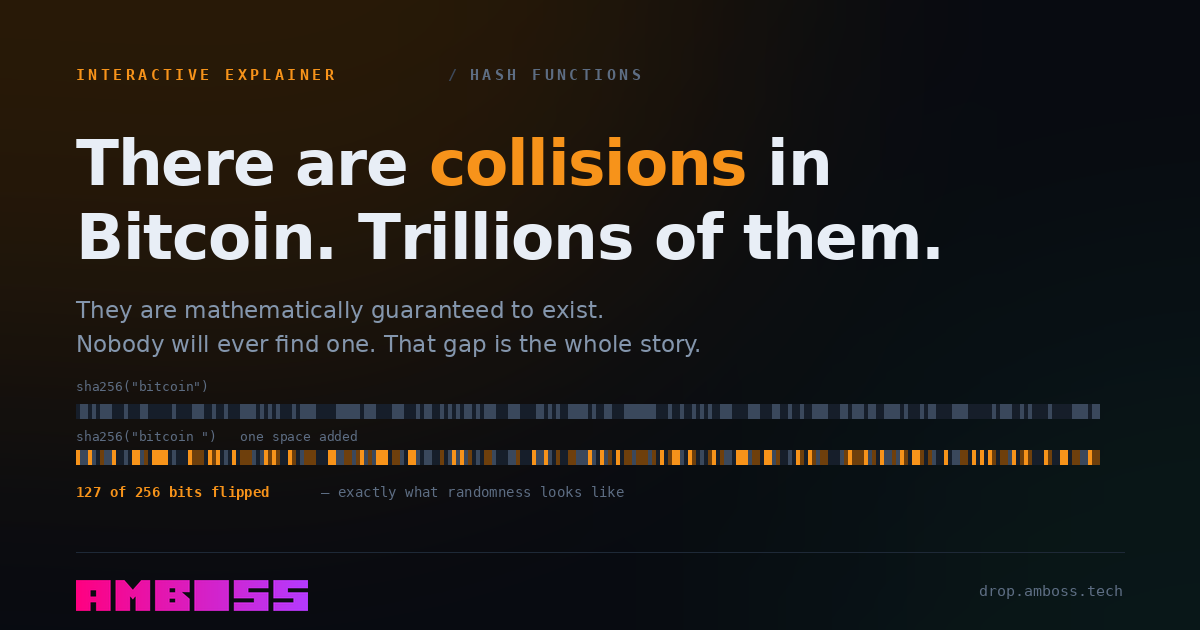
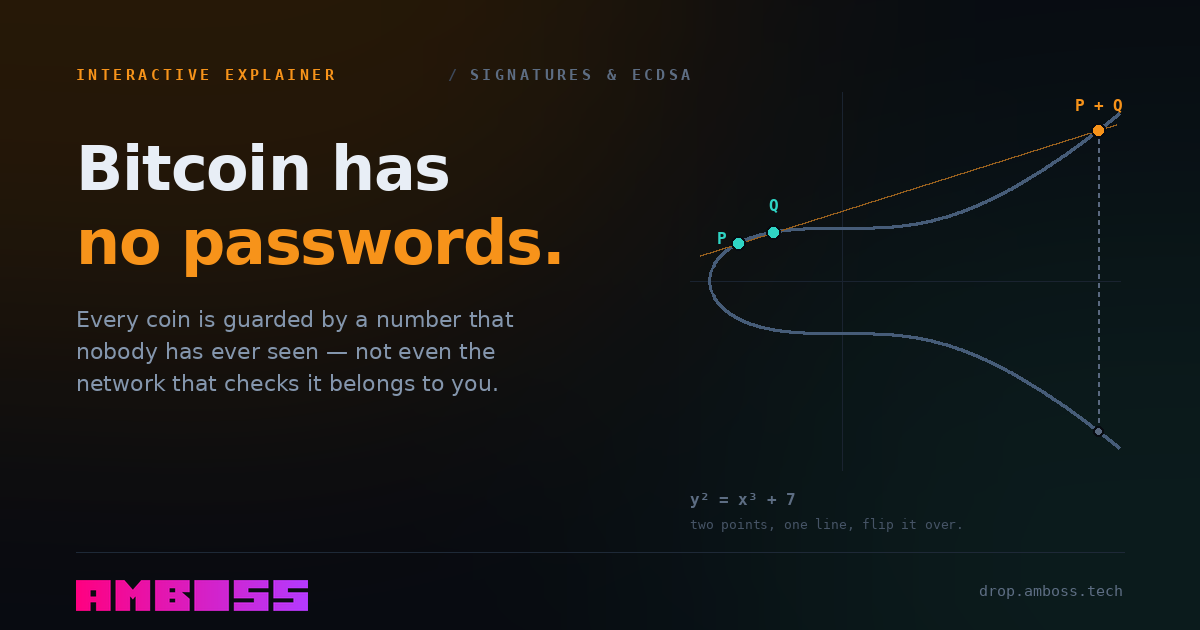
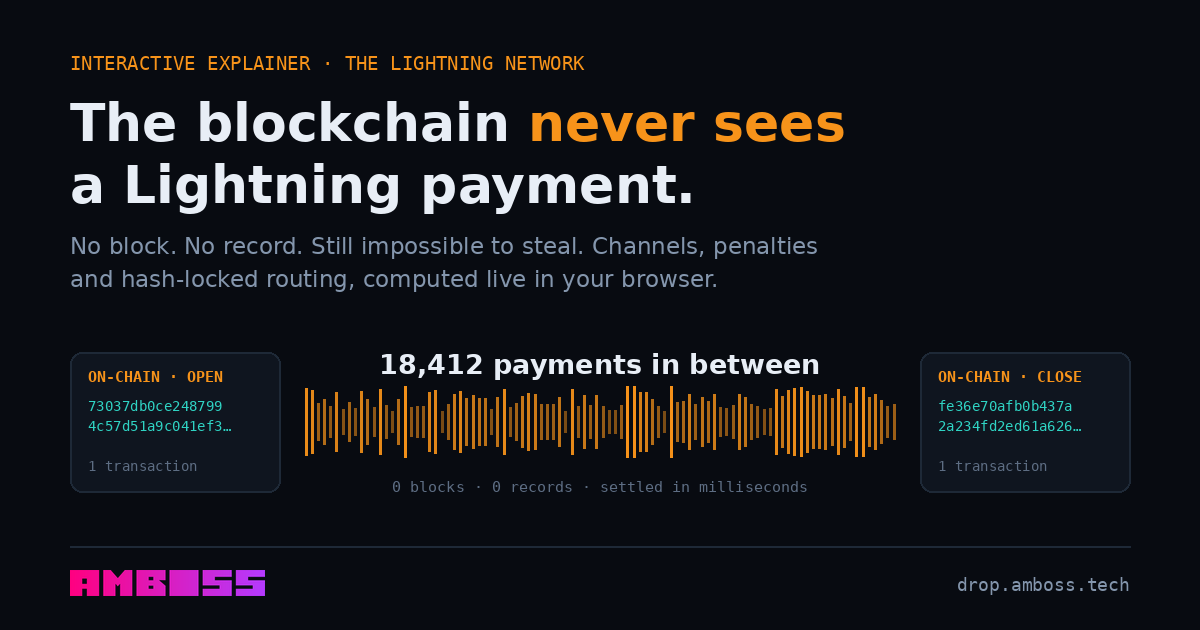
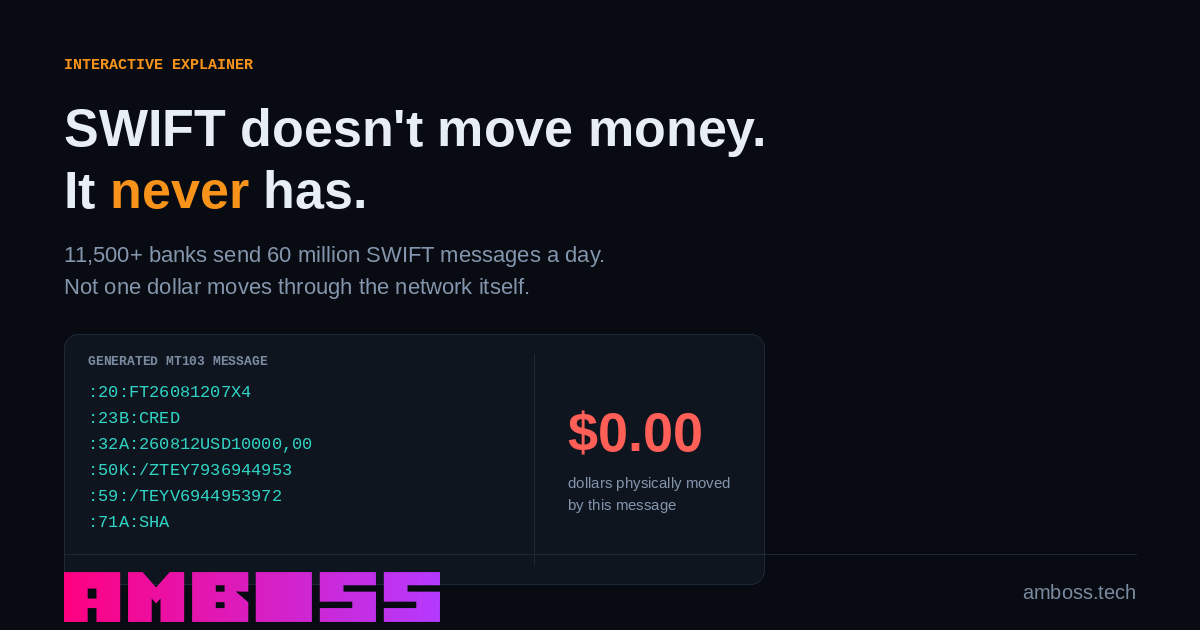
This week we shipped 4 interactive explainers on the crypto foundations of Bitcoin and Lightning: Hash collisions Every Bitcoin address has an absurd number of valid private keys that can spend it. Collisions are guaranteed… and still impractical to find. Signatures: Nonce reuse Sony lost the PS3 master key because one number got used twice. The same bug drained Bitcoin wallets in 2013. Run the attack yourself on real secp256k1 — 77 microseconds. What the blockchain sees of a Lightning payment Nothing. No block. No confirmation. No permanent record. Nobody along the route can take a single sat. SWIFT vs Lightning In 2016, hackers stole $951M from Bangladesh’s central bank using correctly authenticated SWIFT messages. SWIFT only carries instructions, which is why international wires still take 1–5 days through correspondent bank hops. Happy routing ⚡
Amboss's avatar
Amboss 9 months ago
Introducing Magma MCP ⚡ If you run a Lightning node, you know the pain of managing liquidity. Magma MCP lets your AI agent (like Claude) buy #Lightning liquidity via simple prompts: “Buy $10 of Lightning liquidity for my node at [pubkey]” OR “Buy $25 of private channel liquidity...” The agent: → Validates & queries Magma marketplace for optimal channels → Returns a Lightning invoice for you to pay with your wallet Pay it → Magma opens the channel(s) automatically. ✅ Agentic prompting magic for effortless liquidity buys. 🔗 Try it out: https://a4s.me/magma-mcp-npm image
Amboss's avatar
Amboss 9 months ago
P2P trading is coming to Lightning! ⚡ ANNOUNCING RailsX — the first true Lightning-native DEX. image KYC-free. Fully self-custodial. P2P trades directly via Lightning channels. No intermediaries, no bridges, near-zero fees. RailsX turns Lightning payments into seamless P2P trades powered by Taproot Assets on Lightning. image Why it matters 👇 • Unlocks the $9.5T daily FX market on Bitcoin • Capture arbitrage in seconds • 24/7 global, decentralized access • Deep liquidity for volatility & cross-asset flows • High-frequency atomic trading that scales • 100% self-custody • Supports decentralized liquidity providers on Lightning This is 5+ years of Amboss innovation: Magma’s marketplace + Rails’ automated yield + Graph ML optimizations. Bitcoin is evolving into the world’s financial rail with its solid foundation. image Opportunities for: • Traders: Execute secure P2P trades and instant arbitrage. • Liquidity Providers: Capture fees on Rails. • Merchants: Receive payments in your currency of choice. • Stablecoin Issuers: Mint stablecoins on Bitcoin as Taproot Assets. image We're seeking partnerships with Liquidity Providers, on/off-ramps, market makers, and stablecoin issuers. Let's talk — reply or DM us! Traders, LPs, Bitcoiners: this is your moment. 🔗 Sign up for early access → 📖 Deep dive:
Amboss's avatar
Amboss 10 months ago
Lightning Network 2025 Stats: Year in Review ⚡️📊 Across metrics, Lightning showed robust growth with all the hallmarks of health and strength with its expansion. 2025 set a solid foundation for Bitcoin's MoE proliferation in the years ahead. Let the data show you👇 image 1/ Lightning Capacity ATH More Bitcoin is moving onto the #LightningNetwork. Capacity contracted in early 2025, then reversed in August to close the year at record highs. Users continued committing BTC to Lightning, countering downward BTC price pressure. image 2/ Lightning Increased Concentration Early in 2025, the network pruned smaller, inactive channels. While there were fewer connections, the average channel size grew, enabling larger payments. Lightning is evolving from many small roads → fewer highways for higher throughput. 3/ New Channels Signal High Conviction New channel opens (in sats) show a clear strengthening trend. • Channel opens intensified throughout the year in size and number • Capacity moved into fewer, higher-quality channels Liquidity is being strategically deployed: fewer, larger channels support bigger payments. The trend indicates more confidence in peers and the protocol. image 4/ Channel Closures Look Healthier In 2025: • Mutual closes grew modestly (healthy close) • Force closes bursted then fell slightly • Penalty closes were rare (only 7) Pruning in action: Forced closes involved smaller (and likely inactive) channels, preceding large channel opens (pruning) Mutual closes indicate higher network and protocol stability. With smarter channel openings (AI-optimized) and a mature protocol, force closes reduce over time. image 5/ Cost-Conscious Network Growth Lightning grew at low cost in 2025: • Node operators deployed large amounts of capital • Low on-chain fees supported these deployments • Low setup costs enabled higher profit possibilities Flat channel fees plus rising capacity signal a prudent network with maturing structure. image 6/ Magma surged while LINER remained steady Magma, the liquidity marketplace, grew more established in 2025, providing more liquidity pricing data to LINER: • More decentralized liquidity • Deeper market (60 BTC) • Automated Liquidity • Private channel purchases increased (incl. via Alby) Marketplace volume made LINER a more accurate yield indicator. image 7/ The node graph tells a story Nodes grew +2.37% YTD, but the journey was notable: • Early 2025: many channels were closed with a sharp decline of nodes around June/July • Later in the year: larger capacity channels were opened What do you think drove the 2025 node growth? image 8/ The big picture 2025 laid the groundwork for scale. • Bigger channels • Healthier channel lifecycles • Deeper liquidity markets • Larger payment possibilities The network strengthened its foundations amid rapid growth. #LightningNetwork is maturing, now positioned for larger, higher-volume payments. Explore the data behind this thread →
↑