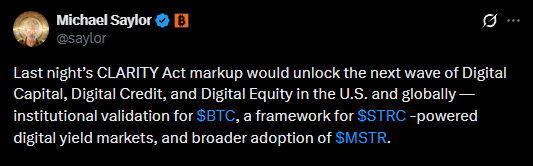
Buried in the CLARITY Act markup the Senate is voting on Thursday: a line that bans the Fed from issuing CBDC directly to consumers.
That's not a small detail. That's the door to programmable central-bank money being nailed shut from the inside.
The Act splits oversight between the SEC and CFTC, protects software developers from money transmitter rules, and writes a framework for stablecoin yield markets that compete with checking accounts paying 0.04%. Tim Scott calls it innovation and certainty. Elizabeth Warren calls it a risk to investors.
They call it "comprehensive regulation." The piece that matters is the piece they're not advertising. The Fed loses the direct-issuance lane to your wallet. Permissioned money lost a battle most people didn't know was being fought.
Self-custody wins by attrition every time the state tries to draw a new line. Every law that names Bitcoin without controlling it is a law that confirms Bitcoin can't be controlled by law.
Thursday's vote is the next checkpoint. Either way the vote goes, your seed phrase still works.
Not your keys, not your coins is gospel because the gospel doesn't need a markup hearing.
Reid Hoffman bought Bitcoin in 2014. He hasn't sold a single sat in twelve years.
When asked what his exit price was, the LinkedIn co-founder said: "Is there such a thing as an exit price?"
You see, "exit price" is fiat-brain. It assumes Bitcoin is the trade and dollars are the destination. Hoffman flipped the script: he's already in the destination. The 12 years of holding aren't conviction. They're literacy. He understands what most people still won't admit. The thing you "exit into" is the thing being debased on purpose.
Rothbard called it correctly fifty years ago: paper money is not a savings vehicle, it's a managed loss. Hoffman ran the math in 2014 and never looked back.
You don't need a billionaire to validate self-custody. But it helps when the market keeps producing them.
Buy bitcoin. Hold your own keys. Stop asking when to leave. There's no exit from sound money.
The Netherlands just told you why self-custody matters.
Today the Dutch government advanced a 36% tax on UNREALIZED gains, money you haven't made yet, on assets you haven't sold, in accounts they can see and you can't move. 61,000 people signed a petition asking them to stop. Parliament shrugged and pushed it through anyway. Rollout: January 1, 2028.
You see, when a state runs out of real productivity, it doesn't shrink. It expands the legal definition of what it can take. First it taxes income. Then it taxes wealth. Then it taxes the appreciation of wealth before you've even touched it. That's not taxation. That's pre-confiscation.
Here's what they cannot tax this way: 12 words you keep in your head.
A bitcoin held in self-custody has no paper profit on a Dutch broker's quarterly statement. It has no AUM line for the tax authority to point at. It exists in a wallet only the holder can open. That's not a loophole. That's the whole design.

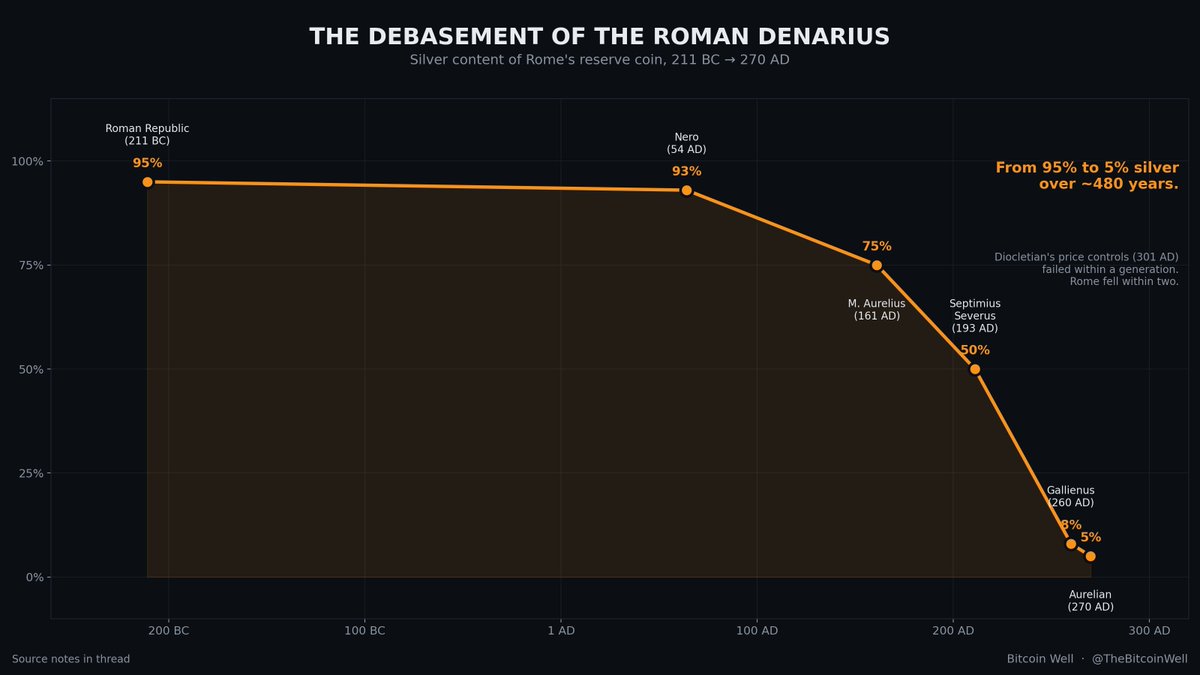
Rome's silver coin went from 95% silver to 5% silver.
The dollar went from 100 cents of 1913 purchasing power to 3.
History doesn't repeat. It mathematically rhymes.
Not your keys. Not your coins. Not your sovereignty.
Most people don't avoid Bitcoin because they think it's a bad idea.
They avoid it because they're afraid they'll mess up. Lose a seed phrase. Send to the wrong address. Buy at the top, panic at the bottom.
Tomorrow at noon ET, we're spending an hour fixing exactly that.
Bitcoin for Beginners. The actual fundamentals: why Bitcoin is a savings tool, how to set up your first self-custody wallet, how to send, receive, and store for the long haul. No jargon. No price predictions. No hard sell.
Just the start-up guide we wish we'd had when we started.
May 6, 12:00 PM ET. Bring a friend who's been on the fence, this one's for them.
Not your keys, not your coins. Tomorrow we make them yours.

StreamYard
Bitcoin for Beginners
Bitcoin for Beginners teaches the basics of why bitcoin is a powerful savings tool, how Bitcoin self-custody is incredibly safe, and how you can st...
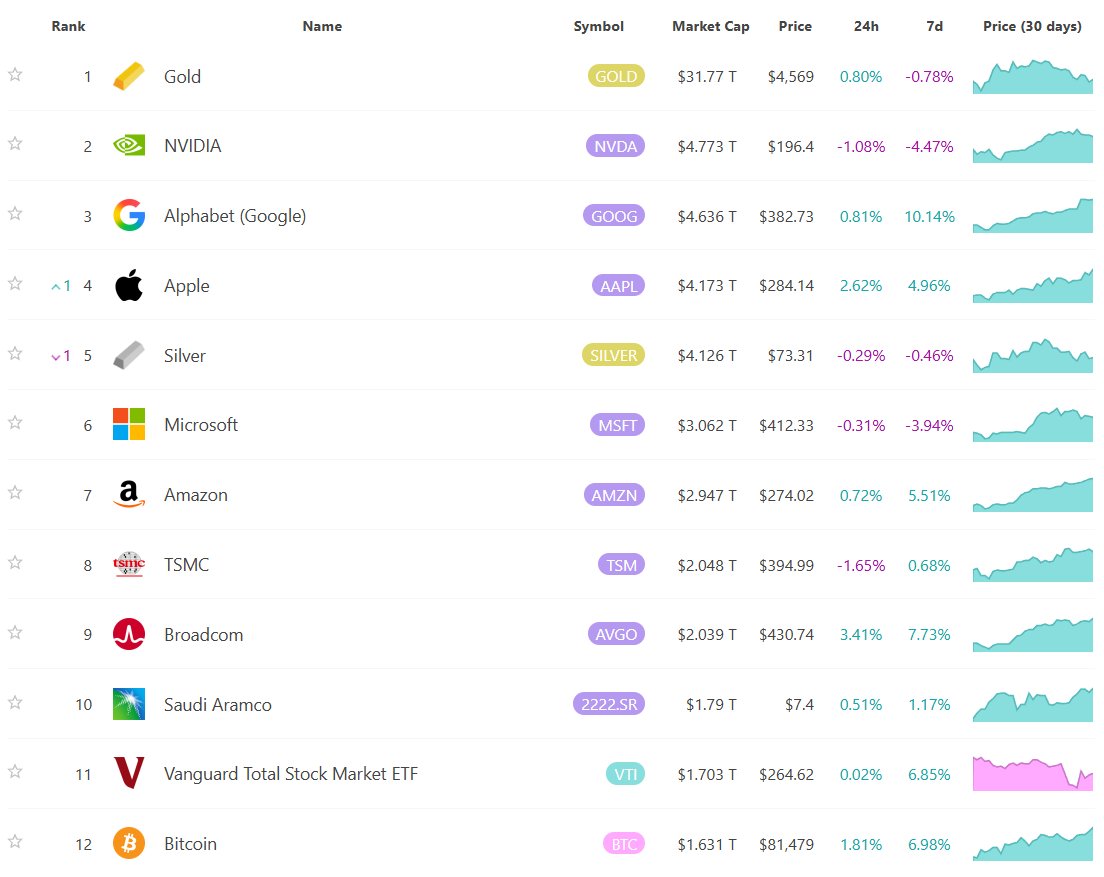
Apple just passed silver as the world's 4th largest asset. $4.17T vs $4.13T.
A 49-year-old company just dethroned a 5,000-year-old monetary metal.
If that doesn't tell you the old monetary order is being rewritten in real time, nothing will.
Bitcoin's coming for gold.
The Battle for Hormuz just started.
Iran fired missiles and drones at US warships this morning. Trump says the Navy will escort vessels through the Strait starting today. If you've been paying attention to the right things, this is the chapter you've been waiting for.
21% of the world's oil flows through the Strait of Hormuz. When that flow gets contested, every dollar-priced commodity reprices in real time, and every petrodollar-dependent currency goes on the watchlist. The question stops being "if oil hits $120" and becomes "what does the Fed do when it does?"
Here's the part most analysts are missing.
Iran spent a decade building Bitcoin infrastructure after being cut off from SWIFT in 2012. The sanctions weren't a punishment, they were free training in how to operate outside the dollar system. Iran is no longer scared of being cut off. They've already been cut off.
Meanwhile, Scott Bessent went on the record calling financial infrastructure a tool of national power. The US Treasury has openly described sanctions as a weapon of war. Every nation watching this is doing the same math: what happens when we're the next Iran?
Bitcoin doesn't care who wins the geopolitical argument. It just keeps producing blocks every ten minutes. No SWIFT to be cut off from. No correspondent bank to freeze. No reserve to seize. A monetary network at the cargo terminal, the central bank, and the cold wallet - all on the same rails.
When the Strait becomes a war zone and the Fed has to choose between fighting inflation and funding a conflict, you'll know which one they pick.
They always pick the printer.
The only question is whether your savings are denominated in something they can print.
Welcome (again) to the PetroSat Era.
Not your keys. Not your coins. Not your sovereignty.
— Zach 🟧

What Can You Actually Buy With Bitcoin in Canada in 2026?
There's a debate happening on the floor at Bitcoin 2026 right now.
Some people are upset that the SEC Chair, the FBI Director, BlackRock, and Eric Trump are all on stage at a Bitcoin conference. They're calling it institutional capture. "Grift." A betrayal of the cypherpunk roots.
I get it. But I think it's actually the opposite of a problem.
Bitcoin was designed for enemies.
That's not a metaphor, it's the architecture. Zero trust. No one has to like each other, agree with each other, or share values. The rules are in the code. You can't cheat. That's the whole point.
Satoshi didn't build Bitcoin for people who already trusted each other. He built it for a world where they don't.
So when governments, banks, and regulators show up at the table? If bitcoin didn't fail, that was always going to happen. Bitcoin doesn't need their permission to work, but it working is exactly why they're here.
The cypherpunks and the suits can both hold Bitcoin. Neither can corrupt it.
That's not capture. That's proof of concept.
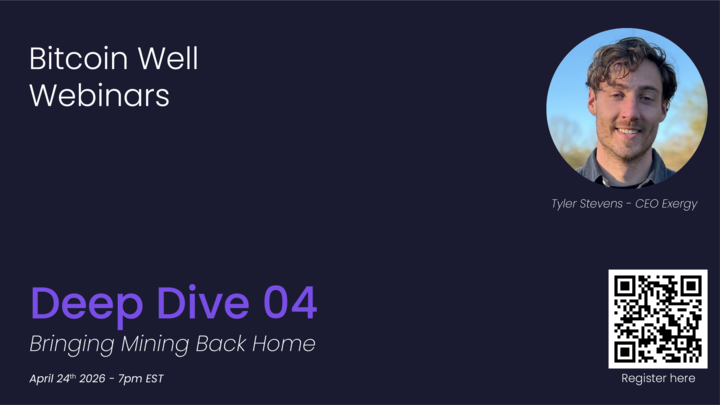
The industrial mining era is hitting a wall. 🛑
With global energy prices pushing mining costs to $88k/BTC, the old model of "centralized mega-farms" is failing. It’s time to bring hashrate home.
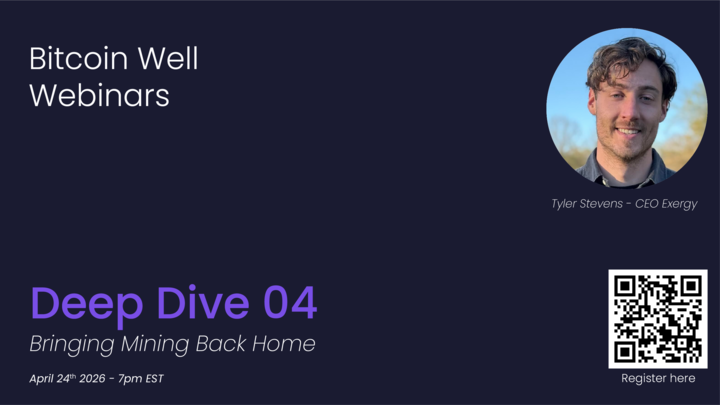
Join us for The Deep Dive with Tyler Stevens (@tylerkstevens) of Exergy (@Exergy_LLC) to learn how Bitcoin miners are evolving into high-efficiency electric heaters for your sovereign smart home.
🏠Decentralize the grid.
🔥 Heat your home.
₿ Earn Bitcoin as a bonus.
📅 TOMORROW April 24 | 07:00 PM EST
Wall Street is trying to monopolize the Timechain.
NYDIG just bought an idle aluminum smelter to turn into an industrial mining operation. American Bitcoin activated 11,000 new ASICs in a single facility.
The corporate hashrate grab is real. But there's a sovereign counter-attack.
This Friday we're going live on The Deep Dive with Tyler Stevens, CEO of Exergy and pioneer of hashrate heating. Your ASIC is just a high-efficiency electric heater. We're going to show you how to bring the hashrate home, monetize your stranded energy, and get paid in Bitcoin just to heat your house.
Decentralize the hashrate. Join us live this Friday. 👇
Congress is front-running the fiat collapse. In plain sight.
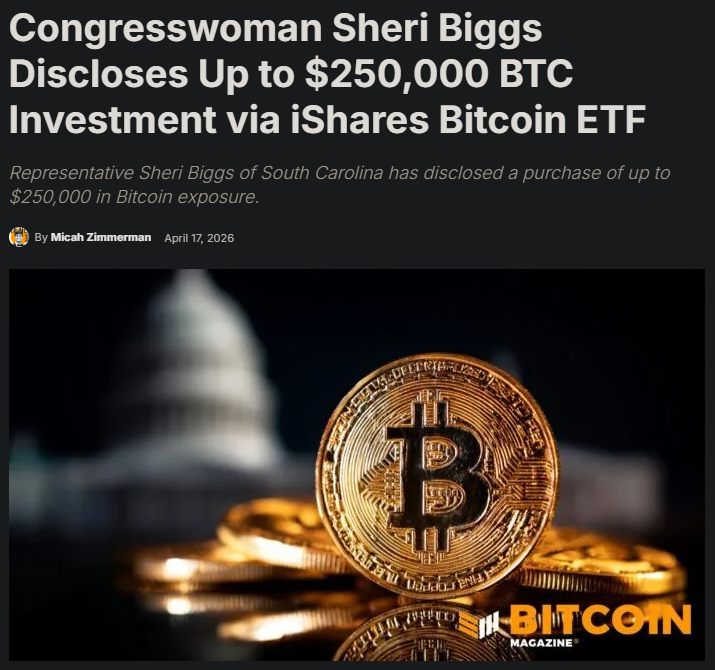
Rep. Sheri Biggs just disclosed a $250,000 purchase of BlackRock's Bitcoin ETF. She sits on the exact committees writing digital asset legislation. Bills for a U.S. National Bitcoin Reserve are pending right now.
Do not be naive. The ruling class knows exactly what happens to the price of absolute scarcity when a global superpower starts printing fiat to accumulate it.
They are locking in generational wealth before they pass legislation that makes it mathematically unattainable for everyone else.
But here's the fatal flaw in her strategy: she didn't actually buy Bitcoin.
She bought a paper IOU managed by UBS and controlled by BlackRock. Even as the political elite panic-buys the hardest asset on earth, they're still too captured by the legacy system to take self-custody.
They want the asymmetric upside of the Timechain while leaving their keys in the hands of the corporatocracy.
Watch what the state does, not what they say. They're quietly rotating out of the dying dollar.
You don't have to play their permissioned paper game. You don't need BlackRock. You don't need a legacy broker.
Front-run the politicians. But do it right.
The KYC Nametag: Why Your Exchange Bitcoin is a GPS Tracker
You think you are buying financial freedom, but if you are buying on a centralized exchange, you are just carrying a GPS tracker inside your wallet.
Every satoshi you purchase on a legacy platform like Coinbase or Kraken has a nametag permanently attached to it. And the state is watching.
Here is the reality of chain surveillance, the illusion of privacy, and how to actually secure your absolute wealth.
The Confiscation Map
When you hand over your government ID, your home address, and a facial scan to a corporate exchange, you are making a permanent trade: you are linking your physical, meat-space identity to a highly transparent, public ledger.
Every withdrawal address you use is logged. Every transaction is mapped. If the state ever decides to execute a coordinated confiscation of wealth, they do not need to guess who holds what. They have a literal, immutable map to your vault. Your exchange didn't give you freedom; they gave you a permissioned asset inside the fiat surveillance grid.
The Two Types of Bitcoin
You must understand that right now, there are essentially two types of Bitcoin in existence:
KYC Bitcoin: Tracked, traced, and monitored by chain analytics firms working directly for the state.
Non-KYC Bitcoin: Digital cash. No identity attached. The only true bearer asset remaining in the digital age.
The UTXO Fatal Error
If you are building a sovereign vault, rule number one is this: Never mix the two.
If you send even one fraction of a KYC satoshi into a Non-KYC wallet, you have mathematically doxed your entire stack. The chain analytics firms will use common-input heuristics to instantly link your physical identity to your anonymous wealth. You just turned a stealth vault into a neon sign.
The Escape Hatch
So how do you step outside the surveillance grid and acquire true, Non-KYC Bitcoin?
Earn it directly: Provide value to the market and get paid directly in Bitcoin. Do not route it through a fiat bank.
Trade P2P: Use decentralized platforms or trade directly with other sovereign individuals.
Use Cash: Take physical fiat paper to a Bitcoin ATM. Trade your analog, melting currency for untraceable digital scarcity.
Bitcoin Well Lite Account: In Canada you can also use a Bitcoin Well Lite account without KYC to buy bitcoin directly through E-Transfers.
The state wants you to believe that financial privacy is a crime. It isn't. Privacy is a fundamental prerequisite for freedom. Without it, your wealth is not actually yours; that its just a temporary privilege granted to you by a bureaucracy.
Stop feeding the corporate honeypots. Stop attaching your name to the hardest money on earth.
There's a two-month-old video you've never seen that explains how the war with Iran really started.
Everyone is blaming sudden geopolitical tension.
That's not what happened. The legacy financial system fired the first shots months ago. They just didn't use missiles.
They used the fiat system.
The Weaponization of the Dollar
In the clip, Bessent is asked about the administration's "maximum pressure strategy" on Iran. His answer is one of the most honest things a Treasury Secretary has ever said out loud and almost no one was paying attention.
He proudly describes how the US Treasury intentionally "created a dollar shortage in the country." Not as a side effect. As the strategy. The goal was deliberate economic destabilization.
According to Bessent, it worked. By December, one of Iran's largest banks had collapsed. A bank run followed. And then came the inevitable fiat reaction; the one that plays out in every broken monetary system, in every country, in every era: "the central bank had to print money."
The Treasury engineered a hyperinflationary death spiral. The Iranian rial went into free fall. Inflation exploded. Citizens poured into the streets as their purchasing power evaporated in real time. Meanwhile, Iranian leadership was quietly wiring their own wealth out of the country. The rats, as Bessent put it, were leaving the ship.
He said this proudly. In a public hearing. Two months ago.
The Part Nobody Planned For
Washington thought they had won. Break the currency, break the regime. Force compliance through financial suffocation.
They were wrong. They didn't break Iran. They taught Iran a lesson.
When you use a centralized fiat currency as a weapon of war, you show the rest of the world exactly what the system really is. Not neutral infrastructure. Not a global commons. A weapon with an owner. And right now, that owner is Washington.
The US didn't just break the Iranian rial. They cracked the foundational promise of the Petrodollar: that dollar-denominated systems are safe to depend on.
That illusion is gone. And the blowback is sitting in the Strait of Hormuz.
What's Actually Happening at the Strait
The blockade may be stopped (or at least changed hands) but Oil is still spiking. Tankers aren't moving.
And Iran wasn't asking for US dollars to let them pass.
They were demanding Bitcoin.
Think about why. Two months ago, the US Treasury demonstrated to every nation on earth that any wealth held inside the legacy banking system can be switched off. Accounts frozen. Currency destroyed.
Purchasing power erased. Not through military force. Through a spreadsheet.
Bitcoin cannot be sanctioned. It cannot be seized through correspondent banking. It cannot be printed into irrelevance by a central bank under political pressure. It is the only monetary asset on earth that is as neutral as mathematics and as physical as the energy required to produce it.
Iran figured this out the hard way. They're not alone in noticing.
The Honest Takeaway
The current conflict didn't start with a provocation or a miscalculation. It started the moment a government decided that money was a weapon.
Mises would have seen this coming. When the state controls money, money becomes a tool of power. And tools of power get used. Always. The only question is when and against whom.
Bitcoin exists precisely because this was always going to happen. Not as a prediction. As a design requirement.
Sound money isn't just a financial preference. It's a precondition for a world that isn't constantly on the edge of e conomic warfare.
The petrodollar was built on one premise: you need dollars to buy oil.
Iran is currently controlling the Strait of Hormuz, 20% of global oil supply, and charging a $1/barrel transit toll.
They're not accepting dollars.
They're demanding Bitcoin.
A sovereign state is bypassing SWIFT, bypassing sanctions, and bypassing the Fed entirely. They assess the cargo, issue the toll, and give vessels seconds to pay in BTC.
Wall Street is still debating CPI prints and rate cuts. They're completely missing the signal: a nation-state just repriced access to the world's most critical energy chokepoint in absolute scarcity.
The country the US cut off from SWIFT in 2012 spent a decade building Bitcoin infrastructure. The sanctions didn't break Iran. They accelerated Bitcoin adoption.
You can't print more Bitcoin to get your tankers through the strait. You can't sanction a math equation. You can't freeze the wallet that collected the toll.
The petrodollar was born in 1974 when Kissinger tied oil to the dollar.
It may be dying in 2026 in the Strait of Hormuz, settled in seconds on a timechain nobody owns.

Tokenizing anything is a scam.
Blockchains can't enforce ownership for anything that exists outside of that blockchain.
Few.
Name something other than #Bitcoin that has survived 17 years, had its creator disappear, and still runs exactly as originally described.
I'll wait.
"No kings" is the wrong frame.
Because the people protesting still want their person in power.
King, Prime minister or President.
Just all different ways to sell you on your own slavery.
How about "No slavery"? #bitcoin
AI uses energy to generate infinite content.
Bitcoin uses energy to generate absolute scarcity.
In a world flooded with deepfakes and fiat, verifiable truth is the most valuable commodity on earth.
Value the truth.
The Most Elegant Engineering in History
#bitcoin